Posts tagged ‘waxman-markey’

Demanding All The Improvement From Drivers

I have already written how Waxman-Markey, by the way in which it allocated free carbon permits, effectively demands almost all the reduced carbon dioxide over the first decade to come from drivers  (rather than electricity consumers or utilities).  Incredibly, even coal fired power plants get what amount to a free pass, while the increasingly efficient transportation sector must bear all the burdens.

Reuters has more on this phenomenon.   The article focuses mainly on “pain to refiners” but anyone with a modicum of economic sense will know that an industry with a single digit margin is not going to bear the cost of these changes – consumers of transportation fuels will through higher prices and more uncertain availability.

Ailing U.S. oil refiners could face a crippling period of contraction under a House-approved climate change bill, making the country more dependent on imported refined products.

The so-called cap-and-trade bill narrowly passed by the House of Representatives in June would limit greenhouse gas emissions by requiring polluters to acquire permits for the carbon dioxide they spew into the atmosphere.

To soften the blow, industry would initially be granted free permits covering 85 percent of emissions. But the refining industry managed to get only 2 percent of the allowances, leaving them vulnerable to encroaching foreign companies.

The bill is “going to put them out of business,” said Phil Flynn, analyst at PFGBest Research in Chicago. “I think you’re going to see refiners close down, especially in this environment we’re in right now.”

Already, a lot of our refined products are imported from foreign refineries, and my guess is that oil companies are going to be building Asian refineries like crazy.

What A Real Global Warming Insurance Policy Would Look Like

Cross posted from Climate Skeptic

It is frustrating to see the absolutely awful Waxman-Markey bill creeping through Congress.  Not only will it do almost nothing measurable to world temperatures, but it would impose large costs on the economy and is full of pork and giveaways to favored businesses and constituencies.

It didn’t have to be that way.   I think readers know my position on global warming science, but the elevator version is this:  Increasing atmospheric concentrations of CO2 will almost certainly warm the Earth — absent feedback effects, most scientists agree it will warm the Earth about a degree C by the year 2100.  What creates the catastrophe, with warming of 5 degrees or more, are hypothesized positive feedbacks in the climate.  This second theory of strongly net positive feedback in climate is poorly proven, and in fact evidence exists the sign may not even be positive.  As a result, I believe warming from man’s Co2 will be small and manageable, and may even been unnoticeable in the background noise of natural variations.

I get asked all the time – “what if you are wrong?  What if the climate is, unlike nearly every other long-term stable natural process, dominated by strong positive feedbacks?  You buy insurance on your car, won’t you buy insurance on the earth?”

Why, yes, I answer, I do buy insurance on my car.  But I don’t pay $20,000 a year for a policy with a $10,000 deductible on a car worth $11,000.  That is Waxman-Markey.

In fact, there is a plan, proposed by many folks including myself and even at least one Congressman, that would act as a low-cost insurance policy.  It took 1000+ pages to explain the carbon trading system in Waxman-Markey– I can explain this plan in two sentences:  Institute a federal carbon excise tax on fuels whose rate increases with the carbon content per btu of the fuel.  All projected revenues of this carbon tax shall be offset with an equivalent reduction in payroll (social security) taxes. No exemptions, offsets, exceptions, special rates, etc.  Everyone gets the same fuel tax rate, everyone gets the same payroll tax rate cut.

Here are some of the advantages:

  • Dead-easy to administer.  The government overhead to manage an excise tax would probably be shockingly large to any sane business person, but it is at least two orders of magnitude less than trying to administer a cap and trade system.  Just compare the BOE to CARB in California.
  • Low cost to the economy.  This plan may hurt the economy or may even boost it, but either effect is negligible compared to the cost of Waxman-Markey.  Politically it would fly well, as most folks would accept a trade of increasing the cost of fuel while reducing the cost of employment.
  • Replaces one regressive (or at least not progressive) tax with a different one.  In net should not increase or decrease how progressive or regressive the tax code is.
  • Does not add any onerous carbon tracking or reporting to businesses

Here are why politicians will never pass this plan:

  • They like taxes that they don’t have to call taxes.  Take Waxman-Markey — supporters still insist it is not a tax.  This is grossly disingenuous.  Either it raises the cost of electricity and fuel or it does not.  If it does not, it has absolutely no benefits on Co2 production.  If it does, then it is a tax.
  • The whole point is to be able to throw favors at powerful campaign supporters.  A carbon tax leaves little room for this.  A cap and trade bill is a Disneyland for lobbyists.

Here are three problems, which are minor compared to those of Waxman-Markey:

  • We don’t know what the right tax rate is.  But almost any rate would have more benefit, dollar for dollar, than Waxman-Market.  And if we get it wrong, it can always be changed.  And it we get it too high, the impacts are minimized because that results in a higher tax cut in employment taxes.
  • Imports won’t be subject to the tax.  I would support just ignoring this problem, at least at first.  We don’t worry about changing import duties based on any of our other taxes, and again this will affect the mix but likely not the overall volumes by much
  • Making the government dependent on a declining revenue source.  This is probably the biggest problem — if the tax is successful, then the revenue source for the government dries up.  This is the problem with sin taxes in general, and why we find the odd situation of states sometimes doing things that promote cigarette sales because they can’t afford declining cigarette taxes, the decline in which was caused by the state’s efforts to tax and reduce cigarette use.

Postscript: The Meyer Energy Plan Proposal of 2007 actually had 3 planks:

  1. large federal carbon tax, offset by reduction in income and/or payroll taxes
  2. streamlined program for licensing new nuclear reactors
  3. get out of the way

On Congressional Bribery

Normally, if I were to contemplate resorting to bribery to change someone’s decision, I would have to face two hurdles.  First, of course, I would face legal consequences because in many contexts., bribery is illegal.  Second, I would have to consider the cost — is the price being demanded worth it.  After all, it makes little sense to spend a million dollars to bribe someone to make a decision worth a hundred thousand dollars to me.

But, unfortunately, neither of these problems exist when Congressional leadership seeks to bribe recalcitrant lawmakers to vote their way.  Bribery in this context is not illegal, its just “horsetrading.”   And the cost is meaningless, because folks like Nancy Pelosi do not bear the cost of the bribe, taxpayers do.

It is totally clear to me that Obama and Pelosi will spend any amount of money to pass their key legislative initiatives.  In the case of Waxman-Markey, the marginal price per vote turned out to be about $3.5 billion.  But they didn’t even blink at paying this.  That is why I fear that some horrible form of health care “reform” may actually pass.  If it does, the marginal cost per vote may be higher, but I don’t think our leaders care.

Dodged A Bullet (so far)

The Waxman-Markey Bill is pretty bad, but it could have been a lot worse:

The citizen suit provision was set forth in Section 336 of the discussion draft version of ACES [Waxman-Markey], and it would have given environmental groups and other activists standing under the Clean Air Act to “commence an action” when someone has “suffered, or reasonably expects to suffer, a harm attributable, in whole or in part, to a violation or failure to act referred to in subsection (a).” Harm under this section was defined as: “For purposes of this section, the term ‘harm’ includes any effect of air pollution (including climate change), currently occurring or at risk of occurring, and the incremental exacerbation of any such effect or risk that is associated with a small incremental emission of any air pollutant (including any greenhouse gas defined in Title VII), whether or not the risk is widely shared.”

Wow, would this create an absolute litigation circus or what? By current anthropogenic greenhouse gas theory and under the actual text above, one could get sued for breathing.  (via Overlawyered)

Why Goldman Sachs, GE, etc. are Behind Cap and Trade

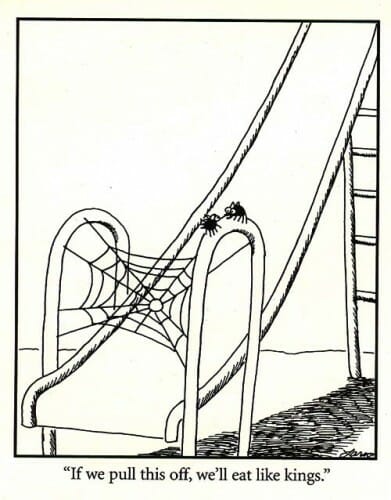
Chris Horner of NRO used this Far Side cartoon as a good way to illustrate why many large corporations have jumped on the Waxman-Markey bandwagon:

eat-like-kings

Waxman-Markey is not climate or energy policy, its a pillar in Obama’s attempt to build a European-style corporate state, where a clique of large unions, large corporations, and selected politicians run the state to their own mutual benefit.

PS-  I’m not buying the Goldman Sachs as trilateral commission conspiracy in Horners article.  But the direct line from Enron to the current cap-and-trade bill is an important one that is under-reported.  Enron was on the cap-and-trade lobbying bandwagon very early on.

Really Bad Bill

I would like to say that Waxman-Markey (the recently passed house bill to make sure everyone has new clothes just like the Emperor’s) is one of the worst pieces of legislation ever, resulting from one of the worst legislative processes in memory.  But I am not sure I can, with recent bills like TARP and the stimulus act to compete with.  Nevertheless, it will be bad law if passed, a giant back door step towards creating a European-style corporate state.  The folks over at NRO have read some of the bill (though probably not all) and have 50 low-lights.  Read it all, it is impossible to excerpt — just one bad provision after another.

Bruce McQuain focuses on the building inspection angle (for the first time the feds are really diving into building codes and inspections, poaching on what typically is state and local turf (just find that in your handy pocket Constitution’s enumerated powers).

And Waxman-Markey is indeed a “green-job creator” of a bill – it creates an entirely new job category – Federal House Inspector. Yes, that’s right, in order to sell your house in the future you must passed a federal housing inspection which will certify your home has the minimal energy rating necessary. And if not, you’ll be required to bring it up to par by replacing appliances (water heaters, air conditioning, etc) or repairing (leaky windows, etc) whatever the inspector finds before you can put it on the market.

Have a candelabra in your dining room? Don’t you dare put any more than a 60 watt bulb in there.  You need to also bone up on what you’ll be allowed to do with outdoor lighting, water dispensers, hot tubs and other appliances, not to mention wood burning stoves and water usage.

Oh, and don’t forget the installation and siting of shade trees, for which it appears a new bureaucracy is being created.  No kidding, read his post.  He has the text from the bill.

Willful Blindness

I am on the road today (off to London).  This is reprinted from Climate Skeptic:

Paul Krugman writes in the NY Times:

And as I watched the deniers make their arguments, I couldn’t help thinking that I was watching a form of treason — treason against the planet.

To fully appreciate the irresponsibility and immorality of climate-change denial, you need to know about the grim turn taken by the latest climate research….

Well, sometimes even the most authoritative analyses get things wrong. And if dissenting opinion-makers and politicians based their dissent on hard work and hard thinking — if they had carefully studied the issue, consulted with experts and concluded that the overwhelming scientific consensus was misguided — they could at least claim to be acting responsibly.

But if you watched the debate on Friday, you didn’t see people who’ve thought hard about a crucial issue, and are trying to do the right thing. What you saw, instead, were people who show no sign of being interested in the truth. They don’t like the political and policy implications of climate change, so they’ve decided not to believe in it — and they’ll grab any argument, no matter how disreputable, that feeds their denial….

Still, is it fair to call climate denial a form of treason? Isn’t it politics as usual?

Yes, it is — and that’s why it’s unforgivable.

Do you remember the days when Bush administration officials claimed that terrorism posed an “existential threat” to America, a threat in whose face normal rules no longer applied? That was hyperbole — but the existential threat from climate change is all too real.

Yet the deniers are choosing, willfully, to ignore that threat, placing future generations of Americans in grave danger, simply because it’s in their political interest to pretend that there’s nothing to worry about. If that’s not betrayal, I don’t know what is.

So is it fair to call it willful blindness when Krugman ignores principled arguments against catastrophic anthropogenic global warming theory in favor of painting all skeptics as unthinking robots driven by political goals? Yes it is.

I am not entirely sure how Krugman manages to get into the head of all 212 “no” voters, as well as all the rest of us skeptics he tars with the same brush, to know so much about our motivations.  He gives one example of excessive rhetoric on the floor of Congress by a skeptic — and certainly we would never catch a global warming alarmist using excessive rhetoric, would we?

Mr. Krugman, that paragon of thinking all of us stupid brutes should look up to, buys in to a warming forecast as high as 9 degrees (Celsius I think, but the scientist Mr. Krugman cannot be bothered to actually specify units).  In other words, he believes there will be about 1 degree per decade warming, where we saw exactly zero over the last decade.  Even in the panicky warming times of the eighties and nineties we never saw more than about 0.2C per decade.  Mr. Krugman by implication believes the the Earth’s climate is driven by strong positive feedback (a must to accept such a high forecast) — quite an odd assumption to make about a long-term stable stystem without any good study showing such feedback and many showing the opposite.

But, more interestingly, Mr. Krugman also used to be a very good, Nobel-prize winning economist before he entered his current career as political hack.  (By the way, this makes for extreme irony – Mr. Krugman is accusing others of ignoring science in favor of political motivations.  But he is enormously guilty of doing the same in his own scientific field).   It is odd that Mr. Krugman would write

But in addition to rejecting climate science, the opponents of the climate bill made a point of misrepresenting the results of studies of the bill’s economic impact, which all suggest that the cost will be relatively low.

Taking this statement at face value, a good economist would know that if the costs of a cap-and-trade system are low, then the benefits will be low as well.  Cap-and-trade systems or more direct carbon taxes only work if they are economically painful for energy consumers.  It is this pain that changes behaviors and reduces emissions.  A pain-free emissions reduction plan is also a useless one.  And in fact, the same studies that show the bill would have little economic impact also show it will have little emissions impact.  And thus it is particularly amazing Krugman can play the “traitor” card on 212 people who voted against a bill nearly everyone on the planet (including the ones who voted for the bill) know will not be effective.

I remember the good old days when Democrats thought it was bad when Republicans called folks who did not agree with them on Iraq “traitors.”  After agreeing with Democrats at the time, I am disapointed that they have adopted the same tactic now that they are in power.
Climate Bill Payoffs

I am again hearing rumblings that the climate bill may pass the House.  If so, it will be interesting to see what last minute bribes were added to make this happen.  The most recent bribe we know about is the commitment to pay farmers not to grow crops with the weak window dressing that this is somehow a carbon offset.

The logic behind this farm offset provision is actually hilarious, as it undermines years of BS arguments by corn ethanol supporters.  These ethanol supporters have argued, against the results of every study ever conducted outside of a state school in the corn belt, that the CO2 used in growing corn and processing it into ethanol is less than the CO2 absorbed by corn while growing.

But the argument of farmers in the recent climate bill is that farmers should be paid to do nothing (ie leave fields fallow) because this will reduce CO2 produced in growing the crops.  But this is only the case if such CO2 in the production phase is larger than the CO2 absorbed from the crop’s growth.  So if Waxman-Markey passes, we will have expensive energy provisions based  on the assumption that Co2 used in crop production simultaneously both is and isn’t greater than CO2 absorbed in growth.  Outstanding.

By the way, for those who still haven’t figured out the power of the farm lobby, note that while farmers are paid not to do their business, no other class of individual or industry will recieve similar payments.