Posts tagged ‘wal-mart’

James Taggart is Alive and Well

In my Forbes column this week, I publish an essay I wrote for an Americans for Prosperity event commemorating Milton Friedman’s birthday.  A brief excerpt:

Having once been successful through excellence, leading businesses typically get lazy and senescent, and become vulnerable to more innovative, lower-cost or more nimble new competitors.  Sears lost its electronics sales to Circuit City, which in turn succumbed to Best Buy, which is now struggling to compete with Wal-Mart, who is being challenged by Amazon.com.

Unfortunately, businesses that were once successful can feel a sense of entitlement, believing that this new competition is somehow unfair, or that consumers are somehow misguided in taking their business elsewhere.  When they have money or political connections, these businesses may run to Congress and beg for special protections against competition, or even new subsidies, mandates, stimulus projects, and bailouts.

Where is the threat to capitalism and individual liberty coming from today?  Is it from some aggrieved proletariat, or is the threat from bailed out Wall Street firms, and AIG, and GM, and Chrysler, and ethanol manufacturers, and electric car makers, and windmill builders?


I Love It When Businesses Get Scrappy with the Government

It happens all to seldom, for reasons I understand well.  Oil companies and Wal-Mart and other vilified private entities that are the object of populist and cynical political attacks very seldom fight back.  The reason is not because they are in the wrong, but because  the government has the power to gut them like a fish in a myriad of ways, and are populated by petty little thugs who love to dish it out but can seldom take any criticism.

That is why its great to see Koch Industries telling demagogues in the Democratic Party to take a hike.  For some bizarre reason, perhaps because the Left saw how much fun the Right had vilifying George Soros for everything, the Koch brothers are not the source of all imaginable plots and schemes.

Check out this letter, where Koch Industries responds to Democratic fundraising pitch.

Wal-Mart Thought for the day

Wal-Mart’s profit to shareholders is about 3.6% of sales.   This means that for the majority of the country, on the items you buy at Wal-Mart, they are earning less than half of what the government takes in sales tax on the same item.

The Chicago Political Paradigm

Over the last few weeks I have been following the story of the city of Glendale, AZ, in order to protect a previous $200 million public investment in our hockey team, proposing to issue another $100 million bond issue to help subsidize the purchase of the hockey team out of bankruptcy.

The real furor began when the Goldwater Institute, a local libertarian-conservative think tank, said they were considering suing over the bond issue because it violates the gift clause of the Arizona Constitution, which basically bans municipal governments from providing direct subsidies or lending their credit to private institutions.  The gift clause has been frequently breached in the past (politicians do love to subsidize high-profile businesses), but of late Goldwater has successfully challenged several public expenditures under the gift clause.

I won’t rehash the whole argument, but I found this bit from Senator McCain interesting

He called on the Goldwater Institute, a Valley watchdog that intends to sue to block the deal, to sit down and negotiate to keep the team

The buyer Matthew Hulsizer and his staff have taken this position throughout the deal — they have lamented that they are more than willing to “negotiate” with Goldwater, and they are frustrated Goldwater won’t come to the table with them.

This claim seems bizarre to me. If Goldwater thinks the deal is un-Constitutional, what is to “negotiate?” I don’t know Hulsizer or anything about him, but it strikes me that he is working from a Chicago paradigm, and is treating Goldwater as if it were a community organizer. In Chicago, community organizers try to use third parties to protest various deals, like the opening of a Wal-Mart or a new bank. These third-parties are nominally protesting on ideological grounds, but in fact they are merely trying to throw a spanner in the works in order to get a pay off from the deal makers, almost like a protection racket. The payoff might be money or some concession for the group (e.g. guarantee of X% jobs for this group in project, $X in loans earmarked for group, etc).

Everything I have seen tells me Hulsizer is approaching Goldwater in this paradigm.  Even going out and rounding up the most prominent politician in the state (McCain) to put pressure on Goldwater is part of this same Chicago paradigm.

Here by the way  is what Hulsizer is apparently offering

As one part of the deal, Glendale would sell bonds to pay Hulsizer $100 million, which the Chicago investor would use to purchase the team for $210 million from the National Hockey League.

Hulsizer said he notified Goldwater he would guarantee the team will pay Glendale at least $100 million during its lease on the city’s Jobing.com Arena through $75 million in team rent and fees and by covering $25 million in team losses that the city promised to pay the NHL this season, which is included in the hockey team’s purchase price.

“We need to move forward now,” he said. “I expect that Goldwater and other people who have come out against this deal will hopefully recognize the benefits of it and will now use all of that energy and tenacity and aggressiveness to go out and help us sell these bonds and make hockey work in the desert forever.”

Hulsizer said Goldwater had not yet responded to him.

By the way, I hesitate to trust the Arizona Republic to report such deal terms correctly, but if what is reported above is correct, the offer appears to be non-sense

  1. What kind of guarantee is he offering?  Is it a guarantee by the corporate vehicle buying the team, because if it is, this is worthless.   The last team ownership group promised to pay the lease for 30 years — what does that mean once they went bankrupt?  I am sure Borders Books promised to pay a lot of real estate owners money for leases, and many of them are going to end up empty-handed in the bankruptcy.  If this is a personal guarantee, that is a nice step forward, though not enough because….
  2. The $75 million in rent is largely irrelevant to the new bond issue — these rents support the old $200 million bond issue.  What they are saying is “issue a new $100 million bond issue for us and we will guarantee you can make 40% of the payments for the old bond issue.”   So?  When Balsillie wanted to move the team, he didn’t ask for an additional bond issue and agreed to pay off $50 million of the old one as an exit fee.
  3. At the end of the day, if the $100 million is not a subsidy, not at risk, and fully backed by guaranteed cash flows, then Hulsizer should go out and get a $100 million private loan.  Period.

Unfortunately, this might be enough to get the deal through the courts.  Glendale will argue that for the $100 million, they will get $100 million paid against their existing bond issues that would not otherwise be paid if the team folds or leaves town.  This may fly with the courts, unfortunately, but it still sucks for taxpayers.   At the end of the day, nothing about this offer makes the $100 million bond issue any safer.   If the team goes bankrupt, it is lost.  That is an equity risk the city is taking with taxpayer funds, and equity risk for which we are getting no equity.  See here for full discussion of the risks and problems.

Postscript: The following is pure speculation, but I think it is close to correct.  The team is worth about $110 million at best (remember, it has never made money in AZ).  Forbes values it at $117 million but several similar franchises have sold for under $100 million lately.   The reason it is selling for $210 million is that the NHL, which bought it out of bankruptcy, guaranteed its other owners the league would not lose a penny on the team.   But the team has been racking up losses, and the accumulated cost to the NHL is now $210 million.  The NHL is insisting on a price that is $100 million north of where it should be.  In effect, the taxpayers of Glendale are bailing out the NHL for this crazy promise to its owners.

I can just see the negotiation.  Hulsizer, who by every evidence is a savvy financial guy, is not going to pay $210 million for an asset worth $110 million.  Glendale has way too many chips on the table to fold now, so it rides in and says it will contribute the $100 million difference.  In fact, the best evidence this is a subsidy is the difference between the purchase price and any reasonable team value.  Someone has to make up the ridiculous gap between the NHL asking price and reality, and Hulsizer is too smart to do it.   I have been calling this a subsidy of Hulsizer, but in fact this is really a subsidy of the NHL.   The NHL has Glendale by the short hairs, because Glendale knows (from the Balsillie offer, among others) that the only way the NHL can get a $210 million price is from a buyer who wants to move the team.

This, by the way, is EXACTLY the reason I opposed the original stadium funding deal.  Once they built the stadium, and then went further and lured businesses to develop around it, they were wide open to blackmail of this sort.

The problem with doubling down at this point is that the team has never made money and has no real public plan for doing so.  I have talked to NHL executives and none of them see how the turnaround is possible.  So how many years will it be before the new owners tire of their plaything and throw the team back into bankruptcy, so that Glendale will be in the exact same spot except $300 million, rather than $200 million, in debt.

The Seen and Unseen: Passenger Rail Edition

We have all heard environmentalists and other American intellectual snobs lamenting that we just are not as smart as Europeans because we have so much less passenger rail.  But because freight and high-speed passenger rail service does not coexist well on the same tracks, urging more passenger rail on the US rail net is effectively asking for more freight to be dumped onto the highways.

Megan McArdle writes:

Moving freight by rail rather than by truck is an enormous carbon saving; one locomotive can haul as much as hundreds of trucks.  It also reduces highway congestion.  Unfortunately, it’s hard for passengers and freight to share tracks.  In part, it’s difficult simply because it’s expensive to upgrade track to handle passenger speeds, but also because freight moves much more slowly, and on an irregular schedule.
I might well argue that if we were simply trying to maximize environmental benefit, we’d ignore passenger rail, and focus on upgrading our freight systems, which sorely need it.  Moreover, these upgrades could largely be made without the massive procedural obstacles that block new high speed rail lines.

But freight rail is not sexy.  It does not excite donors, and it does not excite most of the voters who are motivated by high speed rail.  Politicians win votes by delivering (or at least promising) highly visible improvements; not by silently enhancing the movement of goods from port to Wal-Mart.

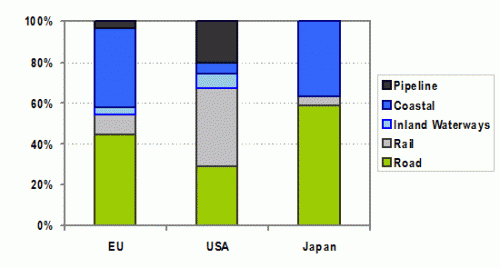
I am not sure politicians really have to do anything other stay out of the way (we already have among the cheapest rail rates in the world, 1/2 of China’s and 1/8 of Germany’s).  The numbers on freight movement are pretty dramatic:

See the percentage of goods moved by freight, which is dramatically higher for the US.  The end result is we have a LOT less freight on our roads than the EU or Japan, and might have even less if US maritime laws had not done so much to kill coastal shipping.
This is the great unseen in all these “sophisticated” conversations about Europe.  These Euro-philes are so much smarter than the rest of us that they manage to ignore the most important part of the equation  (largely because it is unseen and not sexy).  In fact, the US has the best rail system in the world, and in fact the governments of Europe and Japan have likely sub-optimized their rail systems by forcing their focus towards passengers rather than freight.
I will leave the last word to the Anti-Planner:

Europe has decided to run its rail system primarily for passengers, while America’s system is run mainly for freight. Europe’s rail system has about 6 percent of the passenger travel market, while autos have about 78 percent. Meanwhile, 75 percent of European freight goes by highway. Here in the U.S., highway’s share of freight travel is only 29 percent, while the auto’s share of passenger travel is about 82 percent. So trains get 4 percent of potential auto users in Europe out of their cars, but leave almost three times as much freight on the highway.

Why Are Democrats Promising to Raise Prices?

My new column is up at Forbes, and is on the Democratic push to raise the prices of Chinese goods (either through currency policy or tariffs).  This has to be one of the craziest campaign themes of all time — please, let us raise your prices.

We should be thrilled that the Chinese government and its people see fit to spend their own money to subsidize lower prices for American businesses and consumers.  Last week, President Obama put substantial pressure on the Chinese prime minister to revalue Chinese currency, a revaluation that would have the effect of raising prices of all Chinese goods in the United States.  What possible sense does such a move make, particularly in a recession?

Christian Broda and John Romalis, a pair of University of Chicago economists, have been doing work on income distribution.  A couple of years ago they published a paper that showed how our measures of income inequality may be exaggerated because the metrics assume that both rich and poor experience the same rate of inflation.  In fact, the researches found, over the last decade or so the poor have seen much lower rates of inflation than the rich, in large part due to goods of the type imported by China and sold at Wal-Mart (another institution Democrats like to demagogue against).

Sadly, prices for low-income Americans could be even lower were it not for past protectionist measures.  When one looks at the goods that have the highest import tariffs, one sees the very same goods that typically make up a disproportionate share of the poor’s purchases:  Tobacco, clothing, tires, auto parts, fruits and vegetables.  All of these have their prices raised 20-350 percent by import tariffs.

This means that at the same time Democrats have again raised issues of rising income inequality, they are trying to stop some of the most powerful forces at work mitigating these income differences.  There is no question that if Democrats are successful in changing China’s currency policy and/or imposing new tariffs (taxes) on Chinese goods, prices will rise for all Americans, but particularly so for the lower income brackets that are supposedly the Democrats’ constituency.

The most frustrating part of this whole effort is that it is aimed at a myth: the declining American manufacturing base.  In fact, American manufacturing output continues to hit new all-time highs — despite the current recession, American manufacturing output today is still 40% higher than it was in 1990.

Wal-Mart and Income Inequality

First, I have not doubt that income inequality–  in whatever way the folks who care about such things measure it — has increased.  The analysis that has been making the rounds of liberal blogs show the rich “capturing a higher share” of total output.  The very terminology here reveals their faulty core assumption, treating wealth as a zero-sum that must be grabbed and fought for and can only be gained to someone else’s disadvantage.  They always write about incomes as if GDP is a sort of natural fountain in the desert, and the piggy rich crowd in too close to get more than their fair share of water from the fountain.

This is silly.  Wealth is created from the minds of human beings, and there are human minds that create far more wealth than others, and are able to keep some of that wealth for themselves as a reward.  I say “some” because even the richest people tend to keep only a small percentage of the wealth they create.  Sum up the benefits we all get from our iPods and iPhones and iPads, and the total number dwarfs what Apple shareholders have made from these devices.

Anyway, the actual point of this post was to revisit the notion that there are different inflation rates for the rich and poor (via Carpe Diem) that may be skewing income inequality numbers

Using scanner data on household consumption of non-durable goods between 1994 and 2005, we document that the relative prices of low-quality products that are consumed disproportionately by low-income households were falling over this period. This implies that non-durable inflation for the 10th percentile of the income distribution has only been 4.3 percent between 1994 and 2005 (0.4 percent per annum), while the non-durable inflation for the 90th percentile has been 11.9 percent (1.0 percent annually), and 13.4 percent (1.2 percent annually) for the richest 5 percent of households in the sample (see chart above).”…

“A large literature has focused on the rising inequality observed in official statistics, but have mostly abstracted from the fact that these official measures are based on a single price index for a representative consumer. This assumption is not crucial in a world with a stationary relative price distribution or where an identical basket of goods is consumed by different income groups. However, using household data on non-durable consumption, we document that the relative prices of low-quality products that are consumed disproportionately by low-income consumers have been falling over this period.

This fact implies that measured against the prices of products that poorer consumers actually buy, their “real” incomes have been rising steadily. As a consequence, we find that around half of the increase in conventional inequality measures during 1994–2005 is the result of using the same price index for non-durable goods across different income groups. Moreover, given that the increase in price dispersion does not seem to be specific to our sample or time period, the overstatement in the increases in inequality from official measures can be even more significant, changing our view of how progress has been distributed in recent decades substantially.”

The price of a night at the Four Seasons has gone up more than the price of a shirt at Wal-Mart.

Beware the Thin Edge of the Wedge

As someone who once spent nearly a hundred hours to defeat a $20 Department of Labor claim, mainly to fight the precedent, I can sympathize 100% with Wal-Mart spending millions to fight a $7,000 OSHA claim.  Note that despite all the OSHA wailing about not understanding why Wal-Mart is fighting so hard and causing them so much trouble, they admit at the end that they are trying to set a precedent for future actions.

For several years I worked for Emerson Electric, which among its many divisions owned a ladder manufacturer.  If there ever was a product that simply is what it is, totally WYSIWYG, it’s a ladder.  But it turns out in this age of personal responsibility that anyone who ever gets hurt using a ladder, usually doing something stupid, will sue the ladder manufacturer for his or her injury.  Emerson fought every one, all the way to trial and sometimes appeal.  Lawyers said they were crazy, that in any given case, it would be cheaper (considering legal fees) to just settle.  But Chuck Knight (Emerson CEO) knew that these were not individual cases, they were multiple events in an ongoing “game,” and game theory gives a different answer.  Fight enough of these, and tort lawyers looking for a quick buck with little work and cost will choose to spend their time elsewhere.

How Imports Raise Incomes

Opponents of free trade will often say publicly that they are all for free trade but it must be “fair,” which they generally would define as balanced between imports and exports.  This is a dodge, because they know many of our trading partners are not going to open up trade to be entirely free so they can use that inevitability as an excuse not to remove American protectionist barriers.

But trade does not need to be balanced to create wealth, and in fact it is not just exports that provide a boost to real incomes.  Daniel Ikenson at Cato has these two charts comparing the CPI for items that face competition from imports and those that don’t:

See his article for more discussion.

This is also related to something I read about a while back, that we may be underestimating income gains among the lower income quartiles in this country because we adjust to real wages based on an average inflation rate.  The argument was that the inflation rate for the poor has been lower  (the Wal-Mart effect) than the inflation rate for the rich (prices at the Four Seasons keep going up).  One estimate put the difference in inflation rates as high as 6 percentage points, in part because the poor proportionally consume a lot of goods that are imported while the rich consume proportionally a lot of services that are produced domestically with high cost labor.

Dispatches from the Corporate State

From the WSJ:

Robert Brownson long believed that his proposed development here, with its 200,000-square-foot Wal-Mart Supercenter, was being held hostage by nearby homeowners.He had seen them protesting at city hall, and they had filed a lawsuit to stop the project.

What he didn’t know was that the locals were getting a lot of help. A grocery chain with nine stores in the area had hired Saint Consulting Group to secretly run the antidevelopment campaign. Saint is a specialist at fighting proposed Wal-Marts, and it uses tactics it describes as “black arts.”…

Supermarkets that have funded campaigns to stop Wal-Mart are concerned about having to match the retailing giant’s low prices lest they lose market share. Although they have managed to stop some projects, they haven’t put much of a dent in Wal-Mart’s growth in the U.S., where it has more than 2,700 supercenters—large stores that sell groceries and general merchandise. Last year, 51% of Wal-Mart’s $258 billion in U.S. revenue came from grocery sales.

Read the whole article.  There hardly appears to be any major grocery chain or related union that has not contributed significant dollars to preventing their competitor from doing what they have already done – built a store in town.  Knock me over with a feather that Chicago is a major example, training ground for our President and promoter-in-chief of our emerging corporate state.

The only sustainable monopolies are those enforced by the government, which through licensing, regulation, zoning, or all of the above, squash upstart competitors at the expense of consumers in favor of politically connected incumbents.

Bad Fourth Ammendment Decision

Via Valley Fever:

In upholding the conviction of Josue Acosta Marquez, (a.k.a. Martin Contreras-Pulido) in an interstate marijuana smuggling case, the Circuit Court judges wrote that federal agents and Iowa cops did nothing wrong when they planted the electronic monitoring device on a pickup truck used by Marquez while it was parked at a Wal-Mart. Police accessed the unit seven times to change the batteries — always in a public place — and tracked the pickup as it drove between Des Moines and Denver.

Since anyone can see a vehicle parked or driving in public places, the use of electronics to enhance surveillance doesn’t violate Fourth Amendment rights regarding unreasonable search and seizure, wrote Justices Roger Wollman, James Loken and John Gibson.

No warrant neeeded. And there’s nothing stopping cops from planting those suckers as often and wherever they like, says the Eighth Court judges.

First, I have always thought that extended surveillance of a home or moving vehicle, beyond say a few hours, should require a warrant, even if it is all performed in public places.  I think most folks would consider such actions by a private party to be intrusive (thus many state stalking laws) and we generally hold the state to an even tighter standard.

Second, cost is important.  A surveillance approach that is difficult and expensive is less likely to be abused than one that is suddenly 10x or even 100x less expensive.  The judges acknowledge this, but then ignore the problem completely in their statement when they write:

It is imaginable that a police unit could undertake “wholesale surveillance” by attaching such devices to thousands of random cars and then analyzing the volumes of data produced for suspicious patterns of activity. Id. Such an effort, if it ever occurred, would raise different concerns than the ones present here.

Just get a freaking warrant — its not that hard, especially in this case when we are talking about extended surveillance and no particular rush to get started. This kind of lazy law enforcement has become endemic, and we shouldn’t tolerate it.

Amazon and Macmillan

I have been kind of amazed at the backlash at Amazon over its showdown with Macmillan Publishing.  As I understand it, Apple, with its new iPad, had adopted a strategy of wooing publishers by offering promises of higher retail prices, an offer Amazon basically refused to match.   This dynamic (with retail discounters pleasing customers but ticking off manufacturers and product suppliers) is not at all new to retail.  I am sure a lot of manufacturers wish Wal-Mart was never invented, but they have to try to play ball with them because Wal-Mart wields so much power with customers, in large part because of their pricing.

In this sense, I have always thought of Wal-Mart and Amazon as my agents, using the power of my and other consumer’s volume to pound manufacturers on price.  They serve the same role as, and in fact are more effective than, a buying cooperative or consumers union.

So my agent, Amazon, had to go to the mattresses with a publisher on its pricing.  This happens in all negotiations — if you are not willing to walk out the door, then at some point there is a limit to your bargaining power.  I was ready to applaud them for it.  Sure, they had selfish interests of their own, but who cares?  That is how capitalism works — through the alignment of incentives, people who really don’t even know me or really care if I live or die work hard to create value for me  (this is the opposite of big government, where people who claim to care about me deeply work really hard to destroy value).

Anyway, the clients that Amazon represents apparently lost faith quickly, and decided they were more freaked out by a couple day blackout than increased retail prices.  Wimps.

Postscript: I understand the debate is a bit more subtle, with Macmillan arguing that they want price flexibility over a range from $6-$16 (or whatever) for e-books rather than a hard cap at $9.99.  Trust me, though, any inference that this approach roughly averages Amazon’s approach is so much chin music.  Most sales would be for new books at the high price, with low-volume books at the lower price  (something, by the way, Amazon already does).  The average sales price is higher in the Macmillan approach, and I don’t blame them for trying.  And Apples is just trying to differentiate itself, and attempting to lock up publishers into exclusives or sweetheart arrangements fits their proprietary business model.   So I am not crying foul, I simply was rooting for Amazon because I felt my interests as a consumer lay with them in this dispute.   And I am wondering why so many people see it differently.

US vs. Europe: Standard of Living

NY Times | Paul Krugman | Learning From Europe

Europe’s economic success should be obvious even without statistics. For those Americans who have visited Paris: did it look poor and backward? What about Frankfurt or London? You should always bear in mind that when the question is which to believe — official economic statistics or your own lying eyes — the eyes have it.

This is just silly.  Its like walking out on a single day and saying, “well, it doesn’t seem any hotter to me” as a rebuttal to manmade global warming theory.  I am sure I can walk the tourist and financial districts of a lot of European cities with their triumphal centuries-old architecture and somehow be impressed with their wealth.  But the number of upscale shopping options on the Champs-Élysées has little to do with the standard of living of the average Frenchman.

South Bend Seven put it well:

Okay, where did you go in London? Covent Garden? St. James? Soho? Westminster? The City?

Oh, you didn’t go to North Peckham, or Newham, or Hackney? You went to the rich areas of the most prosperous city in the country, and not, I don’t know, Liverpool, or Leicester, or Middlesbrough? No, you’ve never been to those places, have you?

Well several million people live there, and no offense to them, but they’re not quite as charming as the tourist districts in London. I don’t think they’d look to kindly on some rich American spending a vacation watching the Changing of the Guard and taking in a show on Haymarket and concluding he knows about their country and their life.

This really gets back to my post the other day on triumphalism.  This is EXACTLY why states build pretty high-speed trains and grand municipal buildings and huge triumphal arches  — as a way to distract both their own citizens (and outsiders) from their own well-being relative to others.  Its the magician waving something shiny around in his left hand to take your eyes off the right.  And it is pathetic that not only does a former Nobel Laureate fall for it, but he doubles down by telling everyone else to fall for it.

Relevant actual data, via Mark Perry (click to enlarge, this is 1999 data from a 2004 Swedish study but I don’t think the relative positions have changed):

EUUSAHOUSEHOLDS

Triumphal arches and high-speed trains don’t make people wealthy.  Wal-Mart has done far more to make the average person wealthier than any number of government projects you can mention.

Along these lines, I have said for years that one of the reasons we spend more on health care than Europe is because we can.  We are wealthier, and (rationally in my mind) people choose to spend this incremental wealth on their health and well-being.

Green Fraud

Via Anthony Watt, from the Oregonian

State officials deliberately underestimated the cost of Gov. Ted Kulongoski’s plan to lure green energy companies to Oregon with big taxpayer subsidies, resulting in a program that cost 40 times more than unsuspecting lawmakers were told, an investigation by The Oregonian shows.

Records also show that the program, a favorite of Kulongoski’s known as the Business Energy Tax Credit, has given millions of dollars to failed companies while voters are being asked to raise income taxes because the state budget doesn’t have enough to pay for schools and other programs….

According to documents obtained under Oregon’s public records law, agency officials estimated in a Nov. 16, 2006, spreadsheet that expanding the tax credits would cost taxpayers an additional $13 million in 2007-09. But after a series of scratch-outs and scribbled notes, a new spreadsheet pared the cost to $1.8 million. And when energy officials handed their final estimate to the Legislature in February 2007, they pegged the added cost at just $1.2 million for the first two years and $4.1 million for 2009-11.

The higher estimates were never shown to lawmakers. Current and former energy staffers acknowledged a clear attempt to minimize the cost of the subsidies.

“I remember that discussion. Everyone was saying, yes, this is going to be a huge (budget) hit,” recalled Charles Stephens, a former analyst for the Energy Department who left in 2006. “The governor’s office was saying, ‘No, we need a smaller number.’”

Hmm, sounds eerily like what is going on with the health care bill in Congress.

Update: It turns out that all of the “green” companies so far have sold their tax credits for cash to companies like Wal-Mart and US Bank.  This is no enormous problem (though the optics are terrible for the state) but it is yet another reason why the Oregon budget gets busted by this program — a startup solar company won’t use tax credits for years as it will take some time to be profitable (if they ever are) but Wal-Mart can use them right now.

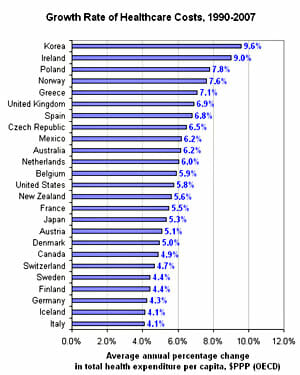
Bait And Switch Alert — Increased Expenditures <> Increase Costs

Kevin Drum presents this chart:

Blog_Healthcare_Growth

Look at the top and the bottom of the chart.  The top says “growth of health care costs” while the bottom says “average annual percentage change in total health expenditures.”  Drum goes on in his post to use rising expenditures and rising costs interchangeably.  I responded in the comments:

Um, I hate to bring measurement and data integrity into this discussion, but “costs” and “expenditures” are not the same thing.

Total per capita expenditures at Wal-Mart have gone up over the last 20 years by a lot. The cost of items sold at Wal-Mart have not increased by nearly so much. The difference is the volume of purchases.

Let’s say 20% of this country was getting no health care. If next year, everything stayed the same but suddenly these 20% could buy the same amount of health care as everyone else, our per capita expenditures would go up by at least 20%. This does not mean the cost goes up. It means we bought more of it. It would be a good thing, not a “cost”

Only from one perpective, that of a single payer, are the words “per capita expenditures” and “costs” the same. In such a scenario, but no other, having people get more health care is an increase in costs, rather than an improvement to the population.

I think this is at the heart of what makes many people worry about single payer health systems — that increased volume of use is a “cost”, so that in turn decreasing supply and volume of use is a reduction in cost. It is this whole way of thinking that equates increased usage with increased costs that makes people suspicious of government run systems, and fear that cost reductions will come through usage restrictions.

We might well expect that in wealthy countries like the US, as the per capita percentage of people’s budgets taken up by food and other necessities drops, that health care spending might increase. What better way to spend incremental wealth than on our own health? In anything else – housing, food, travel, whatever — I would suspect that Mr. Drum would consider increasing per capita spending as a good thing, as a sign of wealth and increasing well-being. Why is health care treated just the opposite?

Health Care “Rationing”

The whole “health care rationing” debate is reaching new levels of absurdity.  In part, this is because the very term “rationing” is a confusing misnomer.

So here is what it boils down to:  For every product or service purchase, someone makes a price-value trade-off to determine if that product or service should be purchased for a given price in that particular instance.

One option for making this decision is to have the person who actually will consume the product or service — and whose money will also be used to complete the transaction — make this price-value tradeoff.  This is how we make these decisions for just about, um, absolutely everything that gets purchased.  Since it is your money and you are the one who will enjoy whatever is being purchased, it makes sense that you make the decision – is the price worth it?  Do you buy a cheaper substitute?  Do you do without?

A second way to do this would be to have someone who has you specifically in mind make the price value tradeoffs for you.  This might be like your wife volunteering to go out to buy you some new underwear.  While results may be superior for this approach in a few cases (e.g. my wife buying me clothes), in most cases this approach is fraught with information asymmetries that will likely lead to a suboptimal purchase.  Consider, for example, my wife buying me the cheap 28″ TV when I had wanted to drop the big bucks on a 60″ beauty.

If one were sloppy, he might say that this second approach is the role that exists with insurance companies or is being proposed for the government.  But this isn’t the case.  Because these third parties are NOT making the decision with me and/or my personal preferences in mind.  They can’t.  While my wife may have an imperfect understanding of my preferences, a government health board has none.

So a third model, and almost certainly the worst in terms of individual satisfaction, is to have a third party make price-value tradeoffs for me only with some notion of average preferences for average people, or worse, with an incentive system that has absolutely nothing to do with my satisfaction at all.  This is clearly the case for the government, and is probably the case for many private insurers today — though at least in the latter case one could imagine a regulatory regime that allowed for much more competition and a range of offerings with different service levels and pricing, such that I was more likely to find a pairing close to my preferences than I would in a one-size-fits-no-one government regime.

Skeptics worry that such a range of choices would not exist under private competition, but in fact it does in every single market where the government allows it.  Take grocery stores, since the President of Whole Foods has come into so much criticism from government health care promoters.  The choices in grocery shopping are simply staggering — just think what different price/value points Wal-Mart, Whole Foods, Safeway, AJ’s, and the farmers market offer.

I am constantly amazed when people say that government health care is no different than private competitive models because there will always be rationing.  If you cannot see the difference between “rationing” for yourself based on your own budget and preferences and “rationing” by government committee, well I suppose you deserve what you get.  Except for the problem that unfortunately, I will be forced to take it too.

My Favorite Quote of the Day

From a Chicago Tribune editorial on the city aldermen blocking Wal-Mart construction in the city, via Carpe Diem:

Organized labor doesn’t like Wal-Mart because Wal-Mart doesn’t have union jobs. It just has jobs (with an average hourly wage of $12.05 in Chicago). The aldermen, of course, already have jobs. They get paid $110,556 a year and they figure that as long as they keep the labor unions off their backs, they’ll keep making $110,556 a year.

Who says the City Council doesn’t generate jobs? If you’re one of the 50 aldermen, your unemployment rate is 0 percent. But the unemployment rate for the rest of Chicago is above 10 percent. One in 10 Chicagoans is out of work.

What Does Pelosi Define as “Immoral” Profits? Greater than Zero?

Nancy Pelosi said this the other day (emphasis added)

I’m very pleased that our Chair of our Democratic Congressional Campaign Committee and member of the leadership will be talking too about the immoral profits being made by the insurance industry and how those profits have increased in the Bush years. We all believe in the profit motive; we all want to reward success.  But having that success come at the expense of America’s working families — have that success come by withholding care, when a person becomes ill, is just not right and we’re going to take this issue in a new direction.

In the past, other leftish pundits have been even more direct:

It means the health insurance industry is scared that we might actually do something in 2009 and they want to be seen as something other than completely obstructionist. That means only one thing: they’ve shown fear, and now it’s time to bore in for the kill and gut them like trouts. Let’s get to it.

I don’t have time to redo the analysis, but for the third quarter 2008 (the last quarter of the dreaded Bush years that increased insurance profits so much) I looked up on Google Finance the profit margins of major health care insurers, providers, and HMO’s.  I am not sure who the Democrats would consider the real Satan of health insurance (ala ExxonMobil or Wal-Mart) but if I left a key company off you are welcome to suggest it in the comments.  Anyway, 3Q08 profit margins were:

Cigna: 3.50%

United Health Group: 4.56%

Aetna: 3.64%

WellCare:  4.08%

Amerigroup: 3.51%

Humana 2.56%

WellPoint: 5.49%

So, if you are a business owner (and that includes those of you who own equities, which are ownership shares), be very afraid.  Look at your company or your favorite stockholding.  If they have margins of 2.5% or more of revenues (and that includes just about every profitable company in America — I think the industrial average is in the eights) then Nancy Pelosi and the Democrats consider your profits immorally high and they intend to gut you like a trout.

Update: OK, I had a bit of time to update numbers, so I took Cigna, which is the first on the list, and looked at their net profit margin over 4 years:

2005:  7.6%

2006:  7.0%

2007:  6.4%

2008:   1.5%

Hmm, not sure I see the profits increasing in the Bush years — looks like they are going down to me.  I would also observe that they never in the last four years even rise to average for a large American public company.

(Temporary) Respite for Wal-Mart and Exxon

I wonder if the board rooms of Wal-Mart and ExxonMobil are enjoying their probably temporary respite from being first to be set on by the pitchforks.  At least for now, I think the public has decided that there are worse things than companies that reliably provide essential products and services for single-digit margins and without taxpayer bailout money .

It’s About Control

Government health care initiatives are not about cheaper or better care.  They are about control, and increased power for government officials.

First, via Carpe Diem:

The state is trying to shut down a New York City doctor’s ambitious plan to treat uninsured patients for around $1,000 a year. Dr. John Muney (pictured above) offers his patients everything from mammograms to mole removal at his AMG Medical Group clinics, which operate in all five boroughs. His patients agree to pay $79 a month for a year in return for unlimited office visits with a $10 co-pay.

“I’m trying to help uninsured people here,” he said.But his plan landed him in the crosshairs of the state Insurance Department, which ordered him to drop his fixed-rate plan – which it claims is equivalent to an insurance policy. Muney insists it is not insurance because it doesn’t cover anything that he can’t do in his offices, like complicated surgery. He points out his offices do not operate 24/7 so they can’t function like emergency rooms. The state believes his plan runs afoul of the law because it promises to cover unplanned procedures – like treating a sudden ear infection – under a fixed rate. That’s something only a licensed insurance company can do.

“I’m not doing an insurance business,” he said. “I’m just providing my services at my place during certain hours.” “If they leave me alone, I can serve thousands of patients,” he said.

Expect similar efforts by Wal-Mart and CVS to run afoul of the government soon, under some pretext.   Massachusetts debated for over a year before allowing just two licenses for this type of clinic.   I have already observed lefty bloggers turning their nose up at this trend, and sense they are scrounging around for some kind of meme or message to consolidate around to oppose this kind of care.  Because having people find private solutions to their problems is the last thing they want to see.  (Seriously – is this the goofiest indictment of the US medical system you have ever seen? How deep are we reaching here?)
Anyway, should you think I am exaggerating, I will leave you with this story I saw on Radley Balko’s site:

The five plaintiffs, who now include former House Majority leader Dick Armey, are challenging a policy of the Department of Health and Human Services (DHHS) that denies Social Security benefits to anybody who refuses to enroll in Medicare.

Read that again: As the policy now stands, if you want to pay for your own health care rather than let taxpayers finance it through Medicare, government will not let you receive the Social Security benefits for which you have spent a lifetime paying taxes.
Note that nobody is trying to avoid contributing to Medicare. The plaintiffs merely want to decline the tax-funded benefits for which they already have paid. None of them want the bureaucracy, the governmental intrusions into their privacy, and the rationing of care they believe Medicare entails – so they volunteer to let taxpayers off the hook by providing their own health care coverage.

But DHHS won’t let them. Or at least not if they want to receive Social Security benefits. Forfeit Medicare, says DHHS, and you must also forfeit Social Security even if you’ve paid for it for half a century.

Not The Best of Times Because, Why?

Kevin Drum posts this chart as a one-picture refutation of McCain’s statement that we are living in the best of times.

Um, OK.  We all got wealthier.  And the problem is, what?  That someone else got even wealthier than I did?  So what.  Do we really have to keep refuting this zero-sum economics-of-envy argument?

I won’t get into the whole zero-sum thing, because the chart itself proves that the world can’t be zero-sum, since everyone got richer on average.  But here is a full refutation of zero-sum wealth arguments.  Also, a zero-sum wealth quiz here.

Looking at changes in income brackets is
always misleading. In the US, most folks are migrating up the brackets
as they age and gain experience. So most folks benefit not just from
the increase in their bracket but a migration to the next bracket.

To this last point, the bottom end of the bracket is being flooded
with new immigrants (legal or not) with poor skills and often no
English. They drag down the averages, again understating how well the
typical person is doing.  Lifetime surveys of individuals rather than percentile brackets always demonstrate that individuals gain wealth over time much fast than this type of analysis demonstrates.  And even the new immigrants at the bottom are presumably gaining vs. their previous circumstances, or else why else would they have immigrated in the first place.

Here is an alternate response to whether we are in the best of times.

By the way, here is an interesting article on why using a single inflation rate for the poor and the rich to get real income growth may be incorrect.  There is an argument to be made that the poor have a lower inflation rate than the rich, thanks to Wal-Mart.

The Format Wars May Be Over

It looks like Blu-Ray will soon defeat HD-DVD

Fans of Toshiba’s HD DVD format have been kicked while they’re down, this time by Wal-Mart’s decision to ditch the format,
and sell Blu-ray players and media exclusively. Effective June, the
move is the result of customer feedback, and an attempt to "simplify"
patron’s decisions. This news closely follows Best Buy’s decision to
also give the format the boot. Speculation has already surfaced that
suggests Toshiba will abandon their own format "in the coming weeks"…

So file all that HD-DVD software next to your Betamax tapes.  I actually preferred the HD-DVD format, but thought from the beginning that Blu-Ray’s position in home gaming machines, which immediately gave them a huge installed based before any of us started buying High Def. movie players for our home theaters, might give it a lead that could not be overcome. 

Most consumers have just wanted the format wars to be over so they could pick the right player and software (I partially avoided this problem by buying a combo player).  This is an interesting consumer-friendly role for Wal-Mart that I have never seen discussed, that of standards-setter.

So here is a message to Blu-Ray:  Now that you are on the verge of victory, you need to clean up your own house.  The creeping standards problem you have had, which has caused early players to be unable to play newer disks, has got to end.  In particular, it is irritating not to be able to play a newer disk because the fancy multimedia menu won’t work.  When when you learn that we aren’t interested in all that crap and just want the movie to start?  Just because the technology says you can do that stuff does not mean that you should.

Update: Reuters with the same news, and a rumor that Toshiba has already shut down production line.

The Problem in Education Is Not Expertise

Via Kevin Drum, Mark S. Tucker and Kevin Toch make the argument, if I understand it right, that school districts and state education organizations simply don’t have the expertise or the capacity to handle the changes required to meet the standards that are being applied by efforts like NCLB (they also argue the tests themselves suck, but I am not going to address that issue).  By the way, you know I’m going to get worked up when the title of an article is "The secret to making Bush’s school reform law work? More bureaucrats"

…we need a long-term solution, which can only lie in building
the capacity of the states, districts, and schools to reach the kinds
of goals contemplated by the framers of NCLB. This is not a simple
matter, but a vast, man-to-the-Moon kind of challenge. It means finding
people with the data management experience to build and administer the
very complex systems called for by the law. It means recruiting experts
who can help create truly world class curriculum standards so that
teachers will know what they are supposed to teach and students will be
able to reach the standards. It means identifying and training
thousands of educators who have succeeded in improving their schools to
provide on-site assistance at other failing schools, and recruiting
still others who can take those schools over if the current staff
cannot or will not rise to the challenge. It means creating and
expanding networks of talent-laden organizations–universities, think
tanks, for-profit and non-profit school companies–that have the skill,
experience, and management capacity to turn around individual schools
and entire districts. And it means greatly strengthening the
capabilities of the agencies that will coordinate this massive effort:
state departments of education.

Wow!  It’s hard to even know where to start, but I guess my first thought is : What the f*ck have public schools been doing in the last 100 years?  Why, after an absolutely enormous spending growth over the last several decades, do districts still not have the ability to create world class curricula?  Why don’t teachers know what they are supposed to teach?   Why is the system so talent poor, despite a huge increase in the number of administrators with various advanced education degrees at all levels of the system?  It’s as if the highway department announced today that they didn’t have the ability to design roads.

The first and last resort of every technocrat is to complain that the system is great, if only the right "smart" people could get put in charge.  These folks are making this same argument yet again.  Our public schools are fine, if we could just get the right experts in charge. 

Bullshit.

The issue is not the lack of expertise.  The issue is one of incentives and senescence in the system itself.  In this context,  NCLB is completely off the mark.   I work with government employees all the time.  There is a very clear difference between the incentives they see and the incentives I see in the market.  For government employees, the biggest incentive is to avoid missing some bureaucratic check box.  They are much more concerned that they not be found later in some audit to have missed a procedure or a required approval authority than with actual performance or productivity.  NOT, I want to emphasize, because they are bad or misguided people, but because that is how their incentive system is set up.  Their actions are entirely rational in the context of their incentive structure, but the results are no less disastrous.

For example, government managers of recreation facilities get almost no credit for improving the customer experience, a metric my company lives and dies for.  I have seen a government park manager do a great job obtaining funds from private sources to add a new facility to their park that pleased guests, only to get criticized for having the slope of an access ramp be 1/4 degree off ADA standards and have a grievance filed by the union that park visitation had gone up, creating more work for the government employees.  I spent an evening having a beer with that manager, and you can bet they are never going to try to actually improve the customer experience again.  As another example, I went in to my government landlord last week and just blasted them for their lack of customer service focus, for the fact that they are blocking me from making improvements customers are begging for.  They yawned, gave me no response,  and handed me a notice that they were missing some of our water testing paperwork and please get it to them ASAP.

NCLB just gives government schools another government wammy to be managed and avoided.  The authors will probably get their wish, and huge bureaucracies will rise up to manage the numbers and reports without anything being done to really improve education.  The authors lament that the California state education department has "only" 1452 employees.  I have every confidence that this "problem" will soon get fixed by California, and the number will balloon up nicely, long before children see any better education.

A while back I wrote a plea to just let GM die.  I said:

A corporation has physical plant (like factories) and workers of
various skill levels who have productive potential.  These physical and
human assets are overlaid with what we generally shortcut as
"management" but which includes not just the actual humans currently
managing the company but the organization approach, the culture, the
management processes, its systems, the traditions, its contracts, its
unions, the intellectual property, etc. etc.  In fact, by calling all
this summed together "management", we falsely create the impression
that it can easily be changed out, by firing the overpaid bums and
getting new smarter guys.  This is not the case – Just ask Ross Perot.
You could fire the top 20 guys at GM and replace them all with the
consensus all-brilliant team and I still am not sure they could fix
it. 

All these management factors, from the managers themselves to
process to history to culture could better be called the corporate
DNA*.  And DNA is very hard to change.  Walmart may be freaking
brilliant at what they do, but demand that they change tomorrow to an
upscale retailer marketing fashion products to teenage girls, and I
don’t think they would ever get there.  Its just too much change in the
DNA.  Yeah, you could hire some ex Merry-go-round** executives, but you
still have a culture aimed at big box low prices, a logistics system
and infrastructure aimed at doing same, absolutely no history or
knowledge of fashion, etc. etc.  I would bet you any amount of money I
could get to the GAP faster starting from scratch than starting from
Walmart.  For example, many folks (like me) greatly prefer Target over
Walmart because Target is a slightly nicer, more relaxing place to
shop.  And even this small difference may ultimately confound Walmart.
Even this very incremental need to add some aesthetics to their
experience may overtax their DNA….

Changing your DNA is tough.  It is sometimes possible, with the right
managers and a crisis mentality, to evolve DNA over a period of 20-30
years.  One could argue that GE did this, avoiding becoming an
old-industry dinosaur.  GM has had a 30 year window (dating from the
mid-seventies oil price rise and influx of imported cars) to make a
change, and it has not been enough.  GM’s DNA was programmed to make
big, ugly (IMO) cars, and that is what it has continued to do.  If its
leaders were not able or willing to change its DNA over the last 30
years, no one, no matter how brilliant, is going to do it in the next
2-3.

I would say the exact same thing is true of public schools: Their DNA is senescent.  Most are the equivalent of alcoholics who keep falling off the wagon and keep asking for more chances.  At some point, you just have to give up.  At some point, it is easier to just start from scratch.  After 30 years of trying, Sears still can’t change itself so there is Wal-Mart.  After 30 years of trying, GM still can’t change itself so there is Toyota.  After 30 years of trying, United Airlines still can’t change itself so there is Southwest.

The only difference in education is that the government has to date suppressed the emergence of Toyota and Wal-Mart and Southwest because, well, because it can.  I am sure that United Airlines would have liked to ban competition from Southwest, but it does not have the coercive power of government.  Fortunately, in most industries other than education, the public gets a choice of offerings, and companies that customers don’t prefer tend to die.

It’s time to give school choice a chance, and radically shift the incentives for public schools in a way that the government can’t with bureaucracy-based programs like NCLB.  Some public schools will thrive, and many will die in favor of private options, but our kids will be far better off either way.  It’s time to stop doubling down on failure.  It’s time to stop giving the alcoholic one more chance.

Postscript:  One of the reasons that competition is important is in the very definition of "expertise."  An expert is someone who presumably has been succesful at a certain activity when others have been less so.  We call Herb Kelleher an expert on airlines and customer service because he designed a model that kicked everyone else’s butt.  But would you have called him an expert in 1972, before Southwest took off?  Probably not.  He was just one of many voices with diverse, untested opinions of what would make a better airline.  What eventually made him an expert, and the others less so, is he went out and applied his ideas and they were succesful.

So the author’s want to send more "expertise" to the schools.  OK, who are the experts?  Nearly every public school is using the same version of the same failed model.  Some succeed more than others, but these differences tend to be incremental rather than radical, like the difference between Sears and Montgomery Ward rather than between Sears and Wal-Mart (or even Amazon.com).  So how can you even know who the experts are within the same failed system, where no one is really allowed to go out and fully test their ideas in practice?  What happens, in reality, is that "experts" in education are the ones that can best enthrall academics and politicians and think tanks with grandiose or politically correct visions.  I would argue that as of this moment there are no experts in education in the US and we have no hope of identifying them until we let entrepreneurs go out and start testing various new models.

The Problem in Education Is Not Expertise

Via Kevin Drum, Mark S. Tucker and Kevin Toch make the argument, if I understand it right, that school districts and state education organizations simply don’t have the expertise or the capacity to handle the changes required to meet the standards that are being applied by efforts like NCLB (they also argue the tests themselves suck, but I am not going to address that issue).  By the way, you know I’m going to get worked up when the title of an article is "The secret to making Bush’s school reform law work? More bureaucrats"

…we need a long-term solution, which can only lie in building
the capacity of the states, districts, and schools to reach the kinds
of goals contemplated by the framers of NCLB. This is not a simple
matter, but a vast, man-to-the-Moon kind of challenge. It means finding
people with the data management experience to build and administer the
very complex systems called for by the law. It means recruiting experts
who can help create truly world class curriculum standards so that
teachers will know what they are supposed to teach and students will be
able to reach the standards. It means identifying and training
thousands of educators who have succeeded in improving their schools to
provide on-site assistance at other failing schools, and recruiting
still others who can take those schools over if the current staff
cannot or will not rise to the challenge. It means creating and
expanding networks of talent-laden organizations–universities, think
tanks, for-profit and non-profit school companies–that have the skill,
experience, and management capacity to turn around individual schools
and entire districts. And it means greatly strengthening the
capabilities of the agencies that will coordinate this massive effort:
state departments of education.

Wow!  It’s hard to even know where to start, but I guess my first thought is : What the f*ck have public schools been doing in the last 100 years?  Why, after an absolutely enormous spending growth over the last several decades, do districts still not have the ability to create world class curricula?  Why don’t teachers know what they are supposed to teach?   Why is the system so talent poor, despite a huge increase in the number of administrators with various advanced education degrees at all levels of the system?  It’s as if the highway department announced today that they didn’t have the ability to design roads.

The first and last resort of every technocrat is to complain that the system is great, if only the right "smart" people could get put in charge.  These folks are making this same argument yet again.  Our public schools are fine, if we could just get the right experts in charge. 

Bullshit.

The issue is not the lack of expertise.  The issue is one of incentives and senescence in the system itself.  In this context,  NCLB is completely off the mark.   I work with government employees all the time.  There is a very clear difference between the incentives they see and the incentives I see in the market.  For government employees, the biggest incentive is to avoid missing some bureaucratic check box.  They are much more concerned that they not be found later in some audit to have missed a procedure or a required approval authority than with actual performance or productivity.  NOT, I want to emphasize, because they are bad or misguided people, but because that is how their incentive system is set up.  Their actions are entirely rational in the context of their incentive structure, but the results are no less disastrous.

For example, government managers of recreation facilities get almost no credit for improving the customer experience, a metric my company lives and dies for.  I have seen a government park manager do a great job obtaining funds from private sources to add a new facility to their park that pleased guests, only to get criticized for having the slope of an access ramp be 1/4 degree off ADA standards and have a grievance filed by the union that park visitation had gone up, creating more work for the government employees.  I spent an evening having a beer with that manager, and you can bet they are never going to try to actually improve the customer experience again.  As another example, I went in to my government landlord last week and just blasted them for their lack of customer service focus, for the fact that they are blocking me from making improvements customers are begging for.  They yawned, gave me no response,  and handed me a notice that they were missing some of our water testing paperwork and please get it to them ASAP.

NCLB just gives government schools another government wammy to be managed and avoided.  The authors will probably get their wish, and huge bureaucracies will rise up to manage the numbers and reports without anything being done to really improve education.  The authors lament that the California state education department has "only" 1452 employees.  I have every confidence that this "problem" will soon get fixed by California, and the number will balloon up nicely, long before children see any better education.

A while back I wrote a plea to just let GM die.  I said:

A corporation has physical plant (like factories) and workers of
various skill levels who have productive potential.  These physical and
human assets are overlaid with what we generally shortcut as
"management" but which includes not just the actual humans currently
managing the company but the organization approach, the culture, the
management processes, its systems, the traditions, its contracts, its
unions, the intellectual property, etc. etc.  In fact, by calling all
this summed together "management", we falsely create the impression
that it can easily be changed out, by firing the overpaid bums and
getting new smarter guys.  This is not the case – Just ask Ross Perot.
You could fire the top 20 guys at GM and replace them all with the
consensus all-brilliant team and I still am not sure they could fix
it. 

All these management factors, from the managers themselves to
process to history to culture could better be called the corporate
DNA*.  And DNA is very hard to change.  Walmart may be freaking
brilliant at what they do, but demand that they change tomorrow to an
upscale retailer marketing fashion products to teenage girls, and I
don’t think they would ever get there.  Its just too much change in the
DNA.  Yeah, you could hire some ex Merry-go-round** executives, but you
still have a culture aimed at big box low prices, a logistics system
and infrastructure aimed at doing same, absolutely no history or
knowledge of fashion, etc. etc.  I would bet you any amount of money I
could get to the GAP faster starting from scratch than starting from
Walmart.  For example, many folks (like me) greatly prefer Target over
Walmart because Target is a slightly nicer, more relaxing place to
shop.  And even this small difference may ultimately confound Walmart.
Even this very incremental need to add some aesthetics to their
experience may overtax their DNA….

Changing your DNA is tough.  It is sometimes possible, with the right
managers and a crisis mentality, to evolve DNA over a period of 20-30
years.  One could argue that GE did this, avoiding becoming an
old-industry dinosaur.  GM has had a 30 year window (dating from the
mid-seventies oil price rise and influx of imported cars) to make a
change, and it has not been enough.  GM’s DNA was programmed to make
big, ugly (IMO) cars, and that is what it has continued to do.  If its
leaders were not able or willing to change its DNA over the last 30
years, no one, no matter how brilliant, is going to do it in the next
2-3.

I would say the exact same thing is true of public schools: Their DNA is senescent.  Most are the equivalent of alcoholics who keep falling off the wagon and keep asking for more chances.  At some point, you just have to give up.  At some point, it is easier to just start from scratch.  After 30 years of trying, Sears still can’t change itself so there is Wal-Mart.  After 30 years of trying, GM still can’t change itself so there is Toyota.  After 30 years of trying, United Airlines still can’t change itself so there is Southwest.

The only difference in education is that the government has to date suppressed the emergence of Toyota and Wal-Mart and Southwest because, well, because it can.  I am sure that United Airlines would have liked to ban competition from Southwest, but it does not have the coercive power of government.  Fortunately, in most industries other than education, the public gets a choice of offerings, and companies that customers don’t prefer tend to die.

It’s time to give school choice a chance, and radically shift the incentives for public schools in a way that the government can’t with bureaucracy-based programs like NCLB.  Some public schools will thrive, and many will die in favor of private options, but our kids will be far better off either way.  It’s time to stop doubling down on failure.  It’s time to stop giving the alcoholic one more chance.

Postscript:  One of the reasons that competition is important is in the very definition of "expertise."  An expert is someone who presumably has been succesful at a certain activity when others have been less so.  We call Herb Kelleher an expert on airlines and customer service because he designed a model that kicked everyone else’s butt.  But would you have called him an expert in 1972, before Southwest took off?  Probably not.  He was just one of many voices with diverse, untested opinions of what would make a better airline.  What eventually made him an expert, and the others less so, is he went out and applied his ideas and they were succesful.

So the author’s want to send more "expertise" to the schools.  OK, who are the experts?  Nearly every public school is using the same version of the same failed model.  Some succeed more than others, but these differences tend to be incremental rather than radical, like the difference between Sears and Montgomery Ward rather than between Sears and Wal-Mart (or even Amazon.com).  So how can you even know who the experts are within the same failed system, where no one is really allowed to go out and fully test their ideas in practice?  What happens, in reality, is that "experts" in education are the ones that can best enthrall academics and politicians and think tanks with grandiose or politically correct visions.  I would argue that as of this moment there are no experts in education in the US and we have no hope of identifying them until we let entrepreneurs go out and start testing various new models.

What if the Wage Isn’t Required for Living?

For those who are new to my blog, I run recreation sites like campgrounds, mostly with retired people as labor.  Retired people love these jobs, because they are looking for a nice place to live for the summer in their RV.  Often they are willing to work just for their site and utilities, though as a private entity I must pay them minimum wage as well (when they work for the government, they don’t get paid).  We sometimes get into odd situations — for example, because of a disability payment or Social Security limits, it is not unusual I have employees that ask me if I could not pay them or pay them below minimum wage, and I have to tell them no (minimum wage is absolutely required, even if the worker begs to be paid less).

This relationship works out well.  The retired persons bring conscientious and low-cost management to the campgrounds.  Our employees, who usually are living comfortably off their retirement savings or pension, get a few extra bucks and a nice place to live for the summer.  These folks may work a bit slow, but I can afford that at $6 an hour.

But what happens when a state like Maryland, because it’s got its blood up against Wal-Mart, passes a $11.30 "living" wage?  A number of problems result.  First, a camping night generally consumes, on average, about an hour of labor.  At $6 an hour with 22% burden for payroll taxes and workers comp, this totals to $7.32  per night of camping in labor.  At $11.30 an hour, this totals $13.79 per night of camping.  Most of our campsites are tent camping sites and more primitive natural campgrounds (see here) and a typical price for a night of camping is $16.  This is a very low price for camping when compared to large RV parks, and makes our sites particularly popular with lower income people.  The Marlyland minimum wage would add at least $6.50 to this price, or increase prices by 41% in one swoop.  And this is before considering second order cost increases in other purchased goods and utilities due to the minimum wage increase.

The other problem is one I would have thought so obvious that it is amazing to me that no one seems to talk about it — not everyone earning minimum wage is trying to live on it.  Certainly people new to the work force are one example, as they are often willing to trade lower initial wages for training and experience and a work record and other valuable but non-quantifiable benefits.  In my case, while I am perfectly happy to tolerate lower productivity from older, retired workers at $6 an hour (the average age of my employees is over 70), when wages are forced arbitrarily to over $11, then I have to think about changing my business model, substituting younger workers for older folks.  As any economist would predict, lower productivity workers get pushed out of the market.

For more on this topic, I discussed four case studies in my business dealing with the minimum wage.