It is something you see all the time -- large companies asking to be regulated, at first glance against self-interest. Those most interested in expansion of the government and the regulatory state will shout, "See! Even large evil companies know they need to be subject to government oversight."
Mark Zuckerberg, who I am increasingly convinced is the most dangerous man in America, and his testimony to Congress begging for regulation, should be seen in this context.
So in Facebook’s case, they will advocate some institutionalized changes in the way social media should work. Every change will involve compliance costs. Facebook will make sure that it can comply...and that its competitors cannot without great expense. That will give them a distinct advantage in the marketplace, make it more difficult for startups to compete, and guarantee this platform a leading place by law.
This is why Mark readily agreed to be regulated. Regulations always work to the advantage of the largest market players....
Nor should this come as some sort of shock. This is the way government regulations have always worked, from the meatpackers in the early 20th century (who crafted and enforced meatpacking legislation), to all labor legislation (it’s labor-union lawyers who exercise the dominant influence) to Bitcoin regulations (the major exchanges are always involved) to digital technology today (no way are Google and Facebook going to be excluded from writing the regulations that govern their industries).
There is a civics-text myth that imagines government workers and politicians as all-knowing, crafting rules that benefit everyone as opposed to particular players. It imagines that major market players are suffering as government forces new rules that require their operations put greed on hold and serve the public. The on-the-ground reality is otherwise. There is not a single regulation on the books that does not have an author who is unattached in some way to the regulated industry in question.
Milton Friedman called this regulatory capture. The problem is the influence of industry is there from the beginning. It’s absolutely not the case that capitalists are champions of capitalist competition, as the career and policies of Donald Trump should make clear. Lots of people are good at using markets to make money; only very special people become defenders of open competitive processes.
Right now, Facebook faces massive competition from other platforms in social media, copycats, and alternative uses of people’s time. In some ways, it’s the best possible moment to call on government to institutionalize Facebook as a form of public utility. That might actually be the end game that Zuckerberg has in mind. Then the politicians can update their timeline status: today we passed regulations that brought this wayward company to heel.
Zuckerberg said from the very beginning that he was dismissive of individual privacy and he has created the Facebook honeytrap to kill it. He now is setting his sights on free speech, begging the government to tear up the First Amendment. He is a one-man individual rights wrecking crew.
Remember the sloppily written "for the children" toy testing law that went into effect last year? The Consumer Product Safety Improvement Act (CPSIA) requires third-party testing of nearly every object intended for a child's use, and was passed in response to several toy recalls in 2007 for lead and other chemicals. Six of those recalls were on toys made by Mattel, or its subsidiary Fisher Price.
Small toymakers were blindsided by the expensive requirement, which made no exception for small domestic companies working with materials that posed no threat. Makers of books, jewelry, and clothes for kids were also caught in the net. Enforcement of the law was delayed by a year—that grace period ended last week—and many particular exceptions have been carved out, but despite an outcry, there has been no wholesale re-evaluation of the law. Once might think that large toy manufacturers would have made common cause with the little guys begging for mercy. After all, Mattel also stood to gain if the law was repealed, right?
Turns out, when Mattel got lemons, it decided to make lead-tainted lemonade (leadonade?). As luck would have it, Mattel already operates several of its own toy testing labs, including those in Mexico, China, Malaysia, Indonesia and California.
So while most small toymakers had no idea this law was coming down the pike until it was too late, Mattel spent $1 million lobbying for a little provision to be included in the CPSIA permitting companies to test their own toys in "firewalled" labs that have won Consumer Product Safety Commission approval.
The million bucks was well spent, as Mattel gained approval late last week to test its own toys in the sites listed above—just as the window for delayed enforcement closed.
Instead of winding up hurting, Mattel now has a cost advantage on mandatory testing, and a handy new government-sponsored barrier to entry for its competitors.
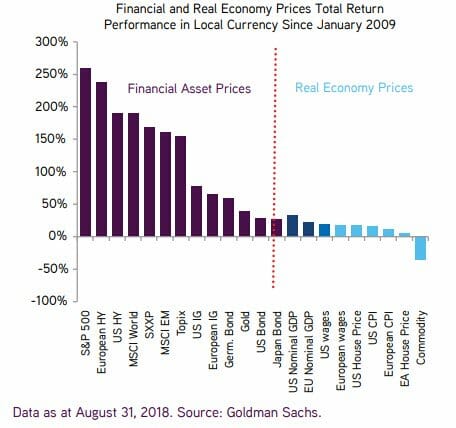
Is it possible that inflation exists but it shows up mainly in financial assets (stocks, bonds, perhaps real estate) that don't really factor into standard inflation metrics? Every step the Fed has taken, as well as other western central banks, appears to me to be crafted to pump money into securities markets rather than into main street. Certainly we have seen a huge inflation in the value of financial assets and real estate over the past several years.
It was an honest question -- I am not an economist. Business school gives one a pretty good working knowledge of micro but macro is usually outside my ken. However, I see this is not a new idea and others make the same point. Saw this chart on the Zero Hedge Twitter feed
I will add that progressives want to use this data to make some sort of fairness / income inequality point about wages vs. rich people's asset holdings, but this chart is not a natural result of unbridled capitalism. It is the predictable result, even the desired result by its creators, of Fed policy in general and quantitative easing in particular.
In part 1, we discussed different ways of measuring income mobility and income growth for the poor, and discovered that many traditional measurement approaches are overly pessimistic -- when one focuses on actual individuals, instead of income quintiles, income for the poor has improved substantially.
Unlike some libertarians, I don't have a problem with intelligently structured income transfer and safety net programs to help the very poor. In fact, I believe that such income transfer programs can be far less distortive and economically inefficient that many other anti-poverty programs. One of the latter I will focus on in this article is the minimum wage.
I want to first call your attention to the figures at the top for mean number of earners per household and household income per earner. Much of anti-poverty policy seems to be based on the assumption that poor people, because they lack bargaining power, get hosed on wages and other work rules. Public policy thus tends to focus on minimum wage and overtime rules and a myriad of other workplace interventions.
But in fact, if we compare the lowest quintile with the middle quintile in the chart above, we see something very different. What we see is the main difference is hours worked, not the relative wage rates. Let's consider two scenarios
We keep the amount of work done the same, but raise the wage rates of the poorest quintile to the middle quintile. In this case, their average income would go up by about 50% from $12,319 to $18,654 (calculated as 0.41 mean earners times middle income per earner of $45,497).
We keep wage rates the same but raise the amount of work done in the poorest quintile household to that of the middle quintile. In this case, their average income more than triples from $12,319 to $41,163 (calculated as 1.37 middle income earners times poor income per earner of $30,046)
So in this example, increasing the poor's wage rates to middle class levels yields $6,335 a year while increasing the poor's amount of work done to middle class levels yields $28,844 a year. Public policy that focuses on increasing work hours for the poor has 4.5 times the effect of public policy focused on wage rates. A corollary to this is that any public intervention on wage rates for the poor that has negative employment effects is likely to have little net effect on poverty.
But in fact this understates the relative benefits of approach #2. Look at the education levels in the poorest quintile vs. the middle. The poorest quintile has 2.5 times as many people without even a high school degree as in the middle. For these folks to progress, the only way they can develop skills is on a job and they can't do this without a job. Or said another way, another advantage of approach #2 and getting them more hours of work is that they gain more skills to overcome their starting disadvantage in education.
I wrote about this in the summer issue of Regulation magazine, in a article entitled "How Labor Regulation Harms Unskilled Labor." I argued that while likely intended to help the very poor, most labor regulation may be harming the poor, particularly those without skills or much experience, by making it harder and harder for them to find work. This not only impoverishes them, but makes it harder for them to progress to better jobs and higher income levels.
In my business,which staffs and operates public campgrounds, I employ about 350 people in unskilled labor positions, most at wages close to the minimum wage. I had perhaps 40 job openings last year and over 25,000 applications for those jobs. I am flooded with people begging to work and I have many people asking for our services. But I have turned away customers and cut back on operations in certain states like California. Why? Because labor regulation is making it almost impossible to run a profitable, innovative business based on unskilled labor.
Why is this important? Why can’t everyone just go to college and be a programmer at Google? Higher education has indeed been one path by which people gain skills and opportunity, but until recently it has never been the most common. Most skilled workers started as unskilled workers and gained their skills through work. But this work-based learning and advancement path is broken without that initial unskilled job. For people unwilling, unable, or unsuited to college, the loss of unskilled work removes the only route to prosperity.
...the mass of government labor regulation is making it harder and harder to create profitable business models that employ unskilled labor. For those without the interest or ability to get a college degree, the avoidance of the unskilled by employers is undermining those workers’ bridge to future success, both in this generation and the next.
Public policy could best help the poor by lowering the regulatory barriers to hiring unskilled labor and promoting economic growth that will help keep us close to full employment.
Postscript: This update on the Seattle minimum wage study is interesting. Note that this study is occuring near peak employment, a time when one would expect the minimum employment impact from a minimum wage increase. However, I do think the findings are roughly consistent with the discussion above:
In their latest paper, which has not been formally peer reviewed, Mr. Vigdor and his colleagues considered how the minimum-wage increases affected three broad groups: People in low-wage jobs who worked the most during the nine months leading up to and including the quarter in which the increase took effect (more than about 600 or 700 hours, depending on the year); people who worked less during that nine-month period (fewer than 600 or 700 hours); and people who didn’t work at all and hadn’t during several previous years, but might later work. The latter were potential “new entrants” to the ranks of the employed, in the authors’ words.
The workers who worked the most ahead of the minimum-wage increase appeared to do the best. They saw a significant increase in their wages and only a small percentage decrease in their hours, leading to a healthy bump in overall pay — an average of $84 a month for the nine months that followed the 2016 minimum-wage increase.
The workers who worked less in the months before the minimum-wage increase saw almost no improvement in overall pay — $4 a month on average over the same period, although the result was not statistically significant. While their hourly wage increased, their hours fell substantially. (That doesn’t mean they were no better off, however. Earning roughly the same wage while working fewer hours is a trade most workers would accept.)
It’s the final group of workers — the potential new entrants who were not employed at the time of the first minimum-wage increase — that Mr. Vigdor and his colleagues believe fared the worst. They note that, at the time of the first increase, the growth rate in new workers in Seattle making less than $15 an hour flattened out and was lagging behind the growth rate in new workers making less than $15 outside Seattle’s county. This suggests that the minimum wage had priced some workers out of the labor market, according to the authors.
“For folks trying to get a job with no prior experience, it might have been worth hiring and training them when the going rate for them was $10 an hour,” Mr. Vigdor speculated, but perhaps not at $13 an hour.
I would add as an aside that I think the NYT is being a bit arrogant an narrowly focused on money (vs. other benefits of employment) when they added the parenthetical phrase at the end of the third paragraph.
After a customer places an order, a robot carrying the desired item scoots over to a worker, who reads on a screen what item to pick and what cubby it’s located in, scans a bar code and places the item in a bright-yellow bin that travels by conveyor belt to a packing station. AI suggests an appropriate box size; a worker places the item in the box, which a robot tapes shut and, after applying a shipping label, sends on its way. Humans are needed mostly for grasping and placing, tasks that robots haven’t mastered yet.
Amazon’s robots signal a sea change in how the things we buy will be aggregated, stored and delivered. The company requires one minute of human labor to get a package onto a truck, but that number is headed to zero. Autonomous warehouses will merge with autonomous manufacturing and delivery to form a fully automated supply chain.
I got some cr*p on twitter a while back about writing this, but I think it is pretty much vindicated by the "one minute" factoid above:
Amazon likely is being pressured by the tightening labor market to raise wages anyway. But its call for a general $15 minimum wage is strategically brilliant. The largest employers of labor below $15 are Amazon's retail competitors. If Amazon is successful in getting a $15 minimum wage passed, all retailers will see their costs rise but Amazon's competition will be hit much harder.
Amazon.com on Tuesday said it was raising the minimum wage it pays all U.S. workers to $15 an hour, a move that comes as the company faced increased criticism about pay and benefits for its warehouse workers.
The new minimum wage will kick in Nov. 1, covering more than 250,000 current employees and 100,000 seasonal holiday employees. The company said it also will start lobbying Congress for an increase in the federal minimum wage, which was set nearly a decade ago and is currently $7.25 an hour.
“We listened to our critics, thought hard about what we wanted to do, and decided we want to lead,” said Jeff Bezos, Amazon’s chief executive, in a statement. “We’re excited about this change and encourage our competitors and other large employers to join us.”
Here is the cynical view of this: Amazon likely is being pressured by the tightening labor market to raise wages anyway. But its call for a general $15 minimum wage is strategically brilliant. The largest employers of labor below $15 are Amazon's retail competitors. If Amazon is successful in getting a $15 minimum wage passed, all retailers will see their costs rise but Amazon's competition will be hit much harder.
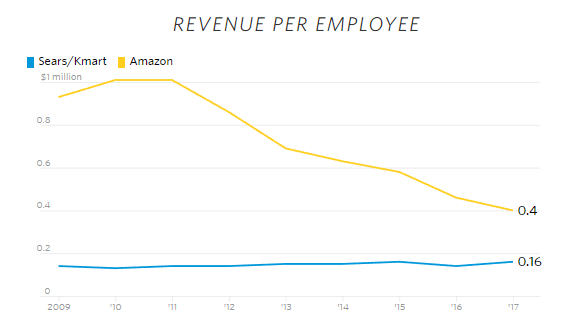
The reason is that due to its internet sales model, Amazon's revenue per employee is MUCH higher than for most retailers -- you can see this in the chart above in a comparison to Sears. If we had data on revenues per employee in small retail, the numbers would be even lower. So a minimum wage increase raises costs to Amazon's competitors by a much larger percentage of revenue than it does for Amazon. In short, Amazon's cost advantage over bricks and mortar retailers would be enhanced by a $15 minimum wage.
I have written the cover story for the Summer 2018 issue of Regulation magazine, titled "How Labor Regulation Harms Unskilled Workers." The link to the Summer 2018 issue is here and the article can be downloaded as a pdf here. I meant to be a bit more prepared for this but it was originally slated for the Spring issue and it (rightly) got kicked to the later issue to add a more timely article on tariffs and trade. The summer publication date sort of snuck up on me until I saw that Walter Olson linked it.
FAQ (I will keep adding to this as I get questions)
How did a random non-academic dude get published in a magazine for policy wonks? This piece started well over a year ago, back when my friend Brink Lindsey was still at Cato (he has since moved to the Niskanen Center). I had told him once that I was spending so much of my personal time responding to regulatory changes affecting my company that I had little time to actually focus on improving my business. I joked that we were approaching the regulatory singularity when regulations were added faster than I could comply with them.
Brink asked that I write something on small business and regulation. After about 10 minutes staring at a blank document in Word, I realized that was way too broad a topic. I decided that the one area I knew well, at least in terms of compliance costs, was labor regulation. After some work, I eventually narrowed that to the final topic, the effect (from a business owner's perspective who had to manage compliance) of labor regulation on unskilled labor.
Once I finished, I was ready to just give up and publish the piece on my blog. I sent it to Brink but told him I thought it was way too rough for publication. He told me that he had seen many good published pieces that looked far worse in their early drafts, so I buckled down and cleaned it up. My editor at Regulation took on the heroic task of getting the original monstrosity tightened down to something about half the length. As with most good editing processes, the piece was much better with half the words gone.
The real turning point for me was advice I got from Walter Olson of Cato. I "know" Walter purely from blogging but I love his work and had been a substitute blogger at Overlawyered in its early years. At one point, I was really struggling with this article because I kept feeling the need to address the broader viability of the minimum wage and the academic literature that surrounds it. But I am not an academic, and I have not done the research and I was not even familiar with the full body of literature on the subject. Walter's advice boiled down to the age-old adage of "write what you know." He encouraged me to focus narrowly on how a business has to respond to labor regulation, and how these responses might effect the employment and advancement prospects of unskilled workers. As such, then, the paper evolved away from a comprehensive evaluation of minimum wages as a policy choice (a topic I have opinions about but I don't have the skills to publish on) into a (useful, I think) review of one aspect of minimum wage policy, a contribution to the discussion, so to speak.
Update: Eek, I forgot since I started this so long ago. I also owe a debt of gratitude to about 8 of our blog readers who own businesses and volunteered to be interviewed for this article so I could make sure I was being comprehensive.
There are many positive (or negative) aspects of labor regulation you have excluded! Yes, as discussed above this paper is aimed narrowly at one aspect of labor regulations -- understanding how businesses that employ unskilled workers respond to these regulations and how those responses affect workers and their employment and advancement prospects
Everyone knows employer monopsony power means there are no employment or price effects to minimum wage increases. Some studies claim to have proved this, others dispute this. I would say that this statement has always seemed insane from my perspective as a small business owner. It sure doesn't feel like I have a power imbalance in my favor with my workers. I address this with a real example in the article but also address it in much more depth here. The short answer is that for minimum wages to have no employment or price effects, a company has to have both monopsony power in the labor market AND monopoly power in its customer markets. Without the latter, all gains from "underpaying" a worker due to monopsony power get competed away and benefit consumers (in the form of lower prices) rather than increase a company's profit.
The costs of these regulations are supposed to come out of your bloated profits. Perhaps that is what happens at Google, where compliance costs are a tiny percentage of what their highly-compensated employees earn and where the company enjoys monopoly profits in its core businesses. For those of us in highly-competitive businesses that employ unskilled workers, our profit margins are really thin (as explained in more depth here). When profits are close to the minimum that supports further investment and participation in the business, then labor regulatory costs are going to get paid by consumers and workers.
Then maybe the best thing for workers is to create monopolies. Funny enough, this idea was actually one of the centerpieces of Mussolini's corporatist economic model, a model that was copied approvingly by FDR in the centerpiece New Deal legislation the National Industrial Recovery Act (NRA). The NRA sought to create cartels in major industries that would fix prices, wages, and working conditions, among other things. The Supreme Court struck the legislation down, a good thing since it would have been a disaster for consumers and for innovation and probably for most workers too. As a bit of trivia, this year's Superbowl winner the Philadelphia Eagles was named in honor of this law. More here.
So do you think minimum wages are a good policy overall or not? Hmm, mostly not. For a variety of reasons, minimum wages are a very inefficient way to tackle poverty (and also here), and tend to have cronyist effects that help one class of worker at the expense of other classes (this latter should be unsurprising since many original supporters of the first federal minimum wages were explicitly hoping to disadvantage black workers competing with whites).
Why are you opposed to all these worker protections? Or, more directly, why do you hate workers? This is silly -- I am not and I don't. However, this sort of critique, which you can find in the comments below, is typical of how public policy discussion is broken nowadays. When I grew up, public policy discussion meant projecting the benefits of a policy and balancing them against the costs and unintended consequences. In this context, I am merely attempting to air some of the costs of these regulations for unskilled workers that are not often discussed. Nowadays, however, public policy is judged solely on its intentions. If a law is intended to help workers (whether or not it will every reasonably achieve its objectives), then it is good, and anyone who opposed this law has bad intentions. This is what you see in public policy debates all the time -- not arguments about the logic of a law itself but arguments that the opposition are bad people with bad intentions. For example, just look in the comments of this and other posts I have linked -- because Coyote points out underappreciated costs to laws that are intended to help workers, his intentions must be to harm workers. It is grossly illogical but characteristic of our post-modernistic age.
I will retell a story about Obamacare or the PPACA. Most of my employees are over 60 and qualify for Medicare. As such, no private insurer will write a policy for them -- why should they? Well, along comes Obamacare, and it says that my business has to pay a $2000-$3000 penalty for every employee who is not offered health insurance, and Medicare does not count! I was in a position of paying nearly a million dollars in fines (many times my annual profits) for not providing insurance coverage to my over-60 employees that was impossible to obtain -- we were facing bankruptcy and the loss of everything I own. The only way out we had was that this penalty only applied to full-time workers, so we were forced to reduce everyone's hours to make them all part-time. It is a real flaw in the PPACA that caused real harm to our workers. Do I hate workers and hope they all get sick and die just because I point out this flaw with the PPACA and its unintended consequence?
I've heard that raising the minimum wage increases worker productivity so much that businesses are better off. I know there is academic literature on this and I am frankly just not that familiar with it. I can say that I have never, ever seen workers suddenly and sustainably work harder after getting a wage increase. What I see instead is employers doing things like cutting back employee hours and demanding the same amount of work gets done. This could result in more productivity if there was fat in the system beforehand but it also can result in things like lower service levels (e.g. the bathrooms get cleaned less frequently). Without careful measurement, these changes could appear to an outsider to be productivity gains. In addition, as discussed in the article, with higher minimum wages employers can substitute more skilled for less skilled workers, which can result in productivity gains but leave unskilled workers without a job.
Workers are human beings. It is wrong to think of them as "costs" or "resources". The most surprised I think I have ever been on my blog is when I got so much negative feedback for writing that the best thing that could happen to unskilled workers is for someone to figure out how to make a fortune hiring them. I thought this was absolutely obvious, but the statement was criticized as being heartless and exploitative. My workers are my friends and are sometimes like family. I hire hundreds of people over 60 years of age, people that the rest of society casts aside as no longer useful. They take pride in their ability to continue to be productive. You don't have to tell me they are human beings. Just this week I have helped modify an employee's job responsibilities to help them manage their newly diagnosed MS, found temporary coverage for a manager who needs to get to a relative's funeral, found a replacement for a manager that wants to take a sabbatical, and loaned two different employees money to help them through some tough financial times. From a self-interested point of view, I need my employees to be happy and satisfied in their work or they will provide bad, grumpy service. But at the end of the day I can only keep these people employed if customers are willing to pay more for the services they provide than the employees cost me. If the cost of employing people goes up, then either customers have to pay more or I can hire fewer employees.
You probably support child labor too. Child labor laws are an entirely reasonable zone of government regulation. The reason this is true stems from the definition of a child -- a child is someone considered under the law to lack agency or the ability to make adult decisions due to their age. We generally give parents, rightly, a lot of the responsibility for protecting their children from bad decisions, but I am fine with the government backstopping this with modest regulations. In other words, I have no problem with the law treating children like children. Instead, I have a problem with the law treating adults like children.
Aren't you just begging to get audited? Hah! That's what my wife says. To me, the logical response of a regulator should be, "wow, this guy knows the law way better than most of the business folks we deal with, so he probably is not a compliance risk" -- but you never know. Actually, we have been audited many times on many of these laws. So much so that practically the first series of posts I did on this blog, way back in the blog pleistocene era of 2004, was 3 part series on surviving a Department of Labor audit. Looking back on the series, everything in it (which included experience from a number of different audits) still seems valid and timely.
I am all for promoting understanding between our two great national tribes. But you ruin your attempt by whipping out a statement like this: "There are plenty of people who are simply beyond reach for liberals. They’re either racist or sexist or they love guns or maybe they’re just plain mean" Seriously? Back to the old "if you don't agree with me you must be racist?"
Further, you execute the classic tribal maneuver of choosing to take on one of the opposition's silliest niches, rather than their best. This is the equivalent of a Conservative making blanket statements about liberals and environmentalists based on a few of silly folks caught on video signing a petition to ban dihydrogen monoxide.
This does pretty much zero to promote understanding, and in fact is smug arrogance and virtue signalling masquerading as an attempt at understanding.
I think the high minimum wages in California are misguided and actually hurt the poor and unskilled, and I have written about why I think so. But you know what? I can sure as hell publish a one or two paragraph defense of minimum wages that you would never know was written by anyone but a hardcore progressive or Bernie Bro. As another example, I am pro-choice but I have really engaged with anti-abortion folks enough in social settings to infer that they really, truly think that abortion is killing human beings. We pro-choicers like to make ourselves feel better by saying that the anti-abortion folks are anti-women or religious fascists or something, because it is much easier to hate those folks. But it is much harder to hate someone who really, honestly thinks a baby is dying, even if we think they are misguided.
A lot of hate in this country would disappear if people really tried to understand their opponents in terms other than crude smears, like they are racist or sexist or fascist or snowflakes or whatever. So much so that if I were a professor, I think that every day in a class discussion at the halfway mark I would make everyone reverse positions and try to credibly argue the opposite side of the question. When I run my once a year high school economics class, I do exactly this. And I did that for years in high school debate. For a whole year, despite being an ardent free trader, in every other debate I had to argue in favor of protectionism. I think it was good for my soul.
I post this because there seems to always be a 50/50 chance that I will get banned after every comment on Mother Jones. I never use profanity, and always try to be reasonable, but I am on my 3rd or 4th ID at Mother Jones because they keep banning me. I still will always treasure the first time they banned me -- the comment that got me banned is below. I am pretty sure they thought I was promoting the National Rifle Association in my comment, when in fact I was referring to the National Industrial Recovery Act and the NRA blue eagle of the New Deal.
The authors portray this (at least in the quoted material) as an anti-trust issue, but I suspect a bigger problem is the cronyist certificate of need process. In many locations, new hospitals, or hospital expansions (even things as small as buying a new cat scanner) require government permission in the form of a certificate of need. As one may imagine, entrenched incumbents are pretty good at managing this process to make sure they get no new competition. This, by the way, is a product of classic progressive thinking, which in its economic ignorance saw competition as duplicative and wasteful. We are lucky the Supreme Court shot down FDR's NRA or we would have this sort of mess in every industry.
Q Mr. President, you said that this was a positive meeting, but from the outside, it seemed quite contentious. Did you get any indication from your interlocutors that they were going to make any concessions to you? And I believe that you raised the idea of a tariff-free G7. Is that —
THE PRESIDENT: I did. Oh, I did. That’s the way it should be. No tariffs, no barriers. That’s the way it should be.
Q How did it go down?
THE PRESIDENT: And no subsidies. I even said no tariffs. In other words, let’s say Canada — where we have tremendous tariffs — the United States pays tremendous tariffs on dairy. As an example, 270 percent. Nobody knows that. We pay nothing. We don’t want to pay anything. Why should we pay?
We have to — ultimately, that’s what you want. You want a tariff-free, you want no barriers, and you want no subsidies, because you have some cases where countries are subsidizing industries, and that’s not fair. So you go tariff-free, you go barrier-free, you go subsidy-free.
Awesome, sign me up. But is this serious? I want to get to that in a minute but first let me offer two practical observations
Trump belabored the 270 percent Canadian dairy tariffs on US products, but at the same time the US tariff rate on Canadian dairy products is effectively infinite, because we simply don't let any in. This is the kind of complexity he is glossing over. Forget Canada, his proposal for no tariffs or subsidies would cause a major freakout among US dairy farmers, a business absolutely chock-full of crazy quilt of progressive state regulation on prices and subsidies and quotas. (and by the way, congrats to Trump for getting progressives like Drum into the free trade, anti-price-control camp).
Simple statements like "no subsidies" are easy to make, but is a lower corporate tax rate a subsidy? How about lower minimum wages? What about really long copyright lives? What about when a governor or mayor gives out relocation incentives and tax abatements? What about the whole Amazon HQ2 deal that is coming? The list of complexities are endless. That is why long and complicated negotiations are necessary to reduce tariffs and subsidies. Fortunately we have actually done this, in deals like NAFTA and the TPP. Unfortunately, Trump has given both of these the boot. So is he really serious?
I have a love for history and like to make comparisons of modern events to history, and in this case I believe there is a very parallel case we can learn from. Here is the problem: It involves Hitler's Germany. Hitler is obviously the third rail of Internet discourse, but the example is so parallel I am still going to go ahead, with the following proviso: I am not saying Trump is Hitler, or making any such analogy or statement. I am merely attempting to learn from a very similar international negotiation that occurred in the 1930's.
If you can put aside all the emotional baggage of Hitler being either the worst mass murderer in history or at least in the top 3, he was (at least for a while until it all blew up on him) very successful in getting wins in diplomatic face-offs of the type Trump seems to want (by this I mean gains for his own country in zero-sum or even negative-sum games made by repudiating past international settlements). Hitler's brashness essentially won out with the reoccupation of the Rhineland, Germany's remilitarization, the annexation of Austria, and even led to the western powers basically handing the Sudetenland over to him.
But the example I have in mind is with the disarmament conferences of the the early 1930's. Major western powers were looking for some sort of agreement to head off an expensive and destabilizing arms race of the type that occurred in the run-up to WWI (and which by the way was way too expensive for countries bogged down in the Great Depression). As the powers discussed incremental limits or reductions, one world leader jumped into the fray and proposed that all the powers agree to total disarmament -- no more militaries at all. Can you guess who made this radical proposal that would be the envy of any 1960's hippie?**
Hitler had [President Roosevelt's] message before him when he prepared the final draft of his speech to the Reichstag. Contrary to expectation, his speech, when delivered, made no threat of immediate rearmament. Germany was ready at any time, Hitler said, to renounce the aggressive weapons forbidden to her by the Treaty of Versailles “if the whole world also bans them.” Without further ado, Germany would dissolve her whole military establishment “if neighboring nations unreservedly did the same.” For President Roosevelt's proposal the German government was “indebted with warm thanks.” Germany was ready to join in “any solemn non-aggression pact because she thinks not of attack but of her security.”
In making this speech, Hitler said that he above everyone else wanted peace. He was a soldier, he had been in the trenches, and no soldier wanted war.
Given his past actions, we suspect Hitler was not a total peacenik, so what was going on here? The Treaty of Versailles had essentially disarmed Germany, reduced its army to 100,000 men and banned it from having an air force and submarines, among other things. Germany chaffed at these limits, considering them grossly unfair, and wanted limits at parity with those on, say, France.
Hitler always liked to turn other nations' values against them in his international statements. Later, when he justified potential annexations in Austria, Czechoslovakia, and Poland, he would say that he was just interested in "self-determination of peoples" and that other powers were inconsistent and unfair when they refused to allow this principle they themselves had established to be applied to ethnic Germans in these countries. Hitler clearly didn't care one bit about free self-determination of peoples, but he was happy to throw US and British and French rhetoric back in their faces.
So in this case Hitler grabbed at the other major powers' pious pronouncements about their commitment to disarmament and again threw it back in their faces. You want disarmament? OK, let's do it -- total disarmament. Hitler knew that they would never do it -- France in particular did not trust Germany at all. Hitler waited until it was clear the other countries were not going to go for this proposal and said something like, "see, those other countries were never serious, they never wanted peace. All they want to do is keep Germany down." He proceeded to resign from the conference, renounce the military limits of the Versailles treaty, and started building Germany's army and air force. Which was what he had intended to do all along.
I know from the comments that there are folks reading my blog who honestly don't seem to understand trade and the trade deficit, and I am at my limit in explaining any more clearly. I know there are also folks who honestly think Trump is following a brinksmanship path to get to a net better set of trade rules in the future. I wrote the other day that I doubted this, but folks have emailed me the quotes about Trump proposing full free trade as proof of his intentions. Sorry, while I would love to believe this is true, and will happily admit my error later if needed, I don't believe it for a minute. It just looks too much like Germany's actions at the disarmament conference. People who truly want and understand free trade do not say things like "there are too many German cars in the United States."***
** This link is squirrelly and sometimes is gated and sometimes not. The full citation is Boeckel, R. M. (1933). The Disarmament Conference, 1933. Editorial research reports 1933 (Vol. II). Washington, DC: CQ Press. Retrieved from http://library.cqpress.com/cqresearcher/cqresrre1933100900
*** Anyone older than about 45 can tell you how badly US cars sucked before foreign competition, and how much better they are today only because we allowed this competition. Even if you don't own a German car (and I do), your American car is better and less expensive than it would be without German and Japanese and Korean competition.
I am constantly amazed how little people understand about economics and prosperity. I have to give some background first. Yesterday Mickey Kaus tweeted, "Isn't point of 'Americans are dreamers too' that there *are* zero-sum aspects: American lo-skill workers, who haven't done well for decades, have to compete for jobs/wages w/ DREAMers and (more important) new illegals a big DREAM amnesty will attract."
People talking about zero-sums in economics always get my hackles up, because they are frequently feared and seldom actually exist. There is a lot of research that immigration does not reduced native-born unskilled employment, but it is impossible to discuss such things on Twitter without devolving into dueling appeals to authority. Instead I wrote:
So what about a bipartisan compromise that increases immigration while simultaneously repealing labor regulations that make profitably employing low-skill workers difficult?
This was towards the end of my time on Twitter when I was mad that it was making me a worse person and I resolved to instead focus on trying to bridge differences. But this proposal got a response I had not expected.
Someone doesn't quite grasp the notion that "profitably employing low skill wokers" is only good for employers, whereas immigration restriction is focused on workers. https://t.co/W4HytSKGKl
I am willing to believe I don't understand his point or Twitter is limiting his ability to explain himself, but this just seems really ignorant of how markets work. How are jobs for low-skill workers going to exist if it is NOT profitable to employ them?
Here is how the world works: Profits attract investment. Profits are the fresh blood in the water that attracts sharks. If I am making a good profit employing low-skill workers, then I am likely to reinvest those profits to grow and get more of those profits next year. But even if I don't, at the same time other people will start to notice my profits and want to copy what I am doing. Through all of this, we will all be hiring more and more unskilled workers. None of this growth, none of this investment, none of this job creation happens without the profits.
This is why I have said for years that the greatest thing that could ever happen to low-skill workers in America is for entrepreneurs to find ways to make a fortune employing them. I always get folks who consider this statement grossly exploitative, but it is the literal truth. There are tons of well-paying jobs for programmers because a bunch of companies like Google are very visibly making a ton of money employing them. Unfortunately, it is harder and harder to make the economics of a business that hires low-skill workers a success, something I know well because I run such a business. The local, state and Federal governments are layering on more and more labor regulations that make it increasingly difficult to viably employ lower-skill workers. I have a lot to say on this, and hopefully a paper I have written on the topic will soon be published and we can talk about it more.
Postscript:Margaret Peters argues that one reason the Republican Party is more nativist is that the business sectors of the party that traditionally lobbied in support of immigration have reduced their support, at least for unskilled immigration, because they just don't have as much demand for unskilled labor any more.
As part of my research, I checked to see whether businesses are indeed lobbying less often on immigration. To find this out, I examined which groups testified before Congress on immigration, using that as one measure of lobbying.
Here's what I found. In the 1950s, on average, more than eight businesses used to testify before Congress at each hearing on immigration. By 2010, that number had dropped to two, as you can see in the figure below. The decline has been even steeper for industries that have been exposed to increased imports from foreign countries -- from eight businesses that produce goods that can be traded per hearing in the 1950s to less than one today.
Some industry groups have increased their lobbying for more immigration -- but those are in the tech sector and others that use high-skill labor. We should expect, then, that Trump will continue to push in his State of the Union address Tuesday for a "merit-based system" in which immigrants with high skills get priority.
In contrast, lobbying by nativist groups has hardly increased.
Google beats the doors down in DC lobbying for more immigration spots for programmers. If someone were making good money hiring unskilled labor, they would be doing the same for unskilled immigration.
Most of us who took Econ 101 would expect that an increase in the minimum wage would increase unemployment, at least among low-skilled and younger workers most affected by the minimum wage. After all, demand curves slope downwards so that an increase in price of labor should result in a decrease in demand for that labor.
There is a great body of work on employment effects of minimum wage, and surveying this corpus is beyond the scope of this paper, but a good starting point might be the recent detailed and careful study by Jardim et. al. of the University of Washington, which analyzed the employment effects of the increase in minimum wages in Seattle from $11 to $13. They found that while average hourly wages for lower-paid workers went up by 3%, the total hours worked went down by 9%, resulting in a net reduction in total wages for lower-paid, lower-skill workers at the same time that other sectors of the Seattle economy were booming.
Monopsony Power & The Labor Market
Supporters of the minimum wage, however, argue that these employment effects are exaggerated, because employers have something called monopsony power when hiring low-skill workers. What a monopoly is to customers – it limits choices – a monopsony does to suppliers, in this case the suppliers of labor. The argument is that due to a bargaining power imbalance, employers can hire workers for less than they would be willing to pay in a truly competitive market, gaining the company added savings that increase its profits. Under this theory, minimum wage laws help to offset this power imbalance and force companies to disgorge some of their excess profits in favor of higher wages. If this assumption is true, then demand for labor would not be reduced due to a minimum wage increase because, prior to the wage increase, companies were paying less than they were willing to pay and thus are still willing to continue to pay the wages at the new higher rates.
While economists argue about this monopsony theory, my intuition as an employer makes me skeptical. However, rather than argue about whether my little company that scrambles to staff itself every year somehow wields excess power in the labor markets, I am going to argue that the existence of monopsony power is irrelevant to the employment effects of a minimum wage increase: Even if companies are able to pay workers less than they might via such bargaining power imbalances, whatever gains they reap from workers will end up in consumer hands. As a result, minimum wage increases still must result either in employment reductions or consumer price increases or more likely both.
Why? Well, we need to back up and do a bit of business theory. Just as macroeconomics (all the way back to Adam Smith) spends a lot of time thinking about why some countries are rich and some are poor, business theory spends a lot of time trying to figure out why some firms are profitable and some are not. One of the seminal works in this area was Michael Porter's Five Forces model, where he outlines five characteristics of markets and firms that tend to drive profitability. We won't go into them all, but the most important of the forces for us (and likely for Porter) is the threat of new entrants -- how easy or hard is it for new firms to enter the marketplace and begin competing against an incumbent firm? If new companies can enter into competition easily, a profitable firm will simply attract new competitors, and keep attracting them until the returns in that market are competed down to some minimum level.
Let’s consider a company paying minimum wage to most of its employees. At least at current minimum wage levels, minimum wage employees will likely be in low-skill positions, ones that require little beyond a high school education. Almost by definition, firms that depend on low-skill workers to deliver their product or service have difficulty establishing barriers to competition. One can’t be doing anything particularly tricky or hard to copy relying on workers with limited skills. As soon as one firm demonstrates there is money to be made using low-skill workers in a certain way, it is far too easy to copy that model. As a result, most businesses that hire low-skill workers will have had their margins competed down to the lowest tolerable level. Firms that rely mainly on low-skill workers almost all have single digit profit margins probably averaging around 5% of revenues (for comparison, last year Microsoft had a pre-tax net income margin of over 23%).
If there were some margin windfall to be obtained from labor market power that allowed a company to hire people for far less than their labor was worth to it, and thus earn well above this lowest tolerable margin, new companies would try to enter the market, probably by lowering prices to consumers using some of that labor premium. Eventually, even if the monopsony premium exists, it is given away to consumers in the form of lower prices. If the wholesale price of gasoline suddenly falls sharply, gasoline retailers don't get to earn a much higher margin, at least not for very long. Competition quickly causes the retailer's lowered costs to be passed on to consumers in the form of lower retail prices. The same goes for any lowering of labor costs due to monopsony power -- if such a windfall exists, it is quickly passed on to consumers.
As a result, the least likely response to increasing labor costs due to regulation is that such costs will be offset out of profits, because for most of these firms, profits have already been competed down to the minimum necessary to cover capital investment and the minimum returns to keep owners interested in the business. The much more likely responses will be:
Raising prices to cover the increased costs. While competitors that are subject to the same laws will likely have similar increases, the increase may not be acceptable to consumers and almost certainly will result in some loss in unit sales.
Reducing employment. There are a variety of ways in which a minimum wage increase could result in employment losses. A company might raise its prices to compensate for higher costs, only to find its unit volumes falling, necessitating a layoff in staff. Or the staff reductions may also be due to targeted technology investments, as increases in labor costs also increase the returns to investments in capital equipment that substitutes for labor
Exiting one or more businesses and laying everyone off. This may take the form of exiting a few selected low-margin lines of business, or liquidation of the entire company if the business is no longer viable with the higher labor costs.
A Real-World Minimum Wage Increase Example
A concrete example should help. Imagine a service business that relies mainly on minimum wage employees in which wages and other labor related costs (payroll taxes, workers compensation, etc.) constitute about 50% of the company’s revenues. Imagine another 45% of company revenues going towards covering fixed costs, leaving 5% of revenues as profit. This is a very typical cost breakdown, and in fact is close to that of my own business. The 5% profit margin is likely the minimum required to support capital spending and to keep the owners of the company interested in retaining their investment in this business.
Now, imagine that the required minimum wage rises from $10 to $15 (exactly the increase we are in the middle of in places like Seattle and California). This will, all things equal, increase our example company's total wage bill by 50%. With the higher minimum wage, the company will be paying not 50% but 75% of its revenues to wages. Fixed costs will still be 45% of revenues, so now profits have shifted from 5% of revenues to a loss of 20% of revenues. This is why I tell folks the math of supposedly absorbing the wage increase in profits is often not even close. Even if the company were to choose to become a non-profit charity outfit and work for no profit, barely a fifth of this minimum wage increase in this case could be absorbed. Something else has to give -- it is simply math.
The absolute best case scenario for the business is that it can raise its prices 25% without any loss in volume. With this price increase, it will return to the same, minimum acceptable profit it was making before the regulation changed (profit in this case in absolute dollars -- the actual profit margin will be lowered to 4%). But note that this is a huge price increase. It is likely that some customers will stop buying, or buy less, at the new higher prices. If we assume the company loses 1% of unit volume for every 2% price increase, we find that the company now will have to raise prices 36% to stay even given both the minimum wage increase and the lost volume. Under this scenario, the company would lose 18% of its unit sales and is assumed to reduce employee hours by the same amount.
In the short term, just for the company to survive, this minimum wage increase leads to a substantial price increase and a layoff of nearly 20% of the workers. Of course, in real life there are other choices. For example, rather than raise prices this much, companies may execute stealth price increases by laying off workers and reducing service levels for the same price (e.g. cleaning the bathroom less frequently in a restaurant). In the long-term, a 50% increase in wage rates will suddenly make a lot of labor-saving capital investments more viable, and companies will likely substitute capital for labor, reducing employment even further but keeping prices more stable for consumers.
As you can see, in our example we don’t need to know anything about bargaining power and the fairness of wages. Simple math tells us that the typical low-margin service business that employs low-skill workers is going to have to respond with a combination of price increases and job reductions.
increases in minimum wages almost always causes job losses among the poor and unskilled
GMO's and genetically modified foods have zero proven negative effects on the body or the environment
homeopathy is completely useless and has zero medical benefits beyond any potential placebo effects
All of these are super-majority consensus statements in their respective fields. It's fine if you are skeptical of any of them (and even better if you can justify this skepticism with a reasonably intelligent scientific argument). But don't tell me that I am somehow inherently wrong to challenge the climate orthodoxy.
I have over several months been answering questions about my climate positions -- I think for a woman's school project but I honestly can't remember any more. Anyway, I answered a question for her today and though I did not spend a ton of time on it, I thought I would share.
She asked:
Why do you find it unproductive to argue for something based on how many experts are agreeing to it? Wouldn't it be hubris to dismiss the fact that a number of experts are contradicting you on a subject that is pretty complex and is something that isn't nesessarily understood intuitively?
Why do you believe it is unproductive to take such a point into serious consideration?
The way I see it. there is this kind of logic:
A math student works on a very complicated math problem from his homework and has all his justifications for his answer. However, it turns out that his math professor has a different answer-- which is saying something important. It would be a slippery slope for the student to posit that his answer is right and the professor's answer is wrong just because the justification he came up with on his own always leads him back to the same answer. (That is, unless he found out an explanation for why his professor got that answer, like say-- maybe the professor never worked out the problem by himself and looked at an answer key which was wrong.)
My off the cuff responses to the student:
This is not a simple math problem. It is a super complex multi-variable chaotic system in which we are trying to attribute changes in one output variable (temperature) to a single input variable out of thousands or millions (CO2). I think the majority of the hubris (given the state of our knowledge) is on the certainty side, not the doubting side. I would observe, by the way, that many of the exact same people who use this "you must respect the experts" argument against climate skeptics themselves challenge many expert assertions, e.g. that minimum wages reduce employment or that GMO's are safe, that are supported by at least as many experts in those other fields. You would be unusual if you personally do not disagree with some proposition that most of the "experts" support.
The way folks often describe science when trying to criticize climate skeptics sounds to me a lot more like religion than science. Saying that there are fundamental assertions that one cannot challenge is a feature of religion, not true science. Science is about having a theory, making predictions from that theory, and if those predictions consistently turn out to be true, then gaining confidence in the theory. Many of global warming predictions have been wrong -- they have overestimated temperature increases to date, hurricanes and tornadoes are not getting more frequent, droughts are not getting more frequent, etc (do not confuse the frequency of these events in the news with their actual underlying frequency -- go live with the data at the NOAA to see that all these severe weather trends are dead flat). But no one goes back and relooks at the model or theories and those that do point out these shortcomings, eg. skeptics, are threatened with censure. Does not sound like science to me.
I am not without relevant expertise. Though I don't have as deep of climate knowledge as some, I know a lot about modeling chaotic multivariable systems (in finance and economics) and know exactly what the shortcomings of models are and can recognize the patterns of many mistakes in climate that I have seen in other fields of modeling. Further, the key difference skeptics have with alarmists is the expectation of strong positive feedbacks in the climate accelerating temperatures greatly. My major and research work in college were in dynamic systems and feedbacks. Climate scientists are positing that there is more positive feedback in the climate system than exists in any other stable natural system we know about. That is worth some skepticism if one understands feedbacks.
The experts in climate would be a lot more credible if they were more transparent and open to discourse. Instead, they frequently refuse to release their data (even on government-funded projects) for replication and carefully engineer peer review panels so no one who actually disagrees with them are on it. It has been years since any climate "expert" has agreed to participate in a public debate.
The most important answer is that what the "experts" are saying and what the media and the general public are saying the experts are saying is completely different. There is a bait and switch going on, where the majority (though maybe not the most vocal) of the experts are very careful and conservative (little c) in their claims, but they are portrayed as being all-in en masse on the most outrageous and spectacular of the claims by activists. I would refer you to this article, but I will reprint below the key part to your question:
So let's come back to our original question -- what is it exactly that skeptics "deny." As we have seen, most don't deny the greenhouse gas theory, or that the Earth has warmed some amount over the last several year. They don't even deny that some of that warming has likely been via man-made CO2. What they deny is the catastrophe -- they argue that the theory of strong climate positive feedback is flawed, and is greatly exaggerating the amount of warming we will see from man-made CO2. And, they are simultaneously denying that most or all of past warming is man-made, and arguing instead that the amount that is natural and cyclic is being under-estimated.
So how about the "97% of scientists" who purportedly support global warming? What proposition do they support? Let's forget for a minute a variety of concerns about cherry-picking respondents in studies like this (I am always reminded by such studies of the quote attributed, perhaps apocryphally, to Pauline Kael that she couldn't understand how Nixon had won because no one she knew voted for him). Let's look at the actual propositions the 97% agreed to in one such study conducted at the University of Illinois. Here they are: 1. When compared with pre-1800s levels, do you think that mean global temperatures have generally risen, fallen, or remained relatively constant? 2. Do you think human activity is a significant contributing factor in changing mean global temperatures? The 97% answered "risen" and "yes" to these two questions. But depending on how one defines "significant" (is 20% a significant factor?) I could get 97% of a group of science-based skeptics to agree to the same answers. So this is the real problem at the heart of the climate debate -- the two sides are debating different propositions! In our chart, proponents of global warming action are vigorously defending the propositions on the left side [see chart in the original], propositions with which serious skeptics generally already agree. When skeptics raise issues about climate models, natural sources of warming, and climate feedbacks, advocates of global warming action run back to the left side of the chart and respond that the world is warming and greenhouse gas theory is correct. At best, this is a function of the laziness and scientific illiteracy of the media that allows folks to talk past one another; at worst, it is a purposeful bait-and-switch to avoid debate on the tough issues.
I could have also said that there were several times in class when I challenged the teacher on a math problem answer and I was right and they were wrong. My wife-to-be was actually in one of these classes and can testify to the fact.
By the way, I find the last point I made about bait and switch to be surprisingly similar to problems I have arguing net neutrality. The problem is that the FCC's actions under Obama were NOT net neutrality, they were applying early 1900's telephone regulation which pretty much killed innovation in that industry to the Internet. Unfortunately, everyone calls those regulations "net neutrality" so if you oppose these dumb counter-productive regulations one is somehow against net neutrality when in fact it is nothing of the sort.
Private employees unions (I will leave out public employee unions from this discussion, as they are a different animal) enter the public discourse a lot less frequently than they did in my youth, say in the 1970's. At that time, union power and actions and negotiations and strikes were very frequent stories on the evening news. However, one thing I have noticed throughout my life is that commentators seems to be either all-in for or against unions. I actually think the issues are more subtle, and that unionization is a mixed bag.
On the pro side, unions are basically free association. It is the right of any set of individuals to band together for negotiating leverage.
On the pro and con side is the role of government. Early on, the government acted to stop individuals from exercising their free association rights and forcibly break up unions and bar their activities. Today, I would probably argue the government has slid the other way by writing rules to tilt negotiating power away from employers towards unions (the obvious counter to this is if it is true, why have private unions withered over the last two decades).
On the con side, and it is a big con, is the tendency of unions to push beyond just wage and working condition negotiation into advocating for productivity destroying rules (e.g. featherbedding, strict job categories, etc). These productivity destroying rules have helped to undermine whole industries, and, ironically, the unions themselves. They embody an inherent contradiction in that the wages gains the union wants require productivity gains to support, productivity gains which are impossible under union-preferred work rules.
Here is a great example of the negative side of these union rules, from a NYT report on why New York subways cost so much more to build than do similar projects in the rest of the world
It is not just tunneling machines that are overstaffed, though. A dozen New York unions work on tunnel creation, station erection and system setup. Each negotiates with the construction companies over labor conditions, without the M.T.A.’s involvement. And each has secured rules that contractors say require more workers than necessary.
The unions and vendors declined to release the labor deals, but The Times obtained them. Along with interviews with contractors, the documents reveal a dizzying maze of jobs, many of which do not exist on projects elsewhere.
There are “nippers” to watch material being moved around and “hog house tenders” to supervise the break room. Each crane must have an “oiler,” a relic of a time when they needed frequent lubrication. Standby electricians and plumbers are to be on hand at all times, as is at least one “master mechanic.” Generators and elevators must have their own operators, even though they are automatic. An extra person is required to be present for all concrete pumping, steam fitting, sheet metal work and other tasks.
In New York, “underground construction employs approximately four times the number of personnel as in similar jobs in Asia, Australia, or Europe,” according to an internal report by Arup, a consulting firm that worked on the Second Avenue subway and many similar projects around the world.
That ratio does not include people who get lost in the sea of workers and get paid even though they have no apparent responsibility, as happened on East Side Access. The construction company running that project declined to comment.
Public officials, mired in bureaucracy, have not acted to curb the costs. The M.T.A. has not adopted best practices nor worked to increase competition in contracting, and it almost never punishes vendors for spending too much or taking too long, according to inspector general reports.
At the heart of the issue is the obscure way that construction costs are set in New York. Worker wages and labor conditions are determined through negotiations between the unions and the companies, none of whom have any incentive to control costs. The transit authority has made no attempt to intervene to contain the spending.
“It’s sad, really,” said Lok Home, owner of the Robbins Company, which manufactured much of the tunneling equipment used for East Side Access. “Because if they controlled the costs, they could do twice as many expansion projects and still have more money for maintenance.”
I like reading Zero Hedge, though their laudable cynicism about government and financial markets sometimes edges into conspiracy theory.
Anyway, I wanted to highlight something in a post there today about BLS data. Various writers at the site have claimed for years that government economic data is being manipulated. I am not sure I buy it -- I distrust government a lot but am not sure their employees could sustain such a fraud over months and years. And besides, once you manipulate data one time to juice some metric, you have to keep doing it or the metric just reverses the next month. Corporations that play special quarter-end inventory games to increase reported sales learn this very quickly. Where there are apparent errors, I am much more willing to assume incompetence than conspiracy.
Goods-Producing Weekly Earnings declined -0.8% from $1,118.68 to $1,109.92
Private Service-Providing Weekly Earnings declined -0.1% from $868.80 to $868.18
And yet, Total Private Hourly Earnings rose 0.2% from $907.82 to %909.19
What the above shows is, in a word, impossible: one can not have the two subcomponents of a sum-total decline, while the total increases. The math does not work.
Certainly this is an interesting catch and if I were producing the data I would take these observations as a reason to check my work. But the author is wrong to say that this is "impossible". The reason is that these are not, as he says, two sub-components of a sum. They are two sub-components of a weighted average. Total private average weekly earnings is going to be the goods producing weekly average times number of goods producing hours plus service producing weekly average times the number of service producing hours all over the total combined hours.
From this I hope you can see that even if the both sub averages go down, the total average can go up if the weights change. Specifically, the total average can still go up if there is a mix shift from service providing to goods producing hours, since the average weekly wages of the latter are much higher than the former. I will confess it would have to be a pretty big jump in mix. The percent goods producing hours would have to rise from 15.6% to almost 17%, which strikes me as a very large jump for one month. So I am not claiming this is what happened, but people miss the mix changes all the time. I had to explain it constantly back in my corporate days. Another example here.
I have written about this mix effect many times, eg here. Imagine a corporate division that sells tables and chairs. The CEO is reviewing this division's performance, and sees that their revenues are increasing but their profit margin is falling. He asks his analyst to look into it - is it the tables or the chairs or both that are showing falling margins. Our poor harassed analyst comes back and says, uh, neither. The profit margins for both tables and chairs went up last year. Well, the CEO asks, if revenues are up and all their component margins are going up, how is their total margin falling? It turns out that tables make a much higher margin than chairs, and over the last year the company has seen a much higher growth in chair sales than table sales. The mix is shifting towards a lower margin product and is bringing the averages down. By the way, I can say with authority that this conversation is much harder when the analyst is yours truly and the CEO is famed tough (but talented) boss Chuck Knight of Emerson Electric.
One mystery of this economic expansion is that wage growth has remained slow even as the labor market has finally tightened. One widely cited culprit is historically low productivity growth. But a new analysis from the Federal Reserve Bank of San Francisco adds a more optimistic, albeit paradoxical, explanation.
The Bureau of Labor Statistics recently reported that median weekly earnings had risen in July by a healthy 4.2% on an annual basis, the fastest growth in a decade. As labor markets tighten, employers typically increase wages. Until this past year, however, median weekly earnings growth had hovered near 2%, which is significantly less than the 3.25% average from 1983 to 2015.
So why haven’t wages risen faster amid an increase in hiring and unfilled jobs? One answer is that wages have actually been growing at a faster clip—around 4% to 5%—at least for full-time workers with steady jobs. But new full-time workers who are generally paid less than the retirees they replace are dragging down the average wage increase.
Researchers at the San Francisco Fed this week updated their 2016 paper that disaggregated the wages of full-time workers with steady employment from recent entrants—that is, new workers or those returning to full-time work. Their earlier analysis showed that average wage growth had slowed less than expected during the recession while staying relatively flat during the recovery.
That’s because workers who lost jobs during the recession were generally lower skilled and lower paid, so average weekly wages didn’t fall significantly. However, many of those workers have since been rehired at below-average wages, which has depressed the aggregate.
In prior expansions, wage growth has been driven mostly by continuously full-time employed workers, and the researchers find that’s still the case. Wage growth for these workers is now close to the pre-recession 2007 peak. But there are now many more workers who have been on the labor-force sidelines who are moving to full-time employment, thus creating a drag on wages.
This is frequently how mix shifts play out in the news. Notice that there are actually two pieces of good news here: 1. Wages for full-time workers who have been employed for a while are growing well and 2. lower-skilled and less experienced workers who left the labor force are now getting jobs and returning to work. However, when these are combined, the net is portrayed as bad news, ie wage growth in the US is sluggish. Because the mix was ignored.
California is a uniquely difficult place for companies trying to actually employ people rather than robots. Owning a business in that state, you could be forgiven that the legislation actually embarked on a program to explicitly punish companies for hiring people. The state has spent the last ten or twenty years defining a myriad of micro offenses employees for which may sue employers and make large recoveries -- everything from having to work through lunch to having the wrong chair and not getting to sit in that chair at the right times of day.
To illustrate this, I want to show you the insurance application I just received. Most companies have something called employment practices liability insurance. This insurance helps pay legal and some settlement expenses if and (nowadays) when a company is sued by an employee for things like discrimination or harassment or any of the variety of sue-your-boss offenses California has established. In that multi-page application, after the opening section about name and address, the very first risk-related question asks this:
They specifically ask about your California employment, and no other state, in order to evaluate your risk.
The other insurance-related result of California's regulatory enviroment is that if one is in California, it is almost impossible to get an employee practices insurance deductible under $25,000. This turns out to be just about exactly the amount of legal costs it takes to get a nuisance suit filed with no real grounding dismissed. It essentially means that any disgruntled ex-employee, particularly one in a protected class, can point their finger at a company without any evidence whatsoever and cost that company about $25,000 in legal expenses. Rising minimum wages is not the only reason MacDonald's is investing so much in robotics.
The Seattle city government commissioned a study (pdf) to see what the actual effects were of their increasing the city minimum wage to $13 (bless their hearts, politicians actually tried to evaluate the actual effects of a controversial policy change). The study authors had access to a uniquely rich data set. Unlike folks like Card and Kruger, who had to use proxies for low-skill labor employment such as employment in the fast food industry, this study's authors had access to individual wage and hour data by person by location. The result was one of the highest measured negative net effects of a minimum wage yet calculated:
This paper evaluates the wage, employment, and hours effects of the first and second phase-in of the Seattle Minimum Wage Ordinance, which raised the minimum wage from $9.47 to $11 per hour in 2015 and to $13 per hour in 2016. Using a variety of methods to analyze employment in all sectors paying below a specified real hourly rate, we conclude that the second wage increase to $13 reduced hours worked in low-wage jobs by around 9 percent, while hourly wages in such jobs increased by around 3 percent. Consequently, total payroll fell for such jobs, implying that the minimum wage ordinance lowered low-wage employees’ earnings by an average of $125 per month in 2016. Evidence attributes more modest effects to the first wage increase. We estimate an effect of zero when analyzing employment in the restaurant industry at all wage levels, comparable to many prior studies.
Note what this means -- the amount of pay raise some low-skill employees got was less than the pay lost by workers who had their hours reduced or eliminated. This is against a backdrop of a huge boom in Seattle in total employment, meaning that the minimum wage greatly increased income inequality, reducing income to lower-skill workers at the same time higher-skill workers were making a lot more money. This is not surprising given the data here, which shows the difference between low-income and middle class to be more than 80% due to hours worked, not wage rates.
To some extent, the severity of these results was influenced by the limited region to which the wage applied (making it easier for customers to run for the border, so to speak, to find lower-priced goods and services). But it is telling that the study with by far the best data shows the biggest negative effects. To this end, the authors actually evaluate the Card and Krueger approach of looking narrowly at fast food employment, and actually are able to replicate Card and Krueger's results (of limited employment effect of a minimum wage increase in the fast food industry) in Seattle. This means that Card and Kruger, with their limited proxy, would have said Seattle had no negative employment effects while better more comprehensive data shows the opposite.
Thus, by using the imprecise proxy of all jobs in a stereotypically low-wage industry, prior literature may have substantially underestimated the impact of minimum wage increases on the target population. Finally, column 5 returns to evaluating effects on total hours, but now for all 34 jobs in NAICS 722. While the estimates continue to be insignificant, they are now more negative, averaging -3.3% in the last three quarters. This result is consistent with Neumark and Wascher’s (2000) critique of Card and Krueger (1994).
If one is curious why the public is economically illiterate, look no further than our media. The AP's Paul Wiseman managed to write 1300 words on the loss of teenage summer jobs, and even lists a series of what he considers to be the causes, without ever once mentioning the minimum wage or the substantial restrictions on teen employment in place in many states. I do not know Paul Wiseman and so I will not guess at his motivations - whether ignorance or intentional obfuscation - but it is impossible to believe that this trend isn't in part due to the minimum wage. As I wrote in the comments on the AZ Republic:
How is it possible to write over 1300 words on the disapearance of teenage summer jobs without once mentioning the minimum wage?
Two of the most substantial criticisms of the minimum wage are 1. it prices low-skilled workers out of the market (and there is no one more unskilled than an inexperienced teenager) and 2. it put 100% emphasis on pay as the only reward for work, while giving no credit for things like gaining valuable experience and skills. We clearly see both at work here, and it is likely no coincidence that we are seeing this article in the same year minimum wages went up by 25% in AZ, as they have in many other states.
By the way, in addition to the minimum wage, AZ (as has many other states) has established all sorts of laws to "protect" underrage workers by adding all sorts of special work rules and tracking requirements. In our business, which is a summer recreation business, we used to hire a lot of teenagers. Now we have a policy banning the hiring of them -- they are too expensive, they create too much liability, and the rules for their employment are too restrictive.
Without evidence, he treats it entirely as a supply problem, ie that teens are busy and are not looking for work. But the data do not support this. The teen unemployment rate, defined as employment by teens actively looking for work, is up. The workforce participation rate for teens is down, but the author has nothing but anecdotal evidence that this is a supply rather than a demand issue. It could be because teens are busier or buried in their cell phones or whatever or it could be because they have given up looking for work.
Most of us who took Econ 101 would expect that an increase in the minimum wage would increase unemployment, at least among low-skilled and younger workers. After all, demand curves slope downards so that an increase in price of labor should result in a decrease in demand for that labor.
Supporters of the minimum wage, however, argue that employers have monopsony power when hiring low-skill workers. What they mean by this is that due to a bargaining power imbalance, employers can hire workers for less than they would be willing to pay in a truly competitive market. As the theory goes, this in turn creates an additional consumer surplus for employers, which manifests itself as higher profits. A minimum wage increase would thus reduce this surplus but not effect employment because companies before the new minimum wage were paying less than they were willing to pay. Thus minimum wage supporters argue that higher wages mandated by minimum wage laws will be paid out of these excess profits, and not result in higher prices or less employment.
My understanding (and I am not an economist) is that the evidence for monopsony power in hiring low-skill workers is weak or at best limited to niche circumstances. However, I am going to argue that it does not matter. Even if companies are able to pay workers less than they might via such monopsony power, whatever gains they reap from workers ends up in consumer hands. As a result, minimum wage increases still must result either in employment reductions or consumer price increases or more likely both.
Why Monopsony Power May Not Matter
Why? Well, we need to back up and do a bit of business theory. Just as macroeconomics (all the way back to Adam Smith) spends a lot of time thinking about why some countries are rich and some are poor, business theory spends a lot of time trying to figure out why some firms are profitable and some are not. One of the seminal works in this area was Michael Porter's Five Forces model, where he outlines five characteristics of markets and firms that tend to drive profitability. We won't go into them all, but the most important for us (and likely for Porter) is the threat of new entrants -- how easy or hard is it for new firms to enter the marketplace and begin competing against an incumbent firm. If new companies can enter into competition easily, a profitable firm will simply attract new competitors, and keep attracting them until the returns in that market are competed down.
So let's consider a company paying minimum wage to most of its employees. At least at current minimum wage levels, minimum wage employees will likely be in low-skill positions, ones that require little beyond a high school education. Almost by definition, firms that depend on low-skill workers to deliver their product or service have difficulty establishing barriers to competition. One can’t be doing anything particularly tricky or hard to copy relying on workers with limited skills. As soon as one firm demonstrates there is money to be made using low-skill workers in a certain way, it is far too easy to copy that model. As a result, most businesses that hire low-skill workers will have had their margins competed down to the lowest tolerable level. Firms that rely mainly on low-skill workers almost all have single digit profit margins (net income divided by revenues) -- for comparison, last year Microsoft had a pre-tax net income margin of over 23%.
As a result, the least likely response to increasing labor costs due to regulation is that such costs will be offset out of profits, because for most of these firms profits have already been competed down to the minimum necessary to cover capital investment and the minimum returns to keep owners invested in the business. The much more likely responses will be
Raising prices to cover the increased costs. This approach may be viable competitively, as most competitors will be facing the same legislated cost pressures, but may not be acceptable to consumers
Reducing employment. This may take the form of stealth price increases (e.g. reduction in service levels for the same price) or be due to a reduction in volumes caused by price increases. It may also be due to targeted technology investments, as increases in labor costs also increase the returns to capital equipment that substitutes for labor
Exiting one or more businesses and laying everyone off. This may take the form of targeted exits from low-margin lines of business, or liquidation of the entire company if the business Is no longer viable with the higher labor costs.
An Example
When I discuss this with folks, they will say that the increase could still come out of profitability -- a 5% margin could be reduced to 3% say. When I get comments like this, it makes me realize that people don't understand the basic economics of a service firm, so a concrete example should help. Imagine a service business that relies mainly on minimum wage employees in which wages and other labor related costs (payroll taxes, workers compensation, etc) constitute about 50% of the company’s revenues. Imagine another 45% of company revenues going towards covering fixed costs, leaving 5% of revenues as profit. This is a very typical cost breakdown, and in fact is close to that of my own business. The 5% profit margin is likely the minimum required to support capital spending and to keep the owners of the company interested in retaining their investment in this business.
Now, imagine that the required minimum wage rises from $10 to $15 (exactly the increase we are in the middle of in California). This will, all things equal, increase our example company's total wage bill by 50%. With the higher minimum wage, the company will be paying not 50% but 75% of its revenues to wages. Fixed costs will still be 45% of revenues, so now profits have shifted from 5% of revenues to a loss of 20% of revenues. This is why I tell folks the math of absorbing the wage increase in profits is often not even close. Even if the company were to choose to become a non-profit charity outfit and work for no profit, barely a fifth of this minimum wage increase in this case could be absorbed. Something else has to give -- it is simply math.
The absolute best case scenario for the business is that it can raise its prices 25% without any loss in volume. With this price increase, it will return to the same, minimum acceptable profit it was making before the regulation changed (profit in this case in absolute dollars -- the actual profit margin will be lowered to 4%). But note that this is a huge price increase. It is likely that some customers will stop buying, or buy less, at the new higher prices. If we assume the company loses 1% of unit volume for every 2% price increase, we find that the company now will have to raise prices 36% to stay even both of the minimum wage increase and lost volume. Under this scenario, the company would lose 18% of its unit sales and is assumed to reduce employee hours by the same amount. In the short term, just for the company to survive, this minimum wage increase leads to a substantial price increase and a layoff of nearly 20% of the workers. Of course, in real life there are other choices. For example, rather than raise prices this much, companies may execute stealth price increases by laying off workers and reducing service levels for the same price (e.g. cleaning the bathroom less frequently in a restaurant). In the long-term, a 50% increase in wage rates will suddenly make a lot of labor-saving capital investments more viable, and companies will likely substitute capital for labor, reducing employment even further but keeping prices more stable for consumers.
As you can see, in our example we don’t need to know anything about bargaining power and the fairness of wages. Simple math tells us that the typical low-margin service business that employs low-skill workers is going to have to respond with a combination of price increases and job reductions.
How My Company Has Responded
Just to put a bit more flesh on this, I will give a real example from my own company. My company operates public recreation facilities, mainly campgrounds, under bid contracts. To understand our response to rising minimum wage, you need to understand some background:
In bidding these, we bid both the camping fee we will charge to customers as well as the rent we will pay to the government for the concession. Given the weights the government uses in the bid process, keeping customer price low is more important than the rent we pay, so in most cases the prices we charge customers are well below the private market rate for similar campgrounds.
We have limited ability to further increase productivity, in part because our ability to invest in these campgrounds in limited.
Because we have many contracts across the country, our reputation is important and so we seldom will entertain reductions in service, such as cleaning frequency
Labor and labor-related costs are about 50% of revenues, and most employees are paid minimum wage. Profit margins hover around 5% of revenues
One of the states we operate in is California. We are in the midst of a minimum wage increase there from $8 an hour several years ago to $15 several years hence, or an increase of 87.5%. Basically we have had two responses:
In places where we are under the market price, we have been able to raise prices without a lot of drop in volume. But this means that our camping rates in some locations have risen from $18 to a future $26 a night, an enormous increase in just a few years.
In places where we did not think the market would bear such a rate increase, or where our contract did not allow such a rate increase, we closed our operation. In fact, we have exited about half our business in California (while simultaneously growing it aggressively in states like Tennessee). In all cases this has resulted in a loss of employment -- either the location was never reopened by anyone else, or else it was reopened by a competitor with different reputational concerns who staffed the location with far fewer employees.
I think many folks are aware of how certain wealthy neighborhoods use zoning to keep out the lower-income people they don't want around (e.g. minimum lot sizes, minimum home sizes, petty harassment over home and lawn maintenance, etc.) If you think of California as one big rich neighborhood, many of their labor and housing laws have this same effect of keeping lower income people out.
Every year from 2000 through 2015, more people left California than moved in from other states. This migration was not spread evenly across all income groups, a Sacramento Bee review of U.S. Census Bureau data found. The people leaving tend to be relatively poor, and many lack college degrees. Move higher up the income spectrum, and slightly more people are coming than going.
About 2.5 million people living close to the official poverty line left California for other states from 2005 through 2015, while 1.7 million people at that income level moved in from other states – for a net loss of 800,000.
...
The leading destination for those leaving California is Texas, with about 293,000 economically disadvantaged residents leaving and about 137,000 coming for a net loss of 156,000 from 2005 through 2015. Next up are states surrounding California; in order, Arizona, Nevada and Oregon.
Wow, I am totally lost. The minimum wage currently in California is $10.50 an hour, going up to $15 over the next 5 years. The minimum wage in Texas is the Federal minimum at $7.25. If I understand it right from progressives, minimum wages are a windfall for workers that raise wages without any reduction in employment. So why are the very people California claims it is trying to help leaving the state in droves? For unenlightened Texas, of all places.
Of course the reason is that minimum wages do indeed have employment effects.If you think of California as one big rich neighborhood, minimum wages act as a zoning plan to keep the "unwashed" out. Setting a minimum wage of $15 is equivalent to saying, "if your skills and education and experience are low enough that your labor is not yet worth $15 an hour or more, stay out."
Of course, there are a lot more problems for jobs in California than just minimum wages. At every turn, California works to make operating a business difficult and hiring unskilled workers more expensive. And then there is the cost side. With its building restrictions and environmental rules, most California cities have artificially inflated housing costs, just another way to tell lower income people to keep out.
Well-paid new arrivals in California enjoy a life that is far out of reach of much of the state’s population. Besides Hawaii and New York, California has the highest cost of living in America.
During the past three years in Sacramento, median rent for a one-bedroom apartment has risen from about $935 a month to $1,230 a month, according to real estate tracking firm Zillow.com. A single mother working 40 hours a week at $15 an hour would spend nearly half of her gross income to afford an apartment at that price. She would pay about 10 percent less for a one-bedroom rental in Houston or Dallas.
Sacramento remains relatively affordable compared to other California markets. Median rent for a one-bedroom apartment in Los Angeles is about $2,270 a month. In San Francisco, $3,700. Without subsidies, those prices are unreachable for a single parent making $15 an hour.
Our company operates a number of public campgrounds and parks, including about 35 in Arizona. This is a letter I sent early this morning to the agencies we work with in Arizona
It appears that the ballot initiative for a higher Arizona minimum wage is going to pass, raising minimum wages as early as January, 2017 from $8.05 to $10.00. This is an increase of 24%, and comes on very short notice.
Currently, about half of our total costs are tied to wage rates (both payroll taxes and workers compensation insurance premiums are directly tied to wages and go up automatically by the same amount wages go up). Because of this, a 24% increase in wage rates will result in our costs going up on average by 12%.
It had been my intention to keep fees to customers flat in 2017, but that is now impossible in Arizona. This 12% expense increase is about twice the amount of profit we make -- there is no way we can absorb it without a fee increase. I apologize for the late notice, but I have never, ever had a minimum wage increase imposed on such short notice.
We will have to look at our financials for each permit, but my guess is that on average, we are talking about camping fee increases of $2 and day use fee increases of $1. This range of fee increases will actually not cover our full cost increase, but we will try to make up the rest with some reductions in employee hours.
For years I have argued that immigration controls in this country are effectively a form of occupational licensing. While US immigration controls are a terrible policy IMO, Germany's approach seems even worse. They welcome people into their country but don't let them work, and then wonder why newly immigrated refugees can't find jobs.
In 2015, Germany waited the longest of any country in Europe to restrict the flow of asylum seekers from the Middle East. Yet once they arrived, the asylees who immediately sought work in Europe’s largest economy were greeted by bureaucracy. The law initially forbade asylees from seeking work for 9 months after their arrival, but was reduced to 3 months in November 2014. Then, inexplicably, at the height of the inflows, the German governmentbanned working if the asylee was forced to stay a reception center, which could be up to 6 months.
After the initial waiting period, asylees did not receive unrestricted employment authorization. Instead, they would have to find a “concrete” job offer—i.e. a firm must promise to hire them if the permit is granted—then apply for authorization. Even then, companies can only hire them during the first 15 months if the jobs are offered first to EU residents, and the federal labor department agrees that no one was willing to take. They also set asylee wages, which can price out low-skilled workers.
The hoops don’t end there. Asylees still have to get the approval of the immigration office at the municipal level. Under the law, it would take four years before they could compete equally with EU citizens.
On top of all these refugee-specific regulations, skilled workers are then tasked with proving that they can work in certain occupations. In order to obtain an occupational license, documentary proof of training—proof that’s often buried under bombed-out homes in Syria—is required. Some states in Germany allow asylees to demonstrate their skills in order to receive licensing, but others do not. “I am a dentist and could work, but what am I supposed to do? I am not allowed to work here!” one asylee told DW News.
Low-skilled immigrants haven’t avoided being targeted either. Germany introduced its first ever minimum wage in 2015—which disproportionately hits lower skilled migrants—and a study by the German government in August 2016 found that it had already cost 60,000 jobs.
Quick background: my company privately operates public parks, making our money solely from the entry fees voluntarily paid by visitors and campers. We don't get paid a single dollar of tax money.
A major partner of ours is the US Forest Service (USFS), which actually operates more recreation sites than any other agency in the world (the National Park Service has a higher profile and the Corps of Engineers has more visitors, but the USFS is the most ubiquitous). Despite the USFS being an early pioneer of using private companies to reduce the operating costs of parks and campgrounds, the USFS still has a large number of employees opposed to what we do. The most typical statement I hear from USFS employees that summarizes this opposition -- and it is quite common to hear it -- is that "It is wrong to make a profit on public lands."
It would be hard to understate the passion with which certain USFS employees hold to this belief. I discovered, entirely accidentally through a FOIA request my trade group had submitted to the USFS, that a Forest Supervisor in California (a fairly senior person in the USFS management structure) whom I have never met or even had a conversation with circulated emails through the agency about how evil he thought I was.
This general distaste for profit, which is seen as "dirty" in contrast to wages which are relatively "clean" (at least up to some number beyond which they are dirty again), is not limited to the USFS or even to government agencies in general, but permeates much of the public. As a result, I thought I would describe a conversation I had with a USFS manager (actually this is the merger of two conversations). The conversation below had been going on for a while discussing technical topics, and we will pick it up when the District Ranger makes the statement highlighted above (a District Ranger is the lowest level line officer in the USFS, responsible in some cases for the land management functions of an area the size of a county. I have cleaned up the text (I am sure the sentences would not be as well-formed if I had a transcript) but I think this captures the gist of it:
Ranger: I think it's wrong that you make a profit on public lands
Me: So you work for free?
Ranger: Huh?
Me: If you think it's wrong to make money on public lands, I assume you must volunteer, else you too would be making money on public lands
Ranger: No, of course I get paid.
Me: Well, I know what I make for profit in your District, and I have a good guess what your salary probably is, and I can assure you that you make at least twice as much as me on these public lands.
Ranger: But that is totally different.
Me: How?
At this point I need to help the Ranger out. He struggled to put his thoughts on this into words. I will summarize it in the nicest possible way by saying he thought that while his wage was honorable, my profit was dishonorable, or perhaps more accurately, that his wage paid by the government was consistent with the spirit of the public lands whereas my profit was not consistent
Me: I'm not sure why. My profit is similar to your wage in that it is the way I get paid for my effort on this land -- efforts that are generally entirely in harmony with yours as we are both trying to serve visitors and protect the natural resources here. But unlike your wage, my profit is also a return on the investment I have made. Every truck, uniform, and tool we use comes out of my profit, whereas you get all the tools you need paid for by your employer above and beyond your salary. Further, your salary is virtually guaranteed to you, short of some staggering malfeasance. Even if you do a bad job you likely would just get shunted to a less interesting staff position at the same salary, rather than fired. On the other hand if I do a bad job, or if one of my employees slips up, or even if some absolutely random occurrence entirely outside my control occurs (like, say, a flood that closes our operations) my profit can completely evaporate, or even turn into a loss. So like you, I get paid for my efforts here on public lands, but I have to take risk and make investments that aren't required of you. So what about that makes my profit less honorable than your wage?
Ranger: Working on public lands should be a public service, not for profit
Me: Well, I think you are starting to make the argument again that you should be volunteering and not taking a salary. But leaving that aside, why is profit inconsistent with service to the public? My company serves over 2 million visitors a year, and 99.9% give us the highest marks for our service. And for the few that don't, and complain about a bad experience, every one of those complaints comes to my desk and I personally investigate them. Do you do the same?
Why do I make such an effort? Part of it is pride, but part is because I understand that my margins are so narrow, if even 5% of those visitors don't come back next year -- because they had a bad time or they saw a bad review online -- I will make no money. Those 2 million people vote with their feet every year on whether they think I am adequately serving the public, and their votes directly affect how much money I make. Do you have that sort of accountability for your public service?
Postscript: Interestingly, though perhaps not surprisingly, the government ranger did not bring up what I would consider the most hard-hitting challenge: How do we know your profits are not just the rents from a corrupt, cronyist government contracting process. Two things let me sleep well at night on this question. The first is that I know what lobbying I do and political connections I have (zero on both) so I am fully confident I can't be benefiting from cronyism in the competitive bid process for these concession contracts. Of course, you don't know that and if our positions were reversed, I am pretty sure I would be skeptical of you.
So the other fact I have in my favor, which is provable to all, is that the recreation areas we operate are run with far lower costs and a demonstrably higher level of service than the vast majority of recreation areas run by the government itself. So while I can't prove I didn't pull some insider connections to get the work, I can prove the public is far better off with the operation of these parks in private hands.
I am exhausted with folks, particularly on the Progressive Left, judging themselves and each other based on their intentions. Your intentions mean virtually nothing. I suppose it is better to have good intentions than bad, but beyond that results, particularly in the public policy arena, are what should matter. And the results of most Progressive well-intentioned legislation are generally terrible. For example, as I wrote earlier today, poverty in this country is mainly caused by lack of work rather than low wage hours, but Progressives preen over their good intentions in introducing higher and higher minimum wages that will only serve to reduce the work hours of low-skilled poor people.
Via Mark Perry comes this great article on Progressive good intentions in Seattle collapsing into rubble. It does not except well, so I recommend you check it out, but I will summarize it.
Begin with a libertarian goal that should be agreeable to most Progressives -- people should be able to live the way they wish. Add a classic Progressive goal -- we need more low income housing. Throw in a favored Progressive lifestyle -- we want to live in high density urban settings without owning a car.
From this is born the great idea of micro-housing, or one room apartments averaging less than 150 square feet. For young folks, they are nicer versions of the dorms they just left at college, with their own bathroom and kitchenette.
Ahh, but then throw in a number of other concerns of the Progressive Left, as administered by a city government in Seattle dominated by the Progressive Left. We don't want these poor people exploited! So we need to set minimum standards for the size and amenities of apartments. We need to make sure they are safe! So they must go through extensive design reviews. We need to respect the community! So existing residents are given the ability to comment or even veto projects. We can't trust these evil corporations building these things on their own! So all new construction is subject to planning and zoning. But we still need to keep rents low! So maximum rents are set at a number below what can be obtained, particularly given all these other new rules.
As a result, new micro-housing development has come to a halt. A Progressive lifestyle achieving Progressive goals is killed by Progressive regulatory concerns and fears of exploitation. How about those good intentions, where did they get you?
The moral of this story comes back to the very first item I listed, that people should be able to live the way they wish. Progressives feel like they believe this, but in practice they don't. They don't trust individuals to make decisions for themselves, because their core philosophy is dominated by the concept of exploitation of the powerless by the powerful, which in a free society means that they view individuals as idiotic, weak-willed suckers who are easily led to their own doom by the first clever corporation that comes along.
Postscript: Here is a general lesson for on housing affordability: If you give existing homeowners and residents the right (through the political process, through zoning, through community standards) to control how other people use their property, they are always, always, always going to oppose those other people doing anything new with that property. If you destroy property rights in favor of some sort of quasi-communal ownership, as is in the case in San Francisco, you don't get some beautiful utopia -- you get stasis. You don't get progressive experimentation, you get absolute conservatism (little c). You get the world frozen in stone, except for prices that continue to rise as no new housing is built. Which interestingly, is a theme of one of my first posts over a decade ago when I wrote that Progressives Don't Like Capitalism Because They Are Too Conservative.
Postscript #2: So, following the logic above, one can think of building restrictions and zoning as a form of cronyism. Classic cronyism is providing subsidies to politically favored companies and restricting the ability of new competitors to arise to compete with them, granting them an effective monopoly and the ability to jack up their prices. So what do we do with housing? We give massive subsidies to home-owners and restrict competition from new housing that might reduce their home value, thus granting current homeowners an effective monopoly and the ability to jack up their prices. I challenge anyone to tell me that rising home prices in Palo Alto are not driven by the exact same government actions for favored constituents as are rising prices for Epipens.
Postscript #3: I will ask a question using Progressive terminology -- you were worried about these young renters and their power imbalance vs. development companies and landlords. So how much more powerful are they now with a thousand fewer rental units on the market? Consumers have power when supply is plentiful. Anything done to reduce supply is going to reduce consumer power.
Mark has a lot of great analysis of this data, too long to excerpt, so I refer you back to the link to see his comments. But I want to add one of my own.
Let me restate the numbers in this chart one other way to give a pretty stark view of utility of raising the minimum wage as a poverty program. Let's look at the first lowest vs. the second lowest quintile.
Raising current workers in the poorest quintile to second quintile earnings ($28,970 to $35,858) would increase the first quintile's average income by $2,962. On the other hand, keeping first income wages flat but raising first quintile household's average earners to second quintile number of earners (0.43 to 0.91) increases the first quintile's average income by $13,905.
By this analysis, increasing first quintile hours worked (and % employment) has 4.7 times more leverage than fiddling with wage rates.
So now consider raising the minimum wage, which will raise some wages but reduce unskilled employment -- it is exactly the wrong thing to do, even before we consider that the majority of minimum wage earners who benefit from such an increase and keep their jobs are not in the lowest quintile but are 2nd and third earners in rich and middle class households.