Posts tagged ‘storms’

Katrina Flashback

It is December, 2005.  The Gulf Coast had just been pounded, in succession, by Katrina, Rita, and Wilma.  Everyone was talking about how global warming seemed to be intensifying hurricanes.  In a speech just after Katrina, Al Gore said

 When the corpses of American citizens are floating in toxic floodwaters five days after a hurricane strikes, it is time not only to respond directly to the victims of the catastrophe but to hold the processes of our nation accountable, and the leaders of our nation accountable, for the failures that have taken place….

There are scientific warnings now of another onrushing catastrophe. We were warned of an imminent attack by Al Qaeda; we didn’t respond. We were warned the levees would break in New Orleans; we didn’t respond. Now, the scientific community is warning us that the average hurricane will continue to get stronger because of global warming. A scientist at MIT has published a study well before this tragedy showing that since the 1970s, hurricanes in both the Atlantic and the Pacific have increased in duration, and in intensity, by about 50 percent….

Two thousand scientists, in 100 countries, engaged in the most elaborate, well-organized scientific collaboration in the history of humankind, have produced long-since a consensus that we will face a string of terrible catastrophes unless we act to prepare ourselves and deal with the underlying causes of global warming….

At about the same time, the IPCC was in the process of preparing its fourth report, later released in 2007.  It said, in part:

Several peer-reviewed studies show a clear global trend toward increased intensity of the strongest hurricanes over the past two or three decades. The strongest trends are in the North Atlantic Ocean and the Indian Ocean. According to the 2007 Fourth Assessment Report of the Intergovernmental Panel on Climate Change (IPCC-AR4), it is “more likely than not” (better than even odds) that there is a human contribution to the observed trend of hurricane intensification since the 1970s. In the future, “it is likely [better than 2 to 1 odds] that future tropical cyclones (typhoons and hurricanes) will become more intense, with larger peak wind speeds and more heavy precipitation associated with ongoing increases of tropical [sea surface temperatures].”

So what happened?  Since Wilma in 2005, we have gone 6 full years without a category 3+ hurricane making landfall in the US, the longest span since 1900 without such an event.  And the clock is still counting.  When alarmists of all stripes were breathlessly predicting hurricane after hurricane in late 2005, the reality is that we wouldn’t see another in the US for  over six years.

Of course, US landfall is in fact a terrible indicator of hurricane activity.  Its relevant to us, but it is a pretty random metric.  I said this when there were a lot of landfalls and I say it again since there have been so few.

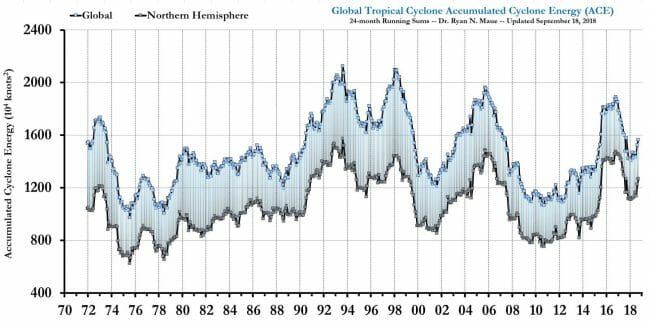
A better metric is accumulated cyclonic energy, a sort of time integral of all large cyclonic storms worldwide.  Here is the most recent ACE figures:

As it turns out, the total strength of hurricane and hurricane-like storms has been falling almost since the exact day of Al Gore’s speech in 2005 (another Gore effect!)  In fact, of late, it has hit numbers close to all-time lows.

Of course this chart will go back up some day, and then back down, and then up … because hurricane activity has always been cyclical over decadal time scales.

The media loves to trumpet end-of-the-world predictions from folks like Al Gore and Paul Ehrlich, but they never go back five years later and back-check their predictions.  And despite their horrendous record for accuracy, the media eagerly publishes the next one.  Here is a proposed editorial rule for the MSM — no breathless publication of anyone’s next prediction without first revisiting the last one.

Manufacturing News to Fit the Narrative

OK, so the Eastern narrative on Arizona is that it is full of a bunch of wacked-out xenophobic conservatives.  And sure, we have our share.  But the NY Times delves into an issue that, living here, I had never even heard of

The massive dust storms that swept through central Arizona this month have stirred up not just clouds of sand but a debate over what to call them.

The blinding waves of brown particles, the most recent of which hit Phoenix on Monday, are caused by thunderstorms that emit gusts of wind, roiling the desert landscape. Use of the term “haboob,” which is what such storms have long been called in the Middle East, has rubbed some Arizona residents the wrong way.

“I am insulted that local TV news crews are now calling this kind of storm a haboob,” Don Yonts, a resident of Gilbert, Ariz., wrote to The Arizona Republic after a particularly fierce, mile-high dust storm swept through the state on July 5. “How do they think our soldiers feel coming back to Arizona and hearing some Middle Eastern term?”

Presumably Yonts also uses some numeric system other than arabic numerals for his math as well.  Seriously, I could mine any community and find some wacko with some crazy idea.  Good journalists are supposed to have some kind of filter on these things to determine if they really are some pressing regional issue.  I live here and I have not heard one word about any such controversy.  But it fits the NY Times caricature of AZ, so they ran with it.

In fact, I think “haboob” has caught on pretty fast because it is a fun sounding name and it is something that is unique to AZ vs. other states.    After living on the Gulf Coast and in tornado alley and on the west coast, it is kind of nice to live in a place where the worst natural disaster you get is a dust tsunami that makes you have to go out and wash your car.

More on Our Dust Storm

I blogged on our dust storm last week.  It was really bizarre to watch it rolling in on us.  It was one of those things that you know intellectually is not really threatening but a steady diet of Stephen King and other authors had some part of my brain wondering if I shouldn’t be driving north at 90MPH to stay ahead of it.

By the way, such storms are called a “haboob”.

Radley Balko linked this time lapse video.

Dust Storm

We get dust storms from time to time here (though not as often as, say, in Eastern Washington, at least from the short experience I had there).  Last night we had a big one, and as usual every surface is covered in dirt.  While it was going on, it looked like a London fog, but with dirt instead of water.

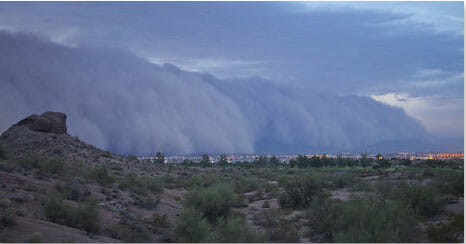
What made this one different for me is that I got to see it roll in from the south.  It was an amazing sight.  It looked like a scene from Steven King’s the Mist, or perhaps from the bottom of a volcano slope watching a pyroclastic flow coming at you.  It reminded me of standing in the streets of Manhattan on 9/11 and watching the cloud of debris coming at us after the first tower fell.  Here is a picture from the AZ Republic of the storm rolling in from the south like a giant tsunami.

Here is a video of it rolling in, which is really cool, if you can ignore the end-is-near typical style of local reporting that has to blow up every odd event into a catastrophe demanding that one tune in at eleven.

Progressives and Capitalism

My Forbes post this week is on progressives and capitalism:

Progressives are often as overwhelmed by the world economy as primitive man was by his natural environment.  Just as the primitive man was confused by and fearful of storms and earthquakes and drought and disease, progressives are befuddled by the rise and fall of industries, booms and recessions, wealth and poverty.  And just as primitive men invented gods and myths to help bring order and a sense of controllability to events they didn’t understand, progressives create governments in the hopes of imposing top-down order on a chaotic economy….

The children of the 1960’s had a number of catch phrases, among them “power to the people.”  The irony is that no system in history has ever empowered individuals as much as has capitalism.  Capitalism is the only way to organize economic activity without the use of force, the only approach that does not require that a few human beings be given power over us to guide our activity from above.  This results in an order that is emergent and bottom-up, as beautiful in its complexity as anything in nature.  And, and order that is as terrifying to progressives as nature was to primitive man.  As a result, progressives would trade it all away, would accept a master, would accept impoverishment and stagnation, in order to attain predictability.

I am sure, if asked, most  progressives would profess to desire iPod’s and cures for cancer.  But they want these without the incentives that drive men to invent them, and the disruption to current markets and competitors and employees that their introduction entails.  They want to end poverty without wealth creation, they want jobs without employers, they want cars without unemployment for buggy whip makers.  When it comes to actual, real-world legislation, progressives will nearly always embrace predictability and egalitarianism over innovation and growth.

Calling BS

Over at Climate Skeptic, I am running a series on flaws in the recently released Global Climate Change Impacts Report (pdf).  I won’t repeat everything over here, and the series is likely to go on for weeks – it is a target-rich environment.

But I thought the folks over here would enjoy the following, wherein I call bullsh*t on a chart that particularly enamored Kevin Drum.

UPDATE:  I obtained more information from the EIA.  My hypothesis below is correct.   Update here.

For this next post, I skip kind of deep into the report because Kevin Drum was particularly taken with the power of this chart from page 58.

electrical-outage

I know that skepticism is a lost art in journalism, so I will forgive Mr. Drum.  But in running a business, people put all kinds of BS analyses in front of me trying to get me to spend my money one way or another.  And so for those of us for whom data analysis actually has financial consequences, it is a useful skill to be able to recognize a steaming pile of BS when one sees it.  (Update: I regret the snarky comment about Kevin Drum — though I disagree with him a lot, he is one of the few folks on either side of the political aisle who is willing to express skepticism for studies and polls even when they support his position.  Mr. Drum has posted an update to his original post after I emailed him this information).

First, does anyone here really think that we have seen a 20-fold increase in electrical grid outages over the last 15 years but no one noticed?  Really?

Second, let’s just look at some of the numbers.  Is there anyone here who thinks that if we are seeing 10-20 major outages from thunderstorms and tornadoes (the yellow bar) in the last few years, we really saw ZERO by the same definition in 1992?  And 1995?  And 1996?  Seriously?  This implies there has been something like a 20-fold increase in outages from thunderstorms and tornadoes since the early 1990’s.  But tornado activity, for example, has certainly not increased since the early 1990’s and has probably decreased (from the NOAA, a co-author of the report):

tornadotrend

All the other bars have the same believability problem.  Take “temperature extremes.”  Anyone want to bet that is mostly cold rather than mostly hot extremes?  I don’t know if that is the case, but my bet is the authors would have said “hot” if the data had been driven by “hot.”  And if this is proof of global warming, then why is the damage from cold and ice increasing as fast as other severe weather causes?

This chart screams one thing at me:  Basis change. Somehow, the basis for the data is changing in the period.  Either reporting has been increased or improved, or definitions have changed, or there is something about the grid that makes it more sensitive to weather, or whatever  (this is a problem in tornado charts, as improving detection technologies appear to create an upward incidence trend in smaller tornadoes where one probably does not exist).   But there is NO WAY the weather is changing this fast, and readers should treat this whole report as a pile of garbage if it is written by people who uncritically accept this chart.

Postscript: By the way, if I want to be snarky, I should just accept this chart.  Why?  Because here is the US temperature anomaly over the same time period (using the UAH satellite data as graphed by Anthony Watt, degrees C):

usa-temp

From 1998 to today, when the electrical outage chart was shooting up, the US was actually cooling slightly!

This goes back to the reason why alarmists abandoned the “global warming” term in favor of climate change.   They can play this bait and switch, showing changes in climate (which always exist) and then blaming them on CO2.  But there is no mechanism ever proposed by anyone where CO2 can change the climate directly without going through the intermediate step of warming.  If climate is changing but we are not seeing warming, then the change can’t be due to CO2. But you will never see that fact in this helpful government propaganda piece.

Warmer and Richer

Over at Climate Skeptic, I discuss a Cato study that finally gets at an issue I have tried to press for years:  That even if one accepts the worst of the IPCC warming scenarios (which I do not) the
cost of CO2 abatement, particularly in terms of lost economic growth, is far
higher than the cost of rising temperatures — ESPECIALLY for the poor. 

Hurricanes are a great example.  The world is probably warming a bit due to man’s CO2, but likely less than the catastrophic rates one sees in the press.  This warming may or may not increase hurricane severity.  But let’s assume it does.  Let’s say Asia faces an extra cyclone or two each year from global warming. 

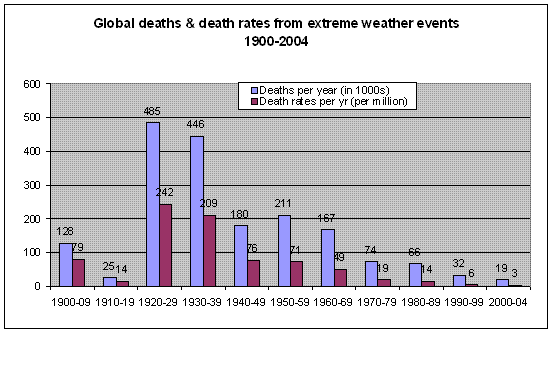
Over time, trends in deaths from hurricanes and severe deaths have shown no correlation with storm frequency or severity.  Death rates from storms track nearly perfectly with wealth:  As wealth has increased in the US, severe storm deaths have dropped to nearly zero;  Where countries are less wealthy, they experience more death.  Bangladesh is not the site of some of the deadliest storms on record because they get hit by the worst storms, but because they are poor.  (figure source)

Figure1

As a result, if we really face this tradeoff (which I doubt) the world still is better off richer with 10 hurricanes than poorer with 8.

The Houston Rabbit Warren

Growing up in Houston, one of the odder parts of the city, even for a local, is the underground tunnel system downtown.  The system was built, I presume, because you can’t even cross the street in the summer time in 100 degree / 100% humidity weather without sweating through your suit coat.  The tunnel system has become quite extensive, such that you can navigate for miles without ever seeing the light of day.  Casual observers often comment on the lack of pedestrian traffic in downtown Houston, but that is perhaps because they never looked under ground.  Over time, underground shopping malls and restaurants and food courts appeared along the tunnels, bringing even more people under ground.

The tunnels are especially difficult to navigate, because there are no visual clues (e.g. we are heading to that building over there) and no signs.  We used to joke people had been lost down there for decades.

Well, the secret is apparently out, as the NY Times has discovered the Houston tunnels.

Seared by triple-digit heat and drenched by tropical storms, midday
downtown Houston appears eerily deserted, the nation’s fourth-largest
city passing for a ghost town.

On the street, that is.

But
below, there are tunnels at the end of the light — nearly seven
color-coded miles of them connecting 77 buildings — aswarm with
Houstonians lunching, shopping and power-walking in dry, air-chilled
comfort….

“Nothing says north, south, east or west. You have to memorize the
buildings,” said David Gerst, a lawyer who opened a lucrative sandwich
shop — BeWitched — off the East McKinney (green) tunnel network under
Commerce Towers, the former Chamber of Commerce building converted to
condominiums. For access to the 3,000 people who stream by his shop
each lunchtime in what tunnel merchants call the holy hours, Mr. Gerst
pays $2,500 a month rent for 800 square feet, more than what surface
lunch space may command.

This is the best part:

It was not centrally planned; it just grew, inspired by Rockefeller
Center in New York. But it is not connected to a transit network. And,
befitting Texans’ distrust of government, most of it is private; each
segment is controlled by the individual building owner who deigns to
allow the public access during business hours — and then locks the
doors on nights and weekends. Some parts, like those belonging to the
former Enron buildings now leased by Chevron, are closed to outsiders
altogether.

Storm Frequency

I already discussed Newsweek’s happy little ad hominem attack on climate skeptics here.  However, as promised, I wanted to talk about the actual, you know, science for a bit, starting from the Newsweek author’s throwaway statement that she felt required no
proof, "The frequency of Atlantic hurricanes has already doubled in the
last century."

This is really a very interesting topic, much more interesting than following $10,000 of skeptics’ money around in a global warming industry spending billions on research.  One would think the answer to this hurricane question is simple.  Can we just look up the numbers?  Well, let’s start there.  Total number of Atlantic hurricanes form the HURDAT data base, first and last half of the last century:

1905-1955 = 366
1956-2006 = 458

First, you can see nothing like a doubling.  This is an increase of 25%.  So already, we see that in an effort to discredit skeptics for fooling America about the facts, Newsweek threw out a whopper that absolutely no one in climate science, warming skeptic or true believer, would agree with.

But let’s go further, because there is much more to the story.  Because 25% is a lot, and could be damning in and of itself.  But there are problems with this data.  If you think about storm tracking technology in 1905 vs. 2005, you might see the problem.  To make it really clear, I want to talk about tornadoes for a moment.

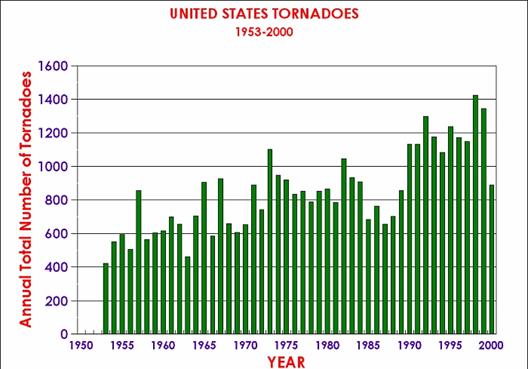
In An Inconvenient Truth, Al Gore and company said that global warming was increasing the number of tornadoes in the US.  He claimed 2004 was the highest year ever for tornadoes in the US.  In his PowerPoint slide deck (on which the movie was based) he sometimes uses this chart (form the NOAA):

Whoa, that’s scary.  Any moron can see there is a trend there.  Its like a silver bullet against skeptics or something.  But wait.  Hasn’t tornado detection technology changed over the last 50 years?  Today, we have doppler radar, so we can detect even smaller size 1 tornadoes, even if no one on the ground actually spots them (which happens fairly often).  But how did they measure smaller tornadoes in 1955 if no one spotted them?  Answer:  They didn’t.  In effect, this graph is measuring apples and oranges.  It is measuring all the tornadoes we spotted by human eye in 1955 with all the tornadoes we spotted with doppler radar in 2000.   The NOAA tries to make this problem clear on their web site.

With increased national doppler
radar coverage, increasing population, and greater attention to tornado
reporting, there has been an increase in the number of tornado reports over the
past several decades. This can create a misleading appearance of an increasing
trend in tornado frequency. To better understand the true variability and trend
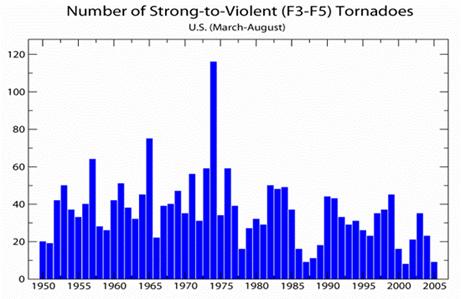
in tornado frequency in the US, the total number of strong to violent tornadoes
(F3 to F5 category on the Fujita scale) can be analyzed. These are the
tornadoes that would have likely been reported even during the decades before
Dopplar radar use became widespread and practices resulted in increasing
tornado reports. The bar chart below indicates there has been little trend in
the strongest tornadoes over the past 55 years.

So itt turns out there is a decent way to correct for this.  We don’t think that folks in 1955 were missing many of the larger class 3-5 tornadoes, so comparing 1955 and 2000 data for these larger tornadoes should be more apples to apples (via NOAA).

Well, that certainly is different (note 2004 in particular, given the movie claim).  No upward trend at all when you get the data right.  I wonder if Al Gore knows this?  I am sure he is anxious to set the record straight.

OK, back to hurricanes.  Generally, whether in 1905 or 2005, we know if a hurricane hits land in the US.  However, what about all the hurricanes that don’t hit land or hit land in some undeveloped area?  Might it be that we can detect these better in 2006 with satellites than we could in 1905?  Just like the tornadoes?

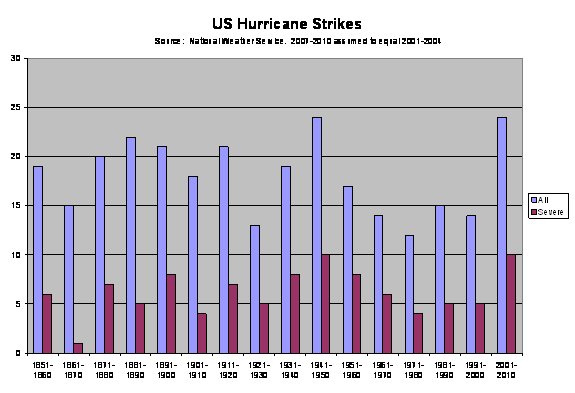
Well, one metric we have is US landfall.  Here is that graph  (data form the National Weather Service — I have just extrapolated the current decade based on the first several years).

Not much of a trend there, though the current decade is high, in part due to the fact that it does not incorporate the light 2006 season nor the light-so-far 2007 season.  The second half of the 20th century is actually lower than the first half, and certainly not "twice as large".  But again, this is only a proxy.  There may be reasons more storms are formed but don’t make landfall (though I would argue most Americans only care about the latter).

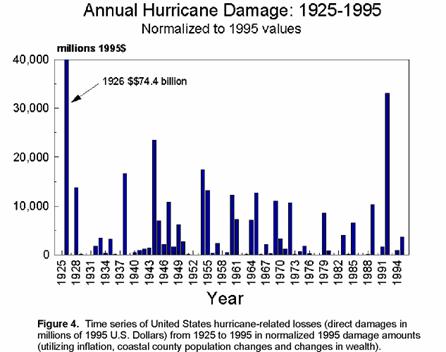
But what about hurricane damages?  Everyone knows that the dollar damages from hurricanes is way up.  Well, yes.  But the amount of valuable real estate on the United State’s coast is also way up.  Roger Pielke and Chris Landsea (you gotta love a guy studying hurricane strikes named Landsea) took a shot at correcting hurricane damages for inflation and the increased real estate value on the coasts.  This is what they got:

Anyway, back to our very first data, several scientists are trying to correct the data for missing storms, particularly in earlier periods.  There is an active debate here about corrections I won’t get into, but suffice it to say the difference between the first half of the 20th century to the latter half in terms of Atlantic hurricane formations is probably either none or perhaps a percentage increase in the single digits (but nowhere near 100% increase as reported by Newsweek).

Debate continues, because there was a spike in hurricanes from 1995-2005 over the previous 20 years.  Is this anomalous, or is it similar to the spike that occurred in the thirties and forties?  No one is sure, but isn’t this a lot more interesting than figuring out how the least funded side of a debate gets their money?  And by the way, congratulations again to MSM fact-checkers.

My layman’s guide to skepticism of catastrophic man-made global warming is here.  A shorter, 60-second version of the best climate skeptic’s arguments is here.

Update:  If the author bothered to have a source for her statement, it would probably be Holland and Webster, a recent study that pretty much everyone disagrees with and many think was sloppy.  And even they didn’t say activity had doubled.  Note the only way to get a doubling is to cherry-pick a low decade in the first half of the century and a high decade in the last half of the century and compare just those two decades — you can see this in third paragraph of the Scientific American article.  This study bears all the hallmarks — cherry picking data, ignoring scientific consensus, massaging results to fit an agenda — that the Newsweek authors were accusing skeptics of.

Update #2:  The best metric for hurricane activity is not strikes or numbers but accumulated cyclonic energy.  Here is the ACE trend, as measured by Florida State.  As you can see, no upward trend.

6a00e54eeb9dc1883400e553bfddf188338

Someone Check the Thermostat! Part 2

In the past, I have argued that it is odd that climate scientists ignore the changes in solar activity in their models.  Despite the fact the sun’s activity is at a very high level (vs. the past several hundred years) the most recent IPCC report says they think that earth’s temperatures would have fallen in the 20th century absent anthropogenic effects.  So then why is this happening:

Mars is being hit by rapid climate change and it is happening so fast that the red planet could lose its southern ice cap,
writes Jonathan Leake.

Scientists from Nasa say that Mars has warmed by about 0.5C
since the 1970s. This is similar to the warming experienced on Earth
over approximately the same period.

Since there is no known life on Mars it suggests rapid changes in planetary climates could be natural phenomena.

The
mechanism at work on Mars appears, however, to be different from that
on Earth. One of the researchers, Lori Fenton, believes variations in
radiation and temperature across the surface of the Red Planet are
generating strong winds.

In
a paper published in the journal Nature, she suggests that such winds
can stir up giant dust storms, trapping heat and raising the planet’s
temperature.

Almost every planet in the Solar System has been found to be warming over the last several decades.  At what point do we turn our attention, at least in part, to Mr. Sun?  (Hat tip Q&O Blog)

British Censors Rewriting… the Future?

Government censors often try to rewrite the past, but Reason’s Hit and Run passes on this funny story of British attempts to rewrite the future:

Britain’s Meteorological Office has instructed forecasters to describe the
country’s damp, dismal, seasonal-affect-disorder-inducing, godawful weather in
Bob Rossian terms:

Prolonged sunshine is expected under new "positive" forecast
guidelines issued by the Meteorological Office…

There is no need to dwell on a "small chance of showers" when "mainly dry"
tells a better story. If there are "localised storms" then it must be "dry for
most". Clouds over Manchester mean generally clear visibility for motorway
drivers

I don’t know what the Brits are complaining about in a forecast such as "small chance of showers".  In the States, the same forecast would be communicated as "huge, civilization ending storm approaching – details at 11".  When I lived in St. Louis, I remember that the local news successfully predicted 11 of the last 3 snowstorms.

Update:  I appears that the media has also been reporting 11 of the last 3 murders:

Five weeks after Hurricane Katrina laid waste to New Orleans, some local, state
and federal officials have come to believe that exaggerations of mayhem by
officials and rumors repeated uncritically in the news media helped slow the
response to the disaster and tarnish the image of many of its
victims.

Claims of widespread looting, gunfire directed at helicopters and
rescuers, homicides, and rapes, including those of "babies" at the Louisiana
Superdome, frequently turned out to be overblown, if not completely untrue,
officials now say.

The sensational accounts delayed rescue and evacuation efforts already hampered
by poor planning and a lack of coordination among local, state and federal
agencies. People rushing to the Gulf Coast to fly rescue helicopters or to
distribute food, water and other aid steeled themselves for battle. In
communities near and far, the seeds were planted that the victims of Katrina
should be kept away, or at least handled with extreme caution.

I had my own commentary about media malpractice here.

This is Sick

The town of New London, CT, is assessing nearly 5 years back rent on Susette Kelo and other property holders whose land the Supreme Court recently allowed the city to confiscate.  As it stands, if New London has its way, Kelo will not only lose her house, she will also be wiped out financially, all for the crime of owning the land where New London wanted condos and hotels.

The U.S. Supreme Court recently found that the city’s original seizure of
private property was constitutional under the principal of eminent domain, and
now New London is claiming that the affected homeowners were living on city land
for the duration of the lawsuit and owe back rent. It’s a new definition of
chutzpah: Confiscate land and charge back rent for the years the owners fought
confiscation.

In some cases, their debt could amount to hundreds of thousands of dollars.
Moreover, the homeowners are being offered buyouts based on the market rate as
it was in 2000...

The New London Development Corp., the semi-public organization hired by the
city to facilitate the deal, is offering residents the market rate as it was in
2000, as state law requires. That rate pales in comparison to what the units are
now worth, owing largely to the relentless housing bubble that has yet to burst.

"I can’t replace what I have in this market for three times [the 2000
assessment]," says Dery, 48, who works as a home delivery sales manager for the New London Day . He soothes himself with humor:
"It’s a lot like what I like to do in the stock market: buy high and sell low."

And there are more storms on the horizon. In June 2004, NLDC sent the seven
affected residents a letter indicating that after the completion of the case,
the city would expect to receive retroactive "use and occupancy" payments (also
known as "rent") from the residents.

In the letter, lawyers argued that because the takeover took place in 2000,
the residents had been living on city property for nearly five years, and would
therefore owe rent for the duration of their stay at the close of the trial. Any
money made from tenants, some residents’ only form of income, would also have to be
paid to the city….

An NLDC estimate assessed Dery for $6,100 per month since the takeover, a
debt of more than $300K. One of his neighbors, case namesake Susette Kelo, who
owns a single-family house with her husband, learned she would owe in the
ballpark of 57 grand. "I’d leave here broke," says Kelo. "I wouldn’t have a home
or any money to get one. I could probably get a large-size refrigerator box and
live under the bridge."

I want to barf.  Hat tip to Reason’s Hit and Run.

This Was Inevitable – Environmentalists Try To Blame Tsunami on Global Warming

Global warming advocates are already trying to make hay from the recent tsunami disaster (via Reuters, who else)

"Global Warming, Pollution Add to Coastal Threats"

Creeping rise in sea levels tied to global warming, pollution and damage to coral reefs may make coastlines even more vulnerable to disasters like tsunamis or storms in future, experts said on Monday.

Of course it says "may…in the future", but advocates want you to believe that the death toll is due in part to global warming.  Forget of course that the world has yet to see any rises in ocean level (presumably due to melting ice somewhere) or that the basic disaster mechanism of earthquake causing tidal wave has nothing, zero, nada to do with climate.

The argument that clearing mangrove swamps may make a tsunami worse may or may not be true to some extent, but this is only a secondary effect.  The primary, by far, human activity that affected the death toll is the desire by humans to live on the coast.  Unless you want to change this (and I would bet that a disproportionate number of the world’s environmentalists make this same personal choice to live on the coast) it does not really matter if there are mangroves or not.

Ironically, the primary way to avoid such disasters is not by reversing human technology (as global warming activists want to do), but by increasing it, in the form of warning systems and evacuation routes.  Global warming advocates actually want to keep everyone poor – they blame wealth and progress for global warming, but note that wealthy countries like the US (the global warming great Satan) has had the technology and the wealth to afford to put systems in place that would have prevented such a huge death toll.  Wealth, prosperity and technology are what would have averted this disaster, and it is just these things that global warming advocates oppose for Southeast Asia.  So here is my alternate headline and first paragraph:

"Poverty, Lack of Technology add to Coastal Threats"

The creeping influence of global warming advocates and treaties that are limiting 3rd world growth and prosperity may make coastlines even more vulnerable to disasters like tsunamis or storms in future, experts said on Monday.