Posts tagged ‘stimulus’

Where Did the Last Batch Go?

Obama and the Left want a big new infrastructure spending bill, based on twin theories that it would be a) stimulative and b) a bargain, as needed infrastructure could be built more cheaply with construction industry over-capacity.

Since this is exactly the same theory of the stimulus four years ago, it seems a reasonable question to ask:  What happened to the damn money we spent last time?  We were sold a 3/4 of a trillion dollar stimulus on it being mostly infrastructure.  So where is it?  Show us pictures, success stories.  Show us how the cost of construction of these projects were so much lower than expected because of construction industry over-capacity.  Show us the projects selected, to demonstrate how well thought-out the investment prioritization was.  If their arguments today have merit, all these things must be demonstrable from the last infrastructure bill.  So where is the evidence?

Of course, absolutely no one who wants to sell stimulus 2 (or 3?) wants to go down the path of investigating how well stimulus 1 was spent.  Instead, here is the argument presented:

Much of the Republican opposition to infrastructure spending has been rooted in a conviction that all government spending is a boondoggle, taxing hard-working Americans to give benefits to a favored few, and exceeding any reasonable cost estimate in the process. That's always a risk with new spending on infrastructure: that instead of the Hoover Dam and the interstate highway system, you end up with the Bridge to Nowhere and the Big Dig.

In that sense, this is a great test of whether divided democracy can work, and whether Republicans can come to the table to govern. One can easily imagine a deal: Democrats get their new infrastructure spending, and Republicans insist on a structure that requires private sector lenders to be co-investors in any projects, deploying money based on its potential return rather than where the political winds are tilting.

This is bizarre for a number of reasons.  First, he implies the problem is that Republicans are not "coming to the table to govern"  In essence  then, it is up to those who criticize government incremental infrastructure spending (with a lot of good evidence for believing so) as wasteful to come up with a solution.  Huh?

Second, he talks about requiring private lenders to be co-investors in the project.  This is a Trojan horse.   Absurd projects like California High Speed Rail are sold based on the myth that private investors will step in along side the government.  When they don't, because the project is stupid, the government claims to be in too deep already and that it must complete it with all public funds.

Third, to the extent that the government can sweeten the deal sufficiently to make private investors happy, the danger of Cronyism looms large.  You get the government pouring money into windmills, for example, that benefits private investors with a sliver of equity and large manufacturers like GE, who practically have a hotline to the folks who run programs like this.

Fourth, almost all of these projects are sure to be local in impact - ie a bridge that helps New Orleans or a street paving project that aids Los Angeles.  So why are the Feds doing this at all?  If the prices are so cheap out there, and the need for these improvements so pressing, then surely it makes more sense to do them locally.  After all, the need for them, the cost they impose, and the condition of the local construction market are all more obvious locally than back in DC.  Further, the accountability for money spent at the Federal level is terrible.  There are probably countless projects I should be pissed off about having my tax money fund, but since I don't see them every day, I don't scream.  The most accountability exists for local money spent on local projects.

Bizarre Alternate Reality

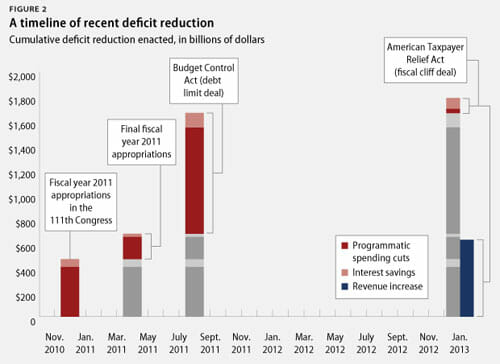
Kevin Drum is claiming that the government has already done much fine work on deficit reduction, reducing spending by $1.8 trillion and increasing taxes by $600 billion.

This is fantasy, pure and simple, and perhaps why the term "reality-based community" has fallen out of favor among Progressives.   There has been and will likely be no reduction in spending -- these "spending cuts" are merely reductions in spending growth rates from the Administration's initial wet dream spending proposals. I am sure the tax increases are probably real, but Obama and the Congress were already proposing to spend most of those in new stimulus and other boondoggles right in the end of year tax legislation.

The tax numbers are characteristic of the stupid budget games played by both parties.   For example, the recent tax law represents a tax increase over law in place on 12/31/2012, but represents a massive tax cut vs. law set to be in place on 1/1/2013.  This gives the administration cover to call it both!  When it wants to portray itself as a deficit hawk, as in this case, it was a tax increase.  When it wants to portray itself as being populist, it was a tax cut.

Charts like this are absolutely worthless.  We will likely get deficit reduction over the next few years, but it will be entirely due to rising tax revenues from an improving economy.

And here we are back to my constant theme -- if you want to posit a trend, then show the trend.

The Perfect Keynesian Stimulus

Hardcore Keynesian theory says that even paying someone to dig a hole one day and fill it in the next is stimulative.  This has always seemed insane to me -- how could it possibly be a net gain in growth and wealth to shift resources from productive activities to unproductive ones?  But in line with this theory, the Keynesians in the Obama Administration have hit on the perfect stimulus:

A cargo train filled with biofuels crossed the border between the US and Canada 24 times between the 15th of June and the 28th of June 2010; not once did it unload its cargo, yet it still earned millions of dollars... The companies “made several million dollars importing and exporting the fuel to exploit a loophole in a U.S. green energy program.” Each time the loaded train crossed the border the cargo earned its owner a certain amount of Renewable Identification Numbers (RINs), which were awarded by the US EPA to “promote and track production and importation of renewable fuels such as ethanol and biodiesel.”

Whole thing here

Words That Have Been Stripped of Any Meaning: "Spending Cuts" and "Austerity"

I have already written that the supposed European austerity (e.g. in the UK) is no such thing, and "austerity" in these cases is being used to describe what is merely a slowing in spending growth.

Apparently the same Newspeak is being applied to spending cuts in the US.  How else  can one match this data:

With these words from President Obama (my emphasis added)

"If we're going to raise revenues that are sufficient to balance with the very tough cuts that we've already made and the further reforms in entitlements that I’m prepared to make, then we’re going to have to see the rates on the top two percent go up"

Seriously?  The only small reductions in the budget were because some supposedly one-time expenses (like TARP bailouts, war costs, and stimulus spending) were not repeated.  Allowing one-time costs to be, uh, one-time does not constitute "tough cuts."

Tough cuts are when we knock government spending back down to 19-20 percent of GDP.  Clinton level spending in exchange for Clinton tax rates.   That's my proposed deal.

On Private Job Creation, Obama and Reagan are Tied

Obama claims to have created more jobs than Reagan.  Republicans fire back with charts that say otherwise.

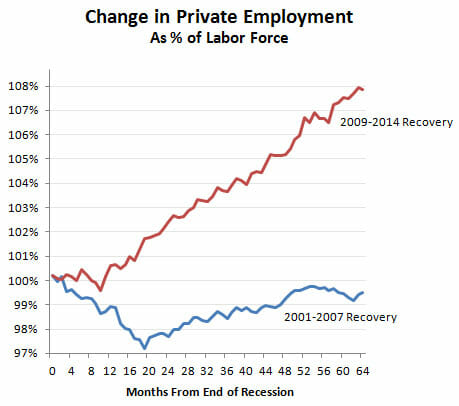
Here are the true numbers for private jobs created by these Presidents in office:

  • Reagan:    zero
  • Obama:     zero

Just once I would like to see a Presidential candidate answer:

"Why, I didn't create a single private job in office.  Anyone I hire is by definition a public employee.  The best I can do is to keep government out of the way, as much as possible, of the private individuals who do create new businesses and new products and new technologies that tend to lead to more private employment.  The worst thing I can do is to try to be investment-banker-in-chief.  Every dollar I hand to some company I like is money taken out of the hands of 300 million private individuals, who collectively know a hell of a lot more than I as to what makes for a better business investment  (and by the way they have far better incentives that I as well, since they are investing their own hard-earned money, and should I develop the hubris to play the stimulus game, I would be investing your hard-earned money."


"Abnormal" Events -- Droughts and Perfect Games

Most folks, and I would include myself in this, have terrible intuitions about probabilities and in particular the frequency and patterns of occurance in the tail ends of the normal distribution, what we might call "abnormal" events.  This strikes me as a particularly relevant topic as the severity of the current drought and high temperatures in the US is being used as absolute evidence of catastrophic global warming.

I am not going to get into the global warming bits in this post (though a longer post is coming).  Suffice it to say that if it is hard to accurately directly measure shifts in the mean of climate patterns given all the natural variability and noise in the weather system, it is virtually impossible to infer shifts in the mean from individual occurances of unusual events.  Events in the tails of the normal distribution are infrequent, but not impossible or even unexpected over enough samples.

What got me to thinking about this was the third perfect game pitched this year in the MLB.  Until this year, only 20 perfect games had been pitched in over 130 years of history, meaning that one is expected every 7 years or so  (we would actually expect them more frequently today given that there are more teams and more games, but even correcting for this we might have an expected value of one every 3-4 years).  Yet three perfect games happened, without any evidence or even any theoretical basis for arguing that the mean is somehow shifting.  In rigorous statistical parlance, sometimes shit happens.  Were baseball more of a political issue, I have no doubt that writers from Paul Krugman on down would be writing about how three perfect games this year is such an unlikely statistical fluke that it can't be natural, and must have been caused by [fill in behavior of which author disapproves].  If only the Republican Congress had passed the second stimulus, we wouldn't be faced with all these perfect games....

Postscript:  We like to think that perfect games are the ultimate measure of a great pitcher.  This is half right.  In fact, we should expect entirely average pitchers to get perfect games every so often.  A perfect game is when the pitcher faces 27 hitters and none of them get on base.  So let's take the average hitter facing the average pitcher.  The league average on base percentage this year is about .320 or 32%.  This means that for each average batter, there is a 68% chance for the average pitcher in any given at bat to keep the batter off the base.  All the average pitcher has to do is roll these dice correctly 27 times in a row.

The odds against that are .68^27 or about one in 33,000.  But this means that once in every 33,000 pitcher starts  (there are two pitcher starts per game played in the MLB), the average pitcher should get a perfect game.  Since there are about 4,860 regular season starts per year (30 teams x 162 games) then average pitcher should get a perfect game every 7 years or so.  Through history, there have been about 364,000 starts in the MLB, so this would point to about 11 perfect games by average pitchers.  About half the actual total.

Now, there is a powerful statistical argument for demonstrating that great pitchers should be over-weighted in perfect games stats:  the probabilities are VERY sensitive to small changes in on-base percentage.  Let's assume a really good pitcher has an on-base percentage against him that is 30 points less than the league average, and a bad pitcher has one 30 points worse.   The better pitcher would then expect a perfect game every 10,000 starts, while the worse pitcher would expect a perfect game every 113,000 starts.  I can't find the stats on individual pitchers, but my guess is the spread between best and worst pitchers on on-base percentage against has more than a 60 point spread, since the team batting average against stats (not individual but team averages, which should be less variable) have a 60 point spread from best to worst. [update:  a reader points to this, which says there is actually a 125-point spread from best to worst.  That is a different in expected perfect games from one in 2,000 for Jared Weaver to one in 300,000 for Derek Lowe.  Thanks Jonathan]

Update:  There have been 278 no-hitters in MLB history, or 12 times the number of perfect games.  The odds of getting through 27 batters based on a .320 on-base percentage is one in 33,000.  The odds of getting through the same batters based on a .255 batting average (which is hits but not other ways on base, exactly parallel with the definition of no-hitter) the odds are just one in 2,830.  The difference between these odds is a ratio of 11.7 to one, nearly perfectly explaining the ratio of no-hitters to perfect games on pure stochastics.

My Favorite Line of the Day

In a report from the DOE Inspector General, which said that $500,000 of equipment bought with stimulus money was missing at a battery company:

 “It would not be appropriate to release the name of stimulus-money recipient where the $500,000 worth of equipment could not be located.”

But it is A-OK to excoriate by name any number of corporations that create value legally if doing so advances this Administration's re-election prospects.

If You Disagree With My Economic Policies, It Must Be Because You Are Trying to Wreck the Economy

Kevin Drum is back on his "because Republicans won't agree to more massive deficit spending, they must be purposefully trying to destroy the economy."   Literally.  He translates Republican opposition to Obama's proposed stimulus packages as being explained by this strategy:

Basically, the Republican strategy for the past three years has been this:

  1. Do everything humanly possible to prevent the economy from recovering.
  2. Wait for 2012.
  3. Run a campaign focused on the fact that the economy is lousy.

This is such a shabby bit of false logic it is amazing anyone even attempts this any more, or more accurately, it's amazing that folks continue to buy it.  Is it really so impossible to believe that there are actually people of goodwill who wish to see the economy improve but disagree with Drum and Obama as to the correct course to achieve that?  Apparently not  (I suppose the last stimulus was so wildly succesful that it is impossible to doubt the success of another trillion or so of deficit spending?)

The irony is that for some reason I simply cannot fathom, from a political tactics point of view, he points to this chart when talking about Truman and his "do-nothing" Congress:


He's is trying to make some political tactical point, but he is so blinded by his own assumptions that he misses the real point -- that the American economy grew at records rates through a "do-nothing" Congress.  Now, I suppose Drum might argue that this was an accident of timing, but in fact Truman inherited what should have been, by Drum's Keynesian thinking, the worst economic situation ever since an enormous amount of government spending was going away after the war and new workers were simultaneously flooding back into the job market.  If any time in recent history should have demanded Keynesian stimulus, this was it, and yet a do-nothing Congress led to a massive expansion.  Hmmmm.

Thinking About Greece

Mike Rizzo writes:

A typical sovereign government can secure funds from three “legitimate” places.*What are these sources?

  1. Taxes today.
  2. Taxes tomorrow. In other words we can borrow money today in order to build our bridge and then use future tax revenues to pay for the debt tomorrow. By the way, if the government is in the business of actually producing valuable “public goods” then you can easily think of this as value enhancing.
  3. Printing money. It’s not generally done this way, but in effect the monetary authorities can monetize the borrowing of a sovereign entity (how they do it is beyond the scope of this post). For simplicity, imagine instead that a central bank prints new bank notes from scratch, hands them to the Treasury, and then the Treasury spends them on goods and services. This is just another form of a tax, again beyond the scope of this post.

So, this is what the government budget identity looks like for “normal” countries:

G = T + the change in debt + the change in base money

I think this is a useful simplification, but I wanted to add a couple other refinements  (refinements by the way he did not neglect in his text, just did not put in the formula).  One other source of funds we have seen in Greece is what I would call Aid, which used to be humanitarian aid (think India in the 1970s) but today tends to be bailout money and debt forgiveness.  So we will write the equation

G = Taxes + ΔDebt  + Money Printing + Aid

But due to the Keynesian orientation of many commenters on the Greek and European situation, it becomes useful to expand the "taxes" term into some sort of base income, which I will just call GDP for simplicity, and some sort of tax rate t.  So then we get:

G = GDP x t + ΔDebt  + Money Printing + Aid

The Greeks can't print money (unless the EU does it for them) and at the moment no one in their right mind will lend to them without guarantees from stronger European countries (e.g. Germany).  If we call EU money printing for Greece or EU loan guarantee programs Aid, we get

G = GDP x t + Aid

As Rizzo noted, aid is drying up and Greek tax revenues are going down rather than up, so basically they are screwed.  The only out seems to be for Greece to exit the Euro and then, once on the drachma again, print money like crazy and inflate their way out of the debt.

But expanding the tax term reveals one more policy alternative that is being suggested.   Keynesians seem to believe there is a path out of this situation in Greece (or if Greece is too far gone, certainly in Italy and Spain) where money from some source  (aid, borrowing, whatever) is spent in the economy by the government in some way that is stimulative, thus increasing GDP and therefore taxes and allowing Greece to increase the money available to the government.  Since Aid is currently only be granted tied to "austerity" programs rather than stimulative spending, they feel Germany et al are following exactly the wrong course.

I am incredibly skeptical of this for two reasons, beyond just my general skepticism of Keynesian stimulus.  First, I have heard something akin to this in my personal experience.  For a short time in my life, during the Internet crazy period, I was brought in by some investors to look at their portfolio of languishing Internet plays (e.g. discountshoelaces.com)* and decide if they should keep pouring money in or shut down.  The plan I got from management was always - always - this stimulus approach.  They suggested that rather than cut back, the investors should give them a bunch of new money to really blow out the marketing effort, which would kick start their growth, etc. etc.

The problem was that they never, ever had a lick of evidence beyond just hope that the next $1 million would suddenly do what the last $10 million failed to do.  So we shut most of these efforts down.  Your first loss is your best loss, as they say.

Similarly, I don't think Keynesians can point to any example in history where this actually worked.   A country is drowning in debt, but suddenly a Hail Mary play of adding a huge chunk more to the debt and spending it on civil service worker salaries suddenly turned the tide.  Seriously, do people honestly think this will work?  Or are they just frustrated because they grew up with an assumption that there is always a public policy answer for everything and there just does not seem to be one here.

I have an emerging hypothesis, not backed by any evidence at this point, that the value of the Keynesian multiplier shifts as debt to total GDP increases.  I am not sure in actual practice it is ever above one, but if it were to be above 1 at 20% debt to GDP, it certainly is not going to be the same at, say, 150%.
OMG, Austerity!

via here

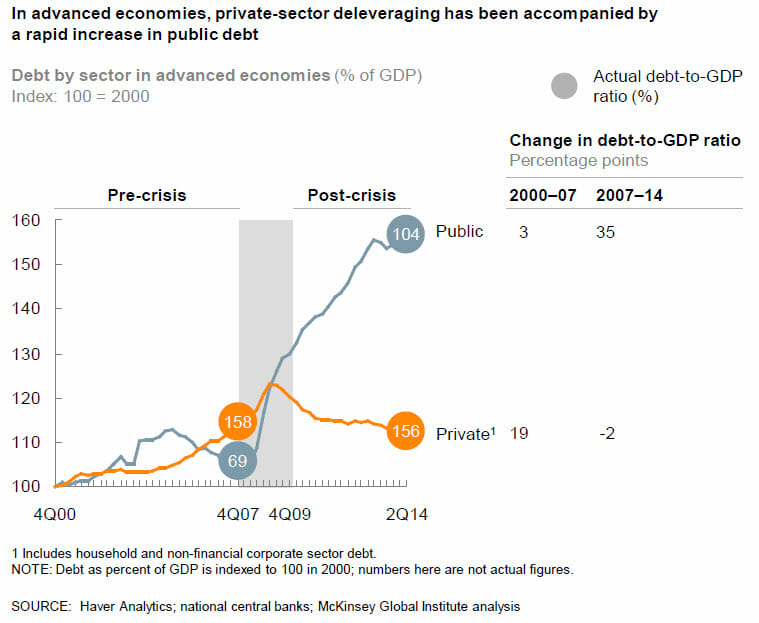
The UK line is particularly interesting, since that is the country that Krugman has declared is austerity-izing itself into a depression. As I have pointed out before, real government spending in UK has been and is still rising.  The percent of GDP of this spending has fallen a bit, but there is nothing about Keynesian stimulus theory that says changes in the percentage of government spending is stimulative, only its absolute value.

Here is one thing I would love to here Krugman et. al. opine on -- at what percentage of government debt to GDP does additional deficit spending become counter-stimulative.   I imagine there is an inverse relationship for deficit-funded stimulus, such that it has a larger effect at lower debt levels with a zero to negative effect at higher interest levels.

Update:  From another source, here is the UK in real $

Can I Have Some of Those Drugs?

Kevin Drum apparently believes the reason Republicans are not passing further stimulus spending is because such a stimulus would be too likely to have immediate results improving the economy and thus will help Democrats in the next election.

This is the kind of politcal bullshit that drives me right out of the system.  I am perfectly capable of believing Drum honestly thinks that further deficit spending will improve the economy this year.  I think he's nuts, and working against all historic evidence, but never-the-less I believe he is sincere, and not merely pushing the idea as part of some dark donkey-team conspiracy.  Why is it that he and his ilk, from both sides of the aisle, find it impossible to believe that their opponents have similarly honest intentions?

I mean, is it really so hard to believe -- after spending a trillion dollars to no visible effect, after seeing Europe bankrupt itself, and after seeing the American economy begin to recover only after crazy stimulus programs have mostly stopped -- that some folks have an honest desire to see economic improvement and think further stimulus programs are a bad idea?

Science and Politics

Matt Welch's description of science and politics strikes a chord

Even more interesting than the soft consensus in favor of government intervention was a strong undercurrent that those who disagreed with it were guilty of denying basic truths. One of the questions from an audience full of Senate staffers, policy wonks, and journalists was how can we even have a rational policy discussion with all these denialist Republicans who disregarded Daniel Patrick Moynihan’s famous maxim that “Everyone is entitled to his own opinion, but not his own facts”? Jared Bernstein couldn’t have been more pleased.

“I feel like we’re in a climate in which facts just aren’t welcome,” he said. “I think the facts of the case are that we know what we can do to nudge the unemployment rate down.…I think the consensus among economists is that this is a good time to implement fiscal stimulus that would help create jobs and make the unemployment rate go down. I consider that a fact.”

In science, you insist most loudly on a fact based on how much it has withstood independent peer review. In politics, it’s closer to the opposite—the more debatable a point is, the more it becomes necessary to insist (often in the face of contrary evidence) that the conclusion is backed by scientific consensus

Stimulus Accounting Still Meaningless

Via Hit and Run, this can't be said too many times

according to the CBO’s top official, the figures in this report and previous mandatory stimulus don’t actually tell us whether or not the stimulus created jobs. That’s because, as  I’venotedsomanytimesbefore, the reports rerun slightly updated versions of the same models of that were used to estimate that the stimulus would create jobs prior to the law’s passage. And lo and behold, if you create a model that predicts the law will create jobs, and then you rerun a mild variation of that model a few years later using updated figures about what money was actually spent, it still reports that the stimulus created jobs. But there’s no counting here, no real-world attempt to assess the reality of the stimulus—just a model that assumes that stimulus spending will create jobs and therefore reports that stimulus spending has in fact created jobs. As CBO director Douglas Elmendorf confirmed on the record last year in response to a question, “if the stimulus bill did not do what it was originally forecast to do, then that would not have been detected by the subsequent analysis.”

Further, the fact that we can count individual jobs in stimulus programs (of which there are all too few, which is why the Administration doesn't do this), we still have to take into account an offset effect.  The trillion dollars came from somewhere, and in effect were diverted from private to public hands.  To justify the stimulus, one needs to be able to argue that the public use of these funds created more jobs than the private use of these funds.  Good luck with that.

Wow

Holly Fretwell of PERC discusses the huge leap in agricultural yields since WWII

Not only does this mean that we have have billions of people on Earth and not starve, but it also has freed up labor for more productive and value-enhancing activities.

As an aside, remember this chart when global warming alarmists argue the the warming trend of the last 50 years is reducing crop yields.  (If the linked article seems simply bizarre given the chart above, realize the NYT is saying that crop yields are down from what they might have been.  This is the same kind of faulty logic that was used by Obama to credit his stimulus with job gains when in fact the economy was losing jobs.  They posit some unproveable hypothetical, and then say reality diverged from that hypothetical because of whatever factor they are trying to push, whether it be CO2 or stimulus).

The problem with food prices is not production, its the fact that we take such a huge percentage of our food grains and, by government dictat, convert them to automotive fuel.

Mind of the Statist

David Roberts (via Kevin Drum) gives us a simply outstanding view of the mind of a statist:

In these grim economic times, one U.S. industry has defied gravity. Not only is it growing, it's thefastest growing industry in the country. It now employs 100,000 Americans at 5,000 mostly small businesses spread across all 50 states. Unlike in so many others, in this industry the U.S. has a positive trade balance with China; it is a net exporter of high-tech manufactured products....

The startling counter-cyclical growth of this industry had been unleashed by a modest bit of economic stimulus: a cash grant program that helps project developers compensate for the crippling credit crunch. In contrast to the familiar tax credits -- which tend to go to large, mature companies that have enough profit to benefit from them -- cash grants help small, innovative, growing businesses that are plowing revenue into growth. In fact, a recent study found that they work twice as well as tax credits. In 2009, this cash grant program pulled in $4.50 of private capital for every public dollar it invested.

The cash grant program expires at the end of the year. Extending it for a single year could support 37,000 additional jobs over and above the industry's baseline. And here's the capper: Since the cash grant program is simply repurposing money that's already devoted to a tax credit program, it requires no new federal revenue.

So you'd think this would be a home run, right? At a time when jobs are at the top of every politician's mind, surely a bit of low-cost economic stimulus that doesn't increase the deficit and leverages tons of private capital and creates tens of thousands of jobs can serve as the rare locus of bipartisan cooperation. Right?

Except the industry in question is the solar industry. And because this industry involves clean energy rather than, I dunno, tractor parts, it has been sucked into conservatives' endless culture war. Rather than lining up to support the recession's rare economic success story, Republicans are trying to use the failure of a single company -- Solyndra -- as a wedge to crush support for the whole industry. Odds are they're going to succeed and the cash grant program (Sec. 1603) won't be renewed next year.

Do you see the basic assumption -- if we don't take money from taxpayers and give it to businesses in a certain industry, that means we don't like that business.  Really?  That means that there is not a single industry in this country that I like, since I don't support subsidies for any of them.   Unless you believe the state is mother and father to us all, the fact that I don't support state subsidies does not mean that I don't like the industry somehow.  Kevin Drum even goes so far as to say that opposition to solar power subsidies is an aspect of the culture wars.  Huh?   Oh and by the way, the politicization of this loan process is just amazing to me.  More and more people at Solyndra seem to be fund raisers for Obama, and here is a story of how a cleaning products company turned donations to Democratic candidates into taxpayers subsidies for themselves.

It is interesting that he would mention tractor parts.  Guess what, folks who don't like the solar subsidies probably don't support subsidies for tractor parts either.  I was going to say something like, "guess what, we don't subsidize tractor parts" but in our screwed up corporate state, we probably do at some level, like with some special export program snagged by a John Deere lobbyist.  But I can pretty much guarantee that we don't subsidize anywhere near the total value of the tractor parts industry like we do the solar industry.

In one silly passage, he says

"In addition to being successful, this industry is wildly popular with the American public, across regions, demographics, and political parties. It has been embraced by mainstream institutions from Walmart to the U.S. military"

I could say the same thing for iPods too, but no one is rushing to provide grant programs for their manufacture.  If it is so wildly popular, why does its use require so many government incentives and subsidies.  Because the author pulls the trick of looking at one narrow solar program, and attributing the entire solar industry growth to that one program.  And then he says, see, look how much benefit we get from this tiny sensible expenditure.

But solar's growth (I don't have the data, but I am willing to be real money that his "fastest growing industry" claim is BS) is due not to just this tiny programs but to a plethora of federal, state, and local subsidies and mandates.  The government gives money to capitalize companies, and then then provides tax credits for up to 30-50% of their customer's purchase, and then through public utility commissions enforce above-market feed-in tariff rates for solar power.  One reason we export so much (the export market for US solar is nearly entirely to Europe) is that European governments have feed-in tariffs for solar power more than 5 times higher than the market rate for electricity.   They are paying something like 70 cents a kilowatt for solar electricity.

So of course solar is growing.  If the government were to buy small cars for $150,000 each, there would be big growth in car manufacturing. This does not mean the product makes sense -- in fact, the necessity for so many government supports at every step of the process means almost by definition that it does not make sense economically.  Look at corn ethanol.  Corn ethanol is the stupidest product ever, but it has grown like crazy due to the same combination of government subsidies, price floors, and mandates.

By the way, I am a huge fan of solar, in theory.  I honestly think that solar will some day be the power system of choice in this country, as companies figure out how to roll solar sheets out of the factory as cheaply and quickly as carpet comes out of Dalton, Georgia.  We are not there yet, and I am not at all convinced that the current approaches are anything but dead end technologies.  Beyond wasting a lot of money, there is a real risk the government actually slow ultimate implementation of sensible and economic solar, just as I would argue they did by forcing manned space flight and the transcontinental railroad ahead of their time.

Shopping with Maxed Out Credit Cards

My Forbes column is up this week and it presents some quick reactions to the Obama jobs speech last night.  A brief excerpt:

Overall, I found the package to be an incredible mish-mash of already tried and failed steps to rejuvenate the economy.   Even if I were to buy into the Keynesian stimulus logic, everything in this package is so under-scale as to be rounding errors on the larger economy.  This is basically a smaller version of the last failed stimulus repeated.

This plan is absolutely in the Obama style, offering goodies to many constituencies without a hint of how they will be paid for.  Presidents often offer a chicken in every pot when they are campaigning, but usually are forced into reality once they enter office.  Not Barack Obama.  Time and again, from health care to the most recent budget fight and last night’s speech, Obama wants to be loved for offering perks, and then wants someone else to take the fall for the unpopular steps required to pay for them.  He is like grandma endearing herself to the grandkids by buying them Christmas presents on dad’s maxxed out credit cards, leaving dad to later figure out later how to pay for them or face the ire of the kids by returning the gifts.

You've Blown Your Trust

Ezra Klein via Kevin Drum asks, fairly reasonably, why with very low US borrowing rates does it not make sense to take infrastructure projects we know we have to do in the next 5-7 years and pull them forward.  If we know we have to rebuild bridge X in 2016, lets do it now when there is so much construction capacity sitting around.

In an idealized Platonic technocratic world that many Lefists still insist on believing we actually live in, trustworthy and knowledgeable agents of the state would work up such a list and we could fund it, happy we have made a good financial decision.  But we don't live in that world, as I wrote in the comments

The reason this does not fly has to do with politician's incentives and trust.  In short, Democrats had their chance to do exactly this.  Two years ago, nearly a trillion dollars of such stimulus was approved and sold to the American people as just this sort of infrastructure spending.

But it was no such thing.  Most of the money went to state and local governments as transfer and stabilization payments to keep unionized government workers, who are reliable Democratic voters, employed.  Congress and the Administration knew that the majority of the public would have been leery about spending it this way, so it was sold as "infrastructure" despite the fact that less than 10%, by my count, could reasonably be called this.

Having sold a trillion dollars of pork, waste and political payoffs as "infrastructure," you should not be surprised that the American public is reluctant to believe that an infrastructure project that just pulls future necessary spending forward is really any such thing.  You have in short blown your trust, which is amazing given just how much of a mandate Obama entered office with.  Note that this is not narrowly a criticism of Democrats, they just happen to be in charge.  No one would trust Republicans either.

And by the way, it takes years to really get infrastructure projects up and running - the environmental reviews and red tape that most of the readers for this site have advocated in favor of for years causes these things to take forever.  Not to mention the engineering and procurement.  Even Obama has admitted that he did not understand that shovel-ready was no such thing, even though many of us warned of exactly this problem the first time around

The money is only "free" in a relative sense if we know we have to spend it anyway in future years.  It is not at all free if we have to take it from some productive private use and redeploy it for some politician's whim that gives him or her a nice bullet point on their re-election web site.  Unfortunately, in the real world we live in, rather than in the technocratic paradise Klein imagines, any such bill will be larded with just such flights of fancy from powerful representatives of both parties.

Update:  Talk about history repreating itself, here is what I wrote in January of 2009.

The infrastructure piece, despite being less than 10% of the bill, allows politicians to call this “investment” and “green energy” and “infrastructure” which sell better with sections of the public than “welfare” and “transfer payments.”  The minority infrastructure pieces allow Congress and Obama to call the bill new and forward looking, rather than the imitation of 1970s legislation that it really is.

Winding Down Debt

via Kevin Drum, personal debt in the US:

One of the problems with the stimulus, in my mind, is that it was aimed at interrupting this process.

Celebrating the Most Recent 5-Year Plan

This sort of thing drives me crazy:

Before 2009, the U.S. was supplying less than 2% of a tiny global market in advanced batteries. When the stimulus-funded factories are all complete, they’ll have the capacity to supply 40% of a rapidly growing global market, about 500,000 batteries a year. The stimulus will also boost our supply of electric-vehicle charging stations by more than 3,000%. And the Obama administration has provided loans to help Tesla, Fisker and Nissan build electric-car factories in the U.S., all part of Obama’s pledge to put 1 million plug-ins on the road by 2015. That is what change looks like, even if the President doesn’t beat his chest and call for mass beheadings on Wall Street while it happens

A few random thoughts

  1. Doesn't this sound like an old Soviet press release about the highlights of their last 5-year plan?
  2. This is a kind of weird economic nationalism that drove a lot of the bad behaviors in the 19th century.  Who cares what percentage of world battery output our country controls?  Don't we just care that there is an adequate supply at good cost from somewhere?  This sounds like chest-thumping for the American Raj.
  3. Left unquestioned is why we should care or be excited.  Consider it this way -- a guy with no business experience is making major investments of our money in companies that were not able to get private investment.  Did you really elect Obama to be venture-capitalist-in-chief?  And if that were truly the President's job descriptions, how many tens of millions of people would you consider more qualified for the job than Obama?  Would you let Obama manage your retirement portfolio for you?
  4. No government investment is at all interesting to me unless I am told what private use of the money was foregone.   All such public investments use money that is taken from private actors and would have been used for some private function.  How many jobs, and what market outcomes, would have occurred if the money had remained in private hands?
  5. Let's see how many Democrats are claiming these successes in a few years when these ventures start going bankrupt.  I expect a lot of this stuff to mysteriously disappear from poloitician's web sites in a few years.
  6. This is the corporate state in spades.  The government creates an industry, and in the future will create protectionist laws for it, and customer subsidies, and bail it out when necessary.  In return, all of its employees and managers know they owe their jobs to the party that sponsored the industry, rather than to any competitive prowess.

James Taggart is Alive and Well

In my Forbes column this week, I publish an essay I wrote for an Americans for Prosperity event commemorating Milton Friedman's birthday.  A brief excerpt:

Having once been successful through excellence, leading businesses typically get lazy and senescent, and become vulnerable to more innovative, lower-cost or more nimble new competitors.  Sears lost its electronics sales to Circuit City, which in turn succumbed to Best Buy, which is now struggling to compete with Wal-Mart, who is being challenged by Amazon.com.

Unfortunately, businesses that were once successful can feel a sense of entitlement, believing that this new competition is somehow unfair, or that consumers are somehow misguided in taking their business elsewhere.  When they have money or political connections, these businesses may run to Congress and beg for special protections against competition, or even new subsidies, mandates, stimulus projects, and bailouts.

Where is the threat to capitalism and individual liberty coming from today?  Is it from some aggrieved proletariat, or is the threat from bailed out Wall Street firms, and AIG, and GM, and Chrysler, and ethanol manufacturers, and electric car makers, and windmill builders?


Using Computer Models To Launder Certainty

For a while, I have criticized the practice both in climate and economics of using computer models to increase our apparent certainty about natural phenomenon.   We take shaky assumptions and guesstimates of certain constants and natural variables and plug them into computer models that produce projections with triple-decimal precision.   We then treat the output with a reverence that does not match the quality of the inputs.

I have had trouble explaining this sort of knowledge laundering and finding precisely the right words to explain it.  But this week I have been presented with an excellent example from climate science, courtesy of Roger Pielke, Sr.  This is an excerpt from a recent study trying to figure out if a high climate sensitivity to CO2 can be reconciled with the lack of ocean warming over the last 10 years (bold added).

“Observations of the sea water temperature show that the upper ocean has not warmed since 2003. This is remarkable as it is expected the ocean would store that the lion’s share of the extra heat retained by the Earth due to the increased concentrations of greenhouse gases. The observation that the upper 700 meter of the world ocean have not warmed for the last eight years gives rise to two fundamental questions:

  1. What is the probability that the upper ocean does not warm for eight years as greenhouse gas concentrations continue to rise?
  2. As the heat has not been not stored in the upper ocean over the last eight years, where did it go instead?

These question cannot be answered using observations alone, as the available time series are too short and the data not accurate enough. We therefore used climate model output generated in the ESSENCE project, a collaboration of KNMI and Utrecht University that generated 17 simulations of the climate with the ECHAM5/MPI-OM model to sample the natural variability of the climate system. When compared to the available observations, the model describes the ocean temperature rise and variability well.”

Pielke goes on to deconstruct the study, but just compare the two bolded statements.  First, that there is not sufficiently extensive and accurate observational data to test a hypothesis.  BUT, then we will create a model, and this model is validated against this same observational data.  Then the model is used to draw all kinds of conclusions about the problem being studied.

This is the clearest, simplest example of certainty laundering I have ever seen.  If there is not sufficient data to draw conclusions about how a system operates, then how can there be enough data to validate a computer model which, in code, just embodies a series of hypotheses about how a system operates?

A model is no different than a hypothesis embodied in code.   If I have a hypothesis that the average width of neckties in this year's Armani collection drives stock market prices, creating a computer program that predicts stock market prices falling as ties get thinner does nothing to increase my certainty of this hypothesis  (though it may be enough to get me media attention).  The model is merely a software implementation of my original hypothesis.  In fact, the model likely has to embody even more unproven assumptions than my hypothesis, because in addition to assuming a causal relationship, it also has to be programmed with specific values for this correlation.

This is not just a climate problem.  The White House studies on the effects of the stimulus were absolutely identical.  They had a hypothesis that government deficit spending would increase total economic activity.  After they spent the money, how did they claim success?  Did they measure changes to economic activity through observational data?  No, they had a model that was programmed with the hypothesis that government spending increased job creation, ran the model, and pulled a number out that said, surprise, the stimulus created millions of jobs (despite falling employment).  And the press reported it like it was a real number.

I'm On Board With This

Via SB7

The US Federal expenditures for 2007 were a total of $2.8 trillion. The US Federal expenditures for 2010 were $3.55 trillion. This is a more than 25% increase. Where has all of this increased spending gone, and why are the programs it went to fund so critical that cutting them is not a serious option? It's not like 2007 was the dark day of anarchy, lawlessness, and starving seniors. Originally the increase was 'stimulus spending' of various kinds, but it seems to have morphed from 'temporary increase' into 'permanent budget baseline,' and any talk of serious cutting is treated as beyond the pale by the media and the Democrats alike.

I'm of the opinion that going back to the 2007 budget (adjusted to account for population growth) should be a viable option, and would save something like $5-6 trillion over 10 years. It sounds (to me) both simple and feasible. What am I missing?"

The Worst Sort of Discourse

Kevin Drum had a post lamenting that Congress is doing nothing when it could be spending money that would, in his view, stimulate the economy out of a recession.  All well and good, and predictable based on his assumptions.  But he ended with this

We are ruled by charlatans and cowards. Our economy is in the tank, we know what to do about it, and we're just not going to do it. The charlatans prefer instead to stand by and let people suffer because that's politically useful, while the cowards let them get away with it because it's politically risky to fight back. Ugh indeed.

I was horrified by this sort of discourse, and wrote back:

It is so tiring to see both parties ascribing horrible and hostile motivations to their political opponents.  Your last paragraph is just absurd, implying that everyone agrees with your economic prescriptions and that the only reason everyone is not following them is either a) political self-interest or b) loathing for the poor and helpless.

Is it really so hard to understand that well-intentioned, intelligent people who honestly want the economy to get better might disagree with you about the benefits of deficit spending? The literature is at best mixed on this topic and certainly there is nothing about the last stimulus that causes me to become a believer.

Those of us who believe strongly that diverting trillions of dollars of capital from private to public hands (ie from hands focused on productively employing it to hands focused on politically employing it) makes the economy worse by necessity are just as motivated by trying to improve the economy as you.

I really don't understand this absolute insistence on ascribing bad motivations to those with whom one disagrees.  Is it ego, or just insecurity?  If one admits his or her opponents can be smart and well-motivated, it certainly creates an edge of doubt and uncertainty.  Deal with it.  That's healthy.  It keeps us intellectually honest.

Assuming Your Conclusion

The latest stimulus analysis out of the Administration is yet another crock.  It claims 2+ million jobs created, but has absolutely no evidence for this.  All it does is take the same hypothetical Keynesian multipliers it used when it proposed the stimulus, and reapply them.  In other words, the models basically say X jobs should have been created per billion dollars spent, so they run the models that then announce that X jobs must have been created per billion dollars spent.  Surely.  Somewhere.  We swear.

This notion of confirming your original predictive model runs with new runs of the same model is the same kind of BS that has become so popular in climate science.  The fact is, the net effect of the stimulus is almost impossible to measure in a complex economy where so much is changing.  It's possible, perhaps  (though this is surprisingly difficult to do right) to measure each person employed in a stimulus project, but this does not answer the question of how many jobs would have been created if the $800 billion had been left in the hands of private actors rather than spent by the government.


Pretty Brazen, Even for a Politician

I have often described this statist feedback loop:

  • Create government program
  • Government programs messes up certain aspects of the market
  • Blame such messes on "failure of markets" or capitalism or even the rich, rather than the government program
  • Create new government program to fix problem created by last program
  • Repeat

Obama's new political strategy seems to be even more brazen

  • Democrats pass new program over Republican objections
  • New program has unseemly subsidies for rich people
  • Blame subsidies on Republicans, to the point of using subsidies as example of bankruptcy of Republican party

Specifically, tax breaks for corporate jets:

The chief economic culprit of President Obama’s Wednesday press conference was undoubtedly “corporate jets.” He mentioned them on at least six occasions, each time offering their owners as an example of a group that should be paying more in taxes.

“I think it’s only fair to ask an oil company or a corporate jet owner that has done so well,” the president stated at one point, “to give up that tax break that no other business enjoys.”

But the corporate jet tax break to which Obama was referring – called “accelerated depreciation,” and a popular Democratic foil of late – was created by his own stimulus package.

Which is not to say that the losers in the Republican party would not likely have supported the same plan had it been their idea.

By the way, this is nearly exactly what Obama has been doing with those so-called special subsidies for oil companies.  This subsidies are in fact the identical tax breaks that all manufacturers receive that allow them to accelerate expensing of capital investment.  This is a tax policy that has enjoyed bipartisan support and no one is suggesting should be eliminated in general -- just eliminated for industries that have bad PR.