I think the table I built for our new hobby room came out pretty well. Having only really done woodwork on speakers, I am most comfortable working with mdf so this is mdf with an alder veneer to match the cabinets in the room. Because I knew the slab of marble (a scrap we found at the stone store on discount) was going to be super heavy (something like 400 pounds) the table is built super solid. I will say that modern design is much easier to build than something antique-looking - really this is only rectangular boxes and frames so it was pretty easy.
Taking in account the over-designed pedestals that are 3/4 inch mdf with interior baffles, this whole things weighs almost 500 pounds. I observed to my wife, who wants to use it as a cutting table, that it would make an awesome beer pong table. Perhaps when she is out of town we will have a coyoteblog get-together to try it out in that mode.
Next up, I finally have small room to do my model railroading in so I will be boring you with updates on that particularly geeky hobby.
Postscript: Yes, I run parks and I like model trains, like Ben in Parks and Rec:
Ben is a fan of model trains, Game of Thrones (his eBay username is "Tall Tyrion Lannister",a reference to a character from the franchise), Batman (he purchased a Batman suit when he joined Donna and Tom for Treat Yo Self), Star Trek (he writes Star Trek fanfiction, and had expressed a preference for Captain Picard over Captain Kirk), Fringe, Harrison Ford, Twin Peaks, Homeland, and Star Wars (among other things).
Ben is a "nationally ranked" player of Settlers of Catan
I am comfortable with all of this except perhaps for the preference for Picard over Kirk.
A surprising number of folks on the Left of late seem to be advocating for restrictions on free speech -- Howard Dean is among the latest. One of the arguments they use is that, they say, it is illegal in one's speech to "incite violence". Folks like Glenn Reynolds and Eugene Volokh have responded with legal analyses of this statement, but I want to point out something slightly different -- that in the way the Left is using this phrase, the meaning has been shifted in very dangerous ways.
First, some basic legal background, and on First Amendment issues I find it is always safe to run to Eugene Volokh for help:
To be sure, there are some kinds of speech that are unprotected by the First Amendment. But those narrow exceptions have nothing to do with “hate speech†in any conventionally used sense of the term. For instance, there is an exception for “fighting words†— face-to-face personal insults addressed to a specific person, of the sort that are likely to start an immediate fight. ....
The same is true of the other narrow exceptions, such as for true threats of illegal conduct or incitement intended to and likely to produce imminent illegal conduct (i.e., illegal conduct in the next few hours or maybe days, as opposed to some illegal conduct some time in the future). Indeed, threatening to kill someone because he’s black (or white), or intentionally inciting someone to a likely and immediate attack on someone because he’s Muslim (or Christian or Jewish), can be made a crime. But this isn’t because it’s “hate speechâ€; it’s because it’s illegal to make true threats and incite imminent crimes against anyone and for any reason, for instance because they are police officers or capitalists or just someone who is sleeping with the speaker’s ex-girlfriend.
So it is illegal to "incite violence" though this exception to free speech is typically very narrow. As I understand it, a KKK speaker who shouts from the podium, "look, a black guy just walked in, everybody go beat him up" would probably be guilty of inciting violence if the crowd immediately beat the guy up. A BLM speaker who shouted as part of his speech that the crowd needed to fight back against police oppression would likely not be guilty of inciting violence if, some months later, one of the audience members assaulted a police officer.
But what all of this has in common is speakers telling their supporters to go out and commit violence against some other person or group. The violence incited is by the speakers supporters and is specifically urged on by the speaker. But this is not how the Left is using the term "incite violence". The Left is using this term to refer to violence by opponents of the speaker attempting to prevent the speaker from being heard. For example, when folks argue that Ann Coulter cannot speak at Berkeley because she will "incite violence", they don't mean that she is expected to stand up and urge her supporters to go do violence against others -- they mean that they expect her opponents to be violent.
This is a horrible newspeak redefinition of a term. It is implying that a speaker is responsible for the violence by those who oppose her. By this definition, the socialists of 1932 Germany were guilty of "inciting violence" whenever Nazi brownshirts tried to brutally shut down socialist meetings and speeches.
I am not sure why the Left is so good at this - perhaps because most of the media is sympathetic to the Left and is willing to let them define the terms of the debate. The Left has successfully performed a similar bit of verbal judo with the claim that Russians "hacked" the last election. By calling leaks of Democratic private correspondence "hacking the election", they have successfully left the impression among many that the Russians actually manipulated vote totals, something for which there is zero evidence and really no credible story of how it might have been done.
I have written before that many universities have focused on creating true diversity of skin pigments and reproductive plumbing among their students but in their primary world of ideas, have created an intellectual monoculture. If you don't believe it, check out this quote from a Yale dean in the Yale Daily News.
Despite ongoing campus discussions about free speech, Yale remains deeply unwelcoming to students with conservative political beliefs, according to a News survey distributed earlier this month.
Nearly 75 percent of 2,054 respondents who completed the survey — representing views across the political spectrum — said they believe Yale does not provide a welcoming environment for conservative students to share their opinions on political issues. Among the 11.86 percent of respondents who described themselves as either “conservative” or “very conservative,” the numbers are even starker: Nearly 95 percent said the Yale community does not welcome their opinions. About two-thirds of respondents who described themselves as “liberal” or “very liberal” said Yale is not welcoming to conservative students.
...
By contrast, more than 98 percent of respondents said Yale is welcoming to students with liberal beliefs. And among students who described themselves as “liberal” or “very liberal,” 85 percent said they are “comfortable” or “very comfortable” sharing their political views in campus discussions.
In an interview with the News, Yale College Dean Jonathan Holloway said the results of the survey were lamentable but unsurprising. Holloway attributed conservative students’ discomfort at sharing their views partly to the pervasiveness of social media.
“So much of your generation’s world is managed through smart phones. There’s no margin anymore for saying something stupid,” Holloway said. “People have been saying dumb things forever, but when I was your age word of mouth would take a while. Now it’s instantaneous, now context is stripped away.”
So the reason Conservatives have a problem at Yale, according to the Yale administration, is that Yale people don't tolerate folks who are stupid. LOL. The Dean later tried to back away from this statement, arguing that he did not mean Conservatives said stupid things, but his comments don't make any sense in any other context.
The institution is certainly hurt by this sort of narrow-mindedness. It is more of a mixed bag for students. While Conservatives are certainly frustrated they are frequently not allowed to bring speakers from their side of political issues to campus, there is potentially a silver lining. As I wrote previously in my letter to Princeton:
I suppose I should confess that this has one silver lining for my family. My son just graduated Amherst College, and as a libertarian he never had a professor who held similar views. This means that he was constantly challenged to defend his positions with faculty and students who at a minimum disagreed, and in certain cases considered him to be a pariah. In my mind, he likely got a better education than left-leaning kids who today can sail through 16 years of education without ever encountering a contrary point of view. Ironically, it is kids on the Left who are being let down the most, raised intellectually as the equivalent of gazelles in a petting zoo rather than wild on the Serengeti,.
After months of paint frustration and poor design planning (I glued in the internal bracing before I installed the individual drivers, making what should have been a simple step a contortion act), my most recent speaker project is done. This pair took longer than all the other speakers I have built, combined. So they better sound good. Here is one (from the back) just before I added the last bit of acoustic poly-fill stuffing and buttoned up the back.
Yes, all those drivers on the left had to be installed reaching through those small holes in the bracing. Ugh. Anyway, after I took this picture, I had one more -- appropriate for this project -- negative surprise when the fit on the port on the back was not quite right and a lot of filing and trimming was needed for the usually simple task of installing the back cover. Right now the speakers are breaking in and then I need to do testing and gain adjustments (I am using an electronic crossover with parametric equalization I built from a miniDSP kit).
The original article on the theory of the design is here. I will post final pictures soon -- they do look simply awesome, though I will say again that life is too short to put a gloss piano black finish on mdf, but I am glad I did it now that all the work is done. Not sure what I will be doing with my weekends going forward.
As an aside, I am not moving -- on his way to his first apartment, my son claimed a couple of my old bookshelves, leaving me with packing boxes of my books on the floor. There is a bit of a story on his whole job search: For months of his senior year he kept telling us he turned down such and such job in Boston or New York. He didn't want to work in the northeast and didn't want to be an investment banker, eliminating about 95% of the companies that come to the small Amherst College campus. However, with some persistence, he landed a job with craft brewer Ballast Point in San Diego. So after all my parental angst about his future, when I tried to lecture him on how to do a job search, he ended up working for a beer company in Southern California. Compare that to my first job, working in an oil refinery in Baytown, Texas. So I suppose he wins job search.
Sears, which has been struggling financially due to falling sales, is opening a store that will be dedicated solely to the sale of appliances.
The retailer says that the 10,000 square foot store opening in Ft. Collins, Colorado on May 19th will be its first solely featuring appliances, the product category that has been one of its core businesses. .
“Appliances is one of our best categories,’’ said Leena Munjal. senior vice president, customer experience and integrated retail, for Sears Holdings. “We’re trying to figure out how you take the physical store and complement it with the online capability to make it a really powerful experience for our customers.’’
I see the same thing now at Best Buy, with workout equipment and other oddball products. I told my son on a visit a year ago to Best Buy to expect to see the a larger appliance selection next time we visit. He asked why, and I said "because Wal-Mart does not generally sell them, and not a lot of people buy their large appliances at Amazon." Sure enough, you see more appliances nowadays.
But it probably was no accident that the article was illustrated with this picture:
What don't you see there? CD's, DVD's, speakers, DVD players, computer games and most of the other stuff that used to make up a lot of Best Buy's floor space. Because they have already been demolished by online retailers in those categories. The picture above is of appliances, one of the few high dollar categories that has not migrated to the web. Go to Best Buy and you will see appliances, health equipment, and TV's, all categories where bricks and mortar stores have some advantages over online.
This makes perfect sense, but don't tell me Best Buy is ready to take on the online retailers. They are bobbing and weaving, ducking this competition wherever they can.
Long-timer readers will know that one of my hobbies is building my own speakers. I built three big ones to go behind my home theater projection screen, and various pairs for music around the house. The first time I built speakers, I worked exactly from plans. The second time I customized a design. The third time I designed from scratch, but they were small simple bookshelf speakers.
This new project is something else. I started almost completely from scratch, beginning only from this academic article on curved line arrays. From space and wife-acceptance-factor reasons, I couldn't build a floor to ceiling traditional line array, so I thought I would try this approach. The height of the speakers was capped by some geography issues in the room they are going in.
So here is what the boxes look like so far. The rectangular openings are for PT2C-8 planar tweeters, and the round ones are for the ND90-8 mid/bass. Despite the small size of the bass drivers, the ones chosen actually go pretty deep and the speaker box models (there are lots of free programs out there) with pretty good bass, though I will have it crossed over to a subwoofer as well. The speaker actually curves upwards more than it looks like in the photo -- the angle of the photo distorts it some. The curve is actually between 25 and 30 degrees.
It turns out that things I thought would be really hard were actually easy. For example, getting the nice curve on the face was easy once I changed my plan to layering several 1/4 inch sheets rather than trying to bend a 1/2 inch or 3/4 inch sheet of mdf. The rectangular holes are not that straight but the drivers have wide flanges that will cover that up. The round holes were made WAY easier with this type of hole saw (which rather than teeth has three or four little carbide router bits that do the cutting).
What was hard was the paint. It was all done with rattle cans, I don't have any professional spray equipment. I have no idea when I decided to try to get a piano black gloss finish on this, but I will tell you now that life is too short to try to get this finish on mdf. If you look really closely you can see a few spots where I should have sanded yet again and re-coated, but I finally called it done. The worse problem was that I accidentally started with a Rustoleum lacquer. It covers beautifully but dries really, really slowly. Any other paint type will make a mess if sprayed over lacquer, so I was stuck with it unless I wanted to strip it off and start over (which in retrospect would have been a good decision). Painting this has been going on for months, with frequent long breaks to let things fully dry. I am still not sure the finish is really as hard as it should be and am paranoid about bumping it into anything. It looks good, though, almost startling when people see it for the first time.
Anyway, the next step is installing the drivers. Part of the academic paper discussed tapering the volume on the various drivers. This requires some simple resistor networks (L-pads) to attenuate each driver by a certain amount. Here are the drivers once all the resistors are soldered (on the back, so largely invisible here), shown while I am testing the network. The laptop is setting the parameters in the digital crossover, which uses a kit I built from miniDSP. The MiniDSP board also has parametric equalizers so when the speakers are finished, I can fine-tune the frequency response.
You can actually see the first driver installed on the lower right.
Here is where we get to the world-class screw-up on my part. The #1 thing I learned in speaker design is to brace the hell out of them. You don't want anything flexing. Unfortunately, I was stupid enough to put the braces in early. This is fine for the rectangular ribbon tweeters, they install from the front. But the round mid-basses install from the back, and this is what that looks like -- the unpainted panels with the holes in it are the braces, and then you can see the actual driver hole in the front of the speaker behind it:
I had this thing up on my bathroom counter so I could see the driver positioning in the mirror. I then had to reach hands through these braces while using a screwdriver with a 12 inch extension. A total contortion act, but I got the hardest one done so I am confident I can do the rest.
In 1980 when I went up north to school I had a Confederate battle flag on my wall. I keep calling it the battle flag because in fact the flag you are thinking about (the one on the Dukes of Hazard's car) is not actually the flag of the Confederate nation. Most folks could not describe the original Confederate flag under torture (here it is).
So the flag you are thinking about, and the Supremes are considering, was actually based on the battle flags of certain state militias, like that of Virginia and Tennessee. It was also used by the Confederate Navy, and was incorporated into a redesign of the official Confederate flag late in the war.
Anyway, there were a couple of reasons a young Texan might put up this flag in his northern dorm room. First, it is awesome looking. There are a lot of bad flags in the world, but this is a great-looking flag. Second, at the time it represented the southern pride of a lot of us who found ourselves displaced and living in that odd northeastern college culture. It never represented (at least at the time) anything racist for me. For southerners (many of us raised, without knowing it, on the Lost Cause school of Civil War historiography) it represented pride and pluck and scrappy determination.
Anyway, I don't remember getting any pushback on the flag at the time. Over the years, though, I came to recognize that the flag was seen by many as a symbol of racism. Part of that was my increasing awareness but a large part was shifts in society and its perceptions -- remember the Dukes of Hazard was a real, popular network show that could likely never get made today. I suppose I could have retained the flag as a symbol of what I thought it was a symbol for, and just ignored other peoples' opinion. But at some point, I realized that other peoples' good opinion of me had value and that I needed to acknowledge how they saw the flag and put it away in a box.
Which brings me back to license plates. If a state is going to create a license plate program where people can make statements with their license plates, then people should be able to make the statement they want to make. I know there are folks in the south who honestly still cling to the symbolism I used to attach to the Confederate battle flag. But let's leave those folks aside. Let's assume for a moment that everyone who wants to display this symbol on their car is a racist. Shouldn't we be thrilled if they want to do so? Here would be a program where racists would voluntarily self-identify to all as a racist (they would even pay extra to do so!) What would be a greater public service?
I make this same argument when people want to ban speakers from campus. If people are willing to come forward with evil thoughts and intentions and announce them publicly, why wouldn't we let them? It's is fine to want to eliminate evil from the Earth, but shilling banning hateful speech doesn't do this -- it only drives evil underground.
Postscript: I actually started thinking about this driving down I-40 from Knoxville to Nashville yesterday. In a bend in the road, on a hill, there is a large home. Their land goes right out to the bend in the highway, and on that bend they have put up a huge flag pole with a big Confederate battle flag. You can see it from miles in each direction. I didn't get a picture but there are plenty on the web. From searching for it, there are apparently similar installations on private land in other states. As I drove, having nothing else to do, I thought a lot about what message they were trying to send. Was it just southern pride? Were they really racists? If they weren't racists, did they know that many would think them as such? And if so, did they even care -- was this in fact just a giant FU?
Update: Fixed the typo in the last line. Did I mean chilling? Not even sure. Banning is what I meant.
I am extremely happy with my Droid Turbo phone on Verizon. A few notes for those thinking about buying a phone:
Why Android over iPhone
I have been an iPhone guy through 2 generations of phones, and still love my iPad. But I am exhausted with iCloud and Apple proprietary calendar and mail. I don't use those tools, I use Gmail and other Google tools, and I got exhausted constantly farting with setup issues. Things I had to use IFTTT to do on the iPhone happen automatically on Android. And don't even get me started on duplicate photos in the iPhone/iCloud world. Drives me crazy.
If on your desktop you live in the Apple world, buy an iPhone. If you, like me, use Gmail, Google Calendar, Google drive and other such tools, it makes a heck of a lot of sense to switch to Android. Google drive is woven into the operating system at many points. And even better than on the desktop, Android is great at working with and recognizing multiple google accounts without signing in and out. For example, in the photo viewer, you can view all your photos together from all your accounts.
The one downside is I don't use Google hangouts and Google+, and those are woven in as well. I had to replace the text messaging app with something else (I use Chomp) but that is the great thing about Android - things that are fixed in iOS are customizable in Android (it is also the bad part of Android if you don't want to mess with that -- I would never put my wife on Android, for example).
As a downside, all the variation in phones and customizations mean that you are not guaranteed to get Android updates when they come out. It depends on your carrier and phone manufacturer.
The ability to load up all my music for free (even FLAC files which they automatically convert online to high quality MP3) and stream it to my phone is way better than Apple's capability.
I think that most of the feature and OS leadership in the last 18 months has really be grabbed by Android. Except for the fingerprint capability on the iPhone, everything in the iPhone 6 and iOS 8 was just catch up with Android.
The Good about the Turbo
Honking big battery. Yes, it makes it a bit heavier and bulkier, but it is way lighter and less bulky than, say, and iPhone with a mophie battery case. I never even come close to running out, even when I use it travelling as a GPS in the car for several hours. You don't realize how much your interaction with your phone is influenced by battery life until you don't have to worry about it. I can even leave the screen on bright all day
Wireless charging. Awesome. The mini-USB connector sucks vs. the iPhone connector because it is not reversible so it is much harder to insert. All that goes away with wireless charging. Love it.
Fast charging. You can use the fast charger to blast a ton of life back into the phone in just 15 minutes.
Near stock Android. I like this over the glossy custom overlays Samsung and Sony and every other company apply. I did replace the front end with the Google Now front end, which is nearly identical but it has Google now cards on the leftmost screen, which I have come to enjoy. Fun travelling in particular when it pops up photo sites or destinations near me. Its news suggestions are tied into my browser history and are pretty spot on.
Near stock Android also pays another benefit - you will get Android updates much faster. All Motorola phones (given Google's ownership) are early on the list of phones that will get Android Lollipop upgrades.
Things that are fine
The camera is fine. Focuses relatively fast, takes decent pictures, but not as good as you might expect from the specs. But competitive with other phones.
The screen is supposed to be a selling point, with its above HD resolution, but almost never can I tell a difference. At some point, the eye just cannot see more pixel density. It has some tradeoffs in that the higher pixel density can lead fonts on some websites to be almost unreadable (no one has really programmed for this high of a pixel density yet). Also, the higher pixel count requires more power, which reduces some of the advantage of the larger battery
The screen is AMOLED, like the Samsung Galaxy phones. It is a love it or hate it thing. The colors on AMOLED tend to be oversaturated. Ironically, I can live with that. I am SUPREMELY fussy about the colors on my TV's and in particular on my movie projection system, but I don't care so much on the phone. Certainly it makes the desktop bright and attractive
Things that are a negative for many reviewers but don't bother me
"Its ugly". That is the #1 review comment. Shrug. I think it is fine. Sure, the Moto X with the bamboo back is awesome looking. But I am deeply into functionality here. The curved back feels nice in the hand.
There is only a single speaker. I have come to understand that millennials are fine listening to music on crappy tinny speakers. I would never listen to music on laptop speakers, and especially not on a cell phone speaker. I only use the cell phone speaker for occasional speakerphone calls. And it is fine for that.
Things that do bother me
I wish it had a memory card slot. I have 64MB which is likely enough, particularly since I have all my music loaded up online with Google play music and I can just stream it most of the time. But I would feel better with an expansion slot
I wish it was water resistant like the Galaxy S5. Wireless charging makes this even more doable since you can plug up the USB port.
I wish it had iPhone's awesome fingerprint scanner
Why do they have to design $800 electronic devices that break when dropped to be so slippery? The edges are finished in some kind of rubbery stuff that is very grippy. I wish they had done the back in the same stuff. That fake nylon webbing stuff on mine is slick, though not wet-bar-of-soap slick like, say, the HTC One M8.
Yesterday, Yale did not cave to pressure from certain parts of the student body and Ayaan Hirsi Ali spoke on campus. As with many controversial speakers, mostly consisting of folks not on the political Left, a number of campus groups tried to force Yale to cancel her speech because they expressed themselves offended by her. Among politically correct colleges, there has been a growing trend towards enforcing a right not to be offended, though this enforcement tends to be asymmetric -- Muslims apparently have a right not to be offended, but Christians do not. Women have it but men do not. Greenpeace has it but Exxon does not.
People of prominence who offend us or with whom we violently disagree should not be the least but the most welcome speakers on campus. I will demonstrate this by using the most extreme of all possible examples: An imaginary speaking tour by Adolph Hitler, say in December of 1938. Could there be a more distasteful person, the leader of Nazi Germany just weeks after the Reichskristallnacht? But I think he would have been the most valuable speaker I could possibly imagine.
If he were honest, which Hitler likely couldn't have stopped himself from being, what valuable insights we could have gained. The West made numerous mistakes in the late thirties and even into the forties because it just could not believe the full extent of Hitler's objectives and hatreds**. Perhaps we would have understood sooner and better exactly what we were dealing with.
Even if he were dishonest, and tried to "convert" the office without discussing specific plans, that would still be fascinating. What arguments did he use? Could we get insights into why he struck a chord among the German people? Would his rhetoric be compelling to American audiences? I despise the guy and almost everything he stood for but I would have loved to have him on campus as a speaker.
I will tell one of my favorite stories about the rise of Hitler. You have heard the story of Jesse Owens at the Berlin Olympics. Supposedly this was a slap in the face to Hitler, to have a black man winning medals. But one of the last events of the games was a four man relay race. The US was certainly going to win. But one of the US runners was Jewish and the US pulled the runner from the race and substituted Owens. The US didn't want to embarrass Hitler by making him hand a medal to a Jew. This sounds odd to put it this way, but one of the problems we had in really taking the worst of the Holocaust seriously as it was happening is that we were not able to see that Hitler's anti-semitism was so much more dangerous than the ubiquitous and run-of-the-mill anti-semitism that obtained all over Britain and America. We should always have a policy of letting even the most extreme people talk as much as they like. We might learn that they have a point and adjust our thinking on something, or we might learn that they are even batshit crazier than we thought. Either outcome is useful.
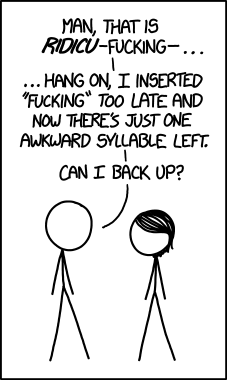
One of the transitions English speakers have to make in Romance languages, and I have found particularly in Italian, is that the object of the sentence that we so often put at the end ends up at the beginning of sentences. For example, in Italian, when translating the phrase "I can show it to you", the "to you" and "it" end up as the first two syllables ahead of everything else.
I was working on this just yesterday in my Italian lesson so I got a laugh out of XKCD
Best Buy says it is not afraid of showrooming, the practice of testing products at a physical retailer and then buying it online. Best Buy says it is confident it can convert visitors into buyers, even if their intent was to buy online.
Well, that is a brave front. And I wish them luck -- I certainly like having bricks and mortar retailers around when I need something fast and can't wait for the UPS truck. But it probably was no accident that the article was illustrated with this picture:
What don't you see there? CD's, DVD's, speakers, DVD players, computer games and most of the other stuff that used to make up a lot of Best Buy's floor space. Because they have already been demolished by online retailers in those categories. The picture above is of appliances, one of the few high dollar categories that has not migrated to the web. Go to Best Buy and you will see appliances, health equipment, and TV's, all categories where bricks and mortar stores have some advantages over online.
This makes perfect sense, but don't tell me Best Buy is ready to take on the online retailers. They are bobbing and weaving, ducking this competition wherever they can.
Postscript: Best Buy is hoping that having "trained" sales people to help customers will garner business. There are two problems with this. One, the training of their sales staff has always been spotty, and likely will not get better as their financials go south. And two, I find that Amazon.com reviews are far more helpful, and often more knowledgeable, than most in-store sales staff. But on the positive side, who doesn't enjoy getting hassled for an extended warranty at checkout?
I discussed a while back by decision to try the Pimsleur course over other brands. So far I have been happy and I feel like I have retained a lot. However, it is NOT for everyone. It did not work for my wife, for example. Here are what I think are two key considerations in committing time to this course / approach:
You have to be able to learn from hearing and speaking. There is only a little reading and no writing. This is perfect for me -- taking notes actually interrupts my memory retention process. But my wife likes to write, take notes, make lists. She is a memorizer, I am an experiencer, if that makes sense. By the time she gave up she had this huge long list of words and definitions she kept referring to. If this is your learning style, it is not going to work well for you.
You have to be a bit of a detective. This did NOT fit my wife but did fit me (I was someone who would never memorize an equation if I knew I could derive it on the fly if I needed it). The tapes almost never, ever explain any grammar. You learn by example, and then are expected to construct the rules yourself in your head from the examples. For example, never are the rules of verb conjugations given. You just start noticing that all the first person present tense conjugations tend to end in "o". I had little trouble with verb conjugations because I learned them in Spanish in a rigorous way and they are fairly similar in Italian. But Italian article and preposition rules are unlike both Spanish and English. They have a lot of "a vs. an" type rules that can be a bit non-intuitive, and the preposition choices between "a" and "in" and "di" and "da" and "per" can drive English speakers up the wall (for example, you use a different proposition for going to a city vs. going to a country). Now, most of us learned the "a vs. an" rules just through usage long before we had a grammar class, and a lot does sink in this way just speaking and listening, but I finally had to buy an Italian grammar book to make sure I had the full set of rules.
The other thing I have trouble with is that my hearing is not great and Italian is all about running your words together. They LOVE contractions and blending ending vowels into beginning vowels of the next word. I keep a Google translate window open on my desk so I can actually see new words they are using to make sure I am learning them correctly.
Postscript: I have decided that Italian articles are Fate's revenge on me for years of fake Russian Boris Badanov accents where one makes fun of the tendency to drop articles (e.g. "Ve must get moose and squirrel"). Italians use articles in many circumstances where we typically do not in English.
I don't like to recommend destinations that are really expensive (why get people excited about a place they can't afford to visit) but we splurged this weekend on the Enchantment Resort in Sedona, Arizona. It is the most spectacular location I have ever seen for a landlocked (ie non ocean-front) resort. It is almost impossible to do it justice in photos, because it sits at the end of a box canyon and is surrounded on three sides by red rock walls. Some pictures are here in the google image result. Expect to pay $300-400 and up for a night, though you will get a very nice room even for the lower rates, and large casitas for higher rates. As is usual for resorts, meals are crazy expensive -- its hard to get through breakfast, for example, for less than $20 a person. But the views and hiking and everything else here are just beautiful.
One of the things I enjoyed was the resort had a native american climb onto a local rock outcropping a couple of times a day and play peaceful flute music that echoed around the resort. You can see a group gathered around to watch (update: A reader was nice enough to Photoshop out some of the haze using a levels command trick he taught me a while back -- you can compare below to this original)
It freaked me out for a while because I would here this low-volume music as I walked around the resort and I could not figure out where it was coming from (I kept looking for hidden speakers until I figured it out).
As an added bonus, the night sky is totally dark -- you are out in the wilderness about 15 miles from Sedona and out of site of any other habitation of any sort and almost completely surrounded by canyon walls. As a result, it is one of the few places where us city folk can see the Milky Way in all its glory (below is my amateur photography (you may have to click to enlarge to really see the Milky Way, but its there).
The restaurant there is quite good and there are excellent tables on the deck outside to watch the sunset. But if you want a slightly different Sedona experience (though equally expensive) the Restaurant at the L'Auberge resort right in the town of Sedona on Oak Creek is terrific. The food is great and the location on the creek is very romantic at night. Here is the view from my table right around sunset.
You can't get closer to the water than that!
Postscript: If you like the idea of creekside dining but don't want to blow a hundred bucks a person for dinner, I have eaten at a much less expensive, much less highbrow restaurant that had a very similar location. It is the Rapids Lodge Restaurant at Grand Lake, Colorado, and is a great place to eat on a trip through Rocky Mountain National Park before you turn around and head back to Estes Park. Here is the view from our table there:
PPS: Other US resort views I like: Highlands Inn, near Carmel; Hapuna Resort, Big Island, Hawaii; Sanctuary Resort, Phoenix, AZ (though the rooms really need an update); Trump Hotel, Las Vegas (located right on the bend of the strip so the strip view rooms look straight down the strip at night).
Update: In the spirit of equal time, a reader writes that the Enchantment Resort ruined Boynton Canyon. Its impossible for me to say -- I never knew it in its pristine state. I will say the resort itself does a pretty good job of keeping a low profile in the canyon -- no buildings that I saw over 2 stories tall, most of the old trees are preserved.
The other day I joked that most of my memories of Spanish in high school were of trying to learn and conjugate the subjunctive, an activity for which English speakers are not well-prepared.
In fact, the only example of a unique subjunctive verb conjugation I can think of in English is "were". For example in "if I were a rich man,..."
I am sure there must be others. I could Google it, but does anyone know any off hand?
Update: We already have an awesome answer in the comments. Though I am unclear how anyone that proficient in grammar can stand to regularly read this blog. Makes me even more self-conscious about proof-reading better, which I actually have been attempting, even if the results are not obvious.
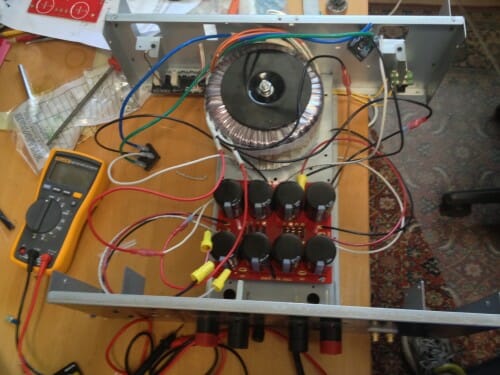
I was looking for a 4-channel amp to drive a pair of bipole speakers. For fun, I decided to try to build one. I bought a broken amp off eBay just for the case for about $30. In retrospect, I probably should have bought an inexpensive blank case they sell to hobbyists. At the time, I was intimidated by drilling and tapping a lot of holes in a metal case. Since then, I have found this to be easy, easier in fact that ripping all the guts out of the old amp.
Anyway, I finished the power supply. The big fat over-sized torroid delivers 35 volts AC to the diode bridges and the smoothing capacitors on the back end, which in turn delivers about 48.5 volts DC for my amp (this measured dead-on the expected 35*sqrt(2)-1 one would expect). I tried to save some of the old amp's 110V circuitry (such as some filter capacitors). It had a relay with some sort of delay circuit in parallel with a big resistor as a soft-start mechanism, to prevent a big inrush current. I could never make it work right, so I replaced it with the poor man's alternative, which is a couple of thermistors that have high resistance cold but quickly heat up and lose their resistance when the power is on.
The capacitors and RC network are in an absolutely beautiful empty board I bought from someone on eBay who etched boards for First Watt kits (an amp series that the designer has generally put into the public domain). I cribbed the power supply off the design for an F5 amp, though I had to adjust wattage and voltage values to match the voltage I needed. I spent a week dithering on what capacitors to use -- audiophiles go on an on about capacitors. Finally, though I am sure all these folks will swear to God they can hear the difference between two brands of capacitor in the power supply, I finally decided I probably would not notice and bought some well-regarded but reasonably priced ones (similar to my approach on that other audio equivalent of wine-snobbery, speaker cables).
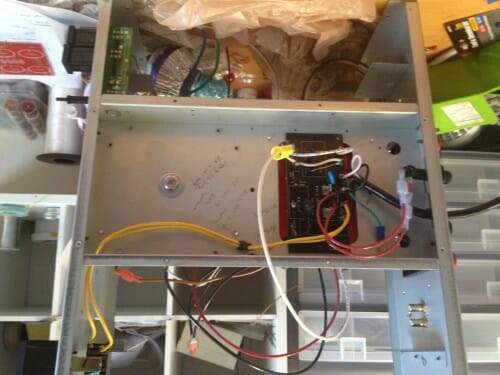
What you don't see are two big aluminum heat sinks, which will fill much of the space on either side of the power supply. The diode bridges and amps will be connected to these. I have circuits both for a Class A amp, which will need every inch of the cooling, and a class D amp, for which the heat sinks will be an unnecessary overkill. But they came with the box and I have the space.
Folks in the OWS neighborhood in NYC are fed up and want the city to kick out the protesters. While they grow old waiting for that, I would suggest taking some individual action right out of the army psi-ops manual (actually, its also from a Sopranos episode).
Find some big-ass speakers
Find the biggest amp you can
Place speakers in window, point out at park.
Find the single most annoying recording you can, and play it at volume 11 .. over and over and over and over, day in and day out. I might try "I'm turning Japanese" or maybe "I want a hippopotamus for Christmas." Possibly the song they used to play over and over in FAO Schwartz stores, or "It's a small world." Or maybe something like a Joel Osteen sermon. It almost doesn't matter once its been repeated 12 times an hour for 3 days.
I really enjoyed my first foray into building speakers (the first ones were here, and were an L-C-R for the home theater). So I tried building a new pair.
The home theater speakers are behind the projection screen (the big gray thing in the picture). The speakers definitely lose something behind the screen. Though it is no big deal on movies, for music I wanted speakers outside the screen. I needed something with high WAF (a term very common on audio discussion boards, it stands for wife acceptance factor) but that sounded good. In effect, I needed something relatively small that filled a big room.
These are bipolar speakers, which does not mean they are good at playing Rage Against the Machine albums. It means they have two drivers, usually at 180 degrees from each other. The advantage if well designed can be more full, room-filling sound. These have the second driver mounted on top, rather than in back. The reason for this is that I knew they would be close to the wall, and bipoles with rear-mounted drivers need space I did not have. I built them roughly to this design, though I used MarkAudio Alpair 7.3 drivers instead of those in the design, and I moved the port to the front from the bottom.
These are full range driver speakers. The driver actually runs from about 60-ish Hz to over 20,000 Hz and is pretty dang flat over that range. The advantage of this is we get rid of the electronic crossovers between the woofer, mid, and tweeter. Often the crossover frequencies sit right in the most sensitive range of the ear, as well as in vocal range, such that even small irregularities degrade the sound. Also, the sound is coming from a single point source, which sounds great, and the speaker is more efficient. The downside, of course, is that it is asking a lot of a driver to cover this wide range.
These speakers sound amazing (I will spare you the audio review-speak that sound so eerily similar to wine-snob-speak). You would simply not believe the sound that comes out of these little drivers. The bass is pretty solid too, though I think I will add a subwoofer on the bottom. The bass reinforcement comes from the quarter-wavelength transmission line design, the theory of which is discussed in great depth here. You can find a lot of this sort of design in stores, as the tall thin tower look is aesthetically appealing, and has the fortunate side effect of working well for bass reinforcement (probably the number one role of any cabinet). I spent a lot of time in Mathcad on these. I am starting to reach my goal of eventually building speakers of my own design -- for these I modeled and then modified an existing design.
The boxes are built out of 3/4-inch baltic birch plywood, again with all large saw cutting done by the lumber yard, while I did the rest at home. This is my first experience with veneer, which i in this case is black-dyed ash and it came out great, though I put the satin polyurethane coating on a bit too think and got them a bit glossier than I wanted. They are well braced on the inside and the back is removable to tune them with more or less fiber stuffing -- at first I only had a bit and the bass was too boomy, but adding more along the length of the speaker tightened the bass as well as the mids a bit.
This was a very easy project, much easier than the first speakers I built. As I learned the first time, with router jibs, round holes are actually easier than square ones. If someone is looking for a great starter project, these speakers, with just one driver, would be my choice. Markaudio is a great driver manufacturer, not only because they are making what may be the best full-range drivers out there, but their proprietor spends a ton of time on the boards interacting with the DIY community to find out what they would like to see changed.
I have invested some decent (but not stupid) money on my home stereo, but I have realized I listen to my crappy computer speakers about 3 times more.
So here is the first step in my upgrade, a pair of powered studio monitor speakers. At under $200 a pair, they are not that much more expensive than higher-end computer speakers. These are built for near-field listening and sound much better than most computer speakers. The one I chose are a tad large, but I have loved them so far, even without a subwoofer. These particular units are cheaper at Amazon by $10 but Sweetwater has better selection and help choosing studio monitors. Just make sure you have the cable situation sorted out -- most studio monitors take a special 3-prong balanced XLR input common in high end and pro audio but not in most consumer audio. But you can easily find a number of converter cables.
If I keep listening at my computer, the next improvement step is an inexpensive DAC (which can correct a lot of mess in computer digital audio).
What do corn farmers and Hollywood studios have in common? They both have an uncanny ability to force self-serving legislation through Congress. This week's bit of sucking up to Hollywood is the PROTECT IP act, currently under consideration in Congress:
An ideologically diverse group of 90 law professors has signed a letter opposing the PROTECT IP Act, the Hollywood-backed copyright enforcement/Internet blacklist legislation now working its way through Congress. The letter argues that its domain-blocking provisions amount to Internet censorship that is barred by the First Amendment.
Jointly authored by Mark Lemley, David Levine, and David Post, the letter is signed not only by prominent liberals like Larry Lessig and Yochai Benkler, but also by libertarians like Post and Glenn "Instapundit"Reynolds.
"The Act would allow courts to order any Internet service to stop recognizing [a] site even on a temporary restraining order... issued the same day the complaint is filed," they write. Such a restraining order, which they describe as "the equivalent of an Internet death penalty," raises serious constitutional questions.
The Supreme Court has held that it's unconstitutional to suppress speech without an "adversary proceeding." That is, a speaker must, at a minimum, be given the opportunity to tell his side of the story to a judge before his speech can be suppressed.
Yet under PIPA, a judge decides whether to block a domain after hearing only from the government. Overseas domain owners (and the speakers who might make use of their websites) aren't offered the opportunity to either participate in the legal process or appeal the decision after the fact. (Affected domain owners may file a separate lawsuit after the fact.) This, the professors say, "falls far short of what the Constitution requires before speech can be eliminated from public circulation."
I wanted to share my build report on my new home theater speakers. I built three matching speakers - left, center, right - to go behind my acoustically perforated projection screen. Because they stay behind the screen, this is perhaps the last time they will ever be seen. But I wanted to get better at wood-working skills, so I tried to build these as if they were to be visible (but at several steps I could have taken shortcuts which I will describe).
Here are the finished product:
I will put the rest below the fold so as not to bore those not interested. My apologizes to feed readers, but I think you will see the whole thing.
My speakers (L-C-R for a home theater) are complete! They sound fine on the initial test, though they need to break in for many hours. Here is how they look (the paint job is actually truck bed liner). I will post a complete build report when I can get caught up.
I have decided to save the photo-essay of my speaker-building project until the project is finished and I can put it all in one long post. However, just as an update, I am really close to done. The three speakers (left, center, right) will go behind my accoustically-perforated projection screen. As you can see, the enclosures are complete and primed and the crossovers are complete and installed. The special paint I ordered arrived today so I can paint this weekend and install the drivers.
The funny shape of the openings at top are due to my choice of drivers -- the tweeter will be a horn-style driver, an approach I wanted to try for home theater in a large room (movie theater speakers use the same technology). The cabinet is ported for bass response -- that is what the rectangular opening is in the upper right. These are based on a design by Pi speakers.
Knock on wood but given my total and complete lack of carpentry skills and experience (think Anthony Michael Hall in the Breakfast Club, the geeky kid who fails shop), I am just thrilled with how they are coming out.
I am in the process of building some speakers for my home theater. This is something I have never done before, but the idea has always intrigued me. So much so I have actually played around with software and designed a lot of cabinets and crossovers, but never built them. I am finally going to build an L-C-R for my home theater, and since they go behind my projection screen (the screen is perforated for sound transmission, just like in movie theaters) the pressure to produce flawless cabinetry is reduced significantly. In fact they will probably be built out of raw MDF finished in black, though I will try to make them look nice just for the practice.
Anyway, one of the reasons I have put off this endeavor is that I do not own a some of the key tools, and do not have the space for these tools. I have a nice router, belt sander, jig saw, etc. but I do not have, and really don't have the space for, either a table saw or a drill press.
Which led me to wonder if folks had well-outfitted workshops that they lease out by the hour for such work. After all, with a good plan in hand, I probably don't need more than an hour on a table saw to get what I need -- most of the project will be in routing the speaker holes and counter sinks, assembly, and sanding/finishing which I can do at home.
Of course, I could not find such a thing. I could not even find a storage locker that would let me use it as a work shop. Thinking about this, I am not surprised. No matter what I get a customer to sign, now matter how well maintained the tools, if someone cuts their hand off using a tool in a stupid and careless way, there is likely going to be a jury somewhere that still wants to assign me liability.
My readers tend to be very nice about rushing to help -- I got about 10 emails offering to help me with my server migrations. I turned them down because part of the point was to learn to do it myself, and my learning process tends to be by trial and error doing things myself. Anyway, please do not offer me your shop -- I have found a local community college that allows its shop to be used after one has completed a training and familiarization course (which seems a reasonable precaution).
I am excited about getting started, and am just starting to accumulate the materials. BTW, in case it becomes relevant to you in the future, a full 4x8 sheet of 3/4-inch MDF is really heavy.
Postscript: I will let you in on my secret ambition. I really, really want to build a pair of line arrays, as much for their shear bad-ass looks as anything else. Of course, my wife would freak and I am not sure where they would go in my house, but someday....