America Bought Me for 20 Tons of Wheat
A Russian immigrant (escapee?) discusses how he got out of Russia as part of an ongoing series of videos pleading with Americans not to head down the path to socialism.
Dispatches from District 48
Posts tagged ‘socialism’
A Russian immigrant (escapee?) discusses how he got out of Russia as part of an ongoing series of videos pleading with Americans not to head down the path to socialism.
I am slammed here at work, but I will give you a couple of nice articles on this topic. First from IBD:
The United Nations' Copenhagen Climate Conference is going fast into meltdown. It may be because it's not about climate anymore, but fitting a noose on the world's productive economies and extracting wealth transfers.
Poor countries have gone from defending their right to economic development as a reason for exemptions to emissions cuts to claiming a "legitimate" right to vast wealth transfers from the West to prevent emissions. They call it "climate justice."
Monday, the Group of 77, led by African states, shut down the conference for the second time, saying they would pick up their marbles and go home if the West didn't agree to their formula for emissions cutbacks and send them more than the $10 billion promised by the West....
Having manipulated the foreign aid racket for decades, the African officials knew just what buttons to push with Western Europeans. Not surprisingly, they won concessions. No doubt they'll do it again to get more, and the Danes and other one-worlders will give them what they want.
The second is from Charles Krauthammer
The idea of essentially taxing hardworking citizens of the democracies to fill the treasuries of Third World kleptocracies went nowhere, thanks mainly to Ronald Reagan and Margaret Thatcher (and the debt crisis of the early '80s). They put a stake through the enterprise.
But such dreams never die. The raid on the Western treasuries is on again, but today with a new rationale to fit current ideological fashion. With socialism dead, the gigantic heist is now proposed as a sacred service of the newest religion: environmentalism.
One of the major goals of the Copenhagen climate summit is another NIEO shakedown: the transfer of hundreds of billions from the industrial West to the Third World to save the planet by, for example, planting green industries in the tristes tropiques....
Socialism having failed so spectacularly, the left was adrift until it struck upon a brilliant gambit: metamorphosis from red to green. The cultural elites went straight from the memorial service for socialism to the altar of the environment. The objective is the same: highly centralized power given to the best and the brightest, the new class of experts, managers and technocrats. This time, however, the alleged justification is not abolishing oppression and inequality but saving the planet.
Leaders of fifty African nations came to Copenhagen asking $400 billion for the next three years to "offset" carbon credit "damages" which they claim to suffer. Inexplicably, two days ago, that demand was increased to an eye-goggling 5% of GDP (gross domestic product), estimated at $722 billion from the United States alone. There never was a response from the industrialized world.
The London Guardian reports today that the disgruntled Africans may boycott the rest of the climate summit. The conference's own web page quotes the Ethiopian prime minister as saying he will "scuttle" talks unless there is discussion of "real money" and "not an illusion."
The treaty draft is really hard to read, as it has all kinds of alternate language in brackets. However, a few folks have already started reviewing the treaty, and what they are finding is less of a climate treaty and more of a blueprint for world socialism. One example, via Anthony Watt, from page 122 of the draft:
17. [[Developed [and developing] countries] [Developed and developing country Parties] [All Parties] [shall] [should]:]
(a) Compensate for damage to the LDCs' economy and also compensate for lost opportunities, resources, lives, land and dignity, as many will become environmental refugees;
(b) Africa, in the context of environmental justice, should be equitably compensated for environmental, social and economic losses arising from the implementation of response measures.
Compensating for "lost opportunities?" Isn't that number just whatever they want it to be? And don't get me started on lost "dignity."
We really couldn't be more screwed when it is up to an NPR reporter to make the argument for free enterprise:
EPA Administrator Lisa Jackson told NPR's Michelle Norris yesterday: "The President has said, and I couldn't agree more, that what this country needs is a one single national road map that tells automakers who are trying to become solvent again what kind of car it is they need to be designing and building for the American people." Norris then asked: "Is that the role of Government though? That doesn't sound like free enterprise." Jackson responded: "Well it is free enterprise in a way."
via Maggies Farm.
Update: Q&O has a great post deconstructing Obama's view of government as health care planner. Very frightening.
Flowing Data draws my attention to this nutty chart in the New Scientist (I have never read the New Scientist, but my experience is that in periodicals one can generally substitute "Socialist" for the word "New"). Click to enlarge.

Will the world really run out of Indium in 5 years? Of course not. New sources will be found. If they are not, then prices will rise and a) demand with be reduced and b) efforts to find new sources will be redoubled. Push come to shove, as prices rise too much, substitutes will be found (which is why John D. Rockefeller probably saved the whales). Uranium is a great example -- sure, proved reserves are low right now, but companies that mine the stuff know that there is tons out there. That is why they are going out of business, there is too much supply for the demand. Any spike in price would immediately generate tons of new developed resources. And even if we run out, there are enormous quantities of thorium which is a potential substitute in reactors.
Absolutely no one who was old enough to be paying attention to the news in the 1970s could have missed charts very similar to this. I remember very clearly mainstream articles that we would run out of oil, titanium, tungsten, etc. by the early 1990's. Seriously, name one commodity we have plain run out of (*cough* Julian Simon *cough*).
People say, well, the resources have to be finite and I would answer, "I suppose, but given that we have explored and mined about 0.000001% of the Earth's crust and none of the floating mineral reservoirs in space (called asteroids), I think we are a long, long way from running out."
You would think that the guys running this analysis would get tired of being so wrong so consistently for so many decades, but in fact their real point is not about resources but about the US and capitalism. The point of the chart is not really to say that the world will credibly run out of tungsten, but to tell the world that it is time to get out their pitchforks because the US is stealing all their wealth and resources. It is an age-old zero-sum wealth fallacy that has never held any water, but remains a powerful talking point among socialists none-the-less.
For socialists, wealth is not created by man's mind and his effort -- it is a spring in the desert with a fixed flow rate. It just exists to be taken or fought over. The wealthy, by this theory, have not earned their wealth, they are just the piggy ones who crowd to the front of the line and take more than their share from the spring. Unfortunately, socialists have never been able to explain why the spring, which flowed so constantly (and so slowly) for thousands of years, suddenly burst forth with a veritable torrent in lockstep with the growth of capitalism in the west. And why it seems to dry up in countries that adopt socialism.
Postscript: A while back I posted on the New Economics Foundation (remember what I said about "New") and their claim the world had just gone into ecological debt.
Megan McArdle did not like this from David Henderson:
President Obama has done something far more serious. He has already, in less than 100 days, moved the U.S. economy further towards fascism. Sean Hannity and other critics keep criticizing Obama for his socialist leanings. But the more accurate term for many of his measures, especially in the financial markets and the auto market, is fascism.
Here's what Sheldon Richman writes about "Fascism" in The Concise Encyclopedia of Economics:
Where socialism sought totalitarian control of a society's economic processes through direct state operation of the means of production, fascism sought that control indirectly, through domination of nominally private owners. Where socialism nationalized property explicitly, fascism did so implicitly, by requiring owners to use their property in the "national interest""“that is, as the autocratic authority conceived it. (Nevertheless, a few industries were operated by the state.) Where socialism abolished all market relations outright, fascism left the appearance of market relations while planning all economic activities. Where socialism abolished money and prices, fascism controlled the monetary system and set all prices and wages politically. In doing all this, fascism denatured the marketplace. Entrepreneurship was abolished. State ministries, rather than consumers, determined what was produced and under what conditions.
She replied
How is this helpful? Has clarifying the distinction between fascism and socialism really added to most peoples' understanding of what the Obama administration is doing? All this does is drag the specter of Hitler into the conversation. And the problem with Hitler was not his industrial policy"“I mean, okay, fine, Hitler's industrial policy bad, right, but I could forgive him for that, you know? The thing that really bothers me about Hitler was the genocide. And I'm about as sure as I can be that Obama has no plans to round up millions of people, put them in camps, and find various creative ways to torture them to death.
I'm confused. It appears to me that McArdle, and not Henderson, was the one who introduced rounding up people in camps into the discussion. In fact, the prototype example of fascism, in Italy, never went in the genocide direction. Genocide per se was not a defining feature of fascism, any more than it was in communism. In both cases genocide was the result of handing immense unchecked power to a small group of people. And I am not clear why, after Stalin and the Kmer Rouge, McArdle thinks that fascism is any more loaded with genocide associations than socialism.
To avoid this whole confusion, I usually use the term "Mussolini-style fascism" since we do seem blinded and incapable of looking past Hitler whenever that word fascism is mentioned. But I think the discussion of Mussolini-style fascism is as least as relevant as the frequent discussions on McArdle's other sites of the causes of the Great Depression. While Italy adopted the model before the Depression, many nations considered emulating it as a response to the Depression. I think the evidence is fairly clear that FDR was an admirer of certain aspects of this model, and his National Industrial Recovery Act emulated many mechanisms at the core of Mussolini's model.
I actually think the Henderson is correct - Mussolini style fascism, and the modern European corporate state, are may be better analogs to describe where this Administration is heading than socialism.
I want to thank Tom Nelson for the pointer, because I usually don't hang out much at the Socialist Unity site. But I thought that this post was telling.
While it may be urgent that we create a red green alliance to
strengthen radical social action to stop climate change, our collective
problem is how are we going to do that?The Climate Change Social Change Conference
held in Sydney Australia during April tried to tackle that
challenge.This was a bold attempt to bring together left and green
activists in order to locate a shared perspective around which we could
begin more consciously organize....Foster and Perez urged the conference's participants to consider
socialism as the only viable solution to the climate emergency. This
was a persistent theme discussed throughout the three day event as
speakers were drawn from a range of environment movements and
organisations (such as the Australian Greens and Friends of the Earth)
as well as academic specialists "” who preferred solution packages which
were not consciously committed to a socialist transformation of
society..
For at least the last thousand years, western society has always had a hard core of doom-sayers who like to climb to the rooftops to shout that the end of the world is close at hand. I am not a good enough student of history to know if this is a predictably human trait, or if it is uniquely tied to western religions like Christianity. Certainly the Medieval millenarian streak was tied closely to the prophesies of Christianity.
Whether initially Christian or not, end-of-the-worldism is now the provenance of many fringe secular groups, not the least of which are the environmentalists. In fact, the current global warming panic fits right into a long history of end-of-the-worldism, though I also think it has strong elements of socialism and youth culture guilt and lacks the optimism of Christian millenarianism.
Today's humorous does of doom comes right here from Arizona, via professor Guy McPherson of the University of Arizona. Incredibly, our local media treats this interview straight up, without even the snark they would bring to, say, the article they wrote about me and other local climate skeptics.
First, let me explain Empire: We exploit humans and resources, often
with extreme violence, to provide Americans with indulgences beyond
belief to most people.Had we started the project of powering down at least 30 years ago,
there might still be time. At this point, I cannot imagine any steps
that could allow us to avoid a meltdown of the economy or a relatively
rapid transition into the post-industrial Stone Age. We depend on
abundant, inexpensive oil for delivery of food, water, shelter, and
health care. The days of abundant, inexpensive oil are behind us. The
American Empire will soon run its course.I am hopeful we can save a few tens of millions of Americans. But
we will need to make massive changes in our entire way of life,
starting immediately. We must abandon the project of globalization and
its attendant indulgences, for example, and focus on saving lives.
Yes, oil production will indeed peak at some point, and may even be peaking now (though I doubt it). But the rest of this is just ignorant.
A few posts ago I wrote my annual rant against Kwanzaa as a seven step program to socialism. I concluded that if blacks in America wanted to stay poor and under the power of others, they could take no better step than to pursue the seven values in Kwanzaa.
In a stunning gap in my reading, I have never read PJ O'Rourke's "Eat the Rich." However, David Boaz reports this interesting snippet from the book:
In Tanzania he gapes at the magnificent natural beauty and the
appalling human poverty. Why is Tanzania so poor? he asks people, and
he gets a variety of answers. One answer, he notes, is that Tanzania is
actually not poor by the standards of human history; it has a life
expectancy about that of the United States in 1920, which is a lot
better than humans in 1720, or 1220, or 20. But, he finally concludes,
the real answer is the collective "ujamaa" policies pursued by the sainted post-colonial leader Julius Nyerere. The answer is "ujaama"”they planned it. They planned it, and we paid for it. Rich countries underwrote Tanzanian economic idiocy."
For those not familiar with Kwanzaa, Ujamaa is one of the seven principals celebrated in Kwanzaa.
The NY Times outdid itself last week with a truly awful article on dentistry. They started with just one fact:
Previously unreleased figures from the Centers for Disease Control and Prevention
show that in 2003 and 2004, the most recent years with data available,
27 percent of children and 29 percent of adults had cavities going
untreated. The level of untreated decay was the highest since the late
1980s and significantly higher than that found in a survey from 1999 to
2002.
They then apply the patented NY Times class-based story-generation model to assume a cause for this rise that is not supported by the study itself:
But many poor and lower-middle-class families do not receive adequate
care, in part because most dentists want customers who can pay cash or
have private insurance, and they do not accept Medicaid
patients. As a result, publicly supported dental clinics have
months-long waiting lists even for people who need major surgery for
decayed teeth. At the pediatric clinic managed by the state-supported University of Florida dental school, for example, low-income children must wait six months for surgery.
So is the rise in untreated dental problems concentrated in the poor? Well, they don't say, and there is not data for that in the study, but that does not prevent the NY Times from just assuming it to be so. In fact, the article itself contradicts this premise, by noting that the problem is not limited to the poor:
The lack of dental care is not restricted to the poor and their
children, the data shows. Experts on oral health say about 100 million
Americans "” including many adults who work and have incomes well above
the poverty line "” are without access to care.
By the way, how did they figure a 100 million don't have "access"? I don't know, but the figure is suspiciously close to this one:
With dentists' fees rising far faster than inflation and more than 100 million people lacking dental insurance...
Anyone want to bet that the NY Times just made its usual logical fallacy of equating lack of insurance with lack of access? And by the way, dental insurance is a HORRIBLE investment. I have priced it many times myself and for a normal family, it is much cheaper to just pay the dental bills, particularly since there are not that many things in your mouth that can go wrong that will be bankrupting. Trying to push everyone to dental insurance is a terrible idea. Every time there is a dental procedure in our family, it turns out there are several options for fixing it at different prices. We actually have the incentive to ask for these alternatives and make trade offs. What do you think would happen if we had insurnace?
In fact, I can think of a LOT of reasons why people don't go to the dentist as often as they should. One reason is that no one like the dentist. Another is people's busy schedules. And certainly rising costs are a factor -- As I mentioned before, our family makes very different decisions about treatment options than we used to with a fat corporate dental plan. Which is as it should be.
By the way, note the screaming socialism here:
The dental profession's critics "” who include public health experts,
some physicians and even some dental school professors "” say that too
many dentists are focused more on money than medicine."Most
dentists consider themselves to be in the business of dentistry rather
than the practice of dentistry," said Dr. David A. Nash, a professor of
pediatric dentistry at the University of Kentucky. "I'm a cynic about my profession, but the data are there. It's embarrassing."
I wonder. Does Dr. Nash accept a salary for being a professor? Then I guess he is focused more on the business of education than the practice of educating.
Oh, and by the way, how is socialism in dentistry working out?
In a survey of 5,000 people in the UK, six percent claimed that
they had done DIY dentistry, including yanking their own teeth and
fixing cracked crowns with glue. Apparently they resorted to such self
treatment because they couldn't get in to see a National Health Service
dentist "¦One respondent in Lancashire, northern England, claimed to
have extracted 14 of their own teeth with a pair of pliers. In
Liverpool, one of those collecting data for the survey interviewed
three people who had pulled out their own teeth in one morning."I took most of my teeth out in the shed with pliers. I have one to go," another respondent wrote.
Apparently Ayn Rand's novel Atlas Shrugged is turning 50, a fact I know only because my fairly libertarian-tilted feed reading list has been deluged of late with retrospectives.
One of the oddities of posts on Ayn Rand is that every author seems to feel required to say something like "I like her work but I am not in total agreement with everything she says." Uh, OK. I'm not clear why this proviso seems so necessary. I have never heard someone saying "I am a big fan of Mozart" and then following up with "but I don't like all of his works." I am sure that is true, but they don't bother saying so. I am a big fan of Ayn Rand, in particular with her non-fiction essays, but of course there are parts of her writing I don't agree with. For example, I would be less likely to take her advice on managing my love life than I would to eat out of Hannibal Lecter's cookbook.
What Rand did so well in Atlas Shrugged was to take collectivist and anti-rational philosophy and play it forward in practice in a very compelling way. She demonstrated with almost mathematical precision the end results of collectivist philosophy. The entropic United States in Atlas Shrugged, running down under the weight of socialism, has turned out to be repeatedly prescient. For this reason, I find her anti-heros to be more memorable. I see analog's to the Jim Taggerts and Lee Hunsackers and Starnes children nearly every day in the news. Through these analogs, Rand still helps me place current events in their philosophical context.
By the way, if you enjoyed her novels but have never read her essays, I encourage you to do so. The Virtue of Selfishness is a reasonable place to start. She was not the first person to voice many of these messages (Hayek and others were saying many of the same things) but because of her novels, I, like many others, heard them first from her.
It is often said that capitalism won over socialism in the late 20th century, with the fall of the Berlin Wall and the rise of powerful Asia market economies. Be that as it may, this statement certainly does not apply to American university campuses. In the ivory tower, capitalism is still the number one whipping boy.
An interesting illustration of this is Jacob Sullum's review of a pair of books that attempt to debunk the myth that being mildly overweight is deadly. This is a rich topic, given some of the really bad science that has gone into trying to make being overweight the next smoking, and the review is worth a read. However, this part caught my eye:
Both he and Campos blame the unjustified obsession with weight and the
cruel vilification of fat people on capitalism, which, they say, prizes
self-discipline and stigmatizes those seen as lacking it. To be fair,
Campos more specifically blames a pro-capitalist Protestant asceticism
that encourages the pursuit of wealth but frowns on those who enjoy it
too much. There's an element of truth to this analysis; a similar
ambivalence regarding pleasure helps explain American attitudes toward
sex, drugs, and gambling.
But wait! Aren't most of the folks like the food nazis who are launching government obesity campaigns leftists? They are, and Sullum makes this point:
But it does give you pause when you consider that the obesity
obsessives also blame capitalism, for precipitating the current crisis
by making food plentiful, inexpensive, appealing, and convenient. New
York University nutritionist Marion Nestle, for example, blames
America's adiposity on "an overly abundant food supply," "low food
prices," "a highly competitive market," and "abundant food choices,"
while Kelly Brownell claims restaurants exploit consumers when they
give them more for less, since "people have biological vulnerabilities
that promote overeating when large portions are available, a strong
desire for value, and the capacity to be persuaded by advertising."
Great. So capitalism causes obesity as well as anti-obesity. You can't win.
From Fred Thompson, via Insty:
But he received his biggest applause for blasting the bipartisan plan
for immigration reform, which he called unworkable. "We are a nation of
compassion, a nation of immigrants," he said. "But this is our home . .
. and we get to decide who comes into our home."
Isn't this an essentially socialist view of property, that the whole country is essentially owned by all of us collectively and it is our government's responsibility to administer access to this community property?
I am just completing a course on the history of Rome from the Teaching Company (whose products have been universally excellent in my experience). One of the interesting things that contributed substantially to Rome's strength, at least through the BC years, was their flexibility and success in absorbing many different peoples into the state. They actually had various grades of citizenship, including such things as Latin Rights where certain peoples could get access to some aspects of citizenship (e.g. ability to conduct commerce and access to the judicial system) while being denied others (e.g. voting).
Can't we figure out something similar? Shouldn't it be possible to allow fairly open access to being present and conducting commerce in this country, while still having much tougher and tighter standards for voting and getting government handouts? The taxes immigrants pay easily cover things like emergency services and extra load on the courts, but fall short of covering extra welfare and education.
Unfortunately, the debate seems to be dominated either by Lou Dobbs racists who see Mexicans as spreading leprosy or by Marxists who see poor immigrants as a wedge to push socialism. The problem is again traceable to a President who tries to lead on divisive issues without trying to clearly communicate a moral high ground. For example, I would have first tried to establish one simple principle that has the virtue of being consistent with most of America's history:
"The US should allow easy access to our country for immigrants, but immigrants should expect that immigration involves financial risks which they, not current Americans, will need to bear. Over time, they will have access to full citizenship but the bar for such rights will be set high."
OK, it needs to be shorter and pithier, but you get the idea. Reagan was fabulous at this, and Clinton was pretty good in his own way. Bush sucks at it.
For years, socialists (and some sloppy capitalists) have operated under the assumption that production only requires labor and capital. Socialists assume that if a government steals both, it can produce just as well as any of those greedy private companies. Hugo Chavez has been operating under this assumption, but he has run into a problem:
The companies ceding control included BP Plc,
ConocoPhillips, Exxon Mobil Corp, Chevron Corp, France's Total SA and
Norway's Statoil ASA. All but ConocoPhillips signed agreements last
week agreeing in principle to state control, and ConocoPhillips said
Tuesday that it too was cooperating.While the state takeover was planned well ahead of time, the oil
companies remain locked in a behind-the-scenes struggle with the
government.Chavez says the state is taking a minimum 60 per cent stake in the
Orinoco operations, but he is urging foreign companies to stay and help
develop the fields.They have until June 26 to negotiate the terms.
The companies have leverage with Chavez because experts agree that
Venezuela's state oil company, Petroleos de Venezuela SA, cannot
transform the Orinoco's tar-like crude into marketable oil without
their investment and experience.
In other words, beyond their workers and plant and equipment, he needs their brains. And I hope the American companies refuse to give in to him.
I made this point earlier in this critique of socialism:
Hanging out at
the beach one day with a distant family member, we got into a
discussion about capitalism and socialism. In particular, we were
arguing about whether brute labor, as socialism teaches, is the source
of all wealth (which, socialism further argues, is in turn stolen by
the capitalist masters). The young woman, as were most people her age,
was taught mainly by the socialists who dominate college academia
nowadays. I was trying to find a way to connect with her, to get her
to question her assumptions, but was struggling because she really had
not been taught many of the fundamental building blocks of either
philosophy or economics, but rather a mish-mash of politically correct
points of view that seem to substitute nowadays for both....I
picked up a handful of sand, and said "this is almost pure silicon,
virtually identical to what powers a computer. Take as much labor as
you want, and build me a computer with it -- the only limitation is you
can only have true manual laborers - no engineers or managers or other
capitalist lackeys"....She
replied that my request was BS, that it took a lot of money to build an
electronics plant, and her group of laborers didn't have any and
bankers would never lend them any....I
told her - assume for our discussion that I have tons of money, and I
will give you and your laborers as much as you need. The only
restriction I put on it is that you may only buy raw materials - steel,
land, silicon - in their crudest forms. It is up to you to assemble
these raw materials, with your laborers, to build the factory and make
me my computer.She thought for a few seconds, and responded "but I can't - I don't know how. I need someone to tell me how to do it"
And
that is the heart of socialism's failure. For the true source of
wealth is not brute labor, or even what you might call brute capital,
but the mind. The mind creates new technologies, new products, new
business models, new productivity enhancements, in short, everything
that creates wealth. Labor or capital without a mind behind it is
useless.
I offered more critiques of state-run companies here and here. My more complete post on this topic his called wealth creation and the zero-sum fallacy.
This is an update of an article I post every year or two around tax day. I was going to skip this year, but tomorrow is the premiere of a show (which I have not seen yet) called the Ultimate Resource which seems to be named after Julian Simon's great book, and looks to be focused on many of the same issues I address in this post.
One of the worst ideas that affect public policy around the world is that wealth is somehow zero sum - that it can be stolen or taken or moved or looted but not created. G8 protesters who claim that poor nations are poor because wealthy nations have made them that way; the NY Times, which for years has flogged the idea that the fact of the rich getting richer in this country somehow is a threat to the rest of us; Paul Krugman, who fears that economic advances in China will make the US poorer: All of these positions rest on the notion that wealth is fixed, so that increases in one area must be accompanied by decreases in others. Mercantilism, Marxism, protectionism, and many other destructive -isms have all rested on zero-sum economic thinking.
The (Incorrect) Physics Analogy
My guess is that this zero-sum thinking comes from our training and intuition about the physical world. As we all learned back in high school, nature generally works in zero sums. For example, in any bounded environment, no matter what goes on inside (short of nuclear fission) mass and energy are both conserved, as outlined by the first law of thermodynamics. Energy may change form, like the potential energy from chemical bonds in gasoline being converted to heat and work via combustion, but its
all still there somewhere.
In fact, given the second law of thermodynamics, the only change that will occur is that elements will end in a more disorganized, less useful form than when they started. This notion of entropic decay also has a strong effect on economic thinking, as you will hear many of the same zero sum economics folks using the language of decay on human society. Take folks like Paul Ehrlich (please). All of their work is about decay: Pollution getting worse, raw materials getting scarce, prices going up, economies crashing. They see human society driven by entropic decline.
Wealth Is Demonstrably Not Zero-Sum
So are they wrong? Are economics and society driven by something similar to the first and second laws of thermodynamics? I will answer this in a couple of ways.
First, lets ask the related question: Is wealth zero sum and is society, or at least the material portions of society, always in decline? The answer is so obviously no to both that it is hard to believe that these concepts are still believed by anyone, much less by a large number of people. However, since so many people do cling to these false notions, we will spend a moment or two with it.
The following analysis relies on data gathered by Julian Simon and Stephen Moore in Its Getting Better all the Time: 100 Greatest Trends of the Last 100 Years. In fact, there is probably little in this post that Julian Simon has not said more articulately, but if all we bloggers waited for a new and fresh idea before we blogged, well, there would not be much blogging going on.
Lets compare the life of an average American in 1900 and today. On every dimension you can think of, we all are orders of magnitude wealthier today (by wealth, I mean the term broadly. I mean not just cash, like Scrooge McDuck's big vault, but also lifespan, healthiness, leisure time, quality of life, etc).
In 1900, the average person started their working life at 13, worked 10 hours a day, six days a week with no real vacation right up to the day they died in their mid-forties. Today, the average person works 8 hours a day for five days a week and gets 2-3 weeks of vacation. They work from the age of 18, and sometimes start work as late as 25, and typically take at least 10 years of retirement before they die.
But what about the poor? Well, the poor are certainly wealthier today than the poor were in 1900. But in many ways, the poor are wealthier even than the "robber barons" of the 19th century: Just check out this comparison! Today, even people below the poverty line have a good chance to live past 70. 99% of those below the poverty line in the US have electricity, running water, flush toilets, and a refrigerator. 95% have a TV, 88% have a phone, 71% have a car, and 70%have air conditioning. Cornelius Vanderbilt had none of these, and his children only got running water and electricity later in life.
To anticipate the zero-summer's response, I presume they would argue that the US somehow did this by "exploiting" other countries. Its hard to imagine the mechanism for this, especially since the US did not have a colonial empire like France or Britain, and in fact the US net gave away more wealth to other nations in the last century (in the form of outright grants as well as money and lives spent in their defense) than every other nation on earth combined. I won't go into the detailed proof here, but you can do the same analysis we did for the US for every country in the world: Virtually no one has gotten worse, and 99.9% of the people of the world are at least as wealthy (again in the broad sense) or wealthier than in 1900. Yes, some have slipped in relative terms vs. the richest nations, but everyone is up on an absolute basis.
The (Correct) Physics Analogy
Which leads to the obvious conclusion, that I shouldn't have had to take so much time to prove: The world, as a whole and in most of its individual parts, is wealthier than in was in 1900. Vastly more wealthy. Which I recognize can be disturbing to our intuition honed on the physical world. I mean, where did the wealth come from? Out of thin air? How can that be?
Interestingly, in the 19th century, scientists faced a similar problem in the physical world in dating the age of the Earth. There was evidence all around them (from fossils, rocks, etc) that the earth had to be hundreds of millions, perhaps billions of years old. The processes of evolution Darwin described had to occur over untold millions of years. Yet no one could accept an age over a few million for the solar system, because they couldn't figure out what could fuel the Sun for longer than that. Every calculation they made showed that by any form of combustion they understood, the sun would burn out in, at most, a few tens of millions of years. If the sun and earth was so old, where was all that energy coming from? Out of thin air?
It was Einstein that solved the problem. E=mc2 meant that there were new processes (e.g. fusion) where very tiny amounts of mass were converted to unreasonably large amounts of energy. Amounts of energy so large that it tends to defy human intuition. Here was an enormous, really huge source of potential energy that no one before even suspected.
The Human Mind Has Huge Potential Energy
Which gets me back to wealth. To balance the wealth equation, there must be a huge reservoir out there of potential energy, or I guess you would call it potential wealth. This source is the human mind. All wealth flows from the human mind, and that source of energy is also unreasonably large, much larger than most people imagine.
But you might say - that can't be right. What about gold, that's wealth isn't it, and it just comes out of the ground. Yes, it comes out of the ground, but how? And where? If you have ever traveled around the western US, say in Colorado, you will have seen certain hills covered in old mines. It has always fascinated me, how those hills riddled with shafts looked, to me, exactly the same as the 20 other hills around it that were untouched. How did miners know to look in that one hill? Don Boudroux at Cafe Hayek expounded on this theme:
I seldom use the term "natural resource." With the possible exception of water, no resource is natural. Usefulness is not an objective and timeless feature ordained by nature for those scarce things that we regard as resources. That is, all things that are resources become resources only after individual human beings creatively figure out how these things can be used in worthwhile ways for human betterment.
Consider, for example, crude oil. A natural resource? Not at all. I suspect that to the pre-Columbian peoples who lived in what is now Pennsylvania, the inky, smelly, black matter that oozed into creeks and streams was a nuisance. To them, oil certainly was no resource.
Petroleum's usefulness to humans "“ hence, its value to humans "“ is built upon a series of countless creative human insights about how oil can be used and how it can be cost-effectively extracted from the earth. Without this human creativity, oil would objectively exist but it would be either useless or a nuisance.
A while back, I published this anecdote which I think applies here:
Hanging out at the beach one day with a distant family member, we got into a discussion about capitalism and socialism. In particular, we were arguing about whether brute labor, as socialism teaches, is the source of all wealth (which, socialism further argues, is in turn stolen by the capitalist masters). The young woman, as were most people her age, was taught mainly by the socialists who dominate college academia nowadays. I was trying to find a way to connect with her, to get her to question her assumptions, but was struggling because she really had not been taught many of the fundamental building blocks of either philosophy or economics, but rather a mish-mash of politically correct points of view that seem to substitute nowadays for both.
I picked up a handful of sand, and said "this is almost pure silicon, virtually identical to what powers a computer. Take as much labor as you want, and build me a computer with it -- the only limitation is you can only have true manual laborers - no engineers or managers or other capitalist lackeys".
She replied that my request was BS, that it took a lot of money to build an electronics plant, and her group of laborers didn't have any and bankers would never lend them any.
I told her - assume for our discussion that I have tons of money, and I will give you and your laborers as much as you need. The only restriction I put on it is that you may only buy raw materials - steel, land, silicon - in their crudest forms. It is up to you to assemble these raw materials, with your laborers, to build the factory and make me my computer.
She thought for a few seconds, and responded "but I can't - I don't know how. I need someone to tell me how to do it"
The only real difference between beach sand, worth $0, and a microchip, worth thousands of dollars a gram, is what the human mind has added.
The economist Julian Simon is famous for his rebuttals of the zero summers and the pessimists and doom sayers, arguing that the human mind has unlimited ability to bring plenty our of scarcity.
"The ultimate resource is people - especially skilled, spirited, and hopeful young people endowed with liberty- who will exert their wills and imaginations for their own benefit, and so inevitably benefit not only themselves but the rest of us as well."
A Framework For Wealth Creation
As a final note, it is worth mentioning that the world still has only harnessed a fraction of this potential. To understand this, it is useful to look back at history.
From the year 1000 to the year 1700, the world's wealth, measured as GDP per capita, was virtually unchanged. Since 1700, the GDP per capita in places like the US has risen, in real terms, over 40 fold. This is a real increase in total wealth, created by the human mind. And it was unleashed because the world began to change in some fundamental ways around 1700 that allowed the human mind to truly flourish. Among these changes, I will focus on two:
The problem (and the ultimate potential) comes from the fact that in many, many nations of the world, these two changes have not yet been allowed to occur. Look around the world - for any country, ask yourself if the average person in that country has the open intellectual climate that encourages people to think for themselves, and the open political and economic climate that allows people to act on the insights their minds provide and to keep the fruits of their effort. Where you can answer yes to both, you will find wealth and growth. Where you answer no to both, you will find poverty and misery.
Even in the US, regulation and the inherent conservatism of the bureaucracy slow our potential improvement. Republicans block stem cell research, Democrats block genetically modified foods, protectionists block free trade, the FDA slows drug innovation, regulatory bodies of all stripes try to block new business models.
All over the world, governments shackle the human mind and limit the potential of humanity.
Postscript: From the press release for the Ultimate Resource, showing why the show has me interested:
Free Market incentives are spectacularly changing lives over much of the world. In the last 25 years, hundreds of millions of people-- 400 million in China alone-- have climbed out of the dire poverty of living on less than $1 per day. It is the largest movement out of poverty in human history.
Yet, two thirds of the world's population-- four billion people-- still does not have the tools to thrive in free markets. Forced to operate outside the rule of law, they have little education, no legal identity, no fungible property, no credit, no capital, and thus few ways to prosper.
This documentary is the story of what can happen when ordinary people around the world are given the tools to help themselves. "The Ultimate Resource" is people-- skilled, spirited and hopeful people, who are using their wills and imaginations for their own benefit, and, inevitably, they will benefit the rest of the world, as well.
Sometimes industries get nationalized, and they seem to do OK, at least for a while. Sometimes when countries go socialist, and they appear to function well, at least at first (Sweden, for example, was held up as a model for a while). I had a couple of thoughts on this topic as we seem to be at the precipice of nationalizing the health care industry in this country:
What drives me most crazy is when socialism's advocates answer criticisms about socialism's consistently dismal long-term results by saying "but it will work if only we can get the right people in charge" (usually this means the speaker and his/her cronies). If you are a Star Trek fan, you will understand why I call this the "John Gill Fallacy." As I wrote before:
Technocratic idealists ALWAYS lose control of the game. It may feel
good at first when the trains start running on time, but the
technocrats are soon swept away by the thugs, and the patina of
idealism is swept away, and only fascism is left. Interestingly, the
technocrats always cry "our only mistake was letting those other guys
take control". No, the mistake was accepting the right to use force on
another man. Everything after that was inevitable.
** Other failures of socialism include this. And this:
You can't make better decisions for other people, even if you are
smarter, because every person has different wants, needs, values, etc.,
and thus make trade-offs differently. Tedy Bruschi of the Patriots is willing to take post-stroke risks by playing pro football again I would never take, but that doesn't mean its a incorrect decision for him.
Q&O has a nice roundup on the science around the Sun and the Sun's well documented increase in intensity and its potential affect on global warming. As I have mentioned before, there is a growing body of evidence that some warming has to be laid at the Sun's doorstep.
The best measurements of global air temperatures come from American
weather satellites, and they show wobbles but no overall change since
1999.That levelling off is just what is expected by the chief
rival hypothesis, which says that the sun drives climate changes more
emphatically than greenhouse gases do. After becoming much more active
during the 20th century, the sun now stands at a high but roughly level
state of activity. Solar physicists warn of possible global cooling,
should the sun revert to the lazier mood it was in during the Little
Ice Age 300 years ago.Climate history and related archeology
give solid support to the solar hypothesis. The 20th-century episode,
or Modern Warming, was just the latest in a long string of similar
events produced by a hyperactive sun, of which the last was the
Medieval Warming.
There is a lot more. I am not ready to say, though, that the substantial increases we have seen in atmospheric CO2 levels are not also having an impact. That impact is just a lot less than warming-panic-spreaders like Al Gore would like to acknowledge After all, it is much easier to demagogue your way through an election beating up Exxon and GM than by beating up the Sun. And, after failing to take over the economy under the banner of socialism, statists want to use global warming to take a second shot at world domination.
Why the CO2 contribution to warming exists but is greatly overstated is explained here.
Most of you know I tend to avoid the topic of religion like the plague on this blog, but suffice it so say that I am a secular guy. But that doesn't stop me from being scared of this guy (Chris Hedges at the Nation Institute):
This is the awful paradox of tolerance. There arise moments when
those who would destroy the tolerance that makes an open society
possible should no longer be tolerated. They must be held accountable
by institutions that maintain the free exchange of ideas and liberty.The radical Christian Right must be forced to include other points
of view to counter their hate talk in their own broadcasts, watched by
tens of millions of Americans. They must be denied the right to
demonize whole segments of American society, saying they are
manipulated by Satan and worthy only of conversion or eradication. They
must be made to treat their opponents with respect and acknowledge the
right of a fair hearing even as they exercise their own freedom to
disagree with their opponents.Passivity in the face of the rise of the Christian Right threatens
the democratic state. And the movement has targeted the last remaining
obstacles to its systems of indoctrination, mounting a fierce campaign
to defeat hate-crime legislation, fearing the courts could apply it to
them as they spew hate talk over the radio, television and Internet.
Whoa, Nellie. The "forced to be free" thing never really works out very well, I promise. I find the outright socialism preached by much of academia to be scary as hell and an incredible threat to me personally as a business owner, but you won't catch me trying to get the government to muzzle them. Hedges attitude is consistent with opposition to school choice discussed here by Neal McCluskey of Cato:
Another frequent objection to letting parents choose their kids'
schools is that American children need to be steeped in a shared
worldview, lest they be in constant combat as adults. This arose as a
major line of argument in a Free Republic discussion about Why We Fight,
and is very similar to the "Americanization" mission given to
industrial-era public schools, where immigrant students were taught to
reject the customs and values of their parents' lands "” and often their
parents themselves "” and adopt the values political elites deemed
proper.Now, if one were willing to accept a system that would, by
definition, quash any thoughts not officially sanctioned, then in
theory one would be okay with a public schooling system intended to
force uniform thought. In the context of an otherwise free society,
however, getting such a system to work is impossible, because
it would require that incredibly diverse and constantly combative
adults create and run an education system that somehow produces uniform
and placid graduates. It's no more realistic than hoping a tornado will
drop houses in a more perfect line than it found them.The practical result of our trying to make uniformity out of diversity has, of course, been constant conflict, as Why We Fight
makes clear. Moreover, there is another by-product of this process that
no one mentions when they weave scenarios about choice producing
schools steeped in ignorance: our schools right now teach very little, especially in the most contentious areas like evolution and history, because they want to avoid conflict.
It all kind of makes a mockery of the left's favorite word "diversity." One suspects what they want is for people of all color and backgrounds to come together and... think just like they do. This seems to be part of the same strategy here to bring back the fairness doctrine.
PS- Remember, before you flame me, I am a secularist here defending the right of everyone to speak. I am not defending Pat Robertson per se, because I almost never agree with the guy, but I am defending his right to say whatever he wants on TV.
I am just amazed at how much bad science and ignorance gets pored into current 9/11 conspiracy theories. For example, someone apparently did a small bit of research and found that structural steel melts at a higher temperature than aviation fuel burns. From these two facts, each correct in the right context, comes the whole theory that the WTC towers came down in a controlled demolition rather than a collapse of fire-weakened structural members. Of course, this is stupid.
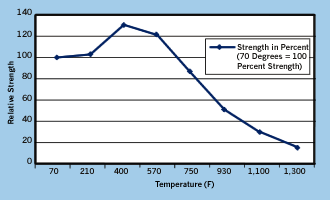
I did piping and boiler design for several years at a refinery. Carbon steel, while it may not actually melt until you get it up to thousands of degrees, loses most of its structural strength between 700 and 1000 degrees(F), well below the temperatures in the WTC fires. I lived with this frustrating fact every day, since many refinery processes crave higher temperatures. Not only does steel's strength drop with higher temperatures, but it falls exponentially once it passes a certain threshold. Some day soon I will post my refinery fire pictures, and show huge steel I-beam structures that collapsed from the heat of petroleum fires. But here is a good reality check: If skyscraper I-beams really won't fail at jet-fuel-fire temperatures, why do skyscraper builders waste millions of dollars insulating all the structural steel against building fires, which I can assure you burn much cooler than aviation fuel fires?
Beyond the basic science, most 9/11 conspiracy theories violate a couple of smell-tests. The first and most obvious is Occam's razor. Any theory that uses as a starting point a few small, minor uncertainties in events and explains these uncertainties with theories that have new, massive uncertainties in them is not necessarily wrong, but one has to treat it with huge dollops of skepticism. As Jesse Walker described 9/11 cospiracy folks in Reason's Hit and Run, "They're the sort of people who will question whether a plane actually
hit the Pentagon on September 11, 2001, but won't question a theory
that can't explain just where the hijacked aircraft landed instead."
The other smell-test I use is a law I have dubbed Coyote's Law, and it goes like this:
When the same set of facts can be explained equally well by
- A massive conspiracy coordinated without a single leak between hundreds or even thousands of people -OR -
- Sustained stupidity, confusion and/or incompetence
Assume stupidity.
Does anyone really believe that a Bush administration that can't keep a program involving a dozen people secret could keep the lid on a conspiracy this massive involving hundreds of people from any number of government agencies? Isn't incompetence a more compelling answer here?
Alexander Cockburn thinks so, as quoted in Reason's Hit and Run:
One characteristic of the nuts is that they have a devout, albeit
preposterous belief in American efficiency, thus many of them start
with the racist premise that "Arabs in caves" weren't capable of the
mission. They believe that military systems work the way Pentagon press
flacks and aerospace salesmen say they should work. They believe that
at 8.14 am, when AA flight 11 switched off its radio and transponder,
an FAA flight controller should have called the National Military
Command center and NORAD. They believe, citing reverently (this is from
high priest Griffin) "the US Air Force's own website," that an F-15
could have intercepted AA flight 11 "by 8.24, and certainly no later
than 8.30."They appear to have read no military history, which is too bad
because if they did they'd know that minutely planned operations -- let
alone responses to an unprecedented emergency -- screw up with
monotonous regularity, by reason of stupidity, cowardice, venality,
weather and all the other whims of providence....August Bebel said anti-Semitism is the socialism of the fools. These
days the 9/11 conspiracy fever threatens to become the "socialism" of
the left, and the passe-partout of many libertarians.
By the way, can anyone tell me why the so called "reality-based" community, that so often criticizes the Right for theocratic attacks on science, is so quick to fall for this pseudo-scientific junk?
Update: In case anyone cares, here is the temperature curve for the strength of carbon steel.
Update 2: I am told by email that I will now be added to the long and growing list of those who are part of the conspiracy. Cool! Please make sure the CIA spells my name right on my payoff check.
Update3: And don't miss James Meigs here.
In every single case, we found that the
very facts used by conspiracy theorists to support their fantasies are
mistaken, misunderstood or deliberately falsified.Here's one
example: Meyssan and hundreds of Web sites cite an eyewitness who said
the craft that hit the Pentagon looked "like a cruise missile with
wings." Here's what that witness, a Washington, D.C., broadcaster named
Mike Walter, actually told CNN: "I looked out my window and I
saw this plane, this jet, an American Airlines jet, coming. And I
thought, 'This doesn't add up. It's really low.' And I saw it. I mean,
it was like a cruise missile with wings. It went right there and
slammed right into the Pentagon."We talked to Walter and,
like so many of the experts and witnesses widely quoted by conspiracy
theorists, he told us he is heartsick to see the way his words have
been twisted: "I struggle with the fact that my comments will forever
be taken out of context."
OK, I confess, I enjoy Las Vegas. I mean, after a while, the smoke and the noise and the weirdness make me ready to go home, but I do enjoy an evening walking up and down the strip, checking out the sites and the people, followed by a long night of blackjack and free drinks.
Vedran Vuk looks at the government run casinos in Canada in comparison with their US counterparts, and is unimpressed.
A policy so offensive resides in Niagara Falls' casinos that I shiver at the
thought of it. Of course, I speak of the policy of no "free" alcoholic
beverages. Free drinks in casinos is something that we have come to take for
granted in our free-market-driven casino industry.Many people go to casinos exclusively for the free drinks. But of course we
can't have anything enjoyable in socialism. One beer is US$7. Furthermore, the
classic cheap and delicious casino buffet was nowhere to be seen. The buffet had
few choices, tasted like roasted nutria, and cost about US$12....This can be most seen at the Texas Hold 'Em Poker tables at which I had the
pleasure of waiting an hour and a half before being permitted to play. There are
ten tables, seven dealers, and four people managing the waiting list.An inefficiency such as this would never go on long in a real casino. What is
the purpose of the four managers when all the casino needs is dealers?! Is there
even a need for one manager of the waiting list? God forbid that the
commie casino would do anything that might be efficient and profit
maximizing.With no shareholders to answer to and no real competition, there is no
incentive to get more dealers instead of waiting-list managers. The bloated
staff of Canada's commie casinos is typical of the kind of patronage schemes
that infect all government enterprises. The end result is me waiting for ninety
minutes, during which time the casino is making no money from me.
You will have to forgive this post if it gets a little long or theoretical. Yesterday I made the mistake of going jogging when it was still 114 degrees outside, and I guess I discovered why biblical prophets seem to always get their visions out in the desert.
One of the worst ideas that affect public policy around the world is that wealth is somehow zero sum - that it can be stolen or taken or moved or looted but not created. G8 protesters who claim that poor nations are poor because wealthy nations have made them that way; the NY Times, which for a number of weeks actively flogged the idea that the fact of the rich getting richer in this country somehow is a threat to the rest of us; Paul Krugman, who fears that economic advances in China will make the US poorer: All of these positions rest on the notion that wealth is fixed, so that increases in one area must be accompanied by decreases in others. Mercantilism, Marxism, protectionism, and many other destructive -isms have all rested on zero sum economic thinking.
My guess is that this zero-sum thinking comes from our training and intuition about the physical world. As we all learned back in high school, nature generally works in zero sums. For example, in any bounded environment, no matter what goes on inside (short of nuclear fission) mass and energy are both conserved, as outlined by the first law of thermodynamics. Energy may change form, like the potential energy from chemical bonds in gasoline being converted to heat and work via combustion, but its all still there somewhere.
In fact, given the second law of thermodynamics, the only change that will occur is that elements will end in a more disorganized, less useful form than when they started. This notion of entropic decay also has a strong effect on economic thinking, as you will hear many of the same zero sum economics folks using the language of decay on human society. Take folks like Paul Ehrlich (please). All of there work is about decay: Pollution getting worse, raw materials getting scarce, prices going up, economies crashing. They see human society driven by entropic decline.
So are they wrong? Are economics and society driven by something similar to the first and second laws of thermodynamics? I will answer this in a couple of ways.
First, lets ask the related question: Is wealth zero sum and is society, or at least the material portions of society, always in decline? The answer is so obviously no to both that it is hard to believe that these concepts are still believed by anyone, much less a large number of people. However, since so many people do cling to it, we will spend a moment or two with it.
The following analysis relies on data gathered by Julian Simon and Stephen Moore in Its Getting Better all the Time: 100 Greatest Trends of the Last 100 Years. In fact, there is probably little in this post that Julian Simon has not said more articulately, but if all we bloggers waited for a new and fresh idea before we blogged, well, there would not be much blogging going on.
Lets compare the life of an average American in 1900 and today. On every dimension you can think of, we all are orders of magnitude wealthier today (by wealth, I mean the term broadly. I mean not just cash, like Scrooge McDuck's big vault, but also lifespan, healthiness, leisure time, quality of life, etc).
In 1900, the average person started their working life at 13, worked 10 hours a day, six days a week with no real vacation right up to the day they died in their mid-forties. Today, the average person works 8 hours a day for five days a week and gets 2-3 weeks of vacation. They work from the age of 18, and sometimes start work as late as 25, and typically take at least 10 years of retirement before they die.
But what about the poor? Well, the poor are certainly wealthier today than the poor were in 1900. But in many ways, the poor are wealthier even than the "robber barons" of the 19th century. Today, even people below the poverty line have a good chance to live past 70. 99% of those below the poverty line in the US have electricity, running water, flush toilets, and a refrigerator. 95% have a TV, 88% have a phone, 71% have a car, and 70% have air conditioning. Cornelius Vanderbilt had none of these, and his children only got running water and electricity later in life.
To anticipate the zero-summer's response, I presume they would argue that the US somehow did this by "exploiting" other countries. Its hard to imagine the mechanism for this, especially since the US did not have a colonial empire like France or Britain, and in fact the US net gave away more wealth to other nations in the last century (in the form of outright grants as well as money and lives spent in their defense) than every other nation on earth combined. I won't go into the detailed proof here, but you can do the same analysis we did for the US for every country in the world: Virtually no one has gotten worse, and 99.9% of the people of the world are at least as wealthy (again in the broad sense) or wealthier than in 1900. Yes, some have slipped in relative terms vs. the richest nations, but everyone is up on an absolute basis.
Which leads to the obvious conclusion, that I shouldn't have had to take so much time to prove: The world, as a whole and in most of its individual parts, is wealthier than in was in 1900. Vastly more wealthy. Which I recognize can be disturbing to our intuition honed on the physical world. I mean, where did the wealth come from? Out of thin air? How can that be?
Interestingly, in the 19th century, scientists faced a similar problem in the physical world in dating the age of the Earth. There was evidence all around them (from fossils, rocks, etc) that the earth had to be hundreds of millions, perhaps billions of years old. The processes of evolution Darwin described had to occur over untold millions of years. Yet no one could accept an age over a few million for the solar system, because they couldn't figure out what could fuel the Sun for longer than that. Every calculation they made showed that by any form of combustion they understood, the sun would burn out in, at most, a few tens of millions of years. If the sun and earth was so old, where was all that energy coming from? Out of thin air?
It was Einstein that solved the problem. E=mc2 meant that there were new processes (e.g. fusion) where very tiny amounts of mass were converted to unreasonably large amounts of energy. Amounts of energy so large that it tends to defy human intuition. Here was an enormous, really huge source of potential energy that no one before even suspected.
Which gets me back to wealth. To balance the wealth equation, there must be a huge reservoir out there of potential energy, or I guess you would call it potential wealth. This source is the human mind. All wealth flows from the human mind, and that source of energy is also unreasonably large, much larger than most people imagine.
But you might say - that can't be right. What about gold, that's wealth isn't it, and it just comes out of the ground. Yes, it comes out of the ground, but how? And where? If you have ever traveled around the western US, say in Colorado, you will have seen certain hills covered in old mines. It always fascinated me, how those hills riddled with shafts looked, to me, exactly the same as the 20 other hills around it that were untouched. How did they know to look in that one hill? Don Boudroux at Cafe Hayek expounded on this theme:
I seldom use the term "natural resource." With the possible
exception of water, no resource is natural. Usefulness is not an
objective and timeless feature ordained by nature for those scarce
things that we regard as resources. That is, all things that are
resources become resources only after individual human beings
creatively figure out how these things can be used in worthwhile ways
for human betterment.Consider, for example, crude oil. A natural resource? Not at all. I
suspect that to the pre-Columbian peoples who lived in what is now
Pennsylvania, the inky, smelly, black matter that oozed into creeks and
streams was a nuisance. To them, oil certainly was no resource.Petroleum's usefulness to humans "“ hence, its value to humans "“ is
built upon a series of countless creative human insights about how oil
can be used and how it can be cost-effectively extracted from the
earth. Without this human creativity, oil would objectively exist but
it would be either useless or a nuisance.
A while back, I published this anecdote which I think applies here:
Hanging out at
the beach one day with a distant family member, we got into a
discussion about capitalism and socialism. In particular, we were
arguing about whether brute labor, as socialism teaches, is the source
of all wealth (which, socialism further argues, is in turn stolen by
the capitalist masters). The young woman, as were most people her age,
was taught mainly by the socialists who dominate college academia
nowadays. I was trying to find a way to connect with her, to get her
to question her assumptions, but was struggling because she really had
not been taught many of the fundamental building blocks of either
philosophy or economics, but rather a mish-mash of politically correct
points of view that seem to substitute nowadays for both.I
picked up a handful of sand, and said "this is almost pure silicon,
virtually identical to what powers a computer. Take as much labor as
you want, and build me a computer with it -- the only limitation is you
can only have true manual laborers - no engineers or managers or other
capitalist lackeys".She
replied that my request was BS, that it took a lot of money to build an
electronics plant, and her group of laborers didn't have any and
bankers would never lend them any.I
told her - assume for our discussion that I have tons of money, and I
will give you and your laborers as much as you need. The only
restriction I put on it is that you may only buy raw materials - steel,
land, silicon - in their crudest forms. It is up to you to assemble
these raw materials, with your laborers, to build the factory and make
me my computer.She thought for a few seconds, and responded "but I can't - I don't know how. I need someone to tell me how to do it"
The only real difference between beach sand, worth $0, and a microchip, worth thousands of dollars a gram, is what the human mind has added.
The economist Julian Simon is famous for his rebuttals of the zero summers and the pessimists and doom sayers, arguing that the human mind has unlimited ability to bring plenty our of scarcity.
"The ultimate resource is people - especially skilled, spirited, and hopeful young people endowed with liberty- who will exert their wills and imaginations for their own benefit, and so inevitably benefit not only themselves but
the rest of us as well."
As a final note, it is worth mentioning that the world still has only harnessed a fraction of this potential. To understand this, it is useful to look back at history.
From the year 1000 to the year 1700, the world's wealth, measured as GDP per capita, was virtually unchanged.
Since 1700, the GDP per capita in places like the US has risen, in real
terms, over 40 fold. This is a real increase in total wealth, created by the human mind. And it was unleashed because the world began to change in some fundamental ways around 1700 that allowed the human mind to truly flourish. Among these changes, I will focus on two:
So today's wealth, and everything that goes with it (from shorter
work hours to longer life spans) is the result of more people using
their minds more freely.
The problem (and the ultimate potential) comes from the fact that in many, many nations of the world, these two changes have not yet been allowed to occur. Look around the world - for any country, ask yourself if the average
person in that country has the open intellectual climate that
encourages people to think for themselves, and the open political and
economic climate that allows people to act on the insights their minds
provide and to keep the fruits of their effort. Where you can answer
yes to both, you will find wealth and growth. Where you answer no to
both, you will find poverty and misery.
Even in the US, regulation and the inherent conservatism of the bureaucracy slow our potential improvement. Republicans block stem cell research, Democrats block genetically modified foods, protectionists block free trade, the FDA slows drug innovation, regulatory bodies of all stripes try to block new business models.
All over the world, governments shackle the human mind and limit the potnetial of humanity.
Today, as linked by Hit and Run, the Washingtonian lists a number of blogs that are popular with journalists. I have no particular problem with the list -- I read many of the same blogs myself. However, this description of the libertarian blog at Reasons's Hit and Run struck me as odd (emphasis added):
The libertarians behind Reason magazine strike back with
moderate commentary on a variety of topics ranging from public
television to Gwen Stefani's "Hollaback Girl."
I am not sure that many Republicans or Democrats would consider Reason to be moderate. Its hard to believe that any of us anarcho-capitalist make-government-and-taxes-go-away libertarians would ever be confused with moderates. Reason has in the last month taken stands against the drug war, against any government intervention into property rights, against the Patriot act, in defense of steroid use, and favoring legalization of prostitution and continued legality of pornography. Not many red-staters or blue-staters would call that moderate. It may be consistent, in that it is against statism and for the primacy of individual decision-making, but libertarianism tends to be extreme and uncompromising in these views. And, while most libertarians are not moderate, most moderates are not libertarians -- those who generally call themselves moderate tend to do so because they pick and choose bits of statism from both political parties.
But there is an explanation for the word "moderate", and it goes back to the crappy civics lessons we all have gotten. As I wrote before, those civics lessons were the statist's wet-dream, portraying the range of political thought on a linear scale from socialism on the left to fascism on the right. In other words, our political choices are defined as running from statist control to... statist control. In this framework, anyone who is not a commie or a Nazi are put somewhere in the middle, which has been shorthanded "moderates".
This is obviously a stupid framework, and breaks down when libertarians come into the picture. More modern self-assessment frameworks use grids of at least two dimensions, with at least one dimension being the degree (from none to total) that one accepts state authority over the individual.
Update: Oops, I missed the fact that some of the Reason writers themselves had much the same reaction.
I am a little late linking this, but the world is in the midst of one of those pure, tightly controlled experiments to demonstrate the true price of socialism. And, as usual, no one will learn from it. Via Jane Galt:
It is depressing to look back at history and see how regularly the same
nice-sounding idea--"let's take the land from the rich people who unjustly own
it and give it to those who need it"--turns into tragedy for everyone. It's even
more depressing to realise that despite the seeming predictibility of the
result, lots of people want to do it anyway.
The Atlantic, which she quote in a follow up post, has more detail:
Mugabe decided on what he called "fast-track land reform" only in February of
2000, after he got shocking results in a constitutional referendum: though he
controlled the media, the schools, the police, and the army, voters rejected a
constitution he put forth to increase his power even further. A new movement was
afoot in Zimbabwe: the Movement for Democratic Change"”a coalition of civic
groups, labor unions, constitutional reformers, and heretofore marginal
opposition parties. Mugabe blamed the whites and their farm workers (who,
although they together made up only 15 percent of the electorate, were enough to
tip the scales) for the growth of the MDC"”and for his humiliating rebuff.So he played the race card and the land card. "If white settlers just took
the land from us without paying for it," the President declared, "we can, in a
similar way, just take it from them without paying for it." In 1896 Africans had
suffered huge casualties in an eighteen-month rebellion against British pioneers
known as the chimurenga, or "liberation war." The war that brought Zimbabwean
blacks self-rule was known as the second chimurenga. In the immediate aftermath
of his referendum defeat Mugabe announced a third chimurenga, invoking a valiant
history to animate a violent, country-wide land grab...The drop-off in agricultural production is staggering. Maize farming, which
yielded more than 1.5 million tons annually before 2000, is this year expected
to generate just 500,000 tons. Wheat production, which stood at 309,000 tons in
2000, will hover at 27,000 tons this year. Tobacco production, too, which at
265,000 tons accounted for nearly a third of the total foreign-currency earnings
in 2000, has tumbled, to about 66,000 tons in 2003.Mugabe's belief that he can strengthen his flagging popularity by destroying
a resented but economically vital minority group is one that dictators elsewhere
have shared. Paranoid about their diminishing support, Stalin wiped out the
wealthy kulak farming class, Idi Amin purged Uganda's Indian commercial class,
and, of course, Hitler went after Jewish businesses even though Germany was
already reeling from the Depression. Whatever spikes in popularity these moves
generated, the economic damage was profound, and the dictators had to exert
great effort to mask it.
Overall, the country has gone from a net exporter of food to outright famine. For this particular experiment, I am happy to live in the control group. Stay tuned, as this show is likely to hit the road soon and move to Venezuela.
Well, it worked for Johnny Carson, why not for me? Instead of leaving you with dead air (photons?) while I am knocking the rust off my beer pong skills back at Princeton, I will share with you a few of my favorite posts from my early days of blogging. Since most of these posts were viewed by about 5 people, there is a certain temptation to just recycle them without attribution, given the unlikelihood of getting caught. Instead, though, I will share them as my best of Coyote...
This post was from early last December, and is titled "60 Second Refutation of Socialism, While Sitting at the Beach":
Last week, there were several comments in Carnival of the
Capitalists that people would like to see more articles highlighting
the benefits of capitalism. This got me thinking about a conversation
I had years ago at the beach:
Hanging
out at the beach one day with a distant family member, we got into a
discussion about capitalism and socialism. In particular, we were
arguing about whether brute labor, as socialism teaches, is the source
of all wealth (which, socialism further argues, is in turn stolen by
the capitalist masters). The young woman, as were most people her age,
was taught mainly by the socialists who dominate college academia
nowadays. I was trying to find a way to connect with her, to get her
to question her assumptions, but was struggling because she really had
not been taught many of the fundamental building blocks of either
philosophy or economics, but rather a mish-mash of politically correct
points of view that seem to substitute nowadays for both.
One
of the reasons I took up writing a blog is that I have never been as
snappy or witty in real-time discussions as I would like to be, and I
generally think of the perfect comeback or argument minutes or hours
too late. I have always done better with writing, where I have time to
think. However, on this day, I had inspiration from a half-remembered
story I had heard before. I am sure I stole the following argument
from someone, but to this day I still can't remember from whom.
I
picked up a handful of sand, and said "this is almost pure silicon,
virtually identical to what powers a computer. Take as much labor as
you want, and build me a computer with it -- the only limitation is you
can only have true manual laborers - no engineers or managers or other
capitalist lackeys".
Yeah, I know
what you're thinking - beach sand is not pure silicon - it is actually
silicon dioxide, SiO2, but if she didn't take any economics she
certainly didn't take any chemistry or geology.
She
replied that my request was BS, that it took a lot of money to build an
electronics plant, and her group of laborers didn't have any and
bankers would never lend them any.
All
too many defenders of capitalism would have stopped here, and said
aha! So you admit you need more than labor - you need capital too.
But Marx would not have disagreed - he would have said it was the
separation of labor and capital that was bad - only when laborers owned
the capital, rather than being slaves to the ruling class that now
controls the capital, would the world reach nirvana. So I offered her
just that:
I
told her - assume for our discussion that I have tons of money, and I
will give you and your laborers as much as you need. The only
restriction I put on it is that you may only buy raw materials - steel,
land, silicon - in their crudest forms. It is up to you to assemble
these raw materials, with your laborers, to build the factory and make
me my computer.She thought for a few seconds, and responded "but I can't - I don't know how. I need someone to tell me how to do it"
And
that is the heart of socialism's failure. For the true source of
wealth is not brute labor, or even what you might call brute capital,
but the mind. The mind creates new technologies, new products, new
business models, new productivity enhancements, in short, everything
that creates wealth. Labor or capital without a mind behind it is
useless.
From the year 1000 to the year 1700, the world's wealth, measured as GDP per capita, was virtually unchanged.
Since 1700, the GDP per capita in places like the US has risen, in real
terms, over 40 fold. This is a real increase in total wealth - it is
not money stolen or looted or exploited. Wealthy nations like the US
didn't "take" the wealth from somewhere else - it never even existed
before. It was created by the minds of human beings.
How? What changed? Historians who really study this
stuff would probably point to a jillion things, but in my mind two are
important:
So today's wealth, and everything that goes with it (from shorter
work hours to longer life spans) is the result of more people using
their minds more freely.
Look around the world - for any country, ask yourself if the average
person in that country has the open intellectual climate that
encourages people to think for themselves, and the open political and
economic climate that allows people to act on the insights their minds
provide and to keep the fruits of their effort. Where you can answer
yes to both, you will find wealth and growth. Where you answer no to
both, you will find poverty and misery.
UPDATE
While it is not exactly a direct follow-on to this article, see my post Progressives are too Conservative to Like Capitalism
for an analysis of some of capitalism's detractors. For yet another
way to explain capitalism, at least libertarian philosophy, here is a new-agy approach that is actually pretty good. Finally, Spontaneous Order
has an interesting post comparing religious creationism in the physical
world with progressives' statism in the economic/social realms.
For years, high school civics books have portrayed our political choices as ranging from socialism on the left to fascism on the right. These textbooks represent the statists' wet dream -- the reframing of political discussion such that all possible outcomes are defined as rigid government control of individual lives. The only difference is who is in charge, and the path they took to get there.
Think I am exaggerating? Here's an example:
The left hate George Bush. Fine. I have my own problems with the man. Over the last few years, the left has cast about for a person to rally around as a counterpoint to Bush. Some latched on the the French leadership, some to Saddam Hussein, some even recently to George Gallway. I think you can see the problem here, and the mistake Michael Moore made. Forcing voters to choose between Saddam Hussein and George Bush is practically begging them to vote Republican.
After the last election, I had hoped that the left had gotten wiser. I guess not. Apparently the "progressive" community is rallying around Hugo Chavez as their next model leader:
Of the top oil producing countries in the world, only one is a democracy with a
president who was elected on a platform of using his nation's oil revenue to
benefit the poor. The country is Venezuela. The President is Hugo Chavez. Call
him "the Anti-Bush."...Instead of using government to help the rich and the corporate, as Bush does,
Chavez is using the resources and oil revenue of his government to help the poor
in Venezuela. A country with so much oil wealth shouldn't have 60 percent of its
people living in poverty, earning less than $2 per day. With a mass movement
behind him, Chavez is confronting poverty in Venezuela. That's why large
majorities have consistently backed him in democratic elections. And why the
Bush administration supported an attempted military coup in 2002 that sought to
overthrow Chavez.
And this is the group that calls themselves "reality-based"? Does anyone really believe that poverty results solely from not handing oil revenue to the poor? The US doesn't do this (well, except in Alaska), yet despite this our poor in this country are wealthier than the middle class in Venezuela, and its because we have a stable government that protects property rights and individual freedoms and provides a stable environment for investment. Prosperity comes from building a healthy and growing economy, not looting a particular industry. (By the way, I am sure that the previous regime was looting the oil industry as well, so I am certainly not defending them.)
However, this point is worth repeating: Progressives consider Venezuela to have a better policy for helping the poor than the US, but the poorest 20% in the US still make more money and live better and longer than at least 80% of Venezuelans. A person in the middle of the "poor" quintile in the US would be upper middle class in Venezuela. And I will bet anyone that after 10 years of Chavez rule, this will be more, not less, true.
Chavez is a totalitarian thug. Human Rights Watch has plenty to say about his miserable record of trashing freedoms. In particular, you can compare the supreme court shenanigans of the "anti-Bush" with ridiculously mild controversy in this country (at least by comparison) over judicial nominations. More background on Chavez here.
So there you are. We are given the choice of Bush or Chavez. Statism or statism. Thanks a lot.


