Posts tagged ‘priorities’

The Forgotten Dead

I was thinking today, what must the families of the 11 people killed on the Deepwater Horizon be thinking?  Their losses are never mentioned in any news reports I see.  Its all about getting oil on the ducks.

Sure, I am pissed off about the enormous damage to the Gulf Coast as well.  But I got to thinking, were I the engineer that made the wrong risk/safety decisions here, what would I feel most guilty about?  I was put in that position for years in a refinery, constantly asked, “is this safe” or “can we keep running” or “do we need to shut down” or “is that vibration a problem?”  These are difficult, because in the real-world of engineering, things are not ever perfectly safe.  But never-the-less, if I had made the wrong call here, I think I would be feeling a lot worse about the 11 dead people than a number of dead fish and birds.  Perhaps my priorities are out of whack with the times.

By the way, TJIC has a great post on risk and cost in the real world of engineering.  I agree with his thoughts 100% from my experience as a troubleshooter / engineer in the field making just these decisions.

Look, we all trade off safety in order to save time and expense.

Do you put on your seat belt when moving your car from one point in the driveway to another?

Do you buy the car that costs twice as much, because it’s got a 1% increase in crash survivability?

Did you pay $40k to get industrial fire sprinklers installed in your house?

Do you have a home defibrillation machine?

There is nothing wrong, in the abstract, with trading off safety in order to save time and expense.

The question is whether BP did this to a level that constitutes “gross negligence”.

Paging Frédéric Bastiat

The US Forest Service is using a million dollars of its stimulus money to … fix broken windows! How appropriate.  But these are not any broken windows — these are energy inefficient windows for a visitor center that was closed two years ago and for which no budget exists now or in the future to reopen.   Beyond the nuttiness of building a multi-million dollar visitor center, then closing it only a few years after it was built, and then spending a million dollars on its abandoned carcass, no one was available to explain how energy efficient windows will save money in a building that shouldn’t be using any energy any more.  Remember, for this spending to truly be stimulative, the money has to be spent more productively than it would have been in whatever private hands it was in before the government took it.

But even forget the stimulus question and just consider the issue of resource allocation.   I work on or near US Forest Service lands in many parts of the country, and know that their infrastructure is falling apart.  Congress loves to appropriate money for new facilities (like shiny new visitor centers), but never wants to appropriate money for capital maintenance and replacements of existing facilities.  So there are plenty of needs for an injection of $274 million in capital improvement money.  And I know that the USFS has had teams of people working for 6 months on their highest priorities.  And after all that work, they allocated  almost a half percent of their funds on upgrading windows in an abandoned building?

Postscript: I have vowed not to write about the US Forest Service because I interact with them so much and such interactions would not be improved by my dissing on them online [I am in the business of privitizing the mangement of public recreation and am constantly working to convince the USFS and other recreation providers to entrust more to private companies.  One thing many people don't know -- the USFS is by far the largest public recreation provider in the world, far larger than the National Park Service or the largest state park systems].  However, I feel on safe ground here, as I think virtually every frontline USFS employee I know would agree with this post and be equally angry.  In recreation at least, this is an organization that begs and pleads to get a few table scraps left over after the National Park Service is done eating, and it is crazy that they spend the few scraps they get this poorly.

Classic Obama Plan: Give Them Taxpayer Money, But Not Liberty

With gays upset that Obama has aligned himself squarely behind DOMA and Don’t-ask-don’t-tell in the military, he has decided to pay them off rather than address their equal treatment questions:

President Barack Obama, whose gay and lesbian supporters have grown frustrated with his slow movement on their priorities, is extending benefits to same-sex partners of federal employees but stopping short of a guarantee of full health insurance, a White House official said.

The health insurance exception is particularly funny given Obama’s current universal-coverage-driven health care proposals.

Priorities and the Precautionary Principle

Indur Goklany (pdf) has deconstructed the IPCC climate forecasts and models and finds something interesting — for all the forecasts of catastrophe, it is hard to find it in the actual IPCC numbers  (vs. off-the-cuff statements by folks like Al Gore).

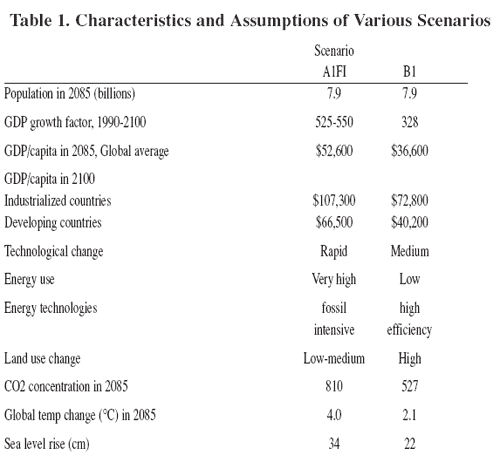
First, one needs to understand the basis for the various scenarios crafted by the IPCC.  I will leave some out, and focus on Goklany’s analysis of just two – the IPCC A1F1 and B1 scenarios.  (the charts below have been edited to simplify them to just these two scenarios)

scenarios

One can think of A1F1 being close to a “do nothing” scenario on CO2, what is often called a Richer but Warmer scenario.  The B1 scenario represents fairly large interventions in Co2 use and investments in energy technologies, with lower CO2 concentrations and as a result lower but still positive GDP growth  (it takes only a small change in GDP growth to result in large changes in GDP 80 years hence — the miracle of compounding).  This is the cooler but poorer scenario.  I know the Left has a fantasy that climate legislation is somehow an economic engine, but most economists on this reality plane achnowlege a tradeoff between CO2 intervention and economic growth.

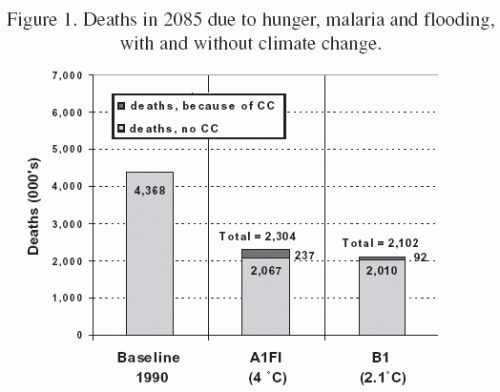
Goklany collates the impact on mortality from these two scenarios in the IPCC report:

mortality

Note that I am not even bothering to quibble with the IPCC numbers, which I could.  I have written plenty that these temperature increase forecasts are based on assumptions of positive feedback in the climate that make little sense.  Further, it makes little sense that the poorer and less advanced world in B1 would have lower base mortality than the richer, more advanced world.

Nevertheless, we can make three observations:

  • The difference in mortality from “do nothing” to “strong intervention” is small, and I would suspect hardly statistically significant
  • The improvement in mortality from advancing technology and wealth from the 1990 baseline dwarfs the effects of climate change
  • The mortality improvements from massive focus on climate change are trivial compared to those that could be achieved with much less expensive focus on other issues.

Hat tip to Watts Up With That, who has more here in a guest essay by Goklany.

Prices vs. Government Action

Very often on this blog I criticize some ill-conceived government intervention as being bloated and/or ineffective and ill-conceived.  A great example is corn-ethanol, where the government has spent billions and caused consumers to spend additional billions in higher food and gas prices, all for a technology that does nothing to reduce oil consumption or CO2 output.

Too often, I criticize these programs for being stupid and ill-conceived, which they are.  But what I don’t take the time to also point out is the necessarily narrow focus of these government actions.  No matter how hard Congress works to stuff energy and farm bills with every micro-managing pork barrel project their campaign donors could wish for, Congress still only has the bandwidth to affect a tiny fraction of a percent of what a single change in market prices can achieve.  Prices have absolutely stunning power of communication.  When gas prices go up, every single citizen likely reassesses his/her behavior and spending in a myriad of ways.  Thousands of entrepreneurs sit at their desk staring at the walls, trying to dream up business opportunities that these new prices may signal.  And thousands of energy producers, from the tiniest to the largest, rethink their investment plans and priorities. 

Is the Global Warming Hysteria Killing Environmentalism?

Of late, I have been getting the strongest sense that the global warming hysteria is sucking all the oxygen out of the rest of the environmental movement.  Quick, what is the last environment-related article you read that didn’t mention global warming?

Here is an example:  I give a lot of my charity money to groups like The Nature Conservancy, because I personally value preservation of unique areas and habitats and I don’t sit around waiting for the government to do it for me.  But it has become almost impossible of late to drum up enthusiasm from contributors for such causes, unless the land can be labeled a carbon-sink or something.  In fact, the global warming hysteria has really been a disaster for private land conservation because it has caused politicians to subsidize ethanol.  This subsidy is bringing much more wild land into cultivation in this country and has been the single biggest driver for deforestation in the Amazon over the last decade. 

Or take China.  China’s cities are an unhealthy mess.  But focus on global warming has led environmentalists to take the position with China they have to stop coal combustion and growth in auto-miles entirely.  This is a non-starter.  There is no WAY they are going to do this.  But it is much more achievable to start getting China focused on a Clean-Air-Act type of attack on vehicle and coal plant emissions of real pollutants like SO2.   China could be made much more healthy, as the US has done over the last 30-60 years, but instead of working with China to get healthier, the focus is on getting them to shut down their growth altogether.

The UPI published a survey of people’s environmental priorities:

  1. drinking water
  2. pollution of rivers, lakes, and ecosystems
  3. smog
  4. forest preservation
  5. acid rain
  6. tropical rain forests
  7. national parks
  8. greenhouse emissions
  9. ozone layer
  10. nature around "my" home
  11. urban sprawl
  12. extinction.

I feel like #1 is overblown based on a lot of media scare stories, but most of the top 6 or 7 would all be things I would rank well above global warming fears as well.  There are still real issues to be dealt with in these areas which can have far more of a positive impact on health and quality of living than CO2 abatement, but they are being suffocated by global warming hype.

You Can’t Make Decisions for Yourself

A frequent topic of this blog is to point out situations where technocrats translate their distrust for individual decision-making into the justification for government control

Kevin Drum provides me with one of the best examples I have seen of late of this phenomena of using distrust of individual decision-making to justify government intervention, in part because he is so honest and up-front about it.  I usually try not to quote another blogger’s posts in total, because I want to give folks an incentive to go visit the site, but in this case I need to show the whole thing (the extensive comments are still worth a visit):

If we treat healthcare like any other market, allowing consumers
free rein to purchase the services they like best, will it produce high
quality results? A recent study suggests not:

Researchers
from the Rand Corp. think tank, the University of California at Los
Angeles and the federal Department of Veterans Affairs asked 236
elderly patients at two big managed-care plans, one in the Southwest
and the other in the Northeast, to rate the medical care they were
getting. The average score was high — about 8.9 on a scale from zero to
10.

….In the second part of their study, the medical researchers
systematically examined 13 months of medical records to gauge the
quality of care the same elderly patients had received….The average
score wasn’t as impressive as those in the patient-satisfaction
surveys: 5.5 on a 10-point scale. But here’s the interesting part:
Those patients who graded the quality of their care as 10 weren’t any
more likely to be getting high-quality care than those who gave it a
grade of 5. The most-satisfied patients didn’t get better medical care
than the least-satisfied.

Surprise! Patients are
poor judges of whether they’re getting good care. And if consumer
preferences don’t map to high quality care, then a free market in
healthcare won’t necessarily produce better results or higher
efficiency, as it does in most markets.

Back to the drawing board. Perhaps a national healthcare system
would be a better bet to reduce costs, cover more people, provide
patients with more flexibility, and produce superior outcomes. After
all, why are we satisfied with allowing the French to have a better
healthcare system than ours even though we’re half again richer than
them?

There is it, in black and white:  Most of you individual slobs out there cannot be trusted to make good health care decisions for yourselves, so the government should do it for you.  (And by the way, who the hell thinks the French have a better health care system, but that’s off-topic for today).

Here is the false premise:  If the intellectuals who ran the study judged that the individuals involved were getting poor care when the individuals themselves thought is was good care, this does not necessarily mean the individuals being studied were wrong.  It may very well mean they have different criteria for judging health care quality and value.  In fact, what goes unquestioned here, and I guess the reader is supposed to swallow, is that there is some sort of Platonic ideal of "high-quality care" that the people who run this study have access to.

But this is ridiculous.   Does high-quality mean fast?  painless?  private?  successful?  pleasant? convenient?  I, for example, have all the patience of an 8-year-old who just ate three pieces of birthday cake washed down by two Cokes.  I need stuff now, now, now.  I hate gourmet restaurants where meals take 3 hours.  Many gourmands, on the other hand, would probably shoot themselves before eating some of the food I eat.  We have different standards.

Let’s take an example from another industry:  Cars.  Every year, the "experts" at Consumer Reports and Car and Driver try out all the new cars and publish the two or three they think are the best.  So, does this mean that everyone who does not buy one of these cars selected by the experts as the best are making a bad decision?  Does this fact tell us the government should step in and buy their cars for them because they can’t be trusted to make the right evaluations?   NO!  Of course not.  It means that the people who buy other types of cars have different criteria and priorities in judging what a "high-quality" car is.  Some want high gas mileage.  Some want a tight interior with leather.  Some want a big honkin’ engine.  Some want a truck jacked way up in the air.  Some want room to carry five kids.   You get the idea.

There are at least two better explanations for the study results.  Let’s first be clear what the study results were:  The study found that the patients studied graded health care differently than did the people who ran the study.  That’s all it found.  This could mean that the intellectuals who ran the study and the individuals studied judged care on different dimensions and with different priorities.  Or it could mean that the individuals studied had incomplete information about their care and their choices.  Neither justifies a government takeover of the industry.  (In fact, to the latter point about information, markets that are truly allowed by the government to be free, which health care has not, often develop information sources for consumers, like the car magazines mentioned above.)

The thinking in Drum’s post betrays the elitist-technocratic impulses behind a lot of the world’s bad government.  Look at "progressive" causes around the world, and you will see a unifying theme of individual decisions that are not trusted, whether its a poor Chinese farmer who can’t be trusted to choose the right factory work or an American worker who can’t be trusted to make her own investment decisions for retirement.

Postscript:  In some past era, I might have called this one of the worst excuses for fascism I had ever heard.  Unfortunately, Brad DeLong recently took that title with his post that the government needs to take even more money from the rich because the rich are ostentatious and that hurts other people’s feelings.  No really, I don’t exaggerate, he said exactly that.  If somehow you have missed this one, look here.

Why do So Many Libertarians Blog?

A few weeks ago, in an interview about blogging, I was asked "why are there so many libertarian bloggers?"  My answer didn’t make the final cut for the article, but I thought it was worth repeating here**:

First, I am tempted to answer with a variation of the argument that the left uses to justify why so many academics
are liberal – ie, that we bloggers are all smarter and therefore libertarians.  I will eschew that one though, because I think the real reason is that libertarians have never had a really good outlet for our opinions and it is a relief to have a channel to be able to express our views without distortion. 

Part of this is because there are few good organized outlets for libertarians.  In the past, libertarians could perhaps find a voice in one of the two major parties, but that tends to just end in frustration as about the 50% of what either party espouses is inconsistent with a true respect for individual liberties.  At the same time, the formal libertarian party has often been a joke, fielding some pretty bizarre candidates with some pretty niche priorities.

However, a major part of the problem is that libertarianism resists organization.  Libertarianism tends to be a big tent that attracts everything from anarcho-capitalists to Cheech-and-chong-esque hempfest organizers to Larry-Flint style pornographers.  For this reason, libertarianism defies efforts to brand it, which is a critical shortcoming since the two major political parties nowadays are much closer to brands than ideologically consistent philosophical alternatives. 

Libertarians revel in differences and being different.  Almost by definition, none of us have the same message, or even believe that we all should have the same message. Many of us are suspicious of top-down organization in and of itself.  Blogging is therefore tailor made for us – many diverse bottom-up messages rather than one official top-down one.

Finally, since libertarianism is really about celebrating dynamism and going in a thousand different directions as each individual chooses, in some sense the Internet and blogging are not only useful tools for us libertarians, but in and of themselves are inherently libertarian vehicles.  Certainly libertarian hero F. A. Hayek would recognize the chaos of the Internet and the blogosphere immediately.  For a good libertarian, chaos is beautiful, and certainly the blogosphere qualifies as chaotic.   The Internet today is perhaps the single most libertarian institution on the planet.  It is utterly without heirarchy, being essentially just one layer deep and a billion URL’s wide.  Even those who try to impose order, such as Google, do so with no mandate beyond their utility to individual users.

When people are uncomfortable with the blog phenomenon, they tend to be the same people who are
uncomfortable with anything chaotic.  I have written several times, particularly here and here, that people across the political spectrum, from left to right, are united by an innate fear of and need to control chaos.  Conservatives don’t like the chaos of themes and messages found in movies and media.  Liberals insist on a unified public education system with unified messaging rather than the chaos of school choice and home schooling.  Socialists hate the chaos and uncertainty of the job market, and long for guaranteed jobs and pensions.  Technocrats hate the chaos of the market, and seek to impose standardization.  Everyone in the established media hates blogs, which threaten to upset the comfortable order of how-we-have-always-done-things.

** Which just demonstrates another reason why we all blog- no editors!  There is a saying that a lawyer who represents himself has a fool for a client.  It may well be that we bloggers are in the process of proving a parallel adage about being our own editors.