Posts tagged ‘pricing’

A Brief Observation on Pricing

Michael Cannon writes about the new trend in airline pricing to charge extra fees for different services (ranging from sodas to checked baggage).  I have seen several writers of the progressive ilk all up in arms about these extra fees.  Which in my mind confirms that there is no foundational position among progressives on such matters, only opportunistic attacks on corporations for whatever they happen to be doing.  They want air travel pricing to be bundled into one rate, covering all potential services one may or may not use.  But wait, they want cable TV pricing to be unbundled, with a la carte pricing rather than one rate so viewers can pay for only what they use. 

Anyway, the only irritation I have with the new airline pricing is that it drives people to try to carry on every bag they can, particularly since, at least on US Airways currently, bags that are gate-checked are not charged a fee.  This is fouling up security lines and making it a necessity to board early on a plane to have any hope of finding a carry-on space.  Which may add another revenue opportunity, that of charging extra for the option to board early.  Which, come to think of it, Southwest is already doing.

Just When Yout Thought Air Travel Could Not Get Worse…

US Airways has chosen to try to cover rising fuel prices by unbundling their ticket price and charging for services that were here-to-fore free, or built into the base ticket price.  They now charge $15 for the first piece of checked baggage ($25 for the second), and charge for most in-cabin services, including for soft drinks.

I’m not going to argue with them about this.  Airline pricing is a wickedly complex topic, and folks who know more than I do think this is the best way to get incremental revenue.  Really, these charges don’t affect me (I almost never check bags, except when on vacation with my family).  In fact, as I write this, it strikes me that the baggage charge is really a price hike mostly on non-business travelers, which is interesting as it bucks the trend of having increasing price spreads over the years between business/last-minute and tourist pricing.

Anyway, the net effect has been to absolutely jam the security screening station this morning.  Every passenger seems to be carrying every bag he or she can on board to avoid the $15 charge.  What a mess.  I can’t wait to see what the boarding process is going to be like.  Glad I don’t have any bags today.

By the way, a few weeks ago I shipped a 60 pound trunk to my kids’ camp for about $16 via UPS.  If these airline bag charges stick, it might be time for UPS to start soliciting the send-your-luggage-ahead business in earnest.  Next time we go skiing or some such place, I am going to seriously consider sending a couple of duffle bags ahead by UPS.

Update: The luggage bins were completely full before the fourth group out of six were called.  There was a fairly long line down the jetway of people gate-checking their bags.  Apparently, the airline is not set up to charge the $15 when they gate-check the bags, so everyone is hauling all of their bags to the gate and either bringing them on the plane or checking them at the gate for free.

Water and Pricing

I while back, I wrote that I could fix our Arizona water "shortage" in about 5 minutes.  I pointed out that we in Phoenix have some of the cheapest water in the country, and if water is really in short supply, it is nuts to send consumers a pricing signal that says it is plentiful. 

David Zetland (via Lynne Keisling) follows up on the same theme:

The real problem is that the price of water in California, as in most
of America, has virtually nothing to do with supply and demand.
Although water is distributed by public and private monopolies that
could easily charge high prices, municipalities and regulators set
prices that are as low as possible. Underpriced water sends the wrong
signal to the people using it: It tells them not to worry about how
much they use.

Unfortunately, water is one of those political pandering commodities.  Municipal and state authorities like to ingratiate themselves with the public by keeping water prices low.  At the same time, their political power is enhanced if shortages are handled through government rationing rather than market forces, since politicians get to make the rationing decision — just think of all those constituencies who will pour in campaign donations to try to get special rights to water from the water rationers.

Peak Pricing for Parking

From my point of view, the NY Times buried the lede in this story about installation of parking sensors on San Francisco streets.  The article focuses mainly on the ability of drivers at some time in the future to get locations of empty parking spots on the streets via smartphone or possibly their GPS.  But I thought the pricing changes they were facilitating were more interesting:

SFpark, part of a nearly two-year $95.5 million program intended to
clear the city’s arteries, will also make it possible for the city to
adjust parking times and prices. For example, parking times could be
lengthened in the evening to allow for longer visits to restaurants.

The
city’s planners want to ensure that at any time, on-street parking is
no more than 85 percent occupied. This strategy is based on research by
Mr. Shoup, who has estimated that drivers searching for curbside
parking are responsible for as much of 30 percent of the traffic in
central business districts.

In one small Los Angeles business
district that he studied over the course of a year, cars cruising for
parking created the equivalent of 38 trips around the world, burning
47,000 gallons of gasoline and producing 730 tons of carbon dioxide.

To
install the market-priced parking system, San Francisco has used a
system devised by Streetline, a small technology company that has
adapted a wireless sensor technology known as “smart dust” that was
pioneered by researchers at the University of California, Berkeley.

It
gives city parking officials up-to-date information on whether parking
spots are occupied or vacant. The embedded sensors will also be used to
relay congestion information to city planners by monitoring the speed
of traffic flowing on city streets. The heart of the system is a
wirelessly connected sensor embedded in a 4-inch-by-4-inch piece of
plastic glued to the pavement adjacent to each parking space.

The
device, called a “bump,” is battery operated and intended to last for
five and 10 years without service. From the street the bumps form a
mesh of wireless Internet signals that funnel data to parking meters on
to a central management office near the San Francisco city hall.

This is actually really cool, but my guess is that politicians will not have the will to charge the level of peak prices the system may demand.

Postscript:  As many of you know, there is a new wave of urban planners who want to impose dense urban living on all of us, whether we like it or not.  I have no problem with folks who want to fight the masses and live in downtown SF or Manhattan, but the world should also have a place for the majority of us who like to have an acre of land and a bit less congestion. 

Anyway, in singing the praises of the urban lifestyle (which often is as much an aesthetic preference vs. suburbia as anything else), you seldom hear much about this type of thing:

Solving the parking mess takes on special significance in San Francisco
because two years ago a 19-year-old, Boris Albinder, was stabbed to
death during a fight over a parking space….

The study also said that drivers searching for metered parking in just
a 15-block area of Columbus Avenue on Manhattan’s Upper West Side drove
366,000 miles[!!] a year.

And here we suburbanites are complaining when we have to park more than 5 spaces from the door of the supermarket.

So Where Are They Storing All the Oil?

I find the current political demagoguery that oil speculators are now the ones responsible for higher oil prices to be absolutely laughable.  I am willing to believe that oil supply and demand are perfectly inelastic over very short time periods, meaning that we might expect little change in supply or demand over a couple of days or weeks after a price change, allowing for a fairly free range of speculative excesses.  However, there is every evidence that oil is by no means perfectly price inelastic, and supply and consumption do change with price.  Already in the past few months we have seen, for example, substantial reductions in passenger car miles in this country. 

For any period of time longer than hours or days (or perhaps weeks), any cabal that is somehow manipulating oil prices well above the natural market clearing price is going to have to deal with a problem:  Extra oil.  Lots of it.  Even if the supply side is sticky due to shortages currently in drilling equipment, demand is not.  People are going to use less, and at the same time, every supplier is going to be trying to send every barrel to market as quick as they can  (oil producers know that prices that rise will eventually fall again — that is the history of oil.  They are all programmed to move as much product as possible when prices are at all time highs).

A lot of dynamics, such as a short squeeze, can create a speculative bulge, but if speculators are somehow purposefully keeping oil prices high for long periods of time, they must be doing one of three things:

  1. Storing a lot of oil somewhere
  2. Creating an extensive system of production controls that keeps oil supply off the market.
  3. Have someone with deep pockets subsidize consumer demand for oil by selling excess oil off at below market prices.

One is just not possible, not in the quantities that would be required.  Two sort of happens in a haphazard and not very consistent way with OPEC, though it is hard to convince me that futures traders in Chicago have an active partnership with large state-run oil companies.  Three is actually happening, with the Chinese government continuing to sell gasoline and other petroleum products at below market prices, but there is evidence that there are limits to how much further they will take this.  Again, I think this is being done for reasons other than cooperation with mercantile exchange traders in the US.

To a large extent, this theory, if it is anything more than just populist capitalism-bashing, is a result of extreme ignorance.  There are an incredible number of people involved in the oil markets every day in numerous countries with numerous different incentives, such a large number that it is impossible to imagine a conspiracy.  There have been a couple of cases of proven petroleum commodity price manipulation in these trading markets – most of these have involved manipulation of prices at the end of the day on certain futures expiration and/or Platt’s pricing windows.  The time frame for these manipulations have been on the order of 1-2 minutes.

But here is the best argument against this manipulation for higher prices, and it is amazing to me that no one ever thinks of it.  Sure, there are a bunch of really savvy people in the commodity trading business who are long on oil and want the price to be higher.  But for every seller, there is a buyer on the other side, someone who is at least as savvy and is desireous of lower prices.  Yes, I know it is a complicated concept, but for every trader selling there is one buying.  If there is an extended conspiracy to push up oil prices by speculators, do you really think the buyers are just going to sit on their hands and take it?  And do you really think the exchanges are going to be happy with this behavior, threatening the integrity of their trading system (really their only asset)?  Just ask the Hunt family, which attempted to corner the market and drive prices up in silver, only to have major buyers and the exchanges stop them cold, driving the Hunts in the process into bankrupcy. 

I wrote about this same topic previously here.

Progressives Support Markets?

It may really be a new era, when markets rather than command-and-control government allocations and restrictions are advocated by progressives to allocate scarce resources.  In this case, the argument is especially surprising, since it is arguing for more open water markets.  For some reason, water is the last place anyone seems to want to apply pricing signals, something I have written on many times.

There are clear gains from having an active market in water rights. It
would help solve the problems posed by current water shortages in the
West, and it would provide the flexibility necessary to confront the
impact of climate change on water supplies in the coming decades. It
would be, in a word, fluid.

At the Superbowl

Yesterday, I had what will likely (given ticket prices) be a once in a lifetime experience for me — I got to take my son to the Superbowl.  Our ability to afford this event really was a result of our living in the same city as the Superbowl.  The obvious reason for this is that we did not incur any significant travel costs and did not have to pay peak demand level hotel pricing.  The less obvious, but ultimately more important, reason was because we could afford to watch the ticket prices on the secondary market up until the absolute last minute.  If your were bringing a group from New York, waiting until Friday or Saturday to buy tickets might have been a bit uncomfortable, given other sunk costs. 

As it turned out, Superbowl ticket prices this year on the secondary market  (e.g. TickCo, Stubhub, et al) followed a parabola.  They were below their peak early-on, particularly since sellers did not have the tickets in hand.  You can buy tickets weeks before the Superbowl, but they will be listed as "for this general area."  You could end up in the front row or the back — it is a bit of a crap shoot.  So they are cheaper because of this.  The peak pricing came the week before the AFC and NFC championship games when many sellers had tickets in hand and could advertise specific seats.  All along, I was looking for a ticket to just get in the door, so I was looking for the cheapest seats (likely upper deck end zone).  At their peak, there was nothing gong for less than about $3800 (when you included the seller commission or transaction fees, typically 10-20% for this type of ticket).  Beginning the Monday before the game, prices started falling  -first 10%, then 20-30%, and finally as much as 50%.  I jumped in towards the end of the week because a pretty good (or at least better than the worst) seat came up for a good price.  I am told by a friend who showed up on game day at the ticket company office that he got in for less than $1500.

Anyway, here is the stadium – yes it is kind of odd looking.  This was taken about halfway through our walk from the car to the stadium.  We just barely parked in the same county.  We showed up about 6 hours before game time and were in the last half of arrivals:
Sb8_2

The stadium is a taxpayer-funded boondoggle that is a good hour away (on the complete opposite side of a very large city) from old Scottsdale where most of the parties and social activities and player hotels were. 

The security included a ban on any bag over 12x12x12 inches, a pat down, and a metal detector.  And the NFL did a MUCH better job than the TSA.  MUCH.  It is hard to see, but the tent on the left is about 1/4 of the length of the full security screening area.   They had  at least 25 lanes open in parallel.  Despite thousands of people, we had no wait at all (the lines below are all moving briskly and continuously).
Sb7

And look!  We must be in the front row!  Well, of the upper deck, but these turned out to be great seats and, having watched prices for weeks, a very good price-value point (in context).  My son braves the wrath of all the surrounding Giants fans by wearing his Cowboys jersey.
Sb6

I thought the fast set up and takedown of the stages was pretty amazing, and something you miss on TV.  Here is Tom Petty’s stage going out (or in, I can’t remember).  The funniest part was the crew of NFL guys who followed along with rags and buckets to dust off the grass after the equipment passed to make sure it looked good for TV.
Sb2

Sb10

We had a decent view of Tom Petty’s back, which once I saw his scraggly beard was probably a good thing.  The crew of screaming fans at the stage was pretty funny.  They ran these folks out for Alicia Keyes, then kicked them out of the stadium, then ran them back in for Tom Petty, and then back out again.  I saw one show on TV last night, and the audience looked young, but to my eye the great mass of the crowd was middle aged women, which I thought was kind of funny.
Sb3

And here is the last play and confetti burst:

It was a great, perhaps historic game, and we loved the whole experience.  Now back to work to pay those bills.

So, here are the [sports-related] events on my must-see list I have tackled:

Baseball all-star game, Superbowl, game at Fenway, game at Yankee stadium, 16th hole at the Phoenix Open, center court at Wimbledon, BCS Championship game, Daytona 500, personally playing golf at St. Andrews, Big 10 home football game, Rose Bowl, Cowboys home game [update: and an original 90s-vintage American Gladiators filming live]

Yet to be tackled:

the Masters, Packers home game, game at Wrigley, NCAA final four, SEC home football game (maybe Tennessee or the cocktail party), maybe at World Series, maybe a World Cup

What else?

Using Copyright Law to Block Price Arbitrage

Movie producers sell DVDs cheaper in, say, Taiwan than they do in the US.  This is not an unheard of economic phenomenon — it happens in every commodity and product.  The reason we don’t notice these price differences too much is that traders and arbitragers and shipping companies will target the largest price differentials and take advantage of them by buying and shifting products around until the price differential is less than the transportation and transaction costs.  Basic economics.

However, despite a number of structural advantages that already serve to reduce this cross-flow (e.g. different languages), the media companies are trying to stretch copyright law far beyond what CopyOwner says is legally defensible:

Copyright owners (including the owners of the “works” embodied in
the copyrighted labels on common non-copyrighted goods) like to
discriminate in pricing by creating artificial markets so that
discounts in one market won’t be resold at a lower price in over-priced
markets. The thinking goes, “Why let U.S. consumers get the benefit of
prices that are affordable to people in developing countries when we
know we can get more out of the U.S. consumer’s pocket?”

The
“first sale doctrine,” now codified as Section 109 of the Copyright
Act, makes clear that the copyright owner’s right of distribution is
subject to the copy owner’s right to sell it to anyone, anywhere, at
any price. And that’s great policy. Entrepreneurs who see too big a gap
between the prices charged U.S. consumers and the prices charged
consumers elsewhere for identical copies can buy the cheaper product
and sell it at a profit, while still giving the U.S. consumer a better
bargain.

But that’s not why I nearly fell out of my chair. I
was used to these anti-competitive price discriminators ranting about
perfectly lawful gray market goods. What this story does is label these
perfectly legal importers as pirates. That’s right. Despite quoting the
Supreme Court in Quality King Distributors v. L’anza Research International,
that “once the copyright owner places a copyrighted item in the stream
of commerce by selling it, he has exhausted his exclusive statutory
right to control its distribution,” a ruling that suggests that the
evildoers are those who try to circumvent the law by preventing gray
market imports, they go on to call the importers “pirates”

Housing: Not At The Bottom

Here is a public service announcement for those of you who might be younger or who did not live through past housing bubbles (such as the mid-80′s bubble in Texas).  Housing bubbles take a long time to sort out.  The typical pattern is that one sees a big build-up of yard "For Sale" signs around town, but no real movement or sales.  What happens is that people selling their houses resist accepting that a change in pricing levels has occurred, and list the homes at the old, higher price levels, particularly when any price cuts would put them underwater on their mortgage.

Eventually, the dam breaks, as sellers are forced to accept lower pricing because they can no longer bear the holding costs any longer.  In Texas, I had at least two friends who just left the keys in the mailbox and walked away, leaving it all to the bank to sort out.  But it can take a really long time for this to play out — I am talking years, not months, depending on how inflated the bubble got.  From my experience (confirmed in the futures markets here) the bottom will not come until at least a year from now.  In Texas in the 1980′s, it took as long as five years for the whole thing to play out and for prices to start recovering.

I’ve Got To Finish A Book Project

I am working on a submission (outline and several chapters) for a book prize that is due December 31, so I may not be posting much over the next week.  The contest is for a novel that promotes the principals of freedom, capitalism, and individual responsibility in the context of a novel (hopefully without 120-page John Galt radio speeches). 

My project is one I have been tinkering with for a while, an update of the Marshall Jevons economist mysteries from the 1980′s.  If you are not familiar with this series, Marshall Jevons was a pseudonym for a couple of economists who wrote several murder mysteries that included a number of expositions on how economics apply to everyday life.  Kind of Agatha Christie meets Freakonomics.  I found the first book, Murder at the Margin, to be disappointing, but the second book called the Fatal Equilibrium was pretty good.  I think the latter was a better book because the setting was university life, and the murder revolved around a tenure committee decision, topics the authors could write about closer to their experience.  The books take a pro-free-market point of view (which already makes them unique) and it is certainly unusual to have the solution to a murder turn on how search costs affect pricing variability.

Anyway, for some time, I have been toying with a concept for a young adult book in roughly the same tradition.  I think the Jevons novels are a good indicator of how a novel can teach some simple economics concepts, but certainly the protagonist as fusty stamp-collecting Harvard professor would need to be modified to engage young adults. 

My new novel (or series of novels, if things go well) revolves around a character named Adam Smith.  Adam is the son of a self-made immigrant and heir to a nearly billion dollar fortune.  At the age of twenty, he rejects his family and inheritance in a wave of sixties rebellion, joins a commune, and changes his name to the unfortunate "Moonbeam."  After several years, he sours on commune life, put himself through graduate school in economics, and eventually reclaims his family fortune.  Today, he leads two lives:  Adam Smith, eccentric billionaire, owner of penthouses and fast cars, and leader of a foundation [modeled after the IJ]; and Professor Moonbeam, aging hippie high school economics teacher who drives a VW beetle and appears to live in a trailer park.  There is a murder, of course, and the fun begins when three of his high school students start to suspect that their economics teacher may have a second life.  As you might expect, the kids help him solve the murder while he teaches them lessons about life and economics.  The trick is to keep the book light and fun rather than pedantic, but since one business model in my last novel revolved around harvesting coins in fountains, I think I can do it.

Anyway, wish me luck and I will be back in force come the new year. 

Problems With London Congestion Charge

The idea of a congestion charge is a good one.  London, however, is struggling with the implementation.  Apparently, while the number of cars in the congestion zone has gone down, the rush hour congestion has gone up.  Why?  Because the congestion charge does not change by time of day, it is more than high enough to drive out off-hour users, but is not high enough to change the behavior of rush hour drivers.  Basically, they have made the center of London quieter at night.

This is actually not surprising. Economic theory would say that the
demand for travel at rush hour is more inelastic (i.e., less
susceptible to fees) than travel at other times of the day. (If it were
not inelastic, people would be willing to drive in such congestion.) If
fees don’t change during the course of the day, they will have the
greatest effect during the hours that are more elastic. A properly
designed fee should temper peak-period demand; a fixed fee instead
tempers off-peak demand.

And, as I can attest from my last visit to London, where I was actually dumb enough to drive a car into town, the way they have implemented the system is not very amenable to time of day pricing. 

Anti-Trust is Anti-Consumer

Pursuing what has become a familiar theme on Coyote Blog, we again revisit anti-trust, and in the process, discover why the NY Times might be better off putting its editorial inanities back behind a firewall.

Writing about Intel, the NY Times editors say:

The abuse of market power to protect a monopoly hurts consumers and
hinders innovation — locking out smaller rivals that may have better
products with new features or lower prices. With an 80 percent to 90
percent share of the microprocessor market, Intel wields much more
power than your local supermarket. Its threat to raise prices the
moment a customer tries to buy from rival A.M.D. can lock in even the
largest computer makers — which depend on Intel for most of their
products and can’t simply swap all their processors overnight. And with
such a level of control, Intel doesn’t have to exert itself to come up
with new and better products.

Which I guess is why Lotus 1-2-3 must still have a hammerlock on the spreadsheet market, Creative must still dominate in MP3 players, IBM must still own the computer market, and GM must still rule the automotive roost.  How can any sentient human being who has lived through the past 20 years doubt that, particularly in technology, market dominance is as fleeting as the next technology cycle.   In fact, AMD several years ago made a huge penetration of the market with a series of processors a year or two ahead of Intel.  Most average consumers who can’t even figure out how to attach a photo to an email never noticed, but among those who understood and cared, AMD ruled the roost.

Oh, and what was Intel’s crime?

They say Intel is improperly protecting its stranglehold of the
microprocessor market by offering big discounts and rebates to computer
makers who minimize the use of processors made by rival Advanced Micro
Devices, and punishing those who stray with higher prices.

Oh my god, they are offering discounts to loyal customers!  Don Boudreax gets right to the heart of it:

Monopolists raise prices; firms facing competition do not.  Intel keeps its prices
low, meaning that it behaves competitively.  Yes, Intel’s pricing
practices make life more difficult for AMD and other rivals, but that’s
what competition is supposed to do.

The popular myth is that anti-trust policy is about protecting consumers.  Well, it may have been at one time or another, but currently it is all about protecting competitors who have political pull.  The Europeans are shameless about this, using anti-trust as a bludgeon to hamstring US companies who are out-competing EU home-grown competitors.  Now the NY Times wants to emulate this practice, explicitly calling on the government to force Intel to raise prices to make things easier for its competitors.

Update:  By the way, is there anyone out there who thinks Dell or H-P don’t get the best possible pricing from Intel, with or without AMD purchases?  The coy little personal shopping example in the opening paragraph of the editorial is probably to help the reader forget that we are talking about Intel selling to customers who are big boys too.

Money Laying on the Sidewalk

For years I had some kind of corporate health plan.  When I started my own business, I bought a Blue Cross plan that roughly mirrored the corporate health plan I used to have — very low deductible, lots of coverage.  And it had very high premiums. 

So I finally got serious and went out and did something 99% of Americans never do or never have to do:  I went out and really researched my health care options.  And what I found was that to raise our family’s deductible from $500 a year to $2000 a year would save me over $3000 a year in premiums.  In fact, if I switched plans, I would get just as high of a maximum payout and I would get a better gaurantee on future pricing and a commitment never to drop my coverage from a large, well-rated insurance company.

There’s an old joke about an economist and another fellow walking down the street.  There was a $10 bill laying on the ground, but the economist just walked right past it.  The other fellow said "what are you doing, you just passed up $10."  And the economist replied "It can’t be a real $10 bill, because in an efficient market someone would have already picked it up."

That was my reaction to my health care options.  I asked my broker, "you mean that if I increase my deductible $1500 I can save $3000 a year?  Even in a worst case year I am better off, and in a healthy year I am MUCH better off."  He replied "Yep."  I asked, "But why doesn’t everyone do this?"  He just shrugged.  As my Harvard investment management professor used to say, as he wrote up a market situation on the chalkboard to begin each class, either this is an opportunity, of there is something we don’t understand.  As I have gained more experience with my new health plan, I have become convinced it is the former.

McQ over at Q&O
has a great post on insurance vs. insulation.  I won’t quote it all, but it is well worth your read.  Towards the end, he quotes John Stoessel on my particular conundrum:

But people are so conditioned to expect others to pay their medical
bills that they hate high deductibles: They feel ripped off if they
must pay a thousand dollars before the insurance company starts paying.

But high deductibles may be the key to lowering costs and putting you in charge of your health care.

I am absolutely convinced that the best possible step for US health care is to expose more users to the market and price-value trade offs, while providing high-deductible insurance that shelters people from bankrupting unusual events.  More here, here, and here.

Gas Pricing Thought for the Day

Today I was working on a bid for a retail concession in a county park in California.  In these bids we usually promise a set percentage of sales as rent in exchange for the concession and use of certain fixed assets.  One of our standard clauses is to exempt gasoline sales (if there are any) from this rent calculation, because gas sales are so horribly low margin.  Considering the licensing, environmental, and safety issues, gasoline is always a money loser for us that we offer either a) because it is expected, as in the case at large marinas or b) because it gets people in the door to buy other stuff.  And I sell gas in rural areas where I have less price competition than in cities.

It is for this reason that I am always flabbergasted at how much time and attention the government and media tend to pay to retail gasoline pricing.  The portion of my business that is clearly the worst, most unprofitable piece, so much so I have to make special contract provisions for it, gets all the attention for price gouging.   It’s like the FEC dedicating most of its labor to investigating Mike Gravel’s campaign donations.  I mean, why bother, there’s nothing there.

A La Carte Pricing Will Hurt Niche Cable Channels

I see that the drive to force cable companies to offer their basic cable package a la carte rather than as a bundle is gaining steam again.  This is the dumbest regulatory step imaginable, and will reduce the number of interesting niche choices on cable.

For some reason, it is terribly hard to convince people of this.  In fact, supporters of this regulation argue just the opposite.  They argue that this is a better plan for folks who only are passionate about, say, the kite-flying channel, because they only have to pay for the channel they want rather than all of basic cable to get this one station.   This is a fine theory, but it only works if the kite-flying channel still exists in the new regulatory regime.  Let me explain.

Clearly the kite-flying channel serves a niche market.  Not that many people are going to be interested enough in kite flying alone to pay $5 a month for it.  But despite this niche status, it may well make sense for the cable companies to add it to their basic package.  Remember that the basic package already attracts the heart of the market.  Between CNN and ESPN and the Discovery Channel and the History Channel, etc., the majority of the market already sees enough value in the package to sign on.

Let’s say the cable company wants to add a channel to their basic package, and they have two choices.  They have a sports channel they could add (let’s say there are already 5 other sports channels in the package) or they can add the Kite-flying channel.  Far more people are likely to watch the sports channel than the kite flying channel.  But in the current pricing regime, this is not necessarily what matters to the cable company.  Their concern is to get more people to sign up for the cable TV.  And it may be that everyone who could possibly be attracted to sports is already a subscriber, and a sixth sports channel would not attract any new subscribers.  It is entirely possible that a niche channel like the kite-flying channel will actually bring more incremental subscribers to the basic package than another sports channel, and thus be a more attractive addition to the basic package for the cable company. 

But now let’s look at the situation if a la carte pricing was required.  In this situation, individual channels don’t support the package, but must stand on their own and earn revenue.  The cable company’s decision-making on adding an extra channel is going to be very different in this world.  In this scenario, they are going to compare the new sports channel with the Kite-flying channel based on how many people will sign up and pay for that standalone channel.  And in this case, a sixth (and probably seventh and eighth and ninth) sports channel is going to look better to them than the Kite-flying channel.   Niche channels that were added to bring greater reach to their basic cable package are going to be dropped in favor of more of what appeals to the majority. 

I think about this all the time when I scan the dial on Sirius radio, which sells its services as one package rather than a la carte.  There are several stations that I always wonder, "does anyone listen to that?"  But Sirius doesn’t need another channel for the majority out at #300 — they need channels that will bring new niche audiences to the package.  So an Egyptian reggae channel may be more valuable as the 301st offering than a 20th sports channel.  This is what we may very likely be giving up if we continue down this road of regulating away cable package pricing.  Yeah, in a la carte pricing people who want just the kite-flying channel will pay less for it, but will it still be available?

New Orleans, Progressive Paradise

From the USA Today:

In working-class areas here, homes for sale
have begun to move briskly. But in the ritzy Uptown district and other
well-to-do neighborhoods, the picture is bleaker. "New Price" and
"Reduced" signs adjoin grand Victorian homes — symbols of a struggling
upscale housing market.

They’re the lingering effects of Hurricane
Katrina. In coastal Louisiana and Mississippi, a glut of higher-end
homes points to soaring property insurance costs that are pricing many
people out of the market. It also speaks to the legions of doctors and
other professionals who have left the area and have yet to return. The
price of their exodus could be severe: Economic development experts
warn that if these professionals stay away en masse, it could cripple
the region’s recovery.

For anyone with a stake in the region’s recovery, the loss of
higher-income residents — and their job skills — is alarming. The
problem is compounded by the shortage of upper-income buyers willing to
put down stakes to replace those who have left.

So what is the problem?  I thought this would make New Orleans a progressive paradise.  No rich to get richer and create envy in the working classes.  No issues with income distribution.  Just a worker’s paradise with no capitalist oppressors.  Huge portions of the populations dependent on the government and refusing to rebuild until they get government handouts to do so.  This sounds like everything Progressives are working for.  But…

Doctors, bankers and other professionals are "the backbone of the
community," says William H. Frey, a demographer at the Brookings
Institution, a Washington think tank. "They’re the people who will help
the tax base. If they leave, they are going to be very hard to replace."

Oh, I see.  We don’t really want them around, but we need milch cows we can tax so we can have handouts for everyone else.  It must be a hard tightrope for progressives to walk — they hate rich people but need them to pay for their schemes.

Wither Supply and Demand, In Favor of the Oil Trading Cabal?

I had an odd and slightly depressing conversation with a friend the other night.  He is quite intelligent and well-educated, and in business is probably substantially more successful, at least financially, than I.

Somehow we got in a discussion of oil markets, and he seemed to find my position suggesting that oil prices are generally set by supply and demand laughable, so much so he eventually gave up with me as one might give up and change the subject on someone who insists the Apollo moon landings were faked. I found the conversation odd, like having a discussion with a fellow
chemistry PHD and suddenly having them start defending the phlogiston
theory of combustion. His core position, as best I could follow, was this:

  1. Limitations on supply in the US, specifically limitations on new oil field development and refinery construction, are engineered by oil companies attempting to keep prices high.
  2. Oil prices are set at the whim of oil traders in London and New York, who are controlled by US oil companies.  The natural price of oil today should be $30 or $40, but oil traders keep it up at $60.  While players upstream and downstream may have limited market shares, these traders act as a choke point that controls the whole market.  All commodity markets are manipulated, or at least manipulatable, in this manner
  3. Oil supply and demand is nearly perfectly inelastic. 
  4. If there really was a supply and demand reason for oil prices to shoot up to $60, then why aren’t we seeing any shortages?
  5. Oil prices only rise when Texas Republicans are in office.  They will fall back to $30 as soon as there is a Democratic president.  On the day oil executives were called to testify in front of the Democratic Congress recently, oil prices fell from $60 to $45 on that day, and then went right back up.

Ignoring the Laws of Economics (Price caps and floors)

While everyone (mostly) knows that we are suspending disbelief when the James Bond villain seems to be violating the laws of physics, there is a large cadre of folks that do believe that our economic overlords can suspend the laws of supply and demand.   As it turns out, these laws cannot be suspended, but they can certainly be ignored.  Individuals who ignore supply and demand in their investment and economic decision making are generally called "bankrupt," at least eventually, so we don’t always hear their stories (the Hunt brothers attempt to corner the silver market is probably the best example I can think of).  However, the US government has provided us with countless examples of actions that ignore economic reality.

The most typical example is in placing price caps.  The most visible example was probably the 1970′s era caps on oil, gasoline, and natural gas prices and later "windfall profit" taxes.  The result was gasoline lines and outright shortages.  With prices suppressed below the market clearing price, demand was higher and supply was lower than they would be in balance. 

The my friend raised is different, one where price floors are imposed by industry participants or the government or more likely both working in concert.   The crux of my argument was not that government would shy away from protecting an industry by limiting supply, because they do this all the time. The real problem with the example at hand is that, by the laws of supply and demand, a price floor above the market clearing price should yield a supply glut.  As it turns out, supply guts associated with cartel actions to keep prices high tend to require significant, very visible, and often expensive actions to mitigate.  Consider two examples:

Realtors and their trade group have worked for years to maintain a tight cartel, demanding a 6% or higher agency fee that appears to be increasingly above the market clearing price.  The result of maintaining this price floor has been a huge glut of real estate agents.  The US is swimming in agents.  In an attempt to manage this supply down, realtors have convinced most state governments to institute onerous licensing requirements, with arcane tests written and administered by… the realtor’s trade group.  The tests are hard not because realtors really need to know this stuff, but because they are trying to keep the supply down.   And still the supply is in glut.  Outsiders who try to discount or sell their own home without a realtor (ie, bring even more cheap capacity into the system) are punished ruthlessly with blackballs.  I have moved many times and have had realtors show me over 300 houses — and you know how many For Sale By Owner homes I have been shown?  Zero.  A HUGE amount of effort is expended by the real estate industry to try to keep supply in check, a supply glut caused by holding rates artificially high. 

A second example of price floors is in agriculture.  The US Government, for whatever political reasons, maintains price floors in a number of crops.  The result, of course, has been a supply glut in these commodities.  Sopping up this supply glut costs the US taxpayer billions.  In some cases the government pays to keep fields fallow, in others the government buys up extra commodities and either stores them (cheese) or gives them away overseas.  In cases like sugar, the government puts up huge tarriff barriers to imports, otherwise the market would be glutted with overseas suppliers attracted by the artificially high prices.  In fact, most of the current subsidy programs for ethanol, which makes almost zero environmental or energy policy sense, can be thought of as another government program to sop up excess farm commodity supply so the price floor can be maintained.

I guess my point from these examples is not that producers haven’t tried to impose price floors above the market clearing price, because they have.  And it is not even that these floors are not sustainable, because they can be if the government steps in to help with their coercive power and our tax money to back them.  My point is, though, that the laws of supply and demand are not suspended in these cases.  Price floors above the market clearing price lead to supply gluts, which require very extensive, highly visible, and often expensive efforts to manage.  As we turn now to oil markets, we’ll try to see if there is evidence of such actions taking place.

The reasons behind US oil production and refining capacity constraints

As to his first point, that oil companies are conspiring with the government to artificially limit oil production and refining capacity, this certainly would not be unprecedented in industry, as discussed above.  However, any historical study of these issues in the oil industry would make it really hard to reach this conclusion here.  There is a pretty clear documented record of oil companies pushing to explore more areas (ANWR, offshore) that are kept off-limits due to environmental pressures.  While we have trouble imagining the last 30 years without Alaskan oil, the US oil companies had to beg Congress to let them build the pipeline, and the issue was touch and go for a number of years.  The same story holds in refining, where environmental pressure and NIMBY concerns have prevented any new refinery construction since the 1970′s (though after years and years, we may be close in Arizona).  I know people are willing to credit oil companies with just about unlimited levels of Machiavellianism, but it would truly be a PR coup of unprecedented proportions to have maintained such a strong public stance to allow more capacity in the US while at the same time working in the back room for just the opposite.

The real reason this assertion is not credible is that capacity limitations in the US have very clearly worked against the interests of US oil companies.  In production, US companies produce on much better terms from domestic fields than they do when negotiating with totalitarian regimes overseas, and they don’t have to deal with instability issues (e.g. kidnapping in Nigeria) and expropriation concerns.  In refining, US companies have seen their market shares in refined products fall since the 1970s.  This is because when we stopped allowing refinery construction in this country, producing countries like Saudi Arabia went on a building boom.  Today, instead of importing our gasoline as crude to be refined in US refineries, we import gas directly from foreign refineries.  If the government is secretly helping oil companies maintain a refining capacity shortage in this country, someone forgot to tell them they need to raise import duties to keep foreign suppliers from taking their place. 

What Oil Traders can and cannot do

As to the power of traders, I certainly believe that if the traders could move oil prices for sustained periods as much as 50% above or below the market clearing price, they would do so if it profited them.  I also think that speculative actions, and even speculative bubbles, can push commodity prices to short-term extremes that are difficult to explain by market fundamentals.  Futures contracts and options, with their built in leverage, allow even smaller players to take market-moving positions.  The question on the table, though, is whether oil traders can maintain oil prices 50% over the market clearing prices for years at a time.  I think not.

What is often forgotten is that companies like Exxon and Shell control something like 4-5% each of world production (and that number is over-stated, since much of their production is as operator for state-owned oil companies who have the real control over production rates).  As a point of comparison, this is roughly the same market Toshiba has in the US computer market and well below Acer’s.  As a result, there is not one player, or even several working in tandem, who hold any real power in crude markets.  Unless one posits, as my friend does, that NY and London traders somehow sit astride a choke point in the world markets.

But here is the real problem with saying that these traders have kept oil prices 50% above the market clearing price for the last 2-3 years:  What do they do with the supply glut?  We know from economics, as well as the historic examples reviewed above, that price floors above the clearing price should result in a supply glut.  Where is all the oil?

Return to the example of when the Hunt’s tried to corner the silver market.  Over six months, they managed to drive the price from the single digits to almost $50 an ounce.  Leverage in futures markets allowed them to control a huge chunk of the available world supply.  But to profit from it (beyond a paper profit) the Hunts either had to take delivery (which they were financially unable to do, as they were already operating form leveraged positions) or find a buyer who accepted $50 as the new "right" price for silver, which they could not.  No one wanted to buy at $50, particularly from the Hunts, since they knew the moment the Hunt’s started selling, the price would crash.  As new supplies poured onto the market at the higher prices, the only way the Hunt’s could keep the price up was to pour hundreds of millions of dollars in to buy up this excess supply.  Eventually, of course, they went bankrupt.  But remember the takeaway:  They only could maintain the artificially higher commodity price as long as they kept buying excess capacity, a leveraged Ponzi game that eventually collapsed.

So how do oil traders’ supposedly pull off this feat of keeping oil prices elevated about the market clearing price?  Well, there is only one way:  It has to be stored, either in tanks or in the ground.  The option of storing the extra supplies in tanks is absurd, especially over a period of years – after all, at its peak, $60 of silver would sit on the tip of my finger, but $60 of oil won’t fit in the trunk of my car.  The world oil storage capacity is orders of magnitude too low.  So the only real option is to store it in the ground, ie don’t allow it to get produced. 

How do traders pull this off?  I have no idea.  Despite people’s image, the oil producer’s market is incredibly fragmented.  The biggest companies in the world have less than 5%, and it rapidly steps down from there. It is actually even more fragmented than that, because most oil production is co-owned by royalty holders who get a percentage of the production.  These royalty holders are a very fragmented and independent group, and will complain at the first sign of their operator not producing fast and hard enough when prices are high.  To keep the extra oil off the market, you would have to send signals to a LOT of people.  And it has to be a strong and clear signal, because price is already sending the opposite signal.  The main purpose of price is in its communication value — a $60 price tells producers a lot about what and how much oil should be produced (and by the way tells consumers how careful to be with its use).  To override this signal, with thousands of producers, to achieve exactly the opposite effect being signaled with price, without a single person breaking the pack, is impossible.  Remember our examples and the economics – a sustained effort to keep prices substantially above market clearing prices has to result in visible and extensive efforts to manage excess supply.

Also, the other point that is often forgotten is that private exchanges can only survive when both Sellers AND buyers perceive them to be fair.  Buyers are quickly going to find alternatives to exchanges that are perceived to allow sellers to manipulate oil prices 50% above the market price for years at a time.  Remember, we think of oil sellers as Machiavellian, but oil buyers are big boys too, and are not unsophisticated dupes.  In fact, it was the private silver exchanges, in response to just such pressure, that changed their exchange rules to stop the Hunt family from continuing to try to corner the market.  They knew they needed to maintain the perception of fairness for both sellers and buyers.

Supply and Demand Elasticity

From here, the discussion started becoming, if possible, less grounded in economic reality.  In response to the supply/demand matching issues I raised, he asserted that oil demand and supply are nearly perfectly inelastic.  Well, if both supply and demand are unaffected by price, then I would certainly accept that oil is a very, very different kind of commodity.  But in fact, neither assertion is true, as shown by example here and here.  In particular, supply is quite elastic.  As I have written before, there is a very wide range of investments one can make even in an old existing field to stimulate production as prices rise.  And many, many operators are doing so, as evidenced by rig counts, sales at oil field services companies, and even by spam investment pitches arriving in my in box.

I found the statement "if oil prices really belong this high, why have we not seen any shortages" to be particularly depressing.  Can anyone who sat in at least one lecture in economics 101 answer this query?  Of course, the answer is, that we have not seen shortages precisely because prices have risen, fulfilling their supply-demand matching utility, and in the process demonstrating that both supply and demand curves for oil do indeed have a slope.  In fact, shortages (e.g. gas lines or gas stations without gas at all) are typically a result of government-induced breakdowns of the pricing mechanism.  In the 1970′s, oil price controls combined with silly government interventions (such as gas distribution rules**) resulted in awful shortages and long gas lines.  More recently, fear of "price-gouging" legislation in the Katrina aftermath prevented prices from rising as much as they needed to, leading to shortages and inefficient distribution.

Manipulating Oil Prices for Political Benefit

As to manipulating oil or gas prices timed with political events (say an election or Congressional hearings), well, that is a challenge that comes up all the time.  It is possible nearly always to make this claim because there is nearly always a political event going on, so natural volatility in oil markets can always be tied to some concurrent "event."  In this specific case, the drop from $60 to $35 just for a Congressional hearing is not even coincidence, it is urban legend.  No such drop has occurred since prices hit 60, though prices did drop briefly to 50.  (I am no expert, but in this case the pricing pattern seen is fairly common for a commodity that has seen a runup, and then experiences some see-sawing as prices find their level.)

This does not mean that Congressional hearings did not have a hand in helping to drive oil price futures.  Futures traders are constantly checking a variety of tarot cards, and indications of government regulatory activity or legislation is certainly part of it.  While I guess traders purposely driving down oil prices ahead of the hearing to make oil companies look better is one possible explanation;  a more plausible one (short of coincidence, since Congress has hearings on oil and energy about every other month) is that traders might have been anticipating some regulatory outcome in advance of the hearing, that became more less likely once the hearings actually occurred.  *Shrug*  Readers are welcome to make large short bets in advance of future Congressional energy hearings if they really think the former is what is occurring. 

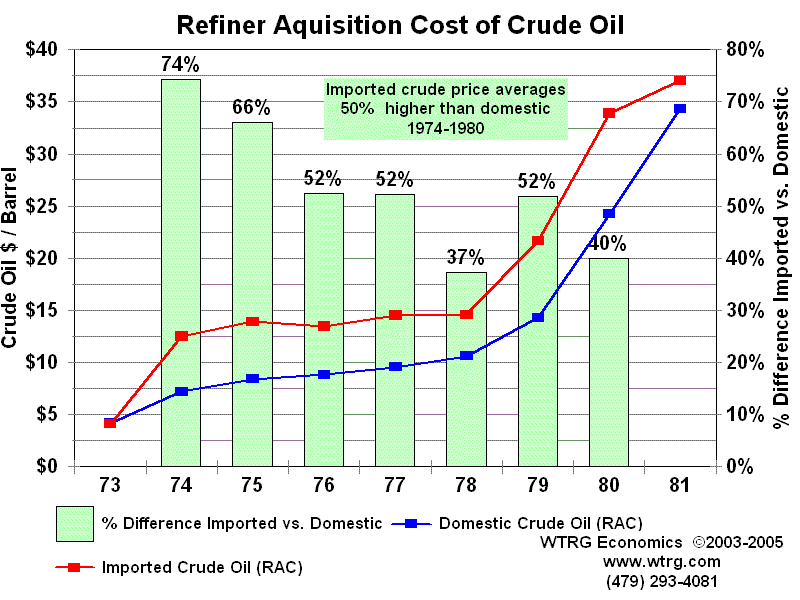
As to a relationship between oil prices and the occupant of the White House, that is just political hubris.  As we can see, real oil prices rose during Nixon, fell during Ford, rose during Carter, fell precipitously during Reagan, were flat end to end for Bush 1 (though with a rise in the middle) and flat end to end for Clinton.  I can’t see a pattern.

If Oil Companies Arbitrarily Set Prices, Why Aren’t They Making More Money?

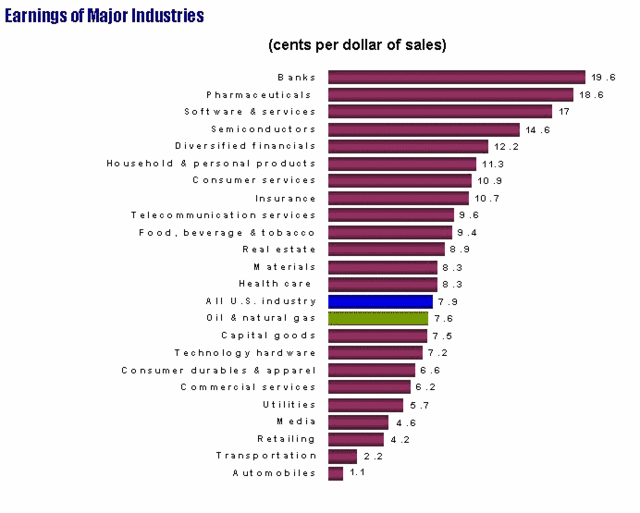
A couple of final thoughts.  First, in these heady days of "windfall" profits, Exxon-Mobil is making a profit margin of about 9% – 10% of sales, which is a pretty average to low industrial profit margin.  So if they really have the power to manipulate oil prices at whim, why aren’t they making more money?  In fact, for the two decades from 1983 to 2002, real oil prices languished at levels that put many smaller oil operators out of business and led to years of layoffs and down sizings at oil companies.  Profit margins even for the larges players was 6-8% of sales, below the average for industrial companies.  In fact, here is the profitability, as a percent of sales, for Exxon-Mobil over the last 5 years:

2006:  10.5%

2005:  9.7%

2004:  8.5%

2003:  8.5%

2002:  5.4%

2001:  7.1%

Before 2001, going back to the early 80′s, Exxon’s profits were a dog.  Over the last five years, the best five years they have had in decades, their return on average assets has been 14.58%, which is probably less than most public utility commissions allow their regulated utilities.  So who had their hand on the pricing throttle through those years, because they sure weren’t doing a very good job!  But if you really want to take these profits away (and in the process nuke all the investment incentives in the industry) you could get yourself a 15 to 20 cent decrease in gas prices.  Don’t spend it all in one place.

** One of the odder and forgotten pieces of legislation during and after the 1972 oil embargo was the law that divided the country into zones (I don’t remember how, by counties perhaps).  It then said that an oil company had to deliver the same proportion of gas to each zone as it did in the prior year  (yes, someone clearly took this right out of directive 10-289).  It seemed that every Representative somehow suspected that oil companies in some other district would mysteriously be hoarding gas to their district’s detriment.  Whatever the reason, the law ignored the fact that use patterns were always changing, but were particularly different during this shortage.  Everyone canceled plans for that long-distance drive to Yellowstone.  The rural interstate gas stations saw demand fall way off.  However, the law forced oil companies to send just as much gas to these stations (proportionally) as they had the prior year.  The result was that rural interstates were awash in gas, while cities had run dry.  Thanks again Congress.

Instalanches are So Last Year

It used to be that Instalanches were the gold standard for blowing out your server bandwidth.  An Instalanche occurred when Glenn Reynolds (or one of the other super-large bloggers) pointed his enormous traffic to an article of interest in some small blog.  The results were sortof like hooking your transistor radio to a high-tension power line.  This was the traffic chart from my first instalanche.

Today, most of my huge traffic spikes come when an article of mine moves up high on reddit or stumbleupon or del.icio.us  (I don’t remember ever getting much from digg).  Right now my article on water pricing is on the front page of reddit, and the traffic spike is enormous. 

Why Doesn’t Google Sell This Service?

With Google headed off in nearly every direction at once in their product development, I wonder why they don’t offer a service to corporations (and even individuals, like politicians) that seems much closer to their core business.  The service I have in mind is the Internet version of the old clipping service (where some PR folks would watch the papers and keep a file of articles about you or your company, bitterly clipped out of the papers).

Let’s say I am Dell, and I would like to see what people are saying about be.  Well, if I search for "Dell,"  the first 30 or 40 hits are probably the same — retailers and such.  What I really want is anything new that popped up in the search today vs. the search yesterday, and which might be buried hundreds of items down in the list.  This is something that a third party could certainly do, caching the search each day, but it would be a layup for Google.  I’d think this service would be pretty valuable, certainly saving money over having employees manually troll blogs and comment boards.  I can think of 10 ways right now this base service could be improved over time with more value-added services hung on the basic structure.  I could sell it to retailers as a way to uncover pirates or illegal channel activity.  You could even charge premium pricing for fast spidering, where the Google spiders go looking in certain places the client cares about more often.

If I have reinvented the wheel here, and someone is already doing this, let me know in the comments.

I vote for Noble House

Nick Gillespie at Reason asks folks for their favorite business novels.  I vote for Noble House by James Clavell.   Ayn Rand’s Atlas Shrugged has a great deal of influence on me, but that book is ultimately about government making business impossible, not about the conduct of business per se.  Noble House is a sympathetic and hugely entertaining depiction of business people being business people in as close to a libertarian environment as we might find (1960s Hong Kong) in the modern world.  Sure its not real business — too much deal making, not enough productive investment, but it is a novel for god sakes, and not a seminar on the capital asset pricing model.

PS – Is there anyone out there who has read both novels and would rather hang out in a bar with Hank Reardon than Ian Dunross?  I didn’t think so.

PPS- Personally, I think this business novel is good too.

What Does “Negotiate” Mean in this Context?

Via Hit and Run:

As part of their 100 hours, the House plans to pass legislation that
would enable the federal government to negotiate Medicare Part D drug
prices.

My experience is that when the government "negotiates" prices via their standard procurement processes, they end up paying higher prices than a private firm might (see "$6000 hammer").  I am not a very experienced political observer who understands all the insider-speak, so maybe someone out there can tell me.  In this context, does "negotiate" actually mean "use the government’s fiat power to demand that prices be set at whatever hell level they want?"

If it is the latter, then does anyone really believe that with populist political pressures, prices are going to be set anywhere near high enough to continue to justify intense drug R&D?  Already most of the world pays just above marginal cost for drugs, such that we in America pay for most all the drug R&D that occurs  (a form of charity we never get credit for).  If the US government "negotiates" US drug prices down to marginal cost, who will be funding the new life extension therapies I will be needing in about 20 years?

Update: One clarification based on the comments.  There is nothing wrong per se with American drug companies selling pharmaceuticals outside the US near marginal cost.  Profit is where you find it.  However, the issue is that US politicians tend to use these international drug prices as a benchmark, as in "US customers should get the same low price foreigners are getting."  The result is all the drug re-importation battles we have from time to time.  (By the way, its funny that politicians who support drug re-importation to reduce the US drug price differential vs. other countries never seem to apply the same solution to the entirely parallel situation of other countries having much lower labor costs than ours — in fact in these cases they actively resist labor re-importation, which we also call immigration or outsourcing.)

A second point I want to make is that we cannot say for certain whether US customers are getting a good value or a bad value at current drug prices, though both supporters and opponents of the current health care system try to draw conclusions about the "fairness" of drug prices.  This is an odd situation to be in.  In other situations when people challenge the "fairness" of pricing, say gasoline prices, we libertarians can always retort "Well, buyers and suppliers both agreed to the transaction at X price, so X price was fair for both."   

But we can’t do this with drug prices.  The reason we can’t determine whether individuals are getting a good value is that, as I wrote at length in this post, our health care system is not structured in a way where individuals make cost-benefit tradeoffs for themselves.  Our employer’s insurance company, via their coverage policies, or the US Government, via its rule-making and tort law, make these trade-offs for us.  Some drugs you might never pay for yourself, but you take because your insurance company pays for them.  Some drugs (e.g. Vioxx) you might dearly love to take, but the American litigation mess effectively precludes your access to it.  My suspicion is that, given the value I put on my life, prices for many US drugs are still a bargain for me, but who knows what trade-offs other people would make in a free society?  At the end of the day, we don’t know what the real market price for pharmaceuticals is.  All we can say with confidence is that whatever price the government "negotiates," it will most likely be wrong.

California Gets A Mulligan

There is no doubt that electricity markets are a mess.  Electric utilities have been regulated for so long and in so many ways, and new capacity is so hard to add, the deregulation experiments tend to fail over short time periods for any number of reasons.  In California, what was called "deregulation" never really was such, since pricing signals were never passed on to consumers and therefore never really influenced demand.  In Texas, the areas where my company operates still struggle with deregulation, and we have seen few price or customer service benefits. 

This is not that surprising when you consider other major industries that have been so thoroughly regulated.   Railroads come to mind, for example.  Deregulation occurred thirty years ago and we are only recently starting to see a renaissance in that industry.  Pre-deregulation airline incumbents (e.g. Delta, United, American) are still struggling with open markets.

Mike Gibberson links a pair of court decisions that may set back any progress made in deregulating at least the wholesale electricity markets.  In a series of suits, the State of California is seeking a mulligan, asking the court to rule that wholesale electricity contracts it entered into in 2000-2001 should be voided because the price was too high and FERC did not have the authority to allow blanket market-based rather than cost-based electricity pricing.  And the judges seem to agree:

The panel held that prices set in those bilateral transactions pursuant
to FERC’s market-based program enjoyed no presumption of legality.

I don’t think there is anything more depressing to a good anarcho-capitalist like myself than seeing the government rule that a price negotiated at arms length by the free will of consenting, and in this case well-informed adults enjoys "no presumption of legality."  If not, then what does?  Is that where we are heading, to a world where no voluntary actions enjoy a presumption of legality?

By the way, one has to remember that this is not a case of an impoverished high school drop-out in East St. Louis signing a high interest rate loan he didn’t understand.  This is the case of highly paid electricity executives and government electricity officials signing electricity contracts.  It is as ridiculous to argue that they were somehow duped in buying the one and only item they ever buy for resale as to argue that Frito-Lay somehow shouldn’t be held responsible for the price it negotiates for potatoes.  These electricity companies knew they had obligations to supply power at retail at certain rates and failed to lock up enough supply in advance.  Whether Jeff Skilling gamed the short-term spot market is irrelevant – the utility executives were at fault for finding themselves beholden to the spot market for so great a volume of electricity, and doubly at fault for taking this power at insane rates when other lower cost options were available to them (such as cutting off customers on interruptible contracts).

Peak Pricing

I know there are folks who get seriously bent out of shape by this type thing (Gouging!), I think this is pretty cool, from Market Power:

I wouldn’t have thought this would
happen, but it appears that a gas station I pass during my commute
practices time-of-day pricing, charging more during the peak period and
charging less during the off peak.

For the past two months, every time I have passed the station in the
evening, the price of gasoline has been at least three cents/litre
lower than it was in the morning on the way to work. This station is
very convenient for people to pull into on the way into London, but it
is very inconvenient for people who are leaving the city at the end of
the workday.

Damned Either Way

"These very simple guidelines,
You can rely upon:
You’re gouging on your
prices if
You charge more than the rest.
But it’s unfair competition if

You think you can charge less!
"A second point that we would make
To
help avoid confusion…
Don’t try to charge the same amount,
That would
be Collusion!
You must compete. But not too much,
For if you do you see,

Then the market would be yours –
And that’s Monopoly!

That is from the Incredible Bread Machine by R.W. Grant.  And it seems to sum up the position of gasoline retailers given this story from Denver, where a grocery store chain was successfully sued for $1.4 million because it provided gasoline discounts to customers who bought over $100 of groceries.

Gasoline retailers can’t win. One day, they’re
accused of "gouging" us at the pump with outrageously high prices; the
next, they’re accused of "predatory pricing," which means giving us a
deal so good it’s illegal….

The effect of the $1.4 million jury verdict against Dillon Co.
means that two of its grocery chains, King Soopers and City Market,
will no longer give customers gas discounts based on grocery purchases.

Safeway wasn’t a defendant but it got the message and likewise
suspended its discount program at 43 of its fuel centers. Discounts
sponsored by other supermarket or big-box chains are also expected to
end.

The lawsuit was based on Colorado’s 69-year-old "Unfair
Practices Act," which prohibits selling a product "below cost." The law
is supposed to be enforced by the attorney general’s office, but the AG
hasn’t brought an action for years because of the near impossibility of
proving that gas sales are below cost when so many grocery products are
also involved.

But the law also permits private civil suits in which winning
plaintiffs are entitled to treble damages. The plaintiffs here were a
couple of independent gasoline dealers in Montrose spurred on by a
trade group representing the state’s independent petroleum marketers….

By the way, seldom do you find a newspaper that actually understands economics when writing about an economics topic, but the Rocky Mountain News is dead on here:

The theory behind predatory pricing laws is that a large
company will sell certain products below cost in order to drive out
competitors. Once the competitors are gone, goes the hypothesis, the
big company will jack up prices to a monopoly level.

The only problem is, this never happens. New competitors always
move fast into markets where prices are unjustifiably high.
Predatory-pricing suits are generally filed by existing companies
unable or unwilling to meet competition provided by more efficient
firms. Legal restrictions on cutting prices invariably work against the
consumer.

I pointed to a similar situation a while back in Maryland.  Thanks to Overlawyered for the pointer.

Asking for Conservation

Have you ever heard of government authorities making public statements around Valentine’s Day to please conserve on roses since we are entering our peak demand season for them and rolling shortages could ensue?  No?  Never?  Well, the demand spike for roses on Valentines is much more dramatic than the demand spike for power on a hot summer day.  So why no urgent government messages for conservation of the former but constant ones for the latter?

Because the rose market is not heavily regulated.  Producers are free to manage their capacity without government interference, and, perhaps more importantly, producers are free to charge peak pricing in high demand periods.  In fact, prices for roses on Valentines go for a multiple of everyday pricing that a similar differential in a peak supply period at, say, a gas station would likely get the proprietor arrested for price gouging.  But we recognize that its tough to manage a business to supply all its capacity in one day of the year, and accept the higher pricing.  Why is it we can’t accept the same facts of life in electrical generation, where capacity is orders of magnitude more expensive to manage than rose growing?

More from Llewellyn Rockwell at the Mises Blog and Lynn Kiesling at the Knowledge Problem