I can hear the reaction now: Finally a break from free speech controversies and economic policy so we can get on with Coyote's promised increased focus on the world's geekiest hobby(tm). So here is what has been happening on the new model railroad (in my tiny, but dedicated, hobby space)
I finished the main body of the railroad. The two lines that cross at a junction in this section will actually continue around the walls in a loop, but I will add those narrow shelves later. I added 1/8-inch lauan plywood on the frame. In the lower left on my desk I am finishing the double crossing which effectively acts as the keystone of the layout, both visually and in construction. I will lay that first and work outwards.
I use 2" foam as a base. This is a good approach for modeling rail in the Phoenix area, which is largely flat in the areas I am modelling, but allows some undulations, washes, and canals to be easily carved out.
I printed the skeleton of the track plan in 1:1 scale and laid it out where it is going to go. You can see the junction in the distance. I did not like some of the aesthetics and wall spacing and building locations, and altered the track plan some after this test. The next step is to reprint the full track plan and transfer it to the foam. I do this using an older (sewing) pounce wheel, which I can run over outlines in the plan and it leaves a series of dots in the foam. I say an older pounce wheel because the one I have looks like a very pointy spur, but my wife's new ones are not nearly as pointy and don't really work for this application.
After that, I will be to start laying down homosote roadbed for the main lines and start laying track, working out in all four directions from the junction. As I do so, I will mostly follow the plan but I tend to adjust exact locations of turnouts and sidings as I go.
You are likely aware that the US, and many other countries, are spending billions and billions of dollars on climate research. After drug development, it probably has become the single most lucrative academic sector.
Let me ask a question. If you were concerned (as you should be) about lead in soil and drinking water and how it might or might not be getting into the bloodstream of children, what would you spend money on? Sure, better treatments and new technologies for filtering and cleaning up lead. But wouldn't the number one investment be in more and better measurement of environmental and human lead concentrations, and how they might be changing over time?
So I suppose if one were worried about the global rise in temperatures, one would look at better and more complete measurement of these temperatures. Hah! You would be wrong.
There are three main global temperature histories: the combined CRU-Hadley record (HADCRU), the NASA-GISS (GISTEMP) record, and the NOAA record. All three global averages depend on the same underlying land data archive, the Global Historical Climatology Network (GHCN). Because of this reliance on GHCN, its quality deficiencies will constrain the quality of all derived products.
The number of weather stations providing data to GHCN plunged in 1990 and again in 2005. The sample size has fallen by over 75% from its peak in the early 1970s, and is now smaller than at any time since 1919.
Well, perhaps they have focused on culling a large poor quality network into fewer, higher quality locations? If they have been doing this, there is little or no record of that being the case. To outsiders, it looks like stations just keep turning off. And in fact, by certain metrics, the quality of the network is falling:
The collapse in sample size has increased the relative fraction of data coming from airports to about 50 percent (up from about 30 percent in the 1970s). It has also reduced the average latitude of source data and removed relatively more high-altitude monitoring sites.
Airports, located in the middle of urban centers by and large, are terrible temperature measurement points, subject to a variety of biases such as the urban heat island effect. My son and I measured over 10 degrees Fahrenheit different between the Phoenix airport and the outlying countryside in an old school project. Folks who compile the measurements claim that they have corrected for these biases, but many of us have reasons to doubt that (consider this example, where an obviously biased station was still showing in the corrected data as the #1 warming site in the country). I understand why we have spent 30 years correcting screwed up biased stations because we need some stations with long histories and these are what we have (though many long lived stations have been allowed to expire), but why haven't we been building a new, better-sited network?
Ironically, there has been one major investment effort to improve temperature measurement, and that is through satellite measurements. We now use satellites for official measures of cloud cover, sea ice extent, and sea level, but the global warming establishment has largely ignored satellite measurement of temperatures. For example, James Hansen (Al Gore's mentor and often called the father of global warming) strongly defended 100+ year old surface temperature measurement technology over satellites. Ironically, Hansen was head, for years, of NASA's Goddard Institute of Space Studies (GISS), so one wonders why he resisted space technology in this one particular area. Cynics among us would argue that it is because satellites give the "wrong" answer, showing a slower warming rate than the heavily manually adjusted surface records.
I have written many times about my frustration with cronyist business relocation incentives handed out by most local and state governments. I have always considered these government incentives to be insanely unproductive spending, often taking taxpayer money to move a company as little as a few miles to get it over some artificial border. One issue I have not considered in these critiques is whether the sorts of companies selected for relocation are really in the long-term interest of the local community at all.
Almost by definition, most relocation subsidies go to large, well-known companies. This is for a couple of reasons. First, large companies have the clout to lobby and demand such subsidies, clout smaller businesses do not have. Second, politicians are handing out these subsidies in order to get re-elected. The actual product of these subsidies is a press release and a blurb on the politician's campaign website. A press release saying that your faithful governor has gotten Joe Smith's Widgets to move to Arizona is a lot less powerful than saying he got a branch of General Electric to move to Arizona. In fact, the sexier the name the better, which is why politicians fall all over themselves to get Google and Apple and Tesla to come to town (despite the fact that in my observation, it is the staid old companies like Honeywell and Wells Fargo and such that tend to invest a lot more in their local communities). We have a plant in the Phoenix area that has already had two subsidized sexy companies in it (First Solar and an Apple screen manufacturing partner) and now is empty yet again waiting for the next sexy crony. Apparently, the state has agreed to subsidize Apple again to use it for a data center, though the move-in may be delayed as there was a large fire at the building when the solar panels on the roof caught fire. Three sexy press releases for Arizona politicians for the same building!
This reminded me of a very interesting study that compared two cities in Michigan, Flint and Grand Rapids:
In 1946, sociologist C. Wright Mills and economist Melville Ulmer concluded the fortunes of two of Michigan's largest cities, Flint and Grand Rapids, were headed in opposite directions.Seventy years later, their predictions are getting new notice from academics.
The researchers warned Flint was overly dependent on its big employers even though its workers made 37 percent more than the national average at the time.
The warning seemed out of place. By 1950, Flint was labeled "the happiest city in Michigan" and the "epicenter of the American Dream," thanks to its thriving auto industry.
Grand Rapids, whose economy was defined by its numerous small businesses, was less flashy. But it offered its citizens more mobility and opportunity for its middle class that would help it survive tough times, the researchers concluded.
Flint was still booming in the late 1960s, so it looked like this 1946 prediction was wrong. But then the prediction suddenly came true. Flint's metro population fell from 445,589 in 1970 to 410,849 in 2015. In contrast, Grand Rapids has been booming, with its metro population soaring from 539,225 in 1970 to 1,038,583 in 2015. And both of these places are in the rustbelt state of Michigan.
It is hard to pick out the most egregious example of bad legislation that has been considered by our state legislature, but this one is certainly close:
Claiming people are being paid to riot, Republican state senators voted Wednesday to give police new power to arrest anyone who is involved in a peaceful demonstration that may turn bad — even before anything actually happened.
SB1142 expands the state’s racketeering laws, now aimed at organized crime, to also include rioting. And it redefines what constitutes rioting to include actions that result in damage to the property of others.
But the real heart of the legislation is what Democrats say is the guilt by association — and giving the government the right to criminally prosecute and seize the assets of everyone who planned a protest and everyone who participated. And what’s worse, said Sen. Steve Farley, D-Tucson, is that the person who may have broken a window, triggering the claim there was a riot, might actually not be a member of the group but someone from the other side....
There’s something else: By including rioting in racketeering laws, it actually permits police to arrest those who are planning events. And Kavanagh, a former police officer, said if there are organized groups, “I should certainly hope that our law enforcement people have some undercover people there.’’
“Wouldn’t you rather stop a riot before it starts?’’ Kavanagh asked colleagues during debate. “Do you really want to wait until people are injuring each other, throwing Molotov cocktails, picking up barricades and smashing them through businesses in downtown Phoenix?’’
This is the sort of law that is almost guaranteed to be abused and enforced in an asymmetrical manner. This is one of those laws where the "Am I comfortable giving my political opponent this sort of power" test is particularly useful. Conservatives rightly complained about the Obama Administrations asymmetric IRS scrutiny on Tea Party groups, but this law would create a far greater potential for abuse. We no longer have Sheriff Joe any more (which is one reason I don't join so many others in complaining about the election of 2016) but does anyone doubt that Arpaio would have used this law to shut down every pro-immigrant protest he could learn about in advance?
As a purchaser of Diet Coke in the medium-sized bottles, I have come to notice that all the other Coke products are often fully stocked, but the Diet Coke is sold out. In hotels, when I hit the vending machine, if one type of soda is sold out, it will be the Diet Coke. Here is my grocery store this morning, with a sight I have seen many times at each of the three stores where I shop. Note that there is full stocking of all the Coke SKU's with a huge gap where the Diet Coke should be.
I like business analysis conundrums like this, so I can think of three explanations:
Observer bias: It could be all the other SKU's are out of stock an equal amount of time, but since I am not looking for them I do not notice. I will say that I began thinking about this years ago and over the last year I have tried to pay special attention each time to what is and isn't stocked, but this is still a very likely possibility.
Diet Coke loses money: It is possible that Diet Coke has the lowest margins for the local distributor. They are committed to stocking it by Coca-Cola, but they intentionally keep the shelf stock short to minimize sales of a bad product for them.
Lack of granularity in distributor stocking plans: By this I mean, if a distributor uses one stocking plan and set of product ratios in all stores, it may be that certain products sell out in areas that are over-weighted towards liking that product. My gut feel is that Diet Coke, vs. Coke, skews more suburban and affluent. So if they stock to a single standard plan across Phoenix, there may not be enough Diet Coke inventory in suburban grocery stores and fancier hotel vending machines. This is a sort of variation of the observer bias issue -- Coke has a stocking problem only in a few locations, but I preferentially shop in those locations.
Americans are leaving the costliest metro areas for more affordable parts of the country at a faster rate than they are being replaced, according to an analysis of census data, reflecting the impact of housing costs on domestic migration patterns.
Those mostly likely to move from expensive to inexpensive metro areas were at the lower end of the income scale, under the age of 40 and without a bachelor’s degree, the analysis by home-tracker Trulia found.
Looking at census migration patterns across the U.S. from 2010 to 2014, Trulia analyzed movement between the 10 most expensive metro areas—including all of coastal California, New York City and Miami—and the next 90 priciest metro areas, based on the percentage of income needed to pay a monthly mortgage on a typical home.
I can't tell you now many people I know here in Arizona that tell horror stories about California and how they had to get out, and then, almost in the same breath, complain that the only problem with Arizona is that it does not have all the laws in place that made California unlivable in the first place. The will say, for example, they left California for Arizona because homes here are so much more affordable, and then complain that Phoenix doesn't have tight enough zoning, or has no open space requirements, or has no affordability set-asides, or whatever. I am amazed by how many otherwise smart people cannot make connections between policy choices and outcomes, preferring instead to judge regulatory decisions solely on their stated intentions, rather than their actual effects.
Working in the world of privatization, one objection I get all the time to privately operating in a here-to-for public space is that government officials are somehow more "accountable" to the public than are private companies.
This strikes me as an utter disconnect with reality. If I screw up, I make less money or even go out of business. When government agencies or officials screw up, they generally remain unchanged and unpunished forever. There are no market competitive forces just waiting to shove a government agency aside -- they have a monopoly enforced at the point of government guns. As I wrote a week ago about a conversation between myself and a government official about my operating public parks:
I understand that my margins are so narrow, if even 5% of those visitors don't come back next year -- because they had a bad time or they saw a bad review online -- I will make no money. Those 2 million people vote with their feet every year on whether they think I am adequately serving the public, and their votes directly affect how much money I make.
Government agencies have nothing like this sort of accountability for public service.
One reason government agencies seldom change is that the typical response to even overt malfeasance is 1) to give the agency more money, as the agency will blame all incompetence on lack of budget (just think "public schools" and teachers unions) and 2) the agency will fire nobody.
Take the Phoenix VA. Congress eventually rewarded the VA with more money, almost no one was fired, and the one of the worst managers in the VA system, a serial failure in multiple VA offices who would have been fired from any private company I can think of, was put in charge of the struggling Phoenix VA.
Patients in the Phoenix VA Health Care System are still unable to get timely specialist appointments after massive reform efforts, and delayed care may be to blame for at least one more veteran's death, according to a new Office of the Inspector General probe.
The VA watchdog's latest report, issued Tuesday, says more than two years after Phoenix became the hub of a nationwide VA scandal, inspectors identified 215 deceased patients who were awaiting specialist consultations on the date of death. That included one veteran who "never received an appointment for a cardiology exam that could have prompted further definitive testing and interventions that could have forestalled his death."
The report portrays Phoenix VA clerks, clinicians and administrators as confused and in conflict about scheduling policies despite more than two years of reform and retraining.
After the scandalous management practices in the Phoenix VA which were proved to sacrifice patient well-being, and even patient lives, in favor of artificially pumping up managers' metrics and bonuses, someone with experience in the private sector might have expected the agency to clean house. Hah!
The Department of Veterans Affairs has named a new director to its beleaguered Phoenix VA Medical Center, and the decision instantly came under fire because the appointee left a previous hospital leadership post after it got the lowest satisfaction rating of any facility in the VA system.
RimaAnn Nelson, who most recently headed a tiny VA clinic in the Philippines, is expected to take charge of a Phoenix VA Health Care System that was the epicenter of a national crisis over its treatment of veterans. She is the seventh director during the past three years to enter a revolving leadership door at Carl T. Hayden VA Medical Center....
Nelson, who began her career as a nurse, was sent to the Philippines in 2013 after a series of incidents under her leadership at the VA St. Louis Health Care System. The Daily Caller, a non-profit, investigative news organization, said the incidents included two closures of the hospital due to medical safety issues, and potential exposure of HIV to hundreds of veterans.
How is this person even still employed, much less being rewarded with a larger, more responsible post?
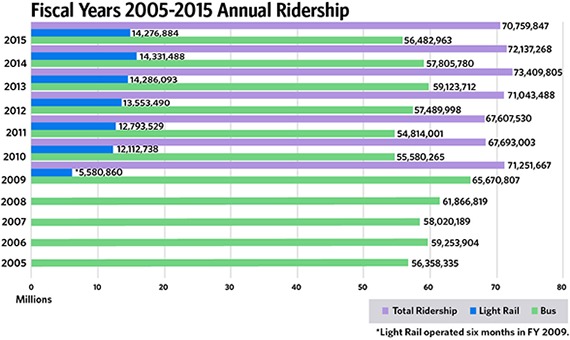
Valley Metro, the agency that operates light rail and most bus service in the Phoenix area, has published its 2016 annual ridership numbers, and they are awful (the agency is on a july-june fiscal year). Over the past year, they have opened two extensions of the current light rail line, spending $o.5 Billion to extend the line 6.2 miles. So what did we get for this? Falling transit use.
To begin with, we must again look past Valley Metro's downright bizarre chartsmanship, where differences in bar length bear absolutely no relationship to the values graphed (just try to figure out the bar lengths for the last three years of light rail data).
We see that light rail ridership is up 9%. This appears low, given that the line and total investment were increased by about 33%, but the new extensions were not available for the whole year. My guess correcting for opening dates is that on a full year basis this represents about a 20% increase. For May, June, and July light rail ridership has been running 19%, 26%, and 20% above the same month last year (before either extension was opened). This is well below the increase in line length (31%) and line total investment (36%)
I have always argued that the first 20 miles of the light rail line cut through the densest part of the city, including the downtown area (such that it is), the two highest visitation sports stadiums, and ASU -- and as such any future expansions were going to have a much harder time justifying themselves (ie, as in this case, a 31% expansion in length would yield something less than 31% increase in ridership). Light rail supporters have argued in return that I had things exactly backwards, that network effects would mean that ridership increased faster than route length. My sense is that this argument will pretty clearly tip in my direction by the time we have 2017 data.
By the way, with total investment up to over $2 billion and average weekday round trip ridership at about 23,500 in fiscal 2016, then the total capital cost (not including annual operating subsidies) of the line sits at about $85,000 per round-trip rider. Whenever Valley Metro supporters defend the line against my attacks, they will often quote various riders saying how much they love it. Of course they do! They damn well should love it -- we taxpayers spent $85,000 for each one of them to open the line AND subsidize every single one of their rides.
But if you really want to see the cost of these subsidies, look at the bus and total transit ridership in the chart above. Total transit ridership in the area has fallen to the lowest point since before the light rail line was first opened, despite the fact the city it serves is still growing. This is because bus ridership has fallen off the map. Just last year, for every 1 rider gained to the light rail line expansions, 3.6 were lost on busses. To see how far bus ridership has fallen, you have to go back further than the chart above shows. Here is an older Valley Metro chart I annotated for a previous article:
You can see from this that bus ridership in Phoenix fell to a level we have not seen since 2003! This is despite the fact that the Phoenix MSA has added about a million people since that time.
As it does in every city, light rail costs are starving the rest of the transit system. By shifting transit dollars into a mode that requires 10x more money to move a single passenger, the numbers of passengers served has to fall. You can see from the chart that Phoenix transit ridership was rising steadily from 1997 to 2009. But once light rail was completed, transit ridership absolutely stopped growing, despite population increases and large increases to total transit budgets. Without light rail, we might very well have seen transit ridership as high as 90 million today, if past ridership growth trends held.
I reported before of clicking on the "today" one-click button at Amazon, meaning that I would pay a premium to get it here today (an option in the Phoenix area but not all locations) and having the item delivered one, two, or even three days later, rather than same day as promised. This is happening with my Amazon orders more often than not - they are showing up days after they were promised when the sale was made.
It has now happened two more times. On Tuesday evening I bought two small items I needed for an emergency computer rebuild, clicking in both cases on the button for delivery on Wednesday. Neither showed up on Wednesday. Neither showed up on Thursday. The tracking on the site now says Friday. (By the way, all the rest of the stuff ordered from Newegg on a one day delivery showed up exactly as promised).
I went back and looked and the order confirmations sure enough say delivery on Friday. I would never have ordered the item for Friday delivery, and in fact skimmed through multiple similar items until I found one that could be delivered on Wednesday. I am positive I clicked Wednesday delivery, but a day later I got confirmations for a Friday delivery, without so much as an apology or even acknowledgement that this was not what I was promised. I am sure Amazon will just call this user error on my part, but it now has happened on 8 or my last 10 rush shipments. I GUARANTEE I know how to use Amazon, and have the order history to prove it, LOL.
I am convinced Amazon is executing a bait and switch, luring me into the purchase with the promise of a quick delivery and then delivering it several days late when it is too late for me to do anything about it. Next time I do a rush order, I am going to take full screenshots of every step I take to prove what is going on. Anyone else having similar experiences? Amazon was dead-on reliable on these types of things until about 6 months ago, and then started to go off the tracks recently.
I have noticed for the last 6 months or so, at least here in Phoenix, that Amazon frequently does not deliver items when they promise. It is not just an issue with the shipper, in the last two cases the item did not even ship until 1-2 days after the date they promised for delivery.
This has reached a head in the last week, when I ordered a number of items to be delivered immediately -- I am leaving town and wanted some items to take to my son's apartment. They are useless to me even a few hours after I depart home. I ordered seven items on Monday with my prime membership, and all promised delivery that same day (one for free, two with a nominal upcharge). Of these, none arrived on Monday. One arrived on Tuesday and as of 4PM on Tuesday, the other six have not even shipped, and Amazon is showing them here on Wednesday at best.
I would not have bought these from Amazon had they given me accurate delivery estimates. I am wondering if they are using fake, overly optimistic delivery estimates to try to woo business from bricks and mortar stores, whose one advantage is immediate fulfillment.
Alex Tabarrok discusses some academic work that shows a declining inter-regional mobility in the United States which is causing local economic declines to last much longer than they used to last.
In a new paper, also cited by Leubsdorf, Danny Yagan at Berkeley suggests that reduced migration is only part of the problem. What has made the aftermath to the 2008-2009 recession so bad is that migration is low at the same time that it has become more necessary than ever. The 2008-2009 recession was especially localized, it hit some places harder than others and in a way that appears to be permanent. But migration has been too slow to solve the problem.
The usual story is that in-and-out migration equalizes wage, unemployment and employment rates across the nation. Some places may be harder hit than others but movement quickly makes the US into one labor market. In the aftermath of this recession, however, that isn’t happening for employment rates. Using a clever research design that looks at workers with similar education and skills doing the same jobs at the same large firms but in different locations, Yagan finds that location continues to matter years after the recession has ended. Workers who worked in the places hardest hit in the 2007-2009 recession have employment rates today that are 1% lower than similar workers in regions that were less hard hit.
It is probably unfair for me to comment on this because I have been highly mobile in my life, having lived and worked in about 10 places as diverse as Houston, Dallas, Boston, Boulder, Seattle, Phoenix, St. Louis. However, I will take a shot at this. Some of my hypotheses:
Government programs to encourage home ownership have reduced mobility. It is simply harder to move if one has a house to sell, and this was worse in the last recession, which was driven in large part by falling home prices, which made it even harder to move when one has an underwater home to sell.
Political/Cultural redlining reduces mobility. As an example, certain millennials want to be nowhere else but San Francisco, despite how absurdly hard it is to live there. They will starve in poverty there before going to, say, Houston, which is an easy place to live when one is young but which many consider to be a evil redneck backwater.
Use of Communication technology causes people to think they can reduce mobility when they perhaps can't. I think a lot of folks with modern communication technology assume that location is irrelevant and that they should be able to do X work anywhere they want. I think they are overestimating where many industries and companies are right now (though they may be correct in the future). Just from tax compliance and regulatory perspectives, it is pure hell for a company in, say, Texas to have an employee in, say, California. Plus I think there are still real networking and management reasons for employees to be concentrated in facilities.
The Arizona Republic reports that the Arizona Department of Water Resources has set six priorities for managing expected water shortages in the future. The six are listed in one of those annoying click-bait page-flipping things, so I will summarize them below:
If you live in Phoenix, you’re probably paying one of the cheapest annual water bills in the country, even with the rate increase that took effect this month, according to a recent national report on public water systems.
The February report by Food & Water Watch said the lead-tainted water supply in Flint, Michigan, was the most expensive in the country, with customers there paying $910.05 a year. It said Phoenix residents paid just $84.24 a year, then the lowest rate in the nation.
A city water department official said the rates could be a little misleading – rates jump for heavy users, one factor that has helped Phoenix keep water use down even as the number of water users has risen sharply.
This is absurd. Why does the state agency need to go around spying on private water use and begging for funding when price is such an obvious lever to match supply and demand. Raise the freaking prices! Are we drawing from lakes and groundwater faster than they can replenish themselves? Raise the dang price until demand falls to a sustainable level. As an extra bonus, this would help solve the funding problem, and have it solved by water users themselves rather than taxpayers.
By the way, I ask these questions but I actually know the answers -- government officials don't want to take the heat when the prices rise. They want to pander to the public and hand them populist goodies like cheap water, and then manage the inevitable water crisis with authoritarian actions like rationing and surveillance that increase their personal power.
And congrats to our newspaper: It has article after article, day after day, listing all the dire water shortages that face the area, and then they write this article with nary a mention that having the country's lowest water rates might be related.
I will give a $10 Amazon gift card to the first person with an email in my inbox (coyote--at---coyoteblog dot com) with a North American retail source (no large lots) for something similar to this:
Does not need to be a scissor lift, could be cables but must be motorized. We have a very modern house which sometimes results in odd rooms. Our laundry room is tiny in footprint but has a 12 foot ceiling (!). So I was just in the process of designing a motor lifted frame with poles to hang clothes for drying** that could lift up and down from the ceiling when I saw this. They seem to have many in Asia but I can't find one here. This one has some sort of air drying system which we don't need so that is not a necessary part of the package. This is a (homemade I think) hand winched version which would also be OK if it were motorized.
My point was that the huge amount of money spent on light rail, which essentially constituted a single commuting route in this enormous and spread-out city, was cannibalizing bus service. The cost and investment to carry a light rail passenger is at least an order of magnitude greater than that needed to carry a bus passenger, and no public system can long endure this sort of cost increase to shift passengers from a relatively cheap transit mode to an expensive one. Inevitably, bus service (which mainly benefits the poor) is terminated to pay for the train (which benefits middle and upper class riders who would not be caught dead on a bus). I am pretty sure the train would have been harder sell if they had been honest and said that they were going to have to cut bus service for the low-income working folks so that ASU students and Arizona Diamondbacks and Phoenix Suns fans could have a better way to get to the ballgame.
Anyway, Valley Metro has updated the chart for 2015 and it continues to look bad:
They were smart to cut off history on this one so you can't see how they killed the growth trend with the advent of light rail. But you see that total transit ridership fell, with a small fall in light rail ridership and a huge fall in bus ridership. Oops. As an aside, they still have not fixed their terrible chart plotting. You can see this years bar for light rail being longer than the one for 2013 despite the fact the number is lower.
The 2016 numbers will be interesting. Since 2015 they will have opened several light rail extensions and got themselves a huge new tax increase approved (over my stern opposition).
Update: In retrospect, the bus ridership fall was significant but "huge" probably is an exaggeration. I was fooled by looking at the bar lengths, which again seem to have nothing to do with the actual data. They are clearly drawing this manually -- no automatic charting program would get it this wrong.
Readers will know that this is one of my favorite topics on this blog, how huge investments in showy rail projects that amp up the prestige of government officials tend to cannibalize lower cost bus service and, at the end of the day, actually reduce total transit ridership. The LA Times almost sortof recognizes this, and Randal O'Toole is on the case:
“Billions spent, but fewer people are using public transportation,” declares the Los Angeles Times. The headline might have been more accurate if it read, “Billions spent, so thereforefewer are using public transit,” as the billions were spent on the wrong things.
The L.A. Times article focuses on Los Angeles’ Metropolitan Transportation Authority (Metro), though the same story could be written for many other cities. In Los Angeles, ridership peaked in 1985, fell to 1995, then grew again, and now is falling again. Unmentioned in the story, 1985 is just before Los Angeles transit shifted emphasis from providing low-cost bus service to building expensive rail lines, while 1995 is just before an NAACP lawsuit led to a court order to restore bus service lost since 1985 for ten years.
...
Transit ridership is very sensitive to transit vehicle revenue miles. Metro’s predecessor, the Southern California Rapid Transit District, ran buses for 92.6 million revenue miles in 1985. By 1995, to help pay for rail cost overruns, this had fallen to 78.9 million. Thanks to the court order in the NAACP case, this climbed back up to 92.9 million in 2006. But after the court order lapsed, it declined to 75.7 million in 2014. The riders gained on the multi-billion-dollar rail lines don’t come close to making up for this loss in bus service.
...
Los Angeles ridership trends are not unusual: transit agencies building expensive rail infrastructure often can’t afford to keep running the buses that carry the bulk of their riders, so ridership declines.
Ridership in Houston peaked at 102.5 million trips in 2006, falling to 85.9 million in 2014 thanks to cuts in bus service necessitated by the high cost of light rail;
Despite huge job growth, Washington ridership peaked at 494.2 million in 2009 and has since fallen to 470.4 million due at least in part to Metro’s inability to maintain the rail lines;
Atlanta ridership peaked at 170.0 million trips in 2000 and has since fallen nearly 20 percent to 137.5 million and per capita ridership has fallen by two thirds since 1985;
San Francisco Bay Area ridership reached 490.9 million in 1982, but was only 457.0 million in 2014 as BART expansions forced cutbacks in bus service, a one-third decline in per capita ridership;
Pittsburgh transit regularly carried more than 85 million riders per year in the 1980s but is now down to some 65 million;
Austin transit carried 38 million riders in 2000, but after opening a rail line in 2010, ridership is now down to 34 million.
I will add that total transit ridership has been totally flat in Phoenix after construction of a major light rail project. The project's total cost is approaching $2 billion as they slowly add on short extensions, but this amount did nothing but cannibalize bus ridership. In fact, the situation is worse than this, since before light rail was built, Phoenix transit ridership was growing rapidly every single year, so in fact light rail actually likely reduced ridership by about 14 million. The whole story is here. (I will have an update in a moment but they have updated the chart from that article and ridership fell yet again in 2015).
I don't want to give too much credence to Cruz's "New York values" dig on Trump. First, it's silly -- New York is not at all monolithic. Second, it doesn't really even apply to Trump, who often thumbs his nose at New York elite.
But I think that if you asked a lot of people in flyover country, the statement would still have resonance. I think the reason is that while New York is not at all monolithic in its culture and values, its media exports do tend to be much more homogeneous and tend to reflect a Left-liberal coastal condescension.
I was thinking about this watching the Broadway show If/Then which was in Phoenix this weekend. I thought this was a pretty forgettable musical, essentially a sort of remake of the movie "Sliding Doors", that was elevated by Idina Menzel in the lead. We in flyover country seldom get stars of this caliber (at least after they are famous) in our roadshows and she (along with one other female lead who was quite good) made the show worth the ticket.
Anyway, a couple of observations about the show in the context of Cruz's statement:
No character in the show (with 2 exceptions) had a productive job in the private sector. Everyone worked in the city planning department or was a housing activist or a public school teacher. I kid you not, there was actually a song about the joys of urban planning. The two exceptions were: 1) a private architect who thanked the city planning department for overruling his designs and 2) an investment banker who acted like a complete tool and was included for 10 seconds only to illustrate the worst possible imaginable male date.
Accusing a character of being a Republican was used as a laugh-line twice. Since the character was one the authors wanted to the audience to have sympathy for, the character quickly avowed he was an Independent.
Living any place in flyover country (e.g. Nebraska, Arizona**) was used as a laugh line in the show and choosing to live in those places was offered up as an example of bad decision-making. The only place deemed acceptable to live outside of New York was Oregon.
I got over getting too worked up about this sort of stuff years ago (or else I would spend all my time holed up in a cave listening to a few old Rush albums). Cruz was wrong to criticize New York values but I think there is a .... call it an attitude that emanates from New York media that the rest of the country sometimes finds irritating.
** in the show we saw, the lead character had just escaped from a bad marriage in Phoenix. My guess is that this was not the original location, but was switched for the show here (though I could be wrong, since such a switch would have meant adjusting a couple of songs too). Anyone see it on Broadway and know what location was used there?
5 minutes ago the title of this post would have been "F*cking Cardinals" for giving up that hail mary pass to Green Bay -- didn't anyone watch the tape on the Detriot game, with the receiver backing into the end zone to make the catch? This play was almost an exact duplicate. I will, though, give credit to the Cardinals for blitzing the QB on that play -- I think that was smart and would have worked against most teams. Only Aaron Rodgers could have gotten that throw off.
Anyway, Fitz was already beloved in Phoenix, not only as a great football player but as an awesome human being. Now just more so.
It is a tradition of Frank Lloyd Wright's Taliesin West architecture school (in Scottsdale, AZ) that students build their own small shelter in the desert. I am a fan of Dan Simmons' Hyperion series. If any of you read it, perhaps you remember the section where Aenea is at some strange out-of-time version of this school. Following the real-world tradition, she builds her own dwelling in the desert.
These are not necessarily cardboard box and plywood forts -- many are real engineered structures whose materials can be expensive (the students do most of the building with their own hands). I wish more architecture schools emphasized their students actually constructing some of their own work.
As an aside, if you are in Phoenix, I would put Taliesin West as one of the top 2 places to tour in town, along with the Musical Instrument Museum. Phoenix of course is much more of an outdoor town. The very top thing to do in town, not just to tour, is probably to climb Camelback Mountain or Piestawa peak. Both are mountains dead in the middle of the city, something that is relatively unusual (in Denver, Portland, Seattle, etc the mountains are off to one side). The views are spectacular, and there is no funicular or cable car. The view only rewards effort.
The local food movement in Arizona needs just that – movement.
While some shoppers enjoy spending their Saturday mornings at local farmers markets, new research indicates Arizona lacks per-capita sales in the local food industry.
The 2015 Locavore Index found that of the 50 states and Washington, D.C., Arizona has the second lowest per-capita sales for local foods.
Here is a scoop for you: We live in the middle of the freaking Sonoran desert. It is a terrible place to grow most foods. In fact, it is an environmentally awful place to grow food. Local food folks somehow have gotten locked into transportation costs as the key driver of food sustainability that they want to focus on, but transportation costs are 10% or less of most food costs. A small savings on transportation is absolutely dwarfed, from a productivity and resource use standpoint, by the productivity of the soil and the fit of the climate with whatever is being grown.
Here is one way to think of it -- yes, locally grown food may not have to be transported very far, but every drop of water for food grown here in the Phoenix area has to be brought hundreds of miles from declining reservoirs to grow that food.
The movement seems to imply that locally grown food is more healthy. Why? Why is an Arizona tomato healthier than a California tomato?
Finally, the micro-trade-protectionism is pretty funny:
If local Arizonans start buying more local food, the economy may benefit as well.
When buying local grown food, “the money stays here in the local economy, as opposed to buying something in a national chain,” said R.J. Johnson, a sales representative for Blue Sky Organic Farms in Litchfield Park. “You buy something locally, 75 percent of that money stays here in town.”
This is so economically ignorant as to be beyond belief. If more people are growing food here locally (something that is likely a fairly unproductive task given our climate), what productive tasks are they giving up. And this is a national effort -- are they really with a straight face telling every single state that they should buy more locally so their money stays at home? Isn't that just one big zero sum game (actually a negative sum game because you lose benefits of specialization and comparative advantage).
If I were a Mexican in Phoenix, I would do a full walk-around checking my vehicle before every trip. A visiting friend once asked me if the fact that Hispanics all seem to drive so slow was a cultural thing and I said that more likely, they know they will get busted for going even a hair over the speed limit.
When Kris Kobach says "In four different sections, the law [SB1070] reiterates that a law-enforcement official 'may not consider race, color, or national origin' in making any stops or determining an alien's immigration status," he is ignoring reality. The law asks police to make a determination (e.g. probable cause that one is an illegal immigrant) that is impossible for actual human beings to make without such profiling. It's like passing a law that says "police must drive their cars 30 miles a day but can't drive their cars to do so." The reality on the ground here in Arizona is that, illegal or not, Sheriff Joe Arpaio has been using racial profiling to make arrest sweeps for years, and his officers have become masters at finding some pretext to pull over a Mexican they want to check out (e.g. the broken tail light). Words in this law about racial profiling are not going to change anything.
Update: I forgot this story from 2008, which is a great example of what I am talking about here
Arrest records from crime sweeps conducted by the Maricopa County Sheriff's Office add substantial weight to claims that deputies usedracial profiling to pull Latino motorists over to search for illegal immigrants....
even when the patrols were held in mostly White areas such as Fountain Hills and Cave Creek, deputies arrested more Latinos than non-Latinos, the records show. In fact, deputies arrested among the highest percentage of Latinos when patrols were conducted in mostly White areas.
On the arrest records, deputies frequently cited minor traffic violations such as cracked windshields and non-working taillights as the reason to stop drivers.
"These are penny-ante offenses that (police) almost always ignore. This is telling you this is being used to get at something else, and I think that something else is immigration enforcement against Hispanic people," Harris said....
The AZ Republic has some of the first information I have ever seen on the nature of Phoenix light rail ridership. The first part confirms what I have always said, that light rail's primary appeal is to middle and upper class whites who don't want to ride on the bus with the plebes
Light rail has changed the demographics of overall transit users since the system opened in 2008, according to Valley Metro.
Passengers report higher incomes than bus riders, with more than a quarter living in households making more than $50,000 a year. Many riders have cars they could use.
The 20-mile system running through Phoenix, Tempe and Mesa recorded more than than 14 million boardings last year. Still, census data estimate less than one-third of 1 percent of Phoenix commuters — or about 2,000 people — use rail as their main transportation to work.
.0033% huh? If we built similar facilities to serve everyone, it would only cost us about $420 billion at the rate of $1.4 billion per third of a percent.
But I thought this next bit was the most startling. I always had a sneaking suspicion this was true but never have seen it in print before:
While the much larger bus system reaches most corners of the Valley, light rail connects specific destinations along a single line. Nearly half of light-rail riders are enrolled in college.
I must have missed this in the original sales pitch for the light rail line: "Let's pay $1.4 billion so ASU students can get to more distant bars." Note that by these numbers, students likely outnumber commuters 10:1. Doesn't bode well for light rail extensions that don't plow right through the middle of the most populous college campus in the country.
Postscript: They don't break out people riding to get to sporting events downtown, but sporting events make up most of the largest traffic days on the system. From my personal acquaintances, many people use light rail as a substitute for expensive downtown parking at sporting events, parking (often semi-illegally) near light rail stops and taking the train the rest of the way in. On the whole, its not very compelling as a taxpayer to be helping to subsidize someone else's parking. And from a municipal fiscal standpoint, it means that light rail fares may be cannibalizing (on a much greater ratio than 1:1 given the price differential) parking fees at municipal parking lots.
I was reading this article in the Arizona Republic (which is generally an unskeptical cheerleader for light rail investments) and looking at the claim that Valley Metro (the operator of Phoenix light rail) had a 45% fare recovery ratio in 2013. One would think that means that their fares cover 45% of their costs -- which would be awful for any real enterprise but is pretty good for government-run rail systems.
But in fact, Valley Metro (along with rail supporters in the Administration) stack the deck by defining most of the costs out of this metric so it looks far better than it really is. In fact, by my reading of their financial statements, the true fare recovery is at best 15.2% and likely much worse.
Look at their costs of $75+ million and fares of about $12.8 million. How do they get to 45%? Simple -- they leave the majority of their costs out. They exclude administrative costs, financing costs, and depreciation (essentially their capital cost) from the equation. This means that their fare recover is 45% -- IF you ignore their large administrative costs and you ignore the $1.4+ billion the line cost to build. Further, because of the way the government does its finances, it is also missing any financing costs (interest and such on debt).
So the true cost recovery, stated in a way that a reasonable person would think about such a number, is 16.8% at best. If one takes into account the $8.28 million in "non-operating expenses" the number is 15.2%. And it is even lower if you were to include interest and other financing costs.
I am sure Valley Metro will argue that this is the way the Feds measure it. I don't care. It has an obligation to accurately report its financial position to the public who is paying for it, particularly when the public is considering further investments in the form of higher taxes. The 45% is a meaningless number that is crafted solely to make light rail look financial stronger than it really is.
The real problem with housing affordability is not at the community level but at the regional level. In a region that has few land-use restrictions, a community that has attracted wealthy people is not going to have much of an effect on the affordability of the region as a whole because builders can always construct more affordable housing elsewhere. The problem is in regions with urban-growth boundaries and other restrictions that limit the construction of affordable housing over the entire region.
If HUD were to apply disparate-impact criteria to regions, it might look at the change in African-American populations between 2000 and 2010. Nationwide, the black population grew by 11 percent in that time period, which was about 1.3 percent faster than the population as a whole. Regions whose black populations grew less than 1.3 percent faster than their whole populations could be considered guilty of housing discrimination.
Based on this, the most racist major (more than a million people) urban area in America is San Francisco-Oakland. Though that region’s population grew by 285,000 people between 2000 and 2010, or 9.5 percent, the region’s black population actually shrank by nearly 49,000, or 14.2 percent, for a difference in growth rates of minus 23.7 percent.
That decline was entirely due to strict land-use policies that prevent development outside of the 17 percent of the region that has already been urbanized, making the Bay Area one of the least affordable housing markets in the nation. Moreover, a recent planto improve affordability by following HUD’s prescription of building more high-density housing was found to actually reduce affordability.
Other major urban areas that would be found racist include Austin (-21.5% difference between black and overall population growth), Riverside-San Bernardino (-17.5%), Honolulu (-15.4%), San Diego (-14.6%), Los Angeles (-14.5%), Bakersfield (-13.6%), and San Jose (-11.1%). All of these regions except Austin have some form of growth-management policy, while Austin has become the least affordable housing market in Texas due to local housing policies.
By comparison, the least racist major urban area is Salt Lake City, whose black population grew 57 percent faster than its total population. Other non-racist areas include Minneapolis-St. Paul (42%), Phoenix (34%), Providence (25%), Boston (19%), Las Vegas (17%), Columbus (14%), Orlando (14%), Atlanta (13%), Tampa (13%), and Miami (10%). Of these, only Providence and Boston are surprises since both have serious housing affordability problems.