Posts tagged ‘Phoenix’

We Can Only Afford This With Other People’s Money

It turns out, the first $100 million a mile extension of Phoenix light rail is having to be postponed.  The reason?  Its just too much money for the local pols.  So why is this one piece being postponed when any number of other extensions, such as the $230 million a mile airport extension, still going forward?  Well, it turns out that all those other lines (as well as the original) use large dollops of federal money, while the delayed extension was planned to use only local money.

It turns out that we are not willing to pay the full freight of building light rail for ourselves, and only want to do it if we are able to grab at least half the cost from people outside of Arizona.  AZ Republic story

Libertarians Are Used to Bad Choices, but…

a debate between Sheriff Joe Arpaio and Al Sharpton certainly leaves me without a side to cheer for.

Double Standard

When private companies in financial distress pay out employee bonuses that were contractually obligated:  bad.  When governments in financial distress pay out employee bonuses that are entirely discretionary: A-OK.

Amid the downturn in the economy, the city of Phoenix handed out more than $300,000 in cash bonuses, a CBS 5 News investigation found.

The bonuses, which ranged from $500 to $6,000 for a grand total of $354,800, were paid in October, according to public records…

Nevertheless, records show former Parks and Recreation Director Sara Hensley received a $3,500 cash award; the same month, she resigned to take a similar job in Texas.

Library Director Tony Garvey received a $4,000 cash award. Shortly after, libraries were forced to shorten hours and cut positions.

Phoenix Light Rail Fail — Half My Light Rail Bet Settled

When Phoenix was building its light rail system, I made the following two-part bet:

  1. I could take all the money spent on construction and easily buy a Prius for every single daily rider, with money to spare
  2. I could take the operating deficits for light rail and buy everyone gas to run their Prius 10,000 miles per year and still have money left over.

This bet has been tested in a number of cities, including LA and Albuquerque, and I have not lost yet.  Now the numbers are in for Phoenix initial ridership, and I am winning the first half of my bet in a landslide.

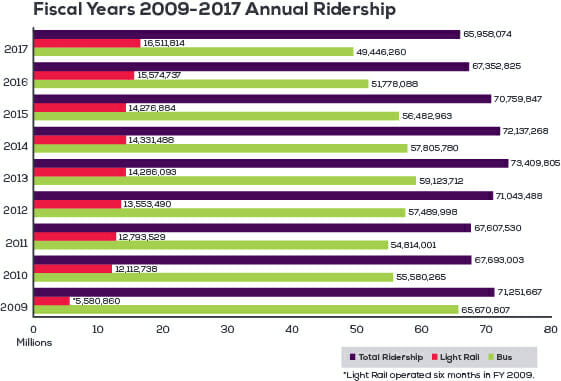
The other day, Phoenix trumpeted that its daily ridership had reached 37,000 boardings per weekday.  Since most of those people have two boardings per day (one each direction) we can think of this as 18,500 people making a round trip each day.

Well, if we bought each of these folks a brand new Prius III for $23,000 it would cost us just over $425 million.  This is WAY less than the $1.4 billion we pay to move them by rail instead.   We could have bought every regular rider a Prius and still have a billion dollars left over!  And, having a Prius, they would be able to commute and get good gas mileage anywhere they wanted to go in Phoenix, rather than just a maximum of 20 miles on just one line.  Sure, I suppose one could argue that light rail is still relatively new and will grow, but even if ridership triples, I still win the fist half of my bet.  And as the system expands, my bet just looks better, as every single expansion proposal has been at a cost of $100 million a mile or more, more expensive than the first 20 miles.

So now, all we have to do is wait to see the operating results to settle the second half of my bet.  If common practice is followed from other metro areas, this will be extremely difficult to prove because the authority will do everything it can to hide the huge operating dollar hole light rail is creating.

But Coyote, what about congestion?

I am glad you asked.  Folks will argue that rail reduces congestion.  Normally, I would agree but argue that it reduces congestion at way too high of a price.  But for Phoenix light rail, it may even be that rail makes congestion worse.

Here is why:  In building Phoenix light rail, the city along most of the line had to remove two lanes of traffic (one each way) to build the line.  So here is the comparison:

  • Light rail carries 37,000 trips per day or about 2,000 per hour  (1,000 each way) through its 18-hour operating day, though certainly there are peaks and valleys around this average
  • A typical lane of road has a capacity of 2000 cars per hour, so light rail removed 4,000 cars per hour of road capacity (2,000 each way).  Its unclear how many riders this equates to, but the average car in the city has 1.5 passengers, so we will call this a road capacity of 6,000 trips per hour (3,000 each way).

So, we have replaced roads that can carry 6,000 trips per hour with train tracks carrying 2,000 trips per hour.  Sure, the train carries more than 2,000 in some peak periods, but probably not more than the road it replaced was capable of carrying.  Further, I can attest from personal experience that the complexity of trains on the road and passing through intersections screws up the timing of lights and results in lost capacity on the roads in the area that remain.

A Thought on Sports Team Subsidies

I would love to see the ridership of the light rail on days with and without a baseball game or basketball game downtown.  My sense is that a significant portion of the ridership is from game attendees (its the only time I have found it useful to ride the train).  If this is the case, then this massive overspending for light rail represents yet another subsidy for professional sports teams.

By the way, I just realized that I am underestimating the financial cost to the city of the train.  Most sports fans ride it not as a transit substitute per se but as a parking substitute — the train allows one to park cheaply away from downtown and ride the the game without traffic hassles.  I wonder how much the lost $15 a pop parking in city lots by the stadium due to the train is costing the city?

Light Rail Hurts the Working Poor

I think it is always important to reiterate why light rail is such a threat to the working poor who depend on transit.  As I wrote the other day:

…light rail is simply not transit for the working poor. It is transit for yuppies that happens to be used by some working poor.  They are built for white collar workers commuting to town who are too high and mighty to be caught dead in a “grubby” bus.  But since light rail is orders of magnitude more expensive than buses, two things happen in every city that ever builds light rail.

1) Light rail fares skyrocket to cover their immense operating deficits and capital costs, giving the lie to politicians that sold these systems as helping working poor.

2) Bus service, the form of transit that serves most of the working poor even today in the Bay Area, is cut back to help pay for rail.

Light rail is the worst enemy of providing transit services to the working poor ever devised in this country.

My Commute: 1.9 Miles

I could drive a Caterpillar D6 to work and still use less fuel than most folks do in their commute.  That is because I choose to work less than 2 miles from my office, out here in the northern suburbs of Phoenix (and, when it is not 110 degrees out, there is a bike path that takes a more direct route that is even shorter).  There is no place I would choose to live anywhere near the central business district of Phoenix;  if my job was downtown, rather than in my suburban neighborhood, my commute would increase to sixty minutes per day rather than six.

So, I wonder why the movement of jobs from city centers to suburbs has the Brookings folks so upset.  If your remember, urban planning types lamented the move of homes to the suburbs, saying this increased commuting time and energy use.  Now that the jobs are moving out to the suburbs as well, close to where people actually live (rather than where the planners want them to live), this increases gas use and commute times as well?

Since 1998, almost every major American metro area has seen a drop in the share of employment located downtown as jobs have increasingly moved into farther-out suburbs, exacerbating “job sprawl” – a phenomenon that threatens to undermine the long-term prosperity of the nation’s vital economic engines, according to a report released today by the Brookings Institution.

“‘People sprawl’ has long been known for its effect on the environment, infrastructure, tax base, quality of life, and more. Now, we must recognize what ‘job sprawl’ means for the economic health of the nation,” stated Elizabeth Kneebone, author of the report and senior research analyst at the Metropolitan Policy Program.

“The location of jobs is also important to the larger discussion about growing the number of jobs,” said Robert Puentes, a Brookings senior fellow. “Allowing jobs to shift away from city
centers hurts economic productivity, creates unsustainable and energy inefficient development, and limits access to underemployed workers.”

The economic productivity argument has me totally flummoxed.  Are they really arguing that companies purposely reduce their own productivity and access to labor?  Why?  This makes no sense, and as the Anti-Planner points out, goes totally unproven in their study.

The only possible argument I can see is a government one, that somehow suburb infrastructure by being more spread out is more costly per person than urban infrastructure.  But this is a point that has never been well proven, and is a classic case of looking at just one variable in an multi-variate system.  Sure, I would guess the total miles of sewer pipe and roads per person is greater in the suburbs than the city.  But the cost of land acquisition, infrastructure construction, and maintenance are all lower.  It is not at all clear how these balance, and the authors do not even try to figure it out.  I would be surprised if the government infrastructure costs per person in, say, Scottsdale is really higher than in Manhattan.

In fact, if there is an issue here, it strikes me it is more a government pricing issue than a demographic issue.  If government is somehow taking a loss on suburban vs. urban infrastructure, then it needs to rethink its tax structure to appropriately set property taxes and fees to match actual costs.  But I think we all know that this is NOT the problem.  Where suburbs are separate cities from the inner cities, those cities tend to have lower taxes and healthier budgets than their inner city cousins, giving the lie to the statement that suburban infrastructure is somehow more expensive (or, as a minimum, that any increase in costs are more than offset by other cost advantages to government of the suburbs).

And all this ignores the individual rights issue of why government should be influencing the shape of people’s living and commuting choices at all.  Note the very suggestive words in the Brookings press release — “Allowing jobs to shift away from city centers hurts economic productivity,” as if the location of my employees requires government approval.   It’s amazing to me that the children of the sixties grew up to be such control freaks.

In the Future, Only Governments Will Own Video Cameras

Having heard that Phoenix has been coming down hard on folks for the “crime” of photographing in public places, The Northern Muckraker went to take a look.  The Photography is Not a Crime blog has a partial transcript:

Hester: I’m free to go, correct?

Guard 1: Not yet.

Hester: Am I being detained?

Guard 1: Are you videotaping my building?

Hester: Am I free to leave?

Guard 1: You’re are free to leave, go …  but if I catch you videotaping the building again you will be arrested by the Phoenix Police Department.

Hester: On what charge, sir?

Guard 1: On charge of … we’ll talk to the Phoenix Police Department about it.

Guard 2: You’re not supposed to videotape any federal court building.

Hester: What law?

Guard 2: National Security Act.

Guard 1: Oklahoma City, that’s why.

Guard 2: It all comes down to Homeland Security and all that.

Guard 1: If you want to talk to our Homeland Security people, we can arrange that right now and we will detain you.

He further observes that the National Security Act, passed in 1947, does not seem to have any mention of video recording.

Update:  Apparently, according to an official Houston PD statement, photographing and taping a police officer is sufficient probably cause for being charged with “assault on a police officer.”

Mr. Haven admitted to verbally disagreeing with Officer Dickerson. He also admitted to photographing the police vehicle and Officer Dickerson, and taping their conversation. Under these circumstances, it is not unreasonable for Officer Dickerson to have believed that Mr. Haven’s relevant actions, taken as a whole, constituted more than “speech only” [and therefore constituted sufficient probable cause for arrest]

Computer Tampering with the Intent to Harass

What does the title of the post mean? Well, if you are the Phoenix police (and at least one sorry-ass local judge) it is the name of the new “crime” invented to describe blogging that is critical of public officials.

In what should send a frightening chill down the spine of every blogger, writer, journalist and First Amendment advocate in the United States, Phoenix police raided the home of a blogger who has been highly critical of the department.

Jeff Pataky, who runs Bad Phoenix Cops, said the officers confiscated three computers, routers, modems, hard drives, memory cards and everything necessary to continue blogging.

The 41-year-old software engineer said they also confiscated numerous personal files and documents relating to a pending lawsuit he has against the department alleging harassment – which he says makes it obvious the raid was an act of retaliation.

Maricopa County Judge Gary Donahoe signed the search warrant that allowed at least ten cops to raid his home in North Phoenix on March 12 while handcuffing his female roommate for three hours as they tore the place apart….

The search warrant lists “petty theft” and “computer tampering with the intent to harass” as probable causes. He has yet to see an actual affidavit that lists in detail the probable cause and is skeptical that one even exists.

Hat tip to Radley Balko.   The police are apparently considering throwing in identity theft to the charges. The Bad Phoenix Cops web site is raw and over the top traffics in salacious gossip about senior police officers, but I can’t see how that is illegal.  Well, its been a good week here in the Phoenix area — Sheriff’s deputies arrest four people for applauding a speech critical of the Sheriff, and now police arrest a blogger who has been critical of them and confiscate his computer.

Postscript: The author of the blog where I excerpted the article above is a Miami photographer who has been on the front lines of one of an emerging civil liberties issue.  Police have somehow developped a theory, based on no law and in total contradiction to the first Ammendment, that it is somehow illegal to photograph or film police doing their jobs in public places.  They particularly hate such filming and photography when it shows them doing something absurd.  The photographer’s ongoing fight with the legal system, all begun when he had the temerity to take pictures of police officers in a public place, is here.  The blog is very well written and thoughtful and seems to try hard to be fair — in fact, this is one of the most unbelieveably fair descriptions I have ever seen someone make of his opposition.

Light Rail Alternative

Apparently, Phoenix is experimenting with a new style of bus transport that looks and operates like a train:

The Mesa Link debuted the same week as light rail. For now, Link involves a fleet of 10 buses. Each $756,000 vehicle carries a transponder to coordinate traffic lights and keep the bus on schedule for a 12-mile run in 45 minutes.

It’s the start of a much more ambitious program.

Over the next few months, the Regional Public Transportation Authority, which coordinates Valley Metro bus service, will build stations and add technology to the Mesa line to give it more of the pace and feel of a train.

Basically, they are building the thing to look and operate like a light rail train, only running on tires on the existing road.    The travel time may seem slow, but it is nearly identical to the average speed of our light rail line (20 miles in a claimed 70 minutes, though a number of riders say its slower).  And the capacity is nearly identical.

So with the same speed and the same capacity and similar scheduled service with similar style stations, here is the real appeal:

In 2010, a second line will be created to run 12 miles along Arizona Avenue in Mesa and Chandler. It will feature 10 stations and cost $28 million for construction and the purchase of nine buses. Future lines are planned for Scottsdale Road, Baseline Road and Chandler Boulevard.

The 20-mile light-rail line cost $1.4 billion to build.

Holy cr*p.  $70 million a mile for light rail vs. $2.3 million a mile for this system.   That is 30x cheaper.  The only discernible difference is one runs on steel rails and the other on tires.  Oh, and the rail line, in most places it was built, completely removed up to two lanes of existing roadway capacity, while the bus-type system leaves the roadway intact and just uses a fraction of one lane’s capacity.

Now, I would have to sit down and look at the numbers and the service profile to decide if this new bus system made sense financially vs. the old bus system, but why are we even considering extending light rail?  And why oh why did we build this white elephant in the first place.

Another Selling Point for Phoenix Light Rail

Share a ride with a prisoner:

Maricopa County sheriff’s deputies may soon begin taking some inmates to Fourth Avenue Jail on Metro light rail in a bid to cut costs.

The Sheriff’s Office announced its intent to transport inmates using the light rail from 44th and Washington streets to the Fourth Avenue Jail in order to eliminate parking fees. MCSO estimates that the new system can save about $72,000 in transport fees.

Seems to be some funny economics at work if the city charges the Sheriff more money for parking a car at the jail than it does for at least 3 people to ride the metro.

Anyway, count on Sheriff Joe to ease any tension you might have with this share-a-ride program:

“There is nothing to be concerned or worried about as my deputies will be armed,” Sheriff Joe Arpaio said in a press release.

Great, but who is going to protect me from the sheriff?  And why does this statement remind me of the famous Al Haig “Don’t Worry, I’m in charge” press conference?

$3,617 an inch

Via a reader, comes this update on the link from Phoenix’s new light rail line to the airport:

Down the line, Sky Harbor plans to phase out shuttles.

Eventually, an automated train will take passengers around the airport. The project will cover 4.8 miles and will cost $1.1 billion.

Construction on the project began this year, and the first phase is scheduled to open in 2013.

The entire system will be up by 2020, Sky Harbor officials say.

I beg your pardon?  $1.1 Billion.  With a B?  For 4.8 miles?  That is, as the title implies, $3,617 per inch.   It is probably so expensive because they will be working at the blistering pace of 1/3 mile per year, or about 5 feet per day.

Some Valley residents have questioned the reason Phoenix and transit officials didn’t build one train system – light rail – with several stations at Sky Harbor.

Transit leaders considered that, but they decided against it, light-rail officials have said.

Running the line through Sky Harbor would have made light rail even more expensive.

Because, you know, if the Sky Harbor extension is an entirely different project that has to be funded later to make up an obvious service gap that everyone and his dog can immediately spot in the system, then the cost doesn’t count?

A Small Setback for the Corporate State

Phoenix’s agreement to give a $100 million handout to a shopping mall development in north Phoenix was struck down as illegal.

A major economic-development agreement between Phoenix and the CityNorth development has been ruled unconstitutional, meaning the project may not grow into the once-envisioned second downtown on the city’s north side.

The Arizona Court of Appeals said Tuesday that the $97.4 million agreement violates the gift clause of the Arizona Constitution, which prohibits governments from granting money or credit to private entities in most cases.

In 2007, the city agreed to give the developer half the sales-tax revenue from the site. The developer, among other provisions, agreed to denser construction and to provide free parking and special spaces for park-and-ride use.

Excellent news.  This handout was engineered in a fairly smart bit of rent-seeking on the developer’s part.  There are two competing shopping mall development sites about a mile apart in a wealthy area along highway 101.  The two sites are close, but on different sides of the Scottsdale-Phoenix border, so the developers managed to get Phoenix to pony up tons of taxpayer swag out of fear that stores like Nordstrom would move to the Scottsdale development (more here).  The parking subsidy came in at around $30,000 per parking space, and the only public benefit was supposedly that other locals could use the lot, though there are no other structures not within this particular development in walking distance of the proposed lot.  Here is the enormous downside that Phoenix now faces for not being able to hand $100 million to the developers:

Representatives of the Thomas J. Klutznick Co. declined interviews but issued a prepared statement saying that, without the agreement, they will be forced to cut the density of the project.

Less density would mean fewer shops, restaurants, hotels and offices and fewer jobs, the statement said.

The company said a “less capital-intensive design” would include surface parking lots covering more than half the development. It also warned that the project will face delays.

Uh, okay.  I think I will survive.   Their problem is they wanted the taxpayer-funded garage so that they could convert surface lots in their plan to more buildings they could rent or sell.  Boohoo.  Either it makes economic sense, and they can pony up their own money, or not.  Speaking personally, fighting Christmas shopping traffic, I am just fine with lower density shopping.