John Hinderaker of Powerline writes approvingly of Trump's apparent trade deal with Mexico. First, he quotes the New York Times celebrating the higher taxes:
Under the changes agreed to by Mexico and the United States, car companies would be required to manufacture at least 75 percent of an automobile’s value in North America under the new rules, up from 62.5 percent, to qualify for Nafta’s zero tariffs. They will also be required to use more local steel, aluminum and auto parts, and have 40 to 45 percent of the car made by workers earning at least $16 an hour, a boon to both the United States and Canada and a win for labor unions, which have been among Nafta’s biggest critics.
I am not sure how narrowing the scope of products subject to lower taxes is a "boon" to this country, though I suppose labor unions might be happy and one is suspicious that this is sufficient reason for the NYT to support it. My suspicion is that these numbers are incredibly carefully tailored by Ford and GM lobbyists to hit a couple of their competitors while missing themselves -- this has all the fingerprints of a classic crony deal that benefits very few powerful groups to the detriment of most consumers.
So the NYT can be expected to cheer for bad crony economics that helps a few unions, but what about Conservatives, who are supposed to understand markets and trade. Hinderaker writes:
So, from 62.5% to 75% to qualify for zero tariffs. Not exactly radical, but positive.
So broadening a US government tax on US consumers is "positive." Powerline in the past has rightfully chided Paul Krugman for abandoning his understanding of economics in favor of cheerleading the Democratic team. Now Powerline is doing the same for Trump.
I'm thinking about writing a novel about people who claim to stand for higher principles, but end up betraying all those principles, in fact defending horrific behavior, in the name of party loyalty. I'll title it "Darkness at Nunes"
Maybe one character could be an economist who entered the world of political punditry and subsequently walked away from many of his earlier economic beliefs when they conflicted with his party loyalty.
Postscript: By the way, my first Venn diagram, which Mark Perry has credited as the inspiration for what he has since turned into an art form, involved Mr. Krugman:
There has been a lot of back and forth over the last few years about "austerity". I have wondered how government spending levels over the last few years that dwarf any peacetime levels in history could be called "austerity", but that is exactly what folks like Paul Krugman have been doing. Apparently, the new theory is that the level of spending is irrelevant to stimulus, and only the first derivative matters. In other words, high spending is not stimulative unless it is also increasing year by year. Kevin Drum provides an explanation of this position:
Austerity is all about the trajectory of government spending, and this is what it looks like. You can argue about whether flat spending represents austerity, but a sustained decline counts in anyone's book. The story here is simple: for a little while, in 2009 and 2010, stimulus spending partially offset state and local cuts, but by the end of 2010 the stimulus had run its course. From then on, the drop in government expenditures was steady and significant. It was also unprecedented. If you run this chart back for 50 years you'll never see anything like it. In all previous recessions and their aftermaths, government spending rose.
So, by this theory of stimulus, the fact that we spent substantially more money in 2010-2014 than in pre-recession years (and are still spending more money) turns out not to be stimulative. The only way government can stimulate the economy is to increase year-over-year per capital real spending every single year.
I will leave macro theory (of which I am increasingly skeptical) to the Phd's. In this case however, Drum's narrative is undermined by his own chart he published a few weeks ago:
In his recent austerity article quoted above, he describes a sluggish recovery with a step-change in 2014 only after "austerity" ends. But his chart from a few weeks earlier shows a steady recovery from 2010-2014, right through his "austerity" period. In fact, during the Bush recovery he derides, we actually did do exactly what he thinks is stimulative, ie increase government spending per capita steadily year by year. How do we know this? From another Drum chart, this one from last year. I changed the colors (described in this article) and compared his two charts:
By Drum's austerity theory, the Bush spending was stimulative but the Obama spending was austerity. But the chart on the right sure makes it look like the Obama recovery is stronger than the Bush recovery.
A better explanation of the data is that a recession driven by the highly-leveraged mis-allocation of too much capital to home real estate was made worse in 2008-2009 by a massive increase in government spending, which is almost by definition a further mis-allocation of capital (government is taking money from where the private sector thinks it should be invested and moves it to where politicians think it should be spent). The economy has recovered as that increase in government spending has been unwound.
Bluecravat found something telling that I missed a few months ago, namely, Paul Krugman explaining back in August that one potential cause of the high unemployment rate in France is that country’s “high minimum wage.” As Bluecravat exclaims after quoting from Krugman’s August post: “Excuse me? What was that? Minimum wage levels impact employment?”
Of course, it could be that France’s minimum wage is too high compared to the one that Krugman advocates for the U.S. Krugman supports Pres. Obama’s call for a $10.10 hourly minimum wage. So how does the employment-discouraging minimum wage in France compare to the allegedly prosperity-enhancing, non-employment-discouraging minimum wage that Krugman, Obama, et al., support for the U.S.? According to Bluecravat, France’s current minimum wage, when adjusted for purchasing-power parity, is $9.30 per hour, a rate that is lower than the minimum-wage rate advocated by Krugman, Obama, et al.
The minimum wage is terrible anti-poverty policy. The thing to remember is that A. The majority of minimum wage earners are not poor (or in the poorest 20%); and B. The majority of the poor don't earn minimum wage. In most cases, the poor are poor because they don't get enough hours or don't have a job at all, a situation that will only be made worse with a higher minimum wage.
This is a follow-up from a post this morning here. Kevin Drum is a Keynesian who thinks that the government is committing economic suicide if it does not increase its spending substantially during and after a recession. Kevin Drum is also a fierce partisan who wants to defend President Obama against his detractors. Unfortunately, trying to do the two simultaneously has led to what I think may be an embarrassing result for him.
In the chart below, I combine two graphs of his. The one on the left is a chart from last year in a Mother Jones cover story blasting "austerity" and lamenting how dumb it was to decrease spending in the years after a recession. The chart on the right is from the other day, when Drum is agreeing with Paul Krugman that the recession recovery under Obama has been much stronger than the one under Bush II. The result is a juxtaposition that seems to undermine his Keynesian assumptions - specifically, the recession where we had the "austerity" was the one with the better recovery. The only thing I have done to his charts is removed lines in the left chart for other past recessions and changed the line colors on the two charts to match. You can click to enlarge:
The blue line is the Bush II recession, the red line is the Obama recession. I believe the start dates are consistent in both charts. All the numbers and choice of start dates and measurement scales are Drum's. Don't yell at me for something in the chart construction being unfair -- they are his choices.
The conclusion? Higher government spending seems to inhibit recovery. Thanks Kevin!
Update: I have posted an update with a side by side chart comparison here.
Last year, Kevin Drum wrote what I believe was the cover story of the September / October issue of Mother Jones (I read the online edition so exactly how the print version is laid out is opaque to me). That article, entitled "It's the Austerity, Stupid: How We Were Sold an Economy-Killing Lie" features this analysis:
He described the chart as follows:
In the end, for reasons both political and ideological, Obama decided that he needed to demonstrate that he took the deficit seriously, and in his 2010 State of the Union address he did just that. "Families across the country are tightening their belts," he said, and the federal government should do the same. To that end, he announced a three-year spending freeze and the formation of a bipartisan committee to address the long-term deficit.
The Beltway establishment may have applauded Obama's pivot to the deficit, but much of the economic community saw it as nothing short of a debacle. Sure, there were still a few economists who believed that even in a deep recession government spending merely crowded out private spending and thus did no good, but they were a distinct minority. Most economists acknowledged that deficit spending was appropriate at a time like this. Paul Krugman fumed that Obama was cravenly trying to score political points by doing a "deficit peacock-strut" that would be destructive in the wake of the financial crisis. Mark Zandi, a centrist economist who has advised leaders of both parties, used more judicious language, but likewise warned that spending cuts might "cost the economy significantly in the longer run."...
This was unprecedented, as the chart above shows. After every other recent recession, government spending has continued rising steadily throughout the recovery, providing a backstop that prevented the economy from sliding backward. It happened under Ronald Reagan after the recession of 1981, under George H.W. Bush after the recession of 1990, and under George W. Bush after the recession of 2001. But this time, even though the 2008 recession was deeper than any of those previous ones, it didn't.
I thought the choice of baseline dates for his charts was deceptive, but never-the-less for the moment lets accept this at face value. Make sure to take a note of the red line, which is the current recession, and the brown line, which was the recovery from the recession in the late Clinton / early Bush years. By Mr. Drum's earlier analysis, the earlier 1990 recession was better handled than the current one (against his Keynesian assumptions) by the government continuing to increase spending after the recession to keep the recovery going. The point of Drum's earlier article was to say that Republicans in Congress were sinking the current economy by not increasing spending as was done after these earlier recessions.
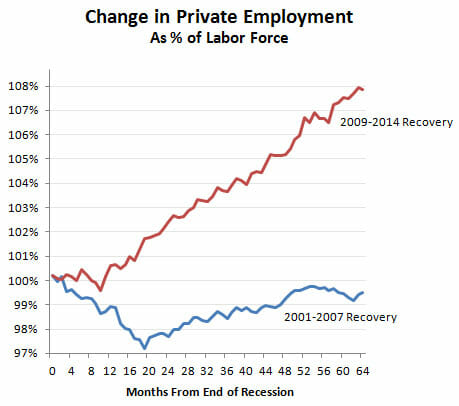
But I think Krugman undersells his case. He shows that the current recovery has created more private sector jobs than the 2001-2007 recovery, and that's true. But in fairness to the Bush years, the labor force was smaller back then and Bush was working from a smaller base. So of course fewer jobs were created. What you really want to look at is jobs as a percent of the total labor force. And here's what you get:
The Obama recovery isn't just a little bit better than the Bush recovery. It's miles better. But here's the interesting thing. This chart looks only at private sector employment. If you want to make Bush look better, you can look at total employment instead. It's still not a great picture, but it's a little better:
Awesome, Kevin! So I guess that austerity you were complaining about was the right thing to do, yes?
Seriously, in his article a year ago Drum argued that the Republicans in Congress were sinking the economy vis a vis the 1990 recession by not continuing to boost spending in the years after the recession. Now, he admits (though since he does not refer back to the original article I guess it is not an admission per se) that this "austerity" led to a stronger recovery than the spending-fueled 1990 version. All hail smaller government, the solution to growing employment!
PS- I wonder how much of this change in private employment since the last recession came in the oil and gas industry, whose expansion the Left generally opposes? Well, they'll bash on oil tomorrow but today, they will take credit for the jobs added.
Update: Here are the two charts combined, with other recessions removed and the colors on the data series set to match (click to enlarge)
Apparently Paul Krugman has weighed in on Amazon and has concluded that it has "too much power".
I just cannot believe progressives are falling into the trap of defending major publishers against Amazon. People like Krugman who bash Amazon are effectively setting themselves up as defenders of a small oligarchy of entrenched publishers who have, until recently, done a very good job of making themselves the sole gatekeeper of who gets into print. Amazon is breaking this age-old system down, in the same way that Uber is challenging taxi cartels and Tesla is challenging traditional auto dealer networks, and giving most everyone access to the book buyer.
The system that Krugman is defending is the system of the 1%. Or 0.1%. The current publishing system benefits about 200 major authors who are in the system and whose work has traditionally been spammed by the large publishers to every bookstore and news outlet. When you walk into an airport book seller, how much diversity of books do you see on the front table? You just know that you are going to see Sue Grafton's "AA is for Aardvark" and Janet Evanovich's "Fabulous Forty-Six". The publishers have risk-return marketing incentives to push the 46th Stephanie Plum novel over trying any new author.
So while the traditional publishers flog the 0.1% of authors, Amazon has empowered 20,000 authors. Those who sell just a few thousand copies (or fewer) of books have found an outlet in Amazon that never existed for them (as disclosure, I am one of those). And writers who distribute mainly through Amazon get a far higher percentage of their book revenues than they ever would get from the traditional publishers.
So Amazon is helping the consumer (lower prices) and 99.9% of authors (better access and higher profits). It is perhaps hurting the top 0.1% and a few century-old entrenched corporations. So what doesn't Krugman like?
I feel like I was way ahead of the pack on May 1 reminding everyone that the Left until recently held up the VA as a model for government health care. I pointed to articles by Kevin Drum and Phil Longman in 2007, but since then others have highlighted articles by Paul Krugman and Ezra Klein that made the same point. Klein said:
If you ordered America's different health systems worst-functioning to best, it would look like this: individual insurance market, employer-based insurance market, Medicare, Veterans Health Administration.
Paul Krugman said
Well, I know about a health care system that has been highly successful in containing costs, yet provides excellent care. And the story of this system's success provides a helpful corrective to anti-government ideology. For the government doesn't just pay the bills in this system -- it runs the hospitals and clinics.
No, I'm not talking about some faraway country. The system in question is our very own Veterans Health Administration, whose success story is one of the best-kept secrets in the American policy debate.
Supposedly, the reason for this success according to Drum and Longman was that ever-popular Lefty magic bullets, electronic medical records and preventative care. On medical records:
"Since its technology-driven transformation in the 1990s...the VA has emerged as the world leader in electronic medical records — and thus in the development of the evidence-based medicine these records make possible." Hospitals that joined Longman's "Vista network" (his name for the VA-like franchise he proposes) would have to install the VA's electronic medical record software and would "also have to shed acute care beds and specialists and invest in more outpatient clinics." By doing this they'd provide better care than any current private network and do it at a lower cost.
On preventative care:
How is a supposedly sclerotic government agency with 198,000 employees from five separate unions outperforming the best the private market has to offer? In a word: incentives. Uniquely among U.S. health care providers, the VA has a near-lifetime relationship with its patients. This, in turn, gives it an institutional interest in preventing its patients from getting sick and in managing their long-term chronic illnesses effectively. If the VA doesn't get its pre-diabetic patients to eat right, exercise, and control their blood sugar, for example, it's on the hook down the road for the cost of their dialysis, amputations, blindness, and even possible long-term nursing home costs....The VA model is that rarest of health care beasts: one with a perfect alignment of interest between patients and providers.
Neither of these have ever proven in real life to actually lower costs in anything but tiny pilot programs, and there is a lot of reason to believe that while preventative care can improve health outcomes, it tends to increase costs.
I have said for years that at the end of the day, the only ideas government planners have for cost control are rationing (which leads to queuing) and cost controls on things it buys from private markets, like doctor time (which leads to shortages and more queuing). This is why every health care system that offers free care to all comers, whether it be socialist systems in other countries or the VA or even an urban emergency room, has long queues.
In fact, the situation, as I think we will find at the VA, is worse. Not only is the old pie being allocated differently (shifting from price-sensitivity to queue tolerance) but the pie of available supply is likely getting smaller as resources are consumed by government red tape and price controls drive suppliers out of the market. The next stories will be about the staggering waste of money on red tape in the VA system, and the stories after that will be about a few VA users jumping the queue because of political connections.
This stuff is so inevitable that it was all addressed years ago in my three part series of Obamacare. In that series, the issues were not failing exchanges and the mess we have seen so far, but the issues we are more likely to see over the long term. The VA is merely a preview, but we shouldn't have needed a preview because we could have looked at countries like England. Of course, if the media had any desire to honestly tell these socialized medical stories we would not get fawning profiles of the horrendous system in Cuba.
Yesterday I was interviewed for a student radio show, I believe from the USC Annenberg school. I have no quarrel with the staff I worked with, they were all friendly and intelligent.
What depressed me though, as I went through my usual bullet points describing the "lukewarmer" position that is increasingly common among skeptics, was that most of what I said seemed to be new to the interviewer. It was amazing to see that someone presumably well-exposed to the climate debate would actually not have any real idea what one of the two positions really entailed (see here and here for what I outlined). This gets me back to the notion I wrote about a while ago about people relying on their allies to tell them everything they need to know about their opponent's position, without ever actually listening to the opponents.
This topic comes up in the blogosphere from time to time, often framed as being able to pass an ideological Touring test. Can, say, a Republican write a defense of the minimum wage that a reader of the Daily Kos would accept, or will it just come out sounding like a straw man? I feel like I could do it pretty well, despite being a libertarian opposed to the minimum wage. For example:
There is a substantial power imbalance between minimum wage workers and employers, such that employers are able to pay such workers far less than their labor is worth, and far less than they would be willing to pay if they had to. The minimum wage corrects this power imbalance and prevents employers from unfairly exploiting this power imbalance. It forces employers to pay employees something closer to a living wage, though at $7.25 an hour the minimum wage is still too low to be humane and needs to be raised. When companies pay below a living wage, they not only exploit workers but taxpayers as well, since they are accepting a form of corporate welfare when taxpayers (through food stamps and Medicare and the like) help sustain their underpaid workers.
Opponents of the minimum wage will sometimes argue that higher minimum wages reduce employment. However, since in most cases employers of low-skilled workers are paying workers less than they are willing and able to pay, raising the minimum wage has little effect on employment. Studies of the fast food industry by Card and Walker demonstrated that raising the minimum wage had little effect on employment levels. And any loss of employment from higher minimum wages would be more than offset by the Keynesian stimulative effect to the economy as a whole of increasing wages among lower income workers, who tend to consume nearly 100% of incremental income.
Despite the fact that I disagree with this position, I feel I understand it pretty well -- far better, I would say, than most global warming alarmists or even media members bother to try to understand the skeptic position. (I must say that looking back over my argument, it strikes me as more cogent and persuasive than most of the stuff on Daily Kos, so to pass a true Turing test I might have to make it a bit more incoherent).
Back in my consulting days at McKinsey & Company, we had this tradition (in hindsight I would call it almost an affectation) of giving interviewees business cases** to discuss and solve in our job interviews. If I were running a news outlet, I would require interviewees to take an ideological Touring test - take an issue and give me the argument for each side in the way that each side would present it.
This, by the way, is probably why Paul Krugman is my least favorite person in journalism. He knows very well that his opponents have a fairly thoughtful and (to them) well intention-ed argument but pretends to his readers that no such position exists. Which is ironic because in some sense Krugman started the dialog on ideological Turing tests, arguing that liberals can do it easily for conservative positions but conservatives fail at it for liberal positions.
** Want an example? Many of these cases were just strategic choices in some of our consulting work. But some were more generic, meant to test how one might break down and attack a problem. One I used from time to time was, "what is the size of the window glass market in Mexico?" Most applicants were ready for this kind of BS, but I do treasure the look on a few faces of students who had not been warned about such questions. The point of course was to think it through out loud, ie "well there are different sectors, like buildings and autos. Each would have both a new and replacement market. Within buildings there is residential and commercial. Taking one of these, the new residential market would be driven by new home construction times some factor representing windows per house. One might need to understand if Mexican houses used pre-manufactured windows or constructed them from components on the building site." etc. etc.
I can think of two groups with whom I have some sympathy -- the Tea Party and climate skeptics -- who share one problem in common: the media does not come to them to ask them what their positions are. The media instead goes to their opposition to ask what their positions are. In other words, the media asks global warming strong believers what the skeptic position is, without ever even talking to skeptics. It should be no surprise then that these groups get painted with straw men positions that frequently bear no resemblance to their actual beliefs.
Paul Krugman provides an excellent example. He writes: (shame on the blog author for not linking Krugman's article, here is the link)
Or we’re told that conservatives, the Tea Party in particular, oppose handouts because they believe in personal responsibility, in a society in which people must bear the consequences of their actions. Yet it’s hard to find angry Tea Party denunciations of huge Wall Street bailouts, of huge bonuses paid to executives who were saved from disaster by government backing and guarantees.
This is really outrageous. I am not a Tea Partier because they hold a number of positions (e.g. on immigration and gay marriage) opposite of mine. But to say they somehow have ignored cronyism and bailouts is just absurd. TARP was one of the instigations, if not the key instigation, for the Tea Party. As I have written any number of times, the Tea Party and Occupy Wall Street actually shared a number of common complaints about bank bailouts and cronyism.
By the way, it is Hilarious to see Krugman trying to claim the moral high ground on Cronyism, as he has been such a vociferous proponent of the Fed balance sheet expansion, which will likely go down in history as one of the greatest crony giveaways to the rich in history.
I am simply exhausted with Paul Krugman calling people anti-science neanderthals for staking out fairly mainstream economic positions that he himself has held in the past. It would be one thing to say, "well, I used to believe the same thing but I changed my mind because x, y, z". That would be a statement to respect. Instead Krugman 1) pretends he never said any such thing and 2) acts like his opponent's position is so out of the mainstream that they are some sort of terrorist for even suggesting it.
Yesterday, New York Times columnist and CUNY economics professor Paul Krugman had some very strong words about the position in Republican Congressman Paul Ryan’s new poverty report that American welfare programs discourage work and “actually reduce opportunity, creating a poverty trap.” In fact, after contrasting the Ryan report’s view on poverty traps with some data on inequality and welfare states, Krugman resoundingly concluded that Ryan’s ideas were a total sham:
So the whole poverty trap line is a falsehood wrapped in a fallacy; the alleged facts about incentive effects are mostly wrong, and in any case the entire premise that work effort = social mobility is wrong.
Despite Krugman’s strong conclusions, however, Ryan’s views about US welfare policies and poverty traps are actually pretty mainstream – cited by people across the political spectrum as a big reason to reform state federal poverty programs. In fact, a New York Times columnist and Princeton economics professor expressed these widely-held views on the Old Grey Lady’s pages a mere two months ago:
But our patchwork, uncoordinated system of antipoverty programs does have the effect of penalizing efforts by lower-income households to improve their position: the more they earn, the fewer benefits they can collect. In effect, these households face very high marginal tax rates. A large fraction, in some cases 80 cents or more, of each additional dollar they earn is clawed back by the government.”
Even more, the Ryan report’s “poverty trap” analysis is based on the work of the Urban Institute’s Gene Steuerle’s (see p. 7 of the Ryan report), on whom the very same Princeton professor once wrote:
[I]t’s actually a well-documented fact that effective marginal rates are highest, not on the superrich, but on workers toward the lower end of the scale. Why? Partly because of the payroll tax, but largely because of means-tested benefits that fade out as your income rises. Here’s a recent discussion by Eugene Steuerle…
That professor, if you haven’t already guessed, was none other than Paul Krugman.
By the way, can I say how happy the first sentance of this quote makes me, to no longer see my alma mater mentioned in the same breath as Krguman at every turn?
Here is the problem: There exists a highly dynamic, multi- multi- variable system. One input is changed. How much, and in what ways, did that change affect the system?
Here are two examples:
The government makes a trillion dollars in deficit spending to try to boost the economy. Did it do so? By how much? (This Reason article got me thinking about it)
Man's actions increase the amount of CO2 in the atmosphere. We are fairly confident that this has some warming effect, but how how much? There are big policy differences between the response to a lot and a little.
The difficulty, of course, is that there is no way to do a controlled study, and while one's studied variable is changing, so are thousands, even millions of others. These two examples have a number of things in common:
We know feedbacks play a large role in the answer, but the system is so hard to pin down that we are not even sure of the sign, much less the magnitude, of the feedback. Do positive feedbacks such as ice melting and cloud formation multiply CO2 warming many times, or is warming offset by negative feedback from things like cloud formation? Similarly in the economy, does deficit spending get multiplied many times as the money gets respent over and over, or is it offset by declines in other categories of spending like business investment?
In both examples, we have recent cases where the system has not behaved as expected (at least by some). The economy remained at best flat after the recent stimulus. We have not seen global temperatures increase for 15-20 years despite a lot of CO2 prodcution. Are these evidence that the hypothesized relationship between cause and effect does not exist (or is small), or simply evidence that other effects independently drove the system in the opposite direction such that, for example, the economy would have been even worse without the stimulus or the world would have cooled without CO2 additions.
In both examples, we use computer models not only to predict the future, but to explain the past. When the government said that the stimulus had worked, they did so based on a computer model whose core assumptions were that stimulus works. In both fields, we get this sort of circular proof, with the output of computer models that assume a causal relationship being used to prove the causal relationship
So, for those of you who may think that we are at the end of math (or science), here is a class of problem that is clearly, just from these two examples, enormously important. And we cannot solve it -- we can't even come close, despite the hubris of Paul Krugman or Michael Mann who may argue differently. We are explaining fire with Phlogiston.
I have no idea where the solution lies. Perhaps all we can hope for is a Goedel to tell us the problem is impossible to solve so stop trying. Perhaps the seeds of a solution exist but they are buried in another discipline (God knows the climate science field often lacks even the most basic connection to math and statistics knowledge).
Maybe I am missing something, but who is even working on this? By "working on it" I do not mean trying to build incrementally "better" economics or climate models. Plenty of folks doing that. But who is working on new approaches to tease out relationships in complex multi-variable systems?
Climate alarmists have mastered the trick of portraying opposition to their theories as not just being wrong, but being anti-science. For years many scientists who have not looked into climate science at all have reflexively signed petitions supporting the alarmists, in the belief they were supporting science against anti-science. (By the way, time and again when these physicists and Earth scientists have actually later looked at the quality of climate science work, they have been astounded at the really poor quality garbage they were implicitly supporting -- I know, I am in that camp myself).
It looks like Paul Krugman, the most politicized economist ever(TM), is trying to bring the same style argumentation to economics. If you don't agree with him, you are not just wrong, you are anti-science. He is Galileo, and you are the ill-informed mystic.
So let me summarize: we had a scientific revolution in economics, one that dramatically increased our comprehension of the world and also gave us crucial practical guidance about what to do in the face of depressions. The broad outlines of the theory devised during that revolution have held up extremely well in the face of experience, while those rejecting the theory because it doesn’t correspond to their notion of common sense have been wrong every step of the way.
Yet a large part of both the political establishment and the economics establishment rejects the whole thing out of hand, because they don’t like the conclusions.
Galileo wept.
There are two other similarities between economics and climate that support this kind of blind (but unwarranted) certainty:
There are few if any opportunities for controlled experiments to truly test cause and effect
There are near infinite numbers of moving parts and variables, such that one can almost always find an analysis that shows your favored variable correlated to something good or bad -- as long, of course, as you are willing to pretend that a zillion other variables weren't changing at the same time which could have equally likely been part of the causation.
I am still reading through the Detroit Free Press report on Detroit's financial history and it is really amazing. All the stuff you expect to see is there -- over taxation, over regulation, crony gifts, huge government pay and pensions, etc. But this was new to me, and even worse than I expected:
Gifting a billion in bonuses: Pension officials handed out about $1 billion in bonuses from the city’s two pension funds to retirees and active city workers from 1985 to 2008. That money — mostly in the form of so-called 13th checks — could have shored up the funds and possibly prevented the city from filing for bankruptcy. If that money had been saved, it would have been worth more than $1.9 billion today to the city and pension funds, by one expert’s estimate.
Outright gifts of taxpayer money to government workers, even beyond their already rich salary and pensions! Folks on the Left from Paul Krugman to Obama are trying to portray Detroit as the innocent victim of economic and demographic exogenous forces beyond their control. Don't let them. The exodus from Detroit and the destruction of its economy were not random events the city had to endure, but self-inflicted wounds.
The Left continues to push the myth that government "austerity" (defined as still running a massive deficit but running a slightly smaller massive deficit) is somehow pushing Europe into a depression. Well, this myth-making worked with Hoover, who is generally thought to have worsened the Depression through austerity despite the reality that he substantially increased government spending.
It is almost impossible to spot this mythical austerity beast in action in these European countries. Sure, they talk about austerity, and deficit reduction, and spending increases, but if such talk were reality we would have a balanced budget in this country. If one looks at actual government spending in European nations, its impossible to find a substantial decline. Perhaps they are talking about tax increases, which I would oppose and have been occurring, but I doubt the Left is complaining about tax increases.
Seriously, I would post the chart showing the spending declines but I can't because I keep following links and have yet to find one. I keep seeing quotes about "commitment" to austerity, but no actual evidence of such.
Let's take Britain. Paul Krugman specifically lashed out at "austerity" programs there are undermining the British and European economy. So, from this source, here is actual and budgeted British government spending by year, in billions of pounds:
2007: 544.0
2008: 575.7
2009: 621.5
2010: 660.6
2011: 683.4
2012: 703.4
2013: 722.2
Seriously, I will believe the so-called austerity when someone shows it to me. And this is not even to mention the irresponsibility of demanding more deficit spending without even acknowledging the fact that whole countries already have so much debt they are teetering on the edge of bankruptcy.
Here is the European problem -- they are pouring hundreds of billions of Euro into bailing out failed banks and governments. They are effectively taking massive amounts of available resources out of productive hands and pouring it into failed institutions. Had they (or we) let these institutions crash four years ago, Europe would be seeing a recovery today. The hundreds of billions of Euros used to keep banks on life support could have instead been used to mitigate the short term effects of bigger financial crash.
In his New York Times column, Paul Krugman blames the coming British recession on the government's "austerity." In the Left's parlance, "austerity" means the government is not spending and in particular deficit spending enough.
a. Of 44 major economies in the world, the British have been running the highest budget deficits of any country except two - Greece and Egypt are higher.
b. British real government spending has risen every year through the financial crisis
Presuming Krugman has access to these basic facts, is his argument that Britain should be deficit spending even more (and if so, wtf is enough?) or is this just political hackery to help Obama dispel concerns about his deficits?
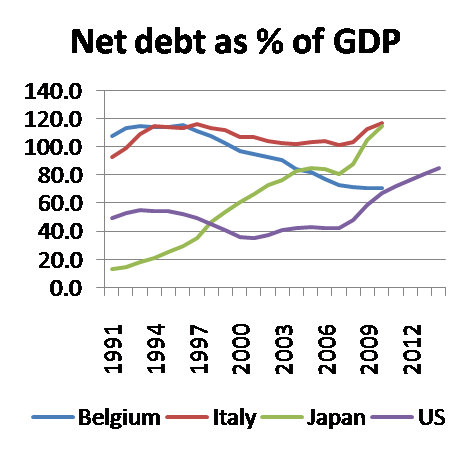
I found this 2009 graph and comment by Paul Krugman (dredged up by Megan McArdle) to be a hilarious call to arms for all his fellow lemmings to follow him over the cliff
[from November 2009]: Why, people ask, would I want to compare us to Belgium and Italy? Both countries are a mess!
Um, guys, that's the point. Belgium is politically weak because of the linguistic divide; Italy is politically weak because it's Italy. If these countries can run up debts of more than 100 percent of GDP without being destroyed by bond vigilantes, so can we.
Today I spent time arguing with a group of folks about global warming and the precautionary principle. The others all argued that a slim chance of a catastrophe justified immediate action. I argued, of course, that they were understating the cost of the intervention, but that is another story.
Its amazing to me that so many on the Left squawk about the precautionary principle in the case of climate, but are ready to continue running up government spending and deficits despite the fact that the disaster of this approach, given the experience in Europe, is no longer even debatable. Its simply math.
Our problem will play out differently than in Europe. Long before interest rates on US securities run up to the 6% or so tipping point, the Fed will be running the printing presses. Don't believe me, well, they already have been.
Savers beware, our path will be devaluation and inflation.
By the way, the speed with which hyperinflation can take hold is astounding. Here is the inflation rate in the Weimar Republic. As with the Fed today, the central bank of the Weimar Republic was buying up government debt with printed currency. Look how fast the inflation took hold:
(source) Imagine a quarterly meeting of the Fed in August of '22. They are probably looking at month-old data, and in July it looks like everything is under control. Boom, three months later, by the next schedule quarterly meeting, inflation is already out of control. Krugman would say not to worry about inflation, they will have plenty of time to act. Coincidently, this is exactly what Italy and France and Spain said about their sovereign debt, but in a flash, the crisis was upon them and so far out of control there is nothing they can do.
My new column is up at Forbes, and it is one of my favorites I have written for a while (at least it seems so with my current scorpion-induced double vision). It begins with Krugman's recent statement that the Left understands the Right and libertarian positions better than the Right and libertarians understand the Left.
But I do understand the leftish position well enough to identify its key mistake. As I mentioned earlier, we libertarians are similarly concerned with aggregations of power. We have, at best, a love-hate relationship with large corporations, for example, enjoying the bounties they can bring us but fearing their size and power.
But what the Left ignores is that there is absolutely no power imbalance as large as that between the government and its citizens. After all, you may get ticked off when Exxon charges you $4.00 a gallon for gas for reasons that aren't transparent to you, but you can always tell Exxon to kiss off and buy from someone else, or ride a bike, or stay home. Because Exxon does not have armies and police and guns and prisons.
Every single time we give the government the power to right a perceived imbalance, we give the government more power than the private entity we are trying to contain. In effect, we make things worse. Because we want the government to counter-act the power of oil companies, Congress now has the power to dump large portions of our food supply into motor fuel, to the benefit of just a few politically connected ethanol companies.
One of the reasons the Left often cannot adequately articulate the libertarian position is that the notion of bottom-up emergent order tends to be difficult for many to understand or accept (this is mildly ironic, since the Left tends to defend the emergent order of Darwinian evolution against the top-down Christian creation vision).
The key to much of libertarian economics is not that libertarians trust private actors, but that libertarians trust natural correction mechanisms in free markets far more than it trusts authoritarian power of the government. When, for example, large corporations become sloppy and abusive and senescent, markets will eventually bring them down.
In fact, when government is given power, nominally to correct such imbalances, they tend to use it to protect those in power as often as they do to protect the disenfranchised. Government restrictive licensing of hair dressers, interior designers, and morticians; bailouts of GM, Chrysler, and AIG; corporate welfare to GE and ADM; and use of imminent domain to hand private property to favored real estate developpers -- all are examples of finding government cures for perceived private power imbalances that are worse than the disease.
Isacc Asimov, in a book called Foundation that Paul Krugman recently rated as one of the most influential on his life, related this fable: Once there was a man and a horse, who were both imperiled by a wolf. The man approached the horse, and said that if the horse would put its superior speed at his disposal, he could kill the wolf. And so the horse agreed to take the man's saddle and bridle, and helped the man kill the wolf. The horse said, "great job, now remove your saddle and we can both be free," and the man said "never!"
I hope the moral of the story is clear. In trying to deal with the threat of the wolf, the horse gave the man so much power he became an even bigger threat. So too when we look to government to solve our problems.
I find it absolutely unsurprising that Paul Krugman was enthralled by the vision of a science that can be used by a few people to control the actions and futures of all humanity. He said “I want to be one of those guys!” I was captivated by the vision in the book as well, but my thought was always "how do we avoid these guys?" The second two books were about how government planners used mind control to deal with humanity whenever individuals had the gall to circumvent their plans. Lovely.
If I remember right, Asimov wrote the Foundation after reading the Rise and Fall of the Roman Empire. The notion of how much of history is inevitable due to large forces (e.g. economics) vs. how much is due to the actions of individuals and what historians now call contingency (e.g. luck) is an endlessly fascinating thing to debate, and I found the Foundation books to be interesting thought exercises along these lines. But it certainly didn't inspire my life's goals, any more than Dune made me wish for a religious jihad.
I can see the secret Second Foundation scratching their heads now in their secret lair (which turns out to be in the New York Times building in the middle of New York City but that's a spoiler from the third book). The equations show right here that a trillion dollar stimulus should have kept unemployment below 8%....
"These [trust fund] balances are available to finance future benefit payments and other trust fund expenditures—but only in a bookkeeping sense. These funds are not set up to be pension funds, like the funds of private pension plans. They do not consist of real economic assets that can be drawn down in the future to fund benefits. Instead, they are claims on the Treasury that, when redeemed, will have to be financed by raising taxes, borrowing from the public, or reducing benefits or other expenditures. The existence of large trust fund balances, therefore, does not, by itself, have any impact on the Government's ability to pay benefits." [bold added]
Needless to say, he has changed his tune now that he is being paid to shout "all is well" as enabler-in-chief of Obama's spending habit.
Paul Krugman has become pretty famous for being able to peer into the complex economy and find something to justify whatever he is promoting. Higher interest rates, lower interest rates, more growth, less growth, unemployment, or boom times all simultaneously are proof of whatever theory he currently holds (which, in turn, is generally exactly the theory required to support actions by the Democratic leadership).
In the same way -- hot weather, cold weather, drought, wet weather, mild weather, lost of hurricanes, a lack of hurricanes -- are all simultaneously the proof for man-made global warming. Whatever the weather currently is, someone can use a government grant to build a model to prove that it is due to anthropogenic global warming. Thus this story -- Global warming causing freezing.
The trust fund is just an accounting fiction "” a pile of worthless IOUs! Generations of voters have been misled by such skillfully-wrought presentations.
....Krugman is our most valuable player by far "” our only player at the top of the press corps. Can he disentangle the trust fund scam in a way average people will understand? We don't know, and it isn't his job; no player should be expected to carry the ball on every play from scrimmage. Tomorrow, we'll offer our own ideas at how the "there-is-no-trust-fund nonsense" might best be approached, in a way average people can follow.
Well, hell, I'll take a crack at it. Here's the simple version.
In 1983, when we last reformed Social Security, we made an implicit deal between two groups of American taxpayers. Call them Groups A and B. For about 30 years, Group A would pay higher taxes than necessary, thus allowing Group B to reduce their tax rates. Then, for about 30 years after that, Group A would pay lower taxes than necessary and Group B would make up for this with higher tax rates.
This might have been a squirrelly deal to make. But it doesn't matter. It's the deal we made. And it's obviously unfair to change it halfway through.
This is an incredible fantasy. Absolutely no one thirty years ago (Drum dates the "deal" to 1983) explicitly or even secretly crafted any such deal. Seriously, is Drum really positing that a Democrat-dominated Congress led by for-god-sakes Tip O'Neil really said "lets have poor people pay some of rich people's taxes for thirty years?" Just last night I was reading a quote from Hitler late in WWII that asserted he actually let the British escape from Dunkirk on purpose because he wanted the British to know he had no real quarrel with them. While it certainly is true Hitler never really wanted a war with Britain, this is just a self-serving rewrite of history. Drum is doing the same thing. Its amazing to me that an obviously intelligent person can convince himself of this.
Here is the real, simple explanation of the Social Security trust fund: Social Security was spinning off huge piles of money and no Congress person of either the Coke or the Pepsi party could resist grabbing it and spending it in a way that would support their reelection. They ended up spending it all. Every bit of it, all gone. The Social Security trust fund is the Enron 401K plan stuffed with Enron stock.
Drum gets to his bizarre theory because he believes the fiscal discipline problem over the last 30 years was all due to tax cuts rather than spending, and that all these tax cuts were for rich people. Of course, throughout the last 30 years, the share of taxes paid for by the rich have steadily risen, so the claim is absurd on its face, but the false assumptions it is built on are ones that every progressive accept as holy writ.
This paragraph is particularly a howler:
The physical embodiment of this deal is the Social Security trust fund. Group A overpaid and built up a pile of bonds in the trust fund. Those bonds are a promise by Group B to repay the money. That promise is going to start coming due in a few years, and it's hardly surprising that Group B isn't as excited about the deal now as it was in 1983. It's never as much fun paying off a loan as it is to spend the money in the first place.
It would be some exercise to try to define groups A and B in a non-overlapping manner. The fact is everyone is in group A, as almost everyone overpays into Social Security on a return on capital basis -- the retirement income most people get represents generally a negative net ROI on the "premiums" paid. And it is amazing to me that I have never heard that we now have government bonds that must be paid back only by a specific sub-section of the population. It may very well have been a progressive assumption that only rich people would be on the hook for every dollar of government debt run up over the last 30 years, but that fact will likely be a surprise to just about everyone else in the country. Here is his conclusion:
But pay it off they must. The rich have been getting a loan from the middle class for decades...
When we gave government money targeted at single women with kids we got, incredibly, more single women with kids. And when we give people money only when they are unemployed, we are going to get more unemployed. The economics of this are pretty bullet-proof. We may choose to do so because we have a humanitarian desire to cushion hardship, but we should accept that when we reduce the hardship of being unemployed, and actually give people money for not working, we are going to get more people unemployed for longer periods.
Talking to reporters, the House speaker was defending a jobless benefits extension against those who say it gives recipients little incentive to work. By her reasoning, those checks are helping give somebody a job. "It injects demand into the economy," Pelosi said, arguing that when families have money to spend it keeps the economy churning. "It creates jobs faster than almost any other initiative you can name."
Pelosi said the aid has the "double benefit" of helping those who lost their jobs and acting as a "job creator" on the side.
I am rapidly approaching the point where I am ready to throw out the whole of macroeconomics as unprovable and unproductive, serving the purpose of allowing statists to do whatever they hell they want to do with some fig leaf from some goofball macro-economics theory (and if the necessary theory is not on the books, Paul Krugman, formerly a real economist, will be more than happy to whomp one up for his buddies on the Left.)
I was going to write a long post on Krugman's article, but Michael Cannon takes care of it with one sentance:
Paul Krugman says libertarianism is not a serious political philosophy because politicians are corruptible, do stupid things, et cetera. My colleagues Aaron Powell and David Boaz demonstrate why that's a bigger problem for Krugman than for libertarians: Krugman's statism wouldn't make politicians any less ignorant or corruptible, it would just give those ignorant and corruptible politicians more power.
By the way, I thought this earlier article by Brett Barkley was pretty interesting. He investigated which economists changed their views the most based on who occupied the White House. Want to lay any bets on who won the title of most politicized economist?
When the White House changes party, do economists change their tune on budget deficits? Brett Barkley does a systematic investigation. Six economists are found to change their tune "“ Paul Krugman in a significant way, Alan Blinder in a moderate way, and Martin Feldstein, Murray Weidenbaum, Paul Samuelson, and Robert Solow in a minor way "“ while eleven are found to be fairly consistent.