Posts tagged ‘obama’

The Demagoguery Moves to GM

From a reader, via Bloomberg

GM’s offer is “grossly unfair to the point of abusive,” Glenn Reynolds, chief executive officer of CreditSights Inc. in New York, wrote in a report this week. “Politics remains an overriding factor in the equation and has been decidedly unfriendly to the interest of bondholders in a contest with the disproportionately outsized power of organized labor and other Washington-heavy constituencies and interest groups.”…

“The attack on institutional investors by the administration in this process is a very strange approach and borders on demagoguery,” CreditSights’ Reynolds wrote in the report. “The bondholders are being painted into a corner and will have no chance but to stand and fight. You can call them names as long as they get treated fairly. Offer them virtually nothing and then call them names? Now that’s just cold.”

And here is Cliff Asness, a hedge fund manager not involved with Chrysler:

  • “Let’s be clear, it is the job and obligation of all investment managers, including hedge fund managers, to get their clients the most return they can. They are allowed to be charitable with their own money, and many are spectacularly so, but if they give away their clients’ money to share in the “sacrifice”, they are stealing.”
  • “The President screaming that the hedge funds are looking for an unjustified taxpayer-funded bailout is the big lie writ large. Find me a hedge fund that has been bailed out. Find me a hedge fund, even a failed one, that has asked for one. In fact, it was only because hedge funds have not taken government funds that they could stand up to this bullying. The TARP recipients had no choice but to go along.”
  • The President’s attempted diktat takes money from bondholders and gives it to a labor union that delivers money and votes for him. Why is he not calling on his party to “sacrifice” some campaign contributions, and votes, for the greater good? Shaking down lenders for the benefit of political donors is recycled corruption and abuse of power.”

Chicago-Style Politics, Chrysler, and the Rule of Law

Finem Respice has a great post on the Administration’s bare-knuckle tactics in trying to enforce its will (against the dictates of bankruptcy law) on Chrysler:

It should be obvious to most observers that, recent allegations of strong-arm tactics in negotiations with Chrysler creditors notwithstanding, given the current situation the White House shouldn’t need to resort to anything so openly thuggish as naked threats issued by the likes of Steven Rattner. Assuming for a moment, and for the purposes of conversation, that the allegations are substantially true (and I believe they are), the fact that a bit of Chicago-style thuggery seems to have been required- and seems to have failed- says a lot about this White House. It also says quite a bit about the wild overconfidence intrinsic in the administration and how entirely unused to being denied their will are the senior members thereof. A more deft executive need not have pushed so hard, or rattled the saber of class warfare so loudly, but then a more deft executive would not have expected so much….

There are three things that are scarier than the actual resort to common thuggery. The ease with which it comes to this administration. The ubiquitous and rank ineptitude that makes a resort to thuggery necessary in the first place- and promises it will become a common tactic in the days to come. And the forgiveness the population regularly affords the administration after one or another of these episodes is, yet again, made public.

The tantrums that follow missed targets sketch an interesting family portrait of a class of politically spoiled children, think Hillary Clinton meets Paris Hilton- totally devoid of real executive experience but somehow still used to getting their way no matter what some silly law book says. I believe I’ll take my chances with the “speculators” over these alternatives any day, particularly when the spoiled children have the 82nd Airborne Division in their toy chest.

When Obama, who has no real experience with bankruptcy or really with any business enterprise, attempts to substitute for a bankruptcy judge, we have to ask ourselves why.  He certainly does not have as much experience or expertise.  He has no particular unique knowledge of the business.  The only unique “quality” Obama has that a bankruptcy judge does not is that Obama does not feel bound by bankruptcy law.   The only possible reason for his involvement is to substitute his desired outcome for the one that would result from the normal application of contract law and bankruptcy precedents.  Since this is an inherently political process, it should not be surprising that at its core, Obama’s actions are meant to promote the interests of a politically important Democratic constituency at the expense of a group of bondholders he is confident he can portray to the public as unsympathetic.

Megan McArdle said it quite well:

For the record, I have no problem with whatever cramdown those debtholders–or any others–get in bankruptcy court.  If the judge thinks that the reorganization can’t be done without making the UAW basically whole, fine.  I just think that the reorganization should be done under the well-established procedures of the bankruptcy court, not at the behest of an administration trying to reward its supporters.

It’s all very well to say that most of the senior lenders are going along, but of course, the leading senior lenders are doing this because the administration has them over a barrel.  I think most of the people enthusing about this actually recognize that in other countries, when the government uses the banking system as a slush fund to reward its constituencies, this generally turns out badly–and makes the banking system a lot more frail.

Nor will it fly to claim that the administration’s threats–and note that Perella Weinberg has most carefully not denied that they were threatened–are just standard jawboning.  Standard jawboning does not involve the White House bloody press corps.  It is true that DIP financiers often get to demand serious concessions from creditors, but those creditors are limited by what those creditors would get out of a recession, and are aimed at either maximizing enterprise value, or maximizing the likelihood that the loan will be repaid.  This deal does neither.

Perhaps it’s idealistic of me, but the American bankruptcy system actually works very, very well.  I think we should be very cautious about mucking with it, particularly when there’s no reason to.  The administration didn’t need to beat up the creditors in order to reorganize the company–or at least, they wouldn’t have needed to do so, if they weren’t trying to make the creditors take less than they’d get in a liquidation.  Nor did it need to do so to keep the UAW at the table–unlike capital, the UAW isn’t going anywhere.  The administration is beating up the creditors because a) it wants to give the UAW a much better deal than they’d get in liquidation and b) they’d like someone else to pay for it.

Update: More of the same coming out (as I predicted here):

Although the focus has so been on allegations that the White House threatened Perella Weinberg, sources familiar with the matter say that other firms felt they were threatened as well. None of the sources would agree to speak except on the condition of anonymity, citing fear of political repercussions.

The sources, who represent creditors to Chrysler, say they were taken aback by the hardball tactics that the Obama administration employed to cajole them into acquiescing to plans to restructure Chrysler. One person described the administration as the most shocking “end justifies the means” group they have ever encountered. Another characterized Obama was “the most dangerous smooth talker on the planet- and I knew Kissinger.” Both were voters for Obama in the last election.

One participant in negotiations said that the administration’s tactic was to present what one described as a “madman theory of the presidency” in which the President is someone to be feared because he was willing to do anything to get his way. The person said this threat was taken very seriously by his firm.

The White House has denied the allegation that it threatened Perella Weinberg.

I Find Your Lack of Faith Disturbing

I am trying to figure out what kind of thinking this post from Kevin Drum represents:

According to people “familiar with the talks,” several of Chrysler’s bondholders have rejected the government’s deal, which amounted to paying them off a little more than 30 cents on the dollar.  So that means it’s probably Chapter 11 time.  Blecch.  I hope the holdouts all end up getting less from the judge than they would have gotten from Obama.

There is only one possible reason** for Obama’s attempt to avert a Chrysler bankruptcy — he is trying to divert value from one group who would get it under a bankruptcy to another group.  There can be no other explanation for what he is trying to do, and in fact evidence is pretty strong that he has been trying to get creditors to take less so unions, who supported his election, can get more.

What has happened is that creditors have refused to get bullied by this near-unprecedented intervention by a US President in a bankruptcy case and are holding out for what they feel is the best way to recover as much as possible of what they are owed (no one is coming out whole).  In this context, Drum’s pique really seems petty.  Rather than press for the money they are legitimately owed, the creditors should have bowed down, I guess, to the King’s wishes and given up their money to those courtiers who were smart enough to back the King’s coronation.

What Drum is probably most upset about is that it is now clear that both Bush and his guy Obama have spent tens of billions of dollars of taxpayer money to absolutely no end, just delaying a bankruptcy that would have been better for economic recovery if it had happened six months ago.

** There is one other explanation — Obama may feel like he is better able to mediate a bankruptcy than a bankruptcy court and judge with decades of experience in the field.  I hope this kind of hubris is not the case, but for this administration it is very possible.  Obama is every bit as unaware of his inability to achieve his goals through shear force of will in domestic policy as GWB was in foreign policy.

The New Obama 5-Year Plan

We really couldn’t be more screwed when it is up to an NPR reporter to make the argument for free enterprise:

EPA Administrator Lisa Jackson told NPR’s Michelle Norris yesterday: “The President has said, and I couldn’t agree more, that what this country needs is a one single national road map that tells automakers who are trying to become solvent again what kind of car it is they need to be designing and building for the American people.” Norris then asked: “Is that the role of Government though? That doesn’t sound like free enterprise.” Jackson responded: “Well it is free enterprise in a way.”

via Maggies Farm.

Update: Q&O has a great post deconstructing Obama’s view of government as health care planner.  Very frightening.

Obama’s Budget Plan

I like TJIC’s analogy for explaining the staggering depths to which the Obama administration is going to look for budget cuts:

Lots of folks are having fun pointing out that Obama’s “$100 million budget cut” on a $3.69 trillion budget is pretty small potatoes.

Speaking of small potatoes, here’s my analogy:

A Big Mac has 540 calories.

A small McDonalds French Fries has 230. Looking at the picture at the McDonalds website, I could believe that there are maybe 42 fries in there, so call it perhaps 5.4 calories per individual fry.

So, Obama’s budget is like saying

“Please give me 370 Big Macs … and one french fry. No, not “a small order of fries.” Just a single, lone french fry.

Wait.

Actually, I’m trying to lose weight.Cancel that french fry – I’ll just have the 370 Big Macs.

Avoiding Bankruptcy to Hose the Creditors in Favor of Politically Stronger Stakeholders

I have predicted it a number of times vis a vis Chrysler, including back in February:

It is criminal that this [restructuring plan] is going to Congress, not a bankruptcy judge.  This is a conspiracy of management (looking to hold onto their jobs and equity), equity holders, and employees to usurp value from the senior debt holders, who would normally be first in line in a bankruptcy.

or in March:

there is a clear set of winners and losers in a bankruptcy — and there is enough case law on it that all the players at GM know it and they know into which category they fall.  Those who are lower down the food chain are hoping that putting the restructuring in Obama’s hands rather than those of the bankruptcy process will improve their outcomes.

Oh, gee, you say, the Anointed One would not be so crass as to used this way, would he?  From Megan McArdle

The government is trying to play hardball with the Chrysler creditors, asking them to accept 15 cents on the dollar when they’re likely to get more in a liquidation.  That’s not a haircut; it’s more like what they do to you the first day of boot camp.

The U.S. and the World

I see a lot of news stories about Obama supporters scratching their heads at why Obama did not get more respect from other nations.  Why do these countries continue to heap scorn on the US as the US contributes more and more to international efforts?

Here is a hint:

  1. These other countries share President Obama’s attitudes about the rich
  2. As far as the rest of the world is concerned, the US is rich

The rich in this country pay for most of the programs Obama takes credit for.  When folks say that Obama “cares”, he does so with the money of America’s rich.  In return, he heaps nothing but scorn on the rich, blaming them for any economic problems that may exist and criticizing them for not paying enough taxes.

Mr. President, the other countries of the world treat you and this country exactly like you treat the rich, and for the same reasons.  If that frustrates you, look to your own values first.

The Emerging Corporate State

I very seldom include really long excerpts from articles, but this is perhaps the most telling article I have read to really give you a feel for what the new government ownership of the automakers really means.

It sounds crazy: Just a week after the White House scolded Chrysler LLC for relying too much on gas guzzlers, the company is heading to a marquee auto show Wednesday to unveil a new SUV.

Chrysler insists the Jeep Grand Cherokee, which clocks in at 20 mpg in its two-wheel-drive version and 19 in four-wheel-drive, is a crowd favorite and a crucial part of its lineup.

“This is a very important vehicle for us. It’s one of the primary legs of the Chrysler stool,” Chrysler spokesman Rick Deneau said. “Customers have told us they want this vehicle and that it’s the right size.”…

The White House slammed Chrysler for having a product lineup so heavily weighted with trucks and SUVs. It added that the automaker does not have enough products in the pipeline to meet an expected increase in demand for small cars.

But Chrysler is standing by the Grand Cherokee. It’s profitable, recognizable and the No. 2-selling vehicle in the Jeep lineup. Grand Cherokee sales fell by almost half during the first three months of the year, but its market share has remained steady, according to Autodata Corp….

Karl Brauer, editor in chief of the automotive Web site Edmunds.com, said it may be hard for Chrysler to please both the government, which is demanding greater fuel efficiency from the Big Three, and its customers, many of whom still demand big cars.

“It would be far more foolish for Chrysler to abandon its core competencies in the Jeep brand lineup than it is to come out with a new” Grand Cherokee, Brauer said.

I hardly know where to start with this.  Some thoughts:

  • As expected, the administration does not really care about the near-term recovery of GM and Chrysler, or, if they care, they are totally ignorant as to the realities of the US car market and the sources of Chrysler’s profitability.   They care about enforcing a particular political agenda that has little to do with, and may actually conflict with, the health of the company.
  • We have hit a new low when the President of the United States has a strong opinion on and reaction to what car a private company chooses to feature at an auto show.
  • We REALLY have hit a new low when my newspaper thinks its “crazy” that a private company would follow its own marketing intuition rather than the dictates of the US President as to what car they should feature at an auto show.  The AZ Republic just assumes the company should do whatever Obama tells them to.
  • “Expected increase in demand for small cars”  — Expected, by whom?  Hybrids are currently losing market share.
  • It takes years to develop a new car, so this particular variation of the Cherokee has been in the pipeline for a while, and millions of dollars have likely been invested in it.  And the product line makes money, unlike many other Chrysler cars.  But the Administration wants them NOT to sell it?  It takes years to change a company’s auto portfolio, but Obama is going to throw a hissy fit because they have not done it in two months?  Don’t they know who he is?
  • The article even gives the data one needs to understand why buyers don’t share Obama’s need to downsize their car.  Based on numbers in the article, this SUV uses $235 more gas a year than the Camry (which I guess is a more politically correct car choice).  That is $19.60 a month.  Assuming a car payment of $450 per month, that is about 4% of the car payment.  In other words, the difference in gas use is a TRIVIAL expense for the person who can afford to buy the car in the first place.  Over 5 years, the cumulative extra gas to fuel the SUV costs about the same as the 16″ alloy wheel option on the Camry.

Every day, I have an increasing sense that we are creating a dictatorship run by a grad school public policy seminar.

I am sure that Obama really believes, in his heart, that Americans really want smaller cars rather than SUVs.  So what?  By acting on his own preferences, he is breaking what I call marketing rule #1:  Never assume ones own personal preferences are shared by the marketplace.

I wrote the following in the comments to this post where a good Bay Area greenie had expressed similar views (that automakers are hurting because they are producing the wrong cars that Americans don’t want):

I have been a marketer all my life. As such, one of the first rules of survival I learned was to never overlay my own personal preferences on the marketplace. GM has had this problem for years, with insular design teams locked in some weird 1970s design world.

But you and others are simply repeating the mistake, with a different set of perspectives — you assume your personal preferences in cars represent that of the majority of buyers, and you wish to use the fiat power of government to enforce those preferences. It is a recipe for fiscal disaster. I promise you what people buy, for example, in rural Arizona is not the same thing that people buy in SF, no matter how much those on the coasts want to forget that flyover country exists.

I actually think there is decent evidence that a lot of people do want what GM is offering, given their market share. Why do people always say they make cars that no one wants to buy, when they sell 10 million of them each year? I will confess the GM product line does nothing for me, but so what? Others seem to like it, and, unlike many, I don’t look down my nose at them for doing so.

The problem is not necessarily their product line, but their cost position. The average price of new cars has not risen for 15 years. Much like in computers, consumers now expect ever better cars for the same or lower price each year. GM is still producing cars with a mindset built in an era of a three-company domestic monopoly, where 4% annual price increases were routine. Their competition is producing like they are Dell or Toshiba, recognizing that they are never going to get price increases and ruthlessly driving down costs.

Update: This is relevent, even if not directed specifically at autos:

Er, industry also knew how to make low-flow toilets, which is why every toilet in my recently renovated rental house clogs at least once a week.  They knew how to make more energy efficient dryers, which is why even on high, I have to run every load through the dryer in said house twice.  And they knew how to make inexpensive compact flourescent bulbs, which is why my head hurts from the glare emitting from my bedroom lamp.    They also knew how to make asthma inhalers without CFCs, which is why I am hoarding old albuterol inhalers that, unlike the new ones, a) significantly improve my breathing and b) do not make me gag.  Etc.

In fact, when I look back at almost every “environmentally friendly” alternative product I’ve seen being widely touted as a cost-free way to lower our footprint, held back only by the indecent vermin at “industry” who don’t care about the environment, I notice a common theme: the replacement good has really really sucked compared to the old, inefficient version.  In some cases, the problem could be overcome by buying a top-of-the-line model that costs, at the very least, several times what the basic models do.  In other cases, as with my asthma inhalers, we were just stuck.

Often “industry reluctance” to offer green products is actually industry understanding of customer reluctance to buy them.

I Was Afraid of This

Unchecked executive power seems to be a bad thing only when weilded by the other guy:

The Obama administration is again invoking government secrecy in defending the Bush administration’s wiretapping program, this time against a lawsuit by AT&T customers who claim federal agents illegally intercepted their phone calls and gained access to their records.

Disclosure of the information sought by the customers, “which concerns how the United States seeks to detect and prevent terrorist attacks, would cause exceptionally grave harm to national security,” Justice Department lawyers said in papers filed Friday in San Francisco.

Kevin Bankston of the Electronic Frontier Foundation, a lawyer for the customers, said Monday the filing was disappointing in light of the Obama presidential campaign’s “unceasing criticism of Bush-era secrecy and promise for more transparency.”

“Trust Me” is not supposed to be the defining principle in the Constitution for the excercise of power.

More, via Cory Doctorow:

Every defining attribute of Bush’s radical secrecy powers — every one — is found here, and in exactly the same tone and with the exact same mindset. Thus: how the U.S. government eavesdrops on its citizens is too secret to allow a court to determine its legality. We must just blindly accept the claims from the President’s DNI that we will all be endangered if we allow courts to determine the legality of the President’s actions. Even confirming or denying already publicly known facts — such as the involvement of the telecoms and the massive data-mining programs — would be too damaging to national security. Why? Because the DNI says so. It is not merely specific documents, but entire lawsuits, that must be dismissed in advance as soon as the privilege is asserted because “its very subject matter would inherently risk or require the disclosure of state secrets.”

What’s being asserted here by the Obama DOJ is the virtually absolute power of presidential secrecy, the right to break the law with no consequences, and immunity from surveillance lawsuits so sweeping that one can hardly believe that it’s being claimed with a straight face. It is simply inexcusable for those who spent the last several years screaming when the Bush administration did exactly this to remain silent now or, worse, to search for excuses to justify this behavior. As EFF’s Bankston put it: “President Obama promised the American people a new era of transparency, accountability, and respect for civil liberties. But with the Obama Justice Department continuing the Bush administration’s cover-up of the National Security Agency’s dragnet surveillance of millions of Americans, and insisting that the much-publicized warrantless wiretapping program is still a “secret” that cannot be reviewed by the courts, it feels like deja vu all over again.”

Liquidity or Insolvency?

This is an update to these two posts on the Geithner toxic asset / bank bailout plan.  In those posts, we looked at a hypothetical investment with a 50/50 chance of being worth 0 or 200.  From this, we said that the expected value was 100, and looked at payout scenarios under the Geithner plan.

A number of folks wrote me that I had missed part of the point of the Geithner plan.  The original assumption of the plan was that the banking system is in a liquidity crisis, and fire sales of assets are reducing the pricing of such assets well below their expected hold-to-maturity value.  According to the Treasury white paper:

Troubled real estate-related assets, comprised of legacy loans and securities, are at the center of the problems currently impacting the U.S. financial system…The resulting need to reduce risk triggered a wide-scale deleveraging in these markets and led to fire sales. While fundamentals have surely deteriorated over the past 18-24 months, there is evidence that current prices for some legacy assets embed substantial liquidity discounts…This program should facilitate price discovery and should help, over time, to reduce the excessive liquidity discounts embedded in current legacy asset prices.

Their point is, in our example, that the asset worth 100 is only trading at, say, 50 due to a liquidity discount and the point of the plan is to make this discount go away.

This does make it clearer to me how these guys are justifying this program.   If we look at the program on the original analysis, based on expected values of assets held to maturity, we got this profile of returns:

geithner-plan1

The bank returns in the analysis were based on the alternative of hold to maturity.  It is all a zero-sum game – gains at the banks and investors come directly out the the taxpayer’s pocket.

If, however, one assumes the asset is trading below expected value, say at 50, due to a liquidity discount, then Geithner can argue the banks get a higher return for the same taxpayer subsidy IF the returns are based on a base case of selling out at the fire-sale market price.

geithner-plan2

In this case, with these assumptions, we get some “free value” or a multiplier effect of the taxpayer subsidy equal to the liquidity discount.

Is this a valid way of looking at it?  Well, the first problem is that this seems like an awful lot of money to spend of taxpayer money just to eliminate a fleeting (in the grand scheme of things) liquidity discount.  Banks have a zero-subsidy alternative to achieving the same end, which is simply to hold the investments to maturity, or until the market eliminates the liquidity discount.  Those of you who own a home know that you are going to take a hit on value if you have to sell now, while the market is a flooded with homes for sale, vs. two or three years from now.  Anybody proposed lately to bail ordinary folks out of this liquidity discount?

But perhaps the more telling criticism of Geithner’s assumptions come from a recent paper by a group of Harvard Business School and Princeton professors who have looked at the current market pricing of these toxic assets, and have found little or no liquidity discount.

“The analysis of this paper suggests that recent credit market prices are actually highly consistent with fundamentals. A structural framework confirms that bonds and credit derivatives should have experienced a significant repricing in 2008 as the economic outlook darkened and volatility increased. The analysis also confirms that severe mispricing existed in the structured credit tranches prior to the crisis and that a large part of the dramatic rise in spreads has been the elimination of this mispricing.”

Three conclusions are drawn:

  • Many banks are now insolvent. “…many major US banks are now legitimately insolvent. This insolvency can no longer be viewed as an artifact of bank assets being marked to artificially depressed prices coming out of an illiquid market. It means that bank assets are being fairly priced at valuations that sum to less than bank liabilities.”
  • Supporting markets in toxic assets has no purpose other than transfering money from taxpayers to banks. “…any taxpayer dollars allocated to supporting these markets will simply transfer wealth to the current owners of these securities.”
  • We’re making it worse. “…policies that attempt to prevent a widespread mark-down in the value of credit-sensitive assets are likely to only delay – and perhaps even worsen – the day of reckoning.”

Update: Critics of the study argue the authors only looked at the most liquid portions of the toxic asset portfolios, thus missing the problem they claim to be studying.  From this brief critique, they seem to have a point.

Michael Rozeff looks at the paper’s findings in the context of Austrian economics, and concludes that in fact, Geithner and company are delaying a recovery in lending, as bankers are frozen in a game of chicken, hoping to make things bad enough to attract government subsidies without making them so bad the institution fails before subsidies arrive.

By contrast, the Austrians, as well as other financial analysts, have argued from the outset that the basic problem is not liquidity of the financial system. The argument on the Austrian side is that the banks and other financial institutions have not been in trouble because there is not enough liquidity to buy their loans. They are in trouble because they made bad loans that are worth far less than their values as carried on the banks’ books. The banks are often insolvent. Furthermore, these banks do not want to and refuse to sell these loans at the low values to get the liquid funds they want. They are playing politics. They are getting a better deal (a) by shifting some of these loans to the FED in return for Treasury securities, and (b) getting bailed out by taxpayer funds.

In the Austrian interpretation, the banks have waited while the government came up with various devices to bail them out with other people’s money. The latest is the Geithner PPIP that uses an FDIC guarantee to private parties to buy the bank loans at prices above market value. In the same vein, the accounting regulatory authority known as FASB has just allowed the banks leeway not to carry these bad loans at their market value by voiding the mark-to-market rule.

Who Could Have Predicted This?

Kevin Drum quotes the Financial Times:

US banks that have received government aid, including Citigroup, Goldman Sachs, Morgan Stanley and JPMorgan Chase, are considering buying toxic assets to be sold by rivals under the Treasury’s $1,000bn (£680bn) plan to revive the financial system.

….Wall Street executives argue that banks’ asset purchases would help achieve the second main goal of the plan: to establish prices and kick-start the market for illiquid assets.  But public opinion may not tolerate the idea of banks selling each other their bad assets. Critics say that would leave the same amount of toxic assets in the system as before, but with the government now liable for most of the losses through its provision of non-recourse loans.

Wow, no one could have predicted this.  Except for anyone who spent 5 minutes with the numbers:

There is an interesting incentive to collude [in the Geithner plan] between banks and investors.  The best outcome for both is for investors to pay a high price to banks and then have the bank kick back some portion to the investor.

I will confess that I did not take the next logical step and consider that the ultimate collusion would be for banks themselves to be the investors, but the incentives for doing so were dead clear (part 1, part 2).

I will stick by my original conclusion — Taxpayers are hosed at any price.

By the way, can anyone tell me what the evidence has been for the contention Barack Obama is “really smart,” because I sure don’t see it.  Yeah, he went to an Ivy League School, but so did I and there were plenty of people there I wouldn’t trust to run a lemonade stand.  Sure, he gives a nice prepared speech and seems to have invested in that vocabulary building course Rush Limbaugh used to peddle on his show, but what else?  All I see is a typical Ivy League denizen of some NGO who thinks he/she can change the world if only someone will listen to them, who just comes off as puerile if you really spend any time with them.  I will go back to what I wrote on inauguration day:

Folks are excited about Obama because, in essence, they don’t know what he stands for, and thus can read into him anything they want.  Not since the breathless coverage of Geraldo Rivera opening Al Capone’s vault has there been so much attention to something where we had no idea of what was inside.  My bet is that the result with Obama will be the same as with the vault.

Hosed At Any Price — An Update on Geithner Plan Analysis

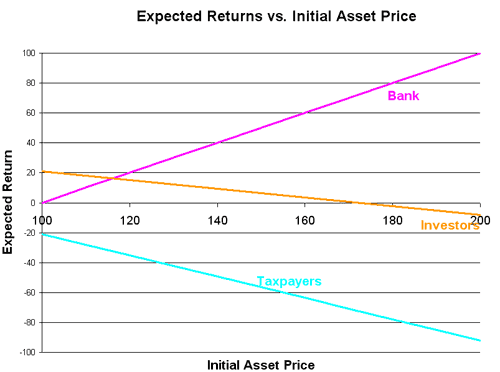
I had someone ask me whether the results in this post on the economics of Geithner’s latest brainstorm were an artifact of the selected purchase price for the distressed asset of 150.  The answer is no.  Investors are willing to buy this asset on these terms at any price under 175, and banks are willing to sell for any price over 100.  Here is the graph of expected values as a function of the purchase price

geithner-plan

Note the taxpayer gets hosed at any price  (kind of the Obama-Geithner update on “unsafe at any speed”)  Two things I had not realized before:

  • Without competition among investors to drive up the price, a very large percentage of the taxpayer subsidy goes to the investors rather than the banks.
  • There is an interesting incentive to collude here between banks and investors.  The best outcome for both is for investors to pay a high price to banks and then have the bank kick back some portion to the investor.

Privitizing Gains, Socializing Losses

Nobel Laureate Joseph Stiglitz has a great deconstruction of the Geithner toxic asset plan in the NY Times.  If you want to see how the new corporate state works, where the government works with a small group of powerful insiders to the benefit of those insiders and the detriment of everyone else, this is a great example.

Stiglitz walks through how the Geithner plan will operate, and I want to do so as well.  I have added a few tables to help illustrate his example a bit better.

Let’s begin with a financial asset that was originally worth $200.    To make things simpler, we’ll assume that with the current economy there are now two outcomes for this asset — a 50% chance it recovers and eventually pays off its full value of $200, and a 50% chance it becomes effectively worthless  (more realistically, there is a range of outcomes, but this does not really effect the following analysis).

The average “value” of the asset is $100. Ignoring interest, this is what the asset would sell for in a competitive market. It is what the asset is “worth.”

This is a classic expected value analysis.  At business school, you spend a lot of your time doing these (trust me).  Expected value is just the percentage chance of each outcome times the value of the outcome, on in this case 50% x $0 + 50% x $200 = $100.

So Stiglitz hypothesizes a situation under the new Geithner plan where a private entity might be willing to pay $150 for this $100 asset.  That’s certainly a windfall for the financial institution that owns the asset currently, since the asset is only worth $100 on the open market.  But why would someone pay $150?  Well, it starts with this:

Under the plan by Treasury Secretary Timothy Geithner, the government would provide about 92 percent of the money to buy the asset but would stand to receive only 50 percent of any gains, and would absorb almost all of the losses

The actual percentages are 8% from the private purchasers, 8% “equity” from the government, and 84% in a government-guaranteed loan  (Equity is in scare quotes because most investors learned long ago that if you provide 80%+ of the capital in a risky venture, you can call the investment “debt” all day long but what you have really done is made an equity investment).

So let’s look at how the purchase cost is divvied up based based on a $150 purchase cost:

Taxpayer $138
Investor $12
Total $150

But we have already posited how this will come out:  a 50/50 chance of $0 and $200 for the final asset value.  So we can compute the outcomes.

50% Chance Investment = $0 50% Chance Investment = $200 Expected Value
Taxpayer -138 +25 -56.5
Investor -12 +25 +6.5
Bank +150 -50 +50

So there is a huge built-in subsidy here.   Now, I don’t personally think the government needs to be injecting equity in banks.  But  I understand there are a lot of people who support it.  So perhaps the $50 subsidy of the banks in the above example is warranted.  But why the $6.5 subsidy of Geithner’s old pals in the investment world?  This is a pure windfall for them, like finding money laying on the street.   Even Vegas does not tip the odds so far in favor of the house.

I agree with Stiglitz’s analysis:

What the Obama administration is doing is far worse than nationalization: it is ersatz capitalism, the privatizing of gains and the socializing of losses. It is a “partnership” in which one partner robs the other. And such partnerships — with the private sector in control — have perverse incentives, worse even than the ones that got us into the mess.

So what is the appeal of a proposal like this? Perhaps it’s the kind of Rube Goldberg device that Wall Street loves — clever, complex and nontransparent, allowing huge transfers of wealth to the financial markets. It has allowed the administration to avoid going back to Congress to ask for the money needed to fix our banks, and it provided a way to avoid nationalization.

Update: I posted an update on the plan and these numbers here.

Only 3-1/2 More Years Until We Go To The Polls To Select A New GM CEO

Russel Roberts deconstructs Obama’s auto speech.  Well worth the read.

I have worked with folks in the government for years.  One of the common syndromes I see in government officials of all levels is something I call “arrogant ignorance.”  I see a lot of it in this administration.

Mussolini-Style Fascism

Megan McArdle did not like this from David Henderson:

President Obama has done something far more serious. He has already, in less than 100 days, moved the U.S. economy further towards fascism. Sean Hannity and other critics keep criticizing Obama for his socialist leanings. But the more accurate term for many of his measures, especially in the financial markets and the auto market, is fascism.

Here’s what Sheldon Richman writes about “Fascism” in The Concise Encyclopedia of Economics:

Where socialism sought totalitarian control of a society’s economic processes through direct state operation of the means of production, fascism sought that control indirectly, through domination of nominally private owners. Where socialism nationalized property explicitly, fascism did so implicitly, by requiring owners to use their property in the “national interest”–that is, as the autocratic authority conceived it. (Nevertheless, a few industries were operated by the state.) Where socialism abolished all market relations outright, fascism left the appearance of market relations while planning all economic activities. Where socialism abolished money and prices, fascism controlled the monetary system and set all prices and wages politically. In doing all this, fascism denatured the marketplace. Entrepreneurship was abolished. State ministries, rather than consumers, determined what was produced and under what conditions.

She replied

How is this helpful?  Has clarifying the distinction between fascism and socialism really added to most peoples’ understanding of what the Obama administration is doing?  All this does is drag the specter of Hitler into the conversation.  And the problem with Hitler was not his industrial policy–I mean, okay, fine, Hitler’s industrial policy bad, right, but I could forgive him for that, you know?  The thing that really bothers me about Hitler was the genocide.  And I’m about as sure as I can be that Obama has no plans to round up millions of people, put them in camps, and find various creative ways to torture them to death.

I’m confused.  It appears to me that McArdle, and not Henderson, was the one who introduced rounding up people in camps into the discussion.  In fact, the prototype example of fascism, in Italy, never went in the genocide direction.   Genocide per se was not a defining feature of fascism, any more than it was in communism.  In both cases genocide was the result of handing immense unchecked power to a small group of people.  And I am not clear why, after Stalin and the Kmer Rouge, McArdle thinks that fascism is any more loaded with genocide associations than socialism.

To avoid this whole confusion, I usually use the term “Mussolini-style fascism” since we do seem blinded and incapable of looking past Hitler whenever that word fascism is mentioned.  But I think the discussion of Mussolini-style fascism is as least as relevant as the frequent discussions on McArdle’s other sites of the causes of the Great Depression.  While Italy adopted the model before the Depression, many nations considered emulating it as a response to the Depression.  I think the evidence is fairly clear that FDR was an admirer of certain aspects of this model, and his National Industrial Recovery Act emulated many mechanisms at the core of Mussolini’s model.

I actually think the Henderson is correct – Mussolini style fascism, and the modern European corporate state, are may be better analogs to describe where this Administration is heading than socialism.

And This Is Better, How?

Critics of high executive pay on the soft-core / moderate left (as opposed to the hard-core socialist left) often argue that they are not against large incomes per se.  However, they argue that high executive pay is often the result of a failure in the structure of corporate governance, where a group of cozy insiders on the board and management hand each other compensation packages to which the rank and file of shareholders would be opposed  (a subset of the agency cost problem).

I am somewhat sympathetic to this argument, as I have personally observed instances where I thought boards and management were too cozy by far.  However, no one has really succeeded at proving this hypothesis on executive pay, and in fact shareholders when they have had a chance to vote on such packages have never really made a meaningful dent in them, and one can find a number of private companies where such governance issues presumably don’t exist but high executive compensation packages can exist.

Just as an aside, a classic example of this can be found in the fabulous book “Barbarians at the Gate” about the RJR Nabisco takeover fight.  The book does a great job of portraying a company with horrible corporate governance issues that seemed to be used to enrich managers with both salaries and perks, but then observed that the new private owners of the company gave their new CEO a compensation package that might have made the previous executives blush.

Anyway, I am yet again off the point.  My point was to observe that the mainstream left seems to believe that there are corporate governance issues at large corporations that disenfranchise the majority of shareholders vis a vis key decisions involving the company executives.  So I have to ask myself, if this is a real fear, then how does one justify having the President of the United States effectively fire the GM CEO, without any vote or substantial input from shareholders?

Postscript: It is all well and good to be cognizant of agency costs.  Everyone should understand when an employee (or contractor or whatever) has different incentives than they themselves possess.  For example, on my recent backyard renovation, I always kept in mind that my architect wanted to create a showplace that would advance his business and possible get into a magazine.  In general, this alligns our interests, but there were times he pressed for things I did not value and I had to be insistent we were not going to do those things.

However, many folks seem to want to run off to government to do something about agency costs whenever or wherever they are found.  This is hugely dangerous, as Congress tends to have the highest agency costs one will ever be likely to find.

A Trillion Dollars? No Problem

The answer to all of Obama’s spending in trillion dollar chunks is obvious.  All we have to do is make our currency work just like that of Zimbabwe, and we will be fine.  We could pay off a trillion dollars with 10 bank notes (I bought just one the other day on eBay for $30 or so).

zimbabwe-trillion

The problem, of course, is that this is what the Obama administration actually appears to be doing.

Dude, The Market Figured That Out 6 Months Ago Before You Started Shoveling My Money At Them

After giving tens of billions of dollars of our money to the auto makers, Obama has now figured out what I and many others knew years ago:

Obama, responding to a question during an online town hall meeting, said the current business model for U.S. carmakers was unsustainable and the Big Three would need to change their ways.

From the article, however, it is still clear that Obama has no intention of allowing GM to go into chapter 11, as they should have 6 months ago.   There is a good political reason for this — remember what I explained before.   Obama is working to equate chapter 11 with the disappearance of the American auto industry, clearly an untrue and facile proposition.  Many large companies, from airlines to energy companies to equipment manufacturers, have gone bankrupt over the last several decades and continued operations or at least had their productive assets taken over by other companies.  GM’s assets are not just going to go poof.

However, there is a clear set of winners and losers in a bankruptcy — and there is enough case law on it that all the players at GM know it and they know into which category they fall.  Those who are lower down the food chain are hoping that putting the restructuring in Obama’s hands rather than those of the bankruptcy process will improve their outcomes.  And, to get those higher on the food chain (ie senior debt holders) to accept this they need the government to bring taxpayer money to the table.  The whole point of an Obama-led restructuring, then, is not to somehow preserve the US auto industry but to improve the financial position of certain GM stakeholders at the expense of US taxpayers  (and probably consumers, and some sort of protectionism is likely to be part of this deal).

But here is the most interesting point that was really hammered into me in reading this article.  If you were to rank Obama as to where he stood vis a vis all American adults in terms of his knowledge of business and what it takes for a company to be successful, where would you rank him?  I don’t think very many would put him in the top half.  In fact, given that he has never, to my knowledge, had any real job in business of any sort (not even a high school job at McDonald’s or something similar), I am not sure I would put him above the 10th percentile.  Anyway, put your own number to this question, and then read these quotes from the linked article

The president said he planned to announce decisions on the future of the industry in the coming days.

“But my job is to measure the costs of allowing these auto companies just to collapse versus us figuring out – can they come up with a viable plan?” he said.

White House spokesman Robert Gibbs said Obama will announce his strategy for the auto industry before he leaves for Europe on Tuesday.

Seriously, would you hand over your business or your stock portfolio for Obama to manage?  I didn’t think so.  It takes years of experience to be able to read a business plan skeptically.  And even people who are experienced at it fail a lot.

By the way, for those who suspect that decisions will not be based on actual market realities but satisfaction of pet political goals, you are probably correct:

The president said even as the economy bounces back, Detroit can’t focus on “trying to build more and more SUVs and counting on gas prices being low.”…

Gibbs said Obama still thinks U.S. automakers build cars that Americans want to buy. Both he and the president own Ford Escape hybrids. “It’s a nice car,” Gibbs said. “It really is.”

So, for example, one can assume its likely the Obama strategy for GM success will include lots of hybrids.  Of course, the market reality is this:

the slowdown has been particularly brutal for hybrids, which use electricity and gasoline as power sources. They were the industry’s darling just last summer,  but sales have collapsed as consumers refuse to pay a premium for a fuel-efficient vehicle now that the average price of a gallon of gasoline nationally has slipped below $2.

“When gas prices came down, the priority of buying a hybrid fell off quite quickly,” said Wes Brown, a partner at Los Angeles-based market research firm Iceology.

I personally believe that a meer restructuring of GM is unlikely to create a turnaround, as I discussed here.

Postscript- It is a bit apples and oranges for me to say that Obama is evaluating business plans here.  In fact, he is not.  Though he calls them that, if the Chrysler retructuring plan they put on the web is any guide, these are political plans, not business plans.  No real business plan, for example, seeking to attract private capital would prioritize the goals “Commitment to Energy Security and Environmental Sustainability”, “Compliance with Fuel Economy Regulations,” and “Compliance with Emissions Regulations” ahead of “Achieving a Competitive Product Mix and Cost Structure.”  In fact, the section about costs and competitive products comes dead last in the Chrysler plan, almost as an afterthought.

Update: This sad story about athletes and their difficulty in managing their money seems relevent.  These guys, who have spent their whole life getting really good at one thing, don’t even have the basic financial vocabulary to understand money management, and absolutely no ability to parse a business plan:

It began in the winter of 1991 when he sank $300,000 into the Rock N’ Roll Café, a theme restaurant in New England designed to ride the wave of the Hard Rock Cafe and Planet Hollywood franchises. One of his advisers pitched the idea as “fail-proof, with no downsides,” Ismail recalls. He never recouped his money and has no idea what became of the restaurant.

Lesson learned? If only. After that Ismail squandered a fortune funding not only that inspirational movie but also the music label COZ Records (“The guy was a real good talker,” says Rocket); a cosmetics procedure whereby oxygen was absorbed into the skin (“We were not prepared for the sharks in the beauty industry”); a plan to create nationwide phone-card dispensers (“When I was in college, phone cards were a big deal”); and, recently, three shops dubbed It’s in the Name, where tourists could buy framed calligraphy of names or proverbs of their choice (“The main store opened up in New Orleans, but doggone Hurricane Katrina came two months later”). The shops no longer exist.

You might say Ismail had a run of terrible luck, but the odds were never close to being in his favor. Industry experts estimate that only one in 30 of the highest-caliber private investment deals works out as advertised. “Chronic overallocation into real estate and bad private equity is the Number 1 problem [for athletes] in terms of a financial meltdown,” Butowsky says. “And I’ve never seen more people come to me about raising money for those kinds of deals than athletes.”

Doesn’t this sound like the current administration in microcosm?  Does Obama have any better chance with his GM investment?

Don’t Say I Didn’t Warn You

MaxedOutMama echoes many of my thoughts on recent economic activity and the shameless way our President has been manipulating these issues:

In January, I was writing that fundamentals had taken an upswing, and that the US economy was going to try to resurge in the third quarter.

The numbers that came in for January and February did show what P-Nat projected, which was a gradual bottoming pattern overall and the beginning of some upticks. Bloomberg today:

Orders for U.S. durable goods unexpectedly rose in February on a rebound in demand for machinery, computers and defense equipment.

Combined with reports showing improvements in retail sales, residential construction and home resales, the figures indicate the economy is stabilizing after shrinking last quarter at the fastest pace in a quarter century. Stepped-up efforts by the Obama administration and Federal Reserve to ease the credit crunch may help revive growth later this year.

Last night Obama took credit for these events, but the stimulus package had nothing to do with it – the effects of that haven’t even hit the economy yet. Very little of that package will be felt in the first half of 2009, in fact, and less than 25% of the effect will be felt in 2009. I would also like to point out that at the time the stimulus bill was being debated, the administration was claiming that the economic emergency was so dire that the representatives and senators shouldn’t even be allowed to read the thing before they voted on it. Instead, this was what was really going on in the economy.

She also shares my concerns that the recovery may in fact be undone by recent government actions, not the least of which is the Weimar Republic-like printing of money to buy back government bonds and help fund a mushrooming deficit.  In fact, she and I must be fairly attuned, as she wrote:

Last week I was so sick at heart that I didn’t think I could continue writing this blog.

I too felt almost exactly the same last week.  Never have I been so depressed about the direction of domestic policy (I might have felt about the same around 1978, but I was only 16 and had other things on my mind).  Every day last week there seemed to be a new policy directive crazier than the last.  I had a real feeling like I was living through the last half of Atlas Shrugged, where an increasingly desperate government initiates a series of policies with disastrous long-term effects crafted just to survive a little longer in office.  The only difference was several years in the book seemed to have been compressed into about a week of real time.

Fortunately, I am basically a happy soul and I seldom stay depressed long.  I just did what I always do when I despair for the world – spent some time with my family and concentrated on what I could fix, namely the health of my own business.

Haiti on the Potomac

The Liberty Papers thinks we have become a lawless Banana Republic.  George Will is thinking along the same lines, snarkily observing that Sweden, China, and Mexico have all observed in one way or another that the Feds seem to be acting outside the rule of law.

I have opined in the past that what really extended the Great Depression was not any real underlying economic issue, or even vast increases in government spending per se.  It was that arbitrariness with which the Roosevelt administration dealt with economic matters.  With nutty programs like the Mussolini-inspired National Industrial Recovery Act coming and going, investors and businesses never knew from day to day what the rules of the game would be next year, or even next week.

I fear that this is exactly the climate Obama and Congress are creating today.

  • When Congress reacts to CNN headlines by retroactively confiscating legal compensation that it had protected just weeks before, what will happen to my compensation?
  • When government deficits soar by trillions of dollars, what will taxes look like next year?
  • When the Administration says that Co2 will have to be reduced by 80%, what numbers do I plug into my forecasts for fuel and electricity?
  • When the government decides on a whim to print a trillion dollars more money to pay off government debt, what will inflation look like in the coming months and years?

As of two months ago, my company was still investing.  We were still getting bank credit, particularly for equipment financing, though it took more work than in the past to secure it.  We still saw opportunity in our business, and in fact saw increased opportunity in the recession for low-cost recreation options and outsourcing of public recreation facilities.

But today, I am reluctant to make any new investments.  Investing $5000 now for $8,000 a year from now normally sounds good, but what happens now that the Feds have more than doubled the money supply?  How much will $8,000 really be worth a year from now?  What will my taxes be on the increase?**  What new costs or liabilities  might be retroactively placed on me for making the investment?  What happens if beltway pundits start thinking I am making too much money?

All this commotion of government intervention started when Paulson and other Bush appointees started screaming that the banking system was going to shut down and therefore crash the whole economy.  As my readers know, I believe to this day that this was all sky-is-falling over-reaction and panic-mongering, and most of the credit crunch resulted from uncertainty about the Treasury and its statements, not due to realities on the ground.   However, whatever tightening of credit we might or might not have avoided by government action, it pales in its effect on investment in comparison to the arbitrariness and trillion-dollar-plan-of-the-day that has been the first 60 days of the Obama administration.

** footnote: For those of you who have not lived through high inflation times, taxes and inflation are a deadly combination.  That is because the Federal Government, after creating inflation, then taxes each of us on its effects.  Here is an example:  Invest $5000 now at a fixed 10% a year.  Suddenly, inflation goes up to 8% a year.  In five years, I now have a bit over $8000.  In economic terms I have made a small profit of, since $8000 in five years at 8% inflation is worth $5,445 today.

But the IRS thinks I have made $3000, not just $445, and will tax me on the full $3000.  If they take a third, I only have $7000 at the end, or $4,764 in current dollars, meaning that after taxes, I actually lost money.

Maybe Mark Sanford Was On To Something

As has been the case for decades (the gun-to-the-head federal strategy to force 55 mph speed limits and seat belt laws come to mind), the feds are sending money to the states with many strings attached.  Apparently, Arizona is running afoul of one of those provisions:

Arizona’s receipt of $1.6 billion in stimulus funding, including more than $300 million already being spent to help keep the state in the black, is at risk because a federal agency says the state is not in compliance with a prohibition against health-care rollbacks.

Arizona could lose the money if the federal determination stands or if state law isn’t changed to eliminate a health-care requalification provision that was the basis of the determination, state officials said Monday.

According to Brewer’s letter, the agency determined that the Arizona Health Care Cost Containment System’s requirement that some enrollees requalify every six months instead of annually violated a stimulus-program prohibition against tightened eligibility standards, methodologies or procedures for a state’s Medicaid program.

There is something supremely irritating about Federal bailouts to states that are tied to restrictions that make it more difficult for states to close their budget shortfalls on their own.  It’s almost as if Congress wants to institutionalize dependency on the Feds  (where have we seen that before?)

Apparently, in the spirit of the retroactive tax-taking of the AIG deferred compensation payments, the restrictions are retroactive to state actions taken as early as July 1, 2008, meaning that Obama is asking states to roll back legislation that was passed months before he was even elected as a condition of getting the cash.

The actions causing problems for Arizona occurred in September, 2008, and were, according to our governor, the result of legislation passed in June of 2008.

Positive News About the Economy

A bit over a week ago, I forecast that we had passed the economic bottom and would soon be back on the way up.  The IBD lists a number of reasons why I may be correct:  (ht:  Carpe Diem)

• A broad rally in stocks, confirmed last Thursday, continuing into this week and led by the beaten-down financials.

• A surprising 22% surge in February housing starts to a seasonally adjusted annual rate of 583,000 units.

• A back-to-back jump in retail sales ex autos, in both January and February.

• A return to profitability at several major banks, including Citigroup, Bank of America and JPMorgan.

• A doubling in the obscure but important Baltic Dry Index, a key indicator of global trade flows.

• An upwardly sloping yield curve, which Fed research suggests all but ensures a rebound by year-end.

• A Housing Affordability Index that has hit an all-time high.

• A two-month improvement in wholesale used-car prices, measured by the Manheim Index.

• A rise in Monster’s Employment Index in February, suggesting a turn in the job market may be around the corner.

• A 4 1/2-year high in the dollar against other major currencies, on a trade-weighted basis.

• A sharp increase in the money supply, as measured by M2 and M1. Weekly M2 growth has averaged 10.1% year-over-year since the start of 2009, while M1 has grown at a 14.6% rate.

• A two-month rally in the Index of Leading Indicators.

• A growing body of evidence that the “liquidity crunch” is dead. Data show nearly $14 trillion in liquidity on the sidelines of the markets, ready to boost consumer spending, credit growth or further stock market gains.

Of course, this makes the entire argument for the trillion dollar plus stimulus bill moot.  If my company had started spending itself into debt to fight some sort of emergency, and then found the emergency did not exist, you can bet we would be spending every hour of the day to stop as much of that emergency spending as possible.  Not so in Washington.  Despite now forecasting an improving economy, and basing his budget on this being a milder-than-normal recession, Obama has not even suggested any roll-back in the massive spending and debt-creation program.  Which just goes to prove that the “stimulus” bill had nothing to do with stimulus in the first place, but was a leftish spending plan sold based on panic, in exactly the same way the Bush administration sold the Patriot Act.

In fact, much of Obama’s remaining legislative agenda (including nationalization of parts of the health care system and a Co2 cap-and-trade system) include what are effectively large tax increases that cannot realistically be passed in the depths of a recession.  So expect a lot of talking up of the economy to prepare the way for these tax increases, not to mention the tax increases that will be necesary, but have not yet been proposed, to pay for the servicing of the huge debt and new spending we just took on.

One final prediction:  As the economy improves enough for the average person to see the improvement, expect the Obama administration to be spinning like mad.  Their first objective will be to take credit for the recovery.  This is absurd, as it appears that the recovery will start long before the first dollar of spending occurs.  The media may, however, let him get away with this.  If it does not, his second story will be that the confidence exuded by the passing of the stimulus bill created the recovery.  This is also absurd on its face, given the crash in equity prices after the stimulus bill was passed and the extreme general skepticism about the stimulus in poll numbers.

Postscript: By the way, I would argue the whole story of this stimulus bill is a microcosm of the climate debate.  Extreme panic was generated based on a fear that their might be some possibility of a catastrophe (ie a second Great Depression) and that on the precautionary principle, we spent a trillion dollars just in case.  Remember that in January, Obama said there will be – not might be – another 5 million job losses, a number we will come nowhere near.

As it turned out, there was never a realistic chance of a catastrophe, but the costs will remain, and all the while the panic over the issue was used as cover to pass a whole range of freedom-reducing initiatives.   Naomi Klein was half right in the shock doctrine — there are folks who use emergencies to successfully push for radical change, but it is almost always the forces of more government control who win out, not the supporters of laissez faire.

Update: A similar list here from Forbes.

The Earmarked Bankruptcy

The normal process for bureaucratic allocation of, say, highway funds, does not always work that well.  Seriously, you don’t have to convince this libertarian of that.  But it is at least intended to try to balance priorities and allocate the funds marginally rationally.   Which points out the problem with earmarks — they are overrides by Congress of the normal allocation and prioritization process for political ends.  By definition, the projects in earmarks would not have normally been funded by the usual operation of the prioritization process.

Which brings me, oddly enough, to AIG  (and to GM).  When companies can no longer meet all of their obligations, they generally file for chapter 11 bankruptcy. This is an extremely well-worn process, both in the courts and the business community, that attempts to save as much value as possible and to allocate that value, based on law and a set of rules everyone understands in advance, to the various stakeholders.   The folks who are involved in this process are pretty hard-headed folks, less out for revenge and retribution as for maintaining value and capturing as much as possible for whatever group one might represent.

Now Congress and the Administration are getting themselves involved in the bankruptcy process, by trying to avert actual chapter 11 filings by AIG and GM.  By doing so, they are effectively overriding the bankruptcy process.  Just as with earmarking, they claim this override is for some good of the country.  But, just as with earmarking, you can assume it is to benefit some politically-favored group.  At GM, the feds are saying that we don’t want employees or the equity holders to take a haircut, as they would in Chapter 11, so we will transfer the loss to taxpayers, and perhaps bondholders (could there be any politically less favored group than taxpayers?).  Same at AIG.   Is it any surprise that the number one beneficiary of the Pauslon bailout of AIG was Goldman Sachs?  The Left thought they smelled a rat when the administrations contracted with ex-Cheney-run Haliburton in Iraq, but no one is going to bat an eye when the Treasury department, populated with ex-Wall Street types, is bailing out all its employees’ old firms?

On the subject de jour, the AIG executive bonuses, many of these were just as guaranteed, contractually, as were payments on AIG policies and bond guarantees.  I don’t know how such obligations are treated in chapter 11 (are they treated as more or less senior than other obligations?) but I do know the decision to keep them or ditch them would be made against a goal of maintaining long-term value, and not public witch-hunting.

This is the real problem, even beyond the taxpayer cost, of this new form of Congressional or Administration-led pseudo-bankruptcy:  Winners and losers are determined by political power and perceptions of short-term political gain, rather than against a goal of maintaining value and following well understood and predictable rule.  This process throws all the old predictable rules and traditions out the window.  Investors and folks with contracts used to know just how senior their obligations were in a corporate failure.  Now, they have no idea, as their position in the bankruptcy may in the future depend more on how much they donated in the last presidential election, or how good their PR agent is.

Who Do You Know Who Has Said All This?

Via Reason:

Obama has promised that no family earning less than $250,000 per year will pay one dime in higher taxes. But the companies that have to pay for permits will pass that cost on to consumers in the form of higher prices for electricity and other products. So these families will pay $645 billion, only some of which will be returned in the form of lower income taxes, for a system that is terribly inefficient.

The solution, of course, would be a straight-forward tax on carbon, the proceeds to be refunded through the payroll tax system. But unlike the hidden tax of cap-and-trade, a carbon tax is out there for the voters to see. And given the choice between a stealthy tax and a visible tax, politicians will pick the former every time.

The Big Lie

I try to never use “lie” or “liar” when discussing politics.  They have become perhaps the most abused and overused words in political discourse, and seldom do they add much to a discussion.

But I simply have no other way to reconcile Obama’s promise that he is not raising taxes on 98% of Americans with his imposition of a cap-and-trade system for CO2.

For years, Al Gore supported a carbon tax on fuels as a way to fight CO2.  As I have written a number of times, if one really feels the need to reduce CO2 emissions (which I don’t), then a carbon tax is far, far more efficient, fair, and effective than a cap-and-trade system.  There are only two advantages to a cap-and-trade system over a carbon tax, and neither has anything to do with Co2 mitigation or program effectiveness:

  1. The tax is hidden, so politicians can pretend the did not really impose a tax.  The author of California’s AB32 cap-and-trade system admitted as much to me in a face-to-face debate we had last year
  2. There are numerous opportunities for politically favored companies to create dubious offset and measurement systems under cap-and-trade which don’t exist under a more straight-forward carbon tax.  Which may explain why Al Gore, who sits on the board of over $2 billion in investments in such companies peddling various offset quackery, now supports cap-and-trade over the carbon tax

Here is the basic economics, a topic on which it is rapidly becoming clear that Obama is completely ignorant**.   First, we have to assume that whatever cap-and-trade system that is implemented is actually effective at reducing CO2 emissions.   This is far from an absolute given, as it can be argued that the European system has done all of about nothing to reduce Co2 emissions (they will claim that it has been effective, but the majority of European CO2 emissions have come from a) British coal-replacement strategy, initiated for reasons other than Co2; b) fall of the inefficient Soviet economies and the shut down of their worst polluting industries; and c) unification of Germany.

But, assuming that cap-and-trade actually reduces CO2, then it HAS to increase costs for consumers.  There is no way around it.  It will do one or both of the following:

  1. Raise prices due to increased producer costs.  An example is electricity generated from any sort of fossil fuel will simply have to be more expensive
  2. Raise prices due to increased scarcity.  In industries where the supply and demand dynamics do not allow cost increases to be passed to consumers, then reduced production and scarcity will result.  In the electrical industry, older coal plants that can’t afford to pay for the Co2 permits may need to shut down.

Recognize that this HAS to occur, especially #2, or the cap-and-trade system won’t be working.  Another way to put it is 1 and 2 above are what designers of the system want and expect to occur.

So how is this not a tax?  Well, this is an old, old strategy.  Rather than tax consumers directly, the government taxes business.  When companies inevitably pass the cost on, it is not the government at fault, it is the business for being greedy and raising prices.  Politicians insulate themselves from criticism.

Further, Obama and the environmental crowd have been laying the groundwork over this for years by arguing that such “green” initiatives actually help the economy and improve efficiency.  They have no proof of this, but they repeat it A LOT.  Repeat something enough, and some people believe it.  This despite the fact that there is no way in the world that obsoleting perfectly good production capacity and requiring its replacement (e.g. coal plants) is a net positive for the economy.  (It can be a net positive for human well-being, but to say it is net positive for the economy is to fall into the broken windows fallacy).

So expect that when power companies inevitably raise prices due to cap-and-trade, politicians will respond by saying that the companies are being greedy and simple minded, and if they were really smart, the cap-and-trade system would not have cost them anything.  It would have made them more efficient.  it would have been a net positive.  And that this failure of theirs to see this probably will drive calls on the left for more government oversight and regulation of these industries.

Don’t believe me?  Think this last paragraph is exaggerated?  Well, here are two things to think about.  The first is from our former Arizona governor, arguing that she got a bunch of government employees into a bull session in a conference room for an hour or so, and they all decided that cap-and-trade would be a net benefit to the power industry:

Napolitano brushed aside questions of what effect the plan will have on utility rates.

“First of all, that it may increase electric bills doesn’t mean it will increase them now,” Napolitano said…

Napolitano said there is “lots of data” to suggest that utilities eventually will be able to save money “by moving to a system of ‘green’ energy.”…

on a long-term basis, there may be cost savings.

So if utilities raise their rates, its obviously because they are greedy profiteers, because all of us here in government think it’s obvious that paying for carbon allowances should result in cost savings.  If it doesn’t, well, maybe we are smarter than they are, and have to provide more government leadership of the industry.

They would never go that far, you say?  So why has Obama created a government commission to restructure the auto industry on the implicit assumption that a couple of smart government guys in a room can do what the industry itself has not been able to do for 30 years?

** This is not to say that Obama does not have highly educated economic ad visors.  But the President’s own knowledge, assumptions, comfort-level and outlook on a subject are critical, no matter what the quality of his advisers.  For example, even if I were crazy enough to want the job, I would never run for President because I know, by outlook and knowledge, I am not qualified to manage foreign policy or be commander-in-chief of the military.  Sure, I could surround myself with advisers, but there are proven limits to the “rely on advisers” approach.  I might argue that Bush’s foreign policy is an example of such limits.