Posts tagged ‘NY Times’

Accountability to Forecasts of Doom

Activists are always making exaggerated statements on current problems and extrapolate these into forecasts of doom.  One thing activists really, really hate is when people come back later and hold them accountable for these forecasts.  You can see it as NASA officials squirm and fire off condescension at skeptics who have the temerity to actually check their global warming forecasts against actual temperatures.

If I had a newspaper, I’d have a special regular feature where I dig back 10-20 years in my archives to find such forecasts of doom and check them against reality  (actually, if I had a paper, I would not allow activist’s press releases to show up virtually unedited as “news” stories, but that is another matter).  Heck, I could have a regular feature just reality-checking old Paul Ehrlich forecasts.

Well, I don’t have a newspaper, but I do have a blog, and this is a new feature I am working on.  I am still trying to play with various search engines and news libraries (such as the NY Times) to see if I can come up with some kind of query format that efficiently digs up such predictions that are at least 10 years old.  I am still a little stumped on this, but I am working on it.

But, as a sort of beta-test of the feature, one such comparison fell into my lap today.  I remember my feminist wife reading a book published in 1994 called “Failing at Fairness.”  This work was a big, big deal at the time.  Media such as the NY Times fawned on it.  I will let a 1994 review on the Society for Women Engineers’ site summarize the book:

Failing at Fairness: How American Schools Cheat Girls eloquently describes the results of years of research into sexism in schools. The study began as an examination of gender bias in textbooks, and evolved into a decade of painstaking classroom observation uncovering a “hidden curriculum” in classroom interaction.   Authors Myra and David Sadker present a compelling tale of gender bias in education at all levels.

Taken at face value, the book more than proves the point of the subtitle: our schools cheat girls out of an education equal to that received by boys. The authors do an excellent job of pointing out some of the more subtle ways of favoring boys over girls. However, so many descriptions of incidents of sexism — blatant, subtle, by old teachers, young teachers, male teachers, female teachers, and even by one of the Sadkers’ own “trained” researchers — are included that it can seem like overkill at
times. In addition, the wealth of statistics can be overwhelming, and yes, even slightly depressing.

One of the more horrifying aspects of Failing at Fairness is the discussion about standardized tests, their historical deliberate design as culturally biased for exclusionary purposes, and the dive in the scores received by girls as they progress through their education.

Current standardized test administrators claim to be more sensitive to cultural prejudices in today’s tests, although minority students still score less than white students (at least on the SAT). Also, the book states quite plainly, “Regardless of ethnic or racial background, all American girls share a common bond: a gender gap in test performance that leaves them behind the boys.” The prevailing opinion of the discussion group is that the tests are still exclusionary; they are not measuring achievement, but are rather reflecting the way students are taught.

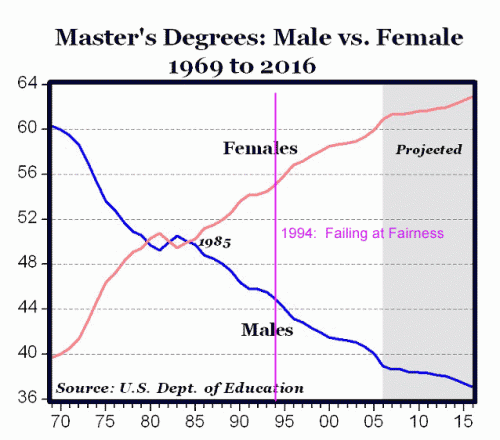
I don’t doubt that they found their share of anecdotal issues.  I am sure I could find them today.  But their overall premise that girls were getting hosed by primary education and that standardized tests were structured to exclude girls from college education made no sense even at the time the book was published:

male_female_jobs

The chart is from Mark Perry, and he shows a similar picture for bachelor’s degrees, where women blew past men in 1981, and in PHDs, where women passed men in 2006.  People would laugh at this book today, as most discussion is about under-performance of boys.

I don’t know the authors, but I would interpret this as the classic inability of activists to declare victory.  I am fairly certain that their hypothesis was far more correct in 1969 than in 1994.  But society really went through a step-change in the 1970s vis a vis attitudes about females.  The previous generation of women’s activists did great work to make these issues plain and help lead change in societal attitudes.

But activists have a really hard time declaring victory.  From a quite personal standpoint, declaring victory as an activist is exactly the same as walking into your boss and telling him that the company really doesn’t need your job position.  Money, prestige, academic advancement, and attention, and (self-esteem, for certain types of people) are all tied to there being a major problem.  If there is no longer a big problem, then all this stuff goes away.

Don’t Dance on the Times’ Grave

Recent circulation numbers showing continued, substantial declines of traditional newspapers give me an excuse to make a point I have wanted to make for some time. 

I am a frequent critic of newspapers.  I think they have lost focus on the hard-hitting investigative journalism which used to be their highest and best calling, instead considering reiteration of an activist's press release sufficient to check the journalism box on some particular issue.  When investigative reporting does occur, it almost always is focused to support the dominant or politically correct outcome, rather than to really challenge conventional wisdom.   Media coverage of any technical issue involving science or statistics or economics is often awful, in large part because journalism is too often the default educational path of folks who want to avoid numbers.  Any time I have been on the inside of some issue receiving coverage, I have generally been astounded by how little the print descriptions matched reality.  Now that I am interviewed more as a source for articles, I never think my views are well-quoted (though that may be my fault for not talking in sound bites).  And, like many, I get irritated that the media's arrogance and self-referential reporting seems to increase in direct proportion to their drop in circulation.

All that being said, the world without healthy newspapers is a bad thing. 

First, we bloggers can blather on all day about being the new media, but with the exception of a few folks like Radley Balko, we're all editorial writers, not reporters  (I consider my role at Climate-Skeptic.com to be more like journalism, but only because there is such a glaring hole on that topic in traditional media).  I couldn't do what I do here, at least on this particular blog, without the New York Times and the Washington Post.  I'm a remora feeding on their scraps.  I can't bring down the big fish by myself, I can only feed on the bits they miss.

Second, and perhaps more important in this world of proposed reinstatement of the Fairness Doctrine, print media is the mode of speech best protected by the First Ammendment.  This isn't the way it should be — all speech should be equal — but in reality goofy regulatory regimes for radio, TV, and even the Internet all offer the government leverage points for speech control they don't have with the print media.  It's why half the dystopic sci fi novels out there have a world dominated by TV — because that is where government has the most control of speech.

So here's hoping you guys at the NY Times get your act together.

Defending Speech With Which I Don’t Agree

Yeah, I think the title is worded awkwardly, but I am trying to curb my enthusiasm for ending sentences with prepositions  (I will continue to boldly split infinitives that no man has split before).

Anyway, in the spirit of this post and this one, I try from time to time to reinforce my support for free speech as an absolute right by publicly supporting the speech rights of those with whom I disagree.  Today's case is the public University of Nebraska-Lincoln deciding to un-invite former terrorist William Ayers to speak on campus.  The reason given was the current weak-ass excuse often used to reverse the invitation of controversial speakers, "we can't gaurantee security." 

Though I would never have hired the guy, Ayers is a professor at a real public university, and what he has to say is particularly relevant given his ties to Barack Obama.  I find the behavior of Nebraska's conservative politicians to be especially absurd here — after months of calling for more discussion and disclusore of Ayers and his ties to Obama, they want to prevent Ayers from speaking publicly?

Update:  In an odd coincidence, at about the same time I was writing this post, the NY Times blog was posting on split infinitives.

Bending Over Backwards to Try to Show Wage Stagnation

The media is really bending over backwards to find ways to twist earnings data for average Americans to try to make the point that real income for many folks has stagnated or dropped.  They are doing this to support a two-pronged legislative strategy in the next Obama administration:

  1. Use the power of the government to further tilt the balance towards unions and against employers in wage negotiations  (this strategy having worked out so well to create prosperity in the automobile and airline industries)
  2. Further modify the income and Social Security tax structures to make them even more regressive than they are today.

They are firing on all cylinders behind this strategy.  They are even mobilizing the neo-Keynesians to make the pitch that the Great Depression and the current financial crisis were caused by a shift in wealth from laborers to the capital classes, and that the only way to prevent future crises and depressions is to, wait for it, increase the power of unions and institute more wealth redistribution  (Example here, via Kevin Drum).

I was going to do a post fisking the James Livingston article linked above on Kevin Drum’s site, but Livingston’s hypothesis was such a mess that it was just going to take too much of my day.  But in doing some research, I found this chart from a couple of years ago in the NY Times that really caught my attention:

Timeswagechart

Talk about chutzpuh — look at the lede on the chart and then look at the chart itself.  Yes, the lede is correct, but only if you choose the totally meaningless number of “cash wages” rather than total compensation.  If one looks at total compensation (or what they call “overall” compensation), the entire argument falls apart.   Workers have maintained about their same “share” of the economy.

Sure, a large percentage of that is now in health care benefits, but that’s a choice workers have made (and the government has encouraged through tax policy).  In fact, this compensation mix has been driven in large part by the Left’s beloved unions, so on what basis can folks say that these other benefits somehow “don’t count?”  Certainly, they cost their employers equally, whether it is cash or health care.  Corporate profits are up a bit, but in line with their normal historical levels in the 1950s and 1960s, the golden age of the US economy, according to the Left.  (By the way, the pattern of falling wage shares and rising profit shares after recessions is a well-documented one.  Wage-earners do best at the end of an economic cycle, employers more towards the beginning.  The chart cut off after 1997 would look about the same as the last several years).

I will tell you right now that every time you hear someone bemoaning the stagnation of wages, they will never, ever, ever be talking about total compensation per individual.  Having, through government policy and union activity pushed the compensation mix to non-cash elements, they then play a heads-I-win-tails-you-lose game of not giving any credit for those compensation elements.

Other games that are played to try to make the case that real earnings have stagnated include:

  • Time frame selection. Everyone making this argument will choose 2000 as a starting point.  They justify it by saying it is the beginning of the Bush years, but 2000 is really selected because it is a pre-recession peak, and they have to measure peak-to-trough of the economic cycle to try to make their point.  Just as an example, if you look at the household income numbers below, you can see there is very typically a 5-year drop after a recession followed by net gains.  If we chose, say, the first Clinton term we could play the same game, showing a peak-to-trough drop in real incomes.
  • Household income game. The household income numbers are fraught with peril, because companies don’t pay households, they pay individuals.  And household makeups are changing simultaneous to income changes.  For example, imagine the economy was just my household.  If my wife were to get fed up with my shtick and divorce me tomorrow, average household income would drop by 50% in one day (as our total income stays the same but we go from one to two households).  If my wife were to go back to her high-paying pre-kids job tomorrow (if only it were so!) our household income would go way up, in part because the labor department does not capture the value of the labor she provides at home.Mark Perry has a lot more on the household income numbers here, but he shows that the household size number has been changing a lot, causing the metric to understate income changes per individual:

Income3

  • Individuals matter. Median income looks at the middle person on the ranked list of US incomes.  So, for example, if there are 100 million income earners, the median income is the income of number 50 million on this list.  But whoever the person is at spot 50 million is almost certainly not the same person who was at spot 50 million last year.  They might have fallen on the list, but the odds are they moved up.  As folks age and gain experience and/or seniority, they tend to increase income faster than inflation.  Most minimum wage earners, for example, tend to be under 25.  The number of families supporting three kids on minimum wage (at least of the primary bread-winner) at the age of 45 is really, really low, despite the anecdotes we are bombarded with in the media.

Numberminwagebyagegroup20052007

  • Immigration has a huge effect. The total number of foreign born people in the labor force is estimated around 21 million, of which perhaps 6.3 million are illegal immigrants.  Positing that at least 10 million of these arrived in the last two decades, and that many of these folks began at relatively low, below-median incomes, means that median incomes are hugely affected by immigration.  Leaving immigrants out so the comparison is close to apples and apples, to find the true median income gain over the last 20 years one would have to count up 10 million or so spots on the list.  Again, as in the previous point, most individuals can be better off even if the median stagnates  (presumably immigrants coming in at the bottom are also better off, even at the bottom, than where they were before, or they would not have come.  We often forget that much of our bottom quartile of income in this country would be upper middle class in many other nations).  This is a classic mix problem that most people, and the media, almost always get wrong.  In a situation with a changing mix of multiple groups, each of the groups can be improving on some metric, but the overall metric can go down.  You can see the income stats by race here.  Every race group has increasing median income, but since the Hispanic group has grown 8x faster than the anglo population in the US, the total results are mixed downwards.Here is a quick example.  Group A has values of 5,6,6,7.  Group B has values of 1,2,3.  Ten years later Group A is the same size and has values of 6,7,7,8.  Group B has doubled in size, and now has values of 2,3,4,2,3,4.  In these examples, every single individual has a higher value.  Also, Group A’s median has increased from 6 to 7, and Group B’s has increased from 2 to 3.  But the median for the whole combined group A+B has dropped from 5 to 4.  Both medians (and averages) can do funny things when mix is shifting.
  • Even the NY Times. The NY Times actually makes two of these points for me in another article, arguing that historic median income drops were concentrated in areas of high immigration, and reported drops were due to the choice of the economic peak as a starting point.  WOW?  Is this the same NY Times I began this post criticizing.  Yes it is, the only difference is that this article ran in 2001, when they were reporting on the economy during a Democratic administration.
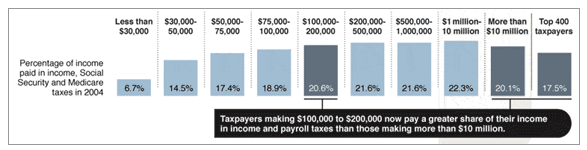
  • Income taxes are already wildly progressive.  While I would love to be in that top 1% group, I don’t really begrudge them their success.  Besides, who can look at the chart below, again from Mark Perry, and come to the conclusion that the top 1% are being treated unfairly generously.

Tax2

  • Every country that has implemented this plan (government-backed unions and wildly progressive tax policy), including most of Western Europe, is demonstrable worse off than the US on absolute measures.  This is both the median, but also in every quintile, including the poorest.  While it is true the poorest quintile has a bigger gap from the riches in the US vs. France for example, on an absolute basis our poorest are at least as well off  (particularly when differences in immigration policy are taken into account).

This Seems Kind of Obvious in Hindsight

Saul Hansell at the NY Times has an interesting article about why risk assessment programs in investment banks were not sounding the alarm coming into the recent turmoil.  The article contains this gem:

Ms. Rahl said that it was now clear that the computers needed to
assume extra risk in owning a newfangled security that had never been
seen before.

“New products, by definition, carry more risk,” she said. The models
should penalize investments that are complex, hard to understand and
infrequently traded, she said. They didn’t.

I continue to see parallels between recent problems and the meltdown at Enron.  In fact, in many ways events in the natural gas trading market were a dry run for events in the mortgage market.   One filmmaker coined the phrase "Smartest Guys in the Room" to describe the hubris of the guys who ran Enron.  To some extent the phrase was absolutely true – I knew Jeff Skilling at McKinsey and he was indeed the smartest guy in the room.  But everyone can be wrong, and sometimes the smartest guys can be spectacularly wrong as they overestimate their ability to predict and control complex events.  I think this is a fair description of what went on in Wall Street over the past several years.

I’m Sure This Is Not In Any Way Relevant To Recent Events

Via Carpe Diem, comes this September 30, 1999 NY Times story:

In a move that could help increase home ownership rates among
minorities and low-income consumers, the Fannie Mae Corporation is
easing the credit requirements on loans that it will purchase from
banks and other lenders.

The action, which will begin as a
pilot program involving 24 banks in 15 markets — including the New
York metropolitan region — will encourage those banks to extend home
mortgages to individuals whose credit is generally not good enough to
qualify for conventional loans. Fannie Mae officials say they hope to
make it a nationwide program by next spring.

Fannie Mae, the
nation’s biggest underwriter of home mortgages, has been under
increasing pressure from the Clinton Administration to expand mortgage
loans among low and moderate income people and felt pressure from stock
holders to maintain its phenomenal growth in profits.

In
addition, banks, thrift institutions and mortgage companies have been
pressing Fannie Mae to help them make more loans to so-called subprime
borrowers. These borrowers whose incomes, credit ratings and savings
are not good enough to qualify for conventional loans, can only get
loans from finance companies that charge much higher interest rates –
anywhere from three to four percentage points higher than conventional
loans.

”Fannie Mae has expanded home ownership for millions of
families in the 1990′s by reducing down payment requirements,” said
Franklin D. Raines, Fannie Mae’s chairman and chief executive officer.
”Yet there remain too many borrowers whose credit is just a notch
below what our underwriting has required who have been relegated to
paying significantly higher mortgage rates in the so-called subprime
market.”

Demographic information on these borrowers is
sketchy. But at least one study indicates that 18 percent of the loans
in the subprime market went to black borrowers, compared to 5 per cent
of loans in the conventional loan market.

In moving, even
tentatively, into this new area of lending, Fannie Mae is taking on
significantly more risk, which may not pose any difficulties during
flush economic times. But the government-subsidized corporation may run
into trouble in an economic downturn, prompting a government rescue
similar to that of the savings and loan industry in the 1980′s.

”From
the perspective of many people, including me, this is another thrift
industry growing up around us,” said Peter Wallison a resident fellow
at the American Enterprise Institute. ”If they fail, the government
will have to step up and bail them out the way it stepped up and bailed
out the thrift industry.”

Those heartless free marketing guys at the AEI — always predicting doom every time we open our hearts to poor people.  Bailout?  What ridiculous scare-mongering.

Peak Pricing for Parking

From my point of view, the NY Times buried the lede in this story about installation of parking sensors on San Francisco streets.  The article focuses mainly on the ability of drivers at some time in the future to get locations of empty parking spots on the streets via smartphone or possibly their GPS.  But I thought the pricing changes they were facilitating were more interesting:

SFpark, part of a nearly two-year $95.5 million program intended to
clear the city’s arteries, will also make it possible for the city to
adjust parking times and prices. For example, parking times could be
lengthened in the evening to allow for longer visits to restaurants.

The
city’s planners want to ensure that at any time, on-street parking is
no more than 85 percent occupied. This strategy is based on research by
Mr. Shoup, who has estimated that drivers searching for curbside
parking are responsible for as much of 30 percent of the traffic in
central business districts.

In one small Los Angeles business
district that he studied over the course of a year, cars cruising for
parking created the equivalent of 38 trips around the world, burning
47,000 gallons of gasoline and producing 730 tons of carbon dioxide.

To
install the market-priced parking system, San Francisco has used a
system devised by Streetline, a small technology company that has
adapted a wireless sensor technology known as “smart dust” that was
pioneered by researchers at the University of California, Berkeley.

It
gives city parking officials up-to-date information on whether parking
spots are occupied or vacant. The embedded sensors will also be used to
relay congestion information to city planners by monitoring the speed
of traffic flowing on city streets. The heart of the system is a
wirelessly connected sensor embedded in a 4-inch-by-4-inch piece of
plastic glued to the pavement adjacent to each parking space.

The
device, called a “bump,” is battery operated and intended to last for
five and 10 years without service. From the street the bumps form a
mesh of wireless Internet signals that funnel data to parking meters on
to a central management office near the San Francisco city hall.

This is actually really cool, but my guess is that politicians will not have the will to charge the level of peak prices the system may demand.

Postscript:  As many of you know, there is a new wave of urban planners who want to impose dense urban living on all of us, whether we like it or not.  I have no problem with folks who want to fight the masses and live in downtown SF or Manhattan, but the world should also have a place for the majority of us who like to have an acre of land and a bit less congestion. 

Anyway, in singing the praises of the urban lifestyle (which often is as much an aesthetic preference vs. suburbia as anything else), you seldom hear much about this type of thing:

Solving the parking mess takes on special significance in San Francisco
because two years ago a 19-year-old, Boris Albinder, was stabbed to
death during a fight over a parking space….

The study also said that drivers searching for metered parking in just
a 15-block area of Columbus Avenue on Manhattan’s Upper West Side drove
366,000 miles[!!] a year.

And here we suburbanites are complaining when we have to park more than 5 spaces from the door of the supermarket.

Why That Separation of Powers Thingie Makes Some Sense

The NY Times reports, via Hit and Run, that judicial review of Gitmo detainees, which the Administration has steadfastly resisted, may be quite justified:

In the first case to review the government’s secret
evidence for holding a detainee at Guantánamo Bay, Cuba, a federal
appeals court found that accusations against a Muslim from western
China held for more than six years were based on bare and unverifiable
claims. The unclassified parts of the decision were released on Monday.

With some derision for the Bush administration’s arguments, a
three-judge panel said the government contended that its accusations
against the detainee should be accepted as true because they had been
repeated in at least three secret documents.

The court compared
that to the absurd declaration of a character in the Lewis Carroll poem
"The Hunting of the Snark": "I have said it thrice: What I tell you
three times is true."

"This comes perilously close to suggesting
that whatever the government says must be treated as true," said the
panel of the Court of Appeals for the District of Columbia Circuit.

The
unanimous panel overturned as invalid a Pentagon determination that the
detainee, Huzaifa Parhat, a member of the ethnic Uighur Muslim minority
in western China, was properly held as an enemy combatant.

The panel included one of the court’s most conservative members, the chief judge, David B. Sentelle….

Pentagon officials have claimed that the Uighurs at Guantánamo were
“affiliated” with a Uighur resistance group, the East Turkestan Islamic
Movement, and that it, in turn, was “associated” with Al Qaeda and the Taliban.

Next up, the detainee whose mother’s gynecologist’s dog’s veterinarian’s great uncle once was friends with a Muslim guy.

The Administration now complains that there is nowhere that this man can be sent back to, and somehow this is supposed to validate his detainment?  He wouldn’t have had to be sent back anywhere if he hadn’t been snatched up in the first place.  I am willing to believe that this guy may be a bad buy, but we let lots of people we are pretty sure are bad guys walk the street, because for good and valid reasons we rank false detainment of the innocent as a greater harm than non-detainment of the guilty.  Anyone seen OJ lately?

Far Be It For Me To Disagree, But…

I love Arizona and the Phoenix area.  However, I thought the NY Times listing of Scottsdale as one of the #9 place to visit this summer to be a bit odd.  Next up will be the suggestion to visit Buffalo in February.  Yes, there are a lot of screaming deals at luxury hotels with great spas, so if want two days of spa treatments and proximity to lots of good restaurants, go for it.  But expect to find something like Paris in August (but with better attitudes).  You may be here but we’ll all be gone, if we can afford it.  Typical summer temperatures every day are 108-112F, with occasional excursions higher into territory that is stupid-hot.  Yeah, its dry heat, and that is exactly what we tell our turkey every Thanksgiving.  And yeah, the wind blows a bit — feels just like a hair dryer. 

More Reasons to Fear Public Employee Unions

Most all local governments have extensive programs in place for government inspection of elevators because, you know, private businesses can’t be trusted to operate safe equipment.  But it turns out the least safe elevators are operated by the government itself:

New York City Transit
has spent close to $1 billion to install more than 200 new elevators
and escalators in the subway system since the early 1990s, and it plans
to spend almost that much again for dozens more machines through the
end of the next decade. It is an investment of historic dimensions,
aimed at better serving millions of riders and opening more of the
subway to the disabled.

These are the results:

¶One of every six elevators and
escalators in the subway system was out of service for more than a
month last year, according to the transit agency’s data.

¶The
169 escalators in the subway averaged 68 breakdowns or repair calls
each last year, with the worst machines logging more than double that
number. And some of the least reliable escalators in the system are
also some of the newest, accumulating thousands of hours out of service
for what officials described as a litany of mechanical flaws.

¶Two-thirds of the subway elevators — many of which travel all of 15
feet — had at least one breakdown last year in which passengers were
trapped inside.

The whole thing is pretty depressing.  But perhaps just as depressing is the fact that the NY Times, in a quite lengthy article, never once questions why the government is in the elevator maintenance business at all.  You see, the New York City Transit system hires all of its own maintenance people, presumably because, though the article never mentions it, the public employees union insists that these functions remain in house.  OK, here is a quiz:  How many private elevator owners in New York City have their own staff repair elevators?  My guess is the answer is close to zero.  Everyone uses third party elevator equipment repair companies or operate under long-term service contracts with the manufacturer.  Why?  Well, lets see what problems NY Transit faces:

“They don’t have enough competent people with the proper training,”
said Michele O’Toole, the president of J. Martin Associates, which the
transit agency hired in 2006 to evaluate its elevator operations. “It
all reflects back to qualifications, training, capabilities.”…

Elevators and escalators are spread out over a far-flung system,
requiring more mechanics and slowing responses to breakdowns. There has
been little standardization of parts, so mechanics must cope with a
bewildering hodgepodge of machinery. And the machines, which operate 24
hours a day, are subject to all sorts of abuse: Elevators become
makeshift bathrooms, and escalator steps are pounded by heavily loaded
hand trucks.

Guess what?  These are all classic reasons for outsourcing.  Manhattan elevator maintenance companies are set up to handle a far-flung elevator inventory, and can more efficiently stock parts, buy special equipment, and provide specialized training than can any individual operator.   Shared external capacity can also be sized and used much more efficiently to deal with random failures — the more elevators in a region one maintains, the better staff can be utilized across a stochastic system.

But of course, the NY Times is never going to go against any public employee union, so it takes the line that this is a good governance issue, rather than a structural issue where an individual elevator owner is always going to be less efficient than outsourcing to a large regional third party company.  It compares NY Transit to other public transit agencies, but not to other private owners of elevators.  My guess is Donald Trump owns more elevators than NY Transit – how does he handle elevator maintenance?

By the way, the article says that there are 167 elevators and 169 escalators in the system.  They also say there are 200 full-time maintenance people.  So, on average, one person spends 60% of their year on a single elevator or escalator.  Think about the elevators and escalators you ride every day.  Can you imagine someone working on it for 1200 hours a year?

And what is this in the quotes above about slow responses to breakdowns in the far-flung empire?  With 200 people for 336 devices, they could practically assign an individual repair person to each one.   I can see him now, with his toolbox, sitting on a folding chair in the back of the elevator with a box of Krispy Kremes, waiting to spring into action at the moment of failure.

The Times Blunders on Ethanol (Even After I Explained it to Them)

Last week I tried to explain why the choice of plant, whether it be a food plant or a non-food plant, that is used to make ethanol is mostly irrelevant to whether ethanol mandates raise fuel prices, at least with current technologies.  I wrote:

Food prices rise not because food is converted to ethanol per se, but
because the amount of grains going into the food supply decreases.  The
issue is the use of farmer’s time and resources and the use of prime
cropland to grow plants for fuel rather than food for consumption.  The
actual crop used to make the fuel, whether corn or switchgrass, does
not matter to food prices — it is the removal of farmers and cropland
from food production that matters.  The only way cellulosic ethanol is
likely to improve food prices in substitution for corn is by being more
efficient per acre in fuel yields than corn  (which may turn out to be
the case, but has not yet been proven in this country).  But even so,
incremental improvements in yield don’t help much, because we are
talking about enormous (40-50% or more) amounts of US cropland that
would have to be dedicated to fuel, whatever the plant technology, to
meet the current ethanol mandates.

I almost didn’t post this the first time around, because I thought it was so obvious.  But on Sunday the NY Times blundered right into the same silly assertion:

This does not mean that Congress should give up on biofuels as an
important part of the effort to reduce the country’s dependency on
imported oil and reduce greenhouse gas emissions. What it does mean is
that some biofuels are (or are likely to be) better than others, and
that Congress should realign its tax and subsidy programs to encourage
the good ones. Unlike corn ethanol, those biofuels will not compete for
the world’s food supply and will deliver significant reductions in
greenhouse gases.

Of course, the ability to produce such biofuels with these magic powers has never actually been demonstrated, but I am all for them when and if someone invents them.  Efficient conversion, for example, of corn stalks, rather than corn itself, to fuel would be great and would solve this trade-off.  This technology does not exist today — and only a lot of hand-waving can translate cellulosic ethanol successes in switchgrass to corn stalks.  Also recognize that even this has costs hidden to us non farmers, because corn stalks are used for a variety of purposes today.  My guess is that cellulosic ethanol from corn may be economically feasible, but only after some genetic modifications of the plant itself.

What is it With the NY Times?

As a libertarian, I don’t really have a horse in the race, but what is it with the NY Times editorial page?  Apparently, the right doesn’t like the conservative writers, and Kevin Drum makes it clear that the left can be embarrassed by the liberal writers there:

I generally try not to read Maureen Dowd’s columns because, you
know, they just don’t pay me enough for that kind of hazard duty. But
today’s column about Hillary Clinton was a train wreck of epic
proportions. I couldn’t avert my eyes. Here’s the final sentence:

As
she makes a last frenzied and likely futile attempt to crush the
butterfly [i.e., Barack Obama], it’s as though she’s crushing the
remnants of her own girlish innocence.

This would be
embarrassing coming from a 12-year-old. Shouldn’t Dowd have an obscure
blog, not a biweekly column in the greatest newspaper in the world?

Day Late, Billions of Dollars Short

The NY Times has finally published a comprehensive take-down on the insanity of biofuel subsidies here.  All well and good, but this is at least five years too late.  For years, while this and other blogs have tried to point out that the biofuel emporer’s has no clothes, the NY Times has been publishing breathless articles in support of biofuel subsidies and mandates, in fact criticizing the Bush administration and Congress for not moving faster on them. 

So is this what we must expect from the NY Times and the rest of the media?  Shameless pandering to politically correct policy goals that make no scientific sense until it is virtually too late to halt their momentum?  If so, everyone should read the Times‘ coverage on climate with a jaded eye, because it would not surprise me in the least to see the Times publish the definitive article on why the global warming alarmists are full of hot air only after Congress has gutted our economy with new climate taxes and mandates. 

Unvarnished Technocracy

The New York Times editorial board had one of the most jaw-dropping pieces I have read in a long time.  In it, they are absolutely unapologetic in saying that they think the government can spend your money better than you can — and the larger the government take, the happier we all will be.

The munificence of American corporate titans warms the heart, sort of.
The Chronicle of Philanthropy reports that the top 50 donors gave $7.3
billion to charity last year — about $150 million per head….

Yet we’d be so much happier about all the good things America’s
moneyed elite pay for if the government made needed public investments
.

The flip side of American private largess is the stinginess of
the public sector. Philanthropic contributions in the United States —
about $300 billion in 2006 — probably exceed those of any other
country. By contrast, America’s tax take is nearly the lowest in the
industrial world.

Oh my God, does anyone actually believe that Congress does a better job spending your money than you do?  Apparently they do:

Critics of government spending argue that America’s private sector does
a better job making socially necessary investments. But it doesn’t.
Public spending is allocated democratically among competing demands.
Rich benefactors can spend on anything they want, and they tend to
spend on projects close to their hearts.

LOLOLOL.  Has anyone looked at the last highway bill?  How many tens of thousands of politically motivated earmarks were there?   

Philanthropic contributions are usually tax-free. They directly reduce
the government’s ability to engage in public spending. Perhaps the
government should demand a role in charities’ allocation of resources
in exchange for the tax deduction. Or maybe the deduction should go
altogether. Experts estimate that tax breaks motivate 25 percent to 30
percent of contributions.

At the end of the day, this is not about a better prioritization process for spending — this is about the NY Times getting a bigger say for itself in said spending.  They know that Warren Buffet couldn’t give a rat’s behind what the NY Times thinks about how he spends his money, but Congressmen trying to get reelected do care.  The NY Times wields a lot of political, but little private, influence, so they want to see as much spending as possible shift to political hands where the Times wields clout.

Postscript: Boy, here is some quality journalism:

Federal, state and local tax collections amount to just more than 25.5
percent of the nation’s economic output. The Finnish government
collects 48.8 percent. As a result, the United States spends less on
social programs than virtually every other rich industrial country,
according to the Organization for Economic Cooperation and Development.
The Finnish government probably has money to build children’s health
clinics.

"Probably has money?"  What does that mean?  Do they have government-funded children’s health clinics or not?  The Times couldn’t work up enough energy to fact-check that?  And by the way, who, other than the NY Times, declared that the best marginal use of additional public funds is for children’s health clinics?

Postscript #2: Many of the very rich have been funding schools that are competitive with government-monopoly schools.  In this and many other cases, wealthy people fund programs that work better and cheaper than government alternatives.  I am sure that not only would the feds be happy to have this money to spend themselves (on some fat earmarks for key donors, most likely) but they would additionally be thrilled to get rid of the competition.

Update:  I must be going senile.  I missed the most obvious logical fallacy of all.  The NY Times says that our democratic government is the best possible mechanism for allocating funds.  But doesn’t that also mean its the best possible mechanism for setting spending levels?  How can it complain that our democratic government is doing a bad job in setting total spending levels but does a great job in allocating that spending?

US Convinces China to Jack Up Prices to American Consumers

From the NY Times:

Bowing to American pressure on the eve of high-level talks to reduce
economic tensions, China agreed Thursday to terminate a dozen different
subsidies and tax rebates that promote its own exports and discourage
imports of steel, wood products, information technology and other goods.

Thanks a lot.  The Bush Administration crows that:

This outcome represents a victory for U.S. manufacturers and their workers

Um, not if they are consumers too, as they all are.  And not if their company buys any inputs from Chinese manufacturers.

Napoleon said to never interrupt an enemy when he was making a mistake.   I don’t consider China an enemy, but it just flabbergasts me that the Chinese taxpayers and consumers see fit to subsidize lower prices for our consumers, and we feel the need to stop them.   More here and here.

The Government Trap

From the NY Times via Maggies Farm:

The rescue of the
Florida Everglades, the largest and most expensive environmental
restoration project on the planet, is faltering.

Seven years into
what was supposed to be a four-decade, $8 billion effort to reverse
generations of destruction, federal financing has slowed to a trickle.
Projects are already years behind schedule. Thousands of acres of
wetlands and wildlife habitat continue to disappear, paved by
developers or blasted by rock miners to feed the hungry construction
industry.

The idea that the federal government could summon the
will and money to restore the subtle, sodden grandeur of the so-called
River of Grass is disappearing, too.

If, forty years ago, individuals who cared about the Everglades had banded together with private money, they could have bought up and preserved huge tracts of land around the current National Park.  Instead, as so many activists do today, rather than trying to rally private action they lobbied the government to do something about it.  Once the ball was thrown into the Feds’ court, all incentive for private action disappeared, and as is so often the case, the Feds bungled their way $8 billion to little effect.

Anti-Trust is Anti-Consumer

Pursuing what has become a familiar theme on Coyote Blog, we again revisit anti-trust, and in the process, discover why the NY Times might be better off putting its editorial inanities back behind a firewall.

Writing about Intel, the NY Times editors say:

The abuse of market power to protect a monopoly hurts consumers and
hinders innovation — locking out smaller rivals that may have better
products with new features or lower prices. With an 80 percent to 90
percent share of the microprocessor market, Intel wields much more
power than your local supermarket. Its threat to raise prices the
moment a customer tries to buy from rival A.M.D. can lock in even the
largest computer makers — which depend on Intel for most of their
products and can’t simply swap all their processors overnight. And with
such a level of control, Intel doesn’t have to exert itself to come up
with new and better products.

Which I guess is why Lotus 1-2-3 must still have a hammerlock on the spreadsheet market, Creative must still dominate in MP3 players, IBM must still own the computer market, and GM must still rule the automotive roost.  How can any sentient human being who has lived through the past 20 years doubt that, particularly in technology, market dominance is as fleeting as the next technology cycle.   In fact, AMD several years ago made a huge penetration of the market with a series of processors a year or two ahead of Intel.  Most average consumers who can’t even figure out how to attach a photo to an email never noticed, but among those who understood and cared, AMD ruled the roost.

Oh, and what was Intel’s crime?

They say Intel is improperly protecting its stranglehold of the
microprocessor market by offering big discounts and rebates to computer
makers who minimize the use of processors made by rival Advanced Micro
Devices, and punishing those who stray with higher prices.

Oh my god, they are offering discounts to loyal customers!  Don Boudreax gets right to the heart of it:

Monopolists raise prices; firms facing competition do not.  Intel keeps its prices
low, meaning that it behaves competitively.  Yes, Intel’s pricing
practices make life more difficult for AMD and other rivals, but that’s
what competition is supposed to do.

The popular myth is that anti-trust policy is about protecting consumers.  Well, it may have been at one time or another, but currently it is all about protecting competitors who have political pull.  The Europeans are shameless about this, using anti-trust as a bludgeon to hamstring US companies who are out-competing EU home-grown competitors.  Now the NY Times wants to emulate this practice, explicitly calling on the government to force Intel to raise prices to make things easier for its competitors.

Update:  By the way, is there anyone out there who thinks Dell or H-P don’t get the best possible pricing from Intel, with or without AMD purchases?  The coy little personal shopping example in the opening paragraph of the editorial is probably to help the reader forget that we are talking about Intel selling to customers who are big boys too.

Supply and Demand, But Not In Water

Thanks to a reader comes this article from the NY Times that yet again discusses a water shortage and possible government action without once mentioning the word "price."  If water prices floated like gas prices, we wouldn’t have to discuss things like these:

Within two weeks, Carol Couch, director of the Georgia Environmental
Protection Division, is expected to send Gov. Sonny Perdue
recommendations on tightening water restrictions, which may include
mandatory cutbacks on commercial and industrial users.

If that
happens, experts at the National Drought Mitigation Center said, it
would be the first time a major metropolitan area in the United States
had been forced to take such drastic action to save its water supply.

But of course politicians love being responsible for resource allocation through command-and-control government, because it creates winners and losers and both will then donate to the next election cycle.  Atlanta already has fairly expensive water, but a quick 50% rate hike about 3 months ago would have likely obviated this shortage while also providing the municipality with additional funds to develop new sources.

I wrote a lot more about water scarcity and the price mechanism, including the observation that Phoenix ridiculously has some of the lowest water prices in the country, here.

postscript: One of the media tricks to make things look worse and panicky is to present asymmetric charts.  For example, the NY Times presents this drought map:
2007droughtgraphic

All you see is what one presumes to be normal in white and then a lot of drought.  But in fact, this chart is truncated.  It omits all the data for areas that are wetter than usual.  Here is the chart for September form the NOAA with both over and under precipitation over the past 12 months:

Spi12_200709_pg

Whoa, that shows a different picture, huh?  Basically, about as much stuff is wetter than normal as drier than normal.  Which is exactly what one might expect in any period.  And by the way, if you look at the last five years, the US is pretty freaking wet:

Usnmx20070960monpctpcppg

Really Awful Article on Dentistry

The NY Times outdid itself last week with a truly awful article on dentistry.  They started with just one fact:

Previously unreleased figures from the Centers for Disease Control and Prevention
show that in 2003 and 2004, the most recent years with data available,
27 percent of children and 29 percent of adults had cavities going
untreated. The level of untreated decay was the highest since the late
1980s and significantly higher than that found in a survey from 1999 to
2002.

They then apply the patented NY Times class-based story-generation model to assume a cause for this rise that is not supported by the study itself:

But many poor and lower-middle-class families do not receive adequate
care, in part because most dentists want customers who can pay cash or
have private insurance, and they do not accept Medicaid
patients. As a result, publicly supported dental clinics have
months-long waiting lists even for people who need major surgery for
decayed teeth. At the pediatric clinic managed by the state-supported University of Florida dental school, for example, low-income children must wait six months for surgery.

So is the rise in untreated dental problems concentrated in the poor?  Well, they don’t say, and there is not data for that in the study, but that does not prevent the NY Times from just assuming it to be so.  In fact, the article itself contradicts this premise, by noting that the problem is not limited to the poor:

The lack of dental care is not restricted to the poor and their
children, the data shows. Experts on oral health say about 100 million
Americans — including many adults who work and have incomes well above
the poverty line — are without access to care.

By the way, how did they figure a 100 million don’t have "access"?  I don’t know, but the figure is suspiciously close to this one:

With dentists’ fees rising far faster than inflation and more than 100 million people lacking dental insurance…

Anyone want to bet that the NY Times just made its usual logical fallacy of equating lack of insurance with lack of access?  And by the way, dental insurance is a HORRIBLE investment.  I have priced it many times myself and for a normal family, it is much cheaper to just pay the dental bills, particularly since there are not that many things in your mouth that can go wrong that will be bankrupting.  Trying to push everyone to dental insurance is a terrible idea.  Every time there is a dental procedure in our family, it turns out there are several options for fixing it at different prices.  We actually have the incentive to ask for these alternatives and make trade offs.  What do you think would happen if we had insurnace?

In fact, I can think of a LOT of reasons why people don’t go to the dentist as often as they should.  One reason is that no one like the dentist.  Another is people’s busy schedules.  And certainly rising costs are a factor — As I mentioned before, our family makes very different decisions about treatment options than we used to with a fat corporate dental plan.  Which is as it should be. 

By the way, note the screaming socialism here:

The dental profession’s critics — who include public health experts,
some physicians and even some dental school professors — say that too
many dentists are focused more on money than medicine.

“Most
dentists consider themselves to be in the business of dentistry rather
than the practice of dentistry,” said Dr. David A. Nash, a professor of
pediatric dentistry at the University of Kentucky. “I’m a cynic about my profession, but the data are there. It’s embarrassing.”

I wonder.  Does Dr. Nash accept a salary for being a professor?  Then I guess he is focused more on the business of education than the practice of educating.

Oh, and by the way, how is socialism in dentistry working out?

In a survey of 5,000 people in the UK, six percent claimed that
they had done DIY dentistry, including yanking their own teeth and
fixing cracked crowns with glue. Apparently they resorted to such self
treatment because they couldn’t get in to see a National Health Service
dentist …

One respondent in Lancashire, northern England, claimed to
have extracted 14 of their own teeth with a pair of pliers. In
Liverpool, one of those collecting data for the survey interviewed
three people who had pulled out their own teeth in one morning.

“I took most of my teeth out in the shed with pliers. I have one to go,” another respondent wrote.

The Patented NY Times Sneer

Yesterday, I talked about my fondness for private conservation projects.  Today, the NY Times makes it clear that they are not so fond of private conservation.  In an article about environmentalist-triggered death of logging in the west, the Times observes that many rich folks are taking up the opportunity to buy large tracts of western forests for second homes and ranches.

William P. Foley II pointed to the mountain. Owns it, mostly. A timber
company began logging in view of his front yard a few years back. He
thought they were cutting too much, so he bought the land.

Mr. Foley belongs to a new wave of investors and landowners across the
West who are snapping up open spaces as private playgrounds on the
borders of national parks and national forests.

Cool, a win-win — conservation without use of tax funds or government coersion.  But instead of being thrilled, the Times adopts their patented sneering tone they use with anything having to do with wealth.

The rise of a new landed gentry in the West is partly another
expression of gilded age economics in America; the super-wealthy elite
wades ashore where it will.

Hmm, I would have thought it an example of how increases in wealth in the US has always driven higher environmental standards and more conservation.  The NY Times tries to portray this as something like turning national parks into sprawling suburbs, lamenting the "increase in density," but this is just a joke and a product of a bunch of New Yorkers who have never really spent time in Montana.  There is zero danger of any kind of urbanization here, and their very story belies this fact when it talks about 640 acre lot sizes. 

The real problem for them seems to be one of access, and they lament that these new owners tend to put up no trespassing signs rather than allowing public access as private loggers used to.  But in so arguing, the Times is trying to have it both ways.  Eliminating recreation access from western lands is a HUGE priority for environmentalists.  In fact, though many in America don’t know it, within a few decades it may be impossible to drive into national parks like Yellowstone and Yosemite.  I know and work with the management of the National Parks, and many of their leaders do not consider their job finished until they get all the visitors out of the parks.  So throwing up no trespassing signs to recreators is exactly what environmentalists want on these lands.  What they don’t like, because many are openly socialist, is private ownership of these lands.  They know that increasingly, because they have gotten so good at filing lawsuits and forcing public lands officials to do their bidding, that public ownership means, effectively, ownership by the environmental groups. 

Dual-Class Citizenship

I understand the logic behind reporter shield laws.  However, I can’t support the establishment of different classes of citizenship with different rights, particularly when these rights are tied to certain professions.  Either everyone should be able to ignore a subpoena, or nobody should be able to do so.   My individual rights should not be subject to a hiring decision by the NY Times.

For those who believe this is essential to the functioning of the press, it is left as an exercise to explain how the press has survived without it for over 200 years.

It is worth noting that this is effectively an extension of what Congress began with McCain-Feingold.  In that law, Congress gave members of the press unique speech rights within 60 days of an election that the rest of us do not have.  The press tries to piously portray itself as a special entity, but they sure do look like any other special interest group lobbying Congress for special privileges.

Much more here.

Killing Entrepeneurship

Regulation is a frequent topic on this blog, and one of the points I try to make over and over is that most supposedly pro-consumer regulation is in fact put in place to protect incumbents from competition and new entrants.   It’s worth repeating this Milton Friedman quote:

The justification offered is always the same: to protect the consumer. However, the reason
is demonstrated by observing who lobbies at the state legislature for
the imposition or strengthening of licensure. The lobbyists are
invariably representatives of the occupation in question rather than of
the customers. True enough, plumbers presumably know better than anyone
else what their customers need to be protected against. However, it is
hard to regard altruistic concern for their customers as the primary
motive behind their determined efforts to get legal power to decide who
may be a plumber.

Apparently, the NY Times has discovered the phenomenon, and argues that it is accelerating under the Bush administration.  I have no evidence to refute this claim, though I note that the NY Times offers no evidence in support of it either.

Never-the-less, it certainly is a feature of most governments to try to protect politically powerful businesses against competitors, foreign and domestic.  Basically, the entire German and French economy is built on this practice, which is why the top corporations in these countries in 1960 are still the top companies today, whereas the list has completely turned over in the US.  Our economy thrives because of entrepreneurship.  New entrants replace senescent competitors, or at least keep the pressure on them so they stay sharp and focused.

This is an enormous issue in my business.  My industry is characterized by about 4-5 larger companies that operate many recreation facilities, of which we are one, and hundreds or perhaps thousands of individual operators.  Over the last five years, the US and state governments have passes a myriad of rules and regulations that are making it virtually impossible for smaller companies to compete.  I don’t know if these are being suggested by any of the larger players (they certainly aren’t coming from me) but these regulations are serving the purpose of strangling smaller competitors and making it nearly impossible for new entrants to compete.

The Houston Rabbit Warren

Growing up in Houston, one of the odder parts of the city, even for a local, is the underground tunnel system downtown.  The system was built, I presume, because you can’t even cross the street in the summer time in 100 degree / 100% humidity weather without sweating through your suit coat.  The tunnel system has become quite extensive, such that you can navigate for miles without ever seeing the light of day.  Casual observers often comment on the lack of pedestrian traffic in downtown Houston, but that is perhaps because they never looked under ground.  Over time, underground shopping malls and restaurants and food courts appeared along the tunnels, bringing even more people under ground.

The tunnels are especially difficult to navigate, because there are no visual clues (e.g. we are heading to that building over there) and no signs.  We used to joke people had been lost down there for decades.

Well, the secret is apparently out, as the NY Times has discovered the Houston tunnels.

Seared by triple-digit heat and drenched by tropical storms, midday
downtown Houston appears eerily deserted, the nation’s fourth-largest
city passing for a ghost town.

On the street, that is.

But
below, there are tunnels at the end of the light — nearly seven
color-coded miles of them connecting 77 buildings — aswarm with
Houstonians lunching, shopping and power-walking in dry, air-chilled
comfort….

“Nothing says north, south, east or west. You have to memorize the
buildings,” said David Gerst, a lawyer who opened a lucrative sandwich
shop — BeWitched — off the East McKinney (green) tunnel network under
Commerce Towers, the former Chamber of Commerce building converted to
condominiums. For access to the 3,000 people who stream by his shop
each lunchtime in what tunnel merchants call the holy hours, Mr. Gerst
pays $2,500 a month rent for 800 square feet, more than what surface
lunch space may command.

This is the best part:

It was not centrally planned; it just grew, inspired by Rockefeller
Center in New York. But it is not connected to a transit network. And,
befitting Texans’ distrust of government, most of it is private; each
segment is controlled by the individual building owner who deigns to
allow the public access during business hours — and then locks the
doors on nights and weekends. Some parts, like those belonging to the
former Enron buildings now leased by Chevron, are closed to outsiders
altogether.

Reputation with Whom?

Eliot Spitzer has been caught using the power of his office to go after his enemies.  Wow, what a surprise.  Frequent readers of this blog will know I don’t think much of Spitzer, who tended to overreach his office all the way back to student government at Princeton.  What I found surprising, though, was this quote from the NY Times:

The report was a blow to Mr. Spitzer, a former prosecutor who came into
office less than seven months ago with a reputation for integrity and
who promised to bring a new ethical climate to Albany.

A reputation for integrity with whom?  Mr. Spitzer, as attorney general, was a sort of liberal bookend to George W. Bush, consistently exceeding the limits of his authority to achieve some goal he argued trumped a narrow reading of the law.  His supporters, just as Bush’s do, justify his overreaching his office on the grounds that the ends justified the means, in Spitzer’s case the assault on various corporate and Wall Street firms liberals were frustrated that Washington would not pursue.  Critics like myself argued that many of his crusades were abuses of his prosecutorial office to pursue personal vendetta’s and to generate headlines to position himself for a run for governor.

I would think that any reasonable definition of "integrity" when applied to an attorney general would include a respect for the letter of the law, something that even his supporters would probably admit Spitzer cast aside when he thought it was for a good cause.  The only interpretation of "integrity" I can come up with in the context of this article is that Spitzer had integrity in the past because his abuses of power were in pursuit of causes the author agreed with.

Look, this is the man that began supporting campaign finance limitations, which tend to support incumbents, starting the day after he became an incumbent.  This is the man who described himself as governor thus:  "I
am a fucking steamroller and I’ll roll over you or anybody else
".  This is the man who involved the State of New York and the courts in a private compensation deal, just to burnish his populist credentials.  In the latter trial, he explicitly left prominent Democrats who had the most involvement with the deal alone and indicted side figures who were Republicans.  Tom Kirkendall has a much longer bill of particulars against Spitzer here.

What Ails the Media

Newsweek:

The press needed there to have been a rape to keep the story going. It
was much too dull to consider that the lacrosse players deserved the
presumption of innocence.

Of course, there is nothing new under the sun, as I am sure you could find the same problem 100 years ago.  But it does give one perspective when the MSM tries to go all high and mighty on us, particularly the always arrogant NY Times, which cheer-led the virtual lynching and went out of its way to prop up the failing DA’s case when nearly everyone else was starting to see the holes in it.  The Rutgers basketball team got an apology from the media figure that slighted them.  Don’t expect the same treatment for the Duke boys.