Posts tagged ‘monopolies’

I Do Not Think That Word Means What You Think It Means

I am sympathetic to the OWS hatred for bailouts and crony capitalism, but struggle to understand how they intend to fix the consequences of the exercise of government power in the private world with yet more exercise of government power in the private world.

Apropos of very little, I found this bit from Matt Taibi funny (emphasis added)

1. Break up the monopolies. The so-called “Too Big to Fail” financial companies – now sometimes called by the more accurate term “Systemically Dangerous Institutions” – are a direct threat to national security. They are above the law and above market consequence, making them more dangerous and unaccountable than a thousand mafias combined. There are about 20 such firms in America, and they need to be dismantled

I am pretty sure that, by definition, a single industry cannot have 20 monopolies.

Though I share the same concern, my solution is to just let them fail.  Right now, the cost of capital for these large companies is lower than the cost of capital for smaller companies because, even though many of them have far worse balance sheets than smaller banks, investors feel they have too big to fail protection.  Let a few fail and have the cost of capital shoot up for larger companies and you can be pretty damn sure they market itself will break up these companies.

In some ways it reminds me of the market premium given in the 1960′s to multi-industry conglomerates like ITT.  When the capital markets made their cost of capital low, everyone tried to copy their conglomerate strategies.  When these strategies started failing and companies like RJ Reynolds found their diversification into shipping and shower curtains was a business disaster, capital dried up for these Frankenstein monsters and most of them were broken up.  All without a hint of government intervention, either to save them or kill them.

Its telling that no one on the Left or with OWS who gives this advice for financial institutions takes their own advice with, say, auto companies.  GM should have failed and likely been broken up as well.

Dispatches from the Corporate State

From the WSJ:

Robert Brownson long believed that his proposed development here, with its 200,000-square-foot Wal-Mart Supercenter, was being held hostage by nearby homeowners.He had seen them protesting at city hall, and they had filed a lawsuit to stop the project.

What he didn’t know was that the locals were getting a lot of help. A grocery chain with nine stores in the area had hired Saint Consulting Group to secretly run the antidevelopment campaign. Saint is a specialist at fighting proposed Wal-Marts, and it uses tactics it describes as “black arts.”…

Supermarkets that have funded campaigns to stop Wal-Mart are concerned about having to match the retailing giant’s low prices lest they lose market share. Although they have managed to stop some projects, they haven’t put much of a dent in Wal-Mart’s growth in the U.S., where it has more than 2,700 supercenters—large stores that sell groceries and general merchandise. Last year, 51% of Wal-Mart’s $258 billion in U.S. revenue came from grocery sales.

Read the whole article.  There hardly appears to be any major grocery chain or related union that has not contributed significant dollars to preventing their competitor from doing what they have already done – built a store in town.  Knock me over with a feather that Chicago is a major example, training ground for our President and promoter-in-chief of our emerging corporate state.

The only sustainable monopolies are those enforced by the government, which through licensing, regulation, zoning, or all of the above, squash upstart competitors at the expense of consumers in favor of politically connected incumbents.

The Last Temptation

Nothing makes purity more interesting than temptation.  This applies to ideological purity just as much as the physical sort.  As a libertarian, my greatest temptation to call for government action comes when I deal, as a retailer, with Visa and Mastercard (V/MC).

This post is not a call for government action, so I guess I am resisting temptation.  But I at least need to vent, sort of like a monk pounding his head on the wall after getting the Victoria’s Secret catalog in the mail.  So here is my rant.

First, let’s start with how credit card companies make their money.  I will confess that I do not know how the card companies (V/MC) and the card processors (often large banks) split the take, so this is how they make money together.  V/MC and the processors charge fees to merchants.  Typically this is a fixed fee per transaction plus a percentage.  On average, a merchant might be paying 2.5-3.5% of a transaction.  The card companies also make money from card holders, charging annual fees, interest fees, etc.

You will have seen of late that most credit cards offer various loyalty programs, from airline miles to cash rebates.  You might have thought those were marketing expenses paid by the credit card companies.  Wrong.  The card companies simply charge merchants a higher fee for processing transactions using these cards.  In a sense, the card companies have organized with card users to use their power to extract extra value from merchants.

All of this I can generally live with.   Visa and MasterCard, through both their credit facility and their implicit standardization, bring enormous value to retailers and customers.  Its a big circular game anyway — customers get 1% back and think they are getting a deal, merchants pay this extra 1% in fees, and then add it into the price of what they are selling.  It’s a wash, except to the extent that customers with reward cards in the end extract a bit of value from customers who pay cash (for reasons explained below).

For this value one must accept the typically arrogant and indifferent customer service provided by any monopoly  (American Express is particularly awful to deal with as a retailer).   But they are no worse to deal with than the government, so its unclear how the government could make the service any better.

What tends to tick me off, though, are rules and restrictions.  Like the creeping work rules in the UAW contract, these are in many ways more insidious than the service and pricing.  Here is what set me off today, from one of my card processors  (in this case Bank of America, which, to be fair, is someone I would recommend for merchant account processing).  Click to enlarge.

visa

So, why are businesses breaking these rules so often?  Let’s take a look:

  • No minimum transaction. Remember that V/MC charges a minimum fee, from 10-40 cents or so, per transaction.  So if someone buys a pack of gum in our store, likely 100% of the sales price is going to V/MC.  Typically it takes at least a one dollar total sale for there to be any money left over beyond paying cost of goods sold and the credit card folks.  So merchants logically want to set a minimum.   V/MC hates this practice, but it is rampant.  I plead the fifth on our own practices.
  • Surcharging. Credit card customers cost more than cash customers.  Sure, we get some non-sufficient funds checks, but the eventual cost of these is nowhere near 2.5% of sales.  Merchants logically don’t like having their cash customers having to subsidize the frequent flyer rewards of their credit customers.  However, unlike transaction minimums, card processors have mostly been able to drive out cash discounts.
  • Requiring ID and Fraudulent Transactions. I will take these two together, since they are so ironic one after the other.  V/MC is telling merchants that they can’t check ID, which is the only reasonable approach to limiting fraud, but that they can’t submit fraudulent transactions.  You say that the text says “known fraudulent?”  Well, read on –

To the latter point, I think most people assume that the credit card companies are absorbing the fraud, which is how they justify the fees they charge.  Wrong again.  Credit card companies only absorb credit risk.  Over the last 10+ years, they have pushed fraud back on the retailer.  If a consumer claims fraud on his card with some transaction, then the credit card company refunds the customer and takes the money from the merchant unless the retailer can absolutely prove he made delivery to the consumer personally (which he can’t prove because he can’t check identification) .  Merchants bear the cost of fraud, not card companies.  Which I could accept (since I have more ability than the card companies to control fraud) expect the card companies ban me from controlling fraud.  So I have to take financial responsibility for something I am not allowed to prevent.  And that really ticks me off.

Anyway, maybe someday we can organize a large merchant boycott, where, even for a day, we all refuse to accept Visa and Mastercard.  Of course we would be breaking the rules, because that is not allowed by our V/MC agreement.

Postscript: I suspect that a few retailers with some power are starting to crack this, at least for themselves.  Costco only takes American Express.  Sams Club only take one card (MC, I think).  My guess is that both, with their large size, bargained for exclusivity in exchange for concessions on fees and/or terms.

Postscript #2: I expect comments like, “Well so-and-so always makes me show an ID.”  I don’t doubt you.  I am merely saying that by doing so, they have either negotiated an exception to the V/MC agreement (very unlikely, as V/MC holds to these rules like the Maginot Line) or the retailer is breaking the rules.

Water and Pricing

I while back, I wrote that I could fix our Arizona water "shortage" in about 5 minutes.  I pointed out that we in Phoenix have some of the cheapest water in the country, and if water is really in short supply, it is nuts to send consumers a pricing signal that says it is plentiful. 

David Zetland (via Lynne Keisling) follows up on the same theme:

The real problem is that the price of water in California, as in most
of America, has virtually nothing to do with supply and demand.
Although water is distributed by public and private monopolies that
could easily charge high prices, municipalities and regulators set
prices that are as low as possible. Underpriced water sends the wrong
signal to the people using it: It tells them not to worry about how
much they use.

Unfortunately, water is one of those political pandering commodities.  Municipal and state authorities like to ingratiate themselves with the public by keeping water prices low.  At the same time, their political power is enhanced if shortages are handled through government rationing rather than market forces, since politicians get to make the rationing decision — just think of all those constituencies who will pour in campaign donations to try to get special rights to water from the water rationers.

Great Moments in Monopolies

True monopolies, which are extraordinarily rare in the private sector but all too common when the government uses it coercive power, lose any incentive to provide good customer service.  Via Adam Schaeffer at Cato, here are your government monopoly schools at work:

In Montgomery County, beloved third-grade teacher Soon-Ja Kim was
bounced on the word of one reviewer despite an outpouring of support
from parents who knew what great work she had done with their
children.  I can’t say it better than it’s reported:

But a panel of eight teachers and eight principals
charged with reviewing Kim’s performance gave little weight to the
parent letters when they considered her future in a closed-door
meeting, according to panel members.

Doug Prouty, vice president of the Montgomery County
Education Association and co-chairman of the panel, said in an
interview that the strong parental support for Kim was considered only
a “secondary data source.”

The good test scores of Kim’s students, he said, were also secondary.
The primary sources for the decisions, he said, were the judgments of
Principal Elaine Chang, a consulting teacher assigned to evaluate Kim
and the panel members themselves that Kim was ineffective in the
classroom and hurting her students’ progress.

“That’s a bunch of hooey,” said Elyse Summers, one of the multitude
of pro-Kim parents. “Our children went to Mrs. Kim’s class every day,
came home and are performing extremely well.”

“We take parent feedback, both good and bad, about teachers very
seriously,” Edwards replied. But the Montgomery schools spokesman added
that “the final decision about the effectiveness of teachers must come
down to those with the professional expertise.”

So, it does not matter if you are a great teacher who gets good results, if you don’t kiss the principal’s ass enough, you are gone.  This is not to say that private employers can’t be equally silly.  However, in the private sector, if a company is stupid enough to fire a good employee for petty political reasons, its competitors will snap that person up.  If it happens enough, company 2 will quickly begin to outcompete company 1.  When the government maintains a forced monopoly on schools, there are no such feedback mechanisms to force improvement, except maybe parental feedback, and you see how much that achieves in this case.

And the First to Violate Net Neutrality is … The Government!

I have never been very excited about the concept of "net neutrality."  Various bills in Congress trying to enforce this strike me as Trojan horses for regulation of the Internet, and are at best the attempts by one segment of the population to enforce their vision of the Internet via the coercive power of the government. But more on this in a second.

The City of Boston has a free municipal Wi-Fi network  (I aired some of my objections to this here).  By using this "free" wi-fi network (which is free only in the sense that you paid for it via taxes rather than use fees) you apparently must accept government filtering of the content, which caused Boing-Boing to get blocked the other day, for some "arbitrary and capricious" reasons.  Readers may remember I already dinged Boston once when it used its government power to try to block free competitors.

So despite all the panic that evil capitalist broadband suppliers will somehow block or skew content from certain content suppliers, it turns out that the government, acting as broadband supplier, is the first to do so.  Fortunately, Bostonians have many free competitors to the municipal service that provide uncensored access to the Internet.  But without those private options, they would be enjoying the Chinese Internet experience.

Which gets us back to the issue of accountability.  In short, socialists distrust individual self-interest and the market as accountability tools, and believe the government is much more accountable, and therefore trustworthy, than any private institution.  What amazes be is that anyone with a working knowledge of history can continue to believe this.  Take any issue:

  • Corruption?  Sure there was Enron and Worldcom, but any crimes at these institutions are trivial compared in both magnitude and frequency to the financial abuses of government.  Take pensions as one example.  Maybe 10-20 out of 500 of the companies in the DJIA have underfunded pensions, with some money put away but not enough.  But probably 99 out of every 100 municipalities you can name have underfunded pensions, and in most cases these not only have too little money put away, they have ZERO!
  • Worker health?  Almost all private work environments are incredibly safe — the very fact that we are worried about carpal tunnel syndrome should tell you something.  But what about in the past?  Well, take one of the highest profile cases of worker harm, that of long-term asbestos exposure.  A huge number of the worst asbestos cases are people exposed in government naval yards.  Government naval yards, for decades, eschewed basic worker protections from asbestos that were common in private industry.
  • Environment?  One only has to look at the superfund site list and see that government sites are represented way out of proportion to their economic activity.  This is not to say their are not god-awful private sites, created either through ignorance or willful disregard, but you will find that the government was at least as active a polluter as even the worst private polluters.   Or look around today, at water quality.  The number of private contributors to water problems is nearly nil.  Most modern water pollution problems are caused by governments (Boston’s "solution" to piping raw sewage into the harbor was to… lay a longer pipe and dump it further out in the ocean).
  • Monopoly?  It is hard to find, in history, any stable private monopolies.  Perhaps the most famous, Standard Oil, was losing market share rapidly due to private forces at the time of its breakup.  Government monopolies, however, can last forever despite high prices and crappy services.  Just look at public education.
  • Commerce?  Those who are frequent readers will know that I buy some product from the government, and they are by far my worst, hardest to deal with, and most abusive vendor.

Getting back to the issue of net neutrality, let’s take a look at what accountability-enforcement tools a private individual has over a private vs. a public broadband supplier.  If I don’t like my private broadband supplier, I can make a phone call and switch to one of several others.  Time elapsed:  About 30 minutes.  If I don’t like my public broadband supplier, I could switch to a private company.  But this is really a libertarian end-around to the socialist problem.  To be fair, we need to look at a pure socialist system and evaluate the accountability tools in this system.  So, assuming the government entity has enforced a monopoly position for itself (like in education or the postal service), I would have to muster a grass roots campaign and likely millions of dollars to force any changes through an entrenched and brain-dead legislative body.  Time elapsed:  From 3 years to never.

In Praise of “Robber Barons”

After seeing a piece of my son’s history curriculum at school, I realized for about the hundredth time just how poor an understanding most people have about the great industrialists of the 19th century, so unfairly painted as "robber barons".  While it is said that "history is written by the victors", I would observe that despite the fact that socialism and communism have been given a pretty good drubbing over the last 20 years, these statists still seem to be writing history.  How else to explain the fact that men who made fortunes through free, voluntary exchange of products can be called "robber barons"; while politicians who expropriate billions by force without permission from the most productive in society are called "progressive".

To be sure, capitalists of the 19th century sometimes played by rules very different from ours today, but in most cases those were the rules of the day and most of what they did was entirely legal.  Also to be sure, there were a number of men who were fat ticks on society, making money through fraud and manipulation rather than real wealth creation (Daniel Drew comes to mind).  However, most of the great industrialists of the 19th century made money by providing customers with a better, cheaper product.  In the rest of this post, I will look at two examples.

The first is Cornelius "Commodore" Vanderbilt, the person to whom the term robber baron was originally applied (by the New York Times, interestingly enough – some things never change).  While Vanderbilt is perhaps best known for his New York Central railroad, the term was actually applied to him earlier in life in his shipping days, where he made a fortune running steamships in and out of New York City.  Vanderbilt stood accused of overly predatory tactics in moving into rivals territories.  However, in 1859 Harpers Weekly observed (via An Empire of Wealth by John Steele Gordon):

…the results in every case of the establishment of opposition lines by Vanderbilt has been the permanent reduction of fares.  Wherever he ‘laid on’ an opposition line, the fares were instantly reduced, and however the contest terminated, whether he bought out his opponents, as he often did, or they bought him out, the fares were never again raise to the old standard.  This great boon — cheap travel– this community owes mainly to Cornelius Vanderbilt". (sorry, no link available — I guess they weren’t putting their articles online in 1859)

In many ways, Vanderbilt was the Southwest Airlines of his day, and, just like with Southwest today, towns begged for him to serve them because they knew he would bring down rates.  In fact, there is actually another parallel with Southwest Airlines.  In the early days of Southwest, most of the airline industry was regulated such that new entrants competing at lower prices were pretty much excluded by government rules.  Southwest got around these rules by flying only in Texas, where interstate rules did not apply.  Their success in Texas was a large reason for the eventual demise of government regulation that effectively protected fat and inefficient incumbent airlines, with drastically lower fairs the result.

When Vanderbilt first entered the steamship business, most routes were given as exclusive charters to protected monopoly companies, most run by men with friends in the state government.  Vanderbilt took on the constitutionality of these government enforced monopolies and, with the help of Daniel Webster, won their case in the Supreme Court.  Within a decade, the horrible experiment with government monopoly charters was mostly over, much to the benefit of everyone.  While private monopolies have always proved themselves to be unstable and last only as long as the company provides top value to customers, publicly enforced monopolies can survive for years, despite any amount of corruption and incompetence.  Vanderbilt, by helping to kill these publicly enforced monopolies, did more than perhaps any other man in US history to help defeat entrenched monopolies, yet today most would call him a monopolist. 

By the way, there are two charges against Vanderbilt that partially stick.   Those are that he bribed legislators and that he sought out price fixing agreements with his competitors.  Both are true, but both need context. 

To understand the bribery, one has to recognize that NY state passed a law that you could not be convicted of bribery solely on the evidence of the other party involved in the bribe.  In other words, they effectively made bribery legal as long as you were smart enough to do it without witnesses.  The real corruption was in the NY legislature at the time.  While Vanderbilt’s motives were likely not always pure, no one who understands the state of NY at the time would deny that Vanderbilt would have been gutted had he not pro-actively played the bribery game himself in Albany in self-defense.

The price-fixing charge is even easier to deal with in context – basically price fixing agreements were entirely legal at the time.  In fact, price-fixing has been thought necessary, particularly in transportation, by politicians of all stripes for centuries – remember as late as the 1970′s we had government enforced price-fixing in railroads and airlines.  In the 1930′s, FDR via the NRA briefly instituted a government price-collusion scheme on the entire economy.

My other featured industrialist here on hug-a-robber-baron day here at Coyote Blog is John D. Rockefeller.  At one point of time, Rockefeller controlled 90% of the refining capacity in the country via his Standard Oil trust.  He was and is often excoriated for his accumulation of wealth and market share in the oil business, but critics are hard-pressed to point to specifics of where his consumers were hurt.  Here are the facts, via Reason

Standard Oil began in 1870, when kerosene cost 30 cents a gallon. By 1897, Rockefeller’s scientists and managers had driven the price to under 6 cents per gallon, and many of his less-efficient competitors were out of business–including companies whose inferior grades of kerosene were prone to explosion and whose dangerous wares had depressed the demand for the product. Standard Oil did the same for petroleum: In a single decade, from 1880 to 1890, Rockefeller’s consolidations helped drive petroleum prices down 61 percent while increasing output 393 percent.

By the way, Greenpeace should have a picture of John D. Rockefeller on the wall of every office.  Rockefeller, by driving down the cost of Kerosene as an illuminant, did more than any other person in the history to save the whales.  By making Kerosene cheap, people were willing to give up whale oil, dealing a mortal blow to the whaling industry (perhaps just in time for the Sperm Whale).

So Rockefeller grew because he had the lowest cost position in the industry, and was able to offer the lowest prices, and the country was hurt, how?  Sure, he drove competitors out of business at times through harsh tactics, but most of these folks were big boys who knew the rules and engaged in most of the same practices.  In fact, Rockefeller seldom ran competitors entirely out of business but rather put pressured on them until they sold out, usually on very fair terms.

From "Money, Greed, and Risk," author Charles Morris

An extraordinary combination of piratical entrepreneur and steady-handed corporate administrator, he achieved dominance primarily by being more farsighted, more technologically advanced, more ruthlessly focused on costs and efficiency than anyone else. When Rockefeller was consolidating the refining industry in the 1870s, for example, he simply invited competitors to his office and showed them his books. One refiner – who quickly sold out on favorable terms – was ‘astounded’ that Rockefeller could profitably sell kerosene at a price far below his own cost of production.   

More here. In fact, many, many of these defeated competitors became millionaires in their own right with the appreciation of the Standard Oil stock they got in the merger.

Eventually the Standard Oil monopoly weakened as most private monopolies do.  Monopolies seldom if ever engage in the price-increase games everyone expects them to, but they do get risk averse and lose vitality over time without serious competition.  This indeed did happen to Standard Oil, and it missed a number of key market turns, such as the Texas oil boom.  By the time is was broken up under the Sherman anti-trust act, Standard’s market share had already fallen to 60%.  As would be the case many times in history, the government acted on the economic "threat" of Standard Oil at the very time the market was already doing the job.

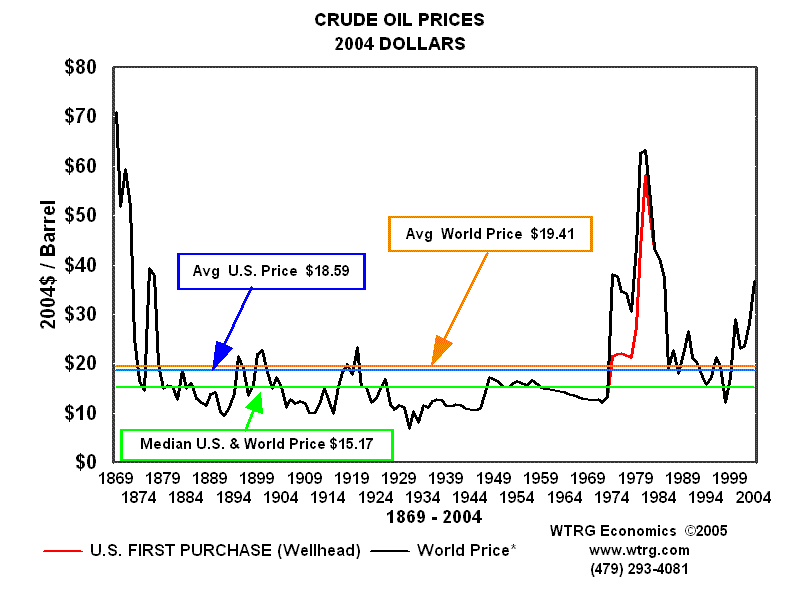
Ever since, people have expended a lot of unnecessary energy getting worried about bigness and monopolies in industry.  I always laugh when "progressives" decry the monopoly power of the oil industry to manage prices.  I worked for the oil industry in the 80s, and if they had the power to manage prices they sure were doing a crappy job of it.  If someone thinks that oil companies have been manipulating prices, they have to explain this chart to me.  If prices are manipulated at all, they look like they are being kept low and stable.

Another great example of monopoly paranoia is the near continuous Microsoft-bashing in the courts.  The most famous anti-trust case was the successful case by Netscape and numerous other Microsoft competitors attempting to kneecap Microsoft, nominally for monopolizing the browser market.  Now lets leave aside the obvious issue of just how consumers are getting hurt by being given a free browser by Microsoft.  The plaintiffs apparently successful argument (incredibly) was that through a series of technology and marketing moves, Microsoft prevented competition.  If that is so, if competing with Microsoft is so hard, then why are 30% of my visitors using Firefox when none used it a year ago.  I use Firefox, and you know what, it took me about 5 minutes to download, install it and start running it.  Boom, monopoly gone.  Lots more on anti-trust here.

UPDATE:  Welcome to the Greenwich Public Schools.  Thanks for linking me from your web site.  Despite my Arizona home today, I actually lived in Greenwich for a while growing up.  You can find other essays on capitalism and individual freedoms here and here, or you can check out Dave Berry, who is much funnier than I am.  If you are looking for a stronger defense of free markets than you can find in most public schools, a good place to start is at the Cato Institute.