Posts tagged ‘light rail’

The Elite Hatred of Buses

Several times in the past I have posited that folks in power simply hate buses.  How else to explain light rail and high speed rail projects that are both substantially more expensive and substantially less flexible than buses.  Some of the reasons for this include:

  • Politicians like rail better because it is sexier.  Period.   They are trying to spend taxpayer money to support their own re-election talking points.
  • Unions and city workers like rail because it is more expensive.  More money gets spent, either creating more union jobs or giving transit leaders bigger budgets which translate into higher salaries and more prestige for themselves.  And the lack of flexibility is good for them because it makes their job immune to budget cutting.  Just too many sunk costs.
  • Middle and upper-middle class folks in the public have a deep disdain for buses, which they associate with poverty and blue collar labor.  Riding buses hurts their self image, even if the service is no worse than trains.  Rail is the Louis Vuitton handbag of transit.

In Phoenix, light rail requires a subsidy of $3.82 center per mile (that is the government spending above and beyond the fare), which is nearly 10x what we spend on buses.  And light rail uses more energy per passenger mile here than driving.

Anyway, this story from Iowa seems to support my point — the government is proposing to spend tens of millions of dollars to create a rail service that is slower and more costly than existing private bus service.

The latest in lunacy in high-speed rail lunacy: at Joel Kotkin’s newgeography.com Wendell Cox reports that the U.S. Transportation Department is dangling money before the government of Iowa seeking matching funds from the state for a high-speed rail line from Iowa City to Chicago. The “high-speed” trains would average 45 miles per hour and take five hours to reach Chicago from Iowa City. One might wonder how big the market for this service is, since Iowa City and Johnson County have only 130,882 people; add in adjoining Linn County (Cedar Rapids) and you’re only up to 342,108—not really enough, one would think, to supply enough riders to cover operating costs much less construction costs.

Oh, one other thing. Cox reports that there is already luxury bus service, with plus for laptops and wireless Internet, from Iowa City to Chicago. It’s part of a larger trend for private companies to offer convenient and inexpensive bus service. A one-way ticket on the bus costs $18, compared to a likely train fare of more than $50. And the bus takes only three hours and 50 minutes to get from Iowa City to Chicago. That’s one hour and 10 minutes faster than the “high-speed” train.

City Planning, Light Rail and White People

I have argued for a long time that the shift of city transit departments from buses to a love affair with light rail has been a disaster.  Rail is so much more expensive per passenger mile, and so inflexible, that it generally forces a shrinkage in the total number of riders at the same time that budgets explode (example article here).

There are a lot of explanations for this phenomenon.  Part of it is incentives – heads of agencies with rail get paid more than bus-only agencies, and unions love the higher-paying rail jobs that never go away (part of the flexibility issues with rail).  Part of the explanation is cultural – rail is now hip and edgy and allegedly green and modern.  Buses are so last century.

And part of it is social/racial.  White upper middle class yuppies wouldn’t be caught dead on buses.   They like trains better, particularly when they are successful in running rail routes through middle class commuting routes.  If the cost of this forces cut backs on buses that run where the poor need to go, oh well.

So, I ask you, what city in America is most famous as a model for urban planning and light rail?  Portland.  So it is interesting to see what effect this planning and transit strategy has had on the population.  I have already written here before that Portland bus service has been gutted in favor of rail, such that total ridership in the city has dropped despite spending a lot more transit dollars.  These maps from the Portland Oregonian show another effect — shifting transit dollars to modes favored by rich white people has… caused Portland to be increasingly white.  What a surprise.  Via the anti-Planner

What if We Bought Into the Light Rail Hype, and Built It For Everyone?

Last year, there were about 3.2 trillion passenger miles driven by urban drivers in cars in the US.  My point about light rail is that we can barely afford it for just a few people, given that we spent $1.3 billion to build a rail line for just 17,000 daily round trip riders in Phoenix.  If it were truly a sustainable technology, it could be applied to all commuters.  But at a national average taxpayer subsidy per light rail passenger mile of about $2**, this means that to roll light rail out to every urban commuter would cost $6.4 trillion a year in government spending, almost half our annual GDP.  If it required the subsidy rates we have in Phoenix per passenger-mile, such a system would cost over $12 trillion  year.  In fact, the numbers would likely be even higher in reality, because light rail in most cities is almost certainly built on the highest populated corridors with the most bang for the buck (though some of the diminishing returns would be offset by network effects).

Light rail only works today because we drain resources from millions of taxpayers to benefit just a few generally middle class commuters.    This is not a model that will scale.

** This includes both service on the debt, which is payment for the original construction costs, as well as annual operating losses.  This subsidy is required essentially forever.  After 20-30 years when the original bonds are paid off, by that time systems generally have to be rebuilt in their entirety   (as folks in places like Washington DC are learning).  There are probably only 5-6 cities in this country that have the urban population densities to make rail systems come even in the ballpark of working financially, and places like Phoenix, Seattle, Houston, Portland and LA are NOT among them.

Light Rail and Sustainability

Let me offer up a definition of sustainability that I think most environmentalists and progressives would accept:

We are acting in a sustainable manner if we are achieving our goals in a way that does not hamper the ability of other people in the world, or of future generations, to achieve their goals.

Most environmentalists and progressives would call light rail lines in US cities a “sustainable” technology because of its notional impact on fuel use and CO2 output (yeah, I know, but we are not going to address those assumptions today).

Let me present one fact, from Federal Transit Administration’s 2009 survey of public transit authorities, whose data is linked in various ways here.  Or you can download the summary spreadsheet here.  For all US light rail systems in total:

User fares paid per passenger-mile:           $0.18

Total cost per passenger-mile:                     $2.22

Taxpayer subsidy per passenger-mile:       $2.04

Since I live in Phoenix and the Phoenix light rail system seems to get particular praise as a “success” from light rail supporters, here are the Phoenix light rail numbers;

User fares paid per passenger-mile:          $0.07

Total cost per passenger-mile:                     $3.89

Taxpayer subsidy per passenger-mile:       $3.82

So there, folks, is your sustainable technology.  As I have written before about sustainability, “I do not think that word means what you think it means.”

Nationwide, non-users of light rail pay for 92% of its costs.   In Phoenix, non-users pay for 98% of the costs.  Taking the Phoenix system as an example, resources are drained from literally millions of people so that 17,000 or so people can ride it round trip each day.   Using resources from millions of people, and building up debts that will last into the next generation, to support the transit of just a few people, seems to be the antithesis of sustainability.

If there is any common denominator among progressives, it is that they have little respect for how individuals spend their money.  So they might be unmoved by the loss of resources from so many.  So lets just look narrowly at transit, which I presume the do care about.

Before Valley Metro operated a light rail system in Phoenix, they also operated a bus transit system.  This system still requires a subsidy, but it is much lower than the light rail subsidy.  In 2009, the bus subsidy was $0.74 per passenger-mile.  This means that for the same amount of taxpayer funds, Valley Metro can provide 1.0 passenger-mile by train or 5.2 by bus ($3.82/$0.74).   I can guarantee that cities building light rail are not having their budgets quintupled.  So the result is that, as light rail gets built, total transit ridership falls in most cities as rail costs crowd out existing bus services.

Update: Most light rail articles in our local papers, which have been mindless boosters of the system, generally consist of asking riders if they like the system, who inevitably answer “yes!”  This is somehow a proof the system is great.  Well, duh.  I too am likely to be happy with a service where I only pay 2% of the costs.

Update #2:  Last year, there were about 3.2 trillion passenger miles driven by urban drivers in cars in the US.  My point about light rail is that we can barely afford it for just a few people, given that we spent $1.3 billion to build a rail line for about 17,000 daily round trip riders in Phoenix.  If it were truly a sustainable technology, it could be applied to all commuters.  But at a national average taxpayer subsidy per light rail passenger mile of about $2, this means that to roll light rail out to everyone would cost $6.4 trillion a year, almost half our annual GDP.  If it required the subsidy rates we have in Phoenix per passenger-mile, such a system would cost over $12 trillion  year.  In fact, the numbers would likely be even higher in reality, because light rail in most cities is almost certainly built on the highest populated corridors with the most bang for the buck (though some of the diminishing returns would be offset by network effects).

Phoenix / Valley Metro Light Rail Report Card: F

Folks who read this site know I have been critical of Phoenix light rail since well before it was opened.  So often, folks just willfully misinterpret my criticisms.   The actual rail line and its service is pretty nice, and the facilities are quite attractive (lets see what they look like in 10 years though).  If Santa Claus had just delivered the Phoenix light rail system for free to Phoenix, I would be thrilled with it.   But Santa unfortunately was not involved, and instead the rail line was paid for by area residents, and it cost them over $75,000 per daily roundtrip rider to build, plus annual operating deficits infinitely into the future.   I would be thrilled if an Aston Martin Vanquish showed up in my garage tomorrow, but I am not going to fork over a quarter of a million bucks for one.  Ditto the light rail system.

Anyway, the 2009 FTA transit database is out, and Randal O’Toole has helpfully summarized it in spreadsheet form, which you can download here.  You can peruse your own local system.  Probably the hardest thing to figure out are the mode codes, which are deciphered here.  Since 2009 was the first full year of operation for Phoenix light rail, we can finally look at data for Phoenix on an apples to oranges apples basis with other transit systems  (it is really, really hard to squeeze useful information out of the data Valley Metro posts on their site).

I am just going to highlight two numbers for Phoenix light rail (TRS_ID 9209 in the data).

  • The public subsidy per individual trip (that is one person boarding and riding one way) is $32.73!!   No one would pay this amount if it were the fare.   This equates to a public subsidy (beyond the fares paid) of $3.82 per passenger mile.  Remember, this is not a hostile analysis, but based on the numbers Valley Metro itself submits to the FTA.   Note the IRS reimbursement rate for the total cost (capital and incremental expense) of driving a car is 50 cents per mile, which drops even lower per passenger mile when the car has more than one person in it.  The average occupancy of a car is something like 1.5, which would make the cost per passenger mile of the average car to be about 33 cents per mile.  Ignoring the passenger fares, the public subsidy alone for light rail in Phoenix is 11.6 times larger [note: and yes, this includes the gas tax, so it includes a lot of the maintenance of the road infrastructure.  To include full cost of maintaining and building highways, it might have to be a few cents higher, but its not going to come anywhere in the ballpark of the light rail number].
  • But we are paying more for rail to save the environment, right?  Well, the BTUs expended per passenger mile for Phoenix light rail was 4402.  This compares to the average for passenger cars as determined by the DOE at 3437 BTU/PM.  So the train actually uses 28% more energy to move one rider one mile than does the average car.

Years before the light rail system was completed, I made my light rail bet:  That with the capital cost, I could easily buy a Prius for every daily rider, and still save money.  And for less than the annual operating subsidy, I could give all the new Prius owners free gas each year.  Already my bet has proved more than correct.  But now we know that under my Prius plan, we also would have saved energy, since the Prius uses less than 1700 BTU/pm, less than a third of what Phoenix light rail consumes.

The Bankruptcy of Sustainability

This story just floored me:

“How much is sustainability worth?” asks Pulitzer-prize winning reporter Nigel Jaquiss. “Try $65 million in public money.” That’s how much taxpayers will be spending on a $72 million “green” building in downtown Portland. At $462 a square foot, it will be “perhaps the most expensive office space ever built in Portland.”

The director of the Oregon Environmental Council defends the building as something that can “leverage long-term outcomes,” whatever that means. But she would defend it, since the state is promising OEC, 1000 Friends of Oregon, and other left-wing environmental groups office space in the building at low rents that are guaranteed to stay fixed for decades.

Although the public is paying for most of the building, “tenants will be expected to share a commitment to help advance Oregon’s leadership in sustainable development, collaborate with fellow tenants, and pursue OSC’s standards for energy and water use.” Apparently, people who don’t share those “commitments” won’t be welcome, even if their taxes helped pay for the building and even if they are willing to pay more for office space than the greenies.

Sustainability supposedly bills itself as being about using a reduced amount of resources.  But this goal is already accomplished by pricing signals, as they signal the relative scarcity of resources we might want to employ.  By definition, then, building the most expensive office space ever means that they are more resources (or a mix of scarcer resources) per square foot than any other previous construction project.  How in heavens name is this “sustainable?”

Like many such public projects (e.g. light rail), this project drains resources from millions of people via taxation to benefit just a few.  It takes an approach that could never, ever be scaled to benefit everyone in the city as it would be bankrupting.  This construction uses unreasonably large resources for an application that will never come close to returning this investment and can only be funded on a small scale using the resources drained from millions of people.  How is this “sustainable?”

I will leave the answer to these questions to the reader, but here is a hint:  Those advocating projects like this tend to treat human labor as free, to be deployed like Egyptian slaves to the whim of the state planner, either via taxation or more directly through demands for free labor (e.g. in recycling programs).

Light Rail Killing Another Bus System

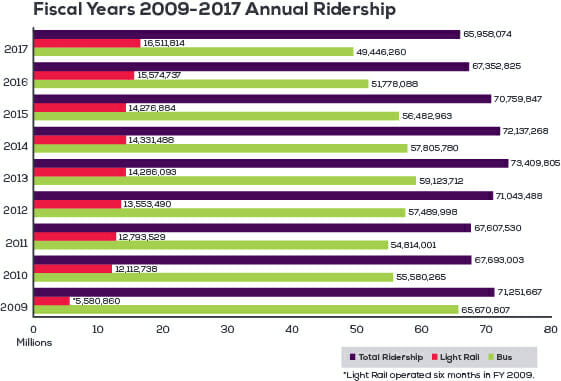
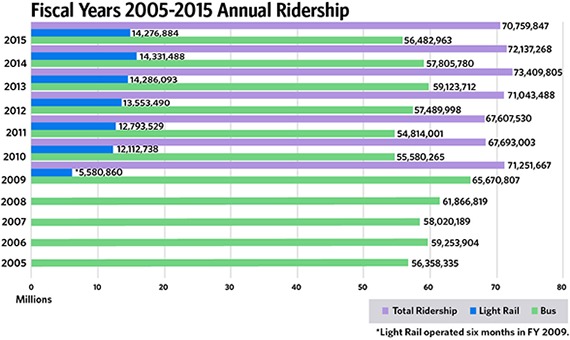
As predicted by skeptics of light rail, like myself, the Phoenix light rail system is starting to kill bus service.  This is a familiar pattern — in most cities that have added rail, from LA to Portland, total transit ridership has fallen as light rail systems have been built.  That is because rail is so expensive, and its costs are mostly fixed (ie bond payments for construction costs) and absolutely inflexible (ie you can’t shift routes).  Since rail costs far more, even orders of magnitude more, per rider than buses, this means that even with modest increases in total transit budgets, total ridership falls when capacity is being shifted to much higher cost rail.  Bus service is inevitably cut, because even if you close rail lines, the costs remain.

So here we are, in Phoenix.  The article is mainly about the regional transit coalition falling apart, which I have no opinion or interest in, but you can see what is going on anyway.

A bad economy has meant that building a regional bus system in the Valley is no longer a regional endeavor.

A half-cent sales tax was supposed to be the magic bullet that paid for transit and roads. But as tax revenues continue to shrink, cuts to the plan have become inevitable.

Avondale leaders say the toll includes the decimation of future West Valley bus routes and the end of the regionalism that Proposition 400 promised….

Paul Hodgins, capital-programming manager for Valley Metro, which operates the transit system,said every region took a 25 percent cut in transit dollars.

Here is what is going on, though the article only sort of alludes tangentially to this way down in the last 2 paragraphs.  Half of the transit dollars in the sales tax increase went to rail, and half to buses.  The rail money is almost all for debt service on capital spending which has already occurred.  This money has to be spent or the local authorities will default on their bonds.  The other half was for bus operations.

Now, there is a 25% cut in the sales tax dollars from this sales tax increase.  The half that went to rail can’t be touched.  So the 25% cut results in a 0% cut in rail and a 50% cut in buses.  Further, since bus service carries a lot more passenger trips per dollar spent than rail, this 25% cut will end up affecting well over 50% of the total ridership that benefited from the sales tax funds.

It is clear from the article that folks probably understand this, but no one from the AZ Republic to the transit agencies are yet ready to admit it.  Expect the proposed solution to be in the form of more taxes rather than a rethinking of transit strategy.  Rail is an albatross, and I wonder how often it has to drive failures like this before people start recognizing it as such.

Cargo Cult Light Rail

Several people sent me this Reason video on light rail in Detroit

I was really struck by the cargo cult reasoning here and the confusion of cause and effect.  Because we see rail in highly developed urban areas (e.g. Manhattan) then if we build rail in a blighted area, it will soon look like Manhattan.

Note the mentions of serving sports stadiums.  As I have observed earlier, light rail systems almost always service professional sports stadiums.  Is there no limit to the public subsidies that politicians are willing to throw at sports franchise owners?

Then ending is a classic

Update: From Wikipedia, for those not familiar with cargo cults:

Cargo cult activity in the Pacific region increased significantly during and immediately after World War II, when the residents of these regions observed the Japanese and American combatants bringing in large amounts of material. When the war ended, the military bases closed and the flow of goods and materials ceased. In an attempt to attract further deliveries of goods, followers of the cults engaged in ritualistic practices such as building crude imitation landing strips, aircraft and radio equipment, and mimicking the behaviour that they had observed of the military personnel operating them.

Sure sounds a lot like Detroit, trying to bring back the prosperity.  This is actually pretty endemic in modern-day policy making, as so few people really understand the origins of wealth.  Obama’s stimulus programs can be seen in the same light, as cargo cult economics.

Phoenix Light Rail Fail

My column in Forbes is up for the week, and discusses the failure of light rail.  In particular, it focuses on Phoenix light rail, which has been hailed by the intelligentsia as a stirring success.  Which it is … if you are willing to completely ignore its costs.  Saying that Phoenix light rail represents an example to be emulated is roughly equivalent to saying that an Aston Martin makes a sensible middle class family car.

One reason Phoenix is a particularly bad candidate for a light rail line is that our population is so dispersed, and there are not any obvious commuting routes.  Our downtown is a destination for very few, but even here the commutes, as shown on this distribution map, are from all over, hardly very good fodder for rail (the downtown is near the “phoenix” label).  More importantly, people work all over, so taking a suburban zip code, look at where people are commuting to from suburban 85032.   Again, all over.  Notice how few are going downtown (where the light rail line is — downtown is toward the south about where the “phoenix” map label is).  In other words, people in Phoenix are driving from all over to all over.

Update: Now here is my idea of rail running in the streets, via Shorpy

Did You Ever Notice….

Did you ever notice that when government programs are labeled “popular,” it is always by their beneficiaries, e.g.

For the second time in two years, the state universities are weighing whether to limit or even get rid of the popular AIMS scholarship, which waives tuition and fees for thousands of college students.

Since most similar government programs consist of giving people something of value for free or at least for a below-market price, aren’t they always going to be popular with their recipients?  Wheat subsidies are popular with wheat farmers, light rail subsidies are popular with those who ride it, cash-for-clunkers was popular with folks who got 2-3x blue book value for their trade-ins, and education subsidies are popular with the students and parents who get them.  In this usage, then, I would argue that the word “popular” in the paragraph above is entirely tautological and should therefore be eliminated from standard usage.  The only meaningful definition of “popular” vis a vis a public program should be “popular with those who fund it.”

Faith-Based Government Investment

The Tampa Rail blog has responded to my post criticizing Phoenix light rail (which the Tampa folks used as a glowing example of rail success).  Remember I wrote, in part:

Look, I don’t think I have ever argued that Phoenix Light Rail was run poorly or didn’t have pretty trains.   And I don’t know if moving 18,000 round trip riders a day in a metropolitan area of 4.3 million people is a lot or a little (though 0.4% looks small to me, that is probably just my “pre-web” thinking, whatever the hell that is).The problem is that it is freaking expensive, so it is a beautiful toy as long as one is not paying for it.  Specifically, it’s capital costs are $75,000 per daily round trip rider, and every proposed addition is slated to be worse on this metric (meaning the law of diminishing returns dominates network effects, which is not surprising in this least dense of all American cities).

Already, like in Portland and San Francisco, the inflexibility of servicing this capital cost (it never goes away, even in recessions) is causing the city to give up bus service, the exact effect that caused rail to reduce rather than increase transit’s total share of commuters in that wet dream of all rail planners, Portland.  Soon, we will have figures for net operating loss and energy use, but expect them to be disappointing, as they have in every other city (and early returns were that fares were covering less than 25% of operating costs).

Of course, as with all government issues, the ultimate argument is that I am some sort of Luddite for actually demanding definable results for billion dollar government spending

Sorry Coyote, save for the topic matter I’m afraid I’m just not going to be much fodder for you. We’re years past ‘it’s an expensive tax thing’.

We know that. We know rail like any capital project is expensive to execute and expensive to maintain – in dollars. But anyone who raises the math to me will wind up with the same big ‘so what’. Community investment doesn’t bother everyone the same way and different people see different value. There’s no way you or I cold supernaturally understand the net benefit for or against light rail. We must simply choose to believe and pick our sides.

If you believe that just because rail is expensive they aren’t worthwhile, you need to explain every public vote that has gone for implementing and expanding rail systems around the world even though most operations are publicly subsidized.

Gotta run’em well, and, over time, integrate with a city, but LR is a carefree mobility solution in areas where people choose to support and pay for it.

See, they are well past my neolithic argument, into their little post-modernist world where aesthetics and political correctness trump any actual need to demonstrate money is being used well.  Though it is interesting to see him resorting to faith as a justification.

I have two words for this person — “opportunity cost.”  On one hand, the money for this project must be taken out of private hands to build the rail line — even leaving out the substantial individual liberties questions here, there is still some obligation to demonstrate the money is better used than it would have been in the private hands from which it is taken.  Ditto, by the way, for the stimulus bill.   On the other hand, to the extent that one wishes to spend government money to move people from A to B, one needs to demonstrate that this method is better than others.  I would argue high speed rail fails both tests.

Update: Joel Epstein and I have a go around the same issues in the Huffpo comments.

On What Freaking Basis?

Tampa Rail writes (hat tip to a reader):

The new Phoenix light rail system is emerging as one of the most successful new systems in the country.  This is especially poignant for Tampa because in scale, project scope, and demographics, Phoenix represents the apogee of operating examples.

Over the course of its first year the system has received high marks in community integration, stunning ridership figures, and respectful financial constraint (making tough decisions on long-term planning that do not inhibit the value of its starter-line status today).  This is exactly what Hillsborough County is shooting for in its own implementation.  A perfect balance of conservative control and benchmarking combined with progressive action and democratic freedom, the latter which may finally come to Hillsborough County in the form of a referendum.  That all good stuff was achieved by such a strikingly similar auto-depenent culture is a great omen.  A starter light rail system can be championed by civic conservatives (Mark Sharpe), and civic progressives (Ed Turanchik) to great outcome….

Both pieces I link to here embarass anti-rail or anti-tax groups who are, as the Phoenix article notes, “muted” if not definetively silenced.  Their arguments against community investement were loud, often intelligent (once one bought into the ideological premise that rail systems must ‘pay for themselves’ and that community investement is somehow inherently evil – points not firmly established by any means among rationale individuals), and grossly atypical.  I will forever hype on how mechanical, unchanging, and how pre-web these attacks were formulated.

Ooh, how can I overcome my embarrassment?  Look, I don’t think I have ever argued that Phoenix Light Rail was run poorly or didn’t have pretty trains.   And I don’t know if moving 18,000 round trip riders a day in a metropolitan area of 4.3 million people is a lot or a little (though 0.4% looks small to me, that is probably just my “pre-web” thinking, whatever the hell that is).

The problem is that it is freaking expensive, so it is a beautiful toy as long as one is not paying for it.  Specifically, it’s capital costs are $75,000 per daily round trip rider, and every proposed addition is slated to be worse on this metric (meaning the law of diminishing returns dominates network effects, which is not surprising in this least dense of all American cities).

Already, like in Portland and San Francisco, the inflexibility of servicing this capital cost (it never goes away, even in recessions) is causing the city to give up bus service, the exact effect that caused rail to reduce rather than increase transit’s total share of commuters in that wet dream of all rail planners, Portland.  Soon, we will have figures for net operating loss and energy use, but expect them to be disappointing, as they have in every other city (and early returns were that fares were covering less than 25% of operating costs).

PS- I get a lot of comments that I have some weird anti-train bias.  Actually, I have an n-scale model railroad in one room of my house, and spent a lot of my teenage years traveling along rural rail lines and photographing trains.  I love trains.  I just don’t like stupid investments.

PPS- I was just thinking, on the basis the Tampa writer declares the building of Phoenix Light Rail a raving success, I could say the same thing about buying a super-size 100″ flat screen TV for $50,000.  It is beautiful.  Everyone who sees it will love it.  It works flawlessly.  Lots of people will be able to enjoy it at one time.  In fact, it is the greatest, most sensible and successful purchase of all time as long as you never mention the cost.  Which is, by the way, why only one person I have ever met has one (I happened to be at a Reason reception the other night and the homeowner had such a beauty on his living room wall).

Update: I try to anticipate every argument in these posts.  The one other argument is that rails takes congestion off roads.  But for most of its length, Phoenix light rail displaced one lane of road in each direction.  These lanes had a capacity as large or larger than what Phoenix light rail carries.  The were also much cheaper to build.  I must say I liked my quote from that post

If running trains requires, as you suggest, draining resources from millions of people just to move thousands, how is it sustainable?

Commuter Rail Numbers Don’t Even Work With the Supporters’ Numbers

From the AZ Republic, which just can’t stop itself from shamelessly cheerleading any effort to spend billions on rail in Phoenix (perhaps the world’s worst candidate for rail transit given its density and distribution of businesses).

Enough people would board a train in the Valley’s suburbs that a future commuter-rail system would be as popular as some of the busiest lines in the West, new studies have found.

Well, that’s a low bar.

A trio of yearlong rail studies, in nearly final form, indicates commuter rail could carry almost 18,000 passengers a day by 2030. Planners at the Maricopa Association of Governments

say, based on the findings, they favor a 105-mile, X-shaped system that could feature 33 stations and cost roughly $1.5 billion. That’s a little more than the Valley’s 20-mile, light-rail starter line.

If this was presented to me as a business opportunity, I would have had them stop right there.   Even before inevitable cost overruns and over-confidence in ridership, even with the supporters’ numbers, they want $1.5 billion to carry 18,000 people a day.   That is a capital cost of $83,000+ per daily rider, beating the old record of Phoenix light rail which cost around $75,000 per daily rider.

Planners assume the trains will recoup about 40 percent of their expenses, based on the national average for similar service. The average fare would be about $6 to $7, Wallace said, although no detailed study has gone into fares. Generally, rates would go up the farther the trip.

Can you imagine any other investor in the world other than the government making an investment knowing that in the best case of its strongest supporters revenues will only cover 40% of costs?  And why should the rest of us subsidize folks who live in outlying areas to commute?  They moved to those areas in large part because housing was cheap and cost of living was low, with the knowlege they had a long commute.  So those of us with the forsight to live close to work have to subsidize them?  This is a really valuable service for them but they can’t even pay half the cost?

Further, lets look at those cost estimates.  If we get 18,000 a day on weekdays and a third that on weekends, that yields 5 million round trips.  Given an 8% interest rate over 30 years, the capital charge is $134 million a year before overruns.  That means the fare would have to be $27 round trip or $13.50 one way just to cover the capital cost alone, without even considering operating costs.

This means their figures are nuts.  $6-$7 one-way fares barely covers 40% of the capital costs, much less the operating expenses.  We are talking about an offering that is deep in the red.  $13 round trip at 5,000,000 round trips equals $65,000,000 of revenue.  That means that taxpayers will have to foot the bill for all the operating costs  ($30 million?  $60 million) and at least $69 million of capital charges.   It is not unfair to assume that this would punch a minimum $100 million hole each year in the government’s budget that we will have to make up with taxes.

Update: Gotta achnowlege this bit of sanity in the AZ Republic comments from “astonished”

Light rail is such a boondoggle. It’s expensive to build and always runs at a loss. It is very hard to change the routes to respond to ridership needs. It’s a vanity project for hip liberals.

If public transportation is a goal, then get some buses going. Buses are flexible, cost effective, cheap to run and maintain, and if ridership changes, you just change the routes and schedules.

The Leftish Mindset, In One Sentence

Cameron Scott meant this sentence as a withering critique of everything that is wrong with the government, from his point of view:

Transit riders shouldered four times the share of the MTA [Metropolitan Transit Authority] 2008 budget disaster [than] drivers did, but officials promised to seek more revenue from parking.

Holy cr*p!  You mean that transit users shouldered four times more of the transit budget than transit non-users?  Gasp!

The Bay Area where he lives is experiencing light rail disease.  This is the phenomenon where middle class voters along heavy white collar commuting routes push for horrendously expensive light rail lines.  The capital costs of these systems drain transit budgets into the distant future, forcing service cuts, particularly in bus systems that serve the poor.  The result is that the city ends up with bigger transit bills, but less actual transit, and progressives like Scott scratch their head and try to figure out what went wrong.  It must be because non-users of Transit aren’t paying enough!

Light Rail Killing Another Transit System

I have written frequently that light rail tends to kill transit systems (Randal O-Toole has been a Cassandra on this subject for years).  Rail is so expensive to build and operate, and so inflexible in its routes and service structure, that once constructed it sucks resources from other modes (especially buses).   This leads to the counter-intuitive conclusion that these huge investments actually in the long run end up reducing transit system coverage and service and reducing ridership.  In particular, the poor, who depend on public transit as their lifeline rather than as a publicly subsidized alternative to buying a Prius, tend to get hammered.  Their bus service is cut and the light rail seldom runs where either their work or their homes are located.  Light rail is in effect a shifting of transit focus from serving the poor to serving the middle class (who wouldn’t be caught dead on a yucky old bus but who like trains).

Enter Phoenix.  For the capital cost of $75,000 per daily rider, and large operating losses, we built ourselves a light rail line in one of the most dispersed cities in the country.  In other words, we spent $1.4 billion to serve a single 20 mile corridor which represented a tiny fraction of the city’s commutes.  I predicted a while back two outcomes:

1) Light rail fares skyrocket to cover their immense operating deficits and capital costs, giving the lie to politicians that sold these systems as helping working poor.

2) Bus service, the form of transit that serves most of the working poor …  is cut back to help pay for rail.

So, here is what I woke up to on the front page of our newspaper:

Phoenix’s bus system, the largest in the Valley, may see a $16 million budget cut next year to avoid a deficit in 2012, transit officials say.

Bus-system officials will discuss the issue with the Citizens Transit Commission today.

The looming deficit is more bad news for bus riders. Cost-cutting in December and July reduced the frequency of some Phoenix routes and eliminated early morning and late-night service. Also, bus fares went up in all metro Phoenix cities and for Metro light rail this year.

Of course, as with all government analyses, the problem is not enough taxes:

Phoenix is going through multiple rounds of belt-tightening because sales-tax revenue, a crucial part of Phoenix’s $171 million transit operating budget, continues to drop because of the economic downturn.

Transit 2000, the 0.4 percent sales tax that voters approved in March 2000, is bringing in less than projected. The tax was expected to generate $21.4 million during the first two months of this fiscal year. It brought in $14.3 million, said Lauri Wingenroth, assistant public-transit director.

Here is what they say dont say in the article, but should:  Most of the 2000 sales tax increase was allocated to the capital costs of light rail construction.  Those can’t be cut back, because they are already sunk.  That means that most of these taxes are dedicated to paying off light rail bonds for the next 30 years, and those expenses exist no matter what they do.  So with no way to cut back on light rail expenses, buses (which have more variable costs than rail) are cut.  All exactly as predicted.

PS- Hilariously, right next to this article which should have been labeled a light rail fail, is an article about the “tragedy” that Phoenix is not on the Obama light rail boondoggle map.  Everyone else gets to waste a ton of federal money, why don’t we have the same right?  If you read the article, you will find that a lot of countries that are orders of magnitude more dense and have much shorter inter-city travel distances than in the US are way ahead of us.  Left out of the article is the much higher percentage of freight that moves by rail rather than road in the US.

Update on Rail Subsidies

As an update on my rail subsidy post, I saw a relevant post from the Thin Green Line yesterday.  At least, I suppose, transit supporters are honest:

When I talked to Dave Snyder earlier this month about a fix for mass transit in the Bay Area, he told me, “Somehow or another we’ve got to get more money from driving.”

However, I thought this was a hilarious lack of perspective:

…one side effect of the green revolution has been a growing awareness of how much roads cost. I imagine you’d be surprised to learn that building a road—not maintaining it, just building it—costs more than $16 per square foot.

I have no doubt that this person, who is a strong light rail supporter, honestly thinks this is a lot of money.  But I did the math in my comments on his post:

$16 per square foot for highway should be considered a bargain. This means that a twenty foot wide two-lane highway is $320 per linear foot.

The Phoenix light rail system cost $1.4 billion (thats building it, not maintaining it) for 20 miles, which at 34,000 boardings per week day is carrying somewhat less traffic than the capacity of a two lane highway. However, it cost $13,258 per linear foot, or 41 times your highway numbers. Which is why highway users easily pay the full cost of their transportation infrastructure through their gas taxes, but transit users don’t even come close.

In Phoenix, light rail fare revenues cover only 7% of its operating and capital costs. Which always has me scratching my head when people say light rail is somehow more “sustainable.” If running trains requires, as you suggest, draining resources from millions of people just to move thousands, how is it sustainable?

The 93% Subsidy

I wondered today what kind of subsidy a rider on the Phoenix Light Rail system was receiving.  Hillary Foose, the public information officer of Metro light rail, was kind enough to send me a link to this board presentation.   Since the rail system opened mid-fiscal year, I will use their own projections for the 2009/2010 fiscal year.

Public accounting is a pain in the butt for someone used to private finances, because it is all cash accounting rather than accrual and they mix together capital expenditures with operating expenditures.  But the table on page 62 carves out the operating budget for the existing 20-mile line from the development and capital budgets.    Here are the key numbers:

Fare Revenue:  $8,985,159

Operating Expenses:  $33,733,168

So already on an operating basis we have a 73% subsidy.  But we have sunk $1.4 billion of capital money into building the line  (actually this is a little low as Metro has spent tens of millions more this year).  Unfortunately, in government accounting, there is no depreciation or interest charge that shows up.   So I am going to charge them with the payment on a 30-year $1.4 billion 5% note, which would be just over $91 million a year.

Totaling the $91 million with the other operating expenses, we get a 93% subsidy for light rail.  This means the true cost of the $1.75 ticket for a light rail ride is actually $25!  METRO says that light rail riders love the service.  I should think anyone who gets a $25 service for $1.75 should be happy.

Another way to look at the subsidy is on a per rider basis.  So far, METRO has averaged about 17,000 round trip riders per weekday (based on about 34,000 boardings per day).   The $115.8 million annual subsidy (capital+expense minus revenues) works out to just over $6,800 per rider per year that the rest of us (who may not live or work near the line**) pay each current rider.

There are a number of ways in which I have likely understated the subsidy:

  1. I used their June revenue projections, which likely will continue to be revised downwards as ridership continues to slump
  2. I used their own expense projections, and we know how often governmental bodies hit their expense numbers
  3. I assumed no new capital spending necessary over a 30 year life.  Rail experience has shown this to be overly-optimistic.  Rail lines have to be rebuilt every 15-20 years or so.  They take tons of capital maintenance dollars.   When we look back twenty years from now, we’ll likely come to the conclusion I grossly understated the capital charge.

**Footnote: Since over a third of the capital to build the line came from the Feds, many of the people subsidizing the METRO riders don’t even live in this state.

Update: The other thing I left out is lost parking revenue.  The revenue numbers for fares is in fact overstated.  It should net out lost parking revenues, for example at baseball games.  This is the only time I ride the Metro, because I substitute a $2.75 Metro round trip ticket for a $10 city garage parking expense.  But the city has never acknowledged this cannibalization.

Update #2: I have posted an update here

In the Pay of Big Transit?

I am always amazed at the lengths to which some folks will try to put lipstick on the light rail pig.  One example I found today.  Michael Graham Richard wrote on treehugger in June:

The sprawling city of Phoenix, of all places, is showing us how light rail should be done. They just opened a 20 mile line with 28 stops last December, and ridership statistics are beating all forecasts (evidence that the same might be true in other cities where they are afraid to invest because their forecasts are too low) with 40,000 daily riders instead of the 25,000 expected.

But here are the ridership figures from Valley Metro, who runs Phoenix Light Rail.  This is weekday ridership (actually number of daily boardings) — weekend ridership is much less:

  • Jan:  30,617
  • Feb:  35,277
  • Mar:  34,376
  • Apr:  37,386
  • May:  33,553
  • Jun:   29,469
  • Jul:  26,554

It is hard to see where one gets a 40,000 figure, especially since a true daily rider/boarding figure would have to average in the lower Saturday/Sunday numbers.

And who cares if it meets some sandbagged forecast or not?  Is 40,000 even a reasonable number?  Note that even at the higher 40,000 figure this implies just 20,000 round trip customers.  This higher ridership number would still make the capital cost of the $1.4 billion line to be $70,000 per round trip rider, and ABSURD subsidy.

Update: The ridership numbers will likely pick up when Arizona State is back in school.  ASU and the baseball stadium are about the only major destinations on the line through dispersed, low-density Phoenix (it goes through our “downtown” but that is not saying much  — it is not a big center of employment).  Did we really build light rail as another subsidy for ASU students?

Update #2: Let’s say there are 50,000,000 big city commuters in the US in cities outside of Boston/NY/Chicago with large transit systems.   Serving these commuters at $70,000 each would create a capital cost of $3.5 trillion for light rail.   Who on the planet really thinks this is reasonable?  Sure, you would get some network effects as you built out lines that increased ridership, but these would be offset by diminishing returns (presumably the first Phoenix line was built on the most promising corridor, and all future corridors will be less promising).

Light Rail Uses Twice the Energy as Driving

One of the justifications for diverting highway money to ridiculously expensive light rail systems is that light rail supposedly reduces energy consumption.  Really?  This is via the most recent report from the DOE’s Transportation Energy Book, as highlighted by the Anti-Planner (click to enlarge):

light-rail-energy

The figures for cars are from tables 2.12 and 2.13 of the same report.  Even the best light rail systems are not substantially more efficient than cars, and this gap will likely continue to close, as it has for years, as cars get more efficient.

A Note on Freight: By the way, passenger rail promoters in the US always point to the Europeans as having a better rail system.  But while the Europeans put more of their passengers on rail than does the US, they put less of their freight there.  I would argue that the US system is much more “green”, as the differences in energy use between a ton mile of freight on road vs. rail is much larger than the difference in energy use of a passenger mile on road vs. rail.  And besides, from a lifestyle standpoint, would you really want more freight on the roads?  (This is a real tradeoff — unless one spends the absurd amount of money to build two separate systems, a rail network can be optimized for freight or passengers — the two do not coexist very well on the same tracks).

Postscript: Just to head off the obvious rhetorical battles — the incremental energy efficiency of moving one driver to a light rail rider of an existing system is very high.  The car consumption goes away and the train does not incrementally increase its energy use much with one more passenger.  So at the margin, it is correct when someone tells you that it saves energy to shift your commuting to an existing light rail line.  However, it does not make sense, from an energy perspective, to build a light rail line in the first place.  The investment is too high, the energy savings are negligible or non-existent, and the operating cost are so high that light rail tends to crowd out bus operations that help the poor.  As I have written before, for every light rail system I have checked, the cost to build the system is enough to buy every daily rider a Prius and the operating deficit enough to keep every one of these Prius’s filled with gas.

Update:  I further understand that cars in the city likely have lower gas mileages than these averages, particularly for commutes that might be substituted by light rail.  But light rail is sold as if it is substantially more energy efficient, and it really would have to be orders of magnitude more efficient to justify the capital costs that are so much higher than for an equivalent capacity of roadway.  The efficiency is just not there.

The Portland Non-Example

The Anti-Planner, in a long post dissecting a speech by Ray LaHood, brings some good facts to the table about the lack of success of efforts in cities to get people out of cars.  Of particular interest is Portland, which is often held up by transit and in particular light rail supporters as the be-all-end-all city on the hill example of transit and growth planning.  OK, let’s use it as an example:

The 2007 American Community Survey found that, since the 2000 census, the number of Portland-area residents who say they usually bicycle to work grew from about 6,800 to 15,900. But the number who say they take transit to work declined from 58,600 to 57,900. The number who go to work by car (not counting taxis) grew from 664,300 to 730,500. This means that Portland roads have about 60,000 more cars during rush hour, but the region has put most of its transportation dollars into light rail and streetcars that carry no more people.

A lot of blame for this can go to the city’s focus on light rail, whose enormous costs have cannibalized bus service and thus reduced total transit service.  In particular, those who support transit as a god-send for the working poor should note that this substitution of large, inexpensive bus networks for more yuppie-friendly trains on narrow routes shifts transit away from the poor to white collar users.

…coerciveness is a fundamental part of the livability campaign, as shown by Portland, Oregon, whose official objective (see table 1.2) is to allow rush-hour traffic to grow to near-gridlock levels (”level of service F”) on many major freeways and arterials. Besides diverting federal highway money into light rail instead of things that will actually relieve congestion, much of the money that Portland does spend on roads goes into “traffic calming,” a euphemism for “congestion building” which consists of putting barriers in roads, speed humps, narrowing streets, and turning auto lanes into exclusive bike lanes.

Beyond the moral and constitutional question of whether government should have the right to intrude into people’s lives is the more practical question of whether the benefits of such intrusions justify their costs. In the case of Portland, the costs include a nearly twelve-fold increase in the costs of congestion between 1982 and 2005, the more than $2 billion spent on light rail, and nearly $2 billion spent on subsidies to transit-oriented developments. Meanwhile, the benefits include a lot of New York Times articles making Portlanders feeling smug about themselves, but not much else except for the lucky (or politically connected) few getting the subsidies.

Phoenix Light Rail Fail — Half My Light Rail Bet Settled

When Phoenix was building its light rail system, I made the following two-part bet:

  1. I could take all the money spent on construction and easily buy a Prius for every single daily rider, with money to spare
  2. I could take the operating deficits for light rail and buy everyone gas to run their Prius 10,000 miles per year and still have money left over.

This bet has been tested in a number of cities, including LA and Albuquerque, and I have not lost yet.  Now the numbers are in for Phoenix initial ridership, and I am winning the first half of my bet in a landslide.

The other day, Phoenix trumpeted that its daily ridership had reached 37,000 boardings per weekday.  Since most of those people have two boardings per day (one each direction) we can think of this as 18,500 people making a round trip each day.

Well, if we bought each of these folks a brand new Prius III for $23,000 it would cost us just over $425 million.  This is WAY less than the $1.4 billion we pay to move them by rail instead.   We could have bought every regular rider a Prius and still have a billion dollars left over!  And, having a Prius, they would be able to commute and get good gas mileage anywhere they wanted to go in Phoenix, rather than just a maximum of 20 miles on just one line.  Sure, I suppose one could argue that light rail is still relatively new and will grow, but even if ridership triples, I still win the fist half of my bet.  And as the system expands, my bet just looks better, as every single expansion proposal has been at a cost of $100 million a mile or more, more expensive than the first 20 miles.

So now, all we have to do is wait to see the operating results to settle the second half of my bet.  If common practice is followed from other metro areas, this will be extremely difficult to prove because the authority will do everything it can to hide the huge operating dollar hole light rail is creating.

But Coyote, what about congestion?

I am glad you asked.  Folks will argue that rail reduces congestion.  Normally, I would agree but argue that it reduces congestion at way too high of a price.  But for Phoenix light rail, it may even be that rail makes congestion worse.

Here is why:  In building Phoenix light rail, the city along most of the line had to remove two lanes of traffic (one each way) to build the line.  So here is the comparison:

  • Light rail carries 37,000 trips per day or about 2,000 per hour  (1,000 each way) through its 18-hour operating day, though certainly there are peaks and valleys around this average
  • A typical lane of road has a capacity of 2000 cars per hour, so light rail removed 4,000 cars per hour of road capacity (2,000 each way).  Its unclear how many riders this equates to, but the average car in the city has 1.5 passengers, so we will call this a road capacity of 6,000 trips per hour (3,000 each way).

So, we have replaced roads that can carry 6,000 trips per hour with train tracks carrying 2,000 trips per hour.  Sure, the train carries more than 2,000 in some peak periods, but probably not more than the road it replaced was capable of carrying.  Further, I can attest from personal experience that the complexity of trains on the road and passing through intersections screws up the timing of lights and results in lost capacity on the roads in the area that remain.

A Thought on Sports Team Subsidies

I would love to see the ridership of the light rail on days with and without a baseball game or basketball game downtown.  My sense is that a significant portion of the ridership is from game attendees (its the only time I have found it useful to ride the train).  If this is the case, then this massive overspending for light rail represents yet another subsidy for professional sports teams.

By the way, I just realized that I am underestimating the financial cost to the city of the train.  Most sports fans ride it not as a transit substitute per se but as a parking substitute — the train allows one to park cheaply away from downtown and ride the the game without traffic hassles.  I wonder how much the lost $15 a pop parking in city lots by the stadium due to the train is costing the city?

Light Rail Hurts the Working Poor

I think it is always important to reiterate why light rail is such a threat to the working poor who depend on transit.  As I wrote the other day:

…light rail is simply not transit for the working poor. It is transit for yuppies that happens to be used by some working poor.  They are built for white collar workers commuting to town who are too high and mighty to be caught dead in a “grubby” bus.  But since light rail is orders of magnitude more expensive than buses, two things happen in every city that ever builds light rail.

1) Light rail fares skyrocket to cover their immense operating deficits and capital costs, giving the lie to politicians that sold these systems as helping working poor.

2) Bus service, the form of transit that serves most of the working poor even today in the Bay Area, is cut back to help pay for rail.

Light rail is the worst enemy of providing transit services to the working poor ever devised in this country.

You Must Subsidize My Unrealistic Choices

I found this a fairly typical example of the thinking by the modern victim class.

Stimulus dollars for new fare boxes strikes me as very close to the extreme in Keynes’s insight that stimulus from the gov’t can be needed and serve well, when he said something like that a “stimulus” could be burying bottles of dollars under a field and people digging them up – his point being that ANY stimulus would help. 50+ yrs later, surely the thought that “yeah, but, a smarter-placed stimulus would have more effect.” Stimulate the company (and its employees) that make fare boxes, or allow SF residents to not be yet further pressed for money? I think the latter is smarter, and am stunned that the former seems to be going to happen.

I beg you to write and publish something on this. Raising fares at Muni also has a ripple effect on local business — I won’t ride the bus on the wkend out into the neighborhoods and maybe use my little splurge money to buy something there. In addition to that, for MTA, I will be overall paying less to them (while feeling a lot more confined, riding a lot less). The fare increase will get less money from me, while imposing more hardship on me, and I will be putting less money into local business.

Thank you for noticing and writing of we “the working poor.” We’re increasing in number. I’m well-educated and under-employed, and right now just trying to get by each month. I am desperately trying to avoid having to move out of SF.

So here is the situation:

  • He is well-educated, presumably with portable skills, but insists on staying in San Francisco where he cannot find full employment.  My sense is he has not tried to find a job anywhere else in the country
  • He considers himself to be poor, but refuses to entertain the idea of living in the most expensive city in the country (save possibly Manhattan)
  • He wants the rest of us via stimulus money to to subsidize his rail transport to help him better live in a city that has no work for his skills and which is too expensive for him to afford

I am OK with helping out folks who have tried everything they can to make ends meet and still need help to survive.  But should I really be thrilled to rush to the aid of someone who refuses to take even the first and most obvious step to address their poverty?

I have moved 9 times in my life trying to make things work for me and my family. I loved Boulder CO the best, and would love to live there, but there is no work for me that fits my skills. I guess I could have stayed and lived their in a financial situation that is less than I desire, but if I did so, it would be hard for me to imagine that I would lash out at the rest of the world for not subsidizing my choice.

Postscript: These guys are on drugs thinking light rail is the answer for the working poor.  As I wrote in the comments:

…light rail is simply not transit for the working poor. It is transit for yuppies that happens to be used by some working poor.  They are built for white collar workers commuting to town who are too high and mighty to be caught dead in a “grubby” bus.  But since light rail is orders of magnitude more expensive than buses, two things happen in every city that ever builds light rail.

1) Light rail fares skyrocket to cover their immense operating deficits and capital costs, giving the lie to politicians that sold these systems as helping working poor.

2) Bus service, the form of transit that serves most of the working poor even today in the Bay Area, is cut back to help pay for rail.

Light rail is the worst enemy of providing transit services to the working poor ever devised in this country.

You Guys Are Losers Because You Are Not Paying For My Stuff

The Thin Green Line has been running a series of articles complaining about price increases and service cuts at the local MTA.  I will leave aside for today the critique I have been putting in the comment section of that blog, which is that if you really care about transit service for the working poor, then you never should have started down the light rail path in the first place.  Light rail is an expensive yuppie toy that inevitably, through its high costs and continuing capital requirements, starves money from the bus services that the working poor actually depend on.

But anyway, I thought it was endemic of a certain type of political outlook that the author could write this with a totally straight face:

Also problematic is that the MTA did not hit drivers and riders equally [with proposed fee and fair increases].

Wow!  You mean a price increase for a service does not hit users and non-users of that service equally?  On what planet does one have to live on to believe that they should?

Transit as the Anti-Stimulus

The (flawed) theory of government stimulus plans is that in certain economic under-capacity situations, government spending can have a multiplier effect.

The Anti-planner shows that, as far as government spending on mass-transit is concerned, $9,150 of taxpayer subsides per rider generate about $6,100 in average savings per rider.  Every dollar of public transit spending destroys about 30 cents of value, which I guess makes it the anti-stimulus.

Update:  Yeah, I know, transit supposedly eliminates all those externalities.  But most rail transit plans typically reduce congestion by fractions of a percent, even by their builder’s estimates, while energy savings is wildly over-estimated.

Update on Light Rail Alternative

Yesterday I posted on a new bus system Phoenix is implementing but that appears to cost 30x less than the light rail system we just built.  I wrote Randal O’Toole of Cato, also known as “the AntiPlanner,” to see what he knew about this system.  Here is what he was wrote back”

Yes, I’ve written about it a lot. The best system is in Kansas City, where they didn’t feel they had to spend $750,000 to make a $300,000 bus look futuristic.

Take a look at my blog, http://ti.org/antiplanner and search for “bus rapid transit” to see some articles on better bus service. Here is the article about Kansas City BRT: http://ti.org/antiplanner/?p=102

Here is an article about Eugene’s bus-rapid transit, which was a stupid waste of money: http://ti.org/antiplanner/?p=21

The only thing good about it is that it didn’t waste as much money as light rail. But that’s like saying you’d rather be stabbed in the heart with a three-inch knife than a six-inch one.

The Eugene mess he refers to has the city building a dedicated bus lane, something Phoenix fortunately is not considering, opting for a traffic light transponder approach rather than dedicated lanes to try to hold schedules.  Here is a snippet of what he wrote about Kansas City:

In 2005, Kansas City did a wonderful thing: It started a bus-rapid transit system the way bus-rapid transit ought to be done. The transit agency didn’t spend hundreds of millions of dollars building exclusive bus lanes. It didn’t buy million-dollar buses just to have a semi-futuristic look.

Instead, it simply began running buses on existing streets on rail schedules. That is, the buses stop only once per mile and the operate three to four times every hour from 4:20 am to 11:20 pm. The greater frequencies and faster buses increased ridership by 25 to 30 percent (see page 11), and most of these new riders were new to transit.

The city built inexpensive but easily identifiable transit stops for the route. The buses were regular buses but were “branded,” that is, painted in an easily recognizable style. In short, Kansas City achieved the kind of ridership increases that light rail would achieve for a tiny fraction of the cost.

In other words, the basic idea makes great sense, but spending a million bucks a bus (as Phoenix plans) just to make the bus look like a train is crazy.

All true, but I might be willing to give in on the more expensive busses if thats what it takes to kill this crazy infatuation with steel rails.   In the Phoenix Mesa Link example, they are probably spending $4.5 million too much for the train-like busses, but if that gives public officials the ability to walk past the light rail buffet and save the $800 million extra rail would have cost, I might consider that a good investment.