Posts tagged ‘licensing’

Stupid Government Indignity of the Day

I had an employee in a truck towing a pontoon boat from a marina we operate in Alabama to a marina we operate in California.  Apparently, we have grossly violated the law because to haul our boat from our own facility in one state to our own facility in another requires that we register as an interstate motor carrier and put DOT numbers on all of our vehicles.  Just great.  Who wants to bet that this will be an enormous and expensive hassle?

Update: Credit where it is due:  The application online was totally arcane (and of course the help link and instructions links were broken) but the guy at the DOT help line was remarkably helpful and walked me through it.  It was pretty clear that a lot of folks who casually transport their private property across state lines gets swept up in this net, and they actually were prepared to be helpful.  I did have to laugh when the very first screen of the application process was to get my credit card number – I think this clarifies the reason for this licensing process.

Licensing Is About Protecting Incumbent Businesses

Most licensing efforts are nominally sold based on some public or consumer good but almost always end up being mostly about protecting politically connected incumbent businesses against new competitors.   Nowhere is this more obvious than in liquor licensing.

If you want to start a new liquor-based business (restaurant or bar) in Phoenix, it is going to cost you a hundred grand just for the license.

In fact, the sales price for existing licenses has dropped in recent years, with prices for a bar license in the Phoenix area slipping from $100,000 to $85,000 or $90,000, he said.

And these are the numbers with record-low demand.  Why does Arizona (or most other states) limit the number of licenses at all?  Why not just issue them to all comers, and let the market sort out who is successful and who is not?  Certainly we would likely see a lot more interesting restaurant startups if there was not an effective $100,000 tax on starting a restaurant imposed by the state.

State officials used to pretend the reason was to protect the community from being overrun by, er, dining choices or bars or whatever, but nowadays they don’t even bother with such justifications and just give the true reason – they are protecting incumbents from competition.

Arizona hadn’t awarded licenses since the late 1980s before the 2005 law passed. That was largely because holders of existing licenses didn’t want to diminish their resale value.

Well, I am a holder of several existing Arizona licenses and I say — open the floodgates!

More Liquor License Woes

Apparently after 20 months of effort, I am within spitting distance of getting one of two liquor licenses I am applying for in Ventura County, California (the other had to be completely restarted due to some paperwork mistakes).

I had to just laugh at the last remaining hurdle.  A part of the licensing process is to post a public notice at the site.  The ABC called me and said they are holding my application until they get my affidavit of posting — this is a one page form with my signature stating on what date the facility was posted.

But here is the funny part — the ABC representative who is calling me actually posted the site herself.  She visited the facility as part of a mandated inspection and then posted the site.  The only way I knew what date the site was posted was by asking her.  So ABC is requiring that I submit a form to tell them what day they themselves posted the site, a date I had to get from them before I could put it on the form to send back to them.

Coming soon:  The Affidavit of Elevated Body Temperature and/or Vomiting that must be submitted before obtaining a doctor’s appointment.

A Bad Day To Get Sympathy From Me Over This

Apparently, Washington DC politicians think that it is an economic disaster that there are … too many competitors in the taxicab business.

The District’s open, all-are-invited taxicab industry is so saturated with drivers that the entire enterprise is threatened, according to a D.C. Council member who has filed a bill to cap the number of cabs allowed on city streets.

Ward 1 Councilman Jim Graham introduced legislation Tuesday to limit the number of taxicabs in D.C. through either a medallion system, like ones used in New York City and Chicago, or a certification system.

The soaring number of taxicab operators in D.C. — roughly 8,000, most of whom own their own cars — is a “pressing and urgent problem,” Graham said. There are more licensed drivers in D.C. per capita than any place in the world, he said, and new applicants continue to take the required class, giving them access to the driver exam administered by the D.C. Taxicab Commission. A glut of drivers could jeopardize the chances of any cabbies making an adequate living, Graham has said.

After spending an entire hour trying to get a cab in the middle of a sunny day in Paris, I have not very sympathetic.  Another example of how government licensing is almost always aimed at protecting incumbent businesses from competition, rather than helping the consumer.

Licensing is Anti-Consumer, Health Care Edition

I have written a zillion times that government licensing programs tend to be incumbent protection from competition for the licensees, rather than any real benefit to consumers.  This is particularly true in health care.

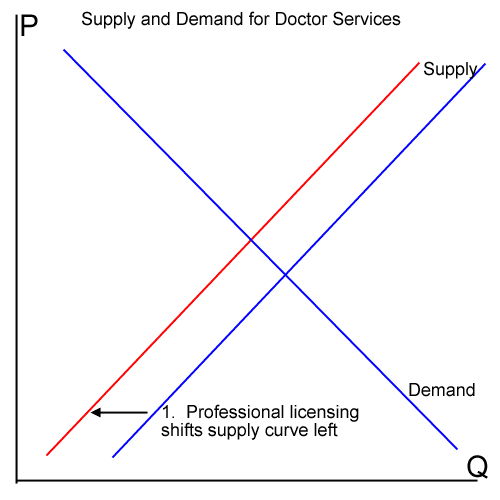
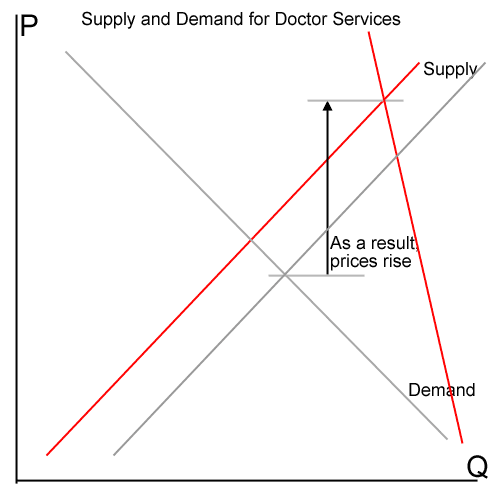
Why does a person need to go to school and residency for a decade to put three stitches in a kid’s cut?  Why do I have to go to a full dentist’s office to get my teeth cleaned?  Why does someone have to go to school for years to tell me my contact lens strength needs to be incremented by another 0.5, when I already knew that and could have just ordered them myself?  The reason is licensing, and it both increases prices by limiting the number of providers and by forcing me to see someone who is often wildly overqualified to handle my problem.

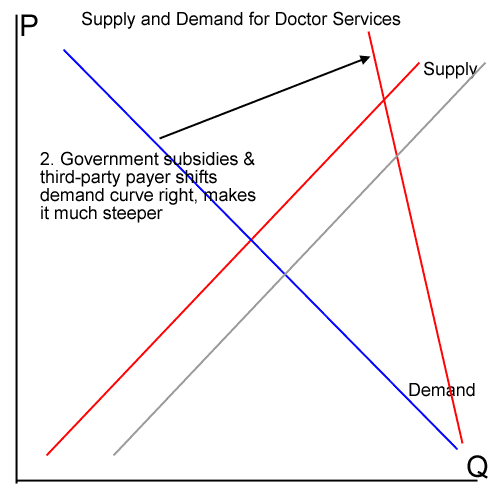
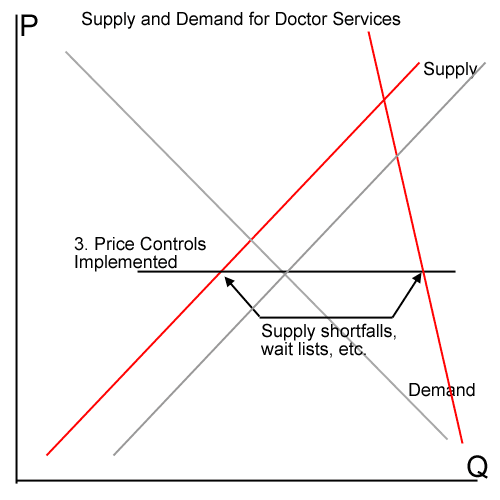
My sense is that this over-licensing for routine functions in medicine is the second largest contributor to costs (the first is the elimination of price-shopping by  making the payor for the services different from the person who receives the services).  But don’t expect the government, long in thrall to the AMA, to do anything about this in any health care “reform”:

bills and amendments died during the Texas legislative session that would have allowed advanced practice nurses to diagnose and to prescribe for common, minor illness and injures without doctor supervision.

You can blame Texas doctors.

Despite better protections from malpractice lawsuits and lower malpractice premiums, Texas has a doctor shortage. Nevertheless, the Texas Medical Association took every step to ensure physicians will have a tight rein on the activities of well-trained nurses.

The barrier against nurses will continue to keep low-fee retail health clinics, such as those operated by Walgreen and CVS drug store chains, from expanding in Texas. The state law requiring doctor supervision adds too much cost to the clinics.

Texas has only about 85 of the 1,200 retail health clinics in the nation. San Antonio does not have a single one. The clinics are popular wherever they exist because nurse practitioners can treat common ailments and minor injuries with little waiting time and fees that average about $60, much less than emergency rooms. The clinics operate evenings and weekends and accept insurance plans.

The clinics would represent real health care reform, especially in Texas. Most of the state, 179 counties out of 254, is classified as medically underserved. Among them are 45 metropolitan counties, including Bexar.  (hat tip:  Carpe Diem)

Postscript: But Coyote, how can you possibly be against licensing of doctors?  You wouldn’t want just anyone doing open heart surgery on you, would you?

No, I wouldn’t, but while AMA licensing is overkill for putting in stitches, it falls short of what I would want for heart surgery, or oncology, or major plastic surgery.  I would not just accept any licensed doctor to do these things – I would do research and get referrals.  I would enforce a higher standard.  And this is why broad licensing is so un-helpful.  It is overkill for certain procedures, but falls short for others.  I guess their may be a Goldilocks application for current licensing (maybe for my GP?) but that is almost an accident.

I don’t oppose third party certifications per se.  I think that in a free society, many groups, such as the AMA (or consumers reports, or the UL, or whoever) could act as certification or review bodies for different medical practices.  And I would very likely as a consumer find such an organization I trust and insist the providers I used for certain procedures be minimally approved by this group.

Another Idea

Apparently, the Obama administration is worried about the shortage of GP physicians.  Personally, I think anything we do within the present framework, or more onerous government interventionist approaches likely to be proposed by Obama, will fail at reversing this problem.  If plumbers were not allowed to contract directly for price and scope of service with individual homeowners they serve, and were forced instead to fill out 23 yards of paperwork just to get paid rates that were set by government bureaucrats, subject to thousands of pages of regulations any one of which could cause his payment request to get rejected, we would have a shortage of plumbers too.

However, since no one in Washington currently seems to be in the mood topromote commercial relationships in medicine that mirror how we contract for every other product and service, I guess we can nibble at the edges of the problem.  David Bernstein suggests:

I have yet to see in any of these articles one simple reform proposed: abolish the requirement of an undergraduate degree before attending medical school, and turn medical school into a five or six-year post-high school program instead. This would eliminate two or three years of debt, and, perhaps even more important, the opportunity costs of two or three years of college. Right now, an aspiring physician must go to college for four years (and take many classes that have nothing to do with his future career), then medical school for four years, and then typically do a poorly paid internship and then residency for another five years. By the time this aspiring physician goes into practice, he will be at least thirty-one years old, and have eight years of student loan debt.

I have a better solution.  Why do we have a one-size-fits-every-corner-of-the-medical-field education and licensing at all?  Why do I need to pay for someone with 8 years of college and five years of residency to put three stitches in my kids’ cut?  Or to write a Viagra scrip?  In dentistry, why do oral hygienists all seem to be in dentists’ offices?  Why do I need to pay the overhead of a dentist to get my teeth cleaned?

We shouldn’t really be surprised, I guess, about this licensing approach — when the government turns over the licensing board to the incumbents of the industry being licensed, they have every incentive to choke off supply and to kill any initiative that might create low-cost competition for themselves.

So the licensing system that is all or nothing — you are either a full-fledged medical doctor that can handle anything, or someone who is allowed to handle nothing.  This is reinforced by the payment system we have, where people do not bear the marginal cost of the services they consume.  So, since every office visit costs them the same (zero or a fixed copay), they might as well ask for the most experienced and over-educated guy they can find — it’s not costing them any extra.

Well, this is true for most people.  I have a high-deductible health insurance policy, and we often consider the price of different alternatives. Here is an example.  I am a healthy person, but still go in for a physical each year.  Nothing complicated happens in these visits.  Surely there could be some kind of less-trained traige MD who could conduct such screenings, passing folks on to the full-fledged doctors if anything unusual pops up.  If you told me that I could be seen by such a person for $100 or a full MD for $300, I would certainly consider it, particularly since the triage guy’s schedule probably runs smoother as he doesn’t get bogged down with the unexpected — he just passes those folks on.

Free Markets, Not Pro-Business

Timothy Carney has a really interesting deconstruction of the US Chamber of Commerce agenda, and it is a good reminder of the forces at work pushing this country towards a corporate state (similar to France and Germany).  When large corporations lobby via the Chamber of Commerce, it is apparently not for low taxes and free markets, but rather targeted interventions and subsidies.  The article does not have a money quote I could find, but this should give you an idea of what the author discovered in the Chamber of Commerce rankings of Congressmen:

On the House side, it’s a similar picture. The Republican with the lowest Chamber score was [Ron] Paul.   Even Rep. Barney Frank, D-MA, who wants to regulate everything except Fannie Mae, scored 14 points higher than Paul on the Chamber’s scorecard.

Suffice it to say a ranking system that has folks like Ron Paul last is not based on free markets and small government.  Apparently, the Chamber marks down Congressmen who did not vote for all the bailout and stimulus packages, did not vote for various alternative energy subsidies, and did not vote to expand college loan subsidies.

The victor of almost any new regulation or licensing program is typically incumbents, and particularly large incumbents.  In my own business, there have been a series of new government regulations added over the years, with the effect that an industry formerly dominated by hundreds of ma and pa operators has consolidated to barely four or five players.  No one else can afford the compliance costs.  Licensing is almost always incumbent protection, and the government even frequently turns over the approval process for new entrants to the current incumbents (e.g. medicine and law).  And subsidies are almost by definition support incumbents over potential new entrants.

Postscript: In terms of incumbent protection, keep an eye on carbon permits.  There will be a ton of pressure to give free or discounted permits to current incumbents, as was done in Europe.  This would be a huge structural barrier to competition, as incumbents can service their current market share for free but new entrants (or expansions of existing entrants) will require expensive new permits.

So We Can’t Have Even One Candidate Who Truly Understands Free Speech

I stand by my no-McCain vow I made years ago after his role in campaign speech limitation.  But Obama does not look like a very promising alternative:

The Obama campaign disputes the accuracy of the advertisement, which is
fine. It has also threatened regulatory retaliation against outlets
that show it, which isn’t fine. Instead of, say, crafting a response
ad, Obama’s team had general counsel Robert F. Bauer send stations a
letter [pdf]
arguing that "Failure to prevent the airing of ‘false and misleading
advertising may be ‘probative of an underlying abdication of licensee
responsibility.’" And, more directly: "For the sake of both FCC
licensing requirements and the public interest, your station should
refuse to continue to air this advertisement."

In particular, I would love to see Obama actually say what positions that are ascribed to him on gun control are false, and what his actual, specific positions are.  A vague, gauzy support for the second amendment does not necessarily mean he has walked away from his earlier positions.  In fact, I am sure that McCain would say he supported the First Amendment but I would certainly feel comfortable pointing out how he fails to do so in the details.

Licensing is Anti-Consumer

Whatever its stated purposes, in reality most professional licensing efforts are mostly aimed at using the power of government to limit new entrants, and thus new competitors, from a certain business:

In Alabama it is illegal to recommend shades of paint without a
license.  In Nevada it is illegal to move any large piece of furniture
for purposes of design without a license.  In fact, hundreds of people
have been prosecuted in Alabama and Nevada for practicing "interior
design" without a license.  Getting a license is no easy task,
typically requiring at least 4 years of education and 2 years of
apprenticeship. Why do we need licenses laws for interior designers?
According to the American Society of Interior Designers (ASID) because,

Every decision an interior designer makes in one way or another affects the health, safety, and welfare of the public.

This hardly passes the laugh test.  Moreover as Carpenter and Ross point out in an excellent article in Regulation from which I have drawn:

In
more than 30 years of advocating for regulation, the ASID and its ilk
have yet to identify a single documented incident resulting in harm to
anyone from the unlicensed practice of interior design…These laws
simply have nothing to do with protecting the public.

As always on this topic, I end with a quote from Milton Friedman on licensing:

The justification offered is always the same: to protect the consumer. However, the reason
is demonstrated by observing who lobbies at the state legislature for
the imposition or strengthening of licensure. The lobbyists are
invariably representatives of the occupation in question rather than of
the customers. True enough, plumbers presumably know better than anyone
else what their customers need to be protected against. However, it is
hard to regard altruistic concern for their customers as the primary
motive behind their determined efforts to get legal power to decide who
may be a plumber.

Update:  This is timely, as 1-800-CONTACTS has informed me that due to various state and federal laws, they may not sell me the contact lenses any more that I have been purchasing from them for a year.  I must go into an office and pay a government-licensed eye doctor to get an updated prescription.  This is despite the fact that, once sized, contact lens strengths are easy to understand.  Every year or so my eyes go up by about 0.5.  I could easily get by still with my old contacts, or I could, if I wanted, self-medicate by adding 0.5 (the minimum step at my level of vision) to each eye and testing to see if this new setting was any better.  This is exactly how people buy reading glasses (or pants, or shoes), by simple trial and error in the store.  But I can’t do this with my contact lenses — or actually I do exactly this, but can only do it in a doctor’s office, paying the government mandated annual toll to get my prescription updated.

Yes, I know, there are all kinds of fabulous reasons to go to the eye doctor each year, to test for glaucoma and other stuff.  But why shouldn’t that be my choice?  The government doesn’t force people with good vision to go to the eye doctor for such tests each year, only those of us with bad vision.  The only analogy I can come up with would be having to go to your physician each year to get your shoe size validated before you could buy shoes for the coming year.  After all, I am sure there are substantial health and safety issues with wearing poorly-fitted shoes.

Regulation and Incumbents

One of the most prevelent misconceptions about the political economy is the assumption that business universally opposes government licensing and regulation.  Often this misconception manifests itself as someone making a statement like, "Even [name of large competitor in the industry to be regulated] supports the proposed regulation so what are you libertarians complaining about."

In fact, regulation tends to protect incumbents at the expense of new entrants or new business models.  Large competitors can pass on the costs of regulation to customers, but new entrants have substantial investments to make just to build the systems and knowledge for compliance.  Perhaps worse, regulation like licensing tends to lock in current business models, by making current business practices part and parcel of becoming licensed.

For these reasons, I am excited by the book In Restraint of Trade by Butler Shaffer:

This extremely important study by Butler Shaffer–professor of law
and economist–will change the way you think of the relationship
between the state and business. It makes a deep inquiry into the
attitudes of business leaders toward competition during the years 1918
through 1938 to see how those attitudes were translated into proposals
for controlling competition, through political machinery under the
direction of trade associations.

What he finds is a business sector not only hostile to free markets
but aggressively in favor of restrictions that would protect their
interests. This, he finds, is the very source of the origins and
development of the regulatory state.

The author chooses this period because it was a time when the entire
relationship between American business and the federal government
underwent dramatic upheaval. It was in this time that business forged a
consensus about the scope and intensity of competition behavior that
they would tolerate. This began to exhibit a disposition favoring
collectivist authority over one another via government-backed
enforcement agencies.

Free and unrestrained competition required more of them than they
were willing to tolerate. It required constant innovation, a fight
against falling prices, a continued effort to seek out new markets, and
the willingness to subject their bottom line to consumer preferences
for lower prices and better products. They saw the vibrancy of free
enterprise as a threat to their firms and well being, so they used
anti-business sentiment in politics to hamper the market in ways that
would benefit them….

If you ever thought that the struggle for free enterprise was about
business versus government, this study, which is written in exciting
prose and beautiful English, will change the way you understand the
essential struggle. The evidence is vast that big business cooperated
closely with big government in building the essential architecture of
the mixed economy.

Presidents and the Economy

There is very little that can make me go non-linear faster than when someone attributes economic growth to a politician, e.g. Reagan’s economy or Clinton’s economy.  So this post from Kevin Drum on the correlation between economic growth and the flavor of president in the Oval Office is just the kind of thing to make me lose it.  And not because I really care whether Team Coke or Team Pepsi looks better.

Larry Bartels says that Democratic presidents produce higher economic
growth than Republican presidents, and that the differences in average
growth rates for middle-class and poor families (but not affluent
families, apparently, who do well under both parties) are statistically
significant by conventional social-scientific standards.

OK, I have seen the analysis done different ways and accept the statistical conclusion.  You used to be able to get a really tight correlation between Washington Redskin football team performance and presidential election outcomes (via Snopes):

Sometimes one natural phenomenon supposedly
forecasts another, as in the belief that a groundhog‘s
seeing his shadow on February 2 portends another six weeks of
winter. In other instances the linkage is between affairs of mankind, as in the
superstition that the winner of football’s Super
Bowl
augurs that year’s stock market performance (or vice-versa).

A recent item of this ilk maintains that the results of the last game
played at home by the NFL’s Washington Redskins (a football team based in
the national capital, Washington, D.C.) before the U.S.
presidential
elections has accurately foretold the winner of the last
fifteen of those political contests, going back to 1944. If the Redskins win
their last home game before the election, the party that occupies the White
House continues to hold it; if the Redskins lose that last home game, the
challenging party’s candidate unseats the incumbent president. While we don’t
presume there is anything more than a random correlation between these factors,
it is the case that the pattern held true even longer than claimed, stretching
back over seventeen presidential elections since 1936

What gets me is not the existence of a correlation, but the explanation:

In recent decades taxes and transfers have probably been more
important. Social spending. Business regulation or lack thereof. And
don’t forget the minimum wage. Over the past 60 years, the real value
of the minimum wage has increased by 16 cents per year under Democratic
presidents and declined by 6 cents per year under Republican
presidents; that’s a 3% difference in average income growth for minimum
wage workers, with ramifications for many more workers higher up the
wage scale. So, while I don’t pretend to understand all the ways in
which presidents’ policy choices shape the income distribution, I see
little reason to doubt that the effects are real and substantial.

I have three thoughts, of which the third is what really gets me:

  • It is funny that no one considers that this correlation may work in reverse.  Everyone assumes government drives short-term economic performance.  What if, to some extent, short-term economic performance drives changes in government?  If one assumes that, even without the public spirited and Herculean efforts of our presidents, economies are naturally cyclical, then why try to explain cycles on politics when we know cycles are going to exist anyway.  Why wouldn’t a perfectly valid alternate explanation be that one political party tends to be elected if the economy is in one part of the cycle and the other gets elected if the economy is in another place?
  • The political brand names "Republican" and "Democrat" shift in meaning over time vis a vis economic policy recommendations, and individual presidents can diverge quite a ways from their party center line.  One can easily argue that Nixon was the most interventionist and economically ignorant president (think:  wage and price controls), despite the "Republican" brand name.  John Kennedy was more laissez faire than most Republicans are today.   Regulation, as measured by pages added to Federal Register, increased at a far faster pace under George Bush (I) than Bill Clinton.  Bill Clinton passed free market legislation, including NAFTA, that John McCain shys away from today, while George Bush passed an expansion of Medicare that Bill Clinton did not consider.  Oh, and when we discuss regulation and such, Congress sortof matter too.
  • The author’s argument boils down to "the more governors and useless loads we add to an engine, the more strongly the engine will run."  It is just absurd.  None of these guys have the first clue what it takes to run a business day to day, nor how much of a business owner’s time and effort is aimed not at service customers better, and not at being more productive, and not at making employees happier or better trainined, but at responding to the latest mass of government regulation, paperwork, liscensing, taxes, and other total crap.  Here is just one example I wrote up about what sits on my desk.

To this last point, take just two things on my desk this morning.  The first is a pile of tax returns and some licensing paperwork.  Last year, our company’s total tax bill was not that large.  But the problem is that the government takes the taxes in so many bites, and every bite costs time on our part learning the process and filling out paperwork.  For example, if I take all the taxes and licensing fees we pay to federal, local, and state governments, and multiply times the number of months or quarters each requires a report, I get a number of over 400.  Four hundred individual bites, each with its own paperwork and overhead.

The other problem sitting on my desk is a snack bar I inherited on a lease in California at Lake Piru.  The snack bar is a dump.  It is designed wrong, it is set up to cook the wrong kinds of foods, and uses space in the building very inefficiently.  I want to lay the whole thing out differently, as a win-win for everyone.  We could sell more with fewer workers.  The customers would get more selection, including much healthier choices.  The operation would be safer, because we would eliminate most of the heavy cooking  (e.g. deep fat fryers).  And it would be cleaner, with less wastewater and cleaner wastewater because there would be less grease and oil.

Unfortunately, it is very clear that Ventura County, California is not going to allow me to make these changes, at least at any cost I can afford.  First, apparently I need to build a new wastewater treatment plant for the snack bar!  But I am reducing the waste water load, I argue.  Does not matter.  New code requires a plant.  So because of this environmental code, I am pushed to continue the current operation which is environmentally worse than my proposed alternative.  We have the exact same problem on fire suppression.  But I am removing the ovens and most of the cooking equipment!  It’s safer!  Doesn’t matter, if I make any change at all, I have to install a new fire suppression system.  And on and on.  this is the true face of government regulation.  We face this kind of thing ten times a day.   

Anyway, I could go on and on about this stuff, but that is what the blog is about, so I will refer you to my past (and future) posts.

Fighting the Competition, One Legislature at a Time

Thanks to an email from a reader, comes this bizarre but all-too-common tale of an industry group supporting licensing to protect itself from competition:

Imagine you were a state legislator and some folks
asked you to pass a law making it a crime to give advice about paint
colors and throw pillows without a license. And imagine they told you
that the only people qualified to place large pieces of furniture in a
room are those who have gotten a college degree in interior design,
completed a two-year apprenticeship, and passed a national licensing
exam. And by the way, it is criminally misleading for people who
practice interior design to use that term without government permission.

You might stare at them incredulously for a moment,
then look down at your calendar and say, "Oh, I get it — April Fool!"
Right? Wrong.

These folks represent the American Society of Interior
Designers (ASID), an industry group whose members have waged a 30-year,
multimillion-dollar lobbying campaign to legislate their competitors
out of business. And those absurd restrictions on advice about paint
selection, throw pillows and furniture placement represent the actual
fruits of lobbying in places like Alabama, Nevada and Illinois, where
ASID and its local affiliates have peddled their snake-oil mantra that
"Every decision an interior designer makes affects life safety and
quality of life."

Legislative analysis by a half-dozen states that
rebuffed ASID’s attempts to cartelize interior design — including
Colorado, Washington and South Carolina — has failed to support ASID’s
claim that the location of your couch or the color of your bedroom
walls is literally a matter of life and death. As the Colorado
Department of Regulatory Agencies put it, there is "no evidence of
physical or financial harm being caused to . . . consumers by the
unregulated practice of interior designers."

I am not sure this even needs comment.  I traditionally end my posts on licensing with this Milton Friedman quote:

The justification offered is always the same: to protect the consumer. However, the reason
is demonstrated by observing who lobbies at the state legislature for
the imposition or strengthening of licensure. The lobbyists are
invariably representatives of the occupation in question rather than of
the customers. True enough, plumbers presumably know better than anyone
else what their customers need to be protected against. However, it is
hard to regard altruistic concern for their customers as the primary
motive behind their determined efforts to get legal power to decide who
may be a plumber.

Many other posts in the same vein here

The Consumers are Saved!

I could probably start a blog just featuring ridiculous government licensing practices.  As I have written before, licensing generally has little to do with the consumer, and more to do with protecting current incumbents from competition.  Via Radley Balko, this is one of the uglier examples I have seen of late:

Mary Jo Pletz was really, really good at eBay. But now the former
stay-at-home mother and gonzo Internet retailer fears a maximum $10
million fine for selling 10,000 toys, antiques, videos, sports
memorabilia, books, tools and infant clothes on eBay without an
auctioneer’s license.

An official from the Department of State knocked on Pletz’s
white-brick ranch here north of Allentown in late December 2006 and
said her Internet business, D&J Virtual Consignment, was being
investigated for violating state laws….

The 33-year-old opened her Internet business in 2004 so she could
stay home with her 6-month-old daughter, Julia, who was diagnosed with
a hypothalamic hamartoma brain tumor.

She cooperated when told it was illegal and works at dental offices
in Allentown, Bethlehem and Lehighton as a hygienist to help pay the
bills at home. Julia, whose health stabilized on medication, is
enrolled in day care. Pletz also has a son, Douglas, 7.

But the state has not dropped prosecution. It sent Pletz a complaint in
April and an amended complaint in December. The complaint says she
could be fined $1,000 for each violation of the state law. The April
complaint noted 10,000 sales. Pletz and her attorney, Joseph V. Sebelin
Jr. of Palmerton, did the math – $10 million in possible fines. The
second complaint does not list a number….

Because of the complaint, Pletz worries the state also could revoke
her dental hygienist’s license, which she earned by attending community
college for seven years at night.

"I really wish that they will walk away from that one and prosecute
somebody else," said State Rep. Michael Sturla (D., Lancaster), who is
chairman of the House Professional Licensure Committee. "There is every
reason in the world that if she is found guilty, she should be
exonerated," he said.

This latter is the most outrageous of all, and it is a line taken by a number of public officials — that the concept of prosecuting people who are selling things on eBay is just fine, but they should not have started with someone who has less sympathetic.  Maybe Exxon has an eBay arm.

Sturla has proposed the bill to create the electronic auctioneer’s
license. The license would require the Internet seller to buy a $5,000
bond for about $40 a year. This would protect consumers, he said.

Bull.  This would protect competitors.  eBay has numerous controls in place to identify problem sellers.

D&J Virtual Consignment had 11,000 feedback comments on eBay
and 14 were negative, Pletz said, giving her a 99.9 percent
satisfaction rating.

I can say from experience that for some reason they must teach this in
government school — when in doubt, make service businesses get a
bond.

This is not unique – Ohio tried to do the same thing.  But why is a person who sells on eBay an auctioneer at all?  Isn’t eBay the auctioneer?  If I turn my stuff over to Christies to auction off, setting a reserve price in advance and having them take a sales commission, how is that any different than putting the same stuff on eBay.  In Ms. Pletz case, eBay is earning the auction commission.  She is just taking a retail margin.

The New Energy Bill

If you want to have mood lighting in your house that dims and doesn’t turn everything a weird color, then go out and stock up on light bulbs today because the new energy bill just passed**.  I have already blogged plenty about the stupid stuff in this bill, but apparently Kevin Drum thinks its a good step.  I don’t see how anyone of any political stripe can see this as a good bill.  Its just stupid in so many ways.  Yes, I understand as a libertarian, my energy bill would look like:

  1. get out of the way

But I can for a moment place myself in a position where I would imagine being worried about CO2 and dependence on fossil fuels.  For someone who really cares about these things, here is what a rational energy plan would look like:

  1. large federal carbon tax, offset by reduction in income and/or payroll taxes
  2. streamlined program for licensing new nuclear reactors
  3. get out of the way

** I personally have replaced most of the bulbs in my house, out of rational economic self-interest, with CF bulbs.  However, there are about 6 where CF’s just won’t do the job I need and about 6 more (3 above my shower and 3 outside) where current CF bulbs do not hold up to the moisture.   The desire by government to micro-manage me into using an inferior solution for these 12 locations is the same compulsion that has led to my not having a single toilet in my house that works  (the shower also sucked too until I figured out how to remove the government-mandated flow restricter from the shower head).

I Called This One

I made this prediction way back in February of 2005:

I resisted the call by a number of web sites at the beginning of the
year to make predictions for 2005.  However, now I will make one:  We
will soon see calls to bring a tighter licensing or credentialing
system for journalists, similar to what we see for lawyers, doctors,
teachers, and, god help us, for beauticians
.  The proposals will be
nominally justified by improving ethics or similar laudable things,
but, like most credentialing systems, will be aimed not at those on the
inside but those on the outside.  At one time or another, teachers,
massage therapists, and hairdressers have all used licensing or
credentialing as a way to fight competition from upstart competitors,
often ones with new business models who don’t have the same
trade-specific educational degrees the insiders have….

Such credentialing can provide a powerful comeback for industry insiders under attack.  Teachers, for example, use it every chance they get to attack home schooling and private schools,
despite the fact that uncertified teachers in both these latter
environments do better than the average certified teacher (for example,
kids home schooled by moms who dropped out of high school performed at
the 83rd percentile).  So, next time the MSM is under attack from the blogosphere, rather than address the issues, they can say that that guy in Tennessee is just a college professor and isn’t even a licensed journalist.

So here we go, here are a few recent such calls for licensing of journalists.  The first via Hot Air:

Supporters of “citizen journalism” argue it provides independent,
accurate, reliable information that the traditional media don’t
provide. While it has its place, the reality is it really isn’t
journalism at all, and it opens up information flow to the strong
probability of fraud and abuse. The news industry should find some way
to monitor and regulate this new trend….

The premise of citizen journalism is that regular people can now
collect information and pictures with video cameras and cellphones, and
distribute words and images over the Internet. Advocates argue that the
acts of collecting and distributing makes these people “journalists.”
This is like saying someone who carries a scalpel is a “citizen
surgeon” or someone who can read a law book is a “citizen lawyer.”
Tools are merely that. Education, skill and standards are really what
make people into trusted professionals. Information without
journalistic standards is called gossip.

But that one is downright sane compared to this, from Cleveland’s Voice for Social Justice (have you noticed how "social justice" always seems to require forcefully silencing people?):

For every champion of journalism who write stories about Walter Reed or
Extraordinary Rendition Flights, there are two reporters at Channel 19
who care very little about society. For every Seymore Hersh there are five Michelle Malkins or Ann Coulters.   With citizen journalists spreading like wildfire in blogs, we seem to have one Froomkin created, there are five extremist blogs proclaiming the assaults on homeless people everyday….

The Society of Professional Journalists must start licensing
journalists or the government will start doing it for them. We need to
start taking this practice seriously and separate the real journalists
from the fakes. The decisions made by journalists have consequences for
ruining people’s lives or for causing grief, suicide or even murder.
The genocide in Rhwanda were carried out using the radio commentators
to urge citizens to kill Tutsis. If journalists want to be taken
seriously they must figure out how to separate the real from the
O’Reilly types. They must set up a structure to license journalists
with an enforcement mechanism to strip bad journalists from practicing
their craft.

This is from the weblog of a bunch of media students:

It scares me to think that the field I will going pursuing when I
graduate might be confused with entertainment reporting – things like
“Who Ben Affleck is dating now” and “Will Brad and Jen get back
together.” Certainly, these things are news to a select few. I will
not, however, get into the whole tabloid issue. I seems to have sparked
some intense debate with that one a few weeks ago. But, I am worried
that with the onslaught of weblogs and internet news, many readers and
listeners will get confused and think what they’re reading and watching
is actually news. I have nothing against web loggers, even though they
are a threat to my future career. But, all of this leads me to question
the professionalism of journalism.

Should we license journalists? This has been a question that has
been debated back and forth for awhile. Many journalists are against
the idea because they believe that that would mean licensing
information and licensing free speech. But I think we need to look at
the issues at hand right now. The news is getting out-of-hand. The
public is being onslaught with an enormous amount of information due to
our increasing rush of technology and it has to be hard for them to
differentiate between real news and opinions being costumed as news.
This is why we need to start seriously considering licensing
journalists. It may be the only real hope for the future of
journalists. With licenses, we can hold on to whatever ethical and
moral characteristics we have left in the news business. There will be
no more “parading reporters” and no more “video news releases.” Who
thinks we should pursue this? Who thinks the entire idea is ridiculous?

Some countries are seriously considering it.  Brazil and Indonesia are looking into licensing their journalists.  Here’s an article
from Indonesia – even though it’s agaist thh idea of licensing it’s
still a good example of how serious this debate is becoming

Its good we are taking lessons on free speech and the media from Indonesia and Brazil.  I probably should not make fun of the typos and grammar errors in this post by a "media student" since I make such mistakes all the time.  Of course, I am not a "licensed journalist."

This is not a new issue.  In the early 1980′s, the US vigorously resisted attempts by the UN to implement a variety of euphemisms that boiled down to licensing requirements for international journalists.

Bloggers are Tehwable

Sports columnist Stephen A. Smith fires off an over-the-top rant at bloggers:

"And when you look at the internet business, what’s dangerous about it
is that people who are clearly unqualified get to disseminate their
piece to the masses. I respect the journalism industry, and the fact of
the matter is …someone with no training should not be allowed to have
any kind of format whatsoever to disseminate to the masses to the level
which they can. They are not trained. Not experts."

Despite its wackiness, we can still draw some useful observations:

  • Yet again, we have an industry incumbent calling for some sort of professional licensing, nominally to protect consumers, but in actuality to protect the incumbent’s position in the industry.  Smith himself couldn’t be more explicit about this:

"Therefore, there’s a total disregard, a level of wrecklessness that
ends up being a domino effect. And the people who suffer are the common
viewers out there and, more importantly, those in the industry who
haven’t been fortunate to get a radio or television deal and only rely
on the written word. And now they’ve been sabotaged. Not because of me.
Or like me. But because of the industry or the world has allowed the
average joe to resemble a professional without any credentials
whatsoever."

He can’t even complete the sentence with the window dressing justification that this is for the consumers before he gets to the real people he is trying to protect, ie traditional media personalities like himself.  You know, trained professionals.   You could subsititute attorneys, doctors, nurses, real estate agents, funeral directors, massage therapists, hair braiders, fishing guides and any other licensed or unionized professional and find the same speech given somewhere at some time.

  • People called me crazy when I said that the next step in the media wars with bloggers was a call for licensing (and here) Whose crazy now?
  • McCain-Feingold sent us a long way down this horrible path by establishing that there are such things as "journalists" who can be trusted to speak in public before elections, and everyone else, who cannot be so trusted.  This was the first time the debate over whether bloggers are journalists turned heated, because there was a legislated cost associated with not being a journalist.
  • Note the implicit disdain for the consumer, or in this case, the viewer or reader.  The unstated assumption is that the consumer is a total idiot, a dupe who mindlessly keeps tuning in to inferior news reports from untrained bloggers rather than watching pros like Stephen A. Smith as they should be
  • Finally, and this may be unfair because I am only partially familiar with Mr. Smith’s work, but I will observe that he is an African-American who brings a kind of street style to his reporting.  A style that I might guess that a crotchety sports reporter from thirty years ago might easily have defined then as unprofessional.  Mr. Smith’s career has benefited in part because he has differentiated himself with new style and approach, but now he wants to slam the door on others trying to similarly bring innovation and new approaches to the sports world.  Unfortunately, all too typical of professionals of all stripes, particularly since the government has set the expectation over the last 100 years that it is open to using its coercive power to enforcing professional standards in even the most trivial of professions.

I end such a discussion, as always, with Milton Friedman:

The justification offered [for licensing] is always the same: to protect the consumer. However, the reason
is demonstrated by observing who lobbies at the state legislature for
the imposition or strengthening of licensure. The lobbyists are
invariably representatives of the occupation in question rather than of
the customers. True enough, plumbers presumably know better than anyone
else what their customers need to be protected against. However, it is
hard to regard altruistic concern for their customers as the primary
motive behind their determined efforts to get legal power to decide who
may be a plumber.

Licensing Update

Awesome!  Via TJIC:

Ten minutes after finding out I passed the Bar, I changed my
long-running position on licensure, which it turns out is awesome. Not
only does it allow me to collect above market rents–which lawyers need
because law school is so damned expensive–but it also keeps those who
can’t afford law school or Barbri from practicing law. This is good
because poor people make bad choices anyway, and I know that because
one week in college I ate Ramen noodles for a week, and that’s the week
I decided to major in music. Also your average poor person, usually
cursed with some manner of hump or undeveloped siamese twin, will not
fit into a decent suit…

In sum, remember when choosing a lawyer that I was the first
one to finish the New York Bar exam, and though I probably didn’t get
the highest score, I got the not-highest score the fastest. So if
you’ve got the choice between an attorney who will show up at 7 AM
sharp, with an obviously freshly dry-cleaned suit, and me, who will be
jogging fifteen minutes behind him while pulling on a shirt and
cleaning up some stubble with an electric razor, remember: the other
guy’s smarter, of course, but I’m still competent. And a lot better
rested. Plus I’m not going to judge you for running that red light and
hitting that old lady–that’s what this case is about, right? Or was
that my other client?–because chances are I nailed two or three myself
on the way over this morning.

More on licensing

Government Limitations on Choice

I am a little late on this, but Ilya Somin has a nice post on Joel Waldfogel’s book on capitalism and serving niche markets. 

University of Pennsylvania business Professor Joel Waldfogel argues that markets give us too few choices because
they often fail to provide products that satisfy minority preferences.
This is the opposite of Barry Schwartz’s argument that markets are bad
because they give people too many choices, which I criticized here.
In one sense, Waldfogel’s point is irrefutable: due to high startup
costs or fixed costs and just to the general scarcity of resources in
the world, there are some minority preferences that the market won’t
satisfy. The market is undoubtedly inferior to a hypothetical world in
which all preferences, no matter how unusual, could be satisfied at
zero cost. Not even the most hard-core of libertarian thinkers denies
this. That, however, says little about the question of whether
government could satisfy such minority preferences better, or whether
it is even a good thing to provide products whose costs are greater
than their benefits.

He makes a number of good points, including the one that first comes to my mind — that in most cases, it is the government that tends to limit choice.

the relative lack of diversity of programming on radio stations – one
of Waldfogel’s principle examples of the inability of the market to
satisfy minority interests – is actually a failure of government
regulation. As Jesse Walker documents in this book,
the FCC has for decades colluded with big broadcasters in suppressing
alternative and "microradio" broadcasters, thereby greatly reducing the
number of stations and making it very difficult to run a station that
caters primarily to the interests of a small minority. Even a
completely free broadcasting market would not satisfy all potential
listeners. But it would have a great deal more diversity than is
currently permitted by the FCC.

I called for the end of broadcast licensing here.  By the way, the author also ignores Sirius and XM, which have some incredibly niche offerings, and which happen to be in the least regulated part of broadcasting.  Why Sirius would have more niche choices than Clear Channel is explained here.

I could add many other examples onto this.  The FCC’s regulation of the cell phone market creates the stupid environment we have today, arguing about locked iPhones.  In a previous post, I demonstrated how new government "a la carte pricing’ regulation will lead to more homogenization and less focus on niche viewing audiences in the cable TV industry:

I can add a million examples.  Hair braiders are stepped on by the government in collusion with licensed beauticians.  Taxi companies get the government to quash low-cost or innovative shuttle transportation.  Discount casket companies are banned by government in collusion with undertakers.  Take dentistry.  Why do I need to go to an expensive dentist when 99% of my dental needs could be served by a hygienist alone?  Because the government colludes with dentists to make it so.  And don’t even get me started on medicine.  My guess is a huge percentage of the conditions people come into emergency rooms with are treatable by someone without a 4 year medical degree and 6 years of internship.  Does one really need a full medical education to stitch up a kids cut knee?  Well, yes, you do today, because doctors collude with the government to make it so.  Why can’t people specialize, with less than 10 years of education, on just, say, setting bones and closing cuts?  Why can’t someone specialize in simple wills or divorces without a full law degree?

Every business where the government has licensing is an industry where the government is limiting consumer choice.  It is limiting the number of competitors, and it is specifying a narrow subset of ways in which a company can compete, eliminating service or product innovation.  In Colorado, my employees needs a license to take our customers fishing on a lake.  In Phoenix, you need a license to paint street numbers on a curb.  In Scottsdale you need a license to work out of your own home, a license to valet park cars, and a license to give massages.  And, of course, there are our tremendously dated liquor licensing laws.

Per Milton Friedman:

The justification offered is always the same: to protect the consumer. However, the reason
is demonstrated by observing who lobbies at the state legislature for
the imposition or strengthening of licensure. The lobbyists are
invariably representatives of the occupation in question rather than of
the customers. True enough, plumbers presumably know better than anyone
else what their customers need to be protected against. However, it is
hard to regard altruistic concern for their customers as the primary
motive behind their determined efforts to get legal power to decide who
may be a plumber.

Update:  Just for fun, I sat here and came up with 10 business ideas that would provide better service for customers, would reduce costs in notoriously high cost industries (e.g. medicine, dentistry, law) and which would make me a pile of money. which are all illegal due to licensing requirements that are set in collusion with current industry incumbents.

Gas Pricing Thought for the Day

Today I was working on a bid for a retail concession in a county park in California.  In these bids we usually promise a set percentage of sales as rent in exchange for the concession and use of certain fixed assets.  One of our standard clauses is to exempt gasoline sales (if there are any) from this rent calculation, because gas sales are so horribly low margin.  Considering the licensing, environmental, and safety issues, gasoline is always a money loser for us that we offer either a) because it is expected, as in the case at large marinas or b) because it gets people in the door to buy other stuff.  And I sell gas in rural areas where I have less price competition than in cities.

It is for this reason that I am always flabbergasted at how much time and attention the government and media tend to pay to retail gasoline pricing.  The portion of my business that is clearly the worst, most unprofitable piece, so much so I have to make special contract provisions for it, gets all the attention for price gouging.   It’s like the FEC dedicating most of its labor to investigating Mike Gravel’s campaign donations.  I mean, why bother, there’s nothing there.

Internet Radio Day of Silence

I found this when I went to Pandora today (one of those applications that makes the Internet so entirely cool and worth all the spam and flame wars).  I found this message:

Hi, it’s Tim from Pandora,

I’m sorry to say that
today Pandora, along with most Internet radio sites, is going off the
air in observance of a Day Of Silence. We are doing this to bring to
your attention a disastrous turn of events that threatens the existence
of Pandora and all of internet radio. We need your help.

Ignoring all rationality and responding only to the
lobbying of the RIAA, an arbitration committee in Washington DC has
drastically increased the licensing fees Internet radio sites must pay
to stream songs. Pandora’s fees will triple, and are retroactive for
eighteen months! Left unchanged by Congress, every day will be like
today as internet radio sites start shutting down and the music dies.

A bill called the "Internet Radio Equality Act" has already
been introduced in both the Senate (S. 1353) and House of
Representatives (H.R. 2060) to fix the problem and save Internet
radio–and Pandora–from obliteration.

I’d like to ask you to call your Congressional
representatives today and ask them to become co-sponsors of the bill.
It will only take a few minutes and you can find your Congresspersons and their phone numbers by entering your zip code here.

Your opinion matters to your representatives – so please take just a minute to call.

Visit www.savenetradio.org to continue following the fight to Save Internet Radio.

As always, and now more than ever, thank you for your support.


  -Tim Westergren
  (Pandora founder)

Licensing Protects Incumbents, Not Consumers

Scott Gustafson’s Arizona Economics blog points to another example of a local regulatory body, in this case the Structural Pest Commission, bravely protecting incumbent competitors from new competition.  As background, you should know that though we don’t have nearly as many pests as most places, the ones we do have (e.g. scorpions) are essentially unkillable with legal chemical technologies.  The best you can hope for is to tighten up your hose to keep them out.  And we have these lovely rodents called roof rats, sort of like squirrels on steroids who are not cute, who like to come in and take up residence in attics and walls.   So a lot of pest control here is about putting up screens over vents and setting traps rather than spraying chemicals.

As retirees go, Rich Hanley seems like a decent enough guy. He’s a former cop who came to town a few years ago. He obeys the law. He pays his taxes. In 2004, he started up a little business, repelling roof rats.
 

Specifically, he covers vents with steel mesh so the little fellas can’t come calling. 

Once, we would have applauded such enterprise. Now, we issue cease-and-desist orders. 

Yep, it’s true. My favorite state bureaucrats over at the Structural Pest Control Commission have decided that Hanley has violated the law… 

"The problem is his advertising," says Lisa Gervase, executive director of the agency… 

The pest-control cops launched a seven-week probe, concluding that Hanley can do the work. He just can’t tell people why he’s doing the work. Thus, his sales pitch – "Keep birds and rodents from invading your home" – has to go. 

Gervase said the state would have no problem if Hanley says he’s covering vents to keep leaves out. "But if he’s advertising that he can keep pests from invading your home, that’s pest control, and you need a license for pest control."

Its nice, I guess, when you trade group can get the government to use its coercive power to do you work for you.  Much more on licensing as anti-competitive behavior rather than consumer protection.

No Free Stuff For Our Consumers!

Arizona is taking another typical step to protect incumbent businesses against new competitors:

"Arizona regulators have ordered a Seattle-based online home price estimator to stop doing business in the state." Zillow.com
has won wide popularity by applying algorithms to publicly available
data to come with rough estimates of the value of existing homes, which
it makes available for free through its site. The Arizona Board of
Appraisal says that Zillow should not be dispensing such information
without an appraiser’s license.

Gee, we’d hate to give people the impression that a whole profession could be replaced by a few computer algorithms and some data base lookups.   I am not sure why, historically, but state governments have an incredible propensity to protect everyone in the real estate field from competition.  For years they have enforced licensing on real estate agents to help support that cartel that the Internet is only just now starting to break up.

By the way, here is another way you could write the headline for this news:  "Arizona Bans Giveaways.  Consumers Must Pay for Everything."  Oh, and my neighbor just sold his house.  The final price he got was within 4% of the Zillow estimate.  I will say that from the houses I am familiar with, they do a pretty good job (though I am sure they make mistakes, for example in neighborhoods with a lot of gentrification and a mix of old and new homes). 

A Step Forward? Or Just Sideways?

A Judge has ruled that the Kaleidescape movie server (basically a big box that rips and stores DVDs on hard disk) did not violate its licensing agreement with the DVD-CCA:

Kaleidescape argued, first and foremost, that nothing in the DVD-CCA
licensing agreement prohibits the development of products that allow
users to copy their DVDs.

Indeed, that’s exactly what Judge Leslie C. Nichols ruled today in
the non-jury trial at the Downtown Superior Court of Santa Clara in San
Jose, Calif. There was no breach of contract.

That seems to be good news for those of us who like the server concept and would like to make copies of our DVDs for our own (fair) use.  However, the judge seems to have sidestepped the copyright and fair use issues, such that this ruling probably will turn out to be pretty narrow and not constitute a useful precedent.

Because of this ruling, the Judge did not have to get into copyright
issues, so the Kaleidescape ruling has no copyright implications. It is
not a statement on the legality of ripping DVDs.

There was the possibility that copyright issues could have come into
play. The DVD-CCA submitted to the Court a particular document, the
"CSS General Specifications," that it asserted was part of the
licensing agreement.

The CSS General Specifications document includes wording about
thwarting the "unauthorized copying" of DVD’s. The issue of what
constitutes an unauthorized copy could have come up, but Judge Nichols
ruled that the document in fact is not part of the DVD-CCA licensing
agreement.

I Was Sortof Right

A couple of years ago I made this prediction:

We will soon see calls to bring a tighter licensing or
credentialing system for journalists, similar to what we see for
lawyers, doctors, teachers, and, god help us, for beauticians
.  The
proposals will be nominally justified by improving ethics or similar
laudable things, but, like most credentialing systems, will be aimed
not at those on the inside but those on the outside.  At one time or
another, teachers, massage therapists, and hairdressers have all used
licensing or credentialing as a way to fight competition from upstart
competitors, often ones with new business models who don’t have the
same trade-specific educational degrees the insiders have….

Such credentialing can provide a powerful comeback for industry insiders under attack.  Teachers, for example, use it every chance they get to attack home schooling and private schools,
despite the fact that uncertified teachers in both these latter
environments do better than the average certified teacher (for example,
kids home schooled by moms who dropped out of high school performed at
the 83rd percentile).  So, next time the MSM is under attack from the blogosphere, rather than address the issues, they can say that that guy in Tennessee is just a college professor and isn’t even a licensed journalist.

Well, despite all efforts by John McCain, we still have free speech on the blogosphere.  But I was almost right, because another country is considering such a proposal — In France:

The government has also proposed a certification system for Web sites,
blog hosters, mobile-phone operators and Internet service providers,
identifying them as government-approved sources of information if they
adhere to certain rules. The journalists’ organization Reporters
Without Borders, which campaigns for a free press, has warned that such
a system could lead to excessive self censorship as organizations
worried about losing their certification suppress certain stories.

NFL Tightens the Screws

As most people know, the NFL doesn’t want you to use the word "Superbowl" when hosting a party, sale, event, etc, and they aggressively enforce their trademark on this term.  In response, since all the country does in fact have parties, sales, events, etc. associated with the Superbowl, folks have adopted the euphemism ‘the big game" in their communications. 

I observed that this not only pointed out some of the silliness in our intellectual property laws, but also was counter-productive for the NFL — shouldn’t they want people talking about and holding events for the Superbowl?  I suggested a simple licensing program that would raise a little money and probably work better for everyone:

The NFL needs to offer a one time use license each year for a bar or
other establishment to hold a Superbowl party and actually use
Superbowl in the promotion.  The license would of course be
non-exclusive, and would carry a myriad of restrictions on how you use
the name, etc.   The license could be purchased for a price that would
be cheap for a business, maybe $200, and could be purchased right over
the web.  It would actually be easier, I think, to go after violators
because the NFL could point to the existence of a legal licensing
program the violator could easily have participated in.  I would think
they could easily bring in a couple of million dollars, not to mention
saving them enforcement money and PR headaches.

The NFL has decided to go in a different direction.  It is trying to trademark the term "the big game" so that term can’t be used either (HT Overlawyered).  I particularly liked this from the application:

Disclaimer NO CLAIM IS MADE TO THE EXCLUSIVE RIGHT TO USE "GAME" APART FROM THE MARK AS SHOWN

Jeez, why not?  Who at the NFL is sleeping on the job here?

Well, that’s what I get as a libertarian for trying to work within the system to make things incrementally better rather than going on one of my usual idealistic rants.  So I officially withdraw my previous suggestion in favor of a new one:  Trademarks should, at most, only give one the protection from someone else labeling a similar product with the trademarked name.  By trademarking Jif, P&G gets protection from another company selling peanut butter under the same name in the US.  However, any other use of Jif in communication should be entirely legal.  If I communicate to people that I am having Jif party, that communication is protected under the first amendment and P&G can’t shut down my party.  If I want to put out a poster and sell it with Jif peanut butter labels and how they have changed over the past 100 years, I should have the right to do so.   Ditto if I want to print bumper stickers that say "Jif sucks."

Similarly, the NFL can be legally protected from having another group host a football game (and if I am in a generous mood, maybe any type of sporting event) and calling it the Superbowl.  And that is it.  They should not be granted an exclusive government monopoly to use the word Superbowl, or more ludicrously, "the big game":

posters, calendars, trading cards, series
of non-fiction books relating to football; magazines relating to
football, newsletters relating to football,notepads, stickers, bumper
stickers, paper pennants; greeting cards; printed tickets to sports
games and events; pens and pencils, note paper, wrapping paper, paper
table cloths, paper napkins, printed paper party invitations, paper
gift cards; paper party decorations, collectible cards; collectible
card and memorabilia holders, souvenir programs for sports events,…toys and sporting goods, namely, plush toys, stuffed toy
animals, play figures, golf balls, footballs, sport balls, toy banks,
playing cards, Christmas tree ornaments…Men’s, women’s and children’s apparel, namely T-shirts, fleece tops, caps, headwear

And don’t even get me started on Pat Riley’s "Threepeat."