Neo-Erlichism from Paul Krugman:
Much of what I did back then was look for estimates of the cost of
alternative energy sources, which played a big role in Nordhaus's big paper that
year. (Readers with access to JSTOR might want to look at the
acknowledgments on the first page.) And the estimates "” mainly from
Bureau of Mines publications "” were optimistic. Shale oil, coal
gasification, and eventually the breeder reactor would satisfy our
energy needs at not-too-high prices when the conventional oil ran out.
None of it happened. OK, Athabasca tar sands have finally become a
significant oil source, but even there it's much more expensive "” and
environmentally destructive "” than anyone seemed to envision in the
early 70s.
You might say that this is my answer to those who cheerfully assert
that human ingenuity and technological progress will solve all our
problems. For the last 35 years, progress on energy technologies has
consistently fallen below expectations.
I'd actually suggest that this is true not just for energy but for
our ability to manipulate the physical world in general: 2001 didn't
look much like 2001,
and in general material life has been relatively static. (How do the
changes in the way we live between 1958 and 2008 compare with the
changes between 1908 and 1958? I think the answer is obvious.)
My goodness, its hard to know where to start. Forgive me if I do not remain well-organized in this post, but there is so much wrong here it is hard to know where to start.
A forecast is not reality
First and foremost, the fact that forecasters, whether they be economists or science fiction writers, are wrong on their forecasts does not say anything about the world they are trying to model -- it merely says that the forecasters were wrong. The fact that the the Canadian will be wrong in its prediction that 4.5 billion people will die by 2012 due to global warming does not mean that the physical world will somehow have changed, it means that the people at the Canadian are idiots. The fact that an ice shelf in Antarctica collapsed earlier than one forecaster expected does not mean global warming is accelerating, it means the forecaster was wrong.
In fact, I can play this kind of game in exactly the opposite way in the energy field. I can point out that economists like Krugman predicted that we were going to be out of oil (and food, etc) by 1980, then by 1985, and later by 1990, and by 2000, and by... now. Does the fact of their continuing forecast errors on oil supply and demand tell us anything meaningful about oil markets, or does it tell us something about economists? He practically begs for this counter-example by titling his article "limits to growth..." which hearkens back to the horribly wrong sky-is-falling forecasts in the 1970s by the likes of the Club of Rome and Paul Ehrlich.
Advances in Energy
But his key statement is that progress on alternative energy technologies has consistently fallen below expectations? Whose expectations? Certainly not mine, or those of the knowledgeable energy industry insiders, who have been consistently pessimistic about most of these alternatives over the last decade or two. Perhaps they have fallen below Krugman's or Greenpeace's expectations, but so what?
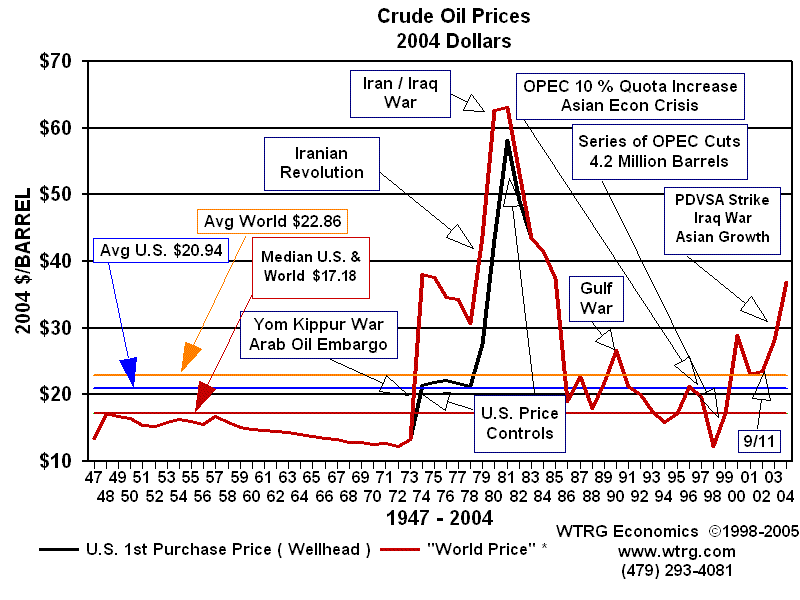
At this point, though it is embarrassing to have to point this out to a man who once was a real economist rather than a political hack, I must remind Mr. Krugman that since we are talking about substitutes for oil, then perhaps oil prices might have something to do with this "lack of progress." Because, while we may tend to forget the fact over the last few years, for 20 of the last 25 years oil prices have been, on a real basis, near all-time lows. They languished for decades at $20 or less, a price level that made the economics of substitutes impossible. Nobody is going to put real money into substitutes when oil is at $16 or so. Exxon, for example, had huge money invested in LaBarge, WY oil shale in the late 70's until decades of middling oil prices in the eighties and nineties forced them to pull the plug. Ditto everyone and everything else, from shale oil to coal gasification. And I can't even believe any sentient adult who lived through this period actually needs it pointed out to him that maybe there are non-technical reasons breeder nuclear reactors have not advanced much, like say the virtual shutdown of the nuclear business by environmentalists and local governments.
I will myself confess to being a bit surprised that solar efficiencies have not advanced very much, but again I remind myself that until the last few years, there was virtually no economic justification for working much with the technology.
But all this masks another fact: One of the reasons that these technologies have not advanced much is due to the absolutely staggering advances in oil exploration and production technology. The last 35 years has seen a revolution, from computer reservoir modeling to horizontal drilling to ultra deep sea oil production to CO2 floods, it is in many ways a totally new industry.
Here is the way to decode what Mr. Krugman is saying: It is not that the energy industry is not making huge technology gains, but that it is making gains in areas that Mr. Krugman did not expect, and, even more likely, it is not making its gains in the areas that Mr. Krugman wanted them to be.
Other technological advances
But Mr. Krugman did not stop there. He could not resist throwing out a bit more red meat when he posits that all of our advances over the last 50 years in manipulating the material world have been disappointing. Really? Again, by what metric? The revolution in computing alone has been staggering, and I feel like I could just say "Moore's Law" and leave my rebuttal at that. Kevin Drum, oddly, suggests that Krugman means to say "besides computers" by using the "manipulate the physical world" wording. If so, that is pretty hilarious. Saying that "when you leave out computing and semiconductors, we haven't done much with technology over the last 50 years" is roughly equivalent to saying "leaving out the energy revolution and the application of steam power, there was not much progress in the early industrial revolution." It's a stupid, meaningless distinction. I am sure he would include a "car" in his definition of manipulating the physical world, but then how would you explain all those semiconductors under the hood?
But, that being said, I will take up the challenge. Here are a number of technological revolutions besides computing and semiconductors over the last 50 years that clearly outstrip the previous 50:
- Cost / Affordability Revolution. One can argue that many of the technologies we enjoy today existed, at least in primitive form, in 1958. But the vast majority of these items, from television to automobiles to air conditioning to long distance travel were playthings for the rich. Over the last 50 years, we have found a way to revolutionize the cost and availability of all these items, such that most are available to everyone (more on this below)
- Reliability revolution. In 1958, and even in 1968 and to a lesser extent in 1978, it was critical to have an address book full of good repair people. Cars, televisions, home appliances, radios, air conditioners -- all were horrendously unreliable. They could fail on you at any time, leaving you in an awkward or even dangerous spot, and repairs were common and expensive. When I was a kid, we used to have a guy in our house at least twice a year fixing the TV -- when was the last time you saw a TV repair man? I would argue that reliability (and this applies to industrial products as well) barely budged from 1908 to 1958, but has improved exponentially in the last 30-40 years.
- Environmental and efficiency Revolution. This one is no contest. The environmental improvement -- in air quality, in water quality, in litter, in just about every category -- has shown substantially more improvement since 1958 than it did in the first half of the century. This one is no contest
- Safety revolution. While there are ways in which this has gone too far, there is no denying that a huge amount of engineering over the last 50 years has gone into making products and services safer to use and operate. And by the way, on the topic of flying cars (everyone likes to lament, "where is my flying car") could one not imagine that one reason we don't have flying cars is that anyone who is smart enough to design one is smart enough to know the government is never going to let people fly around willy-nilly, so maybe there is no mass market for them worth the investment and time?
- Bio-medical revolution. In less than 20 years from the time the world really recognized and understood the AIDS virus, science had a fairly good treatment for it. And people complained it took too long! Think of it -- a new, totally foreign virus that is extremely deadly appears nearly out of nowhere, and science cracks it in 2 decades. No such ability existed before 1958.
- Communications and Entertainment revolution. 1958: Three US TV networks. 2008: 300 million people with the ability to broadcast their thoughts, their movies, their works of art to the world. 'nuff said.
In many ways, all of these thoughts come together if we look at a car. Its easy to say that cars have not changed much - no wings yet! But in fact, a car mechanic from 1909 would have a fighting chance to work on a 1958 engine. No way a 1958 mechanic could make much progress with a 2008 internal combustion engine, much less a hybrid. A car in 1958 was nearly as unsafe, and unreliable, and inefficient, and polluting, as a car in 1908. Today, all of these have improved by orders of magnitude. In addition, our cars have air conditioning and leather seats and hard-top convertible roofs and satellite radios and DVD players for the kids. And mostly, the don't rattle like they used to after 6000 miles.
Material Life
But Krugman is still not done throwing out red meat, as he concludes that material life has not improved much over the last 50 years, and the answer is "obvious", to him at least, as to whether it has improved more in the last 50 years or the previous 50 years.
Well, first I would observe that one should probably not trust people in data-based professions like economics who say that the answers to complicated questions are obvious without feeling the need to put any facts on the table. By so positing, he looks extraordinarily lazy compared to folks like Steven Levitt who are out there trying to quantify the seemingly unquantifiable.
But the question is not at all obvious to me. I suppose one could argue that the very rich have not seen much change in their material condition. In 1958 they could jet around the world and had televisions and air conditioning and could afford the costs of unreliable products (it does not matter so much if your car breaks down a lot if you can afford to have five or six cars).
But is strikes me that the material condition of the poor and middle class have improved markedly over the last 50 years. As I mentioned before, there has been a revolution in the price and availability of what used to be luxury items:
The following are facts about persons defined as "poor" by the Census Bureau, taken from various government reports:
- Forty-three
percent of all poor households actually own their own homes. The
average home owned by persons classified as poor by the Census Bureau
is a three-bedroom house with one-and-a-half baths, a garage, and a
porch or patio.
- Eighty percent of poor households
have air conditioning. By contrast, in 1970, only 36 percent of the
entire U.S. population enjoyed air conditioning.
- Only 6 percent of poor households are overcrowded. More than two-thirds have more than two rooms per person.
- The
average poor American has more living space than the average individual
living in Paris, London, Vienna, Athens, and other cities throughout
Europe. (These comparisons are to the average citizens in foreign countries, not to those classified as poor.)
- Nearly three-quarters of poor households own a car; 31 percent own two or more cars.
- Ninety-seven percent of poor households have a color television; over half own two or more color televisions.
- Seventy-eight percent have a VCR or DVD player; 62 percent have cable or satellite TV reception.
- Eighty-nine percent own microwave ovens, more than half have a stereo, and more than a third have an automatic dishwasher.
What has not improved
To bring us back full circle, the one thing I would argue that definitely has not improved much is forecasting and modeling. It appears from Krugman in this article (and form global warming modelers) that orders of magnitude increases in computing power have improved neither the hubris of the modelers nor the quality of their forecasts. I am sure I could as easily find someone in 1958, or even 1908, out there crying "My forecast is fine - its reality that's broken!"
OK, I am spent. I am sure there is more that could be said on this, but I will leave the rest to you guys.