Posts tagged ‘kevin drum’

Health Care and Prices

Kevin Drum is lauding the transparency an Oregon health insurance exchange which was initiated some apparently welcome price competition into a market for now standardized products.  My response was this:

I applaud any effort by this Administration and others to improve the transparency of pricing in the medical field.  I would have more confidence, though, if all of you folks were not pushing for 100% pre-paid medical plans that will essentially eliminate price-shopping by individuals, and in so doing effectively eliminate the enormous utility of prices.  Prices will soon be meaningful for one thing -- insurance -- in the health care field and absolutely meaningless for everything else in the field.

By the way, at the same time you are improving competition on price, you are eliminating by fiat all competition on features (e.g. what is covered, what deductible I want, etc).  This "success" is like the government mandating one single cell phone design, and then crowing how much easier shopping is for consumers because there is now only one choice.  A simple world for consumers is not necessarily a better world.  I am sure Medieval peasants had a very simple shopping experience as well.

Classic Partisan Thinking

Kevin Drum writes

On the right, both climate change and questions about global limits on oil production have exited the realm of empirical debate and become full-blown fronts in the culture wars. You're required to mock them regardless of whether it makes any sense. And it's weird as hell. I mean, why would you disparage development of renewable energy? If humans are the ultimate creators, why not create innovative new sources of renewable energy instead of digging up every last fluid ounce of oil on the planet?

I am sure it is perfectly true that there are Conservatives who knee-jerk oppose every government renewable energy and recycling and green jobs idea that comes along without reference to the science.  But you know what, there are plenty of Liberals who knee-jerk support all these same things, again without any understanding of the underlying science.  Mr. Drum, for example, only recently came around to opposing corn ethanol, despite the fact that the weight of the science was against ethanol being any kind of environmental positive years and years ago.  In fact, not until it was no longer cool and caring to support ethanol (a moment I would set at when Rolling Stone wrote a fabulous ethanol expose) did Drum finally turn against it.  Is this science, or social signalling?   How many folks still run around touting electric cars without understanding what the marginal fuels are in the electricity grid, or without understanding the true well-to-wheels efficiency?  How many folks still run around touting wind power without understanding the huge percentage of this power that must be backed up with hot backup power fueled by fossil fuels?

Why is his almost blind support of renewable energy without any reference to science or the specifics of the technologies involved any saner than blind opposition?  If anything, blind opposition at least has the numbers on their side, given past performance of investments in all sorts of wonder-solutions to future energy production.

The reason there is a disconnect is because statists like Drum equate supporting government subsidies and interventions with supporting renewables.  Few people, even Conservatives, oppose renewables per se.  This is a straw man.  What they oppose are subsidies and government mandates for renewables.  Drum says he has almost limitless confidence in  man's ability to innovate.  I agree -- but I, unlike he apparently, have limitless confidence in man's ability to innovate absent government coercion.  It was not a government program that replaced whale oil as an illuminant right when we were approaching peak whale, it was the genius of John D. Rockefeller.  As fossil fuels get short, prices rise, and people naturally innovate on substitutes.  If Drum believes that private individuals are missing an opportunity, rather than root for government coercion, he should go take up the challenge.  He can be the Rockefeller of renewable energy.

Postscript:  By the way, it is absurd and disingenuous to equate opposition to what have been a series of boneheaded government investments in questionable ventures and technologies with some sort of a-scientific hatred of fossil fuel alternatives.  I have written for a decade that I long for the day, and expect it to be here within 20 years, that sheets of solar cells are cranked from factories like carpet out of Dalton, Georgia.

Probably an Accurate Prediction

Unfortunately, Kevin Drum's prediction is probably dead on

a fellow with the Twitter handle @FootyTube_ quickly changed his handle last night to @Dzhokhar_ and swapped out his avatar for a thumbnail of the suspect in the Boston bombings. That's hilarious!

Or not. But I predict a growth industry in this kind of thing. FootyTube's idiocy was easy enough to see through, but someone out there now has the bright idea of creating a Twitter/Facebook/Tumblr/etc. account and populating it over time with grievances of some kind. Islamic, gun nut, anti-tax, libertarian, PETA, whatever. Just create a nice long chain of posts and then wait for the next terrorist attack. As soon as pics and names are available, switch the account name, make it public, and wait to be discovered.

I Have A Better Idea: Let's Just Kill It

Kevin Drum thinks the mortgage interest deduction is unfair because people with bigger mortgages get bigger deductions.  In particular, he is concerned that people with smaller deductions get no incremental benefit because these deductions are seldom larger than their default personal exemption.

But tax deductions are always going to be like this in a progressive system -- the rates are progressive and the fixed personal exemption is extremely progressive, so the combination of the two mean that tax deductions are going to preferentially help the rich more.  This reminds me of the arguments in Colorado when tax law required a tax reduction and Democrats in the state legislature complained that people who don't pay taxes would be getting no benefits from this.

He tries to posit some silly alternative tax credit system, but why bother?  Haven't we had enough of distortive tax breaks that favor a single industry and/or shift investment alarmingly into a particular pool of assets (thus increasing the risk of bubbles).  Isn't the whole notion of tax-subsidizing home ownership but not rentals inherently regressive, no matter how the deduction or credit is calculated?  Doesn't the labor market rigidity of home ownership most penalize lower income workers who get trapped in a certain geography by their home and cannot migrate for better wages, as blue collar workers have done in past recessions and recoveries?

Why wouldn't a good progressive like Drum be advocating for an elimination of the deduction altogether?  Is this one of those coke-pepsi party things, where the Republicans have taken over the issue of limiting deductions so Democrats have to reflexively defend them, even if ideologically it would make more sense for them to promote their elimination?

How To Win An Argument With Those Who Already Agree, and Lose With Everyone Else

I think that I am just going to post this line from Kevin Drum largely without comment:

In particular—and please excuse the wild guess here—I imagine that most people who have a serious jones for cutting federal spending are really only interested in cutting spending on poor people. Cutting other services just isn't what they signed up for. It's the Obamaphones and the food stamps that are wasteful, not the Yellowstone snowplows and small town air traffic controllers.

One of the things I tell folks in the climate debate -- don't try to learn about the other side of the argument from yours by listening to your own folks' characterization of it, go actually listen to the other side.  This is what comes of  trying to understand people only by listening to their intellectual enemies.  It is also why I read a lot of blogs (like Drum's) with which I disagree.

Has Drum seriously not ever heard the concentrated benefits, dispersed cost argument?

My Retirement Rant

First, I will say that I am perfectly happy for folks who are either good earners or good savers or both and who choose to use their accumulated wealth to stop working at some age.

However, I am completely lost as to how we have somehow decided that multi-decade end-of-life paid vacations, starting as early as age 50, is somehow an inalienable right that must be guaranteed by government.  I suppose I can see a safety net for folks who, though age and disability, simply get too old to be productive (but remember that I have nearly 500 people mostly over 65 who work for me, mostly doing manual trades, so don't tell me older people can't be productive).  And that was what Social Security initially was -- the age 65 was chosen as a retirement age not because it guaranteed 10-15 years of senior leisure but because it matched the life expectancy at the time.  The equivalent age would be well into the 70's today.

Of course, others think differently.  A group is now proposing an expanded Social Security program that would guarantee nearly 100% of earnings to low-income retirees (there are smaller increases for higher income workers but most all the change is for low-income folks).

While they are proposing higher taxes to support this, my guess is that it will not be long before a wealth tax is suggested.  After all, they are hoping to replace 401K's as a savings vehicle.  If so, why not seize those funds to help pay for the plan.  The other day, Kevin Drum mocked those who fear a government seizure of 401K's as the tinfoil hat brigade.  I would be willing to bet him that within the decade, it will become a mainstream idea in the progressive community to fund shortfalls in Social Security and Medicare with a full or partial seizure of 401K's.

Obamacare-Driven Stagnation

From the file of things that are absolutely obvious to business owners, and a total shocker to the pundit and policy class:

In its latest monthly report on economic conditions across the country, the Federal Reserve points to Obamacare as one reason the unemployment rate has remained near or above 8 percent under the current administration.

That’s what Sally Pipes, president of the Pacific Research Institute, writes in an op-ed piece for Forbes magazine.

The Fed’s so-called “beige book” noted that employers across the country have “cited the unknown effects of the Affordable Care Act as reasons for planned layoffs and reluctance to hire more staff,” Pipes says, adding that as more businesses learn about Obamacare, “the more they’re coming to realize that affordable care” is the last thing it will provide.

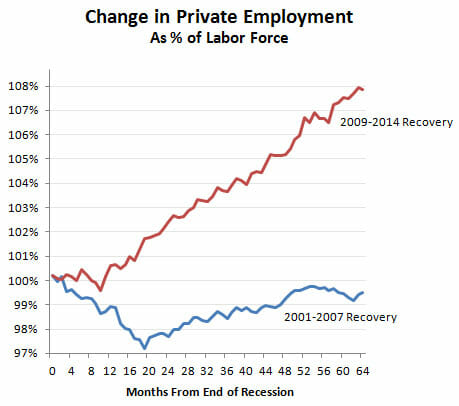
Here is my attempt to illustrate the same thing in one chart (net monthly job creation, which Kevin Drum helpfully posts each month):

click to enlarge

I will revise this chart later - this is actually public and private totals.  When you look at private only, the April 2010 peak goes away (that was temporary census hiring) and the chart has an even more stark inflection right there in March 2010 when Obamacare was passed.


For One Brief Moment, I Thought Reason Might Enter the Discourse on Budgets

Kevin Drum quoted this from James Fallows in a post labelled "threat inflation"

As I think about it this war and others the U.S. has contemplated or entered during my conscious life, I realize how strong is the recurrent pattern of threat inflation. Exactly once in the post-WW II era has the real threat been more ominous than officially portrayed

I thought, "wow, someone from the Coke or the Pepsi party is finally going to call BS on all the apocalyptic forecasts from both parties over the sequester."  But alas, he was just discussing foreign policy.  That is not to say I don't agree with the basic point, that foreign policy prescriptions are often accompanied by exaggerated horror stories of imminent threats -- I just wish they would recognize the same dynamic on the domestic front, whenever the smallest cut in government spending growth rates suddenly mean we are are going to put grandma out on an ice flow to freeze.

US Doctor Salaries

Kevin Drum thinks he has found the smoking health care gun - US doctors are paid more than everyone else.  That is why we have too-expensive medical care!  A few quick thoughts

  • I am the last one to argue that doctors salaries are set anywhere like at a market clearing price.  Our certification system, crazy third-party payer systems, lack of price transparency, and absurd arguments over the "doc fix" and Medicare reimbursement rates all convince me that doctor salaries must be "wrong"
  • The charts he shows have absolutely no correction for productivity, at least as I read the methodology.  Per the text, they don't even have correction for hours worked.  A McKinsey report several years ago found that US doctors made more, but also saw a lot more patients in a day.  GP care cost more than expected vs. other country's experience, but is due mostly to number of visits, not cost per visit.
  • There is no correction for doctor expenses.  Malpractice insurance, anyone?  We have the most costly malpractice insurance in the world because we have the most broken system.  Doctors pay that out of their salary
  • US GP salaries in Drum's linked report are actually falling, unlike all the other countries studied.  Seem to have fallen 6% in 10 years (page 18), whereas France, for example, has increased more than 10%.

To the last point, I have a hypothesis.  When you first overlay a government health care / price control regime, you get an initial savings.  Doctors are forced to work for less and they still, out of habit and momentum, abide by past productivity standards.  But over time, productivity, like any government-captured function falls.  And over time, doctors, like other civil service groups, become better at organizing and lobbying and begin to get increasing pay packages.  After all, if teachers and fire-fighters can scare Californians into absurd pay and benefit packages, what do you think doctors will be able to do once they learn the game?

Abandoning Principle to Protect Their Guy

Scott Lemieux, via Kevin Drum, argues that people are getting way too worked up about the targeted killing memo.  Everything's fine"

Much of the coverage of the memo, including Isikoff's story, focuses on the justifications offered by the Obama administration for killing American citizens, including Anwar al-Awlaki and Samir Khan (two alleged Al Qaeda operatives killed by a 2011 airstrike in Yemen.) In some respects, this focus is misplaced. If military action is truly justified, then it can be exercised against American citizens (an American fighting for the Nazis on the battlefield would not have been entitled to due process.) Conversely, if military action is not justified, extrajudicial killings of non-Americans should hardly be less disturbing than the extrajudicial killing of an American citizen. The crucial question is whether the safeguards that determine when military action is justified are adequate

As I wrote in his comments section to this:

There is an immense chasm of difference between killing an American on the battlefield dressed in a Luftwaffe uniform in the Battle of the Bulge and authorizing assassination of American civilians without any sort of due process (Please don't tell me that presidential conferences and an excel spreadsheet constitute due process).  The donning of an enemy uniform is a sort of admission of guilt, to which there is no parallel here.  A better comparison would be:  Would it have been right for FDR to have, say, Charles Lindberg killed for supporting the nazis and nazi-style eugenics?  How about having a Congressman killed who refused to fund the war on terror - after all, there are plenty of people who would argue that person is abetting terrorism and appeasing Al Qaeda by not voting for the funds.

Before the election, when asked to post possible reasons to vote for Romney, the best one I could think of was that at least under a President Romney, the natural opponents on the Left of targeted killing and drone strikes and warrant-less wiretapping and prosecuting whistle-blowers under treason laws would find their voice, rather than remaining on the sidelines in fear of hurting "their guy" in the White House.

By the way, I know this puts me out of the mainstream, but Presidential targeted killing and drone strikes on civilian targets bothers me whether or not Americans are targeted.  I don't accept the implicit notion that "foreigners" have fewer due process rights than Americans vis a vis our government.  I believe the flaw goes all the way back to the AUMF that was directed against a multinational civilian organization rather against a country and its uniformed military.  I don't believe this is even a valid definition of war, but even if it were, there is no way the traditional rules of war can apply to such a conflict.  But here we are, still trying to apply the old rules of war, and it is amazing to me to see denizens of the Left leading us down this slippery slope.

Update:  As usual, Glenn Greenwald seems to have the definitive editorial on the targeted killing memo.  It is outstanding, top to bottom.  Read it, particularly if you are on the fence about this.

Obamacare Lowest Cost Health Plan at $20,000 per Year?

CNS News reported, and no one in the Obama Administration seems to be denying, that the IRS is assuming the cheapest conforming health insurance policy for a family of four under Obamacare will cost $20,000 per year

The IRS's assumption that the cheapest plan for a family will cost $20,000 per year is found in examples the IRS gives to help people understand how to calculate the penalty they will need to pay the government if they do not buy a mandated health plan.

The examples point to families of four and families of five, both of which the IRS expects in its assumptions to pay a minimum of $20,000 per year for a bronze plan.

“The annual national average bronze plan premium for a family of 5 (2 adults, 3 children) is $20,000,” the regulation says.

Bronze will be the lowest tier health-insurance plan available under Obamacare--after Silver, Gold, and Platinum.

Kevin Drum shot back, saying that Conservatives were essentially out of touch for thinking that health insurance currently, or could ever conceivably, cost much less

So is this unusual? Not really. The average cost of healthcare coverage for a family is currently about $16,000,and by 2015 (the base year for the IRS examples) that will probably be around $18,000 or so. And that's for employer-sponsored plans. Individual plans are generally steeper, so $20,000 isn't a bad guess. It might be a little high, but not by much. And the family in question will, of course, be eligible for generous subsidies that bring this cost down substantially, thanks to the Affordable Care Act. They won't actually pay $20,000 per year.

(We'll ignore that last part as typical Progressive double think -- as long as the government is paying, the costs don't count.  It's like being free!)

I can't believe that Drum has actually shopped for health insurance of late.  The link he relies on for his data is for employer plans only, and Drum makes the unproven assumption that these are somehow less costly than individual plans people have to actually shop for. This is false.  Employer plan averages include a lot of gold-plated policies in the mix driven by noncompetitive union contracts and executives wanting gold-plated plans for themselves at the expense of shareholders.   I would argue that Drum is comparing "platinum" plans today to "bronze" plans under Obamacare, and it should be disturbing that even with this bit of judo, bronze Obamacare plans come out 20%+ more expensive than gold-plated current corporate plans.

But there is an even easier way to solve this, one Drum (who is nominally a "journalist") could solve with a few phone calls or clicks on Internet sites:  we can get some quotes.  Being a blogger with a real job, I do not have time to do this, but fortunately I don't have to because I just did this a few months ago for my family.  Here are a few quotes for a family of four with two 50+ old adults in pretty good health and two teenage kids from Blue Cross - Blue Shield of Arizona:

BlueOptimum- Plus $5000 deductible - $615.45 per mo., 7,385.40 per year>

BluePortfolio-Plus $3000 deductible - $703.80 per mo., 8,445.60 per year  (HSA eligeable)

BluePorfolio-Plus $5500 deductible - $499.75 per mo., 5,997.00 per year  (HSA eligeable)

Note first that these high deductible and HSA policies are ILLEGAL under Obamacare, in large part because they are actual insurance and Progressives don't mean "insurance" when they say "health insurance", they mean fully pre-paid all-encompassing medical care.  I consider the purpose of insurance to be to protect from catastrophes that you can't afford (e.g. your house burns down).  In the case of medical care, I thought about from my financial position, and determined what the largest financial setback I could bear in a year if someone really had a medical problem.  So I set my deductible at that number, and made sure I bought a policy that paid everything else above that reliably, without any low lifetime or maximum payment numbers.

The Blue Optimum above is a fairly standard co-pay plan that covers most doctor visits and drugs with only a copay.  The Blue Portfolio are HSA plans that are pure insurance.  I pay everything (except certain preventative care costs) up to the deductible, and they pay everything else above that.  In this case, note that the deductible is per person but there is a total family/policy deductible of twice that.  In other words, with the second policy, even if everyone in my family gets cancer in the same year, we aren't out of pocket more than $6,000.  So, for this middle policy, in typical years we spend $8,445.60 plus, say, another $1000 on miscellaneous stuff for a total health cost of $9,445.60.  Or half the Obamacare "bronze" or cheapest possible plan.  In the worst possible year, if two family members get very sick in the same year (not a hugely likely event) we are out $14,445.60 per year.  This is the worst case.  Still 28% lower than the cheapest Obamacare option.

In this plan, I am allowed under the HSA provision to bank about $5,000 a year in a pre-tax account.  I can use this money to pay medical bills up to the deductible, or save it.  If money is left over some day, it becomes a retirement account and I can use the money for retirement.  So I have the financial incentive to shop around for best prices, because the residual in the HSA is mine to spend on .... whatever.   I have told the stories a number of times here about my medical shopping experience.  X-rays that were charged to insurance companies for $250 suddenly cost $45 when I said I was paying cash.  My wife got a 70% cost reduction the other day on orthodic shoes when she offered to pay cash rather than put her insurance in play.  So, not only will Obamacare raise the prices of my insurance substantially, it will also raise medical costs in general by stripping away the last incentives for anyone to price-shop for health care.

When I read my Bastiat, I am always reminded how humans tend to insist on adopting the same myths and fallacies about the economy.  The myths he busts in the 19th century can be seen on the pages of our newspapers every day of the 21st century.   But one unique idea we have spawned since Bastiat is this bizarre notion that somehow it is wrong to pay for ones own medical expenses out of pocket.  It took forever to convince even my very smart HBS-educated wife that it was a much better deal to go to a high-deductible health plan.  Since we did so, we have saved a ton of money, and by the way done our small bit to keep prices down for the rest of you by actually shopping for things like x-rays (you can thank me later).  I don't know why this fallacy is so entrenched and hard to change, but we have built the entire edifice of Obamacare on top of it.

Non-Precautionary Principle: Debt Denialists

Kevin Drum begins this post by making a point I have made forever -- that selling debt to Chinese investors does not somehow put the US in China's power.  In fact, one can argue just the opposite, that Chinese policy options vis a vis the US are circumscribed to some extent by the desire to get paid back on all this lending some day.

However, he goes on to make this incredible statement:

Rising U.S. debt hasn't caused inflation. It hasn't sent interest rates skyrocketing. It hasn't reduced Chinese demand for American bonds. It hasn't reduced demand for long-dated bonds. Really, it hasn't done any of the things that conservatives have been predicting with apocalyptic fervor for the past four years.

I am left agog at the incredible blindness of this position, and find it intriguing how it contrasts with Drum's position on rising atmospheric CO2 levels.  In the latter case, he constantly argues that lack of warming today is not an excuse for inaction, that CO2 is dangerous and its production must be greatly curtailed.  He takes this position despite any real historic evidence of harm from CO2 levels -- ie future harm is hypothetical and without precedent.  But still he wants action now.

On the other side, there is plenty of historical evidence for what rising deficit spending and government debt will do to a country and an economy.  Heck, you don't even have to look at history -- it is being pushed in our face every day by Greece and Spain and Italy.  And yet he councils full steam ahead.

Even most climate skeptics (including myself) would not make a statement about CO2 as denialist as Kevin Drum makes about debt.  We acknowledge CO2 is rising, believe it has some impact on rising temperatures, but differ from the most alarmist in the amount of future temperature increases expected.  We expect more modest anthropogenic temperature increases that make more sense to deal with by adaption -- but we don't generally deny its effect altogether (crazy talk show host and a few prominent bloggers notwithstanding).

 Postscript:  The Weimar Republic went from relative normalcy to hyperinflation in less than three months, the time between two quarterly meetings of the Fed.  In Europe, one day there was no problem in Greece and Spain and Italy and a day or a week later, boom, the crisis is upon them.

Forgetting the Fed -- Why a Recovery May Actually Increase Public Debt

Note:  I am not an expert on the Fed or the operation of the money supply.  Let me know if I am missing something fundamental below

Kevin Drum dredges up this chart from somewhere to supposedly demonstrate that only a little bit of spending cuts are needed to achieve fiscal stability.

Likely the numbers in this chart are a total crock - spending cuts over 10 years are never as large as the government forecasts and tax increases, particularly on the rich, seldom yield as much revenue as expected.

But leave those concerns aside.  What about the Fed?  The debt as a percent of GDP shown for 2012 in this chart is around 72%.  Though it is not labelled as such, this means that this chart is showing public, rather than total, government debt.  The difference is the amount of debt held by federal agencies.  Of late, this amount has been increasing rapidly as the Fed buys Federal debt with printed money.  Currently the total debt as a percent of GDP is something like 101%.

The Left likes to use the public debt number, both because it is lower and because it has been rising more slowly than total debt (due to the unprecedented growth of the Fed's balance sheet the last several years).  But if one insists on making 10-year forecasts of public debt rather than total debt, then one must also forecast Fed actions as part of the mix.

Specifically, the Fed almost certainly will have to start selling some of the debt on its books to the public when the economy starts to recover.  That, at least, is the theory as I understand it: when interest rates can't be lowered further, the Fed can apply further stimulus via quantitative easing, the expansion of the money supply achieved by buying US debt with printed money.  But the flip side of that theory is that when the economy starts to heat up, that debt has to be sold again, sopping up the excess money supply to avoid inflation.  In effect, this will increase the public debt relative to the total debt.

It is pretty clear that the authors of this chart have not assumed any selling of debt from the Fed balance sheet.  The Fed holds about $2 trillion in assets more than it held before the financial crisis, so that selling these into a recovery would increase the public debt as a percent of GDP by 12 points.  In fact, I don't know how they get the red line dropping like it does unless they assume the current QE goes on forever, ie that the FED continues to sop up a half trillion dollars or so of debt every year and takes it out of public hands.

This is incredibly unrealistic.  While a recovery will likely be the one thing that tends to slow the rise of total debt, it may well force the Fed to dump a lot of its balance sheet (and certainly end QE), leading to a rise in public debt.

Here is my prediction:  This is the last year that the Left will insist that public debt is the right number to look at (as opposed to total debt).  With a reversal in QE, as well as the reversal in Social Security cash flow, public debt will soon be rising faster than total debt, and the Left will begin to assure us that total debt rather than public debt is the right number to look at.

Bizarre Alternate Reality

Kevin Drum is claiming that the government has already done much fine work on deficit reduction, reducing spending by $1.8 trillion and increasing taxes by $600 billion.

This is fantasy, pure and simple, and perhaps why the term "reality-based community" has fallen out of favor among Progressives.   There has been and will likely be no reduction in spending -- these "spending cuts" are merely reductions in spending growth rates from the Administration's initial wet dream spending proposals. I am sure the tax increases are probably real, but Obama and the Congress were already proposing to spend most of those in new stimulus and other boondoggles right in the end of year tax legislation.

The tax numbers are characteristic of the stupid budget games played by both parties.   For example, the recent tax law represents a tax increase over law in place on 12/31/2012, but represents a massive tax cut vs. law set to be in place on 1/1/2013.  This gives the administration cover to call it both!  When it wants to portray itself as a deficit hawk, as in this case, it was a tax increase.  When it wants to portray itself as being populist, it was a tax cut.

Charts like this are absolutely worthless.  We will likely get deficit reduction over the next few years, but it will be entirely due to rising tax revenues from an improving economy.

And here we are back to my constant theme -- if you want to posit a trend, then show the trend.

Anti-Trust Law and the Corporate State

Kevin Drum is uncomfortable that Google got off the hook on anti-trust charges merely because it was not harming consumers

Google made a number of arguments in its own defense, and consumer welfare was only one of them. Still, it was almost certainly the main reason they won, and it's still not clear to me that this is really what's best for consumers in the long run. Did Google users click on the products they highlighted? Sure. Did they buy some of the stuff? Sure. Were they happy with their purchases? Sure. Is that, ipso facto, evidence that there's no long-run harm from a single company dominating the entire search space? I doubt it. After all, John D. Rockefeller could have argued that consumers bought his oil and were pretty happy with it, so what was the harm in his controlling the entire market?

The tech industry moves fast enough that antitrust might genuinely not be a big issue there. In the end, it wasn't antitrust that hurt IBM and Microsoft. It was the fact that the industry moved rapidly toward smaller computers and then the internet, and neither company was really able to react fast enough to dominate these new spaces. Nonetheless, I'm skeptical of the tautology at the heart of the consumer welfare argument. If a company is successful, then by definition people must be buying its stuff. On this basis, bigness is simply unassailable anymore. That has broad societal implications that I suspect we're not taking seriously enough.

He seems to be arguing that we consider returning to a pure bigness standard without reference to consumer harm.  I am not sure that we ever followed such a standard, but certainly today the alternative to a consumer harm standard is not a bigness standard but a competitor harm standard.  Whether he knows it or now, this is essentially what Drum is advocating.  We see this in the article he quotes:

But while the F.T.C. said that Google’s actions might have hurt individual competitors, over all it found that the search engine helped consumers, as evidenced by Google users’ clicking on the products that Google highlighted and competing search engines’ adopting similar approaches.

I am not sure what Drum really wants, but the result of eliminating the consumer-harm standard would be an environment where every failed company can haul its more successful competitors in front of the government and then duke it out based on relative political pull rather than product quality.  It is pretty well understood out there that this anti-Google FTC claim was initiated and championed by Microsoft, certainly not among the powerless typically championed by progressives, and a company well known to have missed the boat on Internet search and which is apparently trying to do now through government fiat what it has not been able to do in the marketplace.  Microsoft learned this technique from Sun and Oracle, which took Microsoft to the FTC in the famous browser case where Microsoft faced years of anti-trust scrutiny for the crime of giving the public a free product.

Already, anti-trust law is an important tool of the corporate state, to allow politically powerful companies to squash competition from those who invested less money in their Washington office.  I am not a legal expert at all, but this consumer standard in anti-trust strikes me as a critical shield stopping a hell of a lot more abuse of anti-trust law.

By the way, there is a modern bigness problem with corporations that is very troubling -- we have made government tremendously powerful, giving it many tools to arbitrarily choose winners and losers without any reference to justice or rights.  As private entities get larger and richer, they are better able to access and wield this power in their own favor.  The libertarian solution is to reduce the government's power to pick winners and losers.  The progressive answer is to regulate business more with tools like anti-trust.

But the progressive solution has a built-in contradiction, which why Drum probably does not suggest a solution.  Because the very tools progressives suggest to regulate business typically become the tools with which politically connected corporations further tilt the game in their own favor.  Anti-trust is a great example.  We want to reduce the number of large companies with an eye to reducing corporatism and cronyism, but the very tool to do so -- anti-trust law -- has become one the corporate crony's best tools for stepping on competitors and insulating their own market positions.

And by the way, Rockefeller's Standard Oil did a HELL of a job for consumers.  It was nominally punished for what it might some day hypothetically do to consumers.

Here are the facts, via Reason

Standard Oil began in 1870, when kerosene cost 30 cents a gallon. By 1897, Rockefeller's scientists and managers had driven the price to under 6 cents per gallon, and many of his less-efficient competitors were out of business--including companies whose inferior grades of kerosene were prone to explosion and whose dangerous wares had depressed the demand for the product. Standard Oil did the same for petroleum: In a single decade, from 1880 to 1890, Rockefeller's consolidations helped drive petroleum prices down 61 percent while increasing output 393 percent.

By the way, Greenpeace should have a picture of John D. Rockefeller on the wall of every office.  Rockefeller, by driving down the cost of kerosene as an illuminant, did more than any other person in the history to save the whales.  By making kerosene cheap, people were willing to give up whale oil, dealing a mortal blow to the whaling industry (perhaps just in time for the Sperm Whale).

So Rockefeller grew because he had the lowest cost position in the industry, and was able to offer the lowest prices, and the country was hurt, how?  Sure, he drove competitors out of business at times through harsh tactics, but most of these folks were big boys who knew the rules and engaged in most of the same practices.  In fact, Rockefeller seldom ran competitors entirely out of business but rather put pressure on them until they sold out, usually on very fair terms.

From "Money, Greed, and Risk," author Charles Morris

An extraordinary combination of piratical entrepreneur and steady-handed corporate administrator, he achieved dominance primarily by being more farsighted, more technologically advanced, more ruthlessly focused on costs and efficiency than anyone else. When Rockefeller was consolidating the refining industry in the 1870s, for example, he simply invited competitors to his office and showed them his books. One refiner - who quickly sold out on favorable terms - was 'astounded' that Rockefeller could profitably sell kerosene at a price far below his own cost of production.

Software Patent Horror

Ever since Amazon managed to patent one-click ordering, I have been skeptical of software patents.  When I was in the Internet field, I saw companies patent some, uh, patently obvious stuff, roughly akin to patenting an on/off switch.  Or even worse, multiple companies would get patents for the equivalent of an on/off switch, with this company claiming it has the patent for on-off switches for lighting, and this one for appliances, and this one for all electrical devices, and then all three end up sitting in court for about 10 years arguing about who has the patent for turning on the bulb in your refrigerator.

Kevin Drum brings us an amazing horror story of a patent that apparently I owe licensing fees for -- and probably you do too.

Vicinanza soon got in touch with the attorney representing Project Paperless: Steven Hill, a partner at Hill, Kertscher & Wharton, an Atlanta law firm.

"[Hill] was very cordial and very nice," he told Ars. "He said, if you hook up a scanner and e-mail a PDF document—we have a patent that covers that as a process."

It didn’t seem credible that Hill was demanding money for just using basic office equipment exactly the way it was intended to be used. So Vicinanza clarified:

"So you're claiming anyone on a network with a scanner owes you a license?" asked Vicinanza. "He said, 'Yes, that's correct.' And at that point, I just lost it."

Drum has a good discussion, including some prior art with which he actually participated.

Climate De-Bait and Switch

Dealing with facile arguments that are supposedly perfect refutations of the climate skeptics' position is a full-time job akin to cleaning the Augean Stables.  A few weeks ago Kevin Drum argued that global warming added 3 inches to Sandy's 14-foot storm surge, which he said was an argument that totally refuted skeptics and justified massive government restrictions on energy consumption (or whatever).

This week Slate (and Desmog blog) think they have the ultimate killer chart, on they call a "slam dunk" on skeptics.  Click through to my column this week at Forbes to see if they really do.

Capital Controls

I am not sure I understand Kevin Drum's argument for capital controls.  He seems to be arguing that these controls are a sort of financial speed limit and making an awkward analogy to highway speed limits to justify them.

In a world where I as a taxpayer have to bail out banks, I don't have a huge problem with capital requirements for banks, though this seemingly simply topic is rife with unintended consequences -- I have seen it argued persuasively that the pre-2008 Basil capital requirements helped fuel the housing bubble by giving special preference to MBS in computing capital.  In fact, one might argue the same for the sovereign debt crisis, that by creating a huge demand for sovereign debt for bank balance sheets it fueled an unsustainable expansion in such debt.

Anyway, the point of this post was capital controls.  Drum quotes this from an IMF report:

19. Indeed, as the recent global financial crisis has shown, large and volatile capital flows can pose risks even for countries that have long been open and drawn benefits from capital flows and that have highly developed financial markets. For example, in several advanced economies, financial supervision and regulation failed to prevent unsustainable asset bubbles and booms in domestic demand from developing that were partly fueled by cheap external financing. Rather than favoring closed capital accounts, these experiences highlight the need for policymakers to remain vigilant to the risks. In particular, there is a constant need for sound prudential frameworks to manage the risks that capital inflows can give rise to, which may be exacerbated by financial innovation.

The logic, then, is that bubbles are exacerbated by inflows of foreign capital so capital controls can keep bubbles from getting worse.  I have very little knowledge of international finance, but let me test three thoughts I have on this:

  1. Doesn't this cut both ways?  If bubbles can be inflated by capital inflows, can't they also be deflated by capital outflows?  Presumably, if people domestically see the bubble, they would logically look for other places to invest their money.  International investments outside of the overheated domestic market are a logical alternative, and such capital flows would act a s a safety valve to reduce pressure on the bubble.  So wouldn't capital controls just as likely make bubbles worse, by confining capital within the bubble, as make them better by preventing new capital from outside the country flowing in?
  2. The implication here is that the controls would be dynamic.  In other words, some smart person in government would close the gates when a bubble starts to build and open them at other times.  But does that not presupposed the ability to see the bubble when one is in it?  Certainly there were a few who pointed out the housing bubble before 2008, but few in power did so.  And even if they had seen it, what is the likelihood that they would have pointed it out or taken action?  Who wants to be the politician who pops the bubble?  Remember the grief Greenspan got for pointing to an earlier bubble?
  3. Controls on capital inflows tend to be anti-consumer.  Yeah, I know, no one in government ever seems to care when they pass protectionist laws that protect 100 tire workers at the cost of higher tires for 100 million drivers.  But limiting capital inflows would reduce the value of the dollar, and make anything imported (or made from imported parts or materials) more expensive.

Worst Chart Ever?

Kevin Drum posts this chart with a straight face as "proof" that sea level rise is out-pacing forecasts.

I don't really think I need to even point out the problem to most of my readers, but you can see the differences in ending value is because the starting values are different.  Likely the two are drawing from different data sources with a shifted zero value.  The slopes are the same, confirmed by the fact that the 3.2 mm trend per year is well within the IPCC forecast range that was centered, if I remember right, around 3.3 mm per year.  It is also well under Al Gore's forecast, which was for 20 feet by 2100, or about 61 mm per year.

Defending Corporatism, In the Name of Eliminating It

For years I have argued that Obama is leading us to a European-style corporate state rather than socialism per se (though the two have many things in common).  It seems like his defenders on the Left have figured that out, and are getting on board.

The other day, Kevin Drum seems to agree with a Washington Monthly article that defends corporatism in the name of attacking it.  In this case, it was an example from the beer industry:

Prior to the 2008 takeover, Anheuser-Busch generally accepted the regulatory regime that had governed the U.S. alcohol industry since the repeal of Prohibition. It didn’t attack the independent wholesalers in control of its supply chain, and generally treated them well. “Tough but fair” is a phrase used by several wholesale-business sources to describe their dealings with the Busch family dynasty. Everyone was making money; there was no need to rock the boat.

All that changed quickly after Anheuser-Busch lost its independence....Today, with only one remaining real competitor, MillerCoors, the pressure it can put on its wholesalers is extraordinary. A wholesaler who loses its account with either company loses one of its two largest customers, and cannot offer his retail clients the name-brand beers that form the backbone of the market. The Big Two in effect have a captive system by which to bring their goods to market.

.... So distributors are caught in an impossible bind: they either do the brewer’s bidding, including selling their businesses to favored “Anchor Wholesalers,” or they lose Anheuser-Busch InBev as a client. And if the wholesalers try to push back? Anheuser-Busch InBev will get rough.

I don't know if this is just tremendous ignorance or some sort of calculated scheming.  The article decries the growing power of beer manufacturers vis a vis liquor distributors, and wants to call this some sort of slide into corporatism.    Actually just the opposite is true -- what we see is Anheuser-Busch taking on some of the largest beneficiaries of government cronysism:  the liquor wholesalers.

The liquor distribution scheme, and resulting government enforced monopolies, created post-Prohibition have been the worst sort of corporate statism, and what is going on here is that the beer manufacturers are finally fed up with it.  Regional liquor wholesalers are generally some of the most politically powerful forces in local and state politics.  These distribution monopolies have all created multi-millionaire owners who deploy money and political clout to prevent any changes in law that might weaken their government-enforced monopoly position.  Wonder why you still can't mail order from Amazon that bottle of California Merlot -- thank the liquor wholesale lobby.  Without all this government protection of distributors, the soft drink business went through identical changes, relatively quietly, decades ago.

This whole liquor distribution scheme we have today is consistent with FDR's corporatist thinking (he was a great admirer of the economic aspects of Mussolini's fascism, and modeled the National Recovery Act after this Italian system).  But it is also thoroughly anti-consumer, and has both raised prices of alcohol to consumers as well as stifled innovation and competition.  We are living in a glorious age of incredible micro-brew choice, but this almost didn't happen.  The biggest hurdle these early pioneers had to clear was cracking this liquor distribution monopoly.

I find it incredible that a Progressive like Drum sees fit to defend such a system and castigate Anheuser-Busch for challenging it.  It is even more amazing to see him positing that anti-trust is all about protecting millionaire corporate players in one part of the supply chain from billionaire corporate players in another part.  I have said for years that anti-trust has been corrupted from protecting consumers to protecting weaker competitors, even when this protection hurts consumers  (remember, Microsoft was convicted of anti-trust violations for giving away free stuff to consumers).  I just am amazed that the Left has come so far that it has now openly adopted this view of anti-trust.

Update:  Here is another example of the Left describing market attacks on a government-protected corporation "Corporatist."  There are always beneficiaries of deregulation (consumers being the most unsung of these).  It is crazy and disingenuous for the Left to call those who win in a newly deregulated market "cronies."

This Really Struck a Nerve

Kevin Drum writes:

...for the first time that I can remember, this means that I have a personal stake in the election. It's not just that I find one side's policies more congenial in the abstract, but that one policy in particular could have a substantial impact on my life.

You see, I've never really intended to keep blogging until I'm 65. I might, of course. Blogging is a pretty nice job. But I'd really like to have a choice, and without Obamacare I probably won't. That's because I'm normal: I'm in my mid-50s, I have high blood pressure and high cholesterol, a family history of heart trouble, and a variety of other smallish ailments. Nothing serious, but serious enough that it's unlikely any insurance company would ever take me on. So if I decided to quit blogging when I turned 60, I'd be out of luck. I couldn't afford to be entirely without health insurance (the 4x multiplier that hospitals charge the uninsured would doom me all by itself), and no one would sell me an individual policy. I could try navigating the high-risk pool labyrinth, but that's a crapshoot. Maybe it would work, maybe it wouldn't.

But if Obamacare stays on the books, I have all the flexibility in the world. If I want to keep working, I keep working. If I don't, I head off to the exchange and buy a policy that suits me. No muss, no fuss.

So yes, this election matters, and it matters in a very personal way. It does to me, anyway. It's not just about gridlock as far as the eye can see.

I usually have a pretty thick skin for this type of stuff, but this got to me.  I wrote:

Great.  Those of us who are comfortable actually, you know, working to support ourselves look forward to subsidizing your future indolence.
Sorry, I am not usually that much of a snarky jerk, but really, that is what you are celebrating.  You are not celebrating some medical or scientific breakthrough that allows you to stay healthy at a lower cost.  You are celebrating a system to force other people to pay for your body's maintenance.  All so you don't have to support yourself for over a quarter of your life.

If you were to say that, "wow the health dice really rolled against me and I need help," few would begrudge you the help.  But this notion of an indolent retirement is radically new.  It is a product of our century's and our country's great wealth.  Retirement is a luxury good.  I have no problem with anyone consuming this luxury good out of their savings, but consuming it out of mine, and then crowing about it to my face, is highly irritating.

If I were a Republican, or if I had one iota of trust in them, I might write that this is what the election is about.  Since I don't have such trust, I will instead merely highlight Drum's thoughts as a good representation of modern entitled thinking.  For God sakes this guy is not even trying to use my money to escape, say, a coal mine early.  He wants my cash to escape blogging early, perhaps the cushiest job there is (as indicated by the fact that many of us do it for no compensation what-so-ever).

A Terrible Chart

OK, to go along with the bad study in the last chart, I will offer up a terrible chart.  From Kevin Drum:

Drum uses this chart to hammer home the point that the current deficit is Bush's, rather than Obama's fault.  I have absolutely no problem with blaming Bush for all variety of stupid spending and handing him a share of the blame for the Federal debt.   Even using this bad chart (more in a moment), I think Obama gets a lot of the blame, though.  The highlighted bars don't really substantially move the debt until 2009 and after, on Obama's watch.   His complete lack of any effort to take on the rising debt, to pare back past spending programs (or wars, or whatever) has been unparalleled.  In fact, I think it is his absolute indifference to deficit spending and the debt levels that saddles him with a lot of the blame.

Anyway, back to the chart.  Notice that these are just a few of the many components of Federal spending, all of which are increasing in this period.  Picking out which ones "caused the debt" is not a neutral procedure.  Money is fungible.  One could just as easily substitute rising Medicare and Social Security costs (or education funding or transportation funding or government employee salaries) for any of the bars above and be just as correct.  Even if one wanted to just look at Bush actions, one would reasonably need to include the debt associated with the costs of Medicare part D, something left off this chart presumably because Drum supports that particular spending.    All this chart does is demonstrate the biases or preferences of the author, showing us which categories of spending the author most opposes (or which the author feels Obama can't be blamed for, like the down economy).

By the way, the chart's construction actually worse than this, because the chart is only "public debt" rather than total debt (for example debt bought in QE is no longer public debt).  If one looks at public debt, the total number should have crossed 100% some time in the last year, rather than the 70% or so in the chart.   So there are a lot of other things, presumably that the author likes, that are also causing total debt to rise.  But these are hidden, because presumably the Fed only buys debt created by the good spending, and the public buys all the debt created by the bad spending.

Finally, my suspicion is that some of these numbers are just plain wrong.  The chart implies Fannie, Freddie, and Tarp are only going to cause a total of 1% of GDP in debt, or about $160 billion.  That is WAY below the loss numbers that Fannie and Freddie have already acknowledged, with more to come.

How About A Left-Right Coalition Against the Corporate State?

I am encouraged to see this from the Left.  Kevin Drum writes, in response to a proposal for California state licensing of dog groomers:

What's unfortunate, I guess, is that this would all be unobjectionable if it were a voluntary certification program. If you want to pay more to take Fido to a certified groomer, go right ahead. If you want to save money, then don't. But critics are almost certainly right that a voluntary license would become a required license in pretty short order. After all, Vargas's proposal may be for a voluntary license right now, but that's only because he's failed to get support for a required license in the past.

What's more, if the program were voluntary I'm not sure why you'd need the state involved in the first place. If there's really a demand for this kind of certification, it seems likely that a trade association of some kind would set something up. And if there isn't, then why bother?

Right on!  I wish Drum would carry this same thinking further into other economic spheres (why are consumers powerful enough to handle dog grooming choices suddenly infantile when it comes to health care decisions) but I am encouraged none-the-less.  There is room, I think, for a left-right coalition against corporate cronyism (of which licensing is among the worst forms, helping to protect incumbent businesses against upstart competitors).  Unfortunately, such cronyism is so deeply ingrained in both Romney and Obama that it is certainly not going to happen in this election.

Welcome to the Fight, Sort Of

After years of apparently being OK with California's absurd restrictions on development and crazy environmental laws that tied most everything new up in the courts for years, Kevin Drum suddenly thinks they may be flawed now that they are slowing development he likes (wind, solar, high density housing around transit stations).  Drum is a classic technocrat, who is OK with absolute state authority as long as the state is doing what he wants it to do.  I am reminded of what I wrote technocrats 7(!) years ago:

Technocratic idealists ALWAYS lose control of the game.  It may feel good at first when the trains start running on time, but the technocrats are soon swept away by the thugs, and the patina of idealism is swept away, and only fascism is left.  Interestingly, the technocrats always cry “our only mistake was letting those other guys take control”.  No, the mistake was accepting the right to use force on another man.  Everything after that was inevitable.

I am reminded of all this because the technocrats that built our regulatory state are starting to see the danger of what they created.  A public school system was great as long as it was teaching the right things and its indoctrinational excesses were in a leftish direction.  Now, however, we can see the panic.  The left is freaked that some red state school districts may start teaching creationism or intelligent design.  And you can hear the lament – how did we let Bush and these conservative idiots take control of the beautiful machine we built?  My answer is that you shouldn’t have built the machine in the first place – it always falls into the wrong hands.  Maybe its time for me to again invite the left to reconsider school choice.

Today, via Instapundit, comes this story about the GAO audit of the decision by the FDA to not allow the plan B morning after pill to be sold over the counter.  And, knock me over with a feather, it appears that the decision was political, based on a conservative administration’s opposition to abortion.  And again the technocrats on the left are freaked.  Well, what did you expect?  You applauded the Clinton FDA’s politically motivated ban on breast implants as a sop to NOW and the trial lawyers.  In establishing the FDA, it was you on the left that established the principal, contradictory to the left’s own stand on abortion, that the government does indeed trump the individual on decision making for their own body  (other thoughts here).  Again we hear the lament that the game was great until these conservative yahoos took over.  No, it wasn’t.  It was unjust to scheme to control other people’s lives, and just plain stupid to expect that the machinery of control you created would never fall into your political enemy’s hands.

If You Disagree With My Economic Policies, It Must Be Because You Are Trying to Wreck the Economy

Kevin Drum is back on his "because Republicans won't agree to more massive deficit spending, they must be purposefully trying to destroy the economy."   Literally.  He translates Republican opposition to Obama's proposed stimulus packages as being explained by this strategy:

Basically, the Republican strategy for the past three years has been this:

  1. Do everything humanly possible to prevent the economy from recovering.
  2. Wait for 2012.
  3. Run a campaign focused on the fact that the economy is lousy.

This is such a shabby bit of false logic it is amazing anyone even attempts this any more, or more accurately, it's amazing that folks continue to buy it.  Is it really so impossible to believe that there are actually people of goodwill who wish to see the economy improve but disagree with Drum and Obama as to the correct course to achieve that?  Apparently not  (I suppose the last stimulus was so wildly succesful that it is impossible to doubt the success of another trillion or so of deficit spending?)

The irony is that for some reason I simply cannot fathom, from a political tactics point of view, he points to this chart when talking about Truman and his "do-nothing" Congress:


He's is trying to make some political tactical point, but he is so blinded by his own assumptions that he misses the real point -- that the American economy grew at records rates through a "do-nothing" Congress.  Now, I suppose Drum might argue that this was an accident of timing, but in fact Truman inherited what should have been, by Drum's Keynesian thinking, the worst economic situation ever since an enormous amount of government spending was going away after the war and new workers were simultaneously flooding back into the job market.  If any time in recent history should have demanded Keynesian stimulus, this was it, and yet a do-nothing Congress led to a massive expansion.  Hmmmm.