The table of contents for the rest of this paper, . 4A Layman's Guide to Anthropogenic Global Warming (AGW) is here. Free pdf of this Climate Skepticism paper is here and print version is sold at cost here
I mentioned earlier that there is little or no empirical
evidence directly linking increasing CO2 to the current temperature changes in the
Earth (at least outside of the lab), and even less, if that is possible, linking man's contribution to CO2
levels to global warming. It is important to note that this lack of
empirical data is not at all fatal to the theory. For example, there is a
thriving portion of the physics community developing string theory in great
detail, without any empirical evidence whatsoever that it is a correct
representation of reality. Of course, it is a bit difficult to call a theory
with no empirical proof "settled" and, again using the example of string
theory, no one in the physics community would seriously call string theory a
settled debate, despite the fact it has been raging at least twice as long as
the AGW debate.
One problem is that AGW is a fairly difficult proposition to
test. For example, we don't have two Earths such that we could use one as
the control and one as the experiment. Beyond laboratory tests, which
have only limited usefulness in explaining the enormously complex global
climate, most of the attempts to develop empirical evidence have involved
trying to develop and correlate historical CO2 and temperature records.
If such records could be developed, then temperatures could be tested against
CO2 and other potential drivers to find correlations. While there is
always a danger of finding false causation in correlations, a strong historical
temperature-CO2 correlation would certainly increase our confidence in AGW
theory.
Five to seven years ago, climate scientists thought they had
found two such smoking guns: one in ice core data going back 650,000
years, and one in Mann's hockey stick using temperature proxy data going back
1,000 years. In the last several years, substantial issues have arisen
with both of these analyses, though this did not stop Al Gore from using both
in his 2006 film.
Remember what we said early on. The basic "proof" of
anthropogenic global warming theory outside the laboratory is that CO2 rises
have at least a loose correlation with warming, and that scientists "can't
think of anything else" that might be causing warming other than CO2.
The long view
(650,000 years)
When I first saw it years ago, I thought one of the more compelling charts
from Al Gore's PowerPoint deck, which was made into the movie An Inconvenient
Truth, was the six-hundred thousand year close relationship between
atmospheric CO2 levels and global temperature, as discovered in ice core
analysis. Here is Al Gore with one of those great Really Big Charts.
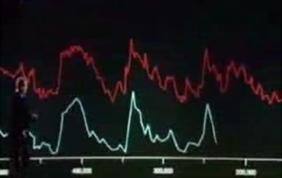
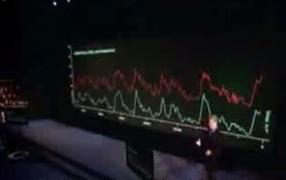
If you are connected to the internet, you can watch this segment of Gore's
movie at YouTube. I will confess that this segment is
incredibly powerful -- I mean, what kind of Luddite could argue with this
Really Big Chart?
Because it is hard to read in the movie, here is the data set that Mr. Gore
is drawing from, taken from page 24 of the recent fourth IPCC report.
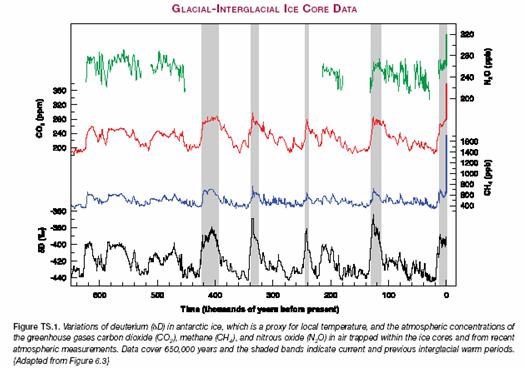
Unfortunately, things are a bit more complicated than presented by Mr. Gore
and the IPCC. In fact, Gore is really, really careful how he narrates
this piece. That is because, by the time this movie was made, scientists
had been able to study the ice core data a bit more carefully. When they
first measured the data, their time resolution was pretty course, so the two
lines looked to move together. However, with better laboratory procedure,
the ice core analysts began to find something funny. It turns out that
for any time they looked at in the ice core record, temperatures actually
increased on average 800 years before CO2 started to increase.
When event B occurs after event A, it is really hard to argue that B caused A.
So what is really going on? Well, it turns out that most of the
world's CO2 is actually not in the atmosphere, it is dissolved in the
oceans. When global temperatures increase, the oceans give up some of
their CO2, outgassing it into the atmosphere and increasing atmospheric
concentrations. Most climate scientists today (including AGW supporters)
agree that some external force (the sun, changes in the Earth's tilt and
rotation, etc) caused an initial temperature increase at the beginning of the
temperature spikes above, which was then followed by an increase in atmospheric
CO2 as the oceans heat up.
What scientists don't agree on is what happens next.
Skeptics tend to argue that whatever caused the initial temperature
increase drives the whole cycle. So, for example, if the sun caused the
initial temperature increase, it also drove the rest of the increase in that
cycle. Strong AGW supporters on the other hand argue that while the sun
may have caused the initial temperature spike and outgassing of CO2 from the
oceans, further temperature increases were caused by the increases in CO2.
The AGW supporters may or may not be right about this two-step
approach. However, as you can see, the 800-year lag substantially
undercuts the ice core data as empirical proof that CO2 is the main driver of
global temperatures, and completely disproves the hypothesis that CO2 is the
only key driver of global temperatures. We will return to this 800-year
lag and these two competing explanations later when we discuss feedback loops.
The medium view
(1000 years)
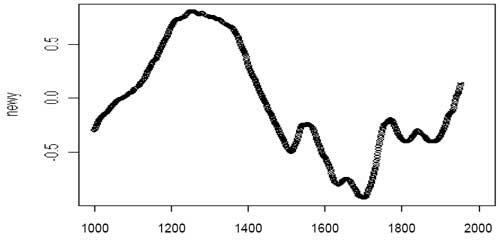
Until about 2000, the dominant reconstruction of the last
1000 years of global temperatures was similar to that shown in this chart from
the 1990 IPCC report:
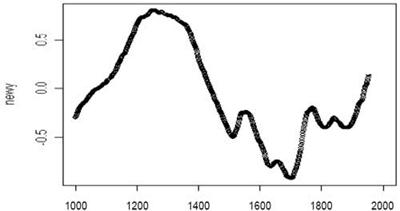
There are two particularly noticeable features on this
chart. The first is what is called the "Medieval Warm Period", peaking in
the 13th century, and thought (at least 10 years ago) to be warmer
than our climate today. The second is the "Little Ice Age" which ended at
about the beginning of the industrial revolution. Climate scientists
built this reconstruction with a series of "proxies", including tree rings and
ice core samples, which (they hope) exhibit properties that are strongly
correlated with historical temperatures.
However, unlike the 650,000 year construction, scientists
have another confirmatory source for this period: written history.
Historical records (at least in Europe) clearly show that the Middle Ages was
unusually warm, with long growing seasons and generally rich harvests (someone
apparently forgot to tell Medieval farmers that they should have smaller crops
in warmer weather). In Greenland, we know that Viking farmers settled in
what was a much warmer period in Greenland than we have today (thus the oddly
inappropriate name for the island) and were eventually driven out by falling
temperatures. There are even clearer historical records for the Little
Ice Age, including accounts of the Thames in London and the canals in Amsterdam
freezing on an annual basis, something that happened seldom before or since.
Of course, these historical records are imperfect. For
example, our written history for this period only covers a small percentage of
the world's land mass, and land only covers a small percentage of the world's
surface. Proxies, however have similar problems. For example, tree
rings only can come from a few trees that cover only a small part of the
Earth's surface. After all, it is not every day you bump into a tree that
is a thousand years old (and that anyone will let you cut down to look at the
rings). In addition, tree ring growth can be covariant with more than
just temperature (e.g. precipitation); in fact, as we continue to study
tree rings, we actually find tree ring growth diverging from values we might
expect given current temperatures (more on this in a bit).
Strong AGW supporters found the 1990 IPCC temperature
reconstruction shown above awkward for their cause. First, it seemed to
indicate that current higher temperatures were not unprecedented, and even
coincided with times of relative prosperity. Further, it seems to show
that global temperatures fluctuate widely and frequently, thus begging the
question whether current warming is just a natural variation, an expected
increase emerging from the Little Ice Age.
So along comes strong AGW proponent (and RealClimate.org
founder) Michael Mann of the University of Massachusetts. Mann
electrified the climate world, and really the world as a whole, with his revised
temperature reconstruction, shown below, and called "the Hockey Stick."
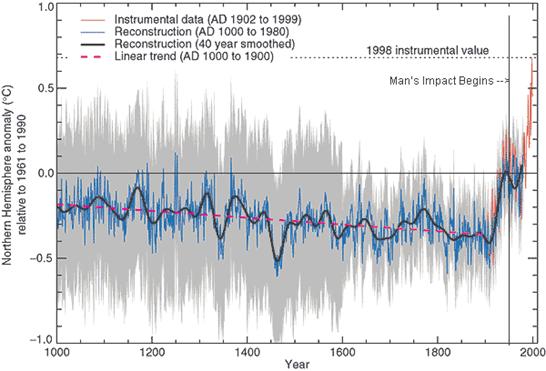
Gone was the Little Ice Age. Gone was the Medieval
Warm Period. His new reconstruction shows a remarkably stable, slightly
downward trending temperature record that leaps upward in 1900. Looking
at this chart, who could but doubt that our current global climate experience
was something unusual and unprecedented. It is easy to look at this chart
and say "“ wow, that must be man-made!
In fact, the hockey stick chart was used by AGW supporters
in just this way. Surely, after a period of stable temperatures, the 20th
century jump is an anomaly that seems to point its finger at man (though if one
stops the chart at 1950, before the period of AGW, the chart, interestingly, is
still a hockey stick, though with only natural causes).
Based on this analysis, Mann famously declared that the 1990's were the
warmest decade in a millennia and that "there is a 95 to 99% certainty
that 1998 was the hottest year in the last one thousand years." (By
the way, Mann now denies he ever made this claim, though you can watch him say
these exact words in the CBC documentary Global
Warming: Doomsday Called Off). If this is not hubris
enough, the USAToday
published a graphic, based on Mann's analysis and which is still online as
of this writing, which purports to show the world's temperature within .0001
degree for every year going back two thousand years!
To reconcile historical written records with this new view of climate
history, AGW supporters argue that the Medieval Warm Period (MWP) was limited
only to Europe and the North Atlantic (e.g. Greenland) and in fact the rest of
the world may not have been warmer. Ice core analyses have in fact verified a MWP
in Greenland, but show no MWP in Antarctica (though, as I will show later,
Antarctica is not warming yet in the current warm period, so perhaps Antarctic
ice samples are not such good evidence of global warming). AGW
supporters, then, argue that our prior belief in a MWP was based on written
records that are by necessity geographically narrowly focused. Of course,
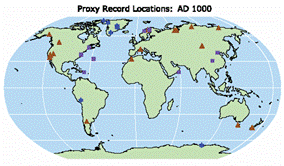
climate proxy records are not necessarily much better. For example, from
the fourth IPCC report, page 55, here are the locations of proxies used to
reconstruct temperatures in AD1000:
As seems to be usual in these reconstructions, there were a lot of arguments
among scientists about the proxies Mann used, and, just as important, chose not
to use. I won't get into all that except to say that many other climate archaeologists did not and do not agree with his choice of proxies and still
support the existence of a Little Ice Age and a Medieval Warm Period.
There also may be systematic errors in the use of these proxies which I will
get to in a minute.
But some of Mann's worst
failings were in the realm of statistical methodology. Even as a layman,
I was immediately able to see a problem with the hockey stick: it shows a
severe discontinuity or inflection point at the exact same point that
the data source switches between two different data sets (i.e. from
proxies to direct measurement). This is quite problematic.
Syun-Ichi Akasofu makes the observation that when you don't try to
splice these two data sets together, and just look at one (in this case,
proxies from Arctic ice core data as well as actual Arctic temperature
measurements) the result is that the 20th century warming in fact
appears to be part of a 250 year linear trend, a natural recovery from the
little ice age (the scaling for the ice core data at top is a chemical
composition variable thought to be proportional to temperature).

However, the real bombshell was dropped on Mann's work by a couple of
Canadian scientists named Stephen McIntyre and Ross McKitrick (M&M).
M&M had to fight an uphill battle, because Mann resisted their third party
review of his analysis at every turn, and tried to deny them access to his data
and methodology, an absolutely unconscionable violation of the principles of
science (particularly publicly funded science). M&M got very good at
filing Freedom of Information Act Requests (or the Canadian equivalent)
Eventually, M&M found massive flaws with Mann's statistical approach,
flaws that have since been confirmed by many experts, such that there are few
people today that treat Mann's analysis seriously (At best, his supporters
defend his work with a mantra roughly akin to "fake but accurate." I'll
quote the MIT
Technology Review for M&M's key finding:
But now a shock: Canadian scientists Stephen
McIntyre and Ross McKitrick have uncovered a fundamental mathematical flaw in
the computer program that was used to produce the hockey stick. "¦
[Mann's] improper normalization procedure tends to
emphasize any data that do have the hockey stick shape, and to suppress all
data that do not. To demonstrate this effect, McIntyre and McKitrick created
some meaningless test data that had, on average, no trends. This method of
generating random data is called Monte Carlo analysis, after the famous casino,
and it is widely used in statistical analysis to test procedures. When
McIntyre and McKitrick fed these random data into the Mann procedure, out
popped a hockey stick shape!
. Recently, a US Congressional Committee asked a group of
independent statisticians led by Dr. Edward Wegman, Chair of the National
Science Foundation's Statistical Sciences Committee, to evaluate the Mann
methodology. Wegman et. al. savaged the Mann methodology as well as the
peer review process within the climate community. From their findings:
It is important to note the isolation of the
paleoclimate community; even though they rely heavily on statistical methods
they do not seem to be interacting with the statistical community.
Additionally, we judge that the sharing of research materials, data and results
was haphazardly and grudgingly done. In this case we judge that there was too
much reliance on peer review, which was not necessarily independent. Moreover,
the work has been sufficiently politicized that this community can hardly
reassess their public positions without losing credibility. Overall, our committee
believes that Dr. Mann's assessments that the decade of the 1990s was the
hottest decade of the millennium and that 1998 was the hottest year of the
millennium cannot be supported by his analysis.
In 2007, the IPCC released its new climate report, and the
hockey stick, which was the centerpiece bombshell of the 2001 report, and which
was the "consensus" reconstruction of this "settled" science, can hardly be
found. There is nothing wrong with errors in science; in fact, science is
sometimes advanced the most when mistakes are realized. What is worrying
is the unwillingness by the IPCC to acknowledge a mistake was made, and to try
to learn from that mistake. Certainly the issues raised with the hockey
stick are not mentioned in the most recent IPCC report, and an opportunity to
be a bit introspective on methodology is missed. M&M, who were ripped
to shreds by the global warming community for daring to question the hockey
stick, are never explicitly vindicated in the report. The climate
community slunk away rather than acknowledging error.
In response to the problems with the Mann analysis, the IPCC
has worked to rebuild confidence in its original conclusion (i.e. that recent
years are the hottest in a millennium) using the same approach it often
does: When one line on the graph does not work, use twelve:

As you can see, most of these newer analyses actually outdo
Mann by showing current warming to be even more pronounced than in the past
(Mann is the green line near the top). This is not an unusual phenomenon
in global warming, as new teams try to outdo each other (for fame and funding)
in the AGW sales sweepstakes. Just as you can tell the newest climate
models by which ones forecast the most warming, one can find the most recent
historical reconstructions by which ones show the coldest past.
Where to start? Well, first, we have the same problem
here that we have in Mann: Recent data from an entirely different data
set (the black line) has been grafted onto the end of proxy data. Always
be suspicious of inflection points in graphs that occur exactly where the data
source has changed. Without the black line from an entirely different data set grafted on, the data would not form a hockey stick, or show anything particularly anomalous about the 20th century. Notice also a little trick, by the way "“ observe how
far the "direct measurement" line has been extended. Compare this to the
actual temperatures in the charts above. The authors have taken the
liberty to extend the line at least 0.2 degrees past where it actually should
be to make the chart look more dramatic.
There are, however, some skeptics conclusions that can be
teased out of this data, and which the IPCC completely ignores. For
example, as more recent studies have deepened the little ice age around
1600-1700, the concurrent temperature recovery is steeper (e.g. Hegerl 2007 and
Moberg 2005) such that without the graft of the black line, these proxies make
the 20th century look like part of the fairly linear temperature
increase since 1700 or at least 1800.
But wait, without that black line grafted on, it looks like the
proxies actually level off in the 20th century! In fact, from
the proxy data alone, it looks like the 20th century is nearly
flat. In fact, this effect would have been even more dramatic if lead
author Briffa hadn't taken extraordinary liberties with the data in his
study. Briffa (who replaced Mann as the lead author on this section
for the Fourth Report) in 2001 initially showed proxy-based temperatures falling
in the last half of the 20th century until he dropped out a bunch of
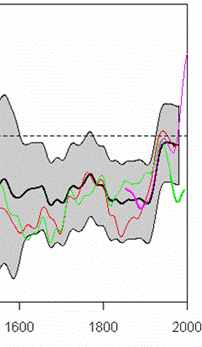
data points by truncating the line around 1950. Steve McIntyre has
reconstructed the original Briffa analysis below without the truncation (pink
line is measured temperatures, green line is Briffa's proxy data). Oops.

Note that this ability to just drop out data that does not
fit is NOT a luxury studies have in the era before the temperature record
existed. By the way, if you are wondering if I am being fair to Briffa,
here is his explanation
for why he truncated:
In the absence of a substantiated
explanation for the decline, we make the assumption that it is likely to be a
response to some kind of recent anthropogenic forcing. On the basis of this
assumption, the pre-twentieth century part of the reconstructions can be
considered to be free from similar events and thus accurately represent past
temperature variability.
Did you get that? "Likely to be a response to some
kind of recent anthropogenic forcing." Of course, he does not know what
that forcing on his tree rings is and can't prove this statement, but he throws
the data out none-the-less. This is the editor and lead author for the
historical section of the IPCC report, who clearly has anthropogenic effects on
the brain. Later studies avoided Briffa's problem by cherry-picking data
sets to avoid the same result.
We'll get back to this issue of the proxies diverging from
measured temperatures in the moment. But let's take a step back and ask
"So should 12 studies telling the same story (at least once they are truncated
and "corrected') make us more confident in the answer?" It is at this
point that it is worth making a brief mention of the concept of "systematic
error." Imagine the problem of timing a race. If one feared
that any individual might make a mistake in timing the race, he could get say
three people to time the race simultaneously, and average the results.
Then, if in a given race, one person was a bit slow or fast on the button, his
error might be averaged out with the other two for a result hopefully closer to
the correct number. However, let's say that all three are using the same
type of watch and this type watch always runs slow. In this case, no amount
of extra observers are going to make the answer any better "“ all the times will
be too low. This latter type of error is called systematic error, and is
an error that, due to some aspect of a shared approach or equipment or data
set, multiple people studying the same problem can end up with the same error.
There are a couple of basic approaches that all of these
studies share. For example, they all rely heavily on the same tree ring
proxies (in fact the same fifty or sixty trees), most of which are of one species
(bristlecone pine). Scientists look at a proxy, such as tree rings, and
measure some dimension for each year. In this case, they look at the tree
growth. They compile this growth over hundreds of years, and get a data
set that looks like 1999- .016mm, 1998, .018mm etc. But how does
that correlate to temperature? What they do is pick a period, something like
1960-1990, and look at the data and say "we know temperatures average X from
1980 to 1990. Since the tree rings grew Y, then we will use a scaling
factor of X/Y to convert our 1000 years of tree ring data to
temperatures.
I can think of about a million problems with this.
First and foremost, you have to assume that temperature is the ONLY driver for
the variation in tree rings. Drought, changes in the sun, changing soil
composition or chemistry, and even CO2 concentration substantially affect
the growth of trees, making it virtually impossible to separate out temperature
from other environmental effects in the proxy.
Second, one is forced to assume that the scaling of
the proxy is both linear and constant. For example, one has to assume a
change from, say, 25 to 26 degrees has the same relative effect on the proxy as
a change from 30 to 31 degrees. And one has to assume that this scaling
is unchanged over a millennium. And if one doesn't assume the scaling is
linear, then one has the order-of-magnitude harder problem of deriving the
long-term shape of the curve from only a decade or two of data. For a
thousand years, one is forced to extrapolate this scaling factor from just one
or two percent of the period.
But here is the problem, and a potential source for
systematic error affecting all of these studies: Current proxy data is
wildly undershooting prediction of temperatures over the last 10-20
years. In fact, as we learned above, the proxy data actually shows little
or no 20th century warming. Scientists call this "divergence"
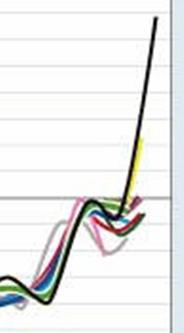
of the proxy data. If Briffa had hadn't artificially truncated his data
at 1950, the effect would be even more dramatic. Below is a magnification
of the spaghetti chart from above "“ remember the black line is "actual," the
other lines are the proxy studies.
|
|
In my mind, divergence is quite damning. It implies
that scaling derived from 1960-1980 can't even hold up for the next decade,
much less going back 1000 years! And if proxy data today can be
undershooting actual temperatures (by a wide margin) then it implies it could
certainly be undershooting reality 700 years ago. And recognize that I am
not saying one of these studies is undershooting "“ they almost ALL are
undershooting, meaning they may share the same systematic error. (It
could also mean that measured surface temperatures are biased high, which we
will address a bit later.
The short view (100
years)
The IPCC reports that since 1900, the world's surface has
warmed about 0.6C, a figure most folks will accept (with some provisos I'll get
to in a minute about temperature measurement biases). From
the NOAA Global Time Series:
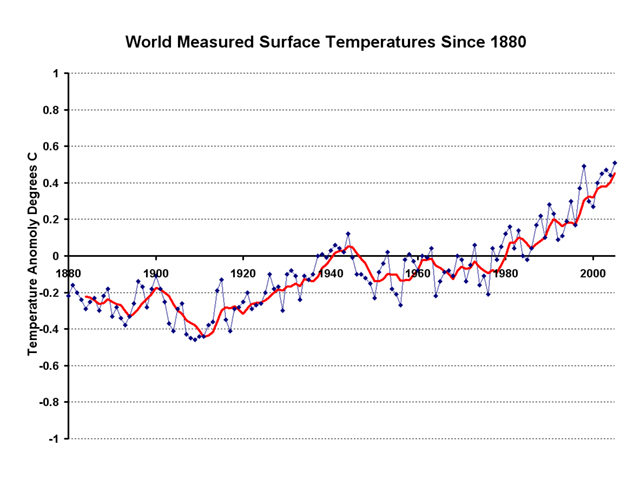
This is actually about the same data in the Mann hockey stick chart -- it
only looks less frightening here (or more frightening in Mann) due to the
miracle of scaling. Next, we can overlay CO2:
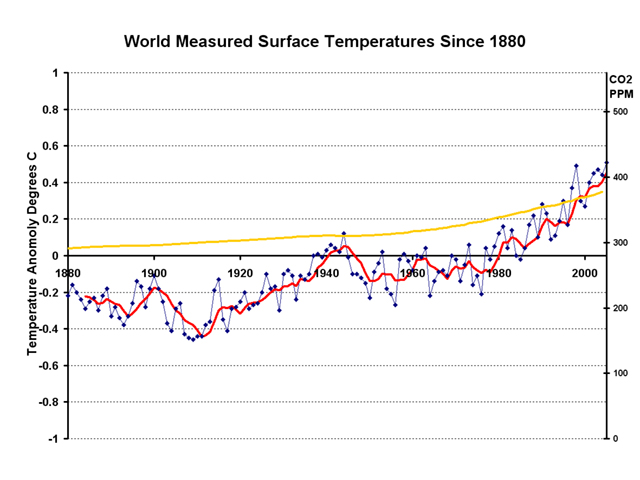
This chart is a real head-scratcher for scientists trying to
prove a causal relationship between CO2 and global temperatures. By
theory, temperature increases from CO2 should be immediate, though the oceans
provide a big thermal sink that to this day is not fully understood.
However, from 1880 to 1910, temperatures declined despite a 15ppm increase in
CO2. Then, from 1910 to 1940 there was another 15ppm increase in CO2 and
temperatures rose about 0.3 degrees. Then, from 1940-1979, CO2 increased
by 30 ppm while temperatures declined again. Then, from 1980 to present,
CO2 increased by 40 ppm and temperatures rose substantially. By grossly
dividing these 125 years into these four periods, we see two long periods
totaling 70 years where CO2 increases but temperature declines and two long
periods totaling 55 years of both CO2 and temperature increases.
 By no means does this variation disprove a causal relation
between CO2 concentrations and global temperature. However, it also can
be said that this chart is by no means a slam dunk testament to such a
relationship. Here is how strong AGW supporters explain this data:
Strong AGW supporters will assign most, but not all, of the temperature
increase before 1950 to "natural" or non-anthropogenic causes. The current
IPCC report in turn assigns a high probability that much or all of the warming after
1950 is due to anthropogenic sources, i.e. man-made CO2. Which still
leaves the cooling between 1940 and 1979 to explain, which we will cover
shortly.
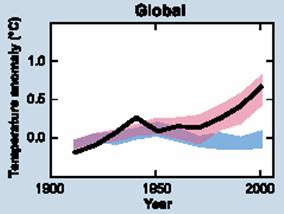
Take this chart from the fourth IPCC report (the blue band
is what the IPCC thinks would have happened without anthropogenic effects, the
pink band is their models' output with man's influence, and the black line is
actual temperatures (greatly smoothed).
Scientists know that "something" caused the pre-1950
warming, and that something probably was natural, but they are not sure exactly
what it was, except perhaps a recovery from the little ice age. This is
of course really no answer at all, meaning that this is just something we don't
yet know. Which raises the dilemma: if whatever natural effects were
driving temperatures up until 1950 cannot be explained, then how can anyone say
with confidence that this mystery effect just stops after 1950, conveniently at
the exact same time anthropogenic warming "takes over"? As you see here,
it is assumed that without anthropogenic effects, the IPCC thinks the world
would have cooled after 1950. Why? They can't say. In fact, I
will show later that this assumption is really just a necessary plug to prevent
their models from overestimating historic warming. There is good evidence
that the sun has been increasing its output and would have warmed the world,
man or no man, after 1950.
But for now, I leave you with the question "“ If we don't
know what natural forcing caused the early century warming, then how can we say
with confidence it stopped after 1950? (By the way, for those of you
who already know about global cooling/dimming and aerosols, I will just say for
now that these effects cannot be making the blue line go down because the IPCC
considers these anthropogenic effects, and therefore in the pink band.
For those who have no idea what I am talking about, more in a bit).
Climate scientist Syun-Ichi Akasofu of the International
Arctic Research Center at University of Alaska Fairbanks makes
a similar point, and highlights the early 20th century
temperature rise:
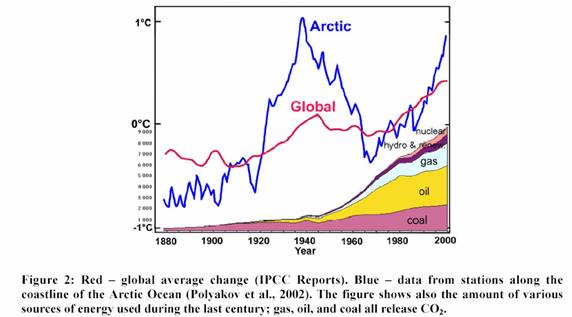
Again, what drove the Arctic warming up through 1940?
And what confidence do we have that this forcing magically went away and has
nothing to do with recent temperature rises?
Sulfates, Aerosols,
and Dimming
Strong AGW advocates are not content to say that CO2 is one
factor among many driving climate change. They want to be able to say CO2
is THE factor. To do so with the historical record over the last 100
years means they need to explain why the world cooled rather than warmed from
1940-1979.
Strong AGW supporters would prefer to forget the global
cooling hysteria in the 1970s. During that time, the media played up
scientific concerns that the world was actually cooling, potentially
re-entering an ice age, and that crop failures and starvation would
ensue. (It is interesting that AGW proponents also predict agricultural
disasters due to warming. I guess this means that we are, by great coincidence,
currently at the exact perfect world temperature for maximizing agricultural
output, since either cooling or warming would hurt production). But even
if they want to forget the all-too-familiar hysteria, they still need to
explain the cooling.
What AGW supporters need is some kind of climate effect that
served to reduce temperatures starting in 1940 and that went away around
1980. Such an effect may actually exist.
There is a simple experiment that meteorologists have run
for years in many places around the world. They take a pan of water of
known volume and surface area and put it outside, and observe how long it takes
for the water to evaporate. If one correctly adjusts the figures to
reflect changes in temperature and humidity, the resulting evaporation rate
should be related to the amount of solar irradiance reaching the pan. In
running these experiments, there does seem to be a reduction of solar
irradiance reaching the Earth, perhaps by as much as 4% since 1950. The
leading hypothesis is that this dimming is from combustion products including
sulfates and particulate matter, though at this point this is more of a
hypothesis than demonstrated cause and effect. The effect is often called
"global dimming."
 The aerosol hypothesis is that sulfate aerosols and black carbon are the
main cause of global dimming, as they tend to act to cool the Earth by
reflecting and scattering sunlight before it reaches the ground. In
addition, it is hypothesized that these aerosols as well as particulates from
combustion may act to seed cloud formation in a way that makes clouds more
reflective. The nations of the world are taking on sulfate and
particulate production, and will likely substantially reduce this production
long before CO2 production is reduced (mainly because it is possible with
current technology to burn fossil fuels with greatly reduced sulfate output,
but it is not possible to burn fossil fuels with greatly reduced CO2
output). If so, we might actually see an upward acceleration in
temperatures if aerosols are really the cause of dimming, since their removal
would allow a sort-of warming catch-up.
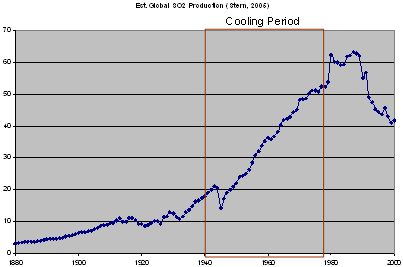
Sulfates do seem to be a pretty good fit with the cooling
period, but a couple of things cause the fit to be well short of perfect.
First, according to Stern,
production of these aerosols worldwide (right) did not peak until 1990, at
level almost 20% higher than they were in the late 1970's when the global
cooling phenomena ended.
One can also observe that sulfate production has not fallen
that much, due to new contributions from China and India and other developing
nations (interestingly, early drafts of the fourth IPCC report hypothesized
that sulfate production may not have decreased at all from its peak, due to
uncertainties in Asian production). Even today, sulfate levels have not
fallen much below where they were in the late 1960's, at the height of the
global cooling phenomena, and higher than most of the period from 1940 to 1979
where their production is used to explain the lack of warming.
Further, because they are short-lived, these sulfate dimming effects really only can be
expected to operate over in a few isolated areas around land-based industrial areas, limiting their effect on global temperatures
since they effect only a quarter or so of the globe. You can see this below, where high sulfate aerosol concentrations, show in orange and red, only cover a small percentage of the globe.
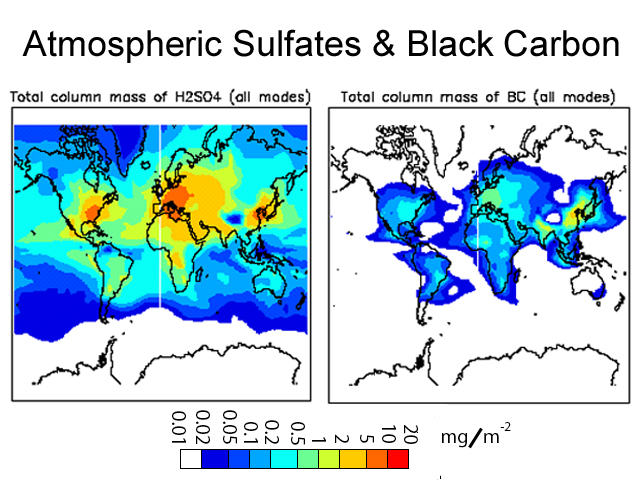
Given these areas, for the whole world to be cooled 1 degree C by aerosols and black carbon, the areas in orange and red would have to cool 15 or 20C, which absolutely no one has observed. In fact, since as you can see, most of these aerosols are in the norther hemisphere, one would expect that, if cooling were a big deal, the northern hemisphere would have cooled vs. the southern, but in fact as we will see in a minute exactly the opposite is true -- the northern hemisphere is heating much faster than the south. Research
has shown that dimming is three times greater in urban areas close to where the
sulfates are produced (and where most university evaporation experiments are
conducted) than in rural areas, and that in fact when you get out of the
northern latitudes where industrial society dominates, the effect may actually
reverse in the tropics.
There are, though, other potential explanations for
dimming. For example, dimming may be an effect of global warming
itself. As I will discuss in the section on feedback processes later,
most well-regulated natural systems have feedback mechanisms that tend to keep
trends in key variables from "running away." In this case, warming may be
causing cloud formation due to increased evaporation from warmer oceans.
It is also not a done deal that test evaporation from pans
necessarily represents the rate of terrestrial evaporation. In fact,
research has shown that pan evaporation can decrease because surrounding
evaporation increases, making the pan evaporation more an effect of atmospheric
water budgets and contents than irradiance.
This is a very important area for research, but as with
other areas where promoters of AGW want something to be true, beware what you
hear in the media about the science. The IPCC's fourth report continues
to say that scientific understanding of many of these dimming issues is
"low." Note also that global dimming does not "prove" AGW by any means,
it merely makes the temperature-CO2 correlation better in the last half of the
20th century. All the other issues we have discussed remain.
The Troposphere
Dilemma and Urban heat islands
While global dimming may be causing us to under-estimate the
amount of global warming, other effects may be causing us to over-estimate
it. One of the mysteries in climate science today has to do with
different rates of warming on the Earth's surface and in the troposphere (the
first 10km or so of atmosphere above the ground). AGW theory is pretty
clear "“ the additional heat that is absorbed by CO2 is added to the
troposphere, so the troposphere should experience the most warming from
greenhouse gasses. Some but not all of this warming will transfer to the
surface, such that we should expect temperature increases from AGW to be larger
in the troposphere than at the surface.
Well, it turns out that we have two ways to measure
temperature in the troposphere. For decades, weather balloons have been
sent aloft to take temperature readings at various heights in the
atmosphere. Since the early 70's, we have also had satellites capable of
mapping temperatures in the troposphere. From Spencer and Christy, who
have done the hard work stitching the satellite data into a global picture,
comes this chart of satellite-measured temperatures in the troposphere.
The top chart is Global, the middle is the Northern Hemisphere, the bottom is
the Southern Hemisphere
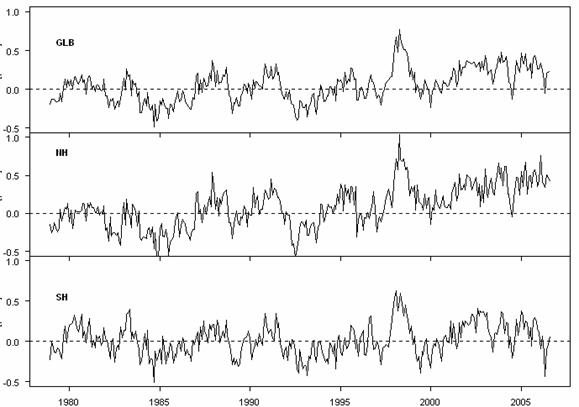
You will probably note a couple of interesting things.
The first is that while the Northern hemisphere has apparently warmed about a
half degree over the last 20 years, the Southern hemisphere has not warmed at
all, at least in the troposphere. You might assume this is because the
Northern Hemisphere produces most of the man-made CO2, but scientists have
found that there is very good global mixing in the atmosphere, and CO2
concentrations are about the same wherever you measure them. Part of the
explanation is probably due to the fact that temperatures are more stable in
the Southern hemisphere (since land heats and cools faster than ocean, and
there is much more ocean in the southern half of the globe), but the surface
temperature records do not show such a north-south differential. At the
end of the day, nothing in AGW adequately explains this phenomenon. (As
an aside, remember that AGW supporters write off the Medieval Warm Period
because it was merely a local phenomena in the Northern Hemisphere not observed
in the south "“ can't we apply the same logic to the late 20th
century based on this satellite data?)
An even more important problem is that the global
temperature increases shown here in the troposphere over the last several
decades have been lower than on the ground, exactly opposite of predictions
by AGW theory,
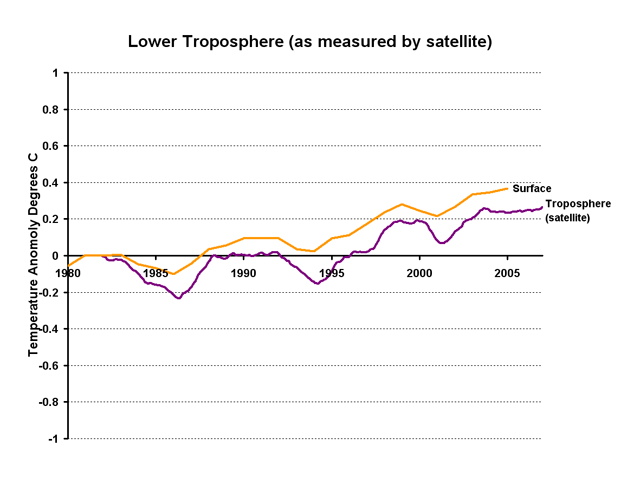
In 2006, David Pratt
put together a combined chart of temperature anomalies, comparing satellite
measurements of the troposphere with ground temperature measurements. He
found, as shown in the chart below, but as you can see for yourself visually in
the satellite data, that surface warming is substantially higher over the last
25 years than warming of the troposphere. In fact, the measured anomaly
by satellite (and by balloon, as we will see in a minute) is half or less than
the measured anomaly at the surface.
There are a couple of possible explanations for this
inconsistency. One, of course, is that there is something other than
CO2-driven AGW that is at least partially driving recent global temperature
increases. We will cover several such possibilities in a later chapter on
alternative theories. One theory that probably does not explain
this differential is global dimming. If anything, global dimming should
work the other way, cooling the ground vs. the troposphere. Also, since
CO2 works globally but SO2 dims locally, one would expect more cooling effect
in the northern vs. the southern hemisphere, while actually the opposite is
observed.
Another possible explanation, of course, is that one or the other
of these data sets has a measurement problem. Take the satellite
data. The measurement of global temperatures from space is a relatively
new art, and the scientists who compile the data set have been through a number
of iterations to their model for rolling the measurements into a reliable
global temperature (Christy just released version 6). Changes over the
past years have actually increased some of the satellite measurements (the
difference between ground and surface used to be even greater). However,
it is unlikely that the quality of satellite measurement is the entire reason
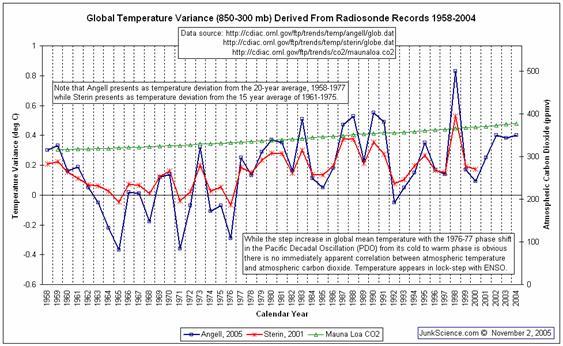
for the difference for the simple reason that troposphere measurement by
radiosonde weather balloons, a much older art, has reached very consistent
findings (if anything, they show even less temperature increase since
1979).
A more likely explanation than troposphere measurement
problems is a measurement problem in the surface data. Surface data is
measured at thousands of points, with instruments of varying types managed by
different authorities with varying standards. For years, temperature
measurements have necessarily been located on land and usually near urban areas
in the northern hemisphere. We have greatly increased this network over
time, but the changing mix of reporting stations adds its own complexity.
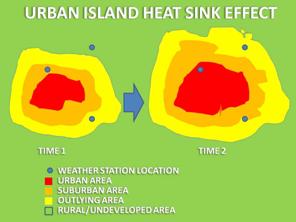
The most serious problem with land temperature data is from
urban heat islands. Cities tend to heat their environment. Black
asphalt absorbs heat, concrete covers vegetation, cars and power sources
produce heat. The net effect is that a city is several degrees hotter
than its surroundings, an effect entirely different from AGW, and this effect
tends to increase over time as the city gets larger. (Graphic
courtesy of Bruce Hall)
Climate scientists sometimes (GISS "“ yes, NOAA -- no)
attempt to correct measurements in urban areas for this effect, but this can be
chancy since the correction factors need to change over time, and no one really
knows exactly how large the factors need to be. Some argue that the
land-based temperature set is biased too high, and some of the global warming
shown is in fact a result of the UHI effect.
Anthony Watts
has done some great work surveying the problems with long-term temperature
measurement (some of which was obtained for this paper via Steve McIntyre's Climate Audit blog).
He has been collecting pictures of California measurement sites near his home,
and trying to correlate urban building around the measurement point with past
temperature trends. More importantly, he has created an online database
at SurfaceStations.org where
these photos are being put online for all researchers to access.

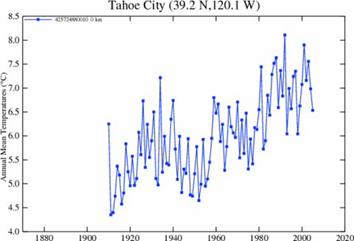
The tennis courts and nearby condos were built in 1980, just
as temperature measurement here began going up. Here is another, in
Marysville, CA, surrounded by asphalt and right next to where cars park with
hot radiators. Air conditioners vent hot air right near the thermometer,
and you can see reflective glass and a cell tower that reflect heat on the
unit. Oh, and the BBQ the firemen here use 3 times a week.
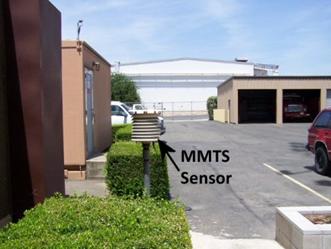
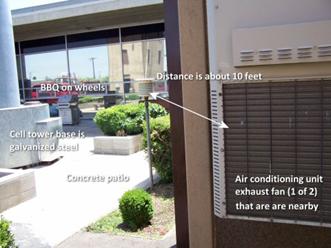
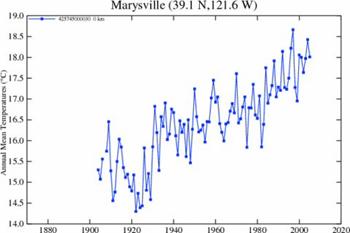
So how much of this warming is
from the addition of air conditioning exhaust, asphalt paving, a nearby
building, and car radiators, and how much is due to CO2. No one
knows. The more amazing thing is that AGW supporters haven't even tried
to answer this question for each station, and don't even seem to care.
As of June 28, 2007, The
SurfaceStations.org documentation effort received a setback when the NOAA, upon
learning of this effort, removed surface station location information from
their web site. The only conclusion is that the NOAA did not want the shameful
condition of some of these sites to be publicized.
I have seen sites like RealClimate arguing in their myth
busting segments that the global temperature models are based only on rural
measurements. First, this can't be, because most rural areas did not have
measurement in the early 20th century, and many once-rural areas are
now urban. Also, this would leave out huge swaths of the northern
hemisphere. And while scientists do try to do this in the US and Europe
(with questionable success, as evidenced by the pictures above of sites that
are supposedly "rural"), it is a hopeless and impossible task in the rest of
the world. There just was not any rural temperature measurement in China
in 1910.
Intriguingly, Gavin Schmidt, a lead researcher at NASA's
GISS, wrote
Anthony Watts that criticism of the quality of these individual temperature
station measurements was irrelevant because GISS climate data does not relay on
individual station data, it relies on grid cell data. Just as background,
the GISS has divided the world into grid cells, like a matrix (example below).

Unless I am missing something fundamental, this is an
incredibly disingenuous answer. OK, the GISS data and climate models use
grid cell data, but this grid cell data is derived from ground measurement
stations. So just because there is a statistical processing step between
"station data" and "grid cell data" does not mean that at its core, all the
climate models don't rely on station data. All of these issues would be
easier to check of course if NASA's GISS, a publicly funded research
organization, would publicly release the actual temperature data it uses and
the specific details of the algorithms it uses to generate and smooth and
correct grid cell data. But, like most all of climate science, they
don't. Because they don't want people poking into it and criticizing
it. Just incredible.
As a final note, for those that think something as seemingly
simple as consistent temperature measurement is easy, check out this theory
courtesy of Anthony
Watts.
It seems that weather stations shelters known as Stevenson Screens (the
white chicken coop like boxes on stilts housing thermometers outdoors) were
originally painted with whitewash, which is a lime based paint, and reflective
of infra-red radiation, but its no longer available, and newer paints have been
used that [have] much different IR characteristics.
Why is this important? Well, paints that appear
"white" and reflective in visible light have different properties in
infrared. Some paints can even appear nearly "black" and absorb a LOT
of infrared, and thus bias the thermometer. So the repainting of thousands of
Stevenson screens worldwide with paints of uncertain infrared characteristics
was another bias that has crept into the instrumental temperature records.
After running this test, Watts actually ran an experiment comparing wood
that had been whitewashed vs. using modern white latex paint. The
whitewashed wood was 5 degrees cooler than the modern latex painted wood.
It is often argued by AGW supporters that because the
historic warming is so close to what the current global warming models say
historic temperatures should look like, and because the models are driven by
CO2 forcings, then CO2 must be causing the historic temperature increase.
We are going to spend a lot of time with models in the next chapter, but here
are a few thoughts to tide us over on this issue.
The implication here is that scientists carefully crafted
the models based on scientific theory and then ran the models, which nearly
precisely duplicated history. Wrong. In fact, when the models were
first built, scientists did exactly this. And what they got looked
nothing like history.
So they tweaked and tuned, changing a constant here, adding
an effect (like sulfates) there, changing assumptions about natural forcings,
until the models matched history. The models match history because they
were fiddled with until they matched history. The models say CO2 caused
warming because they were built on the assumption that CO2 causes
warming. So, unless one wants to make an incredibly circular argument,
the models are useless in determining how much CO2 affects history. But
we'll get to a lot more on models in the next chapter.
The table of contents for the rest of this paper, . 4A Layman's Guide to Anthropogenic Global Warming (AGW) is here. Free pdf of this Climate Skepticism paper is here and print version is sold at cost here
The open comment thread for this paper can be found here.