Currently pregnant women are asked if they smoke by midwives and GPs but the National Institute for health and Clinical Excellence (Nice) wants this to go further.
The organisation has recommended that all pregnant women should have their breath measured for carbon monoxide levels when they book in with a midwife.
This would establish which women smoke and provide an added incentive for them to quit, the guidance said.
I am sure all the women's organizations whose principled stand against abortion restrictions were based on protecting the privacy of one's body from the heavy hand of government will now rise up in protest. Not.
As it turns out, and as I have writtenbefore, most women's groups seem to favor total intrusion of government into every facet of individual health care decision-making EXCEPT abortion. The privacy and libertarian-sounding abortion arguments were really just slights of hand, rolled out to prevent government bans on one particular procedure, and then tucked away when the government proposes to control every other procedure.
A little noticed provision in the recently passed health care reform bill will require every payment to corporations over $600 to be reported on a Form 1099 to the IRS, including payments for the purchase of merchandise and services. This provision takes effect in 2012.
The current law requires a Form 1099 to be submitted to the IRS when your business pays more than $600 for rent, interest, dividends, and non-employee services if the payments are made to entities other than corporations. Currently, payments made to a corporation and payments for merchandise are not required to be reported.
To file the required 1099, a business will have to obtain and keep track of a Taxpayer Information Number (TIN) from every vendor before submitting the 1099 to that business and the IRS. Under current tax law, one copy of the form is sent to the IRS, and another copy is sent to the person to whom the business made the payments.
Rep. Dan Lungren (CA-3) introduced "The Small Business Paperwork Mandate Elimination Act" (H.R. 5141). The legislation would repeal the expanded 1099 reporting requirement. Lungren correctly asserts that the burdens placed on small businesses by this reporting requirement would be overwhelming.
Call your U.S. Representative today and ask them to cosponsor H.R. 5141. The House switchboard number is 202-225-3121. Ask to be connected to your Representative's office.
My small business has over a thousand vendors. I would have to hire someone full time for a month to do this. And it would be to zero purpose. The IRS would be so flooded with forms that there would be no way they could pull any useful information from the blizzard. This is yet another example of legislators operating with absolutely no idea how commerce actually works. We have coined a name for it within our firm -- we call it arrogant ignorance.
I'm stunned that there wasn't a broader debate before such a costly mandate was enacted. If it goes into effect, it will waste vast quantities of human effort in filling out forms, reworking computer systems, collecting and organizing data, and fighting the IRS. The struggling American economy can't afford anymore suffocating tax regulations. This mandate is a giant deadweight loss. It should be repealed.
I have written any number of times about government health care as the excuse to regulate nearly everything, since nearly every individual decision and activity can be argued to affect one's health. If government is paying the health care bills, it now has an interest in regulating behaviors that might raise those bills. Given the US government has been on a 80-year mission to end the concept of individual responsibility, Obamacare is a huge milestone.
You see, Ms. Kaplan obviously thinks it is the role of government to "help Americans eat healthier" even if it means banning things. My guess is she'd not be quite as ready for government bans it they had to do with, oh I don't know, books or something similar.The excuse?
In Santa Clara County, one out of every four kids is either overweight or obese. Among 2- to 5-year-olds from low-income families, the rate is one in three. The county health system spends millions of dollars a year treating kids for health problems related to obesity, and the tab is growing.
If you haven't yet figured out that the passage of ObamaCare has emboldened the nannies at all levels, this ought to make the case. Trust me, this reporter didn't dig this nugget out. It was handed to her by those trying to justify this power grab.
Yeah, I know this is just a local action, but this is just a market test for future similar federal actions. I can just picture John Jay and James Madison arguing in a tavern. "Jimmy, I am just not sure what kind of Constitution we need. Well, John, whatever we do, we absolutely must make sure the Federal government has the power to ban toys from kids meals. Oh, and to regulate salt content too. After all, that's what we fought a war for."
Postscript: My question is, how long are health cost advocates going to nibble at the margins? Childhood obesity costs are probably close to zero, in the grand scheme of things, despite the BS numbers from "advocates." Two individual decisions drive a ton of health care costs - driving (the most dangerous activity we pursue, typically) and sex (not just in disease but in pre and post natal care). And I wonder how long it will be before government health care costs treating gunshot victims will be used to trump 2nd amendment arguments?
The recent bankruptcy of the USPS and the proposal to cut Saturday delivery has interesting implications for government and health care. Everyone, from the GAO to the management of the USPS know that there are substantial productivity improvement that could be had with better labor deployment and employee accountability, but no one has the will to take on the union. As a result, the only cost cutting idea they can propose is service cuts. Which is further proof of what I have been saying for a couple of years -- that despite all the hopey changey talk, the only real idea anyone in the Obama administration or Congress can come up with for health care cost reduction is reduced services and/or price controls (which reduce supply and thus services).
I think this article makes it clear that, no matter what the rhetoric, the only health care cost control idea Obama and the Democrats ever had was saying "no" to care. Whatever one calls this (managed care, rationing, death panels) it is really not that much different from what insurance companies have been doing for years. And it is areal irony that Democrats passed this legislation feeding off anger of voters with insurance companies saying "no", when their plan really depends on the government saying "no" even more often (or else there won't be any cost savings).
The author argues that information is important for patients to make better decisions:
When patients are given information about potential benefits and risks, they seem to choose less invasive care, on average, than doctors do, according to early studies. Some people, of course, decide that aggressive care is right for them "” like the cancer patient (and palliative care doctor) profiled in this newspaper a few days ago. They are willing to accept the risks and side effects that come with treatment. Many people, however, go the other way once they understand the trade-offs.
They decide the risk of incontinence and impotence isn't worth the marginal chance of preventing prostate cancer. Or they choose cardiac drugs and lifestyle changes over stenting. Or they opt to skip the prenatal test to determine if their baby has Down syndrome. Or, in the toughest situation of all, they decide to leave an intensive care unit and enter a hospice.
I agree, but I would go further -- information and incentives are important. And the absolute most important bit of information when it comes to cost control is price, and patients under Obamacare have absolutely no incentive to give a sh*t about price even if they were informed of it. Exactly the opposite of the incentives I have had since I took on a high-deductible health care policy several years ago.
Update:Brad Warbiany discusses the proposed IPAB and its powers to shape health care spending in the context of Congress as an addict trying to control its impulses. However, I think Brad underestimates the power of the board to be captured. What will result is rulings for more coverage of procedures with powerful lobbies, offset by less coverage of procedures with weaker lobbies, irrespective of the science. Just look at the diseases the NIH and NSF gives grant money for -- the grants have nothing to do with the science of where research could be most productive and everything to do with diseases that have large and powerful constituencies.
Update #2: Isn't it interesting to see the NY Times, after arguing for months that Obamacare was not about rationing, is now admitting that rationing is the key to success. It reminds me of this that I wrote a while back:
I have decided there is something that is very predictable about the media: they usually are very sympathetic to legislation expanding government powers or spending when the legislation is being discussed in Congress. Then, after the legislation is passed, and there is nothing that can be done to get rid of it, the media gets really insightful all of a sudden, running thoughtful pieces about the hidden problems and unintended consequences of the legislation.
Medicare already faces a $30 Trillion deficit. The bigger issue is that Democrats are poised to make cuts in Medicare -- something that is incredibly difficult to do -- but instead of applying those cuts towards Medicare, they are applying it towards a lavish new entitlement program.
Of course, that assumed that the spending estimates for the new health care plan are meaningful, which is highly unlikely, since every single entitlement of this kind has always vastly outspent its initial estimates. Greece, here we come.
Yes, the Europeans pay less per person for health care. Is the care as good?
Well, when life-expectancies are adjusted for things that are not amenable to the health care system (like murder rates), Americans have the highest life expectancy in the world, and by far the highest cancer survival rates.
The prices we pay for drugs and medical devices, while high, effectively subsidize the entire world's medical R&D.
In a survey, people were asked how they felt about various forms of medical care for a urinary tract infection or for influenza. While people preferred traditional, office-based care, they would opt to see a nurse-practitioner at a retail clinic if they could save at least $31.42. They would wait one day or more for an appointment if they would save at least $82.12.
The researchers concluded that the appointment wait period is the most important determining factors in an individual's choice on where to seek care for minor health problems such as influenza. Primary-care doctors who fear their business will be undercut by the growing popularity of retail health clinics may want to offer more same-day appointments and walk-in hours."
...
"This study is the first in the United States to quantify the relative importance of and the utility associated with the main attributes of retail clinics. The utility (willingness to pay) associated with receiving same-day care is more than twice the utility associated with receiving care from a physician. Primary care physician practices, especially in competitive markets, are therefore likely to derive greater competitive advantage by addressing patient convenience features (such as same-day scheduling, walk-in hours, and extended hours) than by reducing fees."
Follow the link for more and a link to the original study. Patient convenience is the LAST thing government health care systems design for, but apparently, what actual people most want.
I say over and over, yes, we could reduce the cost of medical care (but by increasing the accountability of individuals for paying for their own care, exactly the opposite direction taken by the Obama plan). But a big reason that we pay more is not because we are stupid and incompetent, but because we can because we are wealthier. It is incontrovertible that we are wealthier per capital than the Europeans -- is it surprising that we would choose to spend a large portion of this extra wealth on our health?
There just seems to be a tremendous mental block people have about paying cash for health care. Megan McArdle is surprised at how strong this bias is in some of her readers. I'm not, as I see it in my wife and friends all the time.
Several years ago we switched to a high-deductible catastrophic health care policy. We save a TON of money with this policy, such that year in and year out, even with fairly high out of pocket expenditures, our total health care expenses have been lowered.
Generally, I go ahead and wash all of the charges through the policy so I get credit for them against the cumulative deductible. But since we have never hit the number, I am increasingly less attached to this approach. Particularly since a number of doctors and other providers are offering cash discounts now for bypassing insurance and paying cash.
Here is an example -- my son has had some elbow pain pitching lately, so seeing all the kids who are having to get Tommy John surgery before they are out of high school, we decided to make sure everything was OK. We took him to a GP who specialized in sports medicine and works with a number of MLB pitchers as a team physician to the Brewers. For cash, he charged me $50 and spent nearly 30 minutes with my son. Then he sent us downstairs for some x-rays of his elbow, and the radiology group there, again for cash, charged us $35 total for three x-rays. There are people who pay more for a pedicure.
Nothing is ever going to improve in health care costs until individuals take more responsibility for the cost-benefit tradeoffs of the services they receive.
"As the government assumes a larger share of health care costs, it is increasingly able to use that as a justification to intrude into personal decisions or private enterprises, whether it's a matter of smoking policy, trans-fats, or salt," we wrote last month. Now the Wall Street Journal is out with an editorial praising Michelle Obama's campaign against childhood obesity, reasoning, "the reality is that U.S. obesity imposes huge costs on taxpayers. In 2006, the per capita increase in spending attributable to obesity was 36% for Medicare and 47% for Medicaid, according to a paper last year in Health Affairs. Many fat kids grow up to be fat adults, and you've got to start somewhere."
Almost any behavior or decisions, from eating to driving to sports participation, has implications on one's potential future health care costs. So by this logic, almost anything can be regulated. For example, I would argue that sex has a much higher health care cost impact than eating, not just in STD's but in the cost of pregnancies and pediatrics. Or as another example, our family spent far more in health care costs on treating our kids' accidents while playing sports than in dealing with any obesity costs. Should we be requiring kids to stay indoors playing on the computer where they will be safe from potentially expensive accidents?
I am sure there are more landmines hidden in the Senate Bill, but the Heritage Foundation has parsed an implementation schedule from the most recent bill:
2010: Physician Medicare payments decrease 21% effective March 1, 2010
2011: "Annual Fee" tax on health insurance, allocated according to share of total premiums. Begins at $2 billion in 2011, then increases to $4 billion in 2012, $7 billion in 2013, $9 billion in the years 2014, 2015, and 2016, and eventually $10 billion for 2017 and every year thereafter. Two insurers in Nebraska and one in Michigan are exempt from this tax.
2012: Medicare payment penalties for hospitals with the highest readmission rates for selected conditions.
2013: Medicare tax increased from 2.9% to 3.8% for incomes over $250,000 (joint filers) or $200,000 (all others). (This is stated as an increase of 0.9 percentage points, to only the employee's share of the FICA tax.)
2014: Individual mandate begins: Tax penalties for not having insurance begin at $95 or 0.5% of income, whichever is higher, rising to $495 or 1% of income in 2015 and $750 or 2% of income thereafter (indexed for inflation after 2016). These penalties are per adult, half that amount per child, to a maximum of three times the per-adult amount per family. The penalty is capped at the national average premium for the "bronze" plan.
2015: Establishment of Independent Medicare Advisory Board (IMAB) to recommend cuts in Medicare benefits; these cuts will go into effect automatically unless Congress passes, and the President signs, an override bill.
2016: Individual mandate penalty rises to $750 per adult ($375 per child), maximum $2,250 per family, or 2% of family income, whichever is higher (capped at the national average premium for the "bronze" plan). After 2016, the penalty will be increased each year to adjust for inflation.
There is a link in the original to a more detailed timeline. There is a lot more that is left out of this brief timeline, see it here.
There are very few problems that can't be traced to information and incentives. I thought of this when Tyler Cowen discusses an attempt to improve health care costs with better information:
The health care reform bill before the U.S. Senate would require hospitals to publicize their standard charges for services, but New Hampshire and Maine have gone much further in trying to make health care costs more transparent to consumers.
New Hampshire and Maine are the only states with Web sites that let consumers compare costs based on insurance claims paid there.
In New Hampshire, the price variation across providers hasn't lessened since the Web site went live in 2007.
The problem is that this is all useless if individuals have not particular incentive to shop. If I were on Unemployment, would I bother to check a web site to see which unemployment offices had the lowest operating costs and go there to get my check? No way, what incentive would I have to do so? I am going to the closest one, or the one with the fewest lines. Ditto with most people and health care:
Of course, the new health care bill will only make this worse. Those of us who actually have an incentive to shop, either with high deductible policies and/or HSA's will see our policies banned. The new health care bill has done nothing but attempt to drive this line all the way to zero.
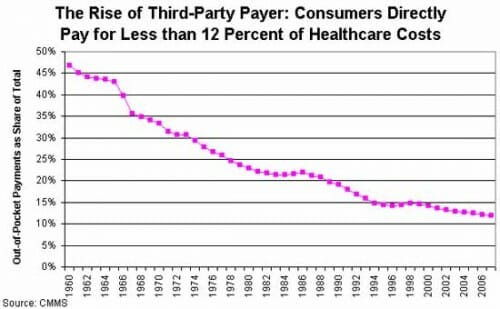
Patients have little direct connection in paying for their care. Their role has fallen significantly. Meanwhile, the government's involvement has grown, as has that of the insurance industry.Because so many Americans rely on an insurance policy or a government program to pay their health care bills, the internal governors that temper the rest of their purchases are turned off. When a visit to the doctor's office or a diagnostic test costs them a mere $10 or $20 co-payment out of pocket "” or there is no charge at all "” cost has little impact on their decision to see a doctor.
"By not knowing the full costs associated with health care, consumers demand more and 'overuse' it," Kenneth E. Thorpe explained a few years back in Health Affairs.
Americans would be more judicious in seeking health care "” they would self-ration "” if the right incentives were in place. An effective way to cut overuse and bring down costs would be to encourage through public policy the use of health savings accounts. If consumers used HSAs to pay the full amount for medical care at the point of service rather than letting employer-funded insurance or a government program pay the bills, the demand would fall.
The Democrats' health care legislation, however, puts more distance between Americans and the payment process and promotes dependence on government. That will only drive down consumers' out-of-pocket expenses even further and force overall health care spending upward. Under such a regime, the system will be worse off than it is now.
A last-minute change in the federal health care bill ditched a proposed 5 percent tax on cosmetic medical procedures and replaced it with a 10 percent tax on indoor tanning services.
Goodbye Botox tax. Hello tan tax.
This seems really random. Why should either of these businesses foot a special, disproportionate share of my health care bill? Well, things that seem random to most of us make perfect sense in Congress.
The tan tax popped up in the health care bill last weekend after powerful medical lobbies "“ including the American Academy of Dermatology Association, American Medical Association, American Society of Plastic Surgeons and Botox-maker Allergan"“ persuaded Congressto remove a tax on cosmetic medical procedures and replace it with a 10 percent surcharge on indoor tanning services.
Lobbyists are very good at punching political hot-buttons. Since they couldn't argue that botox is "for the children," and since it is generally used by rich white people they could not place the race or class card, they played the only card they had:
"Since 90 percent of cosmetic surgery patients are women, this would have been a very discriminatory tax," said White, who opposed the cosmetic surgery tax.
Technocrats want to believe, and perhaps honestly believe themselves, that care guidelines in the new Federal health care system will be science-based. What possible basis do they have for thinking that? We have 50 state laboratories, where states specify must-carry rules on procedures, and not a single one of these lists are science based -- they are loaded with special interest handouts. I even show in this post how special interests give money to academia to produce studies whose entire conclusion is that certain procedures (performed by the special interest group funding the study) need to be in the minimum coverage laws. The very first time out, when confronted with a science-based care recommendation (that women not receive breast cancer screening until after 50), the Congress specifically overrode it in the bill under a firestorm of public outcry.
But maybe the dermatologist guys are really looking after us? After all:
The American Academy of Dermatology warns of significant health risks caused by indoor tanning.
But, as it turns out, it only sees health risks in the use of ultra-violet light by practitioners who are not members of their trade group. I have bolded the key passage that gives away the game.
Indoor tanning industry groups note that dermatologists use tanning equipment in their offices for cosmetic skin conditions, such as eczema and psoriasis, in phototherapy treatments that cost up to $100 per visit billed to health insurance companies. In contrast, indoor tanning salons cost as little as $6 to $20 per session.
The tan tax would exempt phototherapy services performed by a licensed medical professional.
"This is like Coke being allowed to lobby the government to tax Pepsi, but that Coke be allowed to sell the same product and not be taxed for it," International Smart Tan Network Vice President Joseph Levy said in a statement. "It's unbelievable."
Kevin Drum is reporting, as I predicted, that the Democrats have bought off the remaining votes they needed (with our tax money) and that there will be a successful cloture vote this evening on the health care bill. Bad news, though I have been prepared for it for a while. I honestly believe that 90% of this country is going to end up worse off to help out the remaining 10%. The analogy I often use is that this is just like the crappy public housing we built in the 1960's, except everyone, not just the poor, are going to have to move into it. The only remaining questions that remain are 1) how long after passage of this bill do Democrats admit they grossly fibbed on the price and start jacking up taxes; and 2) how hard a hit (and how fast) will drug and medical innovation take. Enjoy. The only silver lining is that many of the folks who passed this mess are not going to have their jobs a year from now.
Update: Overlawyered has more bad news about the bill's provisions. A lot more of this will come out as the people are actually allowed to read it.
It has bothered me in an earlier post that I missed several critical tricks the Democrats in Congress are using to understate the cost of their health care bills. These are important enough that I am re-writing the original post:
I think most folks were shocked that the CBO scored the Baucus bill as deficit-neutral. Well, we are starting to understand why (by the way, these are not criticisms of the CBO, but of the Senate). So far, four major budget tricks have been identified:
1. The cost of the individual mandate is not in the scoring. There seems to be a lot of spin on this issue, as to whether the mandate is a "tax" or not, but word games aside, clearly the individual mandate is a major cost of the program to Americans. The best analogy I can give is that if the government cut your taxes that go to road construction but then mandated that everyone fund directly out of their pocket the cost of a quarter mile of road repairs each year, most people would see this as a cost either way. But it turns out that the CBO scores things differently.
First, a little history. Like both the House and Senate bills, the Clinton health plan would have mandated that individuals and employers purchase private insurance. In its 1994 score of the Clinton plan, Bob Reischauer's CBO included those mandated "private" payments in the federal budget "“- i.e., as federal revenues and federal expenditures.
And yet, none of the CBO scores of this year's bills include the costs of similar individual/employer mandates as federal revenues or federal spending.
My read of the CBO's score of the Clinton health plan is that the private-sector mandates accounted for around 60 percent of the Clinton health plan's total cost, the remainder being (traditional) government spending. So how is it that the CBO made the full cost of the Clinton health plan apparent to the public in 1994, but may now be revealing only 40 percent of the cost of the Obama health plan?...
The Medical Loss Ratios memo is the smoking gun. It shows that indeed, Democrats have been submitting proposals to the CBO behind closed doors and tailoring their private-sector mandates to avoid having those costs appear in the federal budget. Proposals that would result in a complete cost estimate "” such as the proposal by Sen. Rockefeller discussed in the Medical Loss Ratios memo "” are dropped. Because we can't let the public see how much this thing really costs.
Crafting the private-sector mandates such that they fall just a hair short of CBO's criteria for inclusion in the federal budget does not reduce their cost, nor does it make those mandates any less binding. But it dramatically reduces the apparent cost of the legislation. It is the reason we're all talking about an $848 billion Reid bill, rather than a $2.1 trillion Reid bill.
When the Senate Finance Committee released CBO scoring of its health care reform proposal last week, we warned that its claim of reducing future budget deficits was achieved only through dishonestly assuming that Congress will implement a 21% reduction in Medicare payments that is scheduled under current law. We pointed out that Congress has been supposed to make those reductions since 2003, and never has. Now"”surprise, surprise"”Democrats have introduced a bill to eliminate the scheduled cut, at a cost of $247 billion. But Democrats cleverly are putting the new spending in a separate bill, so it won't change scoring of health care reform. Have they no shame?
3. Transfer of costs off the Federal budget to the states (which the CBO does not score). Via Glen Reynolds
Gov. Phil Bredesen warned Tuesday that pending federal health care legislation could cost Tennessee far more than the $735 million "best estimate" his administration previously has cited.
The $735 million would stretch over five years, but "in addition, there are huge unknowns for the states in this reform," Gov. Bredesen said, estimating that those costs, if realized, could exceed another $3 billion from 2014 to 2019. . . . "I'm glad they're trying to do it without increasing the federal deficit, that certainly is important," said Gov. Bredesen, a Democrat who has been critical of the plan's impact on states. "But to turn around and increase the state deficits as the way to handle it that does not seem a very appropriate way to do that."
Bruce McQuain points out something I think has not gotten enough attention in the health care bill. The new taxes being proposed start in 2010, but the benefits don't begin until 2013 and are phased in through something like 2018. That means for any 10-year budget look, there are 10 years of taxes but only 6-7 years of benefits. And even with this trick, the plan STILL adds a trillion dollars to the deficit, even before the certainly more pessimistic CBO numbers come in.
A field as dynamic and innovative as U.S. medicine, in which costs are largely driven by new technologies and better ways of caring for patients, is rife with complexities and uncertainties. But no one bothered to strike that note of caution when Washington was hopped up on a cost-control gambit that was too painless to be true. The new cost-control apologists concede that there isn't any actual plan for controlling costs: Throw enough speculative policies against the wall, they say, and some breakthrough will stick. Yet Mr. Orszag's no-less-confident predecessors spent decades trying to pull down Medicare spending with little to no success. Technocracy rarely if ever works as intended. Mr. Gawande points to the case study of U.S. farm policy, and if politically sacrosanct agriculture subsidies and rural price-supports are the best to hope for, then what's the worst?
More relevant examples include Medicare's "relative value" payment scale, which was designed in 1985 by the Harvard economist William Hsiao to encourage more primary care. That's this year's rallying cry too. "Diagnosis-related groups" were introduced into Medicare in 1983 to alleviate hospital cost growth, and what a monumental success that turned out to be. With only brief periods of relatively slower growth, nominal Medicare spending has risen on average at an annual rate of 9.6% since 1980. Over the same period total Medicare spending has grown 13-fold, climbing from 1.2% of the economy to 3.2% today.
Congress lacks the stomach for serious cost control in any case. One policy Mr. Orszag favors"”Medicare penalties for hospitals that re-admit certain patients"”is limited to only three conditions in the Senate bill, and the penalties are trivial.
Another"”a putatively independent commission that is supposed to enforce cost cutting"”is barred from going after costs incurred by doctors and hospitals, which leaves out more than half of Medicare spending. Earlier this year Mr. Orszag got into a heated debate with Henry Waxman over such a commission at a dinner party hosted by Connecticut Rep. Rosa DeLauro, precisely because the House baron enjoys the political power that flows from controlling health spending.
Paging Friedrich von Hayek. The administration constantly whines that none of his critics ever offer an alternative (a patently false statement that seems to play well in the sympathetic press, very parallel to the global warming alarmist charge that skeptics haven't offered an alternative explanation of past warming).
Hmmm. One liberal sage noted in a 2007 paper that "four decades of empirical research" have shown that insulating people through third-party insurance coverage "from the full cost of health care has been responsible for anywhere from 10% to 50% of the large increase in health expenditures." Ultimately, he concluded, increasing cost-sharing would give individuals a direct stake in more prudent purchasing, as opposed to today's invisible health dollars that vanish as more expensive premiums, foregone wages and higher taxes.
Those are the words of Jason Furman, now the White House deputy economic director who seems to have been put into witness protection. Every serious health economist in the country recommends reforming the tax exclusion for employer-sponsored insurance, perhaps by converting it to a deduction or credit. Cost control will never stick unless it is extricated from politics and transferred to individuals to make their own trade-offs.
Such reforms were ruled out by union opposition, so the Senate gestures at them with a 40% excise tax on high-cost insurance plans, on the theory that two wrongs will make a right. But this untargeted tax will simply raise the cost of coverage for all workers in a given pool"”it's too clever by 40%"”while doing nothing to stem the distortions from first-dollar, third-party insurance.
This was simply amazing to me. For years, I and others have said that putting more health care spending under insurance plans was going exactly the wrong direction, both from an individual choice as well as a system cost perspective. By eliminating the need or incentive to shop by the consumer of services, prices almost inevitably rise.
Here is a fabulous smoking gun example from my windshield repair today. I happen to have free windshield replacement in my insurance policy. I called the insurance company and said I had an auto glass claim. I was transferred to Safelite Auto Glass, who apparently (very intelligently) have a contract to process claims for my insurance company. They said I could use any provider, but would I like them to call out someone for me -- if I used their choice, the insurance company would guarantee the work.
Well, what did I care -- I wasn't paying for it -- so I had them make an appointment for me. Unsurprisingly, it was with Safelite Auto Glass.
I must add here that Safelite did an exceptional job, the guy who showed up at my workplace was friendly and competent. No complaints at all about the service or workmanship.
Anyway, I got a bill for which I owed zero dollars, which I suppose is heading right this minute for the insurance company. Before I show it to you, I was curious what I would have paid for this service if it hadn't been insured and I shopped around. I got just one quote - from the Safelite Auto Glass web site. This is a bit unrealistic because for a purchase this large, I would have gotten several quotes. But this was the only quote I needed. The charge to me if I bought the new glass service with my own money without insurance was$321.05 (click to enlarge).
And this was the bill I signed for the insurance company:
For a total of $710.40. Same service. Same car. Same customer. Same part. Probably the same repair guy. 2.2x higher price.
Now, I suppose I might be willing to believe there is some invoice pricing game here and the insurance company may get a discount over invoice, similar to car sales, though I am not sure what their incentive would be for this game -- it should be the opposite. In fact, we can be nearly positive they are marking up the price to insurance companies given a) the web quote says right up front it is not good for insurance work and b) I have already shown how glass companies give enormous consumer kickbacks for insurance work.
If I had cared, I would have eschewed the offer on the call to have them set up the appointment and shopped around for the best kickback. All a cross subsidy from those who don't use the insurance to those who do use the insurance. Talk about a terrible incentive.
I think the conclusion is pretty strong. Anything we shift to insurance from having individuals pay out of pocket gets substantially more expensive. And this doesn't even address my changing willingness to live with a small windshield crack and avoid this purchase altogether when I am paying the bills vs. when I am not.
I really don't need the report to tell me this. Here is the common sense answer -- before this administration embarked on the health care fiasco, we all pretty mich knew that Medicaire and Medicaid bankrupt and was going to blow a huge hole (McArdle's term) in the budget. So, since this bill at its heart is really just an expansion of Medicaire/Medicaid to cover more people, how can we expect it to do anything but blow an even bigger hole in the budget.
By the way, years ago I wrote:
...health care is not like failed Great Society housing programs. In those housing programs, only the poor got crappy government housing "” the rest of us kept what we had. Universal health care is different, because it will effectively be like forcing everyone to move into the housing projects.
Now that we know what is in the actual bills, I stand by this prediction. Here is the poll question I would still like to see:
Would you support a system of government-run universal health care that guaranteed health care access for all Americans, but would result in you personally getting inferior care than you get today in terms of longer wait times, more limited doctor choices, and with a higher probabilities of the government denying you certain procedures or medicines you have access to today.
I am not sure anyone has actually said this, but that has certainly been the implication, right? Obama & Pelosi spends a lot of time accusing insurance companies of having profits that are too high, so I have to believe his intention is to reap cost savings by cutting into them.
I have blogged about this before, but Carpe Diem also picks up this thread, observing that health insurance companies are #86 on the list of US industries in terms of profit margins, with a ROS of 3.3%. As Mark Perry points out, this gives them a profit of about $100 per individual policy. Not really a very promising source of savings, is it? But it is very scary for any industry that makes more than 3.3% profits, knowing that the Administration thinks they are making too much money and has shown a willingness to slice into profits it thinks to be excessive.
Bruce McQuain points out something I think has not gotten enough attention in the health care bill. The new taxes being proposed start in 2010, but the benefits don't begin until 2013 and are phased in through something like 2018. That means for any 10-year budget look, there are 10 years of taxes but only 6-7 years of benefits. And even with this trick, the plan STILL adds a trillion dollars to the deficit, even before the certainly more pessimistic CBO numbers come in.
Tonight, Obama reduced the number of "uninsured" Americans he is trying to help from 47 to 30 million. Megan McArdle hypothesizes that he has dropped immigrants and illegal aliens from the number to avoid the political fallout from paying for these groups.
But we can also further drop the number from 30 million to 18 million, because 12 million people are in a category "reform" supporters say could afford insurance today but choose not to buy it. Rather than being helped by the plan, these 12 million will be expected to either buy insurance they don't want or need or else face severe penalties from the feds:
Under the plan, people who earn between 100% and 300% of the poverty level (or between about $22,000 a year and $66,000 a year for a family of four) would face fees ranging from $750 to $1,500 a year.
For taxpayers with incomes above 300% of poverty, the penalty starts at $950 a year and reaches as high as $3,800 for families. Nearly 12 million people fit in this category, according to the National Institute for Health Care Management.
The idea behind the penalty is that those who can afford insurance but don't buy it are imposing costs on the entire health system. Under the proposal, nearly 12 million people who currently have no insurance could be subject to such fines, according to figures compiled by the National Institute for Health Care Management.
It is hard to argue these 12 million are being helped. In fact, they are the milch cows helping to pay for the program, giving the lie to Obama's promise not to raise taxes on the middle class.
But of these remaining 18 million, as many as 10-14 million are eligible for Medicare, Medicaid, or SCHIP and are simply waiting until they need medical care before signing up.
Every time anyone counts it, there are about 8-10 million truly hard core poor and uninsured. So we are going to screw up the medical care for the other 290 million of us to help these guys? As I said before, this country is generous and if one were to point out a segment in true need, the money would likely be made available. What concerns most people is not the libertarian fears I have of more spending and government, but the fear that helping a few folks will mean worse care for everyone else. The analogy I have used many times is that people don't have a problem contributing to public housing for the poor (even if it turns out to suck), but they do have a problem if they are forced to leave their own home and enter the crappy public housing as well, in the name of some misplaced notion of egalitarian "fairness."