Posts tagged ‘Health Care’

Health Care Trojan Horse for Fascism

I have been warning you, its coming.  When government pays the health care bills, they can then use that as an excuse to micro-regulate our every behavior.  Because its no longer an individual choice, it affects public costs.

“Denmark finds every sort of way to increase our taxes,” said Alisa Clausen, a South Jutland resident. “Why should the government decide how much fat we eat? They also want to increase the tobacco price very significantly. In theory this is good — it makes unhealthy items expensive so that we do not consume as much or any and that way the health system doesn’t use a lot of money on patients who become sick from overuse of fat and tobacco.  However, these taxes take on a big brother feeling.  We should not be punished by taxes on items the government decides we should not use.”

As an aside, given that Scandinavians tend to have among the world’s highest tolerances for taxes, when they get fed up, it must be getting bad.

Inevitable Result of Price Controls, Health Care Edition

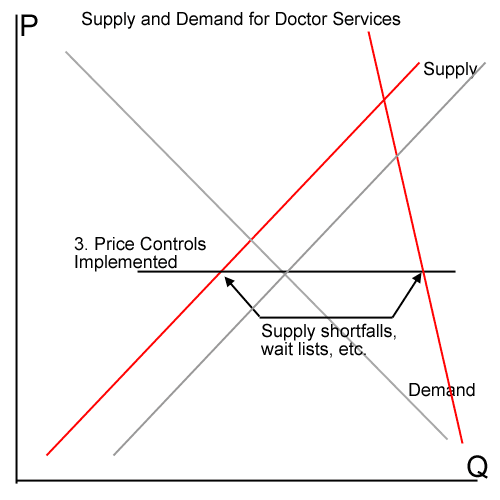
Well, it turns out that the laws of supply and demand do indeed apply in the health care field.  Obamacare and before it Romneycare combine government subsidies of demand with cost controls mainly consisting of price caps on suppliers.  The results are exactly what any college student could predict after even one week of microeconomics 101:  shortages.

First, from the WSJ

A new survey released yesterday by the Massachusetts Medical Society reveals that fewer than half of the state’s primary care practices are accepting new patients, down from 70% in 2007, before former Governor Mitt Romney’s health-care plan came online. The average wait time for a routine checkup with an internist is 48 days. It takes 43 days to secure an appointment with a gastroenterologist for chronic heartburn, up from 36 last year, and 41 days to see an OB/GYN, up from 34 last year….

Massachusetts health regulators also estimate that emergency room visits jumped 9% between 2004 and 2008, in part due to the lack of routine access to providers. The Romney-Obama theory was that if everyone is insured by the government, costs would fall by squeezing out uncompensated care. Yet emergency medicine accounts for only 2% of all national health spending.

The emergency room data is fascinating, as crowded emergency rooms supposedly overwhelmed by the uninsured was such an important image in the campaign to pass Obamacare.  More on this from Q&O:

Hospital emergency rooms, the theory goes, get overcrowded because people without health insurance have no place else to go.

But that’s not the view of the doctors who staff those emergency departments.
The real problem, according to a new survey from the American College of Emergency Physicians,isn’t caused by people who don’t have insurance — it’s caused by people who do, but still can’t find a doctor to treat them.

A full 97 percent of ER doctors who responded to the ACEP survey said they treated patients “daily” who have Medicaid (the federal-state health plan for the low-income), but who can’t find a doctors who will accept their insurance….”The results are significant,” said ACEP President Sandra Schneider in prepared comments. “They confirm what we are witnessing in Massachusetts — that visits to emergency rooms are going to increase across the country, despite the advent of health care reform, and that health insurance coverage does not guarantee access to medical care.”

As I have been saying for a long time, the Obama health care nuts do not have any secret, magical idea or plan for cutting health care costs.  In fact, as I have written here and here, we should expect Federalization to exacerbate the bad information and incentives that make health care more expensive.  The only idea they have, in fact, is the only one that anyone ever has in government for this kind of thing — price controls

Over the weekend, The Washington Postpublished a Q&A-style explainer on the Independent Payment Advisory Board—the panel of federal health care technocrats charged with keeping down spending growth on Medicare.

The details are complicated, but the gist is simple: If spending on Medicare is projected to grow beyond certain yearly targets, then it’s IPAB to the rescue: The 15-member panel appointed by the president has to come up with a package of cuts that will hold Medicare’s growth in check. If Congress want to override that package, it only has two options: Vote to pass a different but equally large package of cuts or kill the package entirely with a three-fifths supermajority in the Senate.

The Post lays out the basic framework above. But what it doesn’t explain in any detail is exactly how those cuts will be achieved. And that, of course, is where the difficulty begins: Here’s how The Wall Street Journal’s editorial board explained it last month: “Since the board is not allowed by law to restrict treatments, ask seniors to pay more, or raise taxes or the retirement age, it can mean only one thing: arbitrarily paying less for the services seniors receive, via fiat pricing.” Medicare already centrally sets the prices it pays for the services of doctors and hospitals. Given the board’s limitations, the most likely cuts we’ll see from IPAB, then, will be arbitrary, quality-blind reductions in these payments (though hospitals will be exempt from cuts for the first couple years).

We know what happens next: Providers stop taking on new Medicare patients, or drop out of the system entirely. In Medicaid, which pays far lower rates than Medicare (which pays somewhat lower rates than private insurance), this is already common: As one emergency physician recently told The New York Times, “Having a Medicaid card in no way assures access to care.” If IPAB cuts Medicare provider payments down to the bone, it could end up transforming Medicare into a seniors’-version of Medicaid.

Free Market Health Care: The Road Not Taken

My column is up at Forbes, and is the fourth in a series on Obamacare.  An excerpt:

Its amazing to me how many ways supporters of government health care can find to rationalize the bad incentives of third-party payers systems.  Take, for example, the prevelance today of numerous, costly tests that appear to be unnecessary.  Obamacare supporters would say that this is the profit motive of doctors trying to get extra income, and therefore a free market failure.   I would point the finger at other causes (e.g. defensive medicine), but the motivation does not matter.   Let’s suppose the volume of tests is truly due to doctors looking for extra revenue, like an expensive restaurant that always is pushing their desserts.  In a free economy, most of us just say no to the expensive dessert.  But the medical field is like a big prix fixe menu — the dessert is already paid for, so sure, we will got ahead and take it whether we are hungry or not.

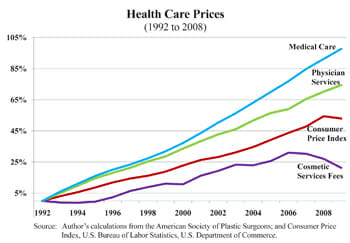
It should be no surprise that while US consumer prices have risen 53% since 1992, health care prices have risen at nearly double that rate, by 98%.  Recognize that this is not inevitable.  This inflation is not something unique to medical care — it is something unique to how we pay for medical care.

Contrast this inflation rate for health care with price increases in cosmetic surgery, which unlike other care is typically paid out of pocket and is not covered by third party payer systems.  Over the same period, prices for cosmetic surgery rose just 21%, half the general rate of inflation and just over one fifth the overall health care rate of inflation.

This is why I call free market health care the road not traveled.  There are many ways we could have helped the poor secure basic health coverage (e.g. through vouchers) without destroying the entire industry with third-party payer systems.  Part of the problem in the public discourse is that few people alive today can even remember a free market in health care, so its impossible for some even to imagine.

Update: Coincidently, Mark Perry has a post that addresses just the issue I do in my article, that is the positive effects of high-deductible health insurance and out of pocket health expenditures on pricing transparency and reduced costs.  The high deductible health plans at GM seem to be having a positive effect on the health care market.  A shame they will probably be illegal under Obamacare.  Of course, since GM is owned by the government, it can get any special rules that it wants, unlike the rest of us.  But that his how things work in the corporate state.

Health Care Fail

For the last three weeks, I have been writing about the informationincentive, and rent-seeking issues that will doom Obamacare — for example, how its impossible for a centralized board to set prices, and why a complete end to individual shopping will doom us to both rising prices and increasing frivolous demand.

I really didn’t have to bother, though, because it is unnecessary to hypothesize — we can just look at Massachusetts, which embarked on a proto-Obamacare several years ago.  John Calfee has a great column in the WSJ today.  Some excerpts

  • On costs

Massachusetts reformers deferred cost control to the vague prospect of a “Round 2″ of reform—much as congressional Democrats did a year ago when they passed ObamaCare. Meanwhile, economists John Cogan, Glenn Hubbard and Daniel Kessler reported in the Forum for Health Economics & Policy (2010) that insurance premiums for individuals (alone or in employer-sponsored group plans) increased 6% to 7% beyond what they would have without the reform. For small employers, the increases are about 14% beyond those in the rest of the nation. Four years after reform, Massachusetts still has the highest insurance premiums in the nation, and the gap is getting wider.

In 2010, insurance firms announced premium increases of 10% to 30% in the individual and small-group market. Gov. Patrick, on the verge of a tough re-election race, had the state insurance commissioner deny the higher rates.

  • On frivolous demand

But the number of emergency room visits, which everyone expected to drop once people had to purchase insurance, is still going up. Surveys show roughly half the visits are unnecessary. Surveys also indicate that finding a primary care physician is becoming more difficult.

  • On the end game of a centralized price-control regime

Last month Round 2 arrived. Gov. Patrick introduced a bill that will impose de facto price controls on everyone from solo primary care doctors to prestigious academic hospital systems. An 18-member board will decide how and how much providers should be paid, and the bill gives regulators the power to force private insurers to accept these fiats. Some 30 states experimented with such rate-setting in the 1970s and ’80s. Except for Maryland, all of them—including Massachusetts—deregulated in the 1990s because costs rose even as quality and choice declined

  • On politicization of decision-making

Insurance firms protested that they increased premiums because they had to deal with entrenched providers, especially hospitals, most notably the academic giants of Boston and Cambridge. Then the state prepared to introduce highly intrusive price controls over those providers—only to discover that this would provoke formidable political opposition while encountering myriad practical difficulties

To the last point, what happens to prices when providers know that a) consumers aren’t shopping any more; b) consumers will take the service at any price, because they aren’t paying; and c) insurance companies have to pay the bill, not matter how high, based on government rules.  Of course prices go up, because the entire price-discovery mechanism has been eliminated by government fiat.  Then the government has to step in with a doomed-to-failure price-setting plan.  In the end, those with political connections get the prices they want, and those who do not get throttled to make up the difference.

Health Care Decisions by Politics, Not Science

In my Forbes columns over the past few weeks, I have been writing about information and incentive problems with any sort of Obamacare type system.  One of the points I made last week was this:

One of the key selling points of Obamacare was that it would reduce cost, in large part through smart public-spirited people making optimized decisions from the top in Washington.  Ignoring the fact that no other agency that has promised such angels of public service has ever delivered them, we discussed in the last few weeks how this task is impossible.  But we should have known that already through our past experience with the political process.  Political decisions are made politically, not by optimizing some public good equation.    Does anyone believe that come election time, Congress won’t vote to add mandates to procedures to placate powerful groups in their base, irrespective of the future costs this would incur?

Need an example?

In 2007 breast cancer was the third leading source of cancer mortality in the US, but it was by far the largest recipient of government cancer research dollars, nearly double that spent on any other type of cancer.    In 2009, out of hundreds of medical procedures, only two procedureswere on the mandated must-carry list of all fifty states – mammography and breast reconstruction.  It is no accident that both of these are related to breast cancer.  With its links to women’s groups and potent advocacy organizations, breast cancer is a disease that has a particularly powerful political lobby.    Similarly, we should expect that, at the end of the day, pricing and coverage decisions under Obamacare will be made politically.  Not because anyone in this Administration is particularly bad or good, but because that is what always happens.

This post from Q&O is a tad old but gets at just this point with a real-life Obamacare example

The opening line in a New York Times piece caught my attention.  It is typical of how government, once it gets control of something, then begins to expand it (and make it more costly for everyone) as it sees fit.  Note the key falsehood in the sentence:

The Obama administration is examining whether the new health care law can be used to require insurance plans to offer contraceptives and other family planning services to women free of charge.

Yup, you caught it – nothing involved in such a change would be “free of charge”.   Instead others would be taxed or charged in order for women to not have to pay at the point of service.  That’s it.  Those who don’t have any need of contraception will subsidize those who do.  And the argument, of course, will be the “common good”.   The other argument will be that many women can’t afford “family planning services” or “contraception”.

But the assumption is the rest of you can afford to part with a little more of your hard earned cash in order to subsidize this effort (it is similar to other mandated care coverage you pay for but don’t need).  Oh, and while reading that sentence, make sure you understand that the administration claims it has not taken over health care in this country.

The next sentence is just as offensive:

Such a requirement could remove cost as a barrier to birth control, a longtime goal of advocates for women’s rights and experts on women’s health.

So now “women’s rights” include access to subsidies from others who have no necessity or desire to pay for those services?  What right does anyone have to the earnings of another simply because government declares that necessary?

It is another example of a profound misunderstanding of what constitutes a “right” and how it has been perverted over the years to become a claim on “free” stuff paid for by others.

Administration officials said they expected the list to include contraception and family planning because a large body of scientific evidence showed the effectiveness of those services. But the officials said they preferred to have the panel of independent experts make the initial recommendations so the public would see them as based on science, not politics.

Really?  This is all about politics.  The fact that the services may be “effective” is irrelevant to the political questions and objections raised above.  This is science being used to justify taking from some to give to others – nothing more.

The Health Care Trojan Horse: Property Rights Edition

For years I have warned that government-funded health care will be used as a Trojan horse for a nearly infinite body of legislation under the pretext that X [where X = nearly every activity or individual choice] has implications for health care costs.  Here is the latest chapter of this ongoing saga:

New stand-alone fast food restaurants have been banned from setting up shop in South Los Angeles, due to rising health concerns by the city council.

This story also mixes in a good portion of corporate statism as well, as it represents pretty transparent protectionism of current competitors against new entrants:

Perry’s new plan bans new so-called “stand alone” fast food restaurants opening within half a mile of existing restaurants.

So McDonald’s, who is likely firmly entrenched in the area, is unaffected, but potential new entrants challenging McDonald’s are out.

For even further points, one can see another powerful constituency at work.  I suppose commercial real estate developers complained about potential loss of tenants, so this was added:

Such stand-alone establishments are on their own property, but those same restaurants are OK if they’re a part of a strip mall, according to the new rules.

Obviously the same food is much more nutritious if served in a leased building rather than on a piece of land the restaurant owns itself.

Read the whole thing, its a great example with a lot of fact-free pronouncements by politicians about market failures.  via Matt Welch

Health Care Trojan Horse

I have warned many times:

When health care is paid for by public funds, politicians only need to argue that some behavior affects health, and therefore increases the state’s health care costs, to justify regulating the crap out of that behavior.

So, don’t be surprised to see a lot more of this:

“Too many lives are lost in motorcycle accidents,” Christopher A. Hart, NTSB vice chairman, said in announcing that helmets had been added to the board’s annual “most-wanted list” of safety improvements. “It’s a public health issue.”

Health Care Trojan Horse

My column this week at Forbes.com is on government health care and the incentives and pressure it creates to micro-manage individual behaviors and diet in order to (in theory) reduce government health care costs.

The Health Care Trojan Horse

This is what happens under state-run medicine, when your doctor becomes an agent of the government.

Currently pregnant women are asked if they smoke by midwives and GPs but the National Institute for health and Clinical Excellence (Nice) wants this to go further.

The organisation has recommended that all pregnant women should have their breath measured for carbon monoxide levels when they book in with a midwife.

This would establish which women smoke and provide an added incentive for them to quit, the guidance said.

I am sure all the women’s organizations whose principled stand against abortion restrictions were based on protecting the privacy of one’s body from the heavy hand of government will now rise up in protest.  Not.

As it turns out, and as I have written before, most women’s groups seem to favor total intrusion of government into every facet of individual health care decision-making EXCEPT abortion.  The privacy and libertarian-sounding abortion arguments were really just slights of hand, rolled out to prevent government bans on one particular procedure, and then tucked away when the government proposes to control every other procedure.

Horrible New Paperwork Requirement Slipped into Health Care Bill

This is lifted from an email I got from America Outdoors

A little noticed provision in the recently passed health care reform bill will require every payment to corporations over $600 to be reported on a Form 1099 to the IRS, including payments for the purchase of merchandise and services. This provision takes effect in 2012.

The current law requires a Form 1099 to be submitted to the IRS when your business pays more than $600 for rent, interest, dividends, and non-employee services if the payments are made to entities other than corporations. Currently, payments made to a corporation and payments for merchandise are not required to be reported.

To file the required 1099, a business will have to obtain and keep track of a Taxpayer Information Number (TIN) from every vendor before submitting the 1099 to that business and the IRS. Under current tax law, one copy of the form is sent to the IRS, and another copy is sent to the person to whom the business made the payments.

Rep. Dan Lungren (CA-3) introduced “The Small Business Paperwork Mandate Elimination Act” (H.R. 5141). The legislation would repeal the expanded 1099 reporting requirement.  Lungren correctly asserts that the burdens placed on small businesses by this reporting requirement would be overwhelming.

Call your U.S. Representative today and ask them to cosponsor H.R. 5141. The House switchboard number is 202-225-3121.  Ask to be connected to your Representative’s office.

My small business has over a thousand vendors.  I would have to hire someone full time for a month to do this.  And it would be to zero purpose.  The IRS would be so flooded with forms that there would be no way they could pull any useful information from the blizzard.  This is yet another example of legislators operating with absolutely no idea how commerce actually works.  We have coined a name for it within our firm — we call it arrogant ignorance.

Chris Edwards at Cato had more on this a while back.

I’m stunned that there wasn’t a broader debate before such a costly mandate was enacted. If it goes into effect, it will waste vast quantities of human effort in filling out forms, reworking computer systems, collecting and organizing data, and fighting the IRS. The struggling American economy can’t afford anymore suffocating tax regulations. This mandate is a giant deadweight loss. It should be repealed.

The Health Care Trojan Horse

I have written any number of times about government health care as the excuse to regulate nearly everything, since nearly every individual decision and activity can be argued to affect one’s health.  If government is paying the health care bills, it now has an interest in regulating behaviors that might raise those bills.  Given the US government has been on a 80-year mission to end the concept of individual responsibility, Obamacare is a huge milestone.

Witness, yet again:

You see, Ms. Kaplan obviously thinks it is the role of government to “help Americans eat healthier” even if it means banning things.  My guess is she’d not be quite as ready for government bans it they had to do with, oh I don’t know, books or something similar.The excuse?

In Santa Clara County, one out of every four kids is either overweight or obese. Among 2- to 5-year-olds from low-income families, the rate is one in three. The county health system spends millions of dollars a year treating kids for health problems related to obesity, and the tab is growing.

If you haven’t yet figured out that the passage of ObamaCare has emboldened the nannies at all levels, this ought to make the case.  Trust me, this reporter didn’t dig this nugget out.  It was handed to her by those trying to justify this power grab.

Yeah, I know this is just a local action, but this is just a market test for future similar federal actions.  I can just picture John Jay and James Madison arguing in a tavern.  “Jimmy, I am just not sure what kind of Constitution we need.  Well, John, whatever we do, we absolutely must make sure the Federal government has the power to ban toys from kids meals.  Oh, and to regulate salt content too.  After all, that’s what we fought a war for.”

Postscript: My question is, how long are health cost advocates going to nibble at the margins?  Childhood obesity costs are probably close to zero, in the grand scheme of things, despite the BS numbers from “advocates.”  Two individual decisions drive a ton of health care costs – driving (the most dangerous activity we pursue, typically) and sex (not just in disease but in pre and post natal care).  And I wonder how long it will be before government health care costs treating gunshot victims will be used to trump 2nd amendment arguments?

Health Care and the Post Office

The recent bankruptcy of the USPS and the proposal to cut Saturday delivery has interesting implications for government and health care.  Everyone, from the GAO to the management of the USPS know that there are substantial productivity improvement that could be had with better labor deployment and employee accountability, but no one has the will to take on the union.  As a result, the only cost cutting idea they can propose is service cuts.  Which is further proof of what I have been saying for a couple of years — that despite all the hopey changey talk, the only real idea anyone in the Obama administration or Congress can come up with for health care cost reduction is reduced services and/or price controls (which reduce supply and thus services).

The Only Health Care Cost Control Idea the Democrats Have Ever Had

I think this article makes it clear that, no matter what the rhetoric, the only health care cost control idea Obama and the Democrats ever had was saying “no” to care.  Whatever one calls this (managed care, rationing, death panels) it is really not that much different from what insurance companies have been doing for years.  And it is areal irony that Democrats passed this legislation feeding off anger of voters with insurance companies saying “no”, when their plan really depends on the government saying “no” even more often  (or else there won’t be any cost savings).

The author argues that information is important for patients to make better decisions:

When patients are given information about potential benefits and risks, they seem to choose less invasive care, on average, than doctors do, according to early studies. Some people, of course, decide that aggressive care is right for them — like the cancer patient (and palliative care doctor) profiled in this newspaper a few days ago. They are willing to accept the risks and side effects that come with treatment. Many people, however, go the other way once they understand the trade-offs.

They decide the risk of incontinence and impotence isn’t worth the marginal chance of preventing prostate cancer. Or they choose cardiac drugs and lifestyle changes over stenting. Or they opt to skip the prenatal test to determine if their baby has Down syndrome. Or, in the toughest situation of all, they decide to leave an intensive care unit and enter a hospice.

I agree, but I would go further — information and incentives are important.  And the absolute most important bit of information when it comes to cost control is price, and patients under Obamacare have absolutely no incentive to give a sh*t about price even if they were informed of it.  Exactly the opposite of the incentives I have had since I took on a high-deductible health care policy several years ago.

Update: Brad Warbiany discusses the proposed IPAB and its powers to shape health care spending in the context of Congress as an addict trying to control its impulses.  However, I think Brad underestimates the power of the board to be captured.  What will result is rulings for more coverage of procedures with powerful lobbies, offset by less coverage of procedures with weaker lobbies, irrespective of the science.   Just look at the diseases the NIH and NSF gives grant money for — the grants have nothing to do with the science of where research could be most productive and everything to do with diseases that have large and powerful constituencies.

Update #2: Isn’t it interesting to see the NY Times, after arguing for months that Obamacare was not about rationing, is now admitting that rationing is the key to success.  It reminds me of this that I wrote a while back:

I have decided there is something that is very predictable about the media:  they usually are very sympathetic to legislation expanding government powers or spending when the legislation is being discussed in Congress.  Then, after the legislation is passed, and there is nothing that can be done to get rid of it, the media gets really insightful all of a sudden, running thoughtful pieces about the hidden problems and unintended consequences of the legislation.

Getting Ready for the New Health Care Regime

Health Care Fiscal Problem in a Nutshell

Via John Stoessel:

Medicare already faces a $30 Trillion deficit. The bigger issue is that Democrats are poised to make cuts in Medicare — something that is incredibly difficult to do — but instead of applying those cuts towards Medicare, they are applying it towards a lavish new entitlement program.

Of course, that assumed that the spending estimates for the new health care plan are meaningful, which is highly unlikely, since every single entitlement of this kind has always vastly outspent its initial estimates.   Greece, here we come.

The Oft-Missed Component When Evaluating European Socialized Health Care

Yes, the Europeans pay less per person for health care.  Is the care as good?

Well, when life-expectancies are adjusted for things that are not amenable to the health care system (like murder rates), Americans have the highest life expectancy in the world, and by far the highest cancer survival rates.

The prices we pay for drugs and medical devices, while high, effectively subsidize the entire world’s medical R&D.

Oh yes, and we don’t have to wait 6 months to get treated.  The wait time issue is often poo-poo’d by elites in the political debate, but it seems to be an important issue for real people:

In a survey, people were asked how they felt about various forms of medical care for a urinary tract infection or for influenza. While people preferred traditional, office-based care, they would opt to see a nurse-practitioner at a retail clinic if they could save at least $31.42. They would wait one day or more for an appointment if they would save at least $82.12.

The researchers concluded that the appointment wait period is the most important determining factors in an individual’s choice on where to seek care for minor health problems such as influenza. Primary-care doctors who fear their business will be undercut by the growing popularity of retail health clinics may want to offer more same-day appointments and walk-in hours.”


“This study is the first in the United States to quantify the relative importance of and the utility associated with the main attributes of retail clinics. The utility (willingness to pay) associated with receiving same-day care is more than twice the utility associated with receiving care from a physician. Primary care physician practices, especially in competitive markets, are therefore likely to derive greater competitive advantage by addressing patient convenience features (such as same-day scheduling, walk-in hours, and extended hours) than by reducing fees.”

Follow the link for more and a link to the original study.  Patient convenience is the LAST thing government health care systems design for, but apparently, what actual people most want.

I say over and over, yes, we could reduce the cost of medical care (but by increasing the accountability of individuals for paying for their own care, exactly the opposite direction taken by the Obama plan).  But a big reason that we pay more is not because we are stupid and incompetent, but because we can because we are wealthier.  It is incontrovertible that we are wealthier per capital than the Europeans — is it surprising that we would choose to spend a large portion of this extra wealth on our health?

The Left and Health Care

For the left, its all about keeping the government out of one’s private decisions about his or her body, with the exception, of course, of any procedure not called “abortion.”

Paying Cash for Health Care

There just seems to be a tremendous mental block people have about paying cash for health care.  Megan McArdle is surprised at how strong this bias is in some of her readers.  I’m not, as I see it in my wife and friends all the time.

Several years ago we switched to a high-deductible catastrophic health care policy.  We save a TON of money with this policy, such that year in and year out, even with fairly high out of pocket expenditures, our total health care expenses have been lowered.

Generally, I go ahead and wash all of the charges through the policy so I get credit for them against the cumulative deductible.  But since we have never hit the number, I am increasingly less attached to this approach.  Particularly since a number of doctors and other providers are offering cash discounts now for bypassing insurance and paying cash.

Here is an example — my son has had some elbow pain pitching lately, so seeing all the kids who are having to get Tommy John surgery before they are out of high school, we decided to make sure everything was OK.  We took him to a GP who specialized in sports medicine and works with a number of MLB pitchers as a team physician to the Brewers.   For cash, he charged me $50 and spent nearly 30 minutes with my son.  Then he sent us downstairs for some x-rays of his elbow, and the radiology group there, again for cash, charged us $35 total for three x-rays.  There are people who pay more for a pedicure.

Nothing is ever going to improve in health care costs until individuals take more responsibility for the cost-benefit tradeoffs of the services they receive.

Update on the Health Care Trojan Horse for Fascism

I have warned for quite a while that government health care is a Trojan horse for all kinds of intrusive micro-regulations of our decisions and behaviors.  Here’s an update: (via Maggies Farm)

“As the government assumes a larger share of health care costs, it is increasingly able to use that as a justification to intrude into personal decisions or private enterprises, whether it’s a matter of smoking policy, trans-fats, or salt,” we wrote last month. Now the Wall Street Journal is out with an editorial praising Michelle Obama’s campaign against childhood obesity, reasoning, “the reality is that U.S. obesity imposes huge costs on taxpayers. In 2006, the per capita increase in spending attributable to obesity was 36% for Medicare and 47% for Medicaid, according to a paper last year in Health Affairs. Many fat kids grow up to be fat adults, and you’ve got to start somewhere.”

Almost any behavior or decisions, from eating to driving to sports participation, has implications on one’s potential future health care costs.  So by this logic, almost anything can be regulated.  For example, I would argue that sex has a much higher health care cost impact than eating, not just in STD’s but in the cost of pregnancies and pediatrics.   Or as another example, our family spent far more in health care costs on treating our kids’ accidents while playing sports than in dealing with any obesity costs.  Should we be requiring kids to stay indoors playing on the computer where they will be safe from potentially expensive accidents?

Obama’s Bosses Say No to Senate Health Care Bill

Health Care Bill Timeline

I am sure there are more landmines hidden in the Senate Bill, but the Heritage Foundation has parsed an implementation schedule from the most recent bill:

2010: Physician Medicare payments decrease 21% effective March 1, 2010

2011: “Annual Fee” tax on health insurance, allocated according to share of total premiums. Begins at $2 billion in 2011, then increases to $4 billion in 2012, $7 billion in 2013, $9 billion in the years 2014, 2015, and 2016, and eventually $10 billion for 2017 and every year thereafter. Two insurers in Nebraska and one in Michigan are exempt from this tax.

2012: Medicare payment penalties for hospitals with the highest readmission rates for selected conditions.

2013: Medicare tax increased from 2.9% to 3.8% for incomes over $250,000 (joint filers) or $200,000 (all others). (This is stated as an increase of 0.9 percentage points, to only the employee’s share of the FICA tax.)

2014: Individual mandate begins: Tax penalties for not having insurance begin at $95 or 0.5% of income, whichever is higher, rising to $495 or 1% of income in 2015 and $750 or 2% of income thereafter (indexed for inflation after 2016). These penalties are per adult, half that amount per child, to a maximum of three times the per-adult amount per family. The penalty is capped at the national average premium for the “bronze” plan.

2015: Establishment of Independent Medicare Advisory Board (IMAB) to recommend cuts in Medicare benefits; these cuts will go into effect automatically unless Congress passes, and the President signs, an override bill.

2016: Individual mandate penalty rises to $750 per adult ($375 per child), maximum $2,250 per family, or 2% of family income, whichever is higher (capped at the national average premium for the “bronze” plan). After 2016, the penalty will be increased each year to adjust for inflation.

There is a link in the original to a more detailed timeline.  There is a lot more that is left out of this brief timeline, see it here.

Health Care Incentives

There are very few problems that can’t be traced to information and incentives.  I thought of this when Tyler Cowen discusses an attempt to improve health care costs with better information:

The health care reform bill before the U.S. Senate would require hospitals to publicize their standard charges for services, but New Hampshire and Maine have gone much further in trying to make health care costs more transparent to consumers.

New Hampshire and Maine are the only states with Web sites that let consumers compare costs based on insurance claims paid there.

In New Hampshire, the price variation across providers hasn’t lessened since the Web site went live in 2007.

The problem is that this is all useless if individuals have not particular incentive to shop.  If I were on Unemployment, would I bother to check a web site to see which unemployment offices had the lowest operating costs and go there to get my check?  No way, what incentive would I have to do so?  I am going to the closest one, or the one with the fewest lines.  Ditto with most people and health care:

third party payer

Of course, the new health care bill will only make this worse.   Those of us who actually have an incentive to shop, either with high deductible policies and/or HSA’s will see our policies banned.   The new health care bill has done nothing but attempt to drive this line all the way to zero.

Update: IBD publishes on the exact same topic (I beat them by 12 hours).

Patients have little direct connection in paying for their care. Their role has fallen significantly. Meanwhile, the government’s involvement has grown, as has that of the insurance industry.Because so many Americans rely on an insurance policy or a government program to pay their health care bills, the internal governors that temper the rest of their purchases are turned off. When a visit to the doctor’s office or a diagnostic test costs them a mere $10 or $20 co-payment out of pocket — or there is no charge at all — cost has little impact on their decision to see a doctor.

“By not knowing the full costs associated with health care, consumers demand more and ‘overuse’ it,” Kenneth E. Thorpe explained a few years back in Health Affairs.

Americans would be more judicious in seeking health care — they would self-ration — if the right incentives were in place. An effective way to cut overuse and bring down costs would be to encourage through public policy the use of health savings accounts. If consumers used HSAs to pay the full amount for medical care at the point of service rather than letting employer-funded insurance or a government program pay the bills, the demand would fall.

The Democrats’ health care legislation, however, puts more distance between Americans and the payment process and promotes dependence on government. That will only drive down consumers’ out-of-pocket expenses even further and force overall health care spending upward. Under such a regime, the system will be worse off than it is now.

Expect A LOT More of This With The New Federal Health Care Rules

Via the Dallas Morning News:

A last-minute change in the federal health care bill ditched a proposed 5 percent tax on cosmetic medical procedures and replaced it with a 10 percent tax on indoor tanning services.

Goodbye Botox tax. Hello tan tax.

This seems really random.  Why should either of these businesses foot a special, disproportionate share of my health care bill?  Well, things that seem random to most of us make perfect sense in Congress.

The tan tax popped up in the health care bill last weekend after powerful medical lobbies – including the American Academy of Dermatology Association, American Medical Association, American Society of Plastic Surgeons and Botox-maker Allergan – persuaded Congress to remove a tax on cosmetic medical procedures and replace it with a 10 percent surcharge on indoor tanning services.

Lobbyists are very good at punching political hot-buttons.  Since they couldn’t argue that botox is “for the children,” and since it is generally used by rich white people they could not place the race or class card, they played the only card they had:

“Since 90 percent of cosmetic surgery patients are women, this would have been a very discriminatory tax,” said White, who opposed the cosmetic surgery tax.

Technocrats want to believe, and perhaps honestly believe themselves, that care guidelines in the new Federal health care system will be science-based.  What possible basis do they have for thinking that?  We have 50 state laboratories, where states specify must-carry rules on procedures, and not a single one of these lists are science based – they are loaded with special interest handouts.   I even show in this post how special interests give money to academia to produce studies whose entire conclusion is that certain procedures (performed by the special interest group funding the study) need to be in the minimum coverage laws.   The very first time out, when confronted with a science-based care recommendation (that women not receive breast cancer screening until after 50), the Congress specifically overrode it in the bill under a firestorm of public outcry.

But maybe the dermatologist guys are really looking after us?  After all:

The American Academy of Dermatology warns of significant health risks caused by indoor tanning.

But, as it turns out, it only sees health risks in the use of ultra-violet light by practitioners who are not members of their trade group.  I have bolded the key passage that gives away the game.

Indoor tanning industry groups note that dermatologists use tanning equipment in their offices for cosmetic skin conditions, such as eczema and psoriasis, in phototherapy treatments that cost up to $100 per visit billed to health insurance companies. In contrast, indoor tanning salons cost as little as $6 to $20 per session.

The tan tax would exempt phototherapy services performed by a licensed medical professional.

“This is like Coke being allowed to lobby the government to tax Pepsi, but that Coke be allowed to sell the same product and not be taxed for it,” International Smart Tan Network Vice President Joseph Levy said in a statement. “It’s unbelievable.”

Health Care Bill At 60

Kevin Drum is reporting, as I predicted, that the Democrats have bought off the remaining votes they needed (with our tax money) and that there will be a successful cloture vote this evening on the health care bill.  Bad news, though I have been prepared for it for a while.  I honestly believe that 90% of this country is going to end up worse off to help out the remaining 10%.  The analogy I often use is that this is just like the crappy public housing we built in the 1960′s, except everyone, not just the poor, are going to have to move into it.    The only remaining questions that remain are 1) how long after passage of this bill do Democrats admit they grossly fibbed on the price and start jacking up taxes; and 2) how hard a hit (and how fast) will drug and medical innovation take.  Enjoy.  The only silver lining is that many of the folks who passed this mess are not going to have their jobs a year from now.

Update: Overlawyered has more bad news about the bill’s provisions.   A lot more of this will come out as the people are actually allowed to read it.

Update: Health Care Bill Cost Gimmickry

It has bothered me in an earlier post that I missed several critical tricks the Democrats in Congress are using to understate the cost of their health care bills.  These are important enough that I am re-writing the original post:

I think most folks were shocked that the CBO scored the Baucus bill as deficit-neutral.  Well, we are starting to understand why (by the way, these are not criticisms of the CBO, but of the Senate).  So far, four major budget tricks have been identified:

1. The cost of the individual mandate is not in the scoring. There seems to be a lot of spin on this issue, as to whether the mandate is a “tax” or not, but word games aside, clearly the individual mandate is a major cost of the program to Americans.  The best analogy I can give is that if the government cut your taxes that go to road construction but then mandated that everyone fund directly out of their pocket the cost of a quarter mile of road repairs each year, most people would see this as a cost either way.  But it turns out that the CBO scores things differently.

First, a little history.  Like both the House and Senate bills, the Clinton health plan would have mandated that individuals and employers purchase private insurance.  In its 1994 score of the Clinton plan, Bob Reischauer’s CBO included those mandated “private” payments in the federal budget –- i.e., as federal revenues and federal expenditures.

And yet, none of the CBO scores of this year’s bills include the costs of similar individual/employer mandates as federal revenues or federal spending.

My read of the CBO’s score of the Clinton health plan is that the private-sector mandates accounted for around 60 percent of the Clinton health plan’s total cost, the remainder being (traditional) government spending.  So how is it that the CBO made the full cost of the Clinton health plan apparent to the public in 1994, but may now be revealing only 40 percent of the cost of the Obama health plan?…

The Medical Loss Ratios memo is the smoking gun.  It shows that indeed, Democrats have been submitting proposals to the CBO behind closed doors and tailoring their private-sector mandates to avoid having those costs appear in the federal budget.  Proposals that would result in a complete cost estimate — such as the proposal by Sen. Rockefeller discussed in the Medical Loss Ratios memo — are dropped.  Because we can’t let the public see how much this thing really costs.

Crafting the private-sector mandates such that they fall just a hair short of CBO’s criteria for inclusion in the federal budget does not reduce their cost, nor does it make those mandates any less binding.  But it dramatically reduces the apparent cost of the legislation.  It is the reason we’re all talking about an $848 billion Reid bill, rather than a $2.1 trillion Reid bill.

2.  Now-you-see-it-now-you-don’t Medicare cuts. Via Michael Tanner of Cato:

When the Senate Finance Committee released CBO scoring of its health care reform proposal last week, we warned that its claim of reducing future budget deficits was achieved only through dishonestly assuming that Congress will implement a 21% reduction in Medicare payments that is scheduled under current law. We pointed out that Congress has been supposed to make those reductions since 2003, and never has.  Now—surprise, surprise—Democrats have introduced a bill to eliminate the scheduled cut, at a cost of $247 billion.  But Democrats cleverly are putting the new spending in a separate bill, so it won’t change scoring of health care reform.   Have they no shame?

3.  Transfer of costs off the Federal budget to the states (which the CBO does not score).  Via Glen Reynolds

Gov. Phil Bredesen warned Tuesday that pending federal health care legislation could cost Tennessee far more than the $735 million “best estimate” his administration previously has cited.

The $735 million would stretch over five years, but “in addition, there are huge unknowns for the states in this reform,” Gov. Bredesen said, estimating that those costs, if realized, could exceed another $3 billion from 2014 to 2019. . . . “I’m glad they’re trying to do it without increasing the federal deficit, that certainly is important,” said Gov. Bredesen, a Democrat who has been critical of the plan’s impact on states. “But to turn around and increase the state deficits as the way to handle it that does not seem a very appropriate way to do that.”

4.  Match 6 years of expenses with 10 years of revenues. From an earlier post:

Bruce McQuain points out something I think has not gotten enough attention in the health care bill.  The new taxes being proposed start in 2010, but the benefits don’t begin until 2013 and are phased in through something like 2018.  That means for any 10-year budget look, there are 10 years of taxes but only 6-7 years of benefits.  And even with this trick, the plan STILL adds a trillion dollars to the deficit, even before the certainly more pessimistic CBO numbers come in.