Posts tagged ‘fashion’

The Obesity Obsession

Via Liz Lightfoot in the Telegraph:

Nearly 60 per cent of girls aged 12 to 15 described themselves as
overweight when only 15 per cent met the medical criteria for excess
body fat.

The findings prompted the Schools Health Education Unit, which carries
out the annual survey, to issue an appeal for an end to the "obsession"
with skeletal body shapes in the media and fashion industry.

Yeah, I know this is the UK, but I bet you would get similar results in the states.  While the article points the finger at the media and fashion industry, how about government and academic know-it-alls who with their recent obsession on teenage obesity are reinforcing this message?  For example, remember this previous post about the Arkansas governor’s new program:

I get email and comments from time to time that my language deriding
government’s intervention into every aspect of our lives is overblown
and exaggerated.  My answer:  Oh yeah, well how about this:

Mike Huckabee, the Governor of Arkansas, now
requires annual fat reports. These are sent to the parents of every
single child aged between 5 and 17; a response, he says, to “an
absolutely epidemic issue that we could not ignore” in the 1,139
schools for which he is responsible.

I
just cannot craft any reasonable theory of government where this is the
state’s job.   The "obesity" crisis in this country just amazes me.
"Experts" every few years broaden the definition of who is overweight
or obese, and suddenly (surprise!) there are more people defined as
overweight.  Even presuming it is the state’s job to optimize our body
weights, is it really the right approach to tell everyone they are too
fat?  Having known several people who were anorexic, including at least
one young woman who died of its complications, is it really a net
benefit to get young people more obsessed with looks and body style?
And what about the kids that are genetically programmed to be
overweight?  Does this mean that years of taunting and bullying by
their peers is not enough, that the state’s governor wants to pile on
now?

It is interesting to note that governor Huckabee apparently started
this initiative after his own personal battle with weight loss:

[Huckabee] lost 110lb after being warned that his
weight, more than 280lb after a life of southern fried food, was a
death sentence. A chair even collapsed under him as he was about to
preside over a meeting of state officials in Little Rock.

We
all have friends who have lost weight or gotten into homeopathy or
became a vegan and simply cannot stop trying to convert their friends
now that they see the light.  Now we have the spectacle of elected
officials doing the same thing, but on a broader scale and with the
force of law, rather than  just mere irritation, on their side.  One
can only imagine what report cards kids would be carrying home if
Huckabee had instead had a successful experience with penis
enlargement.  What’s next, negative reports for kids with bad acne?
For women whose breasts are too small?  For kids who are unattractive?

Political Party as Fashion Statement

A while back I lamented that so few people actually strive to maintain a consistent personal philosophy, rather than a hodge-podge of isolated political views.  In this context, I thought the profile of "progressive" Markos Moulitsas Zuniga (the Daily Kos) by the sympathetic progressive-liberal Washington Monthly was interesting.  For example:

The younger-than-35 liberal professionals who account for most of his
audience seem an ideologically satisfied group, with no fundamental
paradigm—changing demands to make of the Democratic Party. They don’t
believe strongly, as successive generations of progressives have, that
the Democratic Party must develop more government programs to help the
poor, or that racial and ethnic minorities are wildly underrepresented,
or that the party is in need of a fundamental reform towards the
pragmatic center—or at least they don’t believe so in any kind of
consistent or organized manner. As this generation begins to move into
positions of power within the progressive movement and the Democratic
Party, they don’t pose much of a challenge on issues or substance. So
the tactical critique takes center stage.
Moulitsas’s sensibility suits his generation perfectly. But it also
comes with a built-in cost. Moulitsas is just basically uninterested in
the intellectual and philosophical debates that lie behind the daily
political trench warfare. By his own admission, he just doesn’t care
about policy. It’s here that the correlation between sports and
politics breaks down. In sports, as Vince Lombardi is said to have put
it, “Winning isn’t everything, it’s the only thing.” When the season is
over, you hang up your cleats and wait for the next season. But in
politics, that’s not the case—you have to govern, and if you don’t
govern well, you won’t get reelected. So while tactics and message are
crucial, most voters will ultimately demand from politicians ideas that
give them a sense of what a party is going to do once in power. Wanting
to win very badly is an admirable and necessary quality in politics,
and Moulitsas is right that Democrats have needed it in greater
quantity. But it is not really a political philosophy.

This article tends to reinforce a notion I have had of late, that is a trend toward political party as fashion statement.  For example, I get the impression that many of Kos’s audience call themselves Democrats more because of the statement they think it makes about themselves rather than a thought-out comparison of the various party’s positions and how they stack up vs. their own thought-out philosophy.  I am starting to sense that people choose parties for their brand-image rather than for the actual positions or people who represent them.  Democrat might mean "I am smarter than you", "I am with-it and cool", "I am dynamic" while Republican might mean "I am patriotic", "I am moral", "I am level-headed".  By the way, don’t send me mail for the wrong reasons — I am not saying the parties actually consistently meet these images, I am just saying that a large number of people seem to adopt their party to make these kind of statements about themselves.

Postscript:  If you think I am exaggerating, then someone needs to explain to me how a Democratic president can send us to war in Bosnia with Republicans opposing and then have a Republican president send us to war in Iraq with Democrats opposing when at the 40,000 foot level they are the same freaking war (US intervention to unseat a genocidal dictator with at best unclear UN mandate and opposition from key European nations).  I keep coming back to the simplistic explanation that the default political position is "I got my guy’s back no matter what, and you guys suck no matter what", which I admit effectively compares the current political discourse to the chants at a Michigan-Ohio State football game, but I’m going to go with it.

PPS-  As a good libertarian, though, I am happy to know that young progressives are not necessarily pushing for more state control.

Why Its OK if GM Dies

I had a conversation the other day with a person I can best describe as a well-meaning technocrat.  Though I am not sure he would put it this baldly, he tends to support a government by smart people imposing superior solutions on the sub-optimizing masses.  He was lamenting that allowing a company like GM to die is dumb, and that a little bit of intelligent management would save all those GM jobs and assets.  Though we did not discuss specifics, I presume in his model the government would have some role in this new intelligent design (I guess like it had in Amtrak?)

There are lots of sophisticated academic models for the corporation.  I have even studied a few.  Here is my simple one:

A corporation has physical plant (like factories) and workers of various skill levels who have productive potential.  These physical and human assets are overlaid with what we generally shortcut as "management" but which includes not just the actual humans currently managing the company but the organization approach, the culture, the management processes, its systems, the traditions, its contracts, its unions, the intellectual property, etc. etc.  In fact, by calling all this summed together "management", we falsely create the impression that it can easily be changed out, by firing the overpaid bums and getting new smarter guys.  This is not the case – Just ask Ross Perot.  You could fire the top 20 guys at GM and replace them all with the consensus all-brilliant team and I still am not sure they could fix it. 

All these management factors, from the managers themselves to process to history to culture could better be called the corporate DNA*.  And DNA is very hard to change.  Walmart may be freaking brilliant at what they do, but demand that they change tomorrow to an upscale retailer marketing fashion products to teenage girls, and I don’t think they would ever get there.  Its just too much change in the DNA.  Yeah, you could hire some ex Merry-go-round** executives, but you still have a culture aimed at big box low prices, a logistics system and infrastructure aimed at doing same, absolutely no history or knowledge of fashion, etc. etc.  I would bet you any amount of money I could get to the GAP faster starting from scratch than starting from Walmart.  For example, many folks (like me) greatly prefer Target over Walmart because Target is a slightly nicer, more relaxing place to shop.  And even this small difference may ultimately confound Walmart.  Even this very incremental need to add some aesthetics to their experience may overtax their DNA.

Corporate DNA acts as a value multiplier.  The best corporate DNA has a multiplier greater than one, meaning that it increases the value of the people and physical assets in the corporation.  When I was at a company called Emerson Electric (an industrial conglomerate, not the consumer electronics guys) they were famous in the business world for having a corporate DNA that added value to certain types of industrial companies through cost reduction and intelligent investment.  Emerson’s management, though, was always aware of the limits of their DNA, and paid careful attention to where their DNA would have a multiplier effect and where it would not.  Every company that has ever grown rapidly has had a DNA that provided a multiplier greater than one… for a while.

But things change.  Sometimes that change is slow, like a creeping climate change, or sometimes it is rapid, like the dinosaur-killing comet.  DNA that was robust no longer matches what the market needs, or some other entity with better DNA comes along and out-competes you.  When this happens, when a corporation becomes senescent, when its DNA is out of date, then its multiplier slips below one.  The corporation is killing the value of its assets.  Smart people are made stupid by a bad organization and systems and culture.  In the case of GM, hordes of brilliant engineers teamed with highly-skilled production workers and modern robotic manufacturing plants are turning out cars no one wants, at prices no one wants to pay.

Changing your DNA is tough.  It is sometimes possible, with the right managers and a crisis mentality, to evolve DNA over a period of 20-30 years.  One could argue that GE did this, avoiding becoming an old-industry dinosaur.  GM has had a 30 year window (dating from the mid-seventies oil price rise and influx of imported cars) to make a change, and it has not been enough.  GM’s DNA was programmed to make big, ugly (IMO) cars, and that is what it has continued to do.  If its leaders were not able or willing to change its DNA over the last 30 years, no one, no matter how brilliant, is going to do it in the next 2-3.

So what if GM dies?  Letting the GM’s of the world die is one of the best possible things we can do for our economy and the wealth of our nation.  Assuming GM’s DNA has a less than one multiplier, then releasing GM’s assets from GM’s control actually increases value.  Talented engineers, after some admittedly painful personal dislocation, find jobs designing things people want and value.  Their output has more value, which in the long run helps everyone, including themselves.

The alternative to not letting GM die is, well, Europe (and Japan).  A LOT of Europe’s productive assets are locked up in a few very large corporations with close ties to the state which are not allowed to fail, which are subsidized, protected from competition, etc.  In conjunction with European laws that limit labor mobility, protecting corporate dinosaurs has locked all of Europe’s most productive human and physical assets into organizations with DNA multipliers less than one. 

I don’t know if GM will fail (but a lot of other people have opinions) but if it does, I am confident that the end result will be positive for America.

* Those who accuse me of being more influenced by Neal Stephenson’s Snow Crash than Harvard Business School may be correct.
** Gratuitous reference aimed at forty-somethings who used to hang out at the mall.  In my town, Merry-go-round was the place teenage girls went if they wanted to dress like, uh, teenage girls.  I am pretty sure the store went bust a while back.

My Wife as Fashion Diva

Katewithpurses

My lovely and talented wife Kate made the Flypaper fashion blog today:

Kate G., 44, is a handbag designer who hails from Boston, but lives in Scottsdale, Ariz. She recently won the Arizona Rising Star Fashion Award for best new accessory designer.

+ top: Studio M from Macy’s
+ skirt: Frou Frou
+ handbag: made by Kate!
+ boots: Paolo Corelli "I got them at EJ’s in Scottsdale." 
+ bracelet: Metal Pointus in Paris
+ earrings: local designer Amy Mac
+ best Scottsdale shopping: Frou Frou and Carole’s Couture "I am mostly a jeans and T-shirt gal," says Kate.
+ favorites in her closet: James Jeans, Carmen Marc Valvo, and local designer Stephanie Edge

Eat your heart out Glenn Reynolds.

Update:  The #1 biggest issue my wife is trying to deal with is how to ramp up her business to larger scale production.  Nordstroms and Nieman-Marcus are interested in her bags, but its just a whole ‘nother level of volume.  Turns out one of our Coyote readers addresses the issue of growing fashion businesses and manufacturing with her own blog here.

My Wife’s Handbags up For Rising Star Fashion Award

I tried to warn you to buy one of my wife’s designer handbags before she got famous.  It may be too late.  Next week she will be a finalist in the Phoenix Rising Star Fashion Awards:

Phoenix may not be an international center of fashion, but it is a hotbed of design.

The Valley brims with independent designers who make everything from
purses to baby clothes to yoga wear, all available at local boutiques
and/or online.

Three promising Valley designers will receive Rising Star awards on Thursday, given by the Phoenix chapter of Fashion Group International,
a networking organization for fashion professionals. Awards are given
in three categories: clothing, accessory and interior design.

Kategrovespurses2
(click image to enlarge)

Sorry, newspaper photos really don’t scan very well.  They just had to use the chick with the guitar for the online article, so my wife’s photo didn’t make the online edition.  Many of her funky handbag designs are online, and I posted here about the last exposure of her designer purses in Yes Magazine.

Technorati Tags:  ,

Walmart Litigation How-To

Like a smoker trying to quit for the twenty-seventh time, I have tried really, really hard to limit the number tort-related rants in my blog lately.  I sometimes go for weeks without falling off the wagon,and then something comes along that is so insane, I can’t resist.

Via Overlawyered.com comes this site from attorney Lewis Laska dedicated to outlining all the ways people too bored or incompetent to make money the old fashion way can try to support their lifestyles by suing Walmart.  Don’t miss this page, where the attorney will sell you packets of information for how to sue for various occurrences, such as:

Parking Lots- Uneven Surface and Protrusions (16 items, $135)

Parking Lots- Improper Parking Lot Design or Marking (11 items, $90)

Entering the Store – Entranceway Floors and Floormats (21 items, $160)

Entering the Store – Doors and Doorways – Tracked-in Water (32 items,
$200)

Aisle Ways – In-Store Consumable Food on Floor (18 items, $160)

Aisle Ways – Out-of-Store Consumable Food on Floor (14 items, $120)

Aisle Ways – Unknown Substance on Floor (59 items, $200)

Aisle Ways – Packaged Product on Floor (14 items, $110)

Aisle Ways – Unpackaged Product on Floor (13 items, $100)

Merchandise – Merchandise Protruding (1 item, $15)

Shelving and Racks and Displays – Vegetable Produce Displays (1 item,
$15)

Shelving and Racks and Displays – Water/Condensation From
Vegetable/Refrigeration/Freezer Displays (6 items, $55)

Shopping Carts – Overloaded (4 items, $45)

Shopping Carts – Defective (4 items, $45)

This is only a very short sample of the whole list.  I especially like the packaged product on floor.  Get your friend to drop a box of Wheaties on the floor, and then you follow him and sue.  And how the heck is Wal-Mart at fault if you overload your own shopping cart?  Anyway, I am going to order one to see what I get.

By the way, I especially liked this whopper, I guess because he is trying to portray himself as the brave man taking on huge odds:

Most lawyers are not interested in filing suits against Wal-Mart.
The company is reluctant to settle cases promptly and fairly and almost
seems eager to take cases to trial. One of the goals of the Wal-Mart Litigation
Project is to identify lawyers who are ready, willing and able to sue the
company where a case has merit.

I hardly know where to start.  First, if lawyers are so reluctant to sue Wal-Mart, why does Wal-Mart have like 20,000 suits pending against it? (note the numbers in this article, and it is 4 years old) Second, you gotta love the part about the attorney put out because Wal-Mart won’t play the part of the victim like other companies and actually demands their right to a trial.  In this one statement, you see exactly how the plaintiff’s bar works – they don’t really want to go to a trial.  They want to force a fast settlement that requires little of their own time and move on with their 30+% of the take.


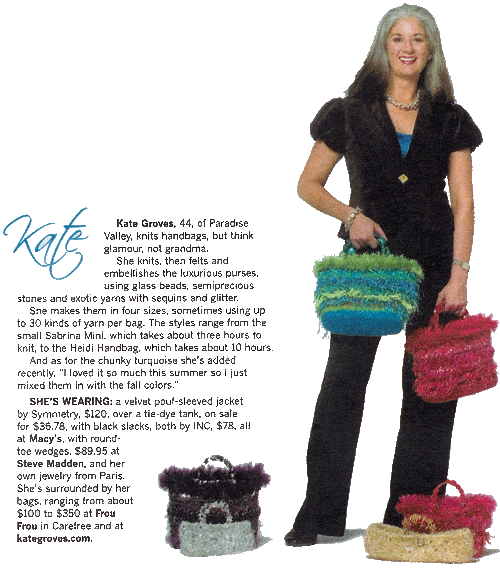
Kate Groves Handbags Featured in the Newspaper!

Kate Groves Handbags

Hey, look!  We are fashion-blogging here at Coyote Blog today (fellow Princetonian Virginia Postrel would be proud)

We are having fun today as my wife, Kate Groves, had her handmade handbags and purses featured in the weekend style section of the Arizona Republic today!

Of course, being the MSM, they forgot to put her web site in the article, but they have the article and a link to her site here.  Since they only keep the articles online for a week (server disk space must be expensive over there) we have cached the article on Kate Groves handbags here. Kate’s website with all of her purse designs are here.

Selling your Business

Since I just completed a three part series on buying a business, which starts here, it seems appropriate to link to this article on selling your business from Entrepreneur.com via the Entrepreneurial Mind.

The amount of disclosure that buyers require can be mind-boggling. Putting it all together in a reasonable fashion is just one reason to consider hiring outside help. An intermediary, such as a business broker or an investment banker, can relieve you of some of the work while also keeping the buyer engaged. “We always recommend that a third-party intermediary represent you,” says Minor.

yes.