Posts tagged ‘FAR’

Guns, Germs, Steel

The story I was always taught is that the Spanish conquistadors rolled over the Aztecs, Maya, and Incas in what would be an inevitable victory chalked up to guns, germs, and steel.  But I always found this conclusion a bit smelly.  Sure the Spanish had guns and horses, but they didn't have very many of them (a few hundred) and they were not very good.  Three and a half centuries later, the US struggled at times in its wars with North American tribes (just ask the Custer family) despite having FAR better guns, many more trained troops (just after the Civil War), numerical superiority rather than inferiority, and a much better logistics situation (land access by rail vs. sea access by wooden boat).  In addition, Latin American civilizations faced by the Spanish were better organized, far more numerous, and technologically more advanced than plains Indians.  So why the seemingly easy victory by the Spanish?

Apparently there is a new book discussing this topic, which claims the results were much more contingent than commonly believed.

The “steel and germs” explanation for the rapidity of conquest has not convinced all specialists. The newcomers’ technological advantages were insufficient and in any case only temporary; differential mortality was a long-term process, not something that happened at the moment of outsiders’ assault. Thinking about the endemic vulnerabilities of empires helps us understand the situation. The Aztecs and the Incas were themselves imperial formations of relatively recent origin, with highly concentrated power and wealth at the center and often violent relations with not entirely assimilated people at the edges of their empires. When the Europeans arrived, indigenous people were not sure whether the newcomers were enemies, gods, or evil spirits–or potentially useful allies against an oppressive power. These uncertainties made it harder for their rulers, who had no way of knowing what was in store for them, to respond effectively. Cortes and Pizarro recruited allies among disaffected peoples, thereby making their armies as large as the Aztec and Inca forces they fought against. The battle against the Aztecs was hard-fought, with Spaniards suffering reverses, despite their indigenous allies and the hesitations of the Aztec emperor Moctezuma. The conquest of the Inca empire–more centralized than that of the Aztecs–was also facilitated by turning those excluded under Inca power into indigenous allies.

A Defense of Israel

I can't call myself a defender of Israel per se because they have done a number of illiberal things in their country that tick me off.  However, I can say that for all the problems they may have, their response to a neighboring country dropping rockets on its citizens is FAR more restrained than would be the response of, say, the US.  If Mexico were dropping rockets into El Paso, Mexico would be a smoking hole in the ground.   We still maintain a stricter economic embargo on Cuba, which has never done a thing to us, than Israel does on Gaza.

I pay attention to the Amherst College community since my son enrolled there.  I thought this was a pretty powerful article by an Amherst student who has taken a leave of absence to join the IDF.  Given my understanding of how Eastern liberal arts faculty think about Israel and Palestine, one should think of this as a voice in the wilderness.

You Get What You Subsidize

An interesting set of data I read the other day:

In 2011, the Arizona Health Care Cost Containment System, Arizona's Medicaid program, paid for 53 percent of the state's 84,979 births, while private insurance paid for 42 percent, according to state statistics. The remainder were paid for by individuals....

Sen. Sylvia Allen, R-Snowflake, estimated that including pre- and postnatal care, it costs Arizona about $7,500 per birth for a delivery with no complications. Using those estimates, the 2011 deliveries would have cost Arizona taxpayers nearly $338 million....

In 2010, 58 percent [of Arizonans] had private insurance and 18 percent were on Medicaid.

So, 18% of Arizonans are having 53% of all births.  Another way to put this is that the 18% of people who get this procedure from the government for free account for half the demand, despite the fact that these folks are the ones who, if rational, should be the least likely to have a lot of births because they presumably have the most difficulty affording an extra mouth to feed.

God forbid I start sounding like some crotchity Conservative, but I continue to be amazed that pregnancy is treated as an "emergency procedure."  It strikes me that unlike, say, cancer, individuals can choose to avoid this condition fairly easily if they can't afford it.  I certainly know my wife and I put FAR more deliberation into having children than we did any other decision in our lives.  There is a terrible tension here - no one wants to turn away an expectant mother and endanger her child, but freely giving away an expensive procedure without any sort of restrictions nearly begs for a baby boom.  Those who try to argue that Obamacare won't increase health care expenses (in other words, arguing that demand curves don't upward) only have to look at these numbers.

PS-  Apparently, our state legislature is appalled by these numbers.  This is the same legislature that has proposed about a zillion abortion restrictions over the last year.  It will be interesting to see if fiscal issues change anyone's thinking on the abortion issue now that there is suddenly a $7500+ incentive to allow an abortion.

Update -- Thinking about this, I think the 18%/53% comparison is directionally correct but the difference is exaggerated due to Medicare.  I doubt Medicare delivers many babies, but a large part of the AZ population is on Medicare.  If the numbers were reset to show the percentage of Arizonans of child-rearing age on Medicaid, the number would be north of 18% but likely well below 53%.

Climate Bait and Switch

Cross posted from Climate Skeptic

This quote from Michael Mann [of Hockey Stick fame] is a great example of two common rhetorical tactics of climate alarmists:

And so I think we have to get away from this idea that in matters of science, it's, you know, that we should treat discussions of climate change as if there are two equal sides, like we often do in the political discourse. In matters of science, there is an equal merit to those who are denying the reality of climate change who area few marginal individuals largely affiliated with special interests versus the, you know, thousands of scientists around the world. U.S. National Academy of Sciences founded by Abraham Lincoln back in the 19th century, all the national academies of all of the major industrial nations around the world have all gone on record as stating clearly that humans are warming the planet and changing the climate through our continued burning of fossil fuels.

Here are the two tactics at play here:

  1. He is attempting to marginalize skeptics so that debating their criticisms is not necessary.  He argues that skeptics are not people of goodwill; or that they say what they say because they are paid by nefarious interests to do so; or that they are vastly outnumbered by real scientists ("real" being defined as those who agree with Dr. Mann).  This is an oddly self-defeating argument, though the media never calls folks like Mann on it.  If skeptics' arguments are indeed so threadbare, then one would imagine that throwing as much sunlight on them as possible would reveal their bankruptcy to everyone, but instead most alarmists are begging the media, as in this quote, to bury and hide skeptics' arguments.  I LOVE to debate people when I know I am right, and have pre-debate trepidation only when I know my position to be weak.
  2. There is an enormous bait and switch going on in the last sentence.  Note the proposition is stated as "humans are warming the planet and changing the climate through our continued burning of fossil fuels."  I, and many other skeptics, don't doubt the first part and would quibble with the second only because so much poor science occurs in attributing specific instances of climate change to human action.  What most skeptics disagree with is an entirely different proposition, that humans are warming the planet to catastrophic levels that justify immensely expensive and coercive government actions to correct.  Skeptics generally accept a degree or so of warming from each doubling of CO2 concentrations but reject the separate theory that the climate is dominated by positive feedback effects that multiple this warming 3x or more.   Mann would never be caught dead in public trying to debate this second theory of positive feedback, despite the fact that most of the warming in IPCC forecasts is from this second theory, because it is FAR from settled.  Again, the media is either uninterested or intellectually unable to call him on this.
I explained the latter points in much more detail at Forbes.com

Great Toy

I have to second Glenn Reynolds recommendation of this Snap Circuits electronic kit.  This is BY FAR the most user friendly electronic building toy we have found, and it works great.  I don't see that many kids with these so its a great gift for nieces and nephews who you are not sure what they already own.

The Power of Regulation

John Stossel has this chart to clearly define the power that is OSHA regulation:

Wow, that sure makes a big difference.  Which confirms my experience as a business owner.  Financial incentives like workers comp rates are a FAR more powerful force, at least in my business, to root our safety issues than the arcane and bureaucratic mandates that flow out of OSHA.

More on California's Big Dig

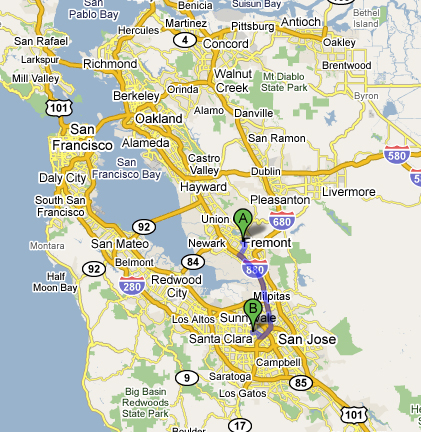
The Anti-Planner has more on the California high speed rail proposal I wrote about earlier.  My guess was that the first $9 billion bond issue, on the ballot this fall, would not get the train out of the LA metro area.  Well, I was right and wrong.  The smart money thinks the line will start at the other end, in San Francisco.  But the betting is that for $9 billion the line won't even get out of the San Francisco metro area, making it perhaps as far as San Jose. 

But we have a second data point -- there is a proposal on the table to extend BART from Fremont to Santa Clara for $4.7 billion, a distance (as shown on the map below) about a third of that from San Francisco to San Jose.
Map

I am not sure what high-speed rail technology that they are considering, but a true high-speed line requires special alignments, track, and signaling that should make it FAR more expensive per mile than a BART line (just as an example, a true high-speed line could take miles to make a 90 degree turn, eating up land and reducing alignment flexibility in a very congested and hilly area).  And remember, the BART cost estimate is probably low.

No way these guys get to San Jose for $9 billion, much less to LA for $40 billion.  Just what Californians need with their massive budget deficit:  a brand new white elephant.

Case Studies on the Minimum Wage

OK, I will begin this post with what I guess is, for some, a damning admision:  My company pays many of its employees minimum wage. 

I believe that I have a very honorable relationship with my employees, but for many, particularly on the left, the fact that I pay minimum wage puts me at the approximate moral level of a forced labor camp gaurd.  For those of you that feel that way, you might as well move on now because this post will just irritate you further.

I want to present four case studies from my own business as to what happens to workers and consumers when minimum wages go up.  For the purpose of this post, I will leave out the philosophical argument of why voters or politicians should even have the right to interfere in the free decision-making between employer and employee, but I certainly addressed it here, in this post.  Unfortunately, a large number of voters accept the argument that there is a power imbalance between employer and employee that needs to be moderated by measures like the minimum wage  (folks who believe this obviously never have tried to attract and retain quality wokers). Many politicians support minimum wage measures, mainly because it is one of those measures, like protectionism, where the benefits (e.g. Joe got a raise) are much easier to identify than the costs (e.g. Mary lost her job).

Before I get into the case studies, it may be helpful to describe my workers, because in some ways their situation is unique.  To run our campgrounds, we mainly employ retired people.  Of my 500 workers, well over half are over 60 years old, more than 150 are over 70, some 25 or so are over 80 and a few are even over 90!  Most are on social security and medicaire, and many have pensions and retirement health plans.  A good number are disabled and have some sort of disability support.  While they work slower, they make up for their low productivity in part by their friendliness with customers and their life experience.

Most of  my employees travel the country in their RV.  They take most of the year off, but many like to work over the summer to make a little money and to pay for their camping site.  I give many of them a free or subsidized campsite, worth about $500+ a month, plus all their utilities and then pay them minimum wage for the hours they work.  Many are thrilled with these terms - so many that I have a waiting list now of over 300 names of people who are looking for this type work.  This list is currently growing by about 10 names a day.

There may be employers somewhere who have a power imbalance over their employees.  Some days, I envy them.  My employees most all have independent means of support.  Further, they all have wheels on their houses, so they can and do pick up and leave if they aren't enjoying their job.  And, if they don't like our company, there are thousands of other campground operators who are looking for help.

So why are so many people lining up for minimum wage jobs when lefties and progressives are telling them that they should not want those jobs?  Here are some reasons:

  • They value the amenities that come with the job, including living for free in a beautiful outdoor setting, something it is impossible to value under minimum wage laws
  • They have other means of support, so the money is incidental.  In fact, I get more inquiries from employees asking me to reduce their hours so as not to mess up their social security or diabiloity payments as I do people asking for more pay
  • They get to work with their spouse as a team.  There are not many employers out there that let a husband and wife split up work between them any way they want or even work together - can you imagine such a situation on a GM assembly plant?
  • They would have a hard time getting hired by anyone else.  Very few employers will hire new workers in their sixities, and certainly not older than that.  Older workers can be slower and less productive.  For $12 an hour, I would have to hire younger workers too, but at minimum wage, I can afford the lower productivity of older workers and gain the benefit of their experience and trustworthiness.

This last point help set the stage for our cases.  I love hiring older workers at $5.15 an hour, and they love the job and line up for it.  But what happens when I have to pay these less productive workers $6.00 an hour?  What about $7.50?  What about at $12.00 an hour?  Here are some examples of what happens:

Case 1:  The jobs just go away

Washington State has one of the higher minimum wages in the country, at $7.35 an hour.  What makes the Washington minimum particularly hard to manage is the fact that it has a built-in escalator, such that it rises each year based on an inflation index (as you might imagine, since labor is a major component of most goods and services, this creates a positive feedback loop). 

We run a number of campgrounds in Washington under concession contract from the US Forest Service.  Most of these campgrounds are both small and very isolated, and are therefore labor intensive.  Given local market conditions, it is increasingly difficult to raise fees fast enough to keep up with rising labor rates (as well as labor-linked costs such as workers comp and unemployment) since we are competing against larger private campgrounds that are designed more efficiently and may be closer to local labor.  We have effectively given up trying to make money in this area, and will very likely not rebid the contract when it expires.  Given USFS experience on other similar contracts in the area, there is a good chance that no private company will bid for the contract, and the campgrounds will revert to USFS operation.  In this case, many will likely be closed, and instead of having minimum wage jobs, there will be no jobs left at all.

Case 2:  The jobs get outsourced to contractors

In a number of locations, we have been forced by rising minimum wages and associated costs (particulalry workers comp.) to switch some of our cleaning and landscaping duties from our live on-site employees to local contractors.  These contractors may pay their workers more than minimum wage, but the workers are often twice as productive as ours, yielding a cost savings for us.  When minimum wages are $5.15 an hour, these contractors can't compete with our own workers, but when minimum wages rise over $7.00, as they are across the west coast, this option starts to become attractive.

Case 3:  The jobs get automated away

One of the more frustrating situations we have is one government concesion contract where the government has continued to insist that the Service Contract Act (SCA) applies.  Like the Davis-Bacon act, the SCA sets minimum wages that contractors have to pay to employees when serving the government (for example, on a contract to clean the bathrooms in a goverment office building).  These rates, while ostensibly the market prevailing wages, are in almost every case FAR higher than what a private company would have to pay in the market to get good employees.  By specific Labor Department regulation, the SCA typically does not apply to concession contracts (I won't bore you with the details, but more in this series here or email me if you need help in a similar situation, I have been forced to become an expert).

Anyway, on this particular concession we have to pay our living-on-site workers based on the SCA.  This means, for example, that someone who sits in a parking lot booth collecting parking fees must be paid something like $12.50 an hour, which translates to a bit over $15.60 when you factor in FICA, SUI and workers comp.  Over 2000 hours a year that is $31,200 a year. 

A fully automated fee collection machine (which actually does more than the attendent, since it takes credit and debit cards as well as makes change for cash) costs $23,000.  Plus, the machine never will sue over wrongful termination, never will discriminate against or sexually harass a customer, never will steal, and never will fail to show up for work. 

What would you do?  I would prefer to have the person there, and if we put the machine in I will still  probably staff the booth on busy summer weekends to help customers out, but over 5 years the machine may save us over $100,000.

Case 4:  Prices go up to customers

Last election, Floridians voted themselves a minimum wage increase of $1.00, and worse, voted that the wage will increase each year by a cost of living factor.  As a result, on the May 2 effective date, our costs will go up by about 15% in managing the swim areas and campgrounds in that area.  Since this is well over our profit margin, prices will also go up by the same amount on the same day.  This is unfortunate, because it tends to be lower income people who most enjoy the recreation opportunities we offer, since historically we have been able to keep our costs, and therefore the pricing, so much lower than outrageously expensive attractions like Disney and Universal Studios.

Final Thoughts

I'm not going to cry that my business is doomed by minimum wage increases, because it is not.  As you can see above, we have many options for dealing with these changes.  What I fear may be doomed, though, is the special relationship our company has always had with older, retired workers. For now, the business model is OK, but there is a point, somewhere between about $7.00 and hour and $10.00 an hour, where rising minimum wages will push us to look for other ways to staff our parks rather other than our traditional use of live-on-site retirees.  And that would be sad for everyone.

For more on the topic, Powerline has a nice article today on minimum wage increase proposals in Minnesota.  It is astounding to me that people still want to believe the notion that minimum wages don't affect employment.  Just look at France and Germany for living proof.  Or, consider any other commodity in the market.  If the government set a price floor for gasolene, say at $3.00 a gallon, would anyone out there argue that people wouldn't use less gas?  But when we try to raise the price floor on labor, the media and politicians with a straight face try to argue that businesses won't use less labor.  Or, for the reverse, look at the experience with natural gas and airline travel - the government removed price floors on these commodities in the lates 70s / early 80s and look at how demand has skyrocketed.  (update: Powerline has a second post on the topic here)

For even more good reading, Cafe Hayek is always a good source for defense of free market economics, including this good post on French work week laws.  More on minimum wage here.