The Wapo had a story about Danish theaters showing movies with subtitles, even for movies in Danish
In recent weeks, many Danish have finally been able to understand their country's actors again — thanks to subtitles.
According to European news site The Local, Danish actors were criticized for mumbling to such an extent that many moviegoers had a hard time following the story plot. In reaction to the complaints, cinema owners promised to provide people with the option to either choose movie screenings with subtitles or without. All films produced in Denmark will be available in both versions in the future....
Pedersen blames the necessity for subtitles on the evolution of the use of Danish in movies. Whereas in the past, actors were focused on articulating themselves in a way understandable for everyone, their main emphasis has now shifted to being as authentic as possible. Hence, many actors have chosen not to imitate more common dialects and have stuck to local versions of Danish. "It's a small country, but there are big differences between the Danish dialects," Pedersen explained.
I suppose this is supposed to be surprising but frankly at home I turn subtitles on for a number of shows that have dialog in English but have unfamiliar accents or dialects -- a range of shows from the Crown to the Wire. I remember a cocktail party conversation with a group of white suburban liberals in which, after much alcohol, everyone admitted their secret vice of turning on subtitles for the Wire.
I have argued that another problem with dialogue is the way movie sound is mixed. The dialog track can be overwhelmed with the other sound and music tracks. This works OK in a theater with good acoustics and lots of sound absorption (e.g. those curtains on the wall) but is a disaster when it comes to showings at home where most living rooms are way more "live" than movie theaters. The result is a lot of extra reflections and delays that serve to further muddy even well articulated dialog.
Also, to be honest, my tinnitus and too many rock concerts in the 70's and 80's probably play a factor too.
Tags: denmark Category: Movies & Entertainment |
Comments Off on Subtitles for One's Own Language? I Turn Them On All Them Time
Kevin Drum, in commenting on a Binyamin Appelbaum article in the NY Times, writes that the Presidential candidates should be talking more about poverty in part because the US is way behind Europe. Specifically, Appelbaum quotes a Harvard Sociology (!) Professor as the source for the poverty claim:
“We don’t have a full-voiced condemnation of the level or extent of poverty in America today,” said Matthew Desmond, a Harvard professor of sociology. “We aren’t having in our presidential debate right now a
serious conversation about the fact that we are the richest democracy in the world, with the most poverty. It should be at the very top of the agenda.”
Drum argues that Desmond is right, because of this chart from the OECD:
One of the dirty secrets about poverty measurement is that the actual measurement seldom has anything to do with absolute well-being. And this is the case with the OECD numbers. The OECD's poverty measurement is based on the country's median income, and is the percentage of people who are below a certain percentage (generally 50%) of the country's own median income. As such, this is more rightly thought of as a graph of income inequality rather than absolute poverty.
Here is an example. Image country A with a median income of $50,000 and an income of the 20th percentile at $20,000. Now imagine country B where the median income is $30,000 and the 20th percentile income is $15,000. In this example, the poorest 20th percentile in country A are better off on an absolute basis, but the OECD (and most other poverty numbers) will show country B doing better because the poor are closer to the (much lower) median income. In an extreme example, if everyone in a country were equally impoverished, the OECD would show that country as doing the best on poverty -- Yes, you read that right. By this metric, the OECD would show a country where every person made just $10,000 a year as having 0% poverty.
Obviously, what one would really like to do is compare across nations the absolute well-being of the lowest 10th or 20th percentile. On a purchasing power parity basis, which country's poor has, after transfers and taxes, more money? Unfortunately, you likely have never ever seen this. Yes, the data comparison is hard, but it is possible, so one has to wonder if there is some ulterior political motive for never showing this quite obvious analysis.
I tried to do this analysis myself for years (I describe some false starts here) but was unsuccessful until I actually identified a data source that would work, ironically from two folks on the Left (Kevin Drum and John Cassidy) who were using data from the LIS Cross-National Data Center to make comparisons of income inequality. It turned out the data they were using could do what I wanted.
So now we get to the chart I call the poverty Rorschach test. It is a comparison of the absolute income, by income percentile and including transfers and taxes, of the US vs. Denmark (the country by Drum's chart that should be the "best" on poverty)
(The date is old, alas, because this kind of cross-country data is only gathered every so often)
This chart shows, on a purchasing power parity basis, that for every single income percentile, all the way to the bottom, an equivalent person in the US has more income than that a similarly situated person in Denmark. In short, the poor in the US are wealthier than the poor in Denmark. The only reason Denmark does better than the US in the way the OECD and others measure poverty is that the middle class in the US are a LOT wealthier than the middle class in Denmark.
I call it the Rorschach test because one either sees the US doing a good job, because everyone is better off, or the Danish doing a better job, because everyone is more even. Proponents of the latter view tend to believe that the size of the economic pie is an exogenous variable, unrelated to the method one chooses to slice it.
I picked the Danish because they were the obvious comparison from Drum's chart, but here is the US vs. all the European countries for which there was data in the survey. The US is better than all but 3 at the 10th percentile and better than all but one country at the 20th percentile. And better -- by a huge margin-- for the middle class than any of the countries in Europe.
Update: One more note on Drum's chart. As I said above, the exact definition of the OECD numbers is percentage of people with income less than 50% of the country's own median income. The US has a median household income, per the OECD, 41% higher than Denmark's. So the US has 9% more people under a number that is 41% higher. That is hardly a fair or meaningful comparison.
For reasons that are beyond my understanding, I am banned at Mother Jones so I cannot post the comments directly to his article. If someone wanted to cut and paste this under his or her own name, I wouldn't complain.
The American Left generally spends most of its time telling us how much better things are in Denmark or France. I can't find a lot of reasons to like Trump, but he has apparently convinced the Left that they need to defend the American economic model against other countries. This post by Kevin Drum at Mother Jones reasd more like what one might expect from Mark Perry at AEI.
"We're a poor country now." I wonder how many people believe that just because Donald Trump keeps saying it? In case anyone cares, the actual truth is in the chart on the right. There's not a single country in the world bigger than 10 million people that's as rich as the US.
Apparently, Denmark is considering a plan (WSJ, gated) to seize valuables from migrants to offset government costs. I am sure this will work out just as fairly as do American asset forfeiture laws
Denmark’s minority government has secured cross-party backing for a plan to seize cash and valuables from asylum seekers to help meet the cost of their stay in the Nordic country despite criticism from the United Nations and some Danish lawmakers.
Details of how the plan, which could be adopted by parliament as early as next month, would be put into action remain scant.
Liberal Party lawmakers, who draw up the proposal, have provided few details other than to say that police won’t be taking people’s possessions as they enter the country. Police or other officials would appraise the value of people’s possessions as they check the identity of asylum seeks before deciding what, if anything, the new arrivals should pay.
For a period of time in the late 1930's, the German government was actually encouraging Jews to leave the country -- the one requirement, though, was that the government stripped them of all their property and valuables on the way out. So I ask the same question slightly modified. What is the moral difference between stripping refugees of their assets as the leave a country vs. as they enter a country?
** Several people argued the point by analogy, saying it is OK to lock people out of your house but not to lock them in your house. Certainly, but this frequent use of exclusionary rights on private property as an analogy for an entire country is deeply flawed. Essentially, for this to be a valid analogy, one would have to adopt Marxist definitions of state ownership of all property and totalitarian views on individual rights to argue that an entire country is just like a private house.
I am going to reprise parts of an article I wrote in Forbes several years ago, because I think the conclusions are particularly relevant given the Democrats' discussion of income inequality and the Scandinavian economic model.
When folks like Bernie Sanders say that we have more income inequality than Sweden or Denmark, this is certainly true. By just about any test, such as Gini ratios, we have a much wider range of incomes.
However, we Sanders implies that this greater income equality means the poor are better off in these countries, he is very probably wrong. Because the data tends to show that while the middle class in the US is richer than the middle class in Denmark, and the rich in the US are richer than the rich in Denmark, the poor in the US are not poorer than those in Denmark.
And isn't this what we really care about? The absolute well-being of the poor?
I am not a trained economist or economic researcher, but I have looked for a while for a data source to get at this. I can find Gini ratios all over the place, but how do I compare the absolute well-being of poor in one country to poor in another?
The first clue that I was maybe on the right track was this chart that actually came from a left-wing group trying to promote the idea of reducing income inequality. The chart is hard to read (the study is no longer online and all I have is a bad screenshot), but it seemed to show that the poor in the US were no worse off than the poor in Denmark and Sweeden
So the data had to be there somewhere. Finally I found a set of data that seemed to does the trick. I used data from the LIS Cross-National Data Center. I cannot vouch for their data quality, but it is the same data set used by several folks on the Left (John Cassidy and Kevin Drum) to highlight inequality issues, so I used the same data source. I then compared the US to several other countries, looking at the absolute well-being of folks at different income percentile levels. I have used both exchange rates and purchasing price parity (PPP) for the comparison but my feeling is that PPP is a better approach when we are comparing consumer well-being.
You can click through the Forbes article to see all the comparisons, but I will focus here on Sweden and Denmark since they are very much in the policy-making discussion on income inequality. As usual, you can click to enlarge:
What does this mean? If the data is correct, it means that all the way down to at least the 10th percentile poorest people, the poor in the US are as well or better off than the poor in Denmark and Sweden. And everyone else, including those at the 20th and 25th percentile we would still likely call "poor", are way better off in the US.
All this talk about reducing income inequality by emulating Denmark is thus not about making the poor better off, but just about cutting the rich and middle class down to size.
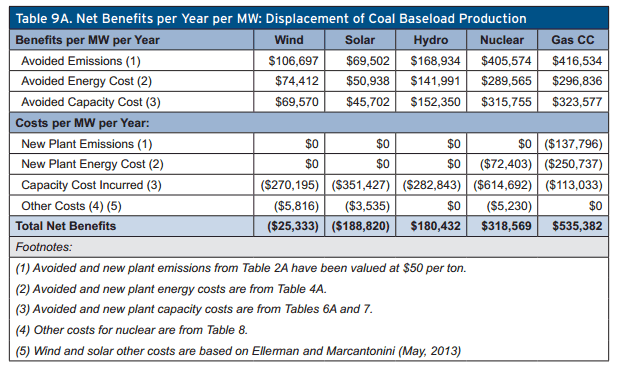
Charles Frank of Brookings has looked at the relative returns of various energy investments in the context of reducing CO2. The results: The best answer is natural gas, with nothing else even close. Solar and Wind can't even justify their expense, at least from the standpoint of reducing CO2. Here is the key chart (Hat tip Econlog)
Note that this is not a calculation of the economic returns of these types of power plants, but a relative comparison of how much avoided costs, mainly in CO2 emissions (valued at $50 per ton), there are in switching from coal to one of these fuel sources. Natural gas plants are the obvious winner. It remains the winner over solar and wind even if the value of a ton of CO2 is doubled to $100 and both these technologies are assumed to suddenly get much more efficient. Note by the way that unlike wind and solar (and nuclear), gas substitution for coal plant yields a net economic benefit (from reduced fuel and capital costs) above and beyond the avoided emissions -- which is why gas is naturally substituting right now for coal even in the absence of a carbon tax of some sort to impose a cost to CO2 emissions.**
I was actually surprised that wind did not look even worse. I think the reason for this is in how the author deals with wind's reliability issues -- he ends up discounting the average capacity factor somewhat. But this understates the problem. The real reliability problem with wind is that it can stop blowing almost instantaneously, while it takes hours to spin up other sorts of power plants (gas turbines being the fastest to start up, nuclear being the slowest). Thus power companies with a lot of wind have to keep fossil fuel plants burning fuel but producing no power, an issue called hot backup. This issue has proved itself to substantially reduce wind's true displacement potential, as they found in Germany and Denmark.
There is no evidence that industrial wind power is likely to have a significant impact on carbon emissions. The European experience is instructive. Denmark, the world's most wind-intensive nation, with more than 6,000 turbines generating 19% of its electricity, has yet to close a single fossil-fuel plant. It requires 50% more coal-generated electricity to cover wind power's unpredictability, and pollution and carbon dioxide emissions have risen (by 36% in 2006 alone).
Flemming Nissen, the head of development at West Danish generating company ELSAM (one of Denmark's largest energy utilities) tells us that "wind turbines do not reduce carbon dioxide emissions." The German experience is no different. Der Spiegel reports that "Germany's CO2 emissions haven't been reduced by even a single gram," and additional coal- and gas-fired plants have been constructed to ensure reliable delivery.
Indeed, recent academic research shows that wind power may actually increase greenhouse gas emissions in some cases, depending on the carbon-intensity of back-up generation required because of its intermittent character.
** Postscript: The best way to read this table, IMO, is to take the net value of capacity and energy substitution and compare it to the CO2 savings value.
The first line is just from the first line of the table above. The second is essentially the net of all the other lines.
I think this makes is clearer what is going on. For wind, we invest $106,697 for $132,030 $132,030 for $106,697 in emissions reduction (again, I think the actual number is lower). In Solar, we invest $258,322 for $69,502 in emissions reduction. For gas, on the other hand, we have no net investment -- we actually have a gain in these other inputs from the switch -- and then we also save $416,534. In other words, rather than paying, we are getting paid to get $416,534 in emissions reduction. That is not several times better than Solar and Wind, it is infinitely better.
Postscript #2: Another way to look at this -- if you put on a carbon tax in the US equal to $50 per ton of CO2 that fuel would produce, then it still likely would make no sense to be building wind or solar plants unless there remained substantial subsidies for them (e.g. investment tax credits, direct subsidies, guaranteed loans, above-market electricity pricing, etc). What we would see is an absolute natural gas plan craze.
I have been warning you, its coming. When government pays the health care bills, they can then use that as an excuse to micro-regulate our every behavior. Because its no longer an individual choice, it affects public costs.
“Denmark finds every sort of way to increase our taxes,” said Alisa Clausen, a South Jutland resident. “Why should the government decide how much fat we eat? They also want to increase the tobacco price very significantly. In theory this is good — it makes unhealthy items expensive so that we do not consume as much or any and that way the health system doesn’t use a lot of money on patients who become sick from overuse of fat and tobacco. However, these taxes take on a big brother feeling. We should not be punished by taxes on items the government decides we should not use.”
As an aside, given that Scandinavians tend to have among the world's highest tolerances for taxes, when they get fed up, it must be getting bad.
The other day I was happy to see lefty Kevin Drum pointing out the obvious problems with subsidizing Edit Post "¹ Coyote Blog "†WordPressethanol. This is a step forward, when smart people on both sides of the aisle can agree that a certain approach is dumb. Of course, given the incentives in government, that doesn't mean that ethanol subsidies will actually stop.
So we make some progress on ethanol, but just replace it without another absurdly dumb subsidized energy technology, in this case wind. Wind is not even close to being ready for grid service, and given the hot backup power one needs to cover its unpredictability, it does about zero to reduce CO2 emissions. A series of studies have shown that it has done nothing to reduce fossil fuel consumption in either Germany or Denmark. And the whole green jobs thing is even more absurd -- it makes no sense theoretically, as shifting private investment to less economically viable uses has never, ever created jobs -- and has been debunked in practice in both Denmark and Spain.
Unfortunately, the Obama administration has bent over backwards to ignore the science and push wind, for no other reason I can figure out except to avoid admitting he was wrong when he campaigned on wind. This makes for a pretty depressing story, and, given there are more documents the Administration is resisting releasing under FOIA, probably more ugly news to follow.
Postscript: One way you could use wind is with some kind of storage system, of which I can think of two. The first is to use wind to pmp water up hill into a reservoir where the potential energy could later be harvested as hydroelectric power. The other is to use the wind power to make hydrogen from water. You need some sort of process that can be stopped and started on short notice.
I have an innate confidence in technology. For example, while I understand solar to be uneconomic for powering my house today, I fully expect that to change. I look forward to the day, not that far in the future, when I can take my Arizona house off the grid, at least during the day.
In contrast, though, it may be that wind power can't be fixed, in large part due to its inherent unpredictability. Sure, solar has a problem as well, in that it doesn't work at night. But at least the times when solar is off here in Arizona (ie when it is dark) are predictable and coincide with lower load periods. Wind is utterly unpredictable and variable, and its peaks and troughs are unrelated to peaks and troughs in electricity demand.
So, if the grid is to reliably supply sufficient power to meet demand, wind must have a backup. And there is the rub. Because just about every technology that might currently be used as a backup takes a really, really long time to start up. Small gas turbines can be producing electricity from a cold stop pretty quickly, but a large coal-fired power plant can take days to go from a cold stop to producing electricity. This is in part because there are a series of steps where A has to precede B which must come before C to start plants up, and partially just because immediately heating the whole system up would cause the plant to blow up just from the thermal stresses.
So, to back up wind power, traditional fossil fuel plants have to be kept warmed up with turbines spinning. This means that fossil fuels are burned but no electricity is produced. I mentioned in a previous post that the largest utility in Germany estimated that 48,000MW of wind capacity was in fact allowing the shut down of just 2000MW of traditional fossil-fuel powered capacity.
A recent article in the National Post argues the Danes are seeing absolutely no substitution from their substantial investment in wind.
There is no evidence that industrial wind power is likely to have a significant impact on carbon emissions. The European experience is instructive. Denmark, the world's most wind-intensive nation, with more than 6,000 turbines generating 19% of its electricity, has yet to close a single fossil-fuel plant. It requires 50% more coal-generated electricity to cover wind power's unpredictability, and pollution and carbon dioxide emissions have risen (by 36% in 2006 alone).
Flemming Nissen, the head of development at West Danish generating company ELSAM (one of Denmark's largest energy utilities) tells us that "wind turbines do not reduce carbon dioxide emissions." The German experience is no different. Der Spiegel reports that "Germany's CO2 emissions haven't been reduced by even a single gram," and additional coal- and gas-fired plants have been constructed to ensure reliable delivery.
Indeed, recent academic research shows that wind power may actually increase greenhouse gas emissions in some cases, depending on the carbon-intensity of back-up generation required because of its intermittent character.
It probably comes as no surprise that the Danes have the highest electricity costs in Europe. The article goes on to call wind power in the US a "huge corporate welfare feeding frenzy."
Ditlev Engel, president and chief executive of the Danish wind-energy company Vestas, said anecdotal evidence about birds being caught in turbine blades and other environmental horror stories do not usually hold up under scrutiny.
"Do people think it's better all those birds are breathing CO2? I'm not a scientist, but I doubt it," said Engel, whose company is expanding its U.S. manufacturing and distribution operations. "Let's get the facts on the table and not the feelings. The fact is, these are not issues."
LOL - Nothing like a paragraph that simultaneously includes the phrase "Let's get the facts on the table" with the hypothesis that a couple hundred ppm increase in CO2 concentrations hurts birds. By the way, from the same article, a lot of discussion of the environmental impact of renewables due to their out-sized use of land. Clearly an issue for solar and wind, and possibly for others:
One of the biggest challenges renewable-energy projects pose is that they often take up much more land than conventional sources, such as coal-fired power plants. A team of scientists, several of whom work for the Nature Conservancy, has written a paper that will appear in the journal PLoS One showing that it can take 300 times as much land to produce a given amount of energy from soy biodiesel as from a nuclear power plant. Regardless of the climate policy the nation adopts, the paper predicts that by 2030, energy production will occupy an additional 79,537 square miles of land.
I am always amazed at the number of environmentalists that laud the Brazilian ethanol push, given the out-sized effect that industry has had in carving up the Amazon rain forest. As a disclosure, I am a member of the Nature Conservancy, and wild land preservation is my environmental interest of choice, though I prefer to pursue it through private means (ie via private purchases of land for conservation purposes). The Nature Conservancy used to spend most of its money for this purpose, though of late it has diverged, as so many environmental groups have, into lobbying government to force people to achieve its ends for them rather than to pursue these ends through non-coercive means.