Posts tagged ‘deficit’

How the Left Analyzes Greece

I find the Left's opinions on Greece to be fascinating.  After all, Greece is essentially the logical end result of all of their love for deficit spending, so what kind of cognitive dissonance is necessary to write about Greece on the Left?  This kind:

OK, but they're spending too much money. Surely they know they have to cut back?

Sure, but the deals on offer are pretty unattractive. Europe wants to forgive half of Greece's debt and put them on a brutal austerity plan. The problem is that this is unrealistic. Greece would be broke even if all its debt were forgiven, and if their economy tanks they'll be even broker.

But that's the prospect they're being offered: a little bit of debt forgiveness and a lot of austerity.

Well, them's the breaks.

But it puts Greece into a death spiral. They can't pay their debts, so they cut back, which hurts their economy, which makes them even broker, so they cut back some more, rinse and repeat. There's virtually no hope that they'll recover anytime in the near future. It's just endless pain. What they need is total debt forgiveness and lots of aid going forward.

I certainly agree that Greece is now in a death spiral, but this analysis is just amazing.  The only way for other countries to avoid sharing Greece's fate is to, very simply, spend within their means.  If they do, problem avoided.  If they don't, and get hooked on deficit spending, then Greece is their future, the only question is when.

So what does Drum do?  He calls the spending withing their means strategy "unrealistic" and "brutal austerity."    So he occupies a long post lamenting what a totally SNAFU'd situation Greece is in, but takes off the table the only possible approach for other counties to avoid the same fate.   And in fact advocates a strategy that will push a few others over the cliff sooner, or even cause a few to jump on their own (after all, if the punishment for spending your way into financial disaster is to get, as Drum recommends, all your debt forgiven and years of aid payments, why the hell would anyone want to be fiscally responsible?)

And it is amazing to me that he calls forgiving half their debt, the equivalent in the US of our creditors erasing about $7 trillion, as "a little bit of debt forgiveness" while cutting government spending a few percent of GDP is "a lot of austerity."

His solution, of course, is not for Greece to face up to its problems but to transfer the costs of its irresponsibility to others and then remain nearly perpetually on the dole.

His mistake is to assume Greece faces endless pain.  It does not.  History has shown that countries that are willing to rip off the bandage quickly rather than over a few decades can recover remarkably quickly if sensible policies are put in place.  Heck, the Weimar Republic, which had inflation so bad people got paid 3 times a day so their family could buy something before the money became worthless a few hours later, got its house in order in a matter of months.

Ka-chunk Ka-chunk

That is the sound of the printing presses running 24/7.  Because that appears to be how we are funding all of Obama's spending right now (source)

When folks say they are not worried about the deficit, because folks still seem eager to buy our debt (as evidenced by the low interest rates) note that the general public has been a net seller of US debt the first 2 quarters of 2011.  In fact, the only buyer has been Uncle Sam himself, buying up the debt with newly minted cash (or electrons, really).

One other interesting issue, the Fed seems to have been soaking up the money supply in the early days of the recession, before the high-profile business and financial failures really got things moving downward.

From the "I Don't Think That Word Means What You Thinik It Means" Files

Via Ed Driscoll, from Richard Cohen in the Washington Post:

The odd thing about the Tea Party is that it uses Washington to attack Washington. This is a version of Hannah Arendt’s observation that totalitarian movements use democratic institutions to destroy democracy. (This is what Islamic radicals will do in Egypt.) Note that the Tea Party is nowhere near a majority — not in the House and not in the Senate. Its followers have only 60 seats in the 435-member House, but in a textbook application of political power they were able to use parliamentary rules to drive the congressional agenda. As we have known since Lenin’s day, a determined minority is hands down better than an irresolute majority.

The Tea Party has recklessly diminished the power and reach of the United States. It has shrunk the government and will, if it can, further deprive it of revenue. The domestic economy will suffer and the gap between rich and poor, the educated and the indolently schooled, will continue to widen. International relations will lack a dominant power able to enforce the rule of law, and the bad guys will be freer to be as bad as they want. Maybe the deficit will be brought under control, but nothing else will. I worry — and I envy (but will not forgive) those who don’t

Yep, those dang totalitarians -- always trying to shrink government and diminish its power and reach.

The Debt Limit: America's Hostage Crisis

My column in Forbes is up.  Here is how it starts.  Hit the link to see it all.

We Americans are all being held hostage.  The ransom demand:  Trillions of dollars in new taxes.  The threat:  the shut down of any number of economic activities, from retirement payments to mortgage lending.

Megan McArdle, blogging at the Atlantic Monthly, posted a hypothetical list of what government activities would have to cease if we bumped up against the debt ceiling and 40% of government activity (ie the amount currently funded by deficit spending) had to cease immediately. Here are two examples from her article:

The market for guaranteed student loans plunges into chaos. Hope your kid wasn’t going to college this year!

The mortgage market evaporates. Hope you didn’t need to buy or sell a house!

Terrorists have tried for years to find some way to threaten the whole of America and have, with the exception of 9/11, never really succeeded.  Who knew that all they really needed was not to buy guns and bombs, but to get elected to Congress.   How did we ever get in this position, where a handful of men and women in Washington had the power to hold the entire economy hostage?


Let's Just Be Clear On What This Means

From our President

"The American people are sold," President Obama said.

"The American people are sold, I just want to repeat that."

"You have 80% of the American people who support a balanced approach. 80% of the American people support an approach that includes revenues and includes cuts. So the notion that somehow the American people aren't sold is not the problem. The problem is members of Congress are dug in ideologically."

The point he is trying to make is that 80% of the people in the US support higher taxes as part of the deficit reduction package.  Not sure I have seen a poll number this high, but let's assume our dear leader would not lie to us.  But let's be clear on what this means - 80% of the people in the US support higher taxes on other people.

It's A Spending Problem

So, should our deficit today be considered a spending problem or a taxation problem?  Kevin Drum argued yesterday it is a tax problem, and used a historic chart of spending as a percent of GDP to make his point.

I have to thank him.  I would have normally been skeptical of such an analysis yielding much that was useful, but I was forced to do the analysis to correct some obvious data errors in Drum's chart.  Having done so, I found the exercise useful and it became the basis for my column this week at Forbes.  The short answer, its a spending problem.  For more, hit the link.

Worst Chart of the Day: Political Rather Than Mathematical Calculation of Trend Lines

Update:  Make sure to see bottom of post, I have run the numbers from the source and the chart below is proven to be totally BS.

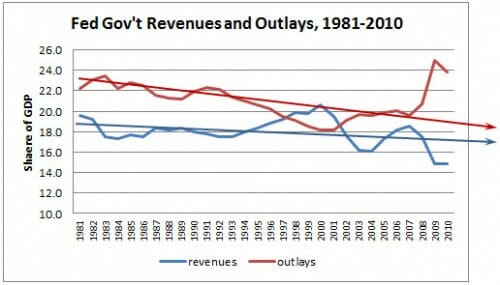
In an effort to paint the current budget deficit as a tax shortfall (ie we don't take enough of others people's money) rather than a spending problem, Kevin Drum offers this chart:

OK, I was going to talk about how they cherry-picked the start date (which is the peak of spending at that time since WWII) and the end date (the left off the ugly 2011).  But I just can't bring myself to talk about anything else except those trendlines.  Not sure what algorithm Drum uses to create the trendlines -- they seem suspicious but surely someone in the science-based, reality-based community would not just draw them on by eye!

It is just incredibly disingenuous (and ballsy) to try to portray 2009 and 2010, which represented the highest numbers since WWII, as a declining trend line falling faster than revenues.

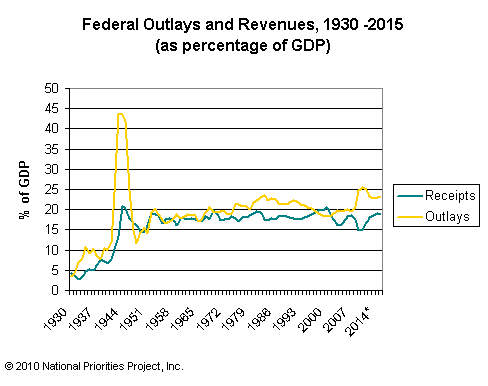
Postscript: Here is the longer view, from here, with projections which I presume come from the Obama budget.  I think if I took 1950 as a start point I would get pretty different trend lines.

Update: Here is the data right from the Federal web site with Excel adding a linear trend.  Sure looks like Drum is wildly exaggerating.  Just as in Drum's chart, red is outlays as a percentage of GDP, blue is collections.

So lets look at the longer trend.  WWII was obviously an anomaly, so we will jump to 1950 to make sure we are well past it.  And we will go through 2012, because those projections are probably pretty good (though optimistic on the spending side).

Here is Drum's chart, with the longer trend and actual mathematically rather than politically calculated trend lines.


Hmmmm.  Revenue or spending problem.  You make the call.

The Worst Sort of Discourse

Kevin Drum had a post lamenting that Congress is doing nothing when it could be spending money that would, in his view, stimulate the economy out of a recession.  All well and good, and predictable based on his assumptions.  But he ended with this

We are ruled by charlatans and cowards. Our economy is in the tank, we know what to do about it, and we're just not going to do it. The charlatans prefer instead to stand by and let people suffer because that's politically useful, while the cowards let them get away with it because it's politically risky to fight back. Ugh indeed.

I was horrified by this sort of discourse, and wrote back:

It is so tiring to see both parties ascribing horrible and hostile motivations to their political opponents.  Your last paragraph is just absurd, implying that everyone agrees with your economic prescriptions and that the only reason everyone is not following them is either a) political self-interest or b) loathing for the poor and helpless.

Is it really so hard to understand that well-intentioned, intelligent people who honestly want the economy to get better might disagree with you about the benefits of deficit spending? The literature is at best mixed on this topic and certainly there is nothing about the last stimulus that causes me to become a believer.

Those of us who believe strongly that diverting trillions of dollars of capital from private to public hands (ie from hands focused on productively employing it to hands focused on politically employing it) makes the economy worse by necessity are just as motivated by trying to improve the economy as you.

I really don't understand this absolute insistence on ascribing bad motivations to those with whom one disagrees.  Is it ego, or just insecurity?  If one admits his or her opponents can be smart and well-motivated, it certainly creates an edge of doubt and uncertainty.  Deal with it.  That's healthy.  It keeps us intellectually honest.

Depressing Fact of the Day

From Tim Cavanough

In the eight days preceding the $38.5 billion deficit reduction deal, the national debt of the United Statesincreased $54 billion.

Budget Explained, In One Chart

Wherein I Actually Praise Republicans

I have been told that the first person in a negotiation that mentions a number will lose.  Something similar is at work with the US federal budget.  When they controlled Congress, Democrats never even proposed a budget for this fiscal year (which began last October, months before they lost control of the House).  Obama's budget is simply a bad joke, a non-effort,  that simply extrapolates current trends without any real change or exercise of control.

Its amazing to me that all the news reports today are about the "risk" Republicans are taking by actually proposing a plan into this vacuum.   It is amazing to me that actually trying to exercise adult supervision when everyone else is voting "present" could be "political suicide," but I have to accept that the political experts know their stuff.

This situation is in fact exactly what Democrats have been hoping for -- they have purposefully hoped to avoid suggesting any solutions in order to force the Republicans to be the first and only ones to the table with suggestions.  Democrats have zero desire to actually close the multi-trillion dollar deficit;  rather, they see it as a huge opportunity that traps Republicans into trying to actually, you know, solve the problem.  These proposed solutions can then be demagogued against to electoral victory.  Or so goes the theory.

So, I want to thank the Republicans for actually producing a budget plan that actually attempts to bring some fiscal sense to the government.  I would have like to see other changes (less defense spending, elimination of Dept. of Education in favor of block grants, zeroing out of all farm and ethanol subsidies, etc) and Ryan's numbers seem screwy, but let us be happy there is at least one adult in Washington.

The Left is Simply Unserious

This is the response from the Left to a proposed 1.6% cut in the Federal budget, that would reduce the annual deficit by a whopping 6%.  Greece here we come!

The Senate is expected to vote this week on alternative plans to approve spending for the rest of this year.  They will vote on whether to agree to the extreme cuts passed by the House (H.R. 1) - $65 billion less than last year's spending for domestic programs.  The House bill will deny vital services to millions of people, from young children to seniors. Please tell your Senators to VOTE NO on H.R. 1 and to vote FOR the Senate alternative. The proposed Senate bill cuts spending $6.5 billion below last year's levels, compared to more than $60 billion in cuts in H.R. 1.  Most of the extreme cuts in the House plan listed below are not made in the Senate bill.

Call NOW toll-free 888-245-0215 (the vote could be as early as Tuesday)
Please call both your Senators and tell them to VOTE NO on H.R. 1 and FOR the Senate full-year FY 2011 bill.  Tell them to vote NO on harsh and unprecedented cuts that will deny health care, education, food, housing, and jobs to millions of the poorest and most vulnerable Americans, while at the same time jeopardizing the economic recovery for all.

Government Rebates for Superbowl Tickets

Vermont Tiger raises a great point about the Volt:  (ht Maggies Farm)

The Volt comes with a manufacturer's suggested retail price of $40,280 and a rebate from Uncle Sam of $7500. GM only plans to make 10,000 Volts this year; and there aren't enough of them to go around. So, naturally, dealers are marking them up – some by much more than the retail amount. One Florida dealer is asking $65,590 (see Motor Trend for details). You might be able to get one on eBay for around $48,000 – after rebate that gets you right back to list price. Hmmm….

No car dealer or manufacturer would offer a rebate on a product that is in backorder status for the foreseeable future. But that's exactly what your government is doing. Even if you believe that there is a compelling reason for the government to want us all to shift to partially electric cars, it's clear that no incentive is required to sell all 10,000 cars available this year since people are buying them at markups which counteract the incentive. In this case the rebate dollars go to dealer margin. Note deficit cutting opportunity.

$75,000,000 down the drain to subsidize upper-middle-class people who want to make a statement about themselves.  Yet another public investment in the self-esteem of the wealthy and our rulers.  In ancient Rome they built coliseums.  In the middle ages they built cathedrals.   In communist countries they built giant statues of their leaders and tractor plants.  Today we subsidize quasi-electric cars and windmills.  None of it makes much sense as way to spend the average person's money, but it makes the elite feel really, really good about themselves.  One wonders what the cumulative historic bill has been for ego maintenance of our rulers.

A Thought on the Trade Deficit

Most of the time when folks lament about the US's trade deficit, I just yawn.  That is because to a large extent the trade deficit is simply an artifact of an arbitrary accounting definition.  Basically, we define a certain fairly arbitrary subset of total commerce and commercial activity between two countries, and then throw tantrums when that arbitrary account is unbalanced.  At the end of the day, the payments loop has to close - the dollars come back to the US somehow.  Historically, most money from such trade deficits have come back to the US as foreign investments in US assets (think, for the example, Japanese investments in the late 80's in US real estate and high profile companies).

It is amazing that we would complain about such a situation.  First, we should be thrilled that foreigners choose to invest in our productive assets rather than just our manufactured goods.  Second, think about it this way -- if we export a product, we get the foreign money but the product goes overseas.  When foreigners invest in our fixed assets, we get the money and the assets remain here.  It is the outsized political influence of shareholders and workers in a few export-oriented industries  rather than economic rationality that keeps the US Congress so fixated on the "trade deficit."

The one issue I have with the trade deficit is it is in large part tied closely to the budget deficits run by the Feds.   Think about it this way -- let's take the definition of the balance of trade and keep it intact, adding just one single additional export product to the calculation:  US Government debt securities.   Certainly these are products we export, and there is nothing wrong with thinking about them as an alternative way for foreigners to spend dollars vs. buying US exports  (just as we all face the choice of investing for savings or buying consumer goods with our own incremental income).

Last year the US trade deficit was between $400 and $500 billion per year.  In 2009 the US government deficit was something like $1.4 trillion.  Assuming they issued debt securities to fund this deficit (ignore QE for now) and assuming foreigner bought 40-50% of these bods, then we exported as much as $700 billion in US government bonds to foreign buyers.  Now, suddenly, when we consider this one additional export product in the mix, we are running a trade surplus.  This is why currencies like the yuan are not necessarily as undervalued as people (including President Obama) may assume -- the issuance of government bonds creates a huge demand for the dollar, and keeps the value high.  If exporters are truly pissed off about the high value of the dollar vs. the yuan, they should not complain to the Chinese, they should complain to Obama and the US Congress for competing with them in foreign markets.  Though we tend to go through phases where we forget it, saving is a competitive product to consumer goods.

Update: Scott Grannis via Carpe Diem

"The Chinese sell us mountains of cheap goods, then turn around and invest most of the proceeds (equivalent to our trade deficit with China) in U.S. Treasury securities. We get the goods, and we get to keep the money. Then we devalue the dollar, and they lose on their investment. Why we would want them to stop doing this is beyond me, though if I were a Chinese citizen, I would be furious with my government for directing such massive quantities of my country's export earnings to Treasuries.

Mixed Feelings Today

I always have mixed feelings about party changes in Washington, because I have little faith the Coke party will taste much different than the Pepsi party.  But I am happy about divided government, so I will take that as a positive.

Unfortunately, while many of the Republican sweeps around the US were based on opposition to deficit spending, bailouts, taxes, and Obamacare (all issues I can readily agree with), victories in AZ came mainly in a wave of xenophobic anti-Mexican hysteria, with our governor (now re-elected) campaigning on crazy fantasy sh*t like Mexicans beheading people and leaving their bodies in the desert.  The Governor "reiterated her assertion that the majority of illegal immigrants are coming to the United States for reasons other than work, saying most are committing crimes and being used as drug mules by the cartels."

Stop Stop Stop Stop STOP!

Please stop talking about there being a fiscal crisis or a government debt crisis.  All this does is give Democrats the opening next year to raise taxes.  "See," they will say, "we care about reducing the deficit."

What we have currently is a government spending crisis.   And the only way to solve it is with less spending.

Thanks, and we now return you to your regular programming.

Libertarians, In Case You Didn't Know This About Yourselves

From JM Berstein in the NY Times, via Kevin Drum, this is about Tea Partiers, but since it addresses the Tea Party distrust and disdain for government, I suppose it applies equally well to we libertarians:

My hypothesis is that what all the events precipitating the Tea Party movement share is that they demonstrated, emphatically and unconditionally, the depths of the absolute dependence of us all on government action, and in so doing they undermined the deeply held fiction of individual autonomy and self-sufficiency that are intrinsic parts of Americans' collective self-understanding.

....This is the rage and anger I hear in the Tea Party movement; it is the sound of jilted lovers furious that the other "” the anonymous blob called simply "government" "” has suddenly let them down, suddenly made clear that they are dependent and limited beings, suddenly revealed them as vulnerable.

Do you get that - we oppose the overwhelming size of government not for any rational reason, but out of a psychological need to deny that the government is inevitably going to grow larger and increase its control over our lives.   This is so absurd it is freaking hilarious.  This is what Louis the XVI's sycophants were telling him to make him feel better in 1789.  I mean, after 200 years of only limited government interference in health care, how is it that a law passed over majority opposition for government takeover of healthcare somehow "demonstrates the absolute dependence of us all on government action?"  Why doesn't it reasonably demonstrate the depth of risk we all face from a minority who have constantly through history been bent on wielding power over us.

Kevin Drum, sort of to his credit, rejects this thesis in favor of his own

So then: why have tea partiers gone off the rails about the federal deficit? It's not because of something unique in their psyches. And it's not because they're suddenly worried that America is going to go the way of Greece. (The polls I linked to above show that tea partiers care more about cutting taxes than reducing the size of government.) It's because they're the usual reactionary crowd that goes nuts whenever there's a Democrat in the White House and they're looking for something to be outraged about

So while he rejects the goofy psychobabble, he accepts the underlying premise, that any opposition to expansion of government and its power of coercion over individuals is irrational.

So take your pick -- libertarians are either a) advocating limited government only as a psychological crutch to hide from ourselves that Obama is really our daddy or b) scheming reactionary nuts.  Whichever the case, remember that there can be no principled opposition to Big Brother.

The Most Outlandish Historical Revisionism I Have Ever Seen

First, the background.  Veronique de Rugy writes something that is undeniably true, though the Left has played semantic games with words like "trust fund" and "lockbox" for years to try to "shelter" the public from this reality:

In practice, [] the trust fund and interest payments it receives are simply accounting fiction. For years, the federal government has been borrowing the Social Security Trust Fund assets for its daily spending. The fund has nothing left in it except IOUs from the federal government. In fact, even the interest is paid in IOUs.

Hence, the only way Social Security will not go into the red this year and in future years is if the federal government pays back Social Security. But since the money has long ago been consumed, it must borrow money from the public or raise taxes to pay its Social Security debts.

In response, Kevin Drum whips out this absolutely stunning statement:

Back in 1983, we made a deal. The deal was this: for 30 years poor people would overpay their taxes, building up the trust fund and helping lower the taxes of the rich. For the next 30 years, rich people would overpay their taxes, drawing down the trust fund and helping lower the taxes of the poor.1

Well, the first 30 years are about up. And now the rich are complaining about the deal that Alan Greenspan cut back in 1983. As it happens, I agree that it was a bad deal. If it were up to me, I'd fund Social Security out of current taxes and leave it at that. But it doesn't matter. Once the deal is made, you can't stop halfway through and toss it out. The rich got their subsidy for 30 years, and soon it's going to be time to raise their taxes and use it to subsidize the poor. Any other option would be an unconscionable fraud.

I really had a WTF moment when reading this.  Its hard to know where to start, so here are some reactions in semi-random order:

  • For those of you over 40, do you remember such a deal?  No, you don't, because there never was one.  What happened was that Congress decided to sweep the Social Security surplus into the deficit calculation in order to disguise the magnitude of unsustainable spending, to help prevent the kind of electoral backlash we may well see later this year.  This is Soviet-style history making.
  • Here is a thought problem: Picture Tip O'Neil, Speaker of the Democrat dominated House of Representatives at the time, publicly signing on to a deal that the poor would pay higher taxes for 30 years to give the rich a tax break.  It is a total joke to even consider.   The absurdity of such a notion is mind-boggling.
  • It took me a while to parse this and figure out what he was even talking about.   For example, there was never a tax increase to the poor during the 1980's, so what does he mean that the poor would pay more for 30 years?  The only way this can even be the correct view of the world is if one makes two assumptions:
      1. Everything Congress chooses to spend money on is perfectly, morally justifiable and therefore spending levels are a fact of nature beyond our ability to challenge or question
      2. Rich people have the moral obligation to pay for all incremental government programs, and all budget gaps will be closed by new taxes on rich people.  Taxes on rich people, as a corollary, are never too high.

      Given these assumptions, then the "Deal" sort of kind of makes sense.  By the progressive "logic" of these two assumptions, social security taxes in an alternate world would have been reduced during the surplus and the general budget deficit would have been filled not with social security surpluses but higher taxes on the rich.

      • The previous logic depends on treating social security taxes as unfairly regressive taxes as part of an income transfer / welfare program.  If you treat them as premiums in an insurance program, the retroactive logic trying to cast this as a "deal" in 1983 doesn't work.  Interestingly, many on the left in other forums have argued against calling social security taxes anything but insurance premiums, including....Kevin Drum

      The men in my family of my father's generation returned home after serving their country and got jobs in the local steel mills, as had their fathers and their grandfathers. In exchange for their brawn, sweat, and expertise, the steel mills promised these men certain benefits. In exchange for Social Security taxes withheld from their already modest paychecks, the government promised these men certain benefits as well.

      "¦.These were church-attending, flag-waving, football-loving, honest family men. They are rightfully proud of providing homes and educations for their children and instilling the sorts of values and manners that serve them well as adults. And if I have to move heaven and earth, now that they've retired, the Republican party is NOT going to redefine them as welfare recipients.

      • Note by the way, that if this really is an insurance program, any private insurer or private pension fund managers in America would be in jail had they done what our trustworthy federal government did.  In effect, they spent other people's pension money on current operations.

      If we want to describe the last 30 year history of Social Security surpluses as a deal, here is what the actual deal was without ex post facto varnish:  Congress in the eighties said that they were going to spend that surplus money now to get themselves re-elected, and some other Congress 30 years hence would have to figure out how to deal with the bare cupboard.   That was the deal.  It was a simple screw you to future generations.

      Drum, given his progressive assumptions, fantasizes a deal based on his assumption that the only way to fill in the hole is with higher taxes on the rich, because his mind is incapable of wrapping itself around any other alternatives (see the two assumptions above).

      But it is worth noting that the surplus was in the main handed away by the Democrats to the poor and middle class through new entitlement spending.  Its hard to figure how a series of actions that took seniors pensions and frittered it away in a variety of programs that at best helped the poor and in reality probably helped no one but government bureaucrats somehow obligates the rich to pay 30 years of new taxes to clean the whole mess up.

      Stock Up on Meeses and Gippers

      The CBO, which Democrats frequently tell us to pay close attention to only when it is giving them the answers they want, is not particularly sanguine about the US budget deficit:

      President Obama's fiscal 2011 budget will generate nearly $10 trillion in cumulative budget deficits over the next 10 years, $1.2 trillion more than the administration projected, and raise the federal debt to 90 percent of the nation's economic output by 2020, the Congressional Budget Office reported Thursday.

      In its 2011 budget, which the White House Office of Management and Budget (OMB) released Feb. 1, the administration projected a 10-year deficit total of $8.53 trillion. After looking it over, CBO said in its final analysis, released Thursday, that the president's budget would generate a combined $9.75 trillion in deficits over the next decade.

      Bruce McQuain, as always, has some good analysis.

      States, apparently, are not in much better shape:

      Pension plans for state government employees today report they are underfunded by $450 billion, according to a recent report from the Pew Charitable Trusts. But this vastly underestimates the true shortfall, because public pension accounting wrongly assumes that plans can earn high investment returns without risk. My research indicates that overall underfunding tops $3 trillion.

      The problem is fundamental: According to accounting rules adopted by the states, a public sector pension plan may call itself "fully funded" even if there is a better-than-even chance it will be unable to meet its obligations. When that happens, the taxpayer is on the hook. Yet public pension plans ignore market risk even as they shift into risky foreign investments, hedge funds and private equity....

      In a recent AEI working paper I've shown that the typical state employee public pension plan has only a 16% chance of solvency. More public pensions have a zero probability of solvency than have a probability in excess of 50%. When public pension assets fall short, taxpayers are legally obligated to make up the difference. The market value of this contingent liability exceeds $3 trillion.

      Productive people in this country are about to get plastered with huge new taxes.  Hang on.

      Health Care Fiscal Problem in a Nutshell

      Via John Stoessel:

      Medicare already faces a $30 Trillion deficit. The bigger issue is that Democrats are poised to make cuts in Medicare -- something that is incredibly difficult to do -- but instead of applying those cuts towards Medicare, they are applying it towards a lavish new entitlement program.

      Of course, that assumed that the spending estimates for the new health care plan are meaningful, which is highly unlikely, since every single entitlement of this kind has always vastly outspent its initial estimates.   Greece, here we come.

      Forced Loans

      Every year, the government forced nearly every working American to give it an interest-free loan.   Each person pays his taxes (via legally required withholding) as much as 16 months early, with not a cent of interest from the government for this loan of funds.  Several states have been toying of late  (and California actually implemented) schemes in which the required withholding rates are jacked far above any conceivable level of tax liability.  These are desperate financing approaches from entities who are no longer able to borrow (or afford the interest of) money at arms length, and so much use the coercive power of the government to force its citizens to fork over interest free loans.

      Apparently, the Obama administration is looking at such a scheme, but on steriods:

      The U.S. Treasury and Labor Departments will ask for public comment as soon as next week on ways to promote the conversion of 401(k) savings and Individual Retirement Accounts into annuities or other steady payment streams, according to Assistant Labor Secretary Phyllis C. Borzi and Deputy Assistant Treasury Secretary Mark Iwry, who are spearheading the effort.

      Whatever their stated justification (I am sure it is somehow for the children), I think Dale Franks gets at the actual motivation:

      There literally isn't enough money in the world to float the T-notes the Treasury must issue in order to prop up our unsustainable spending path.  There are, however, about $3.6 trillion in funds just sitting in 401(k) accounts.  If the government can urge"“or force"“you to convert your 401(k) into T-note funded annuities, the Treasury can continue to issue those notes to float the government's deficit.  Essentially, you'll be converting your retirement funds into an IOU from the government"¦just like your social security account has already done.

      This will allow the Treasury to keep borrowing money"“from your retirement"“in order to keep issuing more debt that they may or may not be able to pay back to you

      This Argument Works for a Libertarian...

      I think this kind of argument might work for a libertarian, but I am not sure it is a very strong argument for a liberal Democrat that wants to do more rather than less of what Congress and the GWB administration did over the last 8 years to worsen the recession.

      Personally, though, I'd say Obama has been remarkably restrained about the whole thing, especially when it comes to our disastrous fiscal situation.  In a mere eight years, George Bush and the Republican Party managed to take a thriving economy and a federal surplus and turn it into a hair's breadth escape from Great Depression II and an endless fiscal sinkhole.  Rome may not have been built in a day, but it didn't take much longer than that for the modern Republican Party to bankrupt America.

      Particularly hilarious is that Drum blames the cost of the useless but expensive stimulus bill on GWB.  Huh?  And blaming Republicans for Fannie and Freddie is a real joke.

      As you might imagine, the deficit in his world is all from tax cuts and not above-inflation increases in spending.  The basic picture he shows is absurd - money is fungible, so any trillion dollars of the government spending could be blamed for the deficit - it just depends on what spending you consider incremental.  Stupid analysis.  Though it is interesting that at least two of the major drivers even by their slanted analysis - Bush tax cuts and Afghanistan - are policy issues Obama was presented with opportunities to reverse and chose not to.

      Update: Health Care Bill Cost Gimmickry

      It has bothered me in an earlier post that I missed several critical tricks the Democrats in Congress are using to understate the cost of their health care bills.  These are important enough that I am re-writing the original post:

      I think most folks were shocked that the CBO scored the Baucus bill as deficit-neutral.  Well, we are starting to understand why (by the way, these are not criticisms of the CBO, but of the Senate).  So far, four major budget tricks have been identified:

      1. The cost of the individual mandate is not in the scoring. There seems to be a lot of spin on this issue, as to whether the mandate is a "tax" or not, but word games aside, clearly the individual mandate is a major cost of the program to Americans.  The best analogy I can give is that if the government cut your taxes that go to road construction but then mandated that everyone fund directly out of their pocket the cost of a quarter mile of road repairs each year, most people would see this as a cost either way.  But it turns out that the CBO scores things differently.

      First, a little history.  Like both the House and Senate bills, the Clinton health plan would have mandated that individuals and employers purchase private insurance.  In its 1994 score of the Clinton plan, Bob Reischauer's CBO included those mandated "private" payments in the federal budget "“- i.e., as federal revenues and federal expenditures.

      And yet, none of the CBO scores of this year's bills include the costs of similar individual/employer mandates as federal revenues or federal spending.

      My read of the CBO's score of the Clinton health plan is that the private-sector mandates accounted for around 60 percent of the Clinton health plan's total cost, the remainder being (traditional) government spending.  So how is it that the CBO made the full cost of the Clinton health plan apparent to the public in 1994, but may now be revealing only 40 percent of the cost of the Obama health plan?...

      The Medical Loss Ratios memo is the smoking gun.  It shows that indeed, Democrats have been submitting proposals to the CBO behind closed doors and tailoring their private-sector mandates to avoid having those costs appear in the federal budget.  Proposals that would result in a complete cost estimate "” such as the proposal by Sen. Rockefeller discussed in the Medical Loss Ratios memo "” are dropped.  Because we can't let the public see how much this thing really costs.

      Crafting the private-sector mandates such that they fall just a hair short of CBO's criteria for inclusion in the federal budget does not reduce their cost, nor does it make those mandates any less binding.  But it dramatically reduces the apparent cost of the legislation.  It is the reason we're all talking about an $848 billion Reid bill, rather than a $2.1 trillion Reid bill.

      2.  Now-you-see-it-now-you-don't Medicare cuts. Via Michael Tanner of Cato:

      When the Senate Finance Committee released CBO scoring of its health care reform proposal last week, we warned that its claim of reducing future budget deficits was achieved only through dishonestly assuming that Congress will implement a 21% reduction in Medicare payments that is scheduled under current law. We pointed out that Congress has been supposed to make those reductions since 2003, and never has.  Now"”surprise, surprise"”Democrats have introduced a bill to eliminate the scheduled cut, at a cost of $247 billion.  But Democrats cleverly are putting the new spending in a separate bill, so it won't change scoring of health care reform.   Have they no shame?

      3.  Transfer of costs off the Federal budget to the states (which the CBO does not score).  Via Glen Reynolds

      Gov. Phil Bredesen warned Tuesday that pending federal health care legislation could cost Tennessee far more than the $735 million "best estimate" his administration previously has cited.

      The $735 million would stretch over five years, but "in addition, there are huge unknowns for the states in this reform," Gov. Bredesen said, estimating that those costs, if realized, could exceed another $3 billion from 2014 to 2019. . . . "I'm glad they're trying to do it without increasing the federal deficit, that certainly is important," said Gov. Bredesen, a Democrat who has been critical of the plan's impact on states. "But to turn around and increase the state deficits as the way to handle it that does not seem a very appropriate way to do that."

      4.  Match 6 years of expenses with 10 years of revenues. From an earlier post:

      Bruce McQuain points out something I think has not gotten enough attention in the health care bill.  The new taxes being proposed start in 2010, but the benefits don't begin until 2013 and are phased in through something like 2018.  That means for any 10-year budget look, there are 10 years of taxes but only 6-7 years of benefits.  And even with this trick, the plan STILL adds a trillion dollars to the deficit, even before the certainly more pessimistic CBO numbers come in.

      Life Support for Government

      I have warned about this before:

      In fact, Hollywood's portion of the stimulus package reveals an important factor of the Recovery Act: The money is not going to areas that would more directly stimulate the economy but instead to provide ongoing life support to deficit-ridden federal, state and local agencies.

      That is the main impression I have gotten when reading the stimulus jobs data base -- the fake districts and BS accounting did not catch my eye so much as the fact that all the jobs seemed to  be saved jobs in government agencies.  I am pretty sure that had the stimulus been originally sold with its true goals -- to help stave off financial accountability in state and local governments -- it would have had more difficulty passing.

      Though some of us saw this even in the bill itself (this blog, Jan 27, 2009)

      So do you see my point. The reason so much of this infrastructure bill can be spent in the next two years is that there is no infrastructure in it, at least in the first two years!  42% of the deficit impact in 2009/2010 is tax cuts, another 44% is in transfer payments to individuals and state governments.  1% is defense.  At least 5% seems to be just pumping up a number of budgets with no infrastructure impact (such as at Homeland Security).  And at most 6% is infrastructure and green energy.  I say at most because it is unclear if this stuff is really incremental, and much of this budget may be for planners and government departments rather than actual facilities on the ground.

      Answer: Zero

      Here is the question:  In estimating the number of net jobs created by the stimulus package, how many jobs did the Administration assume were lost when hundreds of billions of dollars were pulled out of private hands and distributed by public authorities?

      And the answer to that question is just one reason the analysis is absurd.  I have seen a lot of good critiques about accounting in the jobs numbers.  But the biggest single problem is that it is assumed that the trillion dollars Obama has pulled out of private capital markets (via deficit spending) wasn't really doing anything productive, so that redirecting it into pork-barrel programs chosen by Congress based on their campaign donor lists and run by government bureaucrats would use the money much better.

      Anyone believe this?  So why have I not seen a single reporter ask the question, "But how many jobs were lost from where these funds were taken?"  Just because they are invisible or hard to count does not mean they don't exist.