The College Board is going to report an "adversity score" to colleges for each of its test-takers. I believe that the woke intend this to be sort of the inverse of a "privilege" measurement. This will almost certainly be based at lot on the child's address, since self-reported data on "adversity" would be too easy to game
In the recent college admissions scandal, rich parents demonstrated they were willing to spend hundreds of thousands of dollars not to just game the admissions system, but to outright cheat it.
The obvious hack for this is for parents to buy or lease an empty room somewhere in a high adversity zip code and report this as their child's address. To get away with this, probably will need to have also given this address to the school, which might be hard for public schools but is perfectly possible at a private school. "Ah, Ms. Huffman, what was it like growing up in Watts?" I am sure there are already folks gearing up to sell this service.
Middle class kids in good public schools will likely end up with the worst adversity scores.
Tags: admissions, college, game, rich Category: Education |
Comments Off on My Prediction of The Next New Thing: Rich Renting "Accommodation" Addresses to Boost Kids' Adversity Scores
Apparently transgender athletes are starting to dominate in high school and college women's sports. I don't have much passion on this issue one way or another. My only intercollegiate competitive experience was in duplicate bridge, in which all human beings of any gender compete together in one division.
However, it does strike me that this is a godsend for college administrators as it solves one of two problems for them:
If separate women's sports persist, college coaches of women's teams will increasingly seek to recruit transgender athletes. This is a much more comfortable situation for college administrators, who have of late been embarrassed by the number of admissions spots that are given to athletes. Now, they are not recruiting unwoke athletes, but super-high-intersectional point transgendered persons
If this is taken to its logical extreme, it may well start to end separate women's athletics (though if we still have totally meaningless divisions for men and women in chess, who knows what will persist). But women's athletics have always been a major pain for college administrators. They seldom generate any money and it is hard to maintain enough participation in smaller schools to avoid Title IX problems (at least in terms of equality of outcome, ie pure athlete and sports team counts by gender). A whole class of headaches could go away.
Tags: admissions, college, gender Category: Gender, Sports |
Comments Off on Why Transgender Athletes Dominating Women's Sports Is Great News For College Administrators
In an authoritarian regime, those in power demand obedience but not necessarily agreement from their subjects. Even if many of their subjects might oppose the regime, the rulers are largely content as long as everyone obeys, no matter how grudgingly.
Totalitarians are different. They demand not only obedience but lockstep belief. In some sense they combine authoritarian government with a sort of secular church where attendance every Sunday is required and no heresy of any sort is permitted. Everything is political and there is no space where the regime does not watch and listen. Even the smallest private dissent from the ruling orthodoxy is not permitted. Terror from the state keeps everyone in line.
I have tried out a lot of words in my head that are less inflammatory than "totalitarian" to describe the more radical social justice elements on modern college campuses, but I can't find a word that is a better fit. The attempts to drive out dissenting voices through modern forms of social-media-fueled mob terror are both scary and extremely disheartening.
I was thinking about all this in reading an article about Camille Paglia and the students and faculty of her own university who are trying to get her thrown out. I find Paglia to be consistently fascinating, for the very reason that the way her mind works, the topics she chooses to focus on, and sometimes the conclusions she draws are very different from my own experience. The best way to describe her, I think, is that we have traditional axes of thought and she is somewhere off-axis.
Anyway, after horrifying Conservatives for many decades, Paglia has over the last few years run afoul of the totalitarian Left. One example: (emphasis added)
Camille Paglia, the controversial literary and social critic who identifies both as queer and trans, is drawing fire yet again. Students at her own institution, the University of the Arts (UArts) in Philadelphia, are calling for her to be fired. An online petition, currently with over 1,300 signatures, reads in part:
Camille Paglia should be removed from UArts faculty and replaced by a queer person of color. If, due to tenure, it is absolutely illegal to remove her, then the University must at least offer alternate sections of the classes she teaches, instead taught by professors who respect transgender students and survivors of sexual assault.
Another demand in the petition is that, if she can't be canned, the university will stop selling Paglia's books on campus and permanently disallow her from speaking on campus outside of her own classes. Although it's mostly non-faculty speakers who get deplatformed, Paglia is merely the latest target being attacked by students from her own institution. Students at Sarah Lawrence, for instance, are calling for political scientist Samuel Abrams to be fired for writing an op-ed in The New York Times calling for ideological diversity among administrators.
Paglia's critics claim that, despite her own alternative sexual identity, she is so hostile and bigoted towards trans people that her mere presence on campus constitutes an insult or threat. There's no question that she has been dismissive of some claims made by trans people and, even more so, dismissive of students who claim that being subjected to speech with which they disagree is a form of trauma.
What I got to thinking about is this: How far away are we from "her mere presence on campus" constituting a threat to being threatened by "her mere presence in the same country?" I fear it may not be very long.
Postscripts: I wanted to add a couple of postscripts to this story
I find that the "mere presence is a threat" argument being deployed by LGBT activists is extremely ironic. In the camping business I run we have always had a disproportionate number of gay couples managing individual campgrounds. Fifteen years ago I remember twice getting push back from people in the surrounding community (both times in southern, more traditionally religious areas) that the very presence of gay men around young children constituted a threat. I thought this argument was complete nonsense and basically told the protesters to pound sand. But it is ironic for me to now hear LGBT activists deploying the "mere presences is a threat" argument that has been used against them so often in history
We have clearly dumbed down what constitutes a threat when speech is equated with violence. But have we also dumbed down the concept of terror? People -- particularly university administrators but you see it all over -- constantly fold under the pressure of negative comments on twitter. This sure seems a long way from the SS showing up at your door at 4AM, but amazingly social media terror seems to be nearly as effective an instrument of control. Years ago my dad ran a major oil company and he did it with a real sense of mission, that they were doing great things to keep the world running. But he endured endless bombing threats, kidnapping threats, existential threats from Congress, screaming protests at his doorstep, etc. After being personally listed on the Unibomber's target list, I wonder what he would think about the "threat" of social media mobbing.
The Daily Mail claimed that this grammar test is so hard no one will get more than 10 or 20 right. That is absurd, I nailed them all (yes, I have lots of grammatical mistakes in this blog because I am a sucky and indifferent proof-reader, not because I don't know what's correct).
That has to be just click bait or some sort of self-esteem reinforcement process. The only other explanation is that there really has been a divergence between going to school/college and education.
In the college admissions bribery scandal that is unfolding (with almost certainly more to come), parents were willing to spend up to $500,000 for something whose list price is like $50 (ie the application fee). When I see this happen, I immediately think that there must be some sort of artificial shortage. After all, why wouldn't new suppliers jump into the market when such demand is apparently going unmet?
...the Ivy League needs to find a way to increase capacity. The number of kids that are "ivy-ready" has exploded over the last decades, but the class sizes at Ivy schools have remained flat. For years I have been campaigning at Princeton for this, and I am happy to see they are increasing the class size, but only by a small amount. Princeton has an endowment larger than the GNP of most countries. To date, it has spent that money both well and poorly. Well, because Princeton is one of just a handful of schools that guarantee that if you get in, they will make sure you can pay for it, and they do it with grants, leaving every student debt free at graduation. Poorly, because they have been overly focused on increasingly what I call the "educational intensity" or the amount of physical plant and equipment and stuff per student. In this latter case, we have got to be near the limit of spending an incremental $10 million to increase the education quality by .01%. We should instead be looking for ways to offer this very high quality of education to more people, since so many more are qualified today.
Let's say an Ivy has 5,000 students and a 10 point (on some arbitrary scale) education advantage over other schools. Let's consider two investments. One would increase their educational advantage by 10% from 10 to 11 (an increase I would argue that is way larger than the increase from investments they have recently made). The other investment would double the size of the school from 5,000 to 10,000 but let's say that through dilution and distraction it dropped the educational advantage by 10% from 10 to 9. The first investment adds something like 5,000 education points to the world (5,000 kids x 11 minus 5,000 kids x 10). The second adds 40,000 points to the world (10,000 x 9 minus 5,000 x 10). It's not even close. In fact, the expansion option is still favored even if the education advantage drops by 40%.
Here is a test. Quick: Name a well-known liberal arts college or university with a high academic reputation that was founded in the last 100 years. Tick tick. Give up? The only one I can come up with is Claremont-McKenna. When I started asking this question 10 years ago the answer also included Rice University, but it is now out of the window. Compare that to top art schools -- some like RISD go back to the 19th century but CalArts and ArtCenter are both less than 75 years old and probably the hottest current art school SCAD is less than 50 years old. SCAD is a great example. SCAD is growing like crazy -- it owns half of downtown Savannah, it seems -- and has a great reputation despite its youth and despite its admissions policies that are far less restrictive than other colleges or even other art schools. It is innovative and responsive to students in a way that few liberal arts colleges are. It has clearly tapped into a huge unmet demand. Why can't anyone do this in the liberal arts world??
The cynical view, which I lean towards more as I age, is that Ivy-type university degrees are all about signalling and not the education itself, and thus expansion just defeats the purpose because it dilutes the signalling value. For years when I met gung ho kids who were impressed that I went to Princeton and depressed that they likely would not, I would tell them that Princeton differed from their state school in this way: At your state school, you can get a really good education but you may have to work for it; if you choose to slack, you won't get it. In contrast, at an Ivy League school, you are going to get challenged whether you want to or not. At least that is what I used to say. I am not sure that is true any more of the Ivies, if it was ever true (I may have just been fooling myself). We used to use "went to college" as a synonym for "educated", but I think that relationship is gone. It's very clear you can go anywhere, Ivy League included, and fail to leave educated.
Some of my thinking on this was fast-forwarded given the experience of one of my kids. We had classic suburban expectations for our smart kids, and were proud our daughter got into a top 20 university. She really even then wanted to go to art school, but we worried she would end up living in a refrigerator box on the street with an art degree (well, not literally, but that was the family joke). But after a year she hated the university**. She did fine academically, but it wasn't what she wanted to do. And after she took the reigns and worked on a do-over for herself at art school, I started thinking a bit more about it. She works really hard at art school -- way harder than I or her brother worked in college -- and she is learning an actual craft that people value and pay for. She has a heck of a lot more prospects on graduating than the Brown grad who majored in Ecuadorian feminist poetry.
I don't want to be disingenuous here -- I traded on the value of my degrees and the schools they came from until I was 40 (after that I was running on my business and they became largely irrelevant, even a bit of a handicap). But when I think back on what I gained most in my education, I would list these three things first:
The ability to clearly define a problem -- drawing a box around the system, defining inputs and outputs, etc
The ability to write (some examples on this blog notwithstanding)
The joy of learning -- at last count I have complete about 85 Teaching Company courses of an average 36 lectures each and 13 Pimsleur language courses of 30 lessons each.
By the way, if I had to define my main privilege in all of this, Princeton would not be first, because in fact I really developed the three above in a great private high school my parents were able to afford.
Postscript: Many have assumed these kids who got in fraudulently displaced some low income minority. I find that hard to believe, knowing how admissions offices work and the general philosophical outlook of universities. Much more likely that the marginal candidate cut was a midle class Asian-American.
** One of the interesting features of top schools is that it may be hard to get in, but they work to get every kid over the finish line. That is why the real credential of an Ivy League school is as much admission as graduation. To illustrate this, my daughter is in her third year at art school but her university she started at is still sending her emails saying that its not too late to come back.
This brings us back to the question that’s been bothering me. What was accomplished by keeping him off the Oscars stage? Because Hart no longer stood by the jokes in question, the Academy’s decision to stick with him could not reasonably be seen as an endorsement of those jokes, or as a sign the Academy accepted them. So how does anybody benefit by keeping Hart from hosting the ceremony? Is the immense pressure supposed to function as a deterrent?
The notion that people must be purged from a given platform for past mistakes (often unearthed at key moments in their lives) seems to be quickly growing into a reflex and becoming our conventional wisdom, and that goes for both sides of the ideological divide. Is it the only reasonable consequence for these perceived transgressions? Is it reasonable at all when, in Hart’s case, a person’s views have changed?
I was an immature idiot in college. When I was there, part of the appeal was providing a safe space to say or do stupid things so that one can test them out and find them wanting. All those who didn't do, say, or believe stupid sh*t at age 20 may cast the first stone.
I don't think I ever used force on someone or stole any of their stuff. I treated a girlfriend somewhat callously and apologized to her years later. Other than that, I am not sure I would even bother to apologize today for anything I said or wrote 35 years ago in college.
If you pointed it out to me I would likely say, "Yeah, that was stupid. I said and believed a lot of stuff then I don't now. So what? It used to be we didn't treat stuff coming out of the mouths of 20-year-olds very seriously for a good reason.
Tags: college, hosting, Kevin Hart Category: Politics |
Comments Off on Does Mounting Famous Heads over Society's Mantle Really Make Us More Ethical?
In part 1, we discussed different ways of measuring income mobility and income growth for the poor, and discovered that many traditional measurement approaches are overly pessimistic -- when one focuses on actual individuals, instead of income quintiles, income for the poor has improved substantially.
Unlike some libertarians, I don't have a problem with intelligently structured income transfer and safety net programs to help the very poor. In fact, I believe that such income transfer programs can be far less distortive and economically inefficient that many other anti-poverty programs. One of the latter I will focus on in this article is the minimum wage.
I want to first call your attention to the figures at the top for mean number of earners per household and household income per earner. Much of anti-poverty policy seems to be based on the assumption that poor people, because they lack bargaining power, get hosed on wages and other work rules. Public policy thus tends to focus on minimum wage and overtime rules and a myriad of other workplace interventions.
But in fact, if we compare the lowest quintile with the middle quintile in the chart above, we see something very different. What we see is the main difference is hours worked, not the relative wage rates. Let's consider two scenarios
We keep the amount of work done the same, but raise the wage rates of the poorest quintile to the middle quintile. In this case, their average income would go up by about 50% from $12,319 to $18,654 (calculated as 0.41 mean earners times middle income per earner of $45,497).
We keep wage rates the same but raise the amount of work done in the poorest quintile household to that of the middle quintile. In this case, their average income more than triples from $12,319 to $41,163 (calculated as 1.37 middle income earners times poor income per earner of $30,046)
So in this example, increasing the poor's wage rates to middle class levels yields $6,335 a year while increasing the poor's amount of work done to middle class levels yields $28,844 a year. Public policy that focuses on increasing work hours for the poor has 4.5 times the effect of public policy focused on wage rates. A corollary to this is that any public intervention on wage rates for the poor that has negative employment effects is likely to have little net effect on poverty.
But in fact this understates the relative benefits of approach #2. Look at the education levels in the poorest quintile vs. the middle. The poorest quintile has 2.5 times as many people without even a high school degree as in the middle. For these folks to progress, the only way they can develop skills is on a job and they can't do this without a job. Or said another way, another advantage of approach #2 and getting them more hours of work is that they gain more skills to overcome their starting disadvantage in education.
I wrote about this in the summer issue of Regulation magazine, in a article entitled "How Labor Regulation Harms Unskilled Labor." I argued that while likely intended to help the very poor, most labor regulation may be harming the poor, particularly those without skills or much experience, by making it harder and harder for them to find work. This not only impoverishes them, but makes it harder for them to progress to better jobs and higher income levels.
In my business,which staffs and operates public campgrounds, I employ about 350 people in unskilled labor positions, most at wages close to the minimum wage. I had perhaps 40 job openings last year and over 25,000 applications for those jobs. I am flooded with people begging to work and I have many people asking for our services. But I have turned away customers and cut back on operations in certain states like California. Why? Because labor regulation is making it almost impossible to run a profitable, innovative business based on unskilled labor.
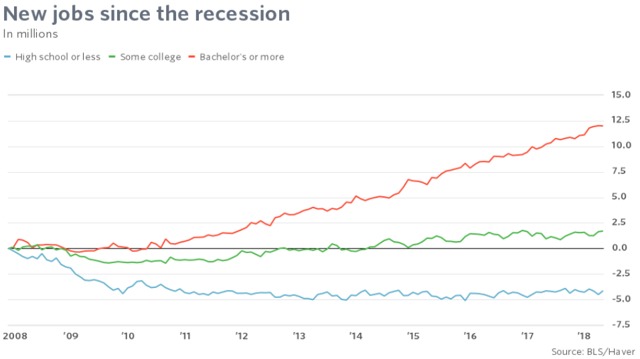
Why is this important? Why can’t everyone just go to college and be a programmer at Google? Higher education has indeed been one path by which people gain skills and opportunity, but until recently it has never been the most common. Most skilled workers started as unskilled workers and gained their skills through work. But this work-based learning and advancement path is broken without that initial unskilled job. For people unwilling, unable, or unsuited to college, the loss of unskilled work removes the only route to prosperity.
...the mass of government labor regulation is making it harder and harder to create profitable business models that employ unskilled labor. For those without the interest or ability to get a college degree, the avoidance of the unskilled by employers is undermining those workers’ bridge to future success, both in this generation and the next.
Public policy could best help the poor by lowering the regulatory barriers to hiring unskilled labor and promoting economic growth that will help keep us close to full employment.
Postscript: This update on the Seattle minimum wage study is interesting. Note that this study is occuring near peak employment, a time when one would expect the minimum employment impact from a minimum wage increase. However, I do think the findings are roughly consistent with the discussion above:
In their latest paper, which has not been formally peer reviewed, Mr. Vigdor and his colleagues considered how the minimum-wage increases affected three broad groups: People in low-wage jobs who worked the most during the nine months leading up to and including the quarter in which the increase took effect (more than about 600 or 700 hours, depending on the year); people who worked less during that nine-month period (fewer than 600 or 700 hours); and people who didn’t work at all and hadn’t during several previous years, but might later work. The latter were potential “new entrants” to the ranks of the employed, in the authors’ words.
The workers who worked the most ahead of the minimum-wage increase appeared to do the best. They saw a significant increase in their wages and only a small percentage decrease in their hours, leading to a healthy bump in overall pay — an average of $84 a month for the nine months that followed the 2016 minimum-wage increase.
The workers who worked less in the months before the minimum-wage increase saw almost no improvement in overall pay — $4 a month on average over the same period, although the result was not statistically significant. While their hourly wage increased, their hours fell substantially. (That doesn’t mean they were no better off, however. Earning roughly the same wage while working fewer hours is a trade most workers would accept.)
It’s the final group of workers — the potential new entrants who were not employed at the time of the first minimum-wage increase — that Mr. Vigdor and his colleagues believe fared the worst. They note that, at the time of the first increase, the growth rate in new workers in Seattle making less than $15 an hour flattened out and was lagging behind the growth rate in new workers making less than $15 outside Seattle’s county. This suggests that the minimum wage had priced some workers out of the labor market, according to the authors.
“For folks trying to get a job with no prior experience, it might have been worth hiring and training them when the going rate for them was $10 an hour,” Mr. Vigdor speculated, but perhaps not at $13 an hour.
I would add as an aside that I think the NYT is being a bit arrogant an narrowly focused on money (vs. other benefits of employment) when they added the parenthetical phrase at the end of the third paragraph.
Jurisdictions across the United States have adopted “ban the box” (BTB) policies preventing employers from asking about job applicants’ criminal records until late in the hiring process. Their goal is to improve employment outcomes for those with criminal records, with a secondary goal of reducing racial disparities in employment. However, removing criminal history information could increase statistical discrimination against demographic groups that include more ex-offenders. We use variation in the timing of BTB policies to test BTB’s effects on employment. We find that BTB policies decrease the probability of employment by 3.4 percentage points (5.1%) for young, low-skilled black men.
This is a pretty predictable outcome, and one that was discussed in my recent paper "How Labor Regulation Harms Unskilled Workers." The effects of these regulations are synergistic. Taken alone, one might expect this outcome from ban-the-box. But combine it with minimum wage laws, rules that increase the monetary risk to employers for hiring unsuitable employees, and the increased regulatory difficulty in terminating employees (particularly minorities) and the effect is likely greater. I explain this all in depth in the paper but here is a taste:
It used to be that the worst human resource risk a company faced was hiring employees who simply did not justify their salary. However, given the current body of regulation, any poorly selected employee is a potential ticking bomb who, through bad behavior with customers or other employees, could tie up the company for years in expensive litigation or regulatory actions. But as a firm’s liability for the negative activity of a poorly chosen
employee rises, regulations are making it harder to get good information to make better hiring choices,while simultaneously making it harder to terminate employees who were poorly chosen and present threats to the workplace or customers. When employers begin to look at their employees not as valuable assets but as potential liabilities, fewer people are going to be hired.
One potential way employers can manage this risk is to shift their hiring from unskilled employees to college graduates. Consider the risk of an employee making a racist or sexist statement to a customer or coworker (and in the process creating a large potential liability for the company). Almost any college graduate will have been steeped in racial and gender sensitivity messages for four years, while an employer might have an hour or two of training on these topics for unskilled workers. Similarly, because good information on prospective employees—credit checks, background checks,reference checks, discussions of past employment and salary—all have new legal limitations, employers who hire college graduates benefit from the substantial due diligence universities perform in their admissions process.
I made a vow a while back to try to get better at appealing to progressives using their assumptions, not mine. So here is my shot at it here. Prejudice exists among some employers that hold a stereotype of African-Americans as disproportionately criminal. The best way to fight prejudice is through information and education. But ban-the-box laws and other restrictions on background checks do just the opposite -- they restrict information. Employers who see full criminal record information, say for African-American applicants, will be struck by how few have criminal records. "Hey, these guys are OK," I can imagine someone saying. Without this information, all that the employer has to work with are his pre-existing prejudices and misinformation, and in that context he might avoid African-Americans thinking "they are probably all criminals."
This summer I had the cover story in Regulation Magazine with my article "How Labor Regulation Harms Unskilled Workers: As government expands regulation of employers, they will increasingly turn to fewer, higher-skilled workers and automation." (pdf here). The article was not an academic project, but based on my own experience as a business owner who employs hundreds of workers in unskilled positions. The premise is that many labor regulations -- not just the minimum wage -- have the perverse effect of making it harder to employ unskilled labor while simultaneously providing incentives to shift hiring from unskilled labor to folks with college degrees, even for unskilled positions.
Because it was not an academic research project, I did not spend a lot of time researching labor statistics, but I can't resist posting this analysis which appeared on Seeking Alpha:
As the economy has grown, employment numbers for unskilled labor have flatlined, never recovering from the last recession. As I observed:
Fifteen years ago I started my current service business. I love my company and my employees. But if I had it all to do over again, I would never start a business based on employing unskilled labor. The government makes it too difficult, in far too many ways, to try to make a living employing unskilled workers. Given a new start, I would find a business with a few high-skill employees creating a lot of value.
And I don’t think I’m alone. In the 1950s, 1960s, and 1970s, there was a wave of successful large businesses built on unskilled labor (e.g., ServiceMaster, Walmart, McDonalds). Today, investment capital and innovation attention is all going to companies that create large revenues per employee with workers who have college educations and advanced skills. Only 4% of the employees at Apple, for example, have less than a college degree.
Even in large service-sector companies that employ unskilled labor, much of their investment today is in finding ways to reduce their reliance on that labor. I remember a number of years ago when the Chili’s restaurant chain started putting little electronic displays on their tables. At first the displays just showed advertising and I thought they were an annoying waste of space. But over time the chain began using the devices first to accept payment for one’s food and more recently to take food orders. They are progressively eliminating the need for most of their wait-staff. Every major restaurant chain is doing the same thing: investing in technology to eliminate unskilled workers. Why bother trying to figure out how to serve a rapidly evolving customer demand with workers who are limited by government in a hundred different ways in how and when they can labor? A website or iPad never sleeps, never sues, never needs a lunch break (let alone documentation of that break), never has to have overtime, and doesn’t have its labor taxed.
I never meet with young women one-on-one any more. If I am interviewing a young woman for college, we meet in the Starbucks rather than my office. I try to meet with sales people via the web rather than face-to-face, but if a young female sales person does show up at my door and I really must meet with them, we do it downstairs in the lobby and not in my office.
I do not know if Kavanaugh is guilty or innocent at this point of a range of alleged actions that range from boorish behavior to attempted sexual assault. Like most folks I await their testimony tomorrow, but perhaps unlike most folks I have a lot of experience trying to adjudicate he-said-she-said conflicts (in the workplace and with customers) and I am reconciled to the fact that we may never be certain of the truth.
What I do know is that having many prominent people in the media and in the highest levels of government claim that a woman's accusation, without any other due process, is enough to convict a man and destroy his career and reputation just proves to me that my policy is absolutely justified. Because even if Kavanaugh's accusers are absolutely correct and honest, the next one's may not be, especially if we establish a rewards system for public accusations of this sort.
My wife tells me I am being incredibly unfair -- how can young women ever advance and get mentored if every male business executive (and males still dominate the c-suite) takes this attitude? Well, let me give an analogy. Let's assume that in reaction to years of abuse, young female actresses made a pact or formed a union. In doing so they agree to never meet with a male director or producer alone. Many directors and producers could reasonably complain that they weren't threats, and this action unfairly punishes them by making their jobs harder. The women would reasonably retort, "perhaps, but as long as the rules are such that if we get assaulted in that room then we have absolutely no recourse for justice -- under these rules we aren't going in to the room. Sure, it may only be a small percentage are predators, but we can't know who is who until after the damage is done."
Would anyone think this was unfair? Perhaps they might be accused of overreacting -- and I am willing to accept that maybe I am over-reacting as well. But I worked 3 years in a refinery, wearing a hard hat and eye protection every minute of that time, and I don't remember anything ever hitting my head or my glasses. But that does not make these things irrational precautions.
Tags: college, media Category: Gender |
Comments Off on The One Thing I am Sure About In the Whole Kavanaugh Brouhaha -- That My Policy of Not Meeting With Young Women Alone Is Absolutely Justified
African American business owners are on the rise. According to the Minority 2018 Small Business Trends survey, the number of black-owned small businesses in the U.S. increased by a staggering 400% in a year-over-year time period from 2017 to 2018.
I call bullsh*t on this. There is no WAY that the number of black-owned businesses increase by a factor of 5** in just one year. There are millions of black-owned small businesses in this country and there is no way this quintupled** in a year. It does not pass any kind of smell test. It is clearly some sort of measurement error, either a small sample size for a survey or a change in data source and definitions from one year to another. I could go investigate the study and try to figure out the cause but I do not even need to bother because economic and demographic data simply do not change at this pace in one year.
Here is the deal with this stat: no one actually really believes it. Why do I say this with confidence? Because parents still send their daughters to college -- in fact they fight and scrap and invest huge amounts of time and money to send their daughter to college. If they really believed their little darling had a 1 in 4 chance of being sexually assaulted, they would never do so.
Here is a point of comparison: The Japanese brutal occupation of Nanjing, China is commonly known as the "Rape of Nanjing." It is called this in part because so many local women were raped. The numbers are fought over by historians, but the best estimate is that 20,000 of the approximately 100,000 women who were in Nanjing at the time were raped by Japanese soldiers, or about one in five. This means that if the one in four number is correct, then colleges are more dangerous for women than being in Nanjing during the Japanese occupation. Now, I would venture to guess that if I tried to stuff you daughter into a time machine and send her back to Nanjing on December 13, 1937 you would probably fight me to the death to prevent it. But parents don't act anything like this vis a vis going to college, ergo no one believes this figure. So why does everyone keep using it like it is accurate?
** I had put quadrupled but my son just called and reminded me that a 400% increase means quintupled. Thanks, Nic. Though I will say there is a good chance the source incorrectly used 400% to mean quadrupled, so I can't rule that out either.
....women have earned a majority of bachelor’s degrees for the last 36 years starting in 1982. Not shown here, but women previously earned a majority of associate’s degrees starting in 1978 and a majority of master’s degrees starting in 1981. By 2006, women earned a majority of doctoral degrees and the “takeover” of higher education by women was complete for degrees at all levels! But instead of declaring “victory” and moving on, many women are still claiming “victim status” in higher education with the need for special gender preferences in the form of funding, scholarships, centers, commissions, fellowships, awards, programs, and initiatives that are only available for women, or are primarily for women.
I have annotated his chart (shown below) to amplify his last sentence.
One of the seminal books on the topic of girls in education was "Failing at Fairness" by Myra P Sadker and published in 1994. The Google Books summary of the book is as follows:
Failing at Fairness, the result of two decades of research, shows how gender bias makes it impossible for girls to receive an education equal to that given to boys.
Girls' learning problems are not identified as often as boys' are
Boys receive more of their teachers' attention
Girls start school testing higher in every academic subject, yet graduate from high school scoring 50 points lower than boys on the SAT
The book was very influential. I know it sat on my feminist wife's night table for quite a while. But note the publication date on Mark Perry's chart above. For kids in high school when that book was published, a fair median date for their college graduation would be 6 years later, or around the year 2000. It's fair to estimate that girls in high school at the time Sadker was writing were going to be 33% more likely to get a college degree than the boys in the same classes. Anyone who had read that book alone and nothing else on the topic would have called you a liar for predicting that.
Look, I have no doubt that one could easily put together a book about all the ways the public education system fails girls because I think the public education system in many parts of this country fails EVERYONE. But we seem to keep obsessively questioning whether we are doing enough for girls in education when the problem seems to be boys.
The New York Times actually talked about boys falling behind in education a few years ago, and had this telling chart about ways in which boys lagged in education. The article forced on poor boys, but note that boys of all socioeconomic classes lagged.
And this is before we even get to the most disturbing metrics about boys and girls, such as youth crime. While girls have closed the gender gap in crime somewhat, boys are still 10 times more likely than girls to be arrested for a homicide, and boys are more than twice as likely to be arrested for any sort of crime than girls (source). Remember that last mass shooter who was female? Neither do I.
I am not an expert on why this is. Shifting success norms from competition to cooperation, elimination of historic outlets for non-academic males like vocational programs, and huge amounts of money and counseling resources all dedicated to girls probably play a part. But the frustrating thing is you almost never see a discussion of this topic. Anyone who does try to address it is immediately pigeon-holed as some alt-right male rights extremist and defenestrated from the Overton Window.
For years (as an engineer) when I made fun of college students not doing any work or not studying anything of actual utility, I often used art students as an example. Today I offer my apology.
My daughter is an illustration major at a college called Art Center in Pasadena, CA. I don't know if this is usual for art schools or if it is just this one college, but these kids do an insane amount of work. My wife and I both attended Ivy League schools and my son went to Amherst, all of which are high on rankings of top academic stress schools, but none of us ever worked like the kids at Art Center. My daughter coasted to A's in one year at Rice University, which she would describe as a cake walk compared to art school. Her art school features five 5-hour classes a week plus each class can and does issue up to 9 hours of homework a week. Typical weekly assignment for 1 course: draw 300 hands.
In addition to all of this there are mid-terms and finals. Below is one project my daughter did for one course's final exam, a set of children's books put together from scratch with her own art. This strikes me as an insane amount of work.
I will add that I have become reconciled to art school in other ways. To some extent my daughter's false start going to a major university in a liberal arts program was a result of our family's expectations about college. Our bias was that a liberal arts degree from a highly-ranked university was the path to success. Art school was for slackers who ended up sleeping on the street in a refrigerator box. But you know what? Art school teaches a real craft and teaches it rigorously. Can Yale say that about its gender studies program?
One caveat to this is that my daughter can write. She went to a high school where all the assignments and exams were essay-based. She can toss off a polished 5-paragraph essay in her sleep. If this were not the case, I would worry about this one aspect of art school. I consider writing (and remember, this comes from a mechanical and aerospace engineer) to be the most important core skill and an education that does not teach writing or provide a lot of writing practice is suspect in my mind.
Ivy League schools are broken, at least to the extent they are true to their word that they are trying to serve mankind and not simply their own prestige. Consider this from the WSJ:
Harvard hit a new low this year—in terms of its acceptance rate.
The university admitted 4.6% of applicants, or 1,962 students for the class set to begin this fall. Last year, it admitted 5.2% of applicants.
The eight campuses making up the Ivy League notified applicants on Wednesday evening about who will make up their first-year undergraduate class come fall. Seven of the eight posted record-high application numbers, while Dartmouth had its highest number in five years; seven recorded their lowest-ever acceptance rates, as Yale tied with its prior record.
Many of the applicants looked perfect on paper. At Princeton, more than 14,200 of the 35,370 applicants had a 4.0 grade point average. Brown boasted that 96% of its admitted students are in the top 10% of their high school classes, while at Dartmouth that rate hit 97%.
Yale admissions officers were “impressed and humbled” by the volume of qualified candidates, said Jeremiah Quinlan, dean of undergraduate admissions and financial aid. That school tied its record-low 6.3% admission rate this year.
These schools invest the vast majority of their impressively-large capital funds in continuing to improve the quality of education by some fraction of a percentage. In contrast, none of them have made meaningful investments in increasing their capacity to bring their already super-high level of education to more students (by this I mean doubling or tripling the size of its school-- Princeton to its credit did increase its capacity several years ago by something like 15%). The number of clearly Ivy-qualified students has increased perhaps by an order of magnitude over the last 30 years but Ivy capacity has increased only trivially.
Let's say an Ivy has 5,000 students and a 10 point (on some arbitrary scale) education advantage over other schools. Let's consider two investments. One would increase their educational advantage by 10% from 10 to 11 (an increase I would argue that is way larger than the increase from investments they have recently made). The other investment would double the size of the school from 5,000 to 10,000 but let's say that through dilution and distraction it dropped the educational advantage by 10% from 10 to 9. The first investment adds something like 5,000 education points to the world (5,000 kids x 11 minus 5,000 kids x 10). The second adds 40,000 points to the world (10,000 x 9 minus 5,000 x 10). It's not even close. In fact, the expansion option is still favored even if the education advantage drops by 40%.
I have written this suggestion in various forms to every Princeton President in the last 20 years and have finally just given up trying. I have come to the conclusion that the administration and faculty don't actually care so much about Princeton's net contribution to the world, and care more about prestige. In their hearts, I would bet that most of the administration and faculty -- very rationally from their personal incentives -- want to be associated with what is arguably the top undergrad school in the country, and might even consider cutting the class size in half if that is what is required to get stay there. They get rewarded for being associated with a school with an educational advantage that is as high as possible, and no one's evaluation of that associated prestige is affected by whether that education is provided to one person or one thousand. If you buy Bryan Caplan's argument that college education is mostly all signalling, then we alumni should have the same attitude.
I did have one Princeton President engage me on this (Shirley M. Tilghman, who also oversaw the modest growth in Princeton's size I mentioned above). The counter argument I hear is that it is really hard to keep these institutions great while tripling them in size and taking online students or whatever. But that is a cop out, in my view. The people who run these institutions preen that they are the thought-leaders in education. Well any fool can run a capital campaign at Yale and build a new molecular biology building. One of these folks should take on a harder task. I have had my issues in the past with Arizona State (ASU) President Michael Crow, but I think it can be argued that he is contributing more to the world trying to figure out how to improve the education of 100,000 kids than is the Harvard President educating the same hand-picked 5,000 undergrads with incrementally-increased intensity.
It is incredible to me that we still fetishize amateurism, which in a large sense is just a holdover from British and other European aristocracies. Historically, the mark of the true aristocrat was one who was completely unproductive. I am not exaggerating -- doing any paid work of any sort made one a tradesman, and at best lowered ones status (in England) or essentially caused your aristocratic credentials to be revoked (France).
The whole notion of amateurism was originally tied up in this aristocratic nonsense. It's fine to play cricket or serve in Parliament unpaid, but take money for doing so and you are out. This had the benefit of essentially clearing the pitch in both politics and sports (and even fields like science, for a time) for the aristocracy, since no one else could afford to dedicate time to these pursuits and not get paid. These attitudes carried over into things like the Olympics and even early American baseball, though both eventually gave up on the concept as outdated.
But the one last bastion of support of these old British aristocratic privileges is the NCAA, which still dedicates enormous resources, with an assist from the FBI, to track down anyone who gets a dollar when they are a college athlete. Jason Gay has a great column on this today in the WSJ:
This is where we are now, like it or not. College basketball—and college football—are not the sepia-toned postcards of nostalgia from generations past. They’re a multibillion dollar market economy in which almost everyone benefits, and only one valve—to the players—is shut off, because of some creaky, indefensible adherence to amateurism. Of course some money finds its way to the players. That’s what the details of this case show. Not a scandal. A market.
Don’t look for the NCAA to acknowledge this, however. “These allegations, if true, point to systematic failures that must be fixed and fixed now if we want college sports in America. Simply put, people who engage in this kind of behavior have no place in college sports,” NCAA president Mark Emmert said in a statement that deserved confetti and a laughing donkey noise at the end of it.
I am not necessarily advocating that schools should or should have to pay student athletes, though that may (as Gay predicts) be coming some day. But as a minimum the ban on athletes accepting any outside money for any reason is just insane. As I wrote before, athletes are the only students at a University that are not allowed to earn money in what they are good at. Ever hear of an amateurism requirement for student poets? For engineers?
When I was a senior at Princeton, Brooke Shields was a freshman. At the time of her matriculation, she was already a highly paid professional model and actress (Blue Lagoon). No one ever suggested that she not be allowed to participate in the amateur Princeton Triangle Club shows because she was already a professional.
When I was a sophomore at Princeton, I used to sit in my small dining hall (the now-defunct Madison Society) and listen to a guy named Stanley Jordan play guitar in a really odd way. Jordan was already a professional musician (a few years after he graduated he would release an album that was #1 on the jazz charts for nearly a year). Despite the fact that Jordan was a professional and already earned a lot of money from his music, no one ever suggested that he not be allowed to participate in a number of amateur Princeton music groups and shows.
My daughter is an art major at a school called Art Center in Pasadena (where she upsets my preconceived notions of art school by working way harder than I did in college). She and many, if not most of her fellow students have sold their art for money already, but no one as ever suggested that they not be allowed to participate in school art shows and competitions.
In the shorter term, I like the proposals out there to eliminate the amateurism requirement—allow a college athlete in any sport (not just football or basketball) to accept sponsor dollars, outside jobs, agents, any side income they can get. The Olympics did this long ago, and somehow survived. I also think we’ll see, in basketball, the NBA stepping up and widening its developmental league—junking the dreadful one-and-one policy, lowering its age minimum, but simultaneously creating a more attractive alternative to the college game. If a player still opts to go to college, they’ll need to stay on at least a couple of seasons.
If you still think the scholarship is sufficient payment for an athlete in a high-revenue sport, ask yourself this question. There are all kinds of scholarships—academic, artistic, etc. Why are athletic scholarship recipients the only ones held to an amateurism standard? A sophomore on a creative writing scholarship gets a short story accepted to the New Yorker. Is he or she prohibited from collecting on the money? Heck no! As the Hamilton Place Strategies founder and former U.S. treasury secretary Tony Fratto succinctly put it on Twitter: “No one cares about a music scholarship student getting paid to play gigs.”
Was at a bar in the new Andaz Hotel in Scottsdale, at a restaurant called Warp and Woof. I like the contemporary vibe of a lot of Andaz hotels, including this one in particular.
Anyway, over the bar, rather than some random college basketball game, they had Bob Ross painting shows on a loop. Excellent.
Updated: I am thinking of an Anchorman - Bob Ross mashup here: "See the happy, happy scotch. Scotchie Scotchie Scotch. Oh, look, I didn't realize I ordered a double. We don’t make mistakes. We just have happy accidents."
Twitter is continuing to act on its promise to fight hate speech, however imperfectly. The site has banned Wisconsin Congressional candidate Paul Nehlen after he posted a racist image that placed the face of Cheddar Man (a dark-skinned British ancestor) over actress and soon-to-be-royal Meghan Markle, who's mixed race. The company said it didn't normally comment on individual accounts, but said the permanent suspension was due to "repeated violations" of its terms of service.
Nehlen, who's hoping to unseat Paul Ryan in the 2018 mid-term elections, has a long history of overtly expressing his racist views. Twitter suspended him for a week in January over anti-Semitic comments, and he has regularly promoted white supremacist ideology. In private, he used direct message groups to coordinate harassment campaigns. Breitbart supported Nehlen's ultimately unsuccessful run against Ryan in 2016, but distanced itself from him in December 2017.
As the title of the post implies, I am torn on this. On the one hand, there is an argument that removing a powerful communications tool from bad people makes it harder to spread their, um, badness. On the other hand, I am not sure that driving these folks underground is the right approach. Sure, Nehlen has likely rallied some people of a similar mind to his side, but the flip side is that he has advertised himself to LOT of people as having distasteful views. I know that from my point of view, my awareness that awful folks like this still exist on the peripheries of power has grown from social media, whereas without it I likely might have convinced myself this sort of stuff was a thing of the past.
Which brings me back to license plates. If a state is going to create a license plate program where people can make statements with their license plates, then people should be able to make the statement they want to make. ... Let's assume for a moment that everyone who wants to display this symbol [the Confederate battle flag] on their car is a racist. Shouldn't we be thrilled if they want to do so? Here would be a program where racists would voluntarily self-identify to all as a racist (they would even pay extra to do so!) What would be a greater public service?
To take this to an extreme, think about the effort to de-platform certain college speakers. I like to imagine who the most extreme example of such a controversial college speaker would be, and I come up with that old standby, Adolf Hitler. So what if in 1938 Adolf Hitler came to the States for a college speaking tour in 1938. Couldn't that have been a good thing? Many of the mistakes made by the world in 1938-1945 was underestimating both Germany's appetite for expansion and its ruthlessness in its approach to the Jews. Wouldn't it have been better to listen to a bad guy and potentially get some clues to this future?
I pride myself on being able, generally, to craft arguments on various issues along any of Arnold Kling's three axes of political discourse. But I can't come up with an argument for why college students (likely Progressives on the oppressor-oppressed axis) would be legitimately afraid of the beach ball (via Maggies Farm). My libertarian axis explanation of course is that having found that the "those guys' speech scares us" approach has been successful at shutting down speech of their opponents in the past, they are rationally pursuing a proven winning strategy. But what is the Progressive argument here?
I don't have a lot to say about the whole Confederate statue thing. Most of what I would say could probably be cut and pasted from my post on the Confederate flag.
The one thing I want to comment on is the criticism that pulling down these statues is "Stalinist", referring to Stalin's proclivity for changing history books and even airbrushing men out of photos when he turned against them. I find this comparison ironic for the following reason: Think back to the fall of communism in Eastern Europe in 1989. I have two images in my mind of that time. One is of people on top of and pulling down the Berlin Wall. But the other is of Soviet-era statues toppling in Eastern Europe. Pulling down the statue of Lenin or Stalin or whoever became the key public declaration that people were making a break with the past.
Public statues on public land are basically government speech. People call it "history" but in most cases it is closer to propaganda. I think it is totally appropriate to question it. Now, I might have gone about the whole thing differently. If I were a city, I would name the statues that I wanted removed, and then give private individuals and groups 6 months to pay to take it away to a private site if they wanted to keep it. If no one cared enough to do so, we'd just demolish it. By the way, I think this gets at the heart of why many folks like myself still have a bit of fear about the current efforts -- the folks on the Left who are doing this don't tend to differentiate between public and private. It is very likely their perfectly reasonable criticism of public speech in public spaces will soon turn into attempts to regulate private speech in private spaces.
The Lost Cause School: I want to provide some help for those not from the South to understand the southern side of the statue thing. In particular, how can good people who believe themselves not to be racist support these statues? You have to recognize that most folks of my generation in the South were raised on the lost cause school of Civil War historiography. I went to one of the great private high schools in the South and realized later I had been steeped in Lost Cause. All the public schools taught it. Here is the Wikipedia summary:
The Lost Cause of the Confederacy, or simply Lost Cause, is a set of revisionist beliefs that describes the Confederate cause as a heroic one against great odds despite its defeat. The beliefs endorse the virtues of the antebellum South, viewing the American Civil War as an honorable struggle for the Southern way of life,[1] while minimizing or denying the central role of slavery. While it was not taught in the North, aspects of it did win acceptance there and helped the process of reunifying American whites.
The Lost Cause belief system synthesized numerous ideas into a coherent package. Lost Cause supporters argue that slavery was not the main cause of the Civil War, and claim that few scholars saw it as such before the 1950s.[2] In order to reach this conclusion, they often deny or minimize the writings and speeches of Confederate leaders of the time in favor of later-written revisionist documents.[3] Supporters often stressed the idea of secession as a defense against a Northern threat to their way of life and say that threat violated the states' rights guaranteed by the Union. They believed any state had the right to secede, a point strongly denied by the North. The Lost Cause portrayed the South as more profoundly Christian than the greedy North. It portrayed the slavery system as more benevolent than cruel, emphasizing that it taught Christianity and civilization. In explaining Confederate defeat, the Lost Cause said the main factor was not qualitative inferiority in leadership or fighting ability but the massive quantitative superiority of the Yankee industrial machine.
Obviously this was promoted by the white supremacists after the war, but in the 20th century many well-meaning people in the South who are not racist and by no means want to see a return of slavery or Jim Crow still retain elements of this story, particularly the vision of the Confederacy as a scrappy underdog. But everything in these two paragraphs including the downplaying of slavery in the causes of the Civil War was being taught when I grew up. It wasn't until a civil war course in college (from James McPherson no less, boy was I a lucky dog there) that I read source material from the time and was deprogrammed.
The comparisons of the current statue removal to Protestant reformation iconoclasm seem particularly apt to me. You see, growing up in the South, Confederate generals were our saints. And the word "generals" is important. No one I knew growing up would think to revere, say, Jefferson Davis. Only the hard-core white supremacists revered Jefferson Davis. Real lost cause non-racist southerners revered Robert E. Lee. He was our Jesus (see: Dukes of Hazard). Every town in the south still has a Robert E Lee High School. Had I not gone to private school, I would have gone to Houston's Lee High (I had a friend who went to college at Lehigh in New Jersey. Whenever he told folks in the South he went there, they would inevitably answer "yes, but where did you go to college.") So Lee was by far and away at the top of the pantheon. Then you had folks like Stonewall Jackson and JEB Stuart who were probably our Peter and Paul. Then all the rest of the generals trailing off through the equivalents of St. Bartholomew or whoever. We even had a Judas, General James Longstreet, who for a variety of reasons was reviled by the Lost Cause school and was blamed for many of Lee's, and the South's, losses.
If you want to see the Southern generals the way much of the South sees them, watch the movie Gettysburg, which I like quite a bit (based on the book Killer Angels, I believe, also a good read). The Southern Generals are good, talented men trying to make the best of a losing cause. Slavery is, in this movie, irrelevant to them. They are fighting for their beloved homes in the South, not for slavery. The movie even has Longstreet saying something like "we should have freed the slaves and then fired on Fort Sumter."
When I was a senior at Princeton, Brooke Shields was a freshman. At the time of her matriculation, she was already a highly paid professional model and actress (Blue Lagoon). No one ever suggested that she not be allowed to participate in the amateur Princeton Triangle Club shows because she was already a professional.
When I was a sophomore at Princeton, I used to sit in my small dining hall (the now-defunct Madison Society) and listen to a guy named Stanley Jordan play guitar in a really odd way. Jordan was already a professional musician (a few years after he graduated he would release an album that was #1 on the jazz charts for nearly a year). Despite the fact that Jordan was a professional and already earned a lot of money from his music, no one ever suggested that he not be allowed to participate in a number of amateur Princeton music groups and shows.
My daughter is an art major at a school called Art Center in Pasadena (where she upsets my preconceived notions of art school by working way harder than I did in college). She and many, if not most of her fellow students have sold their art for money already, but no one as ever suggested that they not be allowed to participate in school art shows and competitions.
A football player for the University of Central Florida has lost his place in the team, and hence his scholarship, due to his YouTube channel. UCF kicker Donald De La Haye runs "Deestroying," which has over 90,000 subscribers and has amassed 5 million views, thus far. It's not the channel itself that cost him his scholarship, though -- it's the fact that he has athletics-related videos on a monetized account.
The NCAA saw his videos as a direct violation to its rule that prohibits student athletes from using their status to earn money. UCF's athletics department negotiated with the association, since De La Haye sends the money he earns from YouTube to his family in Costa Rica. The association gave him two choices: he can keep the account monetized, but he has to stop referencing his status as a student athlete and move the videos wherein he does. Or, he has to stop monetizing his account altogether. Since De La Haye chose not to accept either option, he has been declared inelegible to play in any NCAA-sanctioned competition, effectively ending his college football career.
When I was a sophomore at Princeton, my sister was a Freshman. We were sitting in my dorm the first week of school, watching US Open tennis as we were big tennis fans at the time. My sister told me that she still had not heard from her fourth roommate yet, which was sort of odd. About that time, the semifinals of the US Open were just beginning and would feature an upstart named Andrea Leand. My sister says, hey -- that's the name of my roommate. And so it was. Andrea was a professional tennis player, just like Brook Shields was already a professional actress and Stanley Jordan was already a professional musician. But unlike these others, Andrea was not allowed to pursue her talent at Princeton.
I don't know if student athletes should be paid by the school or not. We can leave that aside as a separate question. People of great talent attend universities and almost all of them -- with the exception of athletes -- are allowed to monetize that talent at the same time they are using it on campus. Athletes should have the same ability.
The whole amateur ideal is just a tired holdover from the British aristocracy, the blue-blooded notion that a true "gentleman" did not actually work for a living but sponged off the local [populace] while perfecting his golf or polo game. These ideas permeated British universities like Oxford and Cambridge, which in turn served as the model for many US colleges. Even the Olympics, though, finally gave up the stupid distinction of amateur status years ago, allowing the best athletes to compete whether or not someone has ever paid them for anything.
In fact, were we to try to impose this same notion of "amateurism" in any other part of society, or even any other corner of University life, it would be considered absurd. Do we make an amateur distinction with engineers? Economists? Poets?...
In fact, of all the activities on campus, the only one a student cannot pursue while simultaneously getting paid is athletics. I am sure that it is just coincidence that athletics happens to be, by orders of magnitude, far more lucrative to universities than all the other student activities combined.
Free markets are governed and regulated by consumers. If suppliers offer something, and consumers like it and like how that particular supplier provides it more than other choices they have, the supplier will likely prosper. If suppliers attempt to offer consumers something they don't want or need, or already have enough of from acceptable sources, the supplier will likely wither and disappear. That is how free markets work. Scratch a Bernie Sanders supporter and you will find someone who does not understand this basic fact of consumer sovereignty.
Regulators generally are operating from a theory that says there is some sort of failure in the market, that consumers are not able to make the right choices or are not offered the choices they really want and only the use of force by regulators can fix this failure. In practice, regulators have no way of mandating a product or service that producers cannot economically or technically provide (see: exit from Obamacare exchanges) and so all they actually do is limit choice by pruning products or services or individual features the regulators don't think consumers should be offered. They substitute the judgement of a handful of people for the judgement of thousands, or millions, and ignore that there is not some single Platonic ideal of a product out there, but thousands or millions of ideals based on the varied preferences of millions of people.
Month after month, in public meeting after public meeting, a trendy pizza mini-chain based in Washington, D.C., hacked its way through a thicket of bureaucratic crimson tape in the hopes of opening up shop in a vacant Harvard Square storefront. But when the chain, called &pizza, arrived at the Cambridge Board of Zoning Appeal in April, the thicket turned into a jungle.
Harvard Square already has plenty of pizza, board chairman Constantine Alexander declared, and though a majority of the board signed off on &pizza’s plans, approval required a four-vote supermajority. Citing the existence of five supposedly similar pizza joints in the area, as well as concerns about traffic congestion, a potential “change in established neighborhood character,†and even the color of the restaurant’s proposed signage, Alexander and cochair Brendan Sullivan dissented.
“A pizza is a pizza is a pizza,†Alexander said at one point during the April hearing, sounding suspiciously like someone who doesn’t eat much pizza or give much thought to the eating habits of the 22,000 or so college students who live in the city.
A city ordinance dictates that any new fast-food place should be approved only if it “fulfills a need for such a service in the neighborhood or in the city.†But the notion that an unelected city board should be conducting market research using some sort of inscrutable eye test to decide precisely what kind of cuisine is appropriate for Harvard Square stretches that to the point of absurdity.
There is nothing in the released material than convinces me I was wrong about Asian-American recruiting, but I want to leave that question aside for today and highlight something I have not heard anyone mention about the documents. I am not sure if they are evidence of discrimination or not, or even if that discrimination really is or should be legal if it existed in a private institution. But what is very clear is that the admissions department has very particular attitudes about race and ethnicity: it appears that race does not "count" if the student involved hasn't done something to highlight their race. Or put another way, the admissions folks seem to be penalizing minority candidates for not obsessing about their race. Here are a few examples:
Of a Hispanic applicant, an admissions officer wrote, “Tough to see putting her ahead of others. No cultural flavor in app.â€
“Were there a touch more cultural flavor I'd be more enthusiastic,†one officer wrote of a native Hawaiian/Pacific Islander.
officers candidly discussed the race of black, Latino, and Native American applicants, often seemingly searching for those who highlighted their racial backgrounds rather than checking off boxes on their Common Applications.
"Nice essays, sweet personality," one admissions officer said of a multiracial applicant. "Bi-racial but not [National Hispanic Recognition Program] and no recognition of her [background] in app by anyone."
When one reader called an applicant's Native American heritage "appealing," the other noted that the only place the boy had mentioned the heritage was in a checkbox on his Common Application. He called himself "a white boy," the admissions officer noted.
I am guessing these are all code words for, "we don't see any race-based activism in this person's past." So we only want kids who obsess about their race and ethnicity, and perhaps act really angry about it. We don't want African-Americans or Hispanics or Native Americans who just seem like normal, reasonably happy, well-adjusted smart kids.
I have always been conceptually OK with ethnicity and some element of affirmative action being part of Princeton admissions, but this looks ugly to me. I also wonder about how this will filter back to high schools. Already, behaviors in private schools that send a lot of kids to top colleges has been changed over the years by perceptions of college admissions expectations. There was a wave of thinking years ago that admissions departments liked kids who played musical instruments, so freaking every kid that graduates from elite private schools can play an instrument, though today it probably has no differentiating power (you will still see a few clever kids who find relatively unique instruments like the xylophone or the harpsichord). Then there was a belief that you needed some sort of unique activity to stand out, and there was a wave of kids who clogged or practiced falconry. Then the word got out that it was de rigueur to do community service, so everyone checks that box. I wonder if we are not going to see a wave of private high schools riven with racial strife and activism because kids will feel like the only way their ethnicity will "count" at an Ivy League school is if they take over the headmasters office. Well, it worked at Princeton, I guess.
I think that I would have preferred that the elite stay “on top” as long as they acquired a higher regard for markets and lower regard for technocratic policies. What has been transpired is closer to the opposite. There was a seemingly successful revolt against the elite (although the elite is fighting back pretty hard), and meanwhile the elite has doubled down on its contempt for markets and its faith in technocracy.
I am disturbed about the news from college campuses. A view that capitalism is better than socialism, which I think belongs in the mainstream, seems to be on the fringe. Meanwhile, the intense, deranged focus on race and gender, which I think belongs on the fringe, seems to be mainstream.
The media environment is awful. Outrage is what sells. Moderation has fallen by the wayside.
The gender #paygap myth has certainly been tenacious. Years ago someone threw out the figure that women earn 77% as much as men, and have since successfully been able to portray this as women not getting equal pay for equal work, despite the fact that the 77% is not at all corrected for equal work (when so corrected, for things like actual hours worked and differences between industries, the gap typically narrows to 5% or less).
The other day, however, the New York Post let a fact slip by that demolishes this whole gender pay gap meme. The only explanation I can come up with is that it was in an article headlined "Childish men are to blame for women having kids late in life" so I suppose the powers-that-be assumed that the article must be OK if it was bashing men. But in it we get this:
Women want an equal partner, but there are increasingly fewer candidates to choose from. The census reports that “the average adult woman in the US is more likely to be a college graduate than the average adult man.” Moreover, today’s young, childless female city-dwellers with college degrees are out-earning their male counterparts by 8 cents on the dollar. Their higher incomes may be why they are less likely (29 percent) to be living with their parents than single men (35 percent).
OOPS! In the eagerness to beat men up for being under-performing, lazy, uneducated slobs still living with mommy, a meme was destroyed. In fact, serious scholars (ie those who are not activists) have pointed out for years that unmarried childless women have no pay gap with men of similar ages, it is only after marriage and babies and other such events that some women make life and career choices that reduce their pay.
I have written both here and here about my issues with my own University. Many folks are frustrated with the state of college campuses nowadays. Your issues may be different, but mine include:
Lukewarm support for, or even opposition to, free speech
Substitution of posturing, virtue signaling, and even violence for dialog and rational discussion
Unwillingness to teach students the need to engage opposing points of view
Utter lack of intellectual diversity in faculties and administration
Absurdly low standards for scholarship in many of the humanities and social sciences, where regurgitating the "right" politics is more important than doing good research
Outright discrimination against Asian-Americans in admissions
Diversity cultures that have gone beyond nurturing tolerance for all into promoting intolerance against new groups
Despite years of mounting criticism on these issues, the response of many universities to such criticism has not been reform but a doubling down on their illiberal policies. Shaming is not working and not going to work, for the simple fact that the smug, elite culture that dominates Universities does not consider you and I to be woke enough to credibly criticize them. The very failing of universities that we are trying to criticize -- that they are promoting a culture of ignoring, no-platforming, and even doing violence against anyone who disagrees with them -- makes them simultaneously immune to criticism. Anyone who criticizes their actions is automatically someone not worth engaging.
So I am suggesting another approach. Hit them in the pocketbook. I know my University carefully monitors alumni giving - both dollars and percentage participation. Even a five or ten percent drop in a year is going to get their attention. So just take the pledge -- this year, I am not giving to my school. Give the money to someone else. I gave mine to Teach for America, but there are an almost unlimited number of good causes out there that could use your money, likely more productively that your University (which will probably just use your money to add a nicer television to the men's football locker room).
This pledge is carefully crafted both to have impact and not to ask folks for more than they are willing to give. For example, it stops short of asking folks to stop giving forever. For a really long time, I loved my alma mater and would like to love it again, and so I couldn't pledge never to support it. The pledge also stops short of asking folks not to send their kids to such and such school. College admissions tend to be a one-time shot at age 18, and deferring that chance for a year might close off opportunities forever. Besides, if your son gets into Yale and can keep his head down for four years (maybe stay celibate?) and avoid the worst of the social justice craziness, the Yale diploma is still really valuable even if he does not learn a thing.