Posts tagged ‘climate science’

I Am Starting To Believe Most Studies Are Crap

I spent years, before I burned out on the task, picking over bad climate studies, and at the time reached the conclusion that there was something about the climate science field that was anomalous,  tolerating so much bad science, bad sampling methodology, and bad statistical approaches.

However, now I am coming to the conclusion that perhaps most studies in every field are dominated by this same crap.  Here is an example, from the NTSB on busses.

Enshrining Peer Review as Part of the Scientific Method

I have written a lot about problems with over-emphasis on peer review and problems in scientific publishing.  This is from a press release by the CRU quoting the highly flawed Muir-Russel review / whitewash of the Climategate emails.

We note that much of the challenge to CRU’s work has not always followed the conventional scientific method of checking and seeking to falsify conclusions or offering alternative hypotheses for peer review and publication. We believe this is necessary if science is to move on, and we hope that all those involved on all sides of the climate science debate will adopt this approach.

Because methodological challenges to scientists work that don't appear in Climate Journals controlled by the scientists in question are not part of the scientific method.

By the way, the statement that "The raw tree-ring data used in our published work are available; anyone is free to use them in any way they wish" is absolutely hilarious for anyone who has followed this saga over the years.  To the extent they are available "freely," it is only because Steve McIntyre and other challengers of CRU's work engaged in a decade long legal campaign to get this publicly-funded data (necessary to verify and/or replicate the CRU's published work) released.  Here is the McIntyre post to which CRU was responding, though they bend over backwards not to actually mention him.


A Guide to the Global Warming Debate

My new column at Forbes is a post I have been thinking about and working on for quite a while, trying to refine over time a simple explanation of what is and is not understood in climate science.  This is how it begins, but I hope you will read it all

Likely you have heard the sound bite that “97% of climate scientists” accept the global warming “consensus”.  Which is what gives global warming advocates the confidence to call climate skeptics “deniers,” hoping to evoke a parallel with “Holocaust Deniers,” a case where most of us would agree that a small group are denying a well-accepted reality.  So why do these “deniers” stand athwart of the 97%?  Is it just politics?  Oil money? Perversity? Ignorance?

We are going to cover a lot of ground, but let me start with a hint.

In the early 1980′s I saw Ayn Rand speak at Northeastern University.  In the Q&A period afterwards, a woman asked Ms. Rand, “Why don’t you believe in housewives?”  And Ms. Rand responded, “I did not know housewives were a matter of belief.”  In this snarky way, Ms. Rand was telling the questioner that she had not been given a valid proposition to which she could agree or disagree.  What the questioner likely should have asked was, “Do you believe that being a housewife is a morally valid pursuit for a woman.”  That would have been an interesting question (and one that Rand wrote about a number of times).

In a similar way, we need to ask ourselves what actual proposition do the 97% of climate scientists agree with.  And, we need to understand what it is, exactly,  that the deniers are denying.   (I personally have fun echoing Ms. Rand’s answer every time someone calls me a climate denier — is the climate really a matter of belief?)

It turns out that the propositions that are “settled” and the propositions to which some like me are skeptical are NOT the same propositions.  Understanding that mismatch will help explain a lot of the climate debate.

More Great Moments in Climate Science

We lost track of a caribou herd, so since we can't find it, we will just tell the press it was destroyed by climate change.   (Happily the herd has been found, right where it always was, so we won't have to see caribou heads on our diet coke bottles).

I joke about this but it is really a serious statement about the quality of science and science journalism that there was really a big climate-related panic over the disappearing caribou a couple of years ago.   This is climate science in a nutshell - make a measurement error, assume the faulty data is real, and then without evidence blame the changing data on climate change.

(Update:  Yes, I actually spelled caribou herd "heard" in the original.  I am a big believer there is no such thing as a single metric for intelligence, but that there are multiple intelligences of various sorts.    We can argue about the other kinds, but I clearly did not get much of the spelling and proof-reading sort.

Well, It's Good to Have That Settled

Via Junk Science

In “Capitalism vs. the Climate“, [Naomi] Klein rants against “the deniers” but makes this admission:

The deniers did not decide that climate change is a left-wing conspiracy by uncovering some covert socialist plot. They arrived at this analysis by taking a hard look at what it would take to lower global emissions as drastically and as rapidly as climate science demands. They have concluded that this can be done only by radically reordering our economic and political systems in ways antithetical to their “free market” belief system. As British blogger and Heartland regular James Delingpole has pointed out, “Modern environmentalism successfully advances many of the causes dear to the left: redistribution of wealth, higher taxes, greater government intervention, regulation.” Heartland’s Bast puts it even more bluntly: For the left, “Climate change is the perfect thing…. It’s the reason why we should do everything [the left] wanted to do anyway.”

Here’s my inconvenient truth: they aren’t wrong. [Emphasis added]

I Don't Think This is Settled

For those who have read my climate work or seen the video, the key question in climate science revolves around the feedback effects in the climate system to Co2 warming.

Skeptics, like alarmists, generally agree that a doubling of Co2 concentrations might warm the Earth about a degree Celsius, absent any other effects.  But we can imagine all sorts of feedback effects, the most important of which are in water vapor and cloud formation.  Warming that forms more clouds might have negative feedback, as clouds offset some of the warming.  Warming that increases humidity could lead to more warming, as water vapor is a strong greenhouse gas.

The difference, then, between minor warming and catastrophe is in the feedbacks, and most importantly in clouds and water vapor.  All the research the government is funding on whether warming will cause sterility in tree frogs is tangential to this key question.

And this question is far from decided.  I won't get into all the arguments here, but to the extent there is any consensus, it is that man' CO2 is probably causing some warming.  Whether this is a catastrophe or a nuisance depends on feedbacks which are not well understood.

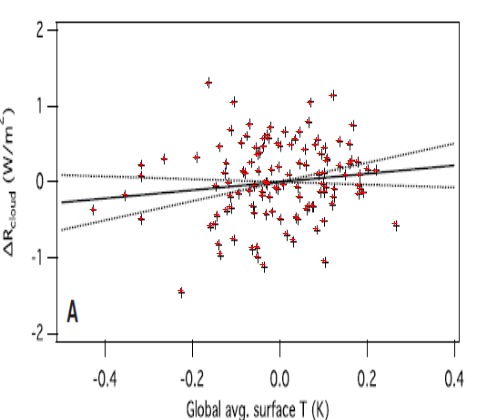
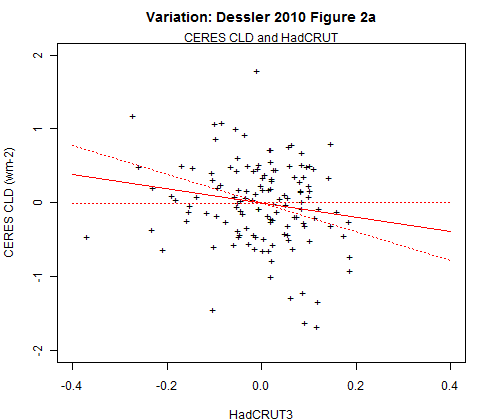
This week there has been a lot of interesting back and forth over a paper by Roy Spencer several months ago arguing that cloud feedback was negative and would serve to limit the total amount of man-made warming.  Just how central this issue is can be seen in the fuss this paper has caused, including editors forced to resign for even daring to publish such heresy, and the speed with which a counter-paper flew through peer review.

I won't get into the depths of this, except to show two charts.  The first is from Dessler in the alarmist camp, the second is the same chart but using a different data series.  I won't explain the axes,  just trust the relationship between these two variables is key to diagnosing the size and direction of feedback.

So we get opposite results (the slope of the regression) simply by using temperature and radiative flux data from to different agencies.  And note how thin the fit is in both -- basically drawing a line through a cloud.  Neither of these likely has an R-squared higher than about .05.

So there you have it, the most important question in climate - really, the only important question associated with anthropogenic global warming.  Settled science, indeed.

Krugman Unintended Irony: Anyone Who Does Not Unquestioningly Believe Authorities is Anti-Science

here.

It's a wonder how, when over "97 percent to 98 percent" of scientific authorities accepted the Ptolomeic view of the solar system that we ever got past that.  Though I could certainly understand why in the current economy a die-hard Keynesian might be urging an appeal to authority rather than thinking for oneself.

When, by the way, did the children of the sixties not only lose, but reverse their anti-authoritarian streak?

Postscript:  I have always really hated the nose-counting approach to measuring the accuracy of a scientific hypothesis.  If we want to label something as anti-science, how about using straw polls of scientists as a substitute for fact-based arguments?

Yes indeed, the number of people in the newly made-up profession of "climate science" that are allowed by the UN control the content of the IPCC reports and whose funding is dependent on global warming being scary probably is very high.  The number of people in traditional scientific fields like physics, geology, chemistry, oceanography and meteorology who never-the-less study climate related topics that wholeheartedly are all-in for catastrophic man-made global warming theory would be very different

 Decide for yourself - see my video on global warming.  Am I anti-science?

Assuming Your Conclusion

The latest stimulus analysis out of the Administration is yet another crock.  It claims 2+ million jobs created, but has absolutely no evidence for this.  All it does is take the same hypothetical Keynesian multipliers it used when it proposed the stimulus, and reapply them.  In other words, the models basically say X jobs should have been created per billion dollars spent, so they run the models that then announce that X jobs must have been created per billion dollars spent.  Surely.  Somewhere.  We swear.

This notion of confirming your original predictive model runs with new runs of the same model is the same kind of BS that has become so popular in climate science.  The fact is, the net effect of the stimulus is almost impossible to measure in a complex economy where so much is changing.  It's possible, perhaps  (though this is surprisingly difficult to do right) to measure each person employed in a stimulus project, but this does not answer the question of how many jobs would have been created if the $800 billion had been left in the hands of private actors rather than spent by the government.


Climate Updates

I have posted a number of updates on climate science here.

Science and Complexity: The Convergence of Climate and Economics

I continue to be fascinated by the similarity between climate science and macro-economics.  Both study unbelievably complex multi-variable systems where we would really like to isolate the effect of one variable.  Because we only have one each of climates and economies  (we can define smaller subsets, but they are always going to be subject to boundary effects from the larger system) it is really hard to define good controlled experiments to isolate single variables.  And all of this is done in a highly charged political environment where certain groups are predisposed to believe their variable is the key element.

In this post by Russ Roberts, one could easily substitute "climate" for "economy" and "temperature" for "unemployment."

Suppose the economy does well this year–growth is robust and unemployment falls. What is the reason for the improvement? Will it be because of the natural rebound of an economy after a downturn that has lasted longer than people thought? The impact of the stimulus finally kicking in? The psychological or real impact of extending the Bush tax cuts? The psychological or real impact of the November election results? The steady hand of Obama at the tiller? All of the above? Can any model of the economy pass the test and answer these questions?

The reason macroeconomics is not a science and not even scientific is that the question I pose above is not answerable. If the economy improves, there will be much talk about the reason. Data and evidence will be trotted out in support of the speaker’s viewpoint. But that is not science. We don’t have a way of distinguishing between those different theories or of giving them weights to measure their independent contribution.

I’m with Arnold Kling. This is a time for humility. It should be at the heart of our discipline. The people who yell the loudest and with the most certainty are the least trustworthy. And the reason for that goes back to Hayek. We can’t measure many of the things we would have to measure to have any reasonable amount of certainty about the chains of connection and causation.

I have heard it said that the only way nowadays to advance pure science is to be working on arcana like the first microsecond of the universe or behavior of the 9th dimension in string theory.   There is still room for a ton of useful work on the analysis, solution, and forecasting of complex multi-variable systems, even if it is just a Goedel-like proof of where the boundaries of our potential understanding can be drawn.

By the way, I wrote my own piece about the limits of macroeconomics here.

But I Am Sure This Would Never Happen in Climate

Wow, suddenly skepticism, and even outright harsh criticism, of peer-reviewed work is OK, as long as it is not in climate I suppose.

On Thursday, Dec. 2, Rosie Redfield sat down to read a new paper called "A Bacterium That Can Grow by Using Arsenic Instead of Phosphorus." Despite its innocuous title, the paper had great ambitions. Every living thing that scientists have ever studied uses phosphorus to build the backbone of its DNA. In the new paper, NASA-funded scientists described a microbe that could use arsenic instead. If the authors of the paper were right, we would have to expand our....

As soon Redfield started to read the paper, she was shocked. "I was outraged at how bad the science was," she told me.

Redfield blogged a scathing attack on Saturday. Over the weekend, a few other scientists took to the Internet as well. Was this merely a case of a few isolated cranks? To find out, I reached out to a dozen experts on Monday. Almost unanimously, they think the NASA scientists have failed to make their case. "It would be really cool if such a bug existed," said San Diego State University's Forest Rohwer, a microbiologist who looks for new species of bacteria and viruses in coral reefs. But, he added, "none of the arguments are very convincing on their own." That was about as positive as the critics could get. "This paper should not have been published," said Shelley Copley of the University of Colorado.

The article goes on to describe many potential failures in the methodology.  None of this should be surprising -- I have written for years that peer-review is by no means proof against bad science or incorrect findings.  It is more of an  extended editorial process.  The real test of published science comes later, when the broader community attempts to replicate results.

The problem in climate science has been that its proponents want to claim that having research performed by a small group of scientists that is peer-reviewed by the same small group is sufficient to making the results "settled science."  Once published, they argue, no one (certainly not laymen on blogs) has the right to criticize it, and the researchers don't (as revealed in the Climategate emails) have any obligations to release their data or code to allow replication.   This is just fresh proof that this position is nuts.

The broken climate science process is especially troubling given the budgetary and reputational incentives to come out with the most dramatic possible results, something NASA's James Hansen has been accused of doing by many climate skeptics.  To this end, consider this from the bacteria brouhaha.  First, we see the same resistance to criticism, trying to deflect any critiques outside of peer-reviewed journals

"Any discourse will have to be peer-reviewed in the same manner as our paper was, and go through a vetting process so that all discussion is properly moderated," wrote Felisa Wolfe-Simon of the NASA Astrobiology Institute. "The items you are presenting do not represent the proper way to engage in a scientific discourse and we will not respond in this manner."

WTF?  How, then, did we ever have scientific process before peer-reviewed journals appeared on the scene?

But Jonathan Eisen of UC-Davis doesn't let the scientists off so easily. "If they say they will not address the responses except in journals, that is absurd," he said. "They carried out science by press release and press conference. Whether they were right or not in their claims, they are now hypocritical if they say that the only response should be in the scientific literature."

Wow, that could be verbatim from a climate skeptic in the climate debate.

And finally, this on incentives and scientific process:

Some scientists are left wondering why NASA made such a big deal over a paper with so many flaws. "I suspect that NASA may be so desperate for a positive story that they didn't look for any serious advice from DNA or even microbiology people," says John Rothof UC-Davis.

Incentives and Conspiracies

I am sort of the anti-conspiracy theorist.  I have written a number of times that events people sometimes explain as orchestrated conspiracies often can be explained just as well by assuming that people with similar preferences and similar information and similar incentives will respond to these incentives in similar ways.

I think the great herd-think around climate alarmism is a good example, and the Bishop Hill blog brings us a specific illustration from the comment section of Watts Up With That.  A commenter observed that it was pretty hard to believe that thousands of scientists could be participating in a conspiracy.  Another commenter wrote back:

Actually not so hard.

Personal anecdote:
Last spring when I was shopping around for a new source of funding, after having my funding slashed to zero 15 days after going public with a finding about natural climate variations, I kept running into funding application instructions of the following variety:

Successful candidates will:
1) Demonstrate AGW [ed:  Anthropogenic Global Warming]
2) Demonstrate the catastrophic consequences of AGW.
3) Explore policy implications stemming from 1 & 2.

Follow the money "” perhaps a conspiracy is unnecessary where a carrot will suffice.

If only alarmist results are funded, then it should not be surprising that only alarmist studies are produced.

By the way, it is probably incorrect to think of climate science really being driven by 2500 scientists.  Here is an analogy:  Strategy at General Motors is in some sense driven by thousands of workers - salesmen who know the market, channel managers who know their distribution partners, planners who watch econometric trends, manufacturers who know what can and can't be done with costs, engineers who see what the next technological opportunities, etc. -- you get the idea.

But realistically, there are probably 20-25 people who are really setting and driving and communicating the corporate strategy for GM.  And those 20-25 people will likely say to the public that their strategy is supported by all those 200,000 workers.  But in fact there are thousands, maybe even a majority, that would say that they don't support the strategy and don't think that strategy is consistent with their bit of knowlege.

I think climate science works roughly the same way.  The same 20-25 people are lead authors on the IPCC, write key reports, contribute to Al Gore's movie, get quoted in the NY Times, run the Realclimate web site, and, of course, feature prominently in the CRU emails.  And while these 25 may claim thousands of scientists support their conclusions based on the mere fact that these other scientists contributed to an IPCC report that had these conclusions, many of these scientists, when actually asked, will disagree.

Here is one thing that is never mentioned -- most of the scientists outside of climate science who have gone on the record somewhere as supporting catastrophic man-made global warming theory, if you really talked to them, would say they made their statement in support of science, not global warming theory.  Most of these folks really haven't dug into the details, but the problem was presented to them as one of science vs. anti-science.  They are told by their peers and the media that AGW skeptics are all fundamentalist super right-wing anti-science evolution deniers who think the Earth is 4000 years old.

By saying they support AGW, these scientists are really trying to make the statement that they support science.  The bitter irony is that they are doing the opposite, enabling those in the core of the climate community who are trying to duck criticism and replication by demanding unquestioning respect for their authority.  The fact is that nearly every time one of these outsider scientists - a physicist or a geologist or a statistician, say - digs into the science, they are appalled at what they find and how bad the science behind catastrophic AGW theory really is.

Dangers of a Monoculture -- Reactions to the CRU Emails

Cross-posted from Climate Skeptic:

I am disappointed to see folks like Lord Monkton calling for scientists to go to jail over what has been discovered in the Hadley CRU emails.  No one is going to jail, at least based on what we know so far.  Laws were broken, but of the type that perhaps people lose their jobs but not their freedom.  And demanding that people go to jail just paints skeptics as opportunistic, over-the-top and vindictive.   We sound like the looniest of the alarmists when we say stuff like this.

This is not to say that the emails (as well as the source code, which Steve McIntyre and his readers are starting to dig into) don't give us useful insights about the climate science process.  And what they really point to for me is the danger of a monoculture.

For years, with the media's active participation, criticism of the mainstream scientific position on global warming has been painted as somehow outside the bounds of reasonable discourse.  Skeptics are called "deniers," with the intent to equate them with those who deny the Holocaust.  At every turn, global warming activists with the help of the media, have tried to make it uncomfortable, even impossible, to criticize the science of catastrophic man-made global warming.  In the extreme, this has degenerated into outright threats.

NASA's James Hansen has called for trials of climate skeptics in 2008 for "high crimes against humanity." Environmentalist Robert F. Kennedy Jr. lashed out at skeptics of 2007 declaring "This is treason. And we need to start treating them as traitors" In 2009, RFK, Jr. also called coal companies "criminal enterprises" and declared CEO's 'should be in jail"¦ for all of eternity."

In June 2009, former Clinton Administration official Joe Romm defended a comment on his Climate Progress website warning skeptics would be strangled in their beds. "An entire generation will soon be ready to strangle you and your kind while you sleep in your beds," stated the remarks, which Romm defended by calling them "not a threat, but a prediction."

In 2006, the eco-magazine Grist called for Nuremberg-Style trials for skeptics. In 2008, Canadian environmentalist David Suzuki called for government leaders skeptical of global warming to be thrown "into jail." In 2007, The Weather Channel's climate expert called for withholding certification of skeptical meteorologists.

The examples go on ad infinitum.  Several folks have emailed me and asked why I have not joined the feeding frenzy over the "climategate."  In part, this is because I don't think there is anything in the emails that is a whole lot worse than what many of the actors have been saying publicly.  The media has played along not only because many of its members were sympathetic to the message, but because the catastrophe played well into the "if it bleeds, it leads" culture.  Even when the media was not "picking a winner" in the science, it supported the catastrophist message in its editorial decisions, choosing to cover (for example) ad nauseum a 30-year low in Arctic sea ice but failing to even mention a 30-year high in Antarctic sea ice which occurred on nearly the same day (more here).  Ditto hurricanes, tornadoes, floods droughts, etc "” only events and records in one particular tail of the normal distribution were covered.  Even when they worked to be fair,  the media were frequently criticized by alarmists for  allowing even a mention of the skeptic position in an article otherwise generally supporting the orthodoxy.  The term "false balance" was coined.

The result was a group who were effectively exempt from criticism "” and knew it.

The most amazing thing to watch has been the absolute scorn and obstructionism piled on Steve McIntyre and his readers and partners.  I  have read Steve's work for years, and find it to be incredibly fair and deeply analytical.  I took as one of my early roles at my climate site the explanation to laymen of exactly what McIntyre was talking about in his posts.  He often challenged the climate orthodoxy - which in most scientific disciplines is highly valued, but in climate science is a crime.  In the emails we even see scientists within the monoculture raising the exact same issues that they have blasted McIntyre for "” apparently it is OK to raise such issues as long as 1) you are an insider and 2) such concerns are suppressed in any public document.

Perhaps the single most abusive part of the monoculture has been its misrepresentation of peer review.  Peer review was never meant as a sort of good housekeeping seal of approval on scientific work.  It is not a guarantee of correctness.  It is really an extension of the editorial process "” bringing scientists from relevant fields to vet whether work is really new and different and worthy of publication, to make sure the actual article communicates the work and its findings clearly, and to probe for obvious errors or logical fallacies.

Climate scientists have tried to portray peer review as the end of the process"“  ie, once one of their works shows up in a peer-reviewed journal, the question addressed is "settled."  But his is never how science has worked.  Publication in a peer-reviewed journal is the beginning, not the end.  Once published, scientists attempt alternatively to tear it down or replicate its conclusions.  Only work that has survived years of such torture testing starts to become "settled."

The emails help to shed light on some aspects of peer review that skeptics have suspected for years.  It is increasingly clear that climate scientists in the monoculture have been using peer review to enforce the orthodoxy.  Peer review panels are stacked with members of the club, and authors who challenge the orthodoxy are shut out of publication, while authors within the monoculture use peer review as a shield against future criticism.  We see in the emails members of the monoculture actually working to force editors who have the temerity to publish work critical of the orthodoxy out of their jobs.  We are now learning that when alarmist scientists claim that there is little peer-reviewed science on the skeptic's side, this is like the Catholic Church enforcing a banned books list and then claiming that everything in print supports the Church's position.

History teaches us that whenever we allow a monoculture - whether is be totalitarian one-party rule or enforcing a single state religion, corruption follows.  Without scrutiny of their actions, actors in such monocultures have few checks and little accountability.  Worse, those at the center of such monocultures can become convinced of their own righteousness, such that any action they take in support of the orthodoxy is by definition ethically justified.

This, I think, is exactly what we see at work in the Hadley CRU emails.

Fake but Accurate -- Now Coming to the Hard Sciences

Most of us remember the famous "fake but accurate" defense of Dan Rather's story on GWB using forged National Guard documents.  If the post-modernism movement were to have an insignia, their tag line  (their "E. Pluribus Unum') could well be "fake but accurate." 

I have written for a while that post-modernism seems to be coming to the hard sciences (I differentiate the hard sciences, because the soft sciences like sociology or women's studies are already dominated by post-modernist thinking).  For example, I quoted this:

For
those of you who cling to scientific method, this is pretty bizarre
stuff. But she, and many others, are dead serious about it. If a
research finding could harm a class of persons, the theory is that
scientists should change the way they talk about that finding. Since scientific method is a way of building a body of knowledge based on skeptical testing, replication, and publication, this is a problem.The tight framework of scientific method mandates figuring out what would disprove the theory being tested and then looking for the disproof.
The thought process that spawned the scientific revolution was
inherently skeptical, which is why disciples of scientific method say
that no theory can be definitively and absolutely proved, but only
disproved (falsified). Hypotheses are elevated to the status of
theories largely as a result of continued failures to disprove the
theory and continued conformity of experimentation and observation with
the theory, and such efforts should be conducted by diverse parties.Needless to say postmodernist schools of thought and scientific method are almost polar opposites.

So here is today's example of fake but accurate in the sciences, not surprisingly also from climate science:

While the critic's advice - to use trained statisticians in studies
reliant on statistics - may seem too obvious to need stating, the
"science is settled" camp resists it. Mann's hockey-stick graph may be
wrong, many experts now acknowledge, but they assert that he
nevertheless came to the right conclusion.

To which the critics,
and doubtless others who want more rigourous science, shake their heads
in disbelief. They are baffled by the claim that the incorrect method
doesn't matter because the answer is correct anyway. With bad science, only true believers can assert that they nevertheless obtained the right answer.

A huge number of physicists and geologists who actually take the time to look into the details of climate science come away being shocked at the scholarship.  Take a world class physicist, drop him into a discussion of the details of the Mann hockey stick analysis, and in an hour you will have a skeptic.

Crazy?  Remember the words of from National Center for Atmospheric Research (NOAA) climate researcher and global warming action promoter, Steven Schneider:

We
have to offer up scary scenarios, make simplified, dramatic statements,
and make little mention of any doubts we have. Each of us has to decide
what the right balance is between being effective and being honest.

Some Thoughts on Peer Review

Some thoughts on the obsession with peer review as the gold standard guarantee of climate science goodness, from Climate Skeptic:


One of the weird aspects of climate science is the over-emphasis on peer
review as the ne plus ultra guarantor of believable results.  This is absurd. 
At best, peer review is a screen for whether a study is worthy of occupying
limited publication space, not for whether it is correct.  Peer review, again at
best, focuses on whether a study has some minimum level of rigor and coherence
and whether it offers up findings that are new or somehow advance the ball on an
important topic. 

In "big
boy sciences
" like physics, study findings are not considered vetted simply
because they are peer-reviewed.  They are vetted only after numerous other
scientists have been able to replicate the results, or have at least failed to
tear the original results down.  Often, this vetting process is undertaken by
people who may even be openly hostile to the original study group.  For some
reason, climate scientists cry foul when this occurs in their profession, but
mathematicians and physicists accept it, because they know that findings need to
be able to survive the scrutiny of enemies, not just of friends.  To this end,
an important part of peer review is to make sure the publication of the study
includes all the detail on methodology and data that others might need to
replicate the results  (which is something climate reviewers are particularly bad at).

In fact, there are good arguments to be made that strong peer review may even
be counter-productive to scientific advancement.  The reason is that peer
review, by the nature of human beings and the incentives they tend to have, is
often inherently conservative.  Studies that produce results the community
expects often receive only cursory scrutiny doled out by insiders chummy with
the authors.  Studies that show wildly unexpected results sometimes have trouble
getting published at all.


 As I read this, it strikes me that one way to describe
climate is that it acts like a social science, like sociology or gender studies,
rather than like a physical science.  I will ahve to think about this -- it
would be an interesting hypothesis to expand on in more depth.  Some quick
parallels of why I think it is more like a social science:

  • Bad statistical methodology  (a hallmark, unfortunately, of much of social
    science)
  • Emphasis on peer review over replication
  • Reliance on computer models rather than observation
  • Belief there is a "right" answer for society with subsequent bias to study
    results towards that answer  (example,
    and another
    example
    )

No Bias Here

Via Tom Nelson comes this interview with climate "scientist" Dr. Kate Rawles:

Greenbang: What do you think is wrong with the debate on climate change?

Dr Kate: It hasn't really got to grips with the fundamental problem,
which is that Western, industrialised lifestyles are literally
unsustainable. Climate change is just one symptom of this. WWF famously
calculated that if everyone on earth were to enjoy the lifestyle of an
average Western European, we would need three planet earths.

Not even the most optimistic believers in technology think that we
can technofix this problem so that 6 billion people (let alone the
projected 9 billion) can enjoy a western lifestyle without ecological
meltdown. It follows that we urgently need to rethink what we currently
mean by a "˜high standard of living' and move away from materialistic
versions of this to an understanding of quality of life that could be
enjoyed by everyone, without causing environmental mayhem. This is
about values, not just about technology.

To a large extent, understanding the passion of climate alarmists is a chicken and egg problem.  Normally, scientists identify a problem and then we seek to solve it.  But, as you can see with this woman, climate science works in reverse.  The debate began with people who believed that technology and economic growth needed to be diminished, and then found global warming as a conveniently manufactured "problem" that pointed to their already preferred solution. 

This, by the way, is her complete answer to the question about what is wrong with climate debate.  You can see her answer to this climate science question has nothing to do with climate, but everything to do with her pro-poverty position.  She actually states her position as anti-western-standard-of-living, because that plays better with the soccer moms, but this is exactly the same as pro-poverty.  And get a load of this great scientist quoting WWF advocacy press releases as if they were peer-reviewed science.

By the way, I personally believe that the world could easily sustain 6 billion people in a western standard of living, and love humanity enough to root for this to occur, so here statement is untrue  (by the way, why are people who advocate for universal poverty like this person considered "sensitive" while folks like me who would love to see all the world wealthy considered evil and cold-hearted?)  I don't know exactly how this will happen, but if I stood in the year 1908 I would not know how (or probably believe) even a single person could  enjoy what we call a western standard of living today, but billions do.  The human mind is a wonderful thing, and can achieve a lot, at least when scientists pursue new possibilities rather than simply shrieking that we need to turn the clock back.

Update:  Here is one faulty assumption she is making:

Current levels of consumption in industrialised societies are too high
- as the three planet earth analysis clearly shows. This presents a
major problem for current economic thinking, which is premised on
growth, and which requires us all to keep consuming more, not less.
Clearly we can't grow infinitely, and consume infinitely, on a finite
planet.

Her assumption is that the Earth is somehow at capacity.  How do we know that?  If a scientist bases all of her beliefs on an assumption like this that has never been proven and the scientist is perfectly comfortable taking on faith, can we really call her a scientist?  Or do we call her a religionist? 

Don't Say I Didn't Warn You -- The Environmentalist Case for Fascism

Our (mostly free) society has survived many challenges.  But will it be able to withstand gentlemen like this waving around immensely flawed climate science:

Liberal democracy is sweet and addictive and indeed in the most
extreme case, the USA, unbridled individual liberty overwhelms many of
the collective needs of the citizens. The subject is almost sacrosanct
and those who indulge in criticism are labeled as Marxists, socialists,
fundamentalists and worse. These labels are used because alternatives
to democracy cannot be perceived! Support for Western democracy is
messianic as proselytised by a President leading a flawed democracy

There must be open minds to look critically at liberal democracy.
Reform must involve the adoption of structures to act quickly
regardless of some perceived liberties. ...

We are going to have to look how authoritarian decisions
based on consensus science can be implemented to contain greenhouse
emissions. It is not that we do not tolerate such decisions in the very
heart of our society, in wide range of enterprises from corporate
empires to emergency and intensive care units. If we do not act
urgently we may find we have chosen total liberty rather than life.

He has great admiration for how China does things

The [plastic shopping bag] ban in China will save importation and use of five million tons of
oil used in plastic bag manufacture, only a drop in the ocean of the
world oil well. But the importance in the decision lies in the fact
that China can do it by edict and close the factories. They don't have
to worry about loss of political donations or temporarily unemployed
workers. They have made a judgment that their action favours the needs
of Chinese society as a whole.

Don't say I didn't warn you.

By the way, here is a little "tip."  The author says this:

Unfortunately it seems increasingly likely that the IPCC underestimated
the speed of climate change and failed to recognise the likely effect
of a range of tipping points which may now be acting in concert.

I believe that man is having a warming effect on the earth, but that effect is small and non-catastrophic.  There are reasons I may be wrong.  BUT, you should immediately laugh out of the room anyone who talk about "a range of tipping points" in a system like the earth's climate that has been reasonably stable for tens of millions of years.  When used by climate catastrophists, the word "tipping point" means:  Yeah, we are kind of upset the world is not warming nearly as fast as our computer models say it should, so we will build an inflection point about 10 years out into the forecast where the slope of change really ramps up and we will call it a "tipping point" because, um, that is kindof a cool hip phrase right now and make us sound sophisticated and stuff.

Postscript:  Anyone who makes this statement is WELL grounded in reality:

All this suggests that the savvy Chinese rulers may be first out of the blocks to assuage greenhouse emissions

LOLOLOL.  They are building a new coal plant, what, every three days or so in China?

Postscript #2: Quiz for older folks out there:  How long ago was it that environmentalists were encouraging us to use plastic bags over paper because it saved a tree?

HT:  Tom Nelson

Anatomy of A False Panic

I am trying to keep most of my long climate posts off this site and over at Climate Skeptic.  However, I have cross-posted this one because it is a good example for laymen of just what crap gets put forward in the media today about global warming.  It demonstrates the gullibility of the media, the gross exaggerations that exist in nearly every climate catastrophe article, and, as an added bonus, demonstrates the scientific incompetence of the man who leads the UN, the organization that has taken onto itself the role of summarizing the state of climate science. 

OK, here is a great example of the media blithely accepting panicky catsrophism where none is warranted (Link HT to Maggies Farm)

Scientists
welcomed Ban Ki Moon to Antarctica with a glass of Johnny Walker Black
Label served "on the rocks" with 40,000-year-old polar ice. But the
researchers delivered an alarming message to the UN Secretary-General
about a potential environmental catastrophe that could raise sea levels
by six metres if an ice sheet covering a fifth of the continent
crumbles.

The polar experts, studying the effects of global warming on the icy
continent that is devoted to science, fear a repeat of the 2002
collapse of the Larsen B ice shelf. The 12,000-year-old shelf was 220
metres (720ft) thick and almost the size of Yorkshire.

"I was told by scientists that the entire Western Antarctica is now
floating. That is a fifth of the continent. If it broke up, sea levels
may rise as much as six metres," Mr Ban said after being briefed at the
Chilean, Uruguayan and South Korean bases during a day trip to King
George Island, at the tip of the Antarctic Peninsula. ...

Eduardo Frei Montalva Air Force Base, a year-round settlement of
corrugated-iron cabins belonging to Chile, lies in one of the world's
worst "hot spots" "“ temperatures have been rising 0.5C (0.9F) a decade
since the 1940s.

I don't even know where to start with this.  So I will just fire off some bullets:

  • Over the last 30 years, satellites have found absolutely no warming trend in Antarctica  (from UAH via Steven Milloy):

South_pole_temperatures

  • The tail is measuring the dog.  The Korean station
    couldn't possibly be more irrelevent to measuring Antarctic
    temperatures.  It is on an island labelled 26-34 north of the tip of the Antarctic Peninsula in the map below.  One might as well declare she is measuring temperatures in the continental US from Key West.

Antarcticastationsmap1s

  • It is well known that the Antarctic Penninsula,
    representing 2% of Antactica's area, is warming while the other 98% is
    cooling.  I discussed this more here.
    Al Gore took the same disingenuous step in his movie of showing only
    the anomolous 2%.  The Antarctic Penninsula in the first graph below shows
    warming.  The rest of Antarctica shows none  (click to enlarge)

Antarc35_2 Antarc34 Antarc33_2

  • The IPCC (run by the Secretary General and his organization) predicts that with global warming, the
    Antarctic penninsula will see net melting while the rest of Antarctica
    will see net increases in ice.  The penninsula is affected more by the
    changing temperatures of sea currents in the surrounding seas than in
    global climate effects.  For most of Antarctica, temperatures will
    never concieveably warm enough to melt the ice sheets, since it is so
    cold even in the summer, and ice sheets are expected to expand as
    warming increases precipitation on the continent.
  • Scientists studying Antarctica have been there at most a few
    decades.  We know almost nothing about it or its histroy.  We certainly
    don't know enough about "what is normal" to have any clue if activities
    on the Larson B ice shelf are anomolous or not.
  • The UN Sec-gen said that this ice shelf represented a fifth of
    the continent.  Here, in actuality, is the Larsen ice shelf.  The red
    box below greatly exaggerates Larsen's size, and Larsen-B is only a portion
    of the entire Larsen shelf.

Antarctic_map_larson_b

  • The statement that the entire Western Antarctic is floating is
    just absurd.  God knows what that is supposed to mean, but even if we
    ignore the word "floating", we can see from the map above we aren't
    even talking about a significant portion of the Antarctic Pennninsula,
    much less of Western Antarctica.  Here are actual pictures of the 2002 event.  (by the way, if ice is really "floating", presumably in sea water, then it's melting will have zero effect on ocean levels)
  • Such a feared collapse already happened 5 years ago, and sea levels did not budge.  But
    the next time it happens, sea levels are going to rise 20 feet??  Even
    the UN's IPCC does not think sea levels will rise more than 8-12 inches
    in the next century due to their overblown temperature forecasts.

As always, you can consult my my book and my movie (both free online) for more details on all these topics.

Video Release

Please check back Monday morning, as I will be releasing my new video, "What is Normal:  A Critique of Catastrophic Man-Made Global Warming Theory."  As with my global warming book, which began as a ten page summary and ended up as an 85-page manuscript, the video started at a goal of 15 minutes and eventually ended up at 50 minutes.  However, unlike other global warming-related videos I will not name, it is all climate science, with no self-congratulatory segments on my childhood.

Anthony Watts Discovers a New Element

From Watts Up With That:

The discovery of the heaviest chemical element yet known to science. The new element has been tentatively  named Governmentium.

Governmentium has 1 neutron, 12 assistant  neutrons, 75 deputy neutrons, and 224 assistant deputy neutrons, giving it  an atomic mass of 312. These 312 particles are held together by forces  called morons, which are surrounded by vast quantities of lepton-like  particles called peons.

Since Governmentium has no electrons, it is  inert. However, it can be detected as it impedes every reaction with which it comes into contact. A minute amount of Governmentium causes one  reaction to take over four days to complete when
it w ould normally take less  than a second.

Of course, there is much more.  Enjoy.

And, don't miss the chance to contribute to Watt's grass roots climate project / scavenger hunt.  Its fun and it contributes a lot to climate science.  I have contributed two sites so far -- I wrote about the first one here.

Climate Scavenger Hunt (No Climate Expertise Required)

Anthony Watts is offering an opportunity to help out climate science and participate in something of a climate scavenger hunt.  What is considered the most "trustworthy" temperature history of the US comes from a series of temperature measurement points called the US Historical Climate Network (USHCN).  There are perhaps 20-25 such measurement points in each state, usually in smaller towns and more remote spots.  Some of these stations are well-located, while others are not - having been encroached by urban heat islands of growing towns or having been placed carelessly (see here and here for examples of  inexcusably bad installations that are currently part of the US historical temperature record).

Historically, climate scientists have applied statistical corrections to try to take into account these biasing effects.  Unfortunately, these statistical methods are blind to installation quality.  Watt is trying to correct that, by creating a photo database of these installations, with comments by reviewers about the installation and potential local biases. 

He has created an online database at surfacestations.org, which he explains here.  Your faithful blogger Coyote actually contributed one of the early entries, and it was fun  -- a lot like geocaching but with more of a sense of accomplishment, because it was contributing to science.

So why is it a scavenger hunt?  Well, my son had a double header in Prescott, AZ, which I saw was near the Prescott USHCN station.  Here is what I began with, from the official listing: 

PRESCOTT (34.57°N, 112.44°W; 1586 m)

That looks easy -- latitude and longitude.  Well, I stuck it in Google maps and found this.  Turns out on satellite view that there is nothing there.  So I then asked around to the state climatologist's office - do you know the address of this station.  Nope.  So I zoomed out a bit, and started doing some local business searches in Google maps around the original Lat/Long.  I was looking for government property - fire stations, ranger stations, airports, etc.  These are typically the location of such stations.  The municipal water treatment plant to the east looked good.  So we drove by, and found it in about ten minutes and took our pictures.  My entry is here.

Not only was it fun, but this is important work.  In trying to find some stations in several states, I actually called the offices of the local state climatologist (most states have one).  I have yet to find one that had any idea where these installations were beyond the lat-long points in the data base.  If we are going to make trillion dollar political choices based on the output of this network, it is probably a good idea to understand it better.

How Climate Science Works

When I was an undergraduate in physics, and later in engineering, we had this quaint process where we would conduct experiments and generate data, and from these results generate conclusions.

Climate science works differently.  First, political types and activists write the management summary in as alarming and as headlines-grabbing terms as they can, largely without the help or concurrence of the majority of the scientists involved in the study.  Then, they spend months modifying the underlying data, models, and scientific analysis to fit this management summary.

The summary of the most recent IPCC climate survey has already been released.  The body of the study, with the actual facts and models and stuff, has not been released (won't be for months) and carries this warning on the last draft:

"Changes (other than
grammatical or minor editorial changes) made after acceptance by the
Working Group or the Panel shall be those necessary to ensure
consistency with the Summary for Policymakers or the Overview Chapter.
"

Welcome 2006 Weblog Awards (Sticky)

Note to readers:  This post is sticky through 12/15.  There are new posts just below this one!

Welcome!  This year we are in the blogs ranked 1751-2500.  Please cast your vote for Coyote Blog hereYou can vote once per day!  For those new to the site, here is some of what I do here:

Real-life small business experiences:  Buying a companyWorking with the Department of Labor; Case Studies on the Minimum WageWhat's on my Desk TodayGetting an SBA Loan

Economics:  The myth of Zero-sum Economics; 60 second refutation of socialism; Business Relocation and the Prisoners Dilemma; Technocrats, government and disasters; Advice for the Reality-Based CommunityRoosevelt's NRA: America's Flirtation with Fascism; the Trade Deficit is not a Debt; A Challenge to Lou DobbsIn Praise of Robber Barons

Libertarian political commentary:  Respecting individual decision-making, The real implications of a Privacy Right, Technocrats get their comeuppance, A defense of Open Immigration, New Alien and Sedition laws, Conservatives, let your enemy speak, Liberals, let your enemy speak(and here), Iraq war, The Kelo decision,  

Climate Science:  The skeptical middle ground on warming; A skeptics guide to An Inconvenient Truth

Frustration with runaway torts:  Jackpot Litigation; Coyote vs. ACME

Camping (my business):  New American nomadsThis RV is just wrong

Attempts at humor: How to spot a dictatorship; Coyote's LawMaking fun of the UN and the Internet;

Sports: The Baseball Closer Role is Nuts; I hate penalty kicks; Pre-season college football rankings are the most important

ACME Products:  Instant Girl; Ultimatum Gun; Earthquake Pills

How I Married Well:  My Wife, the Fashion DivaMy Wife's Fashion Awards (and here)

Oh, and I promote my new novel, BMOC, a little bit.

BMOC by Warren Meyer

Enjoy.

A Skeptics Primer for "An Inconvenient Truth"

Update:  Please enjoy this post; however, I have published a (free) more comprehensive guide to the skeptics arguments concerning man-made global warming.  You can find the HTML version here and a free pdf download here.

A few days ago, my wife announced to me that she wanted me to take her to
"An Inconvenient Truth", the recent movie vehicle for communicating
Al Gore's views on climate change.  I told my wife that I found the
climate issue incredibly interesting -- I have always had a passion for
inter-disciplinary science and climate requires integration of bits not just
from climate science but from economics, statistics, biology, and more.  I
told her I would love to see a true documentary on climate change, but I was as
interested in seeing a "science" film from the group that put this movie
together as I presume she was in seeing a "even-handed" movie on
abortion produced by the Catholic Church.

Never-the-less, she has insisted, so I put together a skeptic's primer for
her, which I will also share with you.  Note that I am not actively involved in climate research myself, so the following is my admittedly incomplete understanding of all the issues.  It is meant to raise issues that you may not find discussed in most global warming accounts.

Overview:  The earth has warmed by 2/3 of a degree to as much as a degree (all temperatures in Celsius)
over the last 100 years, of which man may be responsible for no more than half
through CO2 emissions.  The poles, which are important to all the global
deluge scare scenarios, have warmed less than the average.  Man's CO2
emissions will warm the earth another degree or so over the next 100
years.  There is a possibility the warming will be greater than this, but
scary-large warming numbers that are typical of most climate reports today
depend on positive feedback loops in the climate that are theoretical and whose
effect has not yet been observed.  The effects of warming will be a mix of
positive and negative outcomes, recognizing that the former never seem to get
discussed in various media scare stories.  If the effects of warming are a
net negative on mankind, it is not clear that this negative outweighs the costs
in terms of lost economic growth (and the poverty, disease, and misery that
comes with lower growth) of avoiding the warming.  In other words, I
suspect a warmer but richer world may be better than a cooler but poorer world.

The Hockey Stick:  The Hockey Stick graph as become the emblem,
the sort of coat-of-arms, for the climate change intelligentsia.  Until
recently, the climate consensus for the last 1000 years, taken from reams of
historical records (things like the history of X river freezing in winter or Y
region having droughts) was this:

1000yearold

This chart is from the 1990 IPCC climate report, and in it you can see
features that both historians and scientists have discussed for years -- the
warm period during the Middle Ages and the "little ice age" of the
late 17th century.  Of course, this chart is barely better than a guess,
as are most all historical climate surveys.  For example, 3/4 of the earth
is water (where few consistent observations were taken) and only a small percentage of the rest was "civilized" to
the extent of having any historical records.  In addition to historical
records, scientists try to use things like ice cores and tree rings to get a
sense of long-term global climate patterns.

This long-held consensus changed with Mann, et. al., a study that created a new climate
picture for the last millennia that has immediately caught the fancy of nearly
every advocate of climate Armageddon.

1000yearold

For obvious reasons, this graph is called "the hockey stick" and
it is beloved by the global warming crowd because it hammers home the following
message:  Climate has been incredibly steady over the past 900 years with a flat to declining temperature trend until
man came along and caused a dramatic shift.  Based on this analysis, Mann
famously declared that the 1990's were the warmest decade in a millennia and
that 1998 was the hottest year in the last 1000 years.  (For real hubris, check
out this recent USAToday
graphic
, which purports to know the world's temperature within .001 degree
for every year going back two thousand years)

In fact, what Mann's chart shows for the last 100 years is about what I said in my overview - that
the world has warmed a degree and that man maybe has contributed up to half of
this.  Notice that tacked onto the end of the previous consensus view, the
last 100 years seem like it might just be the start of another natural cyclical
climate variation.    Not necesarily a reason for panic.  Ah,
but Mann's chart!  That's a chart that anyone eager to have the government
intervene massively in the economy is bound to love. It says that we are currently entering an unprecedented anomoly, and that the chief suspect for creating this change must be human civilization.

So is Mann right?  Well, a couple of things to note.  First, its
instructive to observe how eagerly the climate community threw out its old
consensus based on years of research in favor of Mann's study.  It's
unusual for a healthy
scientific community
to throw out their old consensus on the basis of one
study, especially when no one had replicated its findings independently.
Which no one has ever been able to do, since Mann has refused to share his
models or methodology details.  In fact, it took a US Congressional subpoena
to get any of his underlying models into the public domain.  This behavior
by a scientist would normally engender ENORMOUS skepticism in the community --
normally, I mean, except for in climate science, where mountaintop revelation without 3rd party repeatability
is OK as long as it supports a dire man-made climate catastrophe model.
In short, climate change advocates wanted the study to be true, because it was such a
powerful image to show the public.

Despite Mann's reticence to allow anyone to check his work, skeptics still
began to emerge.    Take that big temperature bulge in the Middle
Ages shown in the previous concensus view.  This bulge was annoying to climate
interventionists, because it showed that large variations in temperature on a
global scale can be natural and not necessarily the fault of modern man.
But Mann made this whole medieval bulge go away.  How?  Well, one of
the early revelations about Mann's work is that all the data before 1450 or so
comes from studying the tree rings of one single tree.  Yes, that's one tree
(1).  Using the evidence of this one tree, Mann flattened the temperature
over the 500 year period from 1000-1500 and made the Medieval warm period just go poof.  Wow!

The bigger criticism of Mann has come from statisticians.  Two Canadian
statisticians began questioning Mann's methodology, arguing that his
statistical approach was incorrect.  They demonstrated that Mann's
statistical approach was biased towards creating hockey sticks, and they showed
how the Mann model could be applied to random noise and produce a hockey
stick.   The climate change establishment did not take this criticism
well, and tried their hardest to rip these two guys up.  In fact, you might have believed that the two had been molesting little boys or declaring the world is flat rather than just questioning another scientist's statistical methodology. 

Recently, a US Congressional Committee asked a group of independent statisticians led by
Dr. Edward Wegman, Chair of the National Science Foundation's Statistical
Sciences Committee, to evaluate the Mann methodology.  Wegman
et. al. savaged the Mann methodology
as well as the peer review process
within the climate community:

It is important to note the isolation of the paleoclimate community; even
though they rely heavily on statistical methods they do not seem to be
interacting with the statistical community. Additionally, we judge that the
sharing of research materials, data and results was haphazardly and grudgingly
done. In this case we judge that there was too much reliance on peer review,
which was not necessarily independent. Moreover, the work has been sufficiently
politicized that this community can hardly reassess their public positions
without losing credibility. Overall, our committee believes that Dr. Mann's
assessments that the decade of the 1990s was the hottest decade of the
millennium and that 1998 was the hottest year of the millennium cannot be
supported by his analysis.

Further, Wegman concurred on almost every point with the Canadians, coming to the conclusion that the hockey stick was deepfly flawed.  In most other scientific communities, the Mann analysis would have been sent
to the dustbin along with cold fusion and Archbishop James Ussher's dating of
the earth to October 23, 4004 BC.
The problem is that the Mann chart has become too politically important.  Prominent men
like Al Gore have waved it around for years and put it in his books.  No
one in the core of the climate community can back away from the hockey stick
now without the rest of the world asking, rightly, what else is wrong with your
analyses?  If I seem too hard on the climate science community, then
consider this
quote
from National Center for Atmospheric Research (NOAA) climate researcher and global warming action promoter,
Steven Schneider:

We have to offer up scary scenarios, make simplified, dramatic statements,
and make little mention of any doubts we have. Each of us has to decide what
the right balance is between being effective and being honest.

Now you know why, for all its flaws, you will continue to see the hockey
stick in the press.  Because it is not about the facts, but about "scary scenarios" and "dramatic statements".

Has Man Been Causing the Warming?

Yes, some of it.  But its a little more complicated than the global
warming community lets on.   First, note the last 100 years of the
hockey stick.  The big upwards spike begins in 1900, long before any large
man-made concentrations of CO2 were put into the atmosphere.  In fact,
even those most fanatical about assigning maximum blame for climate change to
man don't blame man-made effects for most of the first half of the 20th century
temperature spike. 

Which begs the question, what caused the 1900-1940 spike of about 1/2 a
degree?  Answer:  Nobody really knows.  Which begs the follow-on
question:  If we don't know what caused the 1900-1940 run-up, how do we
know that this same force is not responsible for some of the run-up since
1950?  Answer:  We don't.  As I will explain below, climate
scientists trying to validate their models have reasons for wanting the
post-1950 temperature rise to be all man-made.  But just because they
assume it to be due to man-made rises in atmospheric CO2 concentrations does
not make it so -- correlation does not equal causation.

Well, what else could be causing this increase?  It could at least partially be
natural
cyclical variations in climate that we don't really understand.
Or it could be something more obvious, like, say, the sun was brighter.  I
can imagine your reaction -- no way it could be just a brighter sun,
Coyote.  I mean, that's the first thing the climate scientists would check
if earth temperatures were rising, right?

Irradiance

This chart compiled from data by Judith Lean of the Naval Research Library
and charted from her data at NOAA by Junkscience.com
shows that interestingly, the sun's output does appear to be higher today than they have been in many, perhaps hundreds of years.  Would such increased activity be
expected to result in higher earth temperatures?  I don't know, but if you
think it odd that scientists talk about global warming without mentioning how
hot the sun is, well, welcome to the world of climate science.   Its kind of like scrambling to find out why your room is too hot without first checking to see where the thermostat on the furnace is set.  More
on the sun's variance
and climate change here
.

Future Warming:  The key question, of course, is about future warming - i.e.,
based on man's economic growth and projected output of CO2, how much can the
world be expected to warm, say over the next 50-100 years.  I don't know
what the movie "An Inconvenient Truth" will claim until I see it, but
most recent studies have shown warming from 2-8 degrees (consistent with what is depicted by the
USAToday graphic linked above).

There are lots of issues with these forecasts that occasionally might even get
mentioned in the popular press.  Some issues are unavoidable, like the
inherent complexity and unpredictability of climate.  Some issues probably
could be avoided, like the egregiously bad economic forecasting that drives CO2
output forecasts in many of these models.  I won't delve into these issues
much, except to say that we are dealing with massively complex systems.
If an economist came up with a computer model that he claimed could predict the
market value of every house in the world in the year 2106 within $10,000, would
you believe him?  No, you would say he was nuts -- there is way to
much uncertainty.  Climate, of course, is not the same as housing
prices.  It is in fact, much, much more complex and more difficult to
predict. 

All these forecasts are created by a pretty insular and incestuous climate
science community that seems to compete to see who can come up with the most
dire forecast.  Certainly there are financial incentives to be as aggressive
as possible in forecasting climate change, since funding dollars tend to get
channeled to the most pessimistic.   The global warming community spends
a lot of time with ad hominem attacks on skeptics, usually accusing them of
being in the pay of oil and power companies, but they all know that their own
funding in turn would dry up rapidly if they were to show any bit of skepticism
in their own work.

Leaving aside all the other modeling problems and focus on one fact:
Most climate scientists would agree that if you focus narrowly just on the
effects of CO2 on warming, that even under the most extravagant assumptions of
CO2 production, the world will not warm more than a degree or two in total,
some of which we have already seen.  The reason is that the effect of CO2
concentration on global temperature is logarithmic.  This means that
increasing concentrations of CO2 have diminishing returns on temperature.
For example, if the first doubling of CO2 concentration raises temperatures by
a degree, then the next doubling may only raise it by a tenths of a
degree.  This is because CO2 only absorbs sunlight and energy in certain
frequency bands and this ability to absorb energy gets saturated, much like a
pot of water can only dissolve so much salt before it is saturated.

There is fair amount of argument over just how saturated the CO2 layers are
in terms of energy absorption, but most scientists will agree that at some
point, in isolation, additional CO2 added to the atmosphere by man stops having
any significant effect on global temperature.

So how do we get these dire forecasts of 6, 7, 8 degrees of warming?
Well, I was careful to say the effect of CO2 in isolation maxes
out.  To get to higher levels of warming, scientists posit "positive
feedback loops" that augment the warming effect.  Positive feedback generally means that once a process gets going in a direction, there is some force that will accelerate the process
faster or farther in the same direction.  Negative feedback means that
once a process is moving there is some force that tends to try to slow the process back down.
Positive feedback is a boulder balanced on the top of a mountain, where one
push will cause it to roll down the mountain faster and faster; Negative
feedback is a boulder in a valley, where despite lots of effort, the rock will
keep coming to rest back where it started.

In global warming models, water vapor plays a key role as both a positive and a negative feedback loop to climate change.  Water vapor
is a far more powerful greenhouse gas than CO2.  It comes into play because CO2 driven warming will
put more water vapor in the atmosphere, because greater heat will vaporize more
water.  If this extra vapor shows up as more humid clear air, then this in
turn will cause more warming as the extra water vapor absorbs more energy and
accelerates warming.  However, if this extra water vapor shows up as
clouds, the cloud cover will tend to reflect energy back into space and retard
temperature growth. 

Which will happen?  Well, nobody knows.  And this is just one
example of the many, many feedback loops that scientists are able to posit but
not prove. And climate scientists are coming up
with numerous other positive feedback looks.  As one skeptic put it:

Regardless, climate models are made
interesting by the inclusion of "positive feedbacks" (multiplier
effects) so that a small temperature increment expected from increasing
atmospheric carbon dioxide invokes large increases in water vapor, which seem
to produce exponential rather than logarithmic temperature response in the
models. It appears to have become something of a game to see who can add in the
most creative feedback mechanisms to produce the scariest warming scenarios
from their models but there remains no evidence the planet includes any such
effects or behaves in a similar manner.

So, is it reasonable to assume these feedback loops?  First, none have
really been proven empirically, which does not of course necessarily make them
wrong.  More damning is the fact that models using mostly positive feedback
loops do a terrible job of modeling the last 100 years.  It is a perfectly
reasonable back check on any model to see if it predicts history.   Most of the aggressive climate models (ie the ones that tend to get quoted in the press) turn out to predict a warming for the
last 50 years far above what we have actually observed, which of course might make one
suspicious of their ability to predict the future.  A while back, I said
that climate scientists had a strong incentive to "claim" as much of
the 20th century warming as possible and attribute it to man.  This is
why:  The need to validate models that predict a lot of manmade warming
over the last 50 years that hasn't shown up.  Scientists will tell you
that they have fixed these problems, but we skeptics are fairly certain they have done it by adding artificial
fudge factors of dubious scientific merit  (I will confess to my embarassment that I have done exactly this when I have created industry models for a consulting client).

But one can also answer these questions about positive feedback loops from a
broader perspective.  Positive feedback loops are not unknown in nature
but are much rarer than negative feedback loops.  The reason is that
positive feedback loops lead to runaway processes that we seldom see in
nature.  Atomic fission is one of these thankfully rare process, and one can see that it is
probably lucky our universe is not populated with many such positive feedback
processes.  In our daily lives, we generally deal with negative
feedback:  inertia, wind resistance, friction are all negative feedback
processes.  If one knew nothing else, and had to guess if a natural
process was governed by negative or positive feedback, Occam's razor would say
bet on negative.  So, what about climate?  The evidence is equivocal,
but to be fair there is an example in our near universe of a runaway global
warming event - on Venus - though it occurred for reasons very different than
we are discussing with man-made climate change.

Negatives (and Positives) of Warming: While I have some trouble with
the science employed by global warming activists up to this point, it is on the
topic of the effects of global warming that the science really gets
flaky.  Now, certain effects are fairly likely.  For example,
hurricane activity will likely increase with warmer ocean temperatures.
Warmer ocean temperatures will also cause sea levels to rise, even without ice
melting, due to thermal expansion of the water.  And ice will melt, though
there is a really broad range of forecasts.

One reason that the ice
melting forecasts are hard
is because while me may talk about the world
warming a degree, the world does not warm evenly.  Most climate models
show the most warming on dry winter nights  (Siberian winters, for
example, get a disproportionate share of the warming).  An extra summer
degree in Arizona would suck; an
extra winter degree in Siberia would probably be
welcomed, and would likely extend growing seasons.

And it is here that you get the greatest silence from warming
fanatics.  Because
it should be self-evident that warming can be good and bad
.  Warming
can raise ocean levels and lead to droughts.  It can also extend growing
seasons and increase rain.  It all depends on where you are and what
forecast you are using.  The only common denominator is that most official
warming reports, such as those from the UN, spend an inordinate amount of time
discussing the negatives and very little time, if any, mentioning positive
offsets.  One of the reasons for this is that there is a culture in which
every environmental activist has been steeped in for years -- that man always
ruins nature.  That everything man does is bad.  Growth is bad.
Technology is bad.  To be fair, its not that many environmental scientists
are hiding the positive offsets, it's that they have been programmed for years to be
unable to recognize or acknowledge them.

Shouldn't We Fix it, Just to Be Safe:  If you get beyond the
hard core of near religious believers in the massive warming scenarios, the
average global warming supporter would answer this post by saying:
"Yes there is a lot of uncertainty, but you said it yourself: 
Though the doomsday warming scenarios via positive feedback in the climate
can't be proven, they are so bad that we need to cut back on CO2 production
just to be safe."

This would be a perfectly reasonable approach if cutting back on CO2
production was nearly cost-free.  But it is not.  The burning of
hydrocarbons that create CO2 is an entrenched part of our lives and our economies.
Forty years ago we might have had an easier time of it, as we were on a path to dramatically cut back on CO2 production
via what is still the only viable technology to massively replace fossil fuel
consumption -- nuclear power.  Ironically, it was environmentalists that
shut down this effort, and power industries around the world replaced capacity
that would have gone nuclear mostly with coal, the worst fossil fuel in terms
of CO2 production (per btu of power, Nuclear and hydrogen produce no CO2,
natural gas produces some, gasoline produces more, and coal produces the most).

Just halting CO2 production at current levels (not even rolling it back)
would knock several points off of world economic growth.  Every point of
economic growth you knock off guarantees you that you will get more poverty,
more disease, more early death.  If you could, politically, even
make such a freeze stick, you would lock China and India,
nearly 2 billion people, into continued poverty just when they were about to
escape it.  You would in the process make the world less secure, because
growing wealth is always the best way to maintain peace.  Right now, China can become wealthier from peaceful internal growth than it can from trying to loot
its neighbors.  But in a zero sum world created by a CO2 freeze, countries
like China would have much more incentive to create trouble outside its borders.  This
tradeoff is often referred to as a cooler but poorer world vs. a richer but
warmer world.  Its not at all clear which is better.
 

One final  statement:  I have lost trust in the scientific
community on this.  There are just too many statements floating around like
this one
that make it clear that getting people converted to the global
warming cause is more important than getting the science right.  Mann's
refusal to share his data so that his results can be validated (or invalidated,
as seems more likely now), the refusal
to consider any dissenting views
in its "scientific" conferences,
the sloppy
science
uncovered, the willingness to absurdly blame
every natural event on global warming
  -- all these create the
impression that global warming is a religion with doctrines that can't be
questioned, rather than what it actually is -- a really, really chaotic and complex area
of science we have only just begun to understand.

For other reading, probably the first place to look is the Skeptical Environmentalist by Bjorn
Lomborg
. Lomborg in this book has probably the best counter-case to the
enviro-disaster stories filling the media. He has become an object of absolute
hatred among the anti-growth anti globalization fanatics who have latched onto climate
change as the key to advancing their anti-technology and anti-capitalist
political agenda. The attacks on him have become nearly as edifying about what
drives the environmental movement as his book itself. The Economist has
a nice article about his book and about the wild-eyed furious reaction of
environmental activists to it. The Economist also editorializes
here
, and you can follow all the criticism and response here on Lomborg's site.

The site junkscience.com is
invaluable, in fact with a better compendium of data on climate than most
climate sites.  A good
place to start is this article
.

Other sources: This paper is
a good roundup of all the issues I have addressed. Cato has a lot of other
material here
as does the Heartland
Institute
and at The
Commons.
  A great post from Silflay Hraka that is much more eloquent
(and concise) than I am is linked here.

Update:  I have published a (free) more comprehensive guide to the skeptics
arguments concerning man-made global warming.  You can find the HTML version here and a free pdf download here.

The Church of Kyoto

After a number of posts on global warming, several of my friends and family have sent me various links and tracts and articles, apparently concerned about me as a Kyoto "unbeliever".  It reminds me a lot of my neighbor giving my wife religious pamphlets when she found out we didn't go to church on Sunday.  Jerry Pournelle has a good series of posts about getting roughly the same reaction

So here is a bit of advice:  First, keep sending me anything thing that has science in it, I always enjoy reading it.  Second, if you are going to send me climate science, make sure you understand where my agnosticism lies:  I don't need more articles saying "see, the world has warmed, therefore we need the Kyoto treaty" or "look at the CO2 rise at Hilo station".  In my mind, there are five logic steps you need to make to justify Kyoto-type emissions limitations.   Everyone sends me proof of the first two steps, but I seldom see science on the last three, which are the most problematic.  Here they are, and where my current thinking is on each:

1.   Is the world warming?  The answer is yes, though ground-based measurements influenced by urban heat islands may be over-estimating the rise, despite corrections.  Also, one needs to remember that some of the warming occurred in the early parts of the century, where man-made CO2 is unlikely to be to blame. 

By the way, be very careful of advocates' graphs - often the time scale is "managed".  Someone sent me this link, of rising temperatures in Central Park.  Unfortunately, the graph is carefully selected, and here is the graph with all the data (same data source) shown.  I have seen the same game played with this chart several times, showing only the data since 1965, which obviously would tell a very different story.  All that being said, I am still convinced the earth is warming some, but what does it tell you when organizations play such exaggeration games with the data - are they being objective scientists or advocates? 

2.  Is the warming due to man-made CO2?  The answer is partially, though perhaps not as much as global-warming activists want to believe.  Yes, man-made CO2 has almost certainly increased CO2 concentrations in the atmosphere, but solar activity has also been at a cyclical peak in this century, and many point to this activity as another contributor to warming.  Also, something other than man-made CO2 drove a half-degree warming early in the century, so whatever caused that warming may well be contributing to warming in the second half of the century (unless you want to take the dangerously untenable position that whatever drove early century warming stopped at the same time that CO2 started having an effect).  Finally, there are still arguments about the quality of the statistical analysis in looking at long term climate trends.

3.  How much will man-made CO2 raise temperatures in the future?  My answer is some, but not nearly as much as models predict.  First, recognize that funding levels for climate research today tend to rise in proportion to how dire the forecast is, so organizations have a financial incentive to over-predict.  Second, when current models are applied to history, they over-predict temperature rise.  This leads me to worry that they may be over-predicting for the future as well.   Yes, they claim to have "corrected" this problem, but in fact they just added fudge factors -- whole fortunes have been lost on Wall Street this way.  Third, and the one thing I can confirm from my own knowledge and analysis, climate models GROSSLY over-estimate man-made CO2 production in the future due to enormously flawed economic models.  I spend a lot more time disecting these mistakes here, but to summarize, the models take the most inefficient nations, assume little efficiency improvements, then grow their economies like crazy:

Because of this economic error, the IPCC scenarios of the future also suggest that relatively poor developing countries such as Algeria, Argentina, Libya, Turkey, and North Korea will all surpass the United States [in terms of GNP]

4.  What is the net cost to the world of global warming?  This is where climate science really begins to break down.  The answer is that, scientifically, we don't know.  We don't even know if it is net bad - warming may be net beneficial.  The "bad things" claims have tended to have a "day after tomorrow" sloppiness to them, but the main bad things cited are rising sea levels and increases in violent weather patterns.  Note that the second is entirely unproven, and, no matter what any media article says, we have not yet seen any increase in violent weather recently -- the data so far does not support it.  As to rising sea levels, there is more science behind the claim but again, we have not yet seen any evidence of it.  Most climate scientists will admit that the majority of the warming will occur on winter nights in the coldest regions (e.g. lots of warming of Siberian winters).  But arctic ice melt in sea level rise scenarios mainly occurs during summer days.  How can this be reconciled?  In fact, NASA data shows little or no warming to date in Antarctica or in the Arctic, despite the fact that models say that it should show the most (and therefore the most melting ice).

Beyond the lack of proof is the fact that most global warming activists don't consider or don't want to admit that there are positive effects.  For example, warming would lengthen growing seasons in most areas, potentially increasing food production.  For example, the Cato Institute reported:

The weather can, of course, be too warm, but that is unlikely to become a major problem if the globe warms. Even though it is far from certain that the temperature will rise, the Intergovernmental Panel on Climate Change (the U.N. body that has been studying this possibility for more than a decade) has forecast that, by the end of the next century, the world's climate will be about 3.6° Fahrenheit warmer than today and that precipitation worldwide will increase by about 7 percent. The scientists who make up this body also predict that most of the warming will occur at night and during the winter. In fact, records show that, over this century, summer highs have actually declined while winter lows have gone up. In addition, temperatures are expected to increase the most towards the poles. Thus Minneapolis should enjoy more warming than Dallas; but even the Twin Cities should find that most of their temperature increase will occur during their coldest season, making their climate more livable.

5.  What is the Cost-Benefit trade-offs of mandated CO2 limitations?  Again, no one knows and if there is any good science on this, I have not seen it.  You can guess that if we have not even figured out if warming is net-bad or net-good, we probably don't have a good handle on cost-benefit trade-offs of treaties like Kyoto.  Even without this trade-off analysis, though, we can come to a few conclusions about Kyoto:

  • Even global warming activists admit that Kyoto will at best reduce temperatures 50 years from now by something like a tenth of a degree.
  • Whatever the benefit of reducing CO2 is, Kyoto takes one of the highest cost approaches (see study here).  The main reason is fairly obvious based on the laws of diminishing returns:  The cheapest place to reduce emissions is in the most inefficient countries, and vice versa.  But Kyoto focuses all its reductions on the most efficient industrialized countries, so it is seeking reductions in the highest possible cost locations.
  • Kyoto is mainly a slam-America treaty.  The way it was constructed, with its 1990 reference date, was cleverly chosen to put most of the burden on the US.  The US has experienced fabulous growth since 1990, while Japan and European nations have experienced slow growth as well as structural changes that make the target artificially easy to reach for them (see more here).   Fast growth developing countries are excluded from the treaty entirely.

So here is my point -- it is possible to believe in the theory of man-made CO2 driving temperature increases and still be skeptical of government action on emissions.  Jerry Pournelle has a good series of posts on the same topic

For other reading, probably the first place to look is the Skeptical Environmentalist by Bjorn Lomborg. Lomborg in this book has probably the best counter-case to the enviro-disaster stories filling the media. He has become an object of absolute hatred among the anti-growth anti globalization fanatics who have latched onto climate change as the key to advancing their anti-technology and anti-capitalist political agenda. The attacks on him have become nearly as edifying about what drives the environmental movement as his book itself. The Economist has a nice article about his book and about the wild-eyed furious reaction of environmental activists to it. The Economist also editorializes here, and you can follow all the criticism and response here on Lomborg's site.

Other sources: This paper is a good roundup of all the issues I have addressed. Cato has a lot of other material here as does the Heartland Institute and at The Commons.

UPDATE:

A great post from Silflay Hraka that is much more eloquent (and concise) than I am is linked here