A lot of folks have asked me if I am going to comment on this
One of the fathers of Germany’s modern green movement, Professor Dr. Fritz Vahrenholt, a social democrat and green activist, decided to author a climate science skeptical book together with geologist/paleontologist Dr. Sebastian Lüning. Vahrenholt’s skepticism started when he was asked to review an IPCC report on renewable energy. He found hundreds of errors. When he pointed them out, IPCC officials simply brushed them aside. Stunned, he asked himself, “Is this the way they approached the climate assessment reports?”
I have not seen the book nor the Der Spiegel feature, but I can say that, contrary to the various memes running around, many science-based skeptics became such by exactly this process — looking at the so-called settled science and realizing a lot of it was really garbage. Not because we were paid off in oil money or mesmerized by Rush Limbaugh, but because the actual detail behind many of the IPCC conclusions is really a joke.
For tomorrow, I am working on an article I have been trying to write literally for years. One of the confusing parts of the climate debate is that there are really portions of the science that are pretty solid. When skeptics point to other parts of the science that is not well-done, defenders tend to run back to the solid parts and point to those. That is why Michael Mann frequently answers his critics by saying that skeptics are dumb because they don’t accept greenhouse gas theory, but most skeptics do indeed accept greenhouse gas theory, what they don’t accept is the separate theory that the climate is dominated by positive feedbacks that amplify small warming from CO2 into a catastrophe.
This is an enormous source of confusion in the debate, facilitated by a scientifically illiterate press and alarmists who explicitly attempt to make this bate and switch so they can avoid arguing the tough points. Even the author linked above is confused on this
Skeptic readers should not think that the book will fortify their existing skepticism of CO2 causing warming. The authors agree it does. but have major qualms about the assumed positive CO2-related feed-backs and believe the sun plays a far greater role in the whole scheme of things.
This is in fact exactly the same position that most skeptics, at least the science-based non-talkshow-host ones have. Look for my Forbes piece tomorrow.
When a psychologist or psychiatrist testifies during a defendant’s competency hearing, the psychologist or psychiatrist shall wear a cone-shaped hat that is not less than two feet tall. The surface of the hat shall be imprinted with stars and lightning bolts. Additionally, a psychologist or psychiatrist shall be required to don a white beard that is not less than 18 inches in length, and shall punctuate crucial elements of his testimony by stabbing the air with a wand. Whenever a psychologist or psychiatrist provides expert testimony regarding a defendant’s competency, the bailiff shall contemporaneously dim the courtroom lights and administer two strikes to a Chinese gong…
In the case of New Mexico, this was meant as satire and eventually was removed from the final bill, but I think it would be a great adjunct for climate forecasts, better than a surgeon general’s warning.
It is December, 2005. The Gulf Coast had just been pounded, in succession, by Katrina, Rita, and Wilma. Everyone was talking about how global warming seemed to be intensifying hurricanes. In a speech just after Katrina, Al Gore said
When the corpses of American citizens are floating in toxic floodwaters five days after a hurricane strikes, it is time not only to respond directly to the victims of the catastrophe but to hold the processes of our nation accountable, and the leaders of our nation accountable, for the failures that have taken place….
There are scientific warnings now of another onrushing catastrophe. We were warned of an imminent attack by Al Qaeda; we didn’t respond. We were warned the levees would break in New Orleans; we didn’t respond. Now, the scientific community is warning us that the average hurricane will continue to get stronger because of global warming. A scientist at MIT has published a study well before this tragedy showing that since the 1970s, hurricanes in both the Atlantic and the Pacific have increased in duration, and in intensity, by about 50 percent….
Two thousand scientists, in 100 countries, engaged in the most elaborate, well-organized scientific collaboration in the history of humankind, have produced long-since a consensus that we will face a string of terrible catastrophes unless we act to prepare ourselves and deal with the underlying causes of global warming….
At about the same time, the IPCC was in the process of preparing its fourth report, later released in 2007. It said, in part:
Several peer-reviewed studies show a clear global trend toward increased intensity of the strongest hurricanes over the past two or three decades. The strongest trends are in the North Atlantic Ocean and the Indian Ocean. According to the 2007 Fourth Assessment Report of the Intergovernmental Panel on Climate Change (IPCC-AR4), it is “more likely than not” (better than even odds) that there is a human contribution to the observed trend of hurricane intensification since the 1970s. In the future, “it is likely [better than 2 to 1 odds] that future tropical cyclones (typhoons and hurricanes) will become more intense, with larger peak wind speeds and more heavy precipitation associated with ongoing increases of tropical [sea surface temperatures].”
So what happened? Since Wilma in 2005, we have gone 6 full years without a category 3+ hurricane making landfall in the US, the longest span since 1900 without such an event. And the clock is still counting. When alarmists of all stripes were breathlessly predicting hurricane after hurricane in late 2005, the reality is that we wouldn’t see another in the US for over six years.
Of course, US landfall is in fact a terrible indicator of hurricane activity. Its relevant to us, but it is a pretty random metric. I said this when there were a lot of landfalls and I say it again since there have been so few.
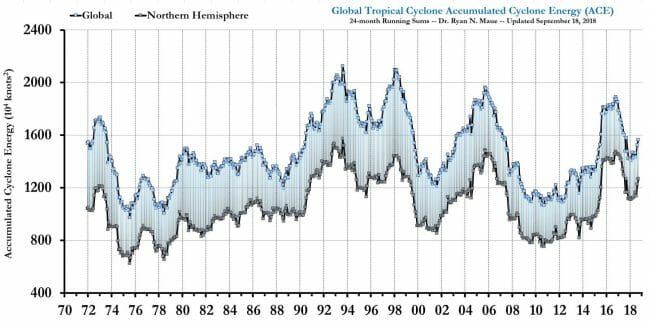
A better metric is accumulated cyclonic energy, a sort of time integral of all large cyclonic storms worldwide. Here is the most recent ACE figures:
As it turns out, the total strength of hurricane and hurricane-like storms has been falling almost since the exact day of Al Gore’s speech in 2005 (another Gore effect!) In fact, of late, it has hit numbers close to all-time lows.
Of course this chart will go back up some day, and then back down, and then up … because hurricane activity has always been cyclical over decadal time scales.
The media loves to trumpet end-of-the-world predictions from folks like Al Gore and Paul Ehrlich, but they never go back five years later and back-check their predictions. And despite their horrendous record for accuracy, the media eagerly publishes the next one. Here is a proposed editorial rule for the MSM — no breathless publication of anyone’s next prediction without first revisiting the last one.
I joke about this but it is really a serious statement about the quality of science and science journalism that there was really a big climate-related panic over the disappearing caribou a couple of years ago. This is climate science in a nutshell – make a measurement error, assume the faulty data is real, and then without evidence blame the changing data on climate change.
(Update: Yes, I actually spelled caribou herd “heard” in the original. I am a big believer there is no such thing as a single metric for intelligence, but that there are multiple intelligences of various sorts. We can argue about the other kinds, but I clearly did not get much of the spelling and proof-reading sort.
Now that the carbon tax has passed through [Australian] federal parliament, the government’s clean-up brigade is getting into the swing by trying to erase any dissent against the jobs-destroying legislation.
On cue comes the Australian Competition and Consumer Commission, which this week issued warnings to businesses that they will face whopping fines of up to $1.1m if they blame the carbon tax for price rises.
It says it has been “directed by the Australian government to undertake a compliance and enforcement role in relation to claims made about the impact of a carbon price.”
…
There will be 23 carbon cops roaming the streets doing snap audits of businesses that “choose to link your price increases to a carbon price”.
Instead, the ACCC suggests you tell customers you’ve raised prices because “the overall cost of running (your) business has increased”.
Addressing the press in Australia, where legislators passed a carbon tax earlier this month, Obama praised Prime Minister Julia Gillard for pursuing “a bold strategy” to trim industrial emissions that most scientists say are contributing to global warming.
The deniers did not decide that climate change is a left-wing conspiracy by uncovering some covert socialist plot. They arrived at this analysis by taking a hard look at what it would take to lower global emissions as drastically and as rapidly as climate science demands. They have concluded that this can be done only by radically reordering our economic and political systems in ways antithetical to their “free market” belief system. As British blogger and Heartland regular James Delingpole has pointed out, “Modern environmentalism successfully advances many of the causes dear to the left: redistribution of wealth, higher taxes, greater government intervention, regulation.” Heartland’s Bast puts it even more bluntly: For the left, “Climate change is the perfect thing…. It’s the reason why we should do everything [the left] wanted to do anyway.”
Here’s my inconvenient truth: they aren’t wrong. [Emphasis added]
Al Gore is doing his best Jerry Lewis imitation by holding an all day climate telethon today. In honor of this, let me repost my climate video for those who have not seen it.
I have written before that peer review is not a guarantee of correctness. Most academics would laugh at that portrayal, yet that is exactly how climate peer review is treated in the media.
A number of years ago, Charles Monnett, flying over the Arctic to do some sort of whale study, saw 3-4 polar bears floating dead in the water. Without either a) retrieving the bear carcasses or b) even getting a picture of them, he wrote up a paper that discussed the siting and hypothesized the bears drowned in a storm and further that more bears would likely drown in the future if global warming melts more Arctic ice in the summer. The findings were the basis for a lot of worry about polar bears, and played a key role in Al Gore’s movie. Panic over the dead bears and Monnett’s wild hypotheses about them helped fuel calls for declaring the bears endangered, despite all evidence that their populations have actually been increasing over the last few years. Monnett did quite well from the work, parlaying his fame into management of a $50 million study budget, the dream of all academics.
Monnett’s study has come back into the news because there has been some kind of investigation of him and his work by the Feds. There has been a lot of speculation among skeptics that the investigation focuses on academic fraud, but I thought that a stretch. As I wrote here
If you read between the lines in the news articles, we really have no idea what is going on. The guy could have falsified his travel expense reports
The likelihood that an Obama Administration agency would be trying to root out academic fraud at all, or that if they did so they would start here, seems absurd to me.
There is no room for fraud because the study was, on its face, facile and useless. The authors basically extrapolated from a single data point. As I tell folks all the time, if you have only one data point, you can draw virtually any trend line you want through it. They had no evidence of what caused the bear deaths or if they were in any way typical or part of a trend — it was all pure speculation and crazy extrapolation. How could there be fraud when there was not any data here in the first place? The fraud was in the media, Al Gore, and ultimately the EPA treating this with any sort of gravitas.
Seriously, you see four floating bear bodies from 1500 feet, once. You don’t have any facts about how they died. You only have one data point in time. Where is there room for fraud? It’s one freaking useless data point. Here is just a taste of what a joke this study was:
The actual survey Monnett was conducting when he observed the dead bears in 2004 was the migration of bowhead whales. Investigators questioned how he later obtained data for a table listing live and dead polar bear sightings from 1987 to 2004.
“So how could you make the statement that no dead polar bears were observed” during that time period? May asked.
“Because we talked to the people that had flown the flights, and they would remember whether they had seen any dead polar bears,” Monnett said.
They only mystery is how this unbelievably trivial piece of work was published.
Well, now we have a better idea. The reviewers for the article were Lisa Rotterman and Andrew Derocher. Incredibly, it turns out Ms. Rotterman is his wife – yes, some people are more peers than others – and Derocher was awarded a large research contract by Monnett just before he reviewed the article. Wow.
By the way, I think I will be both right and wrong. I was pretty sure any government investigation would be about misuse of funds, and that does seem to be the main thrust here, though I was wrong in that it does seem to touch on academic fraud as well, in particular the idea of giving out grant money as a quid pro quo for a positive review (a practice that skeptics have long sustpected in the climate community).
By the way, both Monnett and his partner Gleason now are claiming that everyone blew their study out of proportion and it wasn’t really about global warming. If this is true, they were sure silent about this when they were basking in all kinds of attention and press and grant money. Either of them could have stepped forward and stopped the momentum that built from this article and they did not.
By the way, for those who still want to believe that the EPA is drive by science,
Gleason concedes that the study had a major impact on the controversial listing of the bear as an endangered species because of global warming.
“As a side note, talking about my former supervisor, he actually sent me an e-mail at one point saying, ‘You’re the reason polar bears got listed,’” Gleason said.
One sighting in history of four floating dead polar bears and suddenly our whole fossil fuel economy has to be shut down.
My latest DeSmogBlog post is about how climate skeptics basically seem to believe that their opponents are driven by socialism and communism. We aren’t, of course–duh–but it is fascinating to listen to how they explain this, in their own words.
After some participation years ago in this kind of finger-pointing over motivations in the climate debate, I have of late found such activity to be worthless at best and have tried to stay away from it.
But this became funny when Mooney’s readers started commenting on the post. In effect, they wrote “we are anti-growth socialists.” Mooney was forced to write, in comment #32:
yes. i guess my side loses this round, thanks to this thread. depressing
When I looked at historic temperature and CO2 levels, it was impossible for me to see how they could be in any way consistent with the high climate sensitivities that were coming out of the IPCC models. Even if all past warming were attributed to CO2 (a heroic acertion in and of itself) the temperature increases we have seen in the past imply a climate sensitivity closer to 1 rather than 3 or 5 or even 10 (I show this analysis in more depth in this video).
My skepticism was increased when several skeptics pointed out a problem that should have been obvious. The ten or twelve IPCC climate models all had very different climate sensitivities — how, if they have different climate sensitivities, do they all nearly exactly model past temperatures? If each embodies a correct model of the climate, and each has a different climate sensitivity, only one (at most) should replicate observed data. But they all do. It is like someone saying she has ten clocks all showing a different time but asserting that all are correct (or worse, as the IPCC does, claiming that the average must be the right time).
The answer to this paradox came in a 2007 study by climate modeler Jeffrey Kiehl. To understand his findings, we need to understand a bit of background on aerosols. Aerosols are man-made pollutants, mainly combustion products, that are thought to have the effect of cooling the Earth’s climate.
What Kiehl demonstrated was that these aerosols are likely the answer to my old question about how models with high sensitivities are able to accurately model historic temperatures. When simulating history, scientists add aerosols to their high-sensitivity models in sufficient quantities to cool them to match historic temperatures. Then, since such aerosols are much easier to eliminate as combustion products than is CO2, they assume these aerosols go away in the future, allowing their models to produce enormous amounts of future warming.
Specifically, when he looked at the climate models used by the IPCC, Kiehl found they all used very different assumptions for aerosol cooling and, most significantly, he found that each of these varying assumptions were exactly what was required to combine with that model’s unique sensitivity assumptions to reproduce historical temperatures. In my terminology, aerosol cooling was the plug variable.
In the 1860′s and 1970′s, in the United States, there was a great post-war westward migration. Many settlers began to try to farm lands west of the 100th meridian. These normally very arid regions experienced a couple of decades of much greater rainfall during this period. We know today that this was merely a cyclical variation of the type that is constantly occurring in the climate. However, people of this time chose to believe that this was a permanent change, attributing the shift in rainfall to anthropogenic effects (any of this sound familiar?) The saying at the time was that “rain followed the plow.”
The basic premise of the theory was that human habitation and agriculture through homesteading affected a permanent change in the climate of arid and semi-arid regions, making these regions more humid. The theory was widely promoted in the 1870s as a justification for the settlement of the Great Plains, a region previously known as the “Great American Desert“. It was also used to justify the expansion of wheatgrowing on marginal land in South Australia during the same period.
According to the theory, increased human settlement in the region and cultivation of soil would result in an increased rainfall over time, rendering the land more fertile and lush as the population increased. As later historical records of rainfall indicated, the theory was based on faulty evidence arising from brief climatological fluctuations. The theory was later refuted by climatologists and is regarded as a serious error. In South Australia, George Goyder warned as early as 1865, in his famous report on farming in the state, that rain would not follow the plow. Despite this, until further droughts in the 1880s, farmers talked of cultivating cereal crops up to the Northern Territory border. Today, however, grain crops do not grow further north than Quorn.
The result was eventually disaster for thousands and many abandoned farms in places like Eastern Colorado. To some extent, the theory had a grain of truth – changes in land use do affect the climate. For example, the loss of snow on Kilimanjaro is generally attributed (by non Al Gore types) to deforestation in the area. But as is so often the case, the effects of man’s land use tended to be more local (as with urban heat islands in cities) rather than regional, and ended up in this case being small compared to natural variations.
The sun follows an (approximately) 11-year cycle as sunspots ebb and flow. The peak of these cycles, ie the number of sunspots at the cycle’s maximum, is thought to correlate with the strength of the sun’s output. In the past, periods with very low sunspot activity through an entire cycle have correlated with very cold temperatures (e.g. the Maunder Minimum and the Little Ice Age).
Current prediction for the next sunspot cycle maximum gives a smoothed sunspot number maximum of about 62 in July of 2013. We are currently over two years into Cycle 24. The predicted size would make this the smallest sunspot cycle in nearly 200 years.
The low cycle 200 years ago coincided with a decade or more of wicked-cold temperatures, particularly in Northern Europe (think Napoleon’s army freezing to death in 1812).
One of the reasons this probably has not gotten much coverage is that climate scientists have worked hard in the media to attribute the vast majority of past warming, particularly in the period 1978-1998, to ppm changes in CO2 concentration. But this same 2-decade period saw extremely high solar activity (as measured by sunspots) and ocean cycles like the PDO in the warm phase. To maximize how much past warming was attributed to CO2, warming alarmists had to take the fairly absurd position that these ocean cycles and changes in solar output had only trivial effects on temperatures (much more here).
Well, we may find out over the next few years just how trivial Mr. Sun is or is not to the climate. And we may well find out something else many skeptics have said for years — for activities like agriculture, cooling is way more damaging than warming. In the Middle Ages, agriculture boomed from 1100-1300 even as temperatures rose higher than they are today (at least in Europe). In the first decades of the 1300′s, cooling led to agricultural failure and famine, famines that are often credited for weakening the population and thus increasing the mortality from the Black Death a few years later.
I would argue that the current obsession with small changes to trace levels of CO2 in the atmosphere has in fact gutted the environmental movement. Nothing else is getting done. … My prediction– 10-20 years from now, environmentalists are going to look back on the current global warming hysteria as the worst thing ever to happened to the environmental movement.
The Commission is troubled by nearshore eutrophication, aquatic plant growth caused by excessive nutrients, which causes adverse effects on ecosystems, the economy, recreation, and human health. The reemergence of algal blooms is likely due to multiple factors, including inadequate municipal wastewater and residential septic systems; runoff from increased impervious surface areas and agricultural row-crop areas; discharges from tile drainage which result in more dissolved reactive phosphorus loading; industrial livestock operations; ecosystem changes from invasive mussel species; and impacts from climate change which include warmer water and more frequent and intense precipitation and stormwater events.
Of these listed potential causes, only the last, climate change, is not addressed at all in the main study document, nor is addressing climate change on their list of recommendations, which in fact emphasize that solutions tend to be local. In fact the tone of the study is that the causes are complex and poorly understood, but never again beyond this sentence is climate change mentioned or any evidence of increased precipitation or runoff presented.
One is left with the impression it was a toss-in on the list, included because climate change is “hot” and sexy and a magnet for funding and attention. Certainly the report provides no other evidence or detail as to why it is included in the list. Certainly any intelligent reader would understand that the climate change item was, at best, included to round out the possibilities of a complex and poorly understood problem, but that the study points to many of the other items on the list as more productive places to seek solutions.
Yep, he latched on to the last, least important item that is completely un-adressed by the main report. By doing so, he is in effect helping to distract attention from the real causes that can be addressed and diverting attention to issues that are tangential at best. The solution will likely involve better managing agricultural runoffs and dealing with municipal wastewater plants which are under-treating discharges.
This is why I say that the global warming hysteria will be looked back on as a dead time for the environmental movement, when obsession with trace amounts of CO2 either caused folks to lose attention on important issues, or even caused environmentalists to advocate for ecologically detrimental programs (e.g. biofuels).
Take all the psuedo-quasi-scientific stuff you read in the media about global warming. Of all that mess, it turns out there is really only one scientific question that really matters on the topic of man-made global warming: Feedback.
While the climate models are complex, and the actual climate even, err, complexer, we can shortcut the reaction of global temperatures to CO2 to a single figure called climate sensitivity. How many degrees of warming should the world expect for each doubling of CO2 concentrations (the relationship is logarithmic, so that is why sensitivity is based on doublings, rather than absolute increases — an increase of CO2 from 280 to 290 ppm should have a higher impact on temperatures than the increase from, say, 380 to 390 ppm).
The IPCC reached a climate sensitivity to CO2 of about 3C per doubling. More popular (at least in the media) catastrophic forecasts range from 5C on up to about any number you can imagine, way past any range one might consider reasonable.
But here is the key fact — Most folks, including the IPCC, believe the warming sensitivity from CO2 alone (before feedbacks) is around 1C or a bit higher (arch-alarmist Michael Mann did the research the IPCC relied on for this figure). All the rest of the sensitivity between this 1C and 3C or 5C or whatever the forecast is comes from feedbacks (e.g. hotter weather melts ice, which causes less sunlight to be reflected, which warms the world more). Feedbacks, by the way can be negative as well, acting to reduce the warming effect. In fact, most feedbacks in our physical world are negative, but alarmist climate scientists tend to assume very high positive feedbacks.
What this means is that 70-80% or more of the warming in catastrophic warming forecasts comes from feedback, not CO2 acting alone. If it turns out that feedbacks are not wildly positive, or even are negative, then the climate sensitivity is 1C or less, and we likely will see little warming over the next century due to man.
This means that the only really important question in the manmade global warming debate is the sign and magnitude of feedbacks. And how much of this have you seen in the media? About zero? Nearly 100% of what you see in the media is not only so much bullshit (like whether global warming is causing the cold weather this year) but it is also irrelevant. Entirely tangential to the core question. Its all so much magician handwaving trying to hide what is going on, or in this case not going on, with the other hand.
To this end, Dr. Roy Spencer has a nice update. Parts are a bit dense, but the first half explains this feedback question in layman’s terms. The second half shows some attempts to quantify feedback. His message is basically that no one knows even the sign and much less the magnitude of feedback, but the empirical data we are starting to see (which has admitted flaws) points to negative rather than positive feedback, at least in the short term. His analysis looks at the change in radiative heat transfer in and out of the earth as measured by satellites around transient peaks in ocean temperatures (oceans are the world’s temperature flywheel — most of the Earth’s surface heat content is in the oceans).
Read it all, but this is an interesting note:
In fact, NO ONE HAS YET FOUND A WAY WITH OBSERVATIONAL DATA TO TEST CLIMATE MODEL SENSITIVITY. This means we have no idea which of the climate models projections are more likely to come true.
This dirty little secret of the climate modeling community is seldom mentioned outside the community. Don’t tell anyone I told you.
This is why climate researchers talk about probable ranges of climate sensitivity. Whatever that means!…there is no statistical probability involved with one-of-a-kind events like global warming!
There is HUGE uncertainty on this issue. And I will continue to contend that this uncertainty is a DIRECT RESULT of researchers not distinguishing between cause and effect when analyzing data.
I continue to be fascinated by the similarity between climate science and macro-economics. Both study unbelievably complex multi-variable systems where we would really like to isolate the effect of one variable. Because we only have one each of climates and economies (we can define smaller subsets, but they are always going to be subject to boundary effects from the larger system) it is really hard to define good controlled experiments to isolate single variables. And all of this is done in a highly charged political environment where certain groups are predisposed to believe their variable is the key element.
In this post by Russ Roberts, one could easily substitute “climate” for “economy” and “temperature” for “unemployment.”
Suppose the economy does well this year–growth is robust and unemployment falls. What is the reason for the improvement? Will it be because of the natural rebound of an economy after a downturn that has lasted longer than people thought? The impact of the stimulus finally kicking in? The psychological or real impact of extending the Bush tax cuts? The psychological or real impact of the November election results? The steady hand of Obama at the tiller? All of the above? Can any model of the economy pass the test and answer these questions?
The reason macroeconomics is not a science and not even scientific is that the question I pose above is not answerable. If the economy improves, there will be much talk about the reason. Data and evidence will be trotted out in support of the speaker’s viewpoint. But that is not science. We don’t have a way of distinguishing between those different theories or of giving them weights to measure their independent contribution.
I’m with Arnold Kling. This is a time for humility. It should be at the heart of our discipline. The people who yell the loudest and with the most certainty are the least trustworthy. And the reason for that goes back to Hayek. We can’t measure many of the things we would have to measure to have any reasonable amount of certainty about the chains of connection and causation.
I have heard it said that the only way nowadays to advance pure science is to be working on arcana like the first microsecond of the universe or behavior of the 9th dimension in string theory. There is still room for a ton of useful work on the analysis, solution, and forecasting of complex multi-variable systems, even if it is just a Goedel-like proof of where the boundaries of our potential understanding can be drawn.
By the way, I wrote my own piece about the limits of macroeconomics here.
On Thursday, Dec. 2, Rosie Redfield sat down to read a new paper called “A Bacterium That Can Grow by Using Arsenic Instead of Phosphorus.” Despite its innocuous title, the paper had great ambitions. Every living thing that scientists have ever studied uses phosphorus to build the backbone of its DNA. In the new paper, NASA-funded scientists described a microbe that could use arsenic instead. If the authors of the paper were right, we would have to expand our….
As soon Redfield started to read the paper, she was shocked. “I was outraged at how bad the science was,” she told me.
Redfield blogged a scathing attack on Saturday. Over the weekend, a few other scientists took to the Internet as well. Was this merely a case of a few isolated cranks? To find out, I reached out to a dozen experts on Monday. Almost unanimously, they think the NASA scientists have failed to make their case. “It would be really cool if such a bug existed,” said San Diego State University’s Forest Rohwer, a microbiologist who looks for new species of bacteria and viruses in coral reefs. But, he added, “none of the arguments are very convincing on their own.” That was about as positive as the critics could get. “This paper should not have been published,” said Shelley Copley of the University of Colorado.
The article goes on to describe many potential failures in the methodology. None of this should be surprising — I have written for years that peer-review is by no means proof against bad science or incorrect findings. It is more of an extended editorial process. The real test of published science comes later, when the broader community attempts to replicate results.
The problem in climate science has been that its proponents want to claim that having research performed by a small group of scientists that is peer-reviewed by the same small group is sufficient to making the results “settled science.” Once published, they argue, no one (certainly not laymen on blogs) has the right to criticize it, and the researchers don’t (as revealed in the Climategate emails) have any obligations to release their data or code to allow replication. This is just fresh proof that this position is nuts.
The broken climate science process is especially troubling given the budgetary and reputational incentives to come out with the most dramatic possible results, something NASA’s James Hansen has been accused of doing by many climate skeptics. To this end, consider this from the bacteria brouhaha. First, we see the same resistance to criticism, trying to deflect any critiques outside of peer-reviewed journals
“Any discourse will have to be peer-reviewed in the same manner as our paper was, and go through a vetting process so that all discussion is properly moderated,” wrote Felisa Wolfe-Simon of the NASA Astrobiology Institute. “The items you are presenting do not represent the proper way to engage in a scientific discourse and we will not respond in this manner.”
WTF? How, then, did we ever have scientific process before peer-reviewed journals appeared on the scene?
But Jonathan Eisen of UC-Davis doesn’t let the scientists off so easily. “If they say they will not address the responses except in journals, that is absurd,” he said. “They carried out science by press release and press conference. Whether they were right or not in their claims, they are now hypocritical if they say that the only response should be in the scientific literature.”
Wow, that could be verbatim from a climate skeptic in the climate debate.
And finally, this on incentives and scientific process:
Some scientists are left wondering why NASA made such a big deal over a paper with so many flaws. “I suspect that NASA may be so desperate for a positive story that they didn’t look for any serious advice from DNA or even microbiology people,” says John Rothof UC-Davis.
With United Nations climate negotiators facing an uphill battle to advance their goal of reducing emissions linked to global warming, it’s no surprise that the woman steering the talks appealed to a Mayan goddess Monday.
Christiana Figueres, executive secretary of the U.N. Framework Convention on Climate Change, invoked the ancient jaguar goddess Ixchel in her opening statement to delegates gathered in Cancun, Mexico, noting that Ixchel was not only goddess of the moon, but also “the goddess of reason, creativity and weaving.
The Mayans used to also cut the hearts out of living human beings as sacrifices to their gods, an apt metaphor for what the assembled UN delegates want to do to development and the world economy.
Regular readers will have no doubts about my skepticism of the theory of catastrophic man-made global warming. In particular, in these pages and at Climate Skeptic, I have repeatedly criticized the details of Michael Mann’s work on the hockey stick. I won’t repeat those issues today, though some of the past articles are indexed here.
That being said, efforts by Republicans in Virginia to bring legislative or even criminal action against Mann for his work when he was at the University of Virginia is about the worst idea I have heard in quite some time. Though nominally about forcing public disclosure (something I am always in favor of from state entities) the ultimate goal is to drag Mann into court
Cuccinelli has said he wants to see whether a fraud investigation would be warranted into Mann’s work, which showed that the earth has experienced a rapid, recent warming
[As an aside, this is actually NOT what Mann's hockey stick work purports to show. The point of the hockey stick is to make the case that historic temperatures before 1850 were incredibly stable and flat, and thus recent increases of 0.6-0.8C over the last 150 years are unprecedented in comparison. His research added nothing to our knowledge about recent warming, it was on focused on pre-industrial warming. The same folks that say with confidence the science is settled don't even understand it].
For those frustrated with just how bad Mann’s work is and upset at the incredible effort to protect this work from criticism or scrutiny by hiding key data (as documented in the East Anglia climategate emails), I know it must feel good to get some sort of public retribution. But the potential precedent here of bringing up scientists on charges essentially for sloppy or incorrect work is awful.
Bad science happens all the time, completely absent any evil conspiracies. Human nature is to see only the data that confirms ones hypotheses and, if possible, to resists scrutiny and criticism. This happens all the time in science and if we started hauling everyone into court or into a Senate committee, we have half of academia there (and then likely the other half when the party in power changed). Team politics are a terrible disease and the last thing we need is to drag them any further into science and academia.
Science will eventually right itself, and what is needed is simply the time and openness to allow adversarial scrutiny and replication within academia to run its course. Seriously, are we next going to drag the cold fusion guys in to court? How about all the folks in the geology field that resisted plate tectonics for so long. Will we call to account the losers in the string theory debate?
If legislators want to help, they can
Make sure there are standards in place for archiving and public availability of any data and code associated with government funded research
Improve the governments own climate data management
Ensure that state funding is distributed in a way to support a rich dialog on multiple sides of contested scientific issues.
Robert Orr, UN under secretary general for planning, said the next Intergovernmental Panel on Climate Change report on global warming will be much worse than the last one.
Hmm, that kind of confirms what critics have been saying for years, that the IPCC has nothing to do with science. Because, you see, to my knowledge the scientists of the next IPCC have not even started their work, but the UN leadership has already determined what the report will say. Which is consistent with their process in the last go around, where the UN political guys crafted the management summary first, and then circulated it to the scientific teams with instructions to adjust their sections of the report to fit the pre-existing conclusion.
In the same article, we get more of the “accelerating” nonsense:
He said UN Secretary General Ban Ki-moon would make it clear to world leaders in Cancun “that we should not take any comfort in the climate deniers’ siren call.”
“The evidence shows us quite the opposite– that we can’t rest easy at all” as scientists agree that climate change “is happening in an accelerated way.”
Its not even clear what the value of the first derivative is for climate change, or even if such a metric has any meaning in the complex climate system where regional trends can easily be going in opposite directions. But anyone who can tell you that we know the second derivative, or even its sign, is totally full of crap.
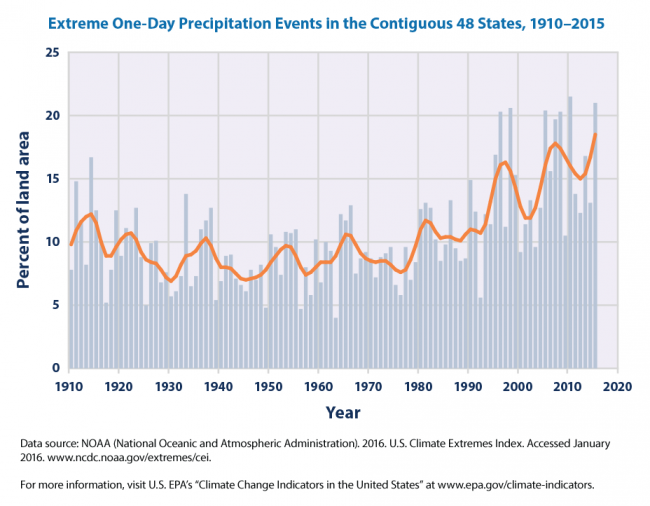
Never (except perhaps with shark attack scares which come and go) have I seen such a classic case of observer bias. Certain events occur in the tail ends of the normal distribution. Suddenly everyone claims that these events are happening with more frequency, mainly because they get reported with more frequency. I reported on a great example of this from a supposedly scientific government report here, where researchers mistook improved measurement of certain events as a real underlying increase in the number of such events. Another example here.
Of course, 95 percentile events can’t be, by definition, happening more frequently. The only thing that can happen is the normal distribution can have its standard deviation increase. Similar to the second derivitive argument above, I am not a statistician, but my sense is that the odds that we could detect a standard deviation shift in the distribution of weather events using just a few years of highly imperfect data, even if such an underlying shift existed, is really really low.
I wanted to link to Richard Lindzen’s Congressional testimony. For slides, they are pretty easy to follow as they are mostly text. I want to particularly point out slide 4, which I think on one page outlines the single most important point to understand about anthropogenic global warming theory. When given just one minute to discuss climate, this slide embodies the message I give.
Here are two statements that are completely agreed on by the IPCC. It is crucial to be aware of their implications.
1. A doubling of CO2, by itself, contributes only about 1C to greenhouse warming. All models project more warming, because, within models, there are positive feedbacks from water vapor and clouds, and these feedbacks are considered by the IPCC to be uncertain.
2. If one assumes all warming over the past century is due to anthropogenic greenhouse forcing, then the derived sensitivity of the climate to a doubling of CO2is less than 1C. The higher sensitivity of existing models is made consistent with observed warming by invoking unknown additional negative forcings from aerosols and solar variability as arbitrary adjustments.
Given the above, the notion that alarming warming is ‘settled science’ should be offensive to any sentient individual, though to be sure, the above is hardly emphasized by the IPCC. 4
My most recent climate video, which discusses this issue and more, is here. I also have an older, shorter video focusing on just the issues in Lindzen’s fourth slide here.
From the Thin Green Line, a reliable source for any absurd science that supports environmental alarmism:
Sending and receiving email makes up a full percent of a relatively green person’s annual carbon emissions, the equivalent of driving 200 miles.
Dealing with spam, however, accounts for more than a fifth of the average account holder’s electricity use. Spam makes up a shocking 80 percent of all emails sent, but most people get rid of them as fast as you can say “delete.”
So how does email stack up to snail mail? The per-message carbon cost of email is just 1/60th of the old-fashioned letter’s. But think about it — you probably send at least 60 times as many emails a year than you ever did letters.
One way to go greener then is to avoid sending a bunch of short emails and instead build a longer message before you send it.
This is simply hilarious, and reminds me of the things the engineers would fool the pointy-haired boss with in Dilbert. Here was my response:
This is exactly the kind of garbage analysis that is making the environmental movement a laughing stock.
In computing the carbon footprint of email, the vast majority of the energy in the study was taking the amount of energy used by a PC during email use (ie checking, deleting, sending, organizing) and dividing it by the number of emails sent or processed. The number of emails is virtually irrelevant — it is the time spent on the computer that matters. So futzing around trying to craft one longer email from many shorter emails does nothing, and probably consumers more energy if it takes longer to write than the five short emails.
This is exactly the kind of peril that results from a) reacting to the press release of a study without understanding its methodology (or the underlying science) and b) focusing improvement efforts on the wrong metrics.
The way to save power is to use your computer less, and to shut it down when not in use rather than leaving it on standby.
If one wants to argue that the energy is from actually firing the bits over the web, this is absurd. Even if this had a measurable energy impact, given the very few bytes in an email, reducing your web surfing by one page a day would keep more bytes from moving than completely giving up email.
By the way, the suggestion for an email charge in the linked article is one I have made for years, though the amount is too high. A charge of even 1/100 cent per email would cost each of us about a penny per day but would cost a 10 million mail spammer $1000, probably higher than his or her expected yield from the spam.
If you are young (I suppose 20′s or younger) and have been actively involved in some way as a climate skeptic in the Washington DC area, reporter Andrew Restuccia of the Washington Independent would like to talk to you. He is writing an article on young climate skeptics, I think. Drop him a note, he seems to be developing a hypothesis that skeptics are all crusty old dudes and showing him some fresh faces would help: arestuccia –at– washingtonindependent.com
Nick Rahall, a Democratic Congressmen from WV and a supporter of the global warming alarmist position (probably an issue in coal-dependent WV this election cycle) gave an analogy I think is right on:
“Climate change — to deny it exists, to just put your head in the sand and, ‘oh no, it doesn’t exist, what are you talking about,’ is about like standing on the floor of Macy’s during the month of December and claiming Santa Claus doesn’t exist.
While he was trying to actually denigrate climate skeptics, in fact he confirms exactly what we believe. Saying Santa Claus does not exist is absolutely correct, but doing so would get in the way of everyone around us making money off the myth. Via Climate Depot
I suppose one cold say that climate alarmism jumped the shark years ago. But they have certainly moved to a new level, one for which there is not even a term, in this video. This video has everything – the government school teacher politically indoctrinating the kids, followed by bloody gory death dealt out to the kids who refuse to toe the government line. I am not kidding.
When I first saw it, I was sure it was a skeptic satire, ala Jonathon Swift’s ‘A Modest Proposal,’ and I am still afraid that this may be some elaborate put-on because the video and its message — that skeptics need to be killed — is so obscene. But apparently, according to this article at the Guardian, it is totally for real and includes contributions from some fairly prominent artists, as well as funding from the UK government and the 10:10 program (a plea to reduce carbon emissions by 10% per year, eerily with a name probably purposely similar to 9-11).
Our friends at the 10:10 climate change campaign have given us the scoop on this highly explosive short film, written by Britain’s top comedy screenwriter Richard Curtis, ahead of its general release….
Had a look? Well, I’m certain you’ll agree that detonating school kids, footballers and movie stars into gory pulp for ignoring their carbon footprints is attention-grabbing. It’s also got a decent sprinkling of stardust – Peter Crouch, Gillian Anderson, Radiohead and others. But it’s pretty edgy, given 10:10′s aim of asking people, businesses and organisations to take positive action against global warming by cutting their greenhouse gas emissions by 10% in a year, and thereby pressuring governments to act.
“Doing nothing about climate change is still a fairly common affliction, even in this day and age. What to do with those people, who are together threatening everybody’s existence on this planet? Clearly we don’t really think they should be blown up, that’s just a joke for the mini-movie, but maybe a little amputating would be a good place to start?” jokes 10:10 founder and Age of Stupid film maker Franny Armstrong.
But why take such a risk of upsetting or alienating people, I ask her: “Because we have got about four years to stabilise global emissions and we are not anywhere near doing that. All our lives are at threat and if that’s not worth jumping up and down about, I don’t know what is.”
The latter claim is hilarious. Over the next four years, CO2 levels will likely increase, if they stay on trend, from .0392% of the atmosphere to .0400% of the atmosphere. I would love to see these so-called science-based folks demonstrate how the next .0008% shift in atmospheric concentration triggers the point-of-no return tipping point. In actual fact, the have just latched onto the round number of 400ppm and declared, absolutely without evidence, that this number (which the Earth has crossed many times in the past) will somehow lead to a runaway chain reaction.
Anyway, I have teased it long enough, here is the video. Beware — there is gore (no pun intended) here worthy of a zombie movie.
Wow, its sure good that the world has decided that skeptics are the mindless, thuggish, anti-science side of this debate, because if that had not already been made clear, we might think that key climate alarmism groups had lost their freaking minds. It will be interesting to see if this gets any play in the US media — my guess is it will not. Magazines are happy to spend twenty pages dissecting the motives of the Koch family in funding skeptic and libertarian causes, but environmentalists get a free pass, even with stuff like this.
Lubos Motl is all over this, and has mirror sites for the video if (or more likely when) the video gets taken down. This is one of those propaganda offers that are the product of an echo chamber, with a group of like-minded people all patting themselves on the back only to be surprised at the inevitable public backlash.
I have mirrored the video here in case it gets a youtube takedown.
Update: As a reminder, this is not satire. It is made by a group of true believers. It was funded and approved and released by a climate alarmism group, which paid top dollar (including UK taxpayer funds) for a large professional team of actors, writers, and directors. All interviewed participants, including the first little actor blown up, have stated how proud they were of the film and its contribution to educating people on the need for immediate action on global warming.
For the last hour, I have sat and tried to think if, as a skeptic, I had wanted to make a satire critiquing the excesses of global warming alarmism, could I have made a better video. The only thing that might have made it better would have been if the final button-pusher was someone famous like James Cameron or Bono, who after then pushed the button climbed on their Gulfstream jet to fly home. But that’s just a quibble. I have changed my opinion. This may be the greatest skeptic video ever, and the Koch family didn’t even have to pay a dime for it. Thanks 10:10.
Update #2: This movie reminds me of nothing so much as Tarantino’s Inglorious Bastards. It is clearly not reality, but the author’s fantasy. Tarantino fantasizes about a group of jews kicking ass on the Nazi high command and ending the war early. 10:10 fantasizes about blowing up skeptics, in a video that, amazingly, is more blood-spattered than Tarantino’s.
Update #3: The group pulls the video with a classic “I’m sorry you guys are so easily offended” apology.
Update #4: Unsurprisingly, Joe Romm (in the italics in this post) goes to the kindergarten argument of “he started it,” arguing that the video is just the flip side of the stuff skeptics are doing all the time. In making his pitch, he shows the mindset that allowed this stupid film to get made.
I am not sure exactly what comparable films skeptics have produced that are similar, and the only example he can cite is Anthony Watt’s blog post comments on the shooting of an eco-terrorist. I did not even go back and look at Watt’s comments, but I generally think that lots of people are too gleeful when suspected criminals, who are innocent before the law, are gunned down by police.
Never-the-less, its seems a stretch to equate the offhand comments in real time of an independent blogger with a film involving probably a hundred people (including those who commissioned it in the 10:10 organization), commissioned in an official and thoughtful act (after all this had to be months in the works), and funded in part by the British government. He takes the opportunity of his team’s screw-up to launch this broadside on people like me (in bold no less).
None of this excuses that disgusting video. But the difference is that those who are trying to preserve a livable climate and hence the health and well-being of our children and billions of people this century quickly denounce the few offensive over-reaches of those who claim to share our goals — but those trying to destroy a livable climate, well, for them lies and hate speech are the modus operandi, so such behavior is not only tolerated, but encouraged.
Is anyone else getting tired of this working definition that “hate speech” is any speech by people who disagree with me, because I have the best interest of humanity in mind so clearly those who oppose me hate the human race?
Note you can see this right in his statement — “for those trying to destroy a livable climate.” That’s absurd. Does he really think anyone is trying to destroy a livable climate? I could say that through CO2 controls he is trying to impoverish billions of poor people in lesser developed countries by halting development, but I don’t think that is really his motive. I think that is an outcome of what he advocates, just as he thinks an unlivable climate is an outcome of what I advocate, but I can distinguish between motives and assumptions, but he apparently cannot. This attitude is EXACTLY what causes this kind of unfortunate video to be made — it is only a small step from believing, as he says he does, that skeptics are “trying to destroy a liveable climate” to making a movie that jokes about killing them all (or, to be frank, to feeling justified in acts of eco-terrorism).
I encourage you to watch my climate video and decide if folks like me are trying to thoughtfully decipher nature or are engaging in hate speech.
Update #6: I guess this was inevitable, but all the rats in the 10:10 ship are claiming that they had no idea what the video would be like and were appalled when they saw it. Right. An organization funds a major film production, including any number of high profile participants, and no one asked to see a script, screened the video before release, or even asked for some kind of written treatment of the concept? Yeah, right. No one in the 10:10 organization or who funded the video even peeked at it before it was released to the entire planet? This is so utterly lame but will probably be enough of a fig leaf for most of the media to hide behind and allow them not to follow up on a video whose basic premises they likely agree with.