Posts tagged ‘canada’

Chickens Roosting in Glendale

Via the WSJ

Glendale, Ariz., is selling about $136 million in debt in the municipal-bond market this week, just days after Moody’s Investors Service cut its bond rating because of the desert city’s obligations to cover losses on a National Hockey League franchise.

In exchange for the NHL’s promise to manage team operations and keep the team in Glendale until a new owner is found, the city agreed to compensate the league, the city’s executive communications director, Julie Frisoni, said.

The Coyotes filed for bankruptcy protection in 2009, and that spring, the NHL became the owner of the team. In exchange for keeping the team, the city signed an agreement to absorb up to $25 million of the team’s losses in both 2011 and 2012, in anticipation of finding a new owner, Moody’s analysts said.

Glendale is slowly sinking itself in a mountain of debt to pursue its insane strategy to subsidize every billionaire sports owner in Arizona.  The town of 225,000 people is spending $25,000,000 to fund the operating losses of a freaking hockey team — that’s nearly $500 a year for every 4-person family in the city.  Nuts.  And this is just their operating subsidy, it does not include debt service on the $300 million stadium it built for the team.

The problem is that the team is worth less than $100 million in Arizona (based on recent sales comps of other NHL franchises in warm cities like Atlanta) but might be worth $300-$400 million if moved to Canada (Jim Balsillie made an offer in this range, including an offer to pay down $150 million or so of the city’s debt, before RIM stock started to crash).  The NHL, which owns the team now, has promised owners that they will not take a penny less than $200 million for the team, and that they will not suffer any operating losses.

So, because they simply cannot admit they were wrong to subsidize the team the first time around, to keep the team in Glendale the city must either fund $25 million a year in team operating losses or it must pony up $100 million or so to bridge the team’s $100 million value in Arizona and the league’s $200 million price tag (something they tried and failed to do last year when the Goldwater Institute pointed out that such a subsidy was unconstitutional in AZ.

I repeat, what a big freaking mess.  How do you avoid it?  The only way is the Wargames strategy, ie the only winning move is not to lay the sports team subsidy game in the first place.

Political Correctness Gone Wild

Apparently, the Dire Straits song “Money for Nothing” has been banned from the Canadian airwaves:

The Dire Straits song “Money for Nothing” was ruled by the Canadian Broadcast Standards Council to be “extremely offensive” and thus inappropriate for airing on radio or television because it uses an anti-gay slur.

The decision against St. John’s radio station CHOZ-FM in Newfoundland was released Wednesday. In it, the panel ruled that the word “faggot” “contravened the Human Rights Clauses” and its ethics code and is “no longer” permitted “even if entirely or marginally acceptable in earlier days.”

This is stupid on its face, and even stupider if the song in question is understood.  If you have never heard the song before, it may seem an odd juxtaposition at first — why does it alternate between jabs at rock stars on MTV and talk about moving appliances?  Because the song is exactly what it sounds like — Mark Knopfler overheard some workers in an appliance store watching MTV and heckling the performers they saw for being rich and spoiled and overpaid and not working very hard.

The song is interesting not just because it has a great opening that is fun to play at maximum volume, but because Knopfler is one of those guys on MTV the workers are heckling.  Does he secretly agree with them, is he hurt by them, does he find them funny?   Anyway, the word “faggot” in the piece is essentially aimed at the performers themselves — they are describing a critique they have received, repeated in all its salty blue-collar flavor.  As such the words feel utterly authentic, perhaps because they are — Knopfler reportedly grabbed a piece of scratch paper right at the store and started jotting down notes.

I cannot imagine a less offensive use of the word.  There is absolutely no way to read the lyrics of the song and come to the conclusion the word was aimed at gays, or really at anyone else but the author and performer.   I presume by this standard  that Canada expects to ban the entire body of hip hop music?

I could have easily titled this post “the Left and Right converge,” because in it I see the Left acting exactly like the religious Right I grew up around in the South that would try to ban any number of books and songs, often out of an incredibly poor understanding of what the story or song was really about.

By the way, the statists among you will be happy to know that this ban only applies to private companies — the state is still allowed to play the song because, you know, government motives are pure and thereby sanitize any harm that might come from playing this song

Ron Cohen, the CBSC’s national chairman, told The Washington Times on Thursday that the decision effectively sets a “nationwide” precedent binding on all private license holders for TV, cable-TV and radio broadcasting. It does not cover the state-run Canadian Broadcasting Corp. or “community and university” stations.

I have seen Knopfler live many times live.  To be fair, Knopfler himself seems to have some sympathy for this position, as I have seen him change the offending word to others in more recent live performances.  I don’t know if this is an achnowlegement the word should be changed or he is knuckling under to pressure.    Here is the original video on YouTube.  Here is a live version where faggot is replaced.  Extra bonus cameo – Clapton in a pink suit.
Postscript: It is a fairly commonly-known bit of trivia that the first song played on MTV was “Video Killed the Radio Star.”  But this was new to me:

When MTV Europe began airing in 1987, “Money for Nothing,” which begins with Sting’s opening falsetto whisper “I want my MTV,” was the first video played.

It’s Not Over When it’s Over

So the head of the IOC declares the Olympics over, the flame is out, but there still seem to be people on the stage.  It seems that Canadians, so long without an overt sense of nationalism, have decided to use the stage to hold a pep rally for their country.   Can you imagine how unbelievably creepy, and probably scary, it would have been had the Chinese closed the Olympics in a similar China-uber-alles manner.  But since the Canadians are thought to be (mostly) harmless, I suppose its OK.

Postscript: Not 30 seconds before this started, I was lamenting the fact that Rush was not a musical act, with the silver lining that we had not seen William Shatner either, when lo and behold he rises onto the stage.

PPS: I thought the way they opened the show, with the clown fixing the broken torch, was much more consistent with the Canadian style, and more flattering in a sense than the goofy show at the end.  It is particularly funny, to me at least, to see that all the people who they have chosen so far to extol the virtues of Canada actually left the country for the US to make their fortune.  What are they selling, that Canada is a great place to be from?  They couldn’t have found someone like Jim Balsillie who actually mad his fortune and reputation, you know, in Canada.

PPPS:  OK, it was only the talking quasi-celebrities I thought was odd.  Who couldn’t love the giant inflatable beavers that followed?

And We’ll Never Know What We Are Missing

Perhaps the scariest potential effect of the proposed health care bills is the negative effect they likely will have on innovation.  And if we adopt the bill, we will never know what we have lost.  Unlike budgets, which with near certainty will become overdrawn quickly, we will never be able to point to the health care innovation we didn’t have.

I want to quote liberally from a Ronald Bailey post, but I encourage you to read the whole thing:

Yet, the elements of market competition that still manage to survive have had the salubrious effect of driving medical innovation and improving patient health outcomes. A new study by the free market Cato Institute, “Bending the Productivity Curve: Why America Leads the World in Medical Innovation” reports:

…In three of the four general categories of innovation examined in this paper — basic science, diagnostics, and therapeutics — the United States has contributed more than any other country, and in some cases, more than all other countries combined. In the last category, business models, we lack the data to say whether the United States has been more or less innovative than other nations; innovation in this area appears weak across nations….

…Harvard University economist Kenneth Rogoff observed:

“[I]f all countries squeezed profits in the health sector the way Europe and Canada do, there would be much less global innovation in medical technology. Today, the whole world benefits freely from advances in health technology that are driven largely by the allure of the profitable U.S. market. If the United States joins other nations in having more socialized medicine, the current pace of technology improvements might well grind to a halt.”

In my column, “2005 Medical Care Forever,” I suggested this thought experiment:

…what if the United States had nationalized its health care system in 1960? That would be the moral equivalent of freezing (or at least drastically slowing) medical innovation at 1960 levels. The private sector and governments would not now be spending so much more money on health care. There might well have been no organ transplants, no MRIs, no laparoscopic surgery, no cholesterol lowering drugs, hepatitis C vaccine, no in vitro fertilization, no HIV treatments and so forth. Even Canadians and Britons would not be satisfied with receiving the same quality of medical care that they got 45 years ago….

As Rogoff suggests, the nationalized health care systems extolled by progressives have been living off the innovations developed by the “only country without a universal health care system.” I wonder how Americans would vote if they were asked if they would be happy freezing medical care at 2005 levels forever?

23 Different Health Reform Plans, and Not One Mentions Torts

It is amazing to me that there can be numerous health care plans in Congress plus a jillion speeches on the topic by the President and not once does anyone mention “torts.”  Now, I am not one to ascribe all cost problems in the medical field to defensive medicine and tort settlements.  Buthey t certainly are a factor.  It is just stunning that a President can stand up and talk numerous times about “unnecessary tests and procedures” and ascribe all of these to some weird profit motive by the doctors – weird because generally, the doctor gets no extra revenue from these tests, so somehow he or she is motivated by the profits of a third party lab.

But I think the rest of us understand that American tort law, which allows juries to make multi-million dollar judgements based on emotions and empathy rather than facts and true liability, has at least a share of the blame.   Not just the settlements, but the steps doctors go through to try to protect themselves from frivolous suits down the road.  Here are two interesting stories along these lines.  The first from Carpe Diem:

Zurich University Hospital has stopped treating North American “medical tourists,” fearing million-dollar claims from litigious patients if operations go wrong. Hospitals in canton Valais have also adopted measures to protect themselves against visitors from the United States, Canada and Britain.

“The directive applies only to patients from the US and Canada who come to Zurich for elective, non-essential health treatments,” said Zurich University Hospital spokeswoman Petra Seeburger.

“It is not because treatment is not financed; it is because of different legal systems.” In a statement the hospital said it was “not prepared to risk astronomical damages or a massive increase in premiums.” Seeburger emphasised that the restrictions only affected people not domiciled in Switzerland.

Apologies to Mark Perry for quoting his whole post, but if you are not reading Mark Perry, you should be.  The second example comes from Overlawyered:

Oh, I miss the days when you got a radiology report that said, “fracture right 3rd rib, no pneumothorax”. Because of frivolous lawsuits radiologists have learned to be vague, noncommittal and to pass the buck of possible litigation. So now you get a 2 page report that says “linear lucency in right 3rd rib, clinical correlation recommended, underinflated lung fields cannot exclude underlying interstitial disease and or masses. CT recommended for further evaluation, if condition warrants.” along with several other paragraphs of lawyer imposed legalmedspeak….

The US Has The Greatest Health Care in the World

Via Steve Chapman at Reason:

[President Obama] says though the United States spends more per person on medical care than any other nation, “the quality of our care is often lower, and we aren’t any healthier. In fact, citizens in some countries that spend substantially less than we do are actually living longer than we do.”

That’s one of the favorite rationales for a government-led overhaul. But it gives about as realistic a picture of American medicine as an episode of Scrubs.

It’s true that the United States spends more on health care than anyone else, and it’s true that we rank below a lot of other advanced countries in life expectancy. The juxtaposition of the two facts, however, doesn’t prove we are wasting our money or doing the wrong things.

It only proves that lots of things affect mortality besides medical treatment. Heath Ledger didn’t die at age 28 because the American health care system failed him.

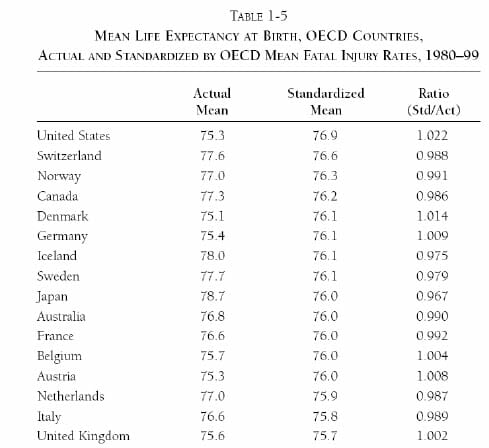
One big reason our life expectancy lags is that Americans have an unusual tendency to perish in homicides or accidents. We are 12 times more likely than the Japanese to be murdered and nearly twice as likely to be killed in auto wrecks.

In their 2006 book, The Business of Health, economists Robert L. Ohsfeldt and John E. Schneider set out to determine where the U.S. would rank in life span among developed nations if homicides and accidents are factored out. Their answer? First place.

That discovery indicates our health care system is doing a poor job of preventing shootouts and drunk driving but a good job of healing the sick. All those universal-care systems in Canada and Europe may sound like Health Heaven, but they fall short of our model when it comes to combating life-threatening diseases.

Real Options for Health Insurance

Two large drivers of high health insurance costs in certain states is 1) bans on interstate competition for health insurance and 2) state-by-state mandates for minimum coverage.  These two government actions lead to some states having remarkably higher health insurance prices than others.  Via Carpe Diem:

The average health insurance ranges from a low of $1,254 in Wisconsin to a high of $8,537 in Massachusetts, and the national average is $2,613. That kind of variation couldn’t exist in a competitive market for health insurance. Interstate competition for health insurance would go a long way towards bringing health insurance costs down.

That Massachusetts model sure is doing wonders, huh?  If reimportation of drugs from Canada makes sense, why not of policies across state lines? See where your state ranks here.

The Emergency Room

We often hear that one of the reasons health care “reform” is necesary in the US is because the uninsured overwhelm emergency rooms.  We hear horror stories of overcrowded emergency rooms with long wait times, which would only be better if we had a national health care system like Canada.

A couple of interesting facts:

Average US emergency room wait time:  4.05 hours

Average Canada emergency room wait time:  8.9 to 23 hours

I confess the numbers are not apples-apples, but they are certainly in the ballpark and highly illustrative.   Have any commenters seen a direct comparison?

Update: OK, the numbers are more apples-apples than I thought.  The US 4 hour number is total time from coming in the door to leaving or getting a bed, the same as the Canadian numbers.  The CNN report linked above got their data from here.

The Silver Lining

TJIC has the silver lining nailed for libertarians:

Let us not forget the good news from the election: one statist, speech limiting, freedom-agnostic candidate lost.

I’m kind of ambivalent this morning -  I knew in advance that freedom was going to lose again in this election, no matter what the outcome.

If I am depressed this morning, it is more about propositions and side issues than about the President and Congress.  Had this been a leftward shift in the county, I could have been satisfied that at least losses in freedom in one area might be substituted by gains in others  (though for me personally, changes in economic freedom tend to have far more direct and immediate impact than changes in social freedoms).

But the only pattern I could see yesterday was not leftward but government-ward.  In the same states where Democratic candidates won with economic interventionist messages, Constitutional bans on gay marriage also won by sizable majorities.   In Arizona, gay marriage was banned, an initiative to limit future tax increases was defeated, an initiative to protect health care choice was defeated, an initiative to soften last year’s anti-immigrant legislation was defeated, and a payday loan ban was confirmed.  The voting in some way defies a traditional left-right explanation and is only consistent in that it was almost all the reverse of the libertarian position.  And to make the results even more irrational, nearly the biggest defeat of any ballot initiative in Arizona was for a pay increase for state legislators — the voters seem to like government but don’t trust or respect the individuals employed there.

After the last Bush election, a number of leftish folks claimed they were moving to Canada or France or wherever.  But that’s the problem for libertarians in this country — there is not place to run.  Those who want to run away to a country with a more controlling government have 180 or so choices.  Those of us who seek more freedom have approximately none.

Update: This slight paraphrase from the movie Zoolander encapsulates my thought on this election:

They’re the same! Doesn’t anybody notice this? I feel like I’m taking crazy pills!

I am actually less frightened by the candidates than by people who seem to get so excited by one or the other of them.

If I Had to Leave the United States

There is a quote from Robert Redford in Three Days of the Condor** that honestly reflects my opinion on the topic of leaving the US  (Redford is Joe Turner, running away from the CIA, while Joubert is an assassin-for-hire):

Turner: I’d like to go back to New York.

Joubert: You have not much future there. It will happen this
way. You may be walking. Maybe the first sunny day of the spring. And a
car will slow beside you, and a door will open, and someone you know,
maybe even trust, will get out of the car. And he will smile, a
becoming smile. But he will leave open the door of the car and offer to
give you a lift.

Turner: You seem to understand it all so well. What would you suggest?

Joubert: Personally, I prefer Europe.

Turner: Europe?

Joubert: Yes. Well, the fact is, what I do is not a bad occupation. Someone is always willing to pay.

Turner: I would find it… tiring.

Joubert: Oh, no — it’s quite restful. It’s… almost peaceful.
No need to believe in either side, or any side. There is no cause.
There’s only yourself. The belief is in your own precision.

Turner: I was born in the United States, Joubert. I miss it when I’m away too long.

Joubert: A pity.

Turner: I don’t think so.

A great line, particularly in a movie steeped in cold war weariness.  Anyway, I was listening to some rant on NPR about leaving the US if McCain won the election, and I asked myself if I had to leave the US, what would be my rank order of countries to which I might move.  My list is highly influenced by language (at 46 I hardly feel like learning a new language) and by countries of which I am knowledgeable.  Here is what I came up with:

  1. Australia
  2. Bermuda
  3. UK
  4. Canada
  5. Singapore
  6. the Netherlands
  7. Switzerland
  8. Spain
  9. Germany / Austria
  10. Costa Rica

Here are some notes on the list, as well as some explanations of countries left off:

  • I have yet to meet an American who did not enjoy living in Australia (and many long to go back).  I came within about 5 minutes of living in Bermuda about seven years ago.  I have always liked the UK and have spent many summers there.
  • Ireland might belong high on the list, but I have never been there and am not that familiar with it.  But my sense is that if I really were to research it, Ireland would make the top 5.  I could also probably have rattled off a number of other British island colonies, but kept it to Bermuda.
  • Canada … its like a whole other state   (this is a line I uttered at business school once, echoing the then-current “Texas … its like a whole other country” advertising campaign.  It was not well-recieved by our northern neighbors.  I still think a few Canadians are trying to hunt me down up there
  • Been to Singapore a few times.  An odd place, but certainly a liveable one.  Last gasp of the English speaking choices on the list.
  • Netherlands and Switzerland are both fairly capitalist-friendly nations with good support for a displaced English speaker.  I have spent more time with the Dutch, so it is a bit higher, but Switzerland is freaking gorgeous.
  • Spain is on the list mostly as a language play.  Not a huge fan of the Spanish government, but I speak the language well enough to pick it up quickly.  Good beaches, and the south coast has many of the appeals of Provence without the prices (and the French).  A couple of years ago this probably would have been Argentina.  I really loved Argentina when I was there, but I am scared a bit by the current political and economic climate.
  • I like Austria, and Germany is OK.  Not America but perfectly reasonable places to live.
  • If I am really running not just form the US but the first world in general, I might pick Costa Rica.  A pretty good government, particularly for Latin America, beautiful, and plenty of places to be secluded (and/or hide, if the need were to arise).
  • I considered the Czech Republic.  Prague seems to be the white-hot destination for American tourists, and they certainly know their beer.  But I suspect that Eastern Europe has several more decades of work before the every day conveniences and creature comforts to which I have become accustomed in the US are prolific there.
  • Scandinavia is too freaking cold.  Maybe if I were single I might find some appealing reasons to reconsider…
  • There may be some country like Monaco that would suit me perfectly but of which I am wholly unfamiliar.

Readers are welcome to propose their own priorities in the comments.

** Postscript: Three Days of the Condor is one of my favorites, for a couple of reasons.  First, I always loved Faye Dunaway.  Second, and more important, I like thrillers that have a more languid pace.  I know that sounds weird to say, and if I were a film critic I might have the right words, but there is something about the music and the editing and the pacing that almost stands in contrast to the urgencies of the plot itself.  Despite being on the run through the movie, Redford never actually runs.  No car chases either.  Sort of the antonym to the shaky rapid-cut camera action of, say, the Bourne movies.  Other movies I would put in this same category are LA Confidential (maybe my favorite movie) and perhaps the newer version of the Thomas Crowne Affair. I might put Chinatown on this list too, but then since 3 of the 4 would include Dunaway, one might think my first rather than my second criteria was driving the list.

By the way, even action movies could learn something from this.  The first Indiana Jones movie was great in part because the action scenes were interspersed with quiet scenes.  The audience gets to rest from time to time, and the action is highlighted by the contrast.  You can even have some token character development.  Later Indiana Jones movies fell into the trap of going for non-stop adrenalin.

Canada to Join EU Free Trade Zone?

If so, great for them.  The more free trade in the world, the better:

Canadian and European officials say they plan to begin
negotiating a massive agreement to integrate Canada’s economy with the
27 nations of the European Union, with preliminary talks to be launched
at an Oct. 17 summit in Montreal three days after the federal election.

Trade Minister Michael Fortier and his staff have been engaged for
the past two months with EU Trade Commissioner Peter Mandelson and the
representatives of European governments in an effort to begin what a
senior EU official involved in the talks described in an interview
yesterday as “deep economic integration negotiations.”

If successful, Canada would be the first developed nation to have
open trade relations with the EU, which has completely open borders
between its members but imposes steep trade and investment barriers on
outsiders…

A pact with the United States would be politically impossible in Europe, senior European Commission officials said.

I would have said that changing the last statement would be a great goal for an Obama administration that wants to make Europe love us again (did they ever?)  But he has made clear that trade does not count in his definition of good relations, and in fact has already committed to initiating trade wars against our neighbors Mexico and Canada.

Update on the Massachussetts Health Insurance Mandate

Via Michael Tanner:

  • Slightly less than half of Massachusetts’ uninsured population
    actually complied with the mandate. True, the number of people without
    health insurance was reduced from 13% of the state’s population to 7%,
    but when the bill was passed, advocates promised that “all Massachusetts citizens will have health insurance.”  Perhaps it depends on your definition of “all.”
  • Most of those who are signing up are low-income individuals, whose
    coverage is fully or partially subsidized, proving once again that if
    you give something away for free people will take it. It certainly
    appears that it is the expensive and generous Massachusetts subsidies
    (up to 300% of the poverty level), not the unprecedented individual
    mandate that is responsible for much of the increased coverage.
  • Adverse selection remains a big problem, with the young and healthy
    failing to comply with the mandate. The state refused to change its
    community rating laws which drive up the cost of insurance for young,
    healthy individuals. Not surprisingly, they don’t find this a good deal.
  • The program is far exceeding its projected costs, with at least a 33% budget overrun in its first year.
  • The program has increased demand for health care services without
    increasing the supply of providers. As a result, patients are having
    trouble finding providers and waiting lists (Canada here we come) are
    beginning to develop.

Really a Joke

I am finding Andrew Coyne’s live blog of the Canadian hate speech "trial" to be endlessly fascinating.  Imagine taking the the most self-important but dysfunctional local school board you can find, give them a knowledge of court procedure and the rules of evidence mainly through watching People’s Court reruns, and put them in charge of enforcing speech and censorship, and you will about have duplicated this proceeding.

Interestingly, the current evidence being entered in the proceeding seems to be blog comments made on non-Canadian blogs.  Every so often, we have to go through an educational process with the MSM to help them understand that commenters on blogs do not necessarily represent the opinion of the blogger.  It may be OK to use blog comments as evidence that the community at the Free Republic or the Democratic Underground are loony, but not to say that blogger X or Y is a racist because racist comments have been posted on his blog.

It appears that the government of Canada needs a similar education, but I can see this being hard to do.  Remember, each of the hearing "judges" are essentially people who make their living as government censors.  Their job is wiping out speech with which they do not agree.  It is therefore quite likely difficult for them to comprehend that many bloggers (like myself) have no desire to edit or control the content of our commenters.

When is Curtailing Freedom the Mature and Wise Choice?

…. Uh, never.  Except of course at Colorado College, according to Amanda Udis-Kessler, Colorado College’s Director of Institutional Research and Planning:

Social inequality is deeply grounded in a lack of respect-for women,
people of color, lesbian and gay people, and others. When we choose to
curtail our freedom to disrespect others in order to build a meaningful
society, we have made a mature and wise choice-and one that college
should help us learn.

The rest of the post is a roundup of the fallout over the punishment by the university of a parody of a campus feminist publication.  Basically, the argument boils down to the feminists feeling "dissed" and arguing that being dissed is a sufficient reason to curtail speech if one is in a protected group.   But remember this plea by the Colorado College feminists:

But please stop fabricating a story about humorless, offended feminists silencing men’s free speech.

Oh, okay.

There are enough cases of this new theory of speech running around, that speech may be curtailed if someone in a protected group feels hurt or challenged by the speech, for real concern.  It is the same theory at the heart of the kerfuffle in Canada over the human rights commission’s attack on conservative magazines and bloggers, and the same theory in the recent New Mexico decision that a photographer cannot choose not to photograph gay marriages.

Support Canadian Free Speech (Because These Same Tactics Are Being Tested in the US)

Via Five Feet of Fury:

Richard "The Boy Named Sue" Warman has finally filed his statement of claim.

Canada’s busiest litigant, serial "human rights" complainant and — the guy Mark Steyn has called "Canada’s most sensitive
man" — Richard Warman is now suing his most vocal critics — including me.

The suit names:

•    Ezra Levant (famous for his stirring YouTube video of his confrontation with the Canadian Human Rights
tribunal after he published the “Mohammed Cartoons”)

•    FreeDominion.ca (Canada’s answer to FreeRepublic.com)

•    Kate McMillan of SmallDeadAnimals.com

•    Jonathan Kay of the National Post daily newspaper and its in-house blog

•    and me, Kathy Shaidle of FiveFeetOfFury.com

Richard Warman used to work for the notorious Human Rights Commission, which runs the "kangaroo courts" who’ve charged Mark
Steyn with "flagrant Islamophobia."

Richard Warman has brought almost half these cases single-handledly, getting websites he doesn’t like shut down, and making
tens of thousands of tax free dollars in "compensation" out of web site owners who can’t afford to fight back or don’t
even realize they can.

The province of British Columbia had to pass a special law to stop Richard Warman from suing libraries because they
carried books he didn’t approve of.

Richard Warman also wants to ban international websites he doesn’t like from being seen by Canadians.

The folks named in his new law suit are the very bloggers who have been most outspoken in their criticism of Warman’s
methods.

She includes a paypal link to accept donations for their legal defense  (or is it defence in Canadian?)

Health Care Trojan Horse, Canada Edition

Next in my series about the health care Trojan Horse for fascism, comes this story via Q&O in Canada  (McQ gives as good a definition of any of the Trojan Horse: "once government has control over your health care, it will use all
sorts of justifications and excuses to exert more and more control over
your life as a result.")

For 60 years or more, libertarians and conservatives have been arguing
that government programs intended to promote the public welfare
inevitably end by restricting freedom more and more: as the state does
more for you, it finds itself doing ever more to you. Who
would dare challenge that premise now, in the face of Judge James
Blacklock’s decision? The man made no secret of the chief pretext for
his ruling. Motorcycle riders who don’t wear helmets are more costly to the medicare system; therefore, in the name of reducing those costs, the government is free to require the wearing of helmets
,
even if that conflicts with a fundamental Charter right and interferes
with the most personal and intimate sort of decision-making conceivable.

Getting the Bureaucrat’s Permission to Speak

Ezra Levant has posted YouTube videos of his interrogation by an oily little Canadian bureaucrat called "a human rights officer."  He has done it in a series of post, so go to his site and keep scrolling.  Apparently, in Canada, free speech is not a human right but "freedom from criticism" is, at least for certain politically connected groups  (threatening violence at the drop of a hat also seems to help gain one this "freedom from criticism" right.  Levant is being hauled in by the government for publication of those Danish cartoons that barely register at 0.1 on a criticism meter that goes to 10

This exchange really resonated with me:

Officer McGovern said "you’re entitled to your opinions, that’s for sure."

Well, actually, I’m not, am I? That’s the reason I was sitting
there. I don’t have the right to my opinions, unless she says I do.

For all of you who left the US for Canada for more freedom from Bush and the Iraq war, have at it.  Because Bush will be gone and we will be out of Iraq long before Canada (as well as Europe) catch up to the US in terms of its protection of [most] individual rights, like free speech.

via Maggies Farm

Update, from Mark Steyn:

Ms McGovern, a blandly unexceptional bureaucrat, is a classic example
of the syndrome. No "vulnerable" Canadian Muslim has been attacked over
the cartoons, but the cartoonists had to go into hiding, and a gang of
Muslim youths turned up at their children’s grade schools, and Muslim
rioters around the world threatened death to anyone who published them,
and even managed to kill a few folks who had nothing to do with them.
Nonetheless, upon receiving a complaint from a Saudi imam trained at an
explicitly infidelophobic academy and who’s publicly called for the
introduction of sharia in Canada, Shirlene McGovern decides that the
purely hypothetical backlash to Muslims takes precedence over any
actual backlash against anybody else.

Unbundling Citizenship

Those who oppose more open immigration generally have three arguments, to which I have varying levels of sympathy:

  • It’s illegal!  Illegal immigration violates the rule of law.  I have always thought this argument weak and circular.  If the only problem is that immigrants are violating the law, then the law can be changed and its now all legal.  Since this is not the proposed solution, presumably there are other factors that make more open immigration bad beyond just the fact of its illegality.  I am positive I could come up with hundreds of bad laws that if I asked a conservative, "should I aggressively enforce this bad law or should I change it," the answer would be the latter.
  • We will be corrupting our culture.  I am never fully sure what these arguments mean, and they always seem to carry a touch of racism, even if that is not what is intended.  So I will rewrite this complaint in a way I find more compelling:  "We are worried that in the name of liberty and freedom, we will admit immigrants who, because of their background and culture, will vote against liberty and freedom when they join our democracy."  I am somewhat sympathetic to this fear, though I think the horse may already be out of the barn on this one.  Our current US citizens already seem quite able to vote for restrictions on liberties without any outside help.  If I were really worried about this, I might wall off Canada before Mexico.
  • Open Immigration or Welfare State:  Pick One.  I find this the most compelling argument for immigration restrictions.  Historically, immigration has been about taking a risk to make a better life.  I have been reading a biography of Andrew Carnegie, which describes the real risks his family took, and knew they were taking, in coming to America.  But in America today, we aren’t comfortable letting people bear the full risk of their failure.  We insist that the government step in with our tax money and provide people a soft landing for their bad decisions (see:  Mortgage bailout) and even provide them with a minimum income that in many cases dwarfs what they were making in their home country. 

My problem with conservatives is that they are too fast to yell "game over" after making these arguments, particularly the third.  There are some very real reasons why conservatives, in particular, should not so easily give up on finding a way to allow more free immigration.  Consider these questions:

  • Should the US government have the right and the power to dictate who I can and cannot hire to work for me in my business?
  • Should the US government have the right and the power to dictate who can and cannot take up residence on my property (say as tenants)?

My guess is that many conservatives would answer both these questions in the negative, but in reality this is what citizenship has become:  A government license to work and live in the boundaries of this nation.

I can’t accept that.  As I wrote here:

The individual rights we hold dear are our rights as human beings, NOT
as citizens.  They flow from our very existence, not from our
government. As human beings, we have the right to assemble with
whomever we want and to speak our minds.  We have the right to live
free of force or physical coercion from other men.  We have the right
to make mutually beneficial arrangements with other men, arrangements
that might involve exchanging goods, purchasing shelter, or paying
another man an agreed upon rate for his work.  We have these rights and
more in nature, and have therefore chosen to form governments not to be
the source of these rights (for they already existed in advance of
governments) but to provide protection of these rights against other
men who might try to violate these rights through force or fraud….

These rights of speech and assembly and commerce and property
shouldn’t, therefore, be contingent on "citizenship".  I should be
able, equally, to contract for service from David in New Jersey or Lars
in Sweden.  David or Lars, who are equally human beings,  have the
equal right to buy my property, if we can agree to terms.  If he wants
to get away from cold winters in Sweden, Lars can contract with a
private airline to fly here, contract with another person to rent an
apartment or buy housing, contract with a third person to provide his
services in exchange for wages.  But Lars can’t do all these things
today, and is excluded from these transactions just because he was born
over some geographic line?  To say that Lars or any other "foreign"
resident has less of a right to engage in these decisions, behaviors,
and transactions than a person born in the US is to imply that the US
government is somehow the source of the right to pursue these
activities, WHICH IT IS NOT…

I can accept that there can be some
minimum residence requirements to vote in elections and perform certain
government duties, but again these are functions associated with this
artificial construct called "government".  There should not be, nor is
there any particular philosophical basis for, limiting the rights of
association, speech, or commerce based on residency or citizenship,
since these rights pre-date the government and the formation of borders.

I have advocated for years that the concept of citizenship needs to be unbundled (and here, on the Roman term Latin Rights).   Kerry Howley makes a similar argument today:

Citizenships are club memberships you happen to be born with. Some
clubs, like the Norway club, have truly awesome benefits. Others, like
the Malawi club, offer next to none. Membership in each club is kept
limited by club members, who understandably worry about the drain on
resources that new members might represent. Wishing the U.S. would
extend more memberships in 2008 isn’t going to get you very far.   

Conceptually,
for whatever reason, most of us are in a place where we think labor
market access and citizenships ought to be bundled. A Malawian can’t
come work here, we think, without the promise of a club membership,
which is nearly impossible to get. This is an incredibly damaging
assumption for two reasons: (1) memberships are essentially fixed in
wealthy democratic societies (2) uneven labor market access is a major
cause of global inequality. Decoupling the two leads to massive gains,
as we see in Singapore, without the need to up memberships.   

Here’s
another way to think about it: Clubs have positive duties toward their
members, including those of the welfare state. But the negative duty
not to harm outsiders exists prior to clubs, and denying people the
ability to cooperate with one another violates their rights in a very
basic way. Our current policy is one of coercively preventing
cooperation. In saying “we can’t let people into this country unless we
confer upon them all the rights and duties of citizenship,” you are
saying that we need to violate their right to move freely and cooperate
unless we can give them welfare benefits. But that’s backwards.

Oops

Bummer:

General Motors Corp. (NYSE: GM) today announced it will record a net
noncash charge of $39 billion for the third quarter of 2007 related to
establishing a valuation allowance against its deferred tax assets
(DTAs) in the U.S., Canada and Germany.

Not everyday you can restate your balance sheet by $39 billion.  Apparently, if you lose money long enough, then FASB rules assume that there is a good chance you may never use your tax-loss carry-forwards, so they have to be written down.

Competitor or Enemy

I heard Obama get asked a question at the AFL-CIO yesterday whether he thought China was a competitor or an enemy.  I am not very good at parsing politician-speak, but he seemed to answer "both." 

How about neither?  Let’s try "partner in the worldwide division of labor" or maybe "home of a billion people who would like to trade with us 300 million individuals to our mutual self interest."   Or maybe "One reason we have full employment AND low prices."

Our trade with Canada is 60% higher than with China.  Does that make them an enemy?  Yes, for some of the Democratic candidates.

Government Health Care and Efficiency

I am always absolutely amazed when advocates of some form of national or single-payer health care argue that such a system would be more efficient.  For example, Kevin Drum argued:

A few days ago, during an email exchange with a
friend, I mentioned that I don’t usually tout cost savings as a big
argument in favor of universal healthcare. It’s true that a national
healthcare plan would almost certainly save money compared to our
current Rube Goldberg system, but I suspect the savings would be
modest. Rather, the real advantages of national healthcare are related
to things like access (getting everyone covered), efficiency (cutting down on useless — or even deliberately counterproductive — administrative bureaucracies), choice
(allowing people to choose and keep a family doctor instead of being
jerked around everytime their employer decides to switch health
providers), and social justice (providing decent, hassle-free healthcare for the poor).

I don’t think any of these are true.  For example, let’s take access.  Yes, everyone in a universal health care system would have a piece of paper that says they have health care, and the left seems really focused on that piece of paper.  But that paper has about as much value as my piece of paper that says I own a hundred shares of Enron.  Because someone has to redeem that piece of paper and actually provide the care, and there is the rub, is it not?  Canadian David Gratzer writes (vis Q&O):

My book’s thesis was simple: to contain rising
costs, government-run health-care systems invariably restrict the
health-care supply. Thus, at a time when Canada’s population was aging
and needed more care, not less, cost-crunching bureaucrats had reduced
the size of medical school classes, shuttered hospitals, and capped
physician fees, resulting in hundreds of thousands of patients waiting
for needed treatment—patients who suffered and, in some cases, died
from the delays….

Nor were the problems I identified unique to
Canada—they characterized all government-run health-care systems.
Consider the recent British controversy over a cancer patient who tried
to get an appointment with a specialist, only to have it canceled—48
times. More than 1 million Britons must wait for some type of care,
with 200,000 in line for longer than six months. A while back, I toured
a public hospital in Washington, D.C., with Tim Evans, a senior fellow
at the Centre for the New Europe. The hospital was dark and dingy, but
Evans observed that it was cleaner than anything in his native England.
In France, the supply of doctors is so limited that during an August
2003 heat wave—when many doctors were on vacation and hospitals were
stretched beyond capacity—15,000 elderly citizens died. Across Europe,
state-of-the-art drugs aren’t available. And so on.

I had forgotten about the heat wave.  Could you imagine backwards old America having 15,000 people die when the temperature got into the 90′s?

As to efficiency, which Drum defines as "cutting down on useless — or even deliberately counterproductive — administrative bureaucracies," does anyone really ascribe these characteristics to the government?  Really?  Even European health care bureaucrats would not agree with this statement:

This privatizing trend is reaching Europe, too.
Britain’s government-run health care dates back to the 1940s. Yet the
Labour Party—which originally created the National Health Service and
used to bristle at the suggestion of private medicine, dismissing it as
“Americanization”—now openly favors privatization. Sir William Wells, a
senior British health official, recently said: “The big trouble with a
state monopoly is that it builds in massive inefficiencies and
inward-looking culture.”

I won’t get much into the last two, except to say that we actually have a ton of health care choice in the US today, far more than any other country.  And even if we did not, what does doctor choice mean if the best people are driven away from being doctors, as they are in socialized medicine.  And social justice?  Well, the poor get care in the US, the key is the "hassle-free" in his statement.  Would you immediately assume that a government-run service is going to involve less hassle than a private service?  Have you renewed your drivers license lately?  It may well be that the poorest 10% have such an awful health care experience that they will see things better.  But almost assuredly the other 90% are going to be worse off.

Remember this — Universal health care is NOT a system in which the majority of us who are satisfied with our care can keep our current system, while the poor get a better one.  It is a system where all of us are thrown out of our current system and given the same care the poor get.  It is roughly equivalent to a Great Society housing program in which not just the homeless get housing, but everyone in the country are forced to give up their current house and live in public housing.

Postscript:  There is great improvement to be had in the health care system.  It revolves, though, around making the payer for health care the same person who receives the service, as it is for every other product and service we buy in this country.  We already have too much single-payer.  We need multi-payer.  I won’t go there today, but I explained here.

Another Thought:
A huge pillar of the women’s movement was that the government should not make decisions for a woman and her body (e.g. by banning abortion).   All well and good.  But I have never understood how this was consistent with support, say, for the FDA, which tells women exactly what they can and can’t put in their body.  And now women’s groups are all for universal health care, where government will make all the medical decisions about what procedures one can and can’t have, and when.  Consistency please?

Does the Hippocratic Oath Make Doctors Our Slaves?

In the beginning, human rights were things we could enjoy by ourself on a desert island.  Speech, assembly, the ability to make decisions for our own life, to keep the product of our own labors — these are all rights that don’t require other people to make them real.  The only role for government is merely to keep other people from trampling on these rights by the use of force.

And then, in the 20th century, we invented new rights — the "right" to sustenance, to be clothed, to have shelter, to be educated, to have health care.  These were not the passive rights like freedom of speech.  For example, the right to shelter did not mean that we were free to go and build ourselves a shelter and have it protected from attack or burglary by others.  No, it has come to mean that if we don’t have shelter, either through hardship or fecklessness, it should be provided for us. 

I hope you can see the difference.  These new rights require action by someone else.  They require that someone, by force if necessary, be made to provide us these things, or at least be made to forfeit wealth which is used to purchase these things for us.   These new rights are not only different from traditional rights like speech and property, but they are 180 degrees opposite.  The old-style rights established that no other person has a call on our mind, our bodies, or our labor.  The new-style rights establish the opposite, that we do have a call on someone else’s mind and labor.  In fact, these news-tyle rights are not rights at all, but dressed up slavery.  Because no matter how you try to pretty them up, the fact is that none of them have any meaning unless force can be used to make someone provide the object in question, whether it be health care or education or housing.

Now when we libertarians begin calling things like this slavery, the average American turns off.  Oh, you libertarian guys, always exaggerating.  But Eugene Volokh brings us a great example that proves otherwise.  Libertarian Dr. Paul Hsieh wrote what I thought was a pretty reasonable letter to the Denver Post:

Health care is not a right, and it is not the proper role of
government to provide health care for all citizens. Instead, this
should be left to the free market. It is precisely the attempts of the
governments of countries like Canada (or states like Tennessee) to
attempt to mandate universal coverage which have led to the rationing
and waiting lists for vital medical services. Similar problems are
already starting to develop in the Massachusetts plan as well. Any plan
of government-mandated "universal coverage" is nothing more than
socialized medicine, and would be a disaster for Colorado.

Paul S. Hsieh, M.D., Sedalia

Denver Post columnist Jim Spencer is scandalized by Dr. Hsieh’s position:

The craziest letter to the editor that I’ve read in some time came
from a physician who claimed that Coloradans have no right to health
care.

Seems the guy not only forgot his Hippocratic oath but also the law.

If you’re sick enough or badly injured, they have to treat you at the emergency room regardless of your ability to pay.

The doctor aimed his editorial rant against socialized medicine. But
he wrote it because a state blue-ribbon commission is now cobbling
together a plan for medical treatment and prescription drugs for
Coloradans….

First, it is depressing how deeply these new non-rights are embedded even in the freest country in the world — so much so that the reporter considers it the craziest notion in the world that free health care might not be a human right.  (I have a thought problem for you — if free health care is a fundamental human right, and a group of us are stranded on an island with no doctor, how do we exercise our right?)

Second, the fact that something is written into the law does not make it a right.  Rights flow from man’s nature (or from God, depending on your beliefs) and NOT from the government.  The fact that the government legislates against free speech does not change my right to free speech, it just marks itself as a bad government.  On the other hand, if the government legislates that we all get free plasma TV’s, it does not change the fact that man does not have the inherent right to a plasma TV. 

Third, and I think most interesting, is how Mr. Spencer is using Dr Hsieh’s Hippocratic oath as a club.  In effect he is saying "you swore an oath and now you are obligated to provide us all with health care at whatever price, including zero, we wish to pay for it."  Mr Spencer demands the right to health care — and Mr. Hsieh is going to provide it at any price the government demands because his Hippocratic Oath forbids him to do otherwise.  Very unsubtly, Mr. Spencer is treating Dr. Hsieh as his and society’s slave, and he is appalled that the slave has talked back to the masters.

Postscript:
  I could not let this other paragraph in the article go. 

"Insurance companies are not in the
business of providing quality, equitable health care," [health care reform advocate] White explained.
"They’re in the business of making money. I said, ‘OK, let’s fix this
once and for all.’ This establishes a single- payer system."

I just love the people that treat "making money" and "quality service" as incompatible.  Because its just so easy to make a crappy product and sustain profits over a number of years.  Here is an exercise:  Name 10 private for-profit businesses that make a quality product or service.  Gee, how about Apple, Sony, Toshiba, GE, Home Depot, UPS, Wal-Mart, etc. etc.  You get the idea.  Now name 10 government run agencies that provide a quality service.  Gee there’s the post office, uh no, not really.  DMV?  no.  VA hospital?   no.  Amtrak?  no.  OK, name one.

Anti-Science From Both Left and Right

The political left in this country likes to claim the moral high ground of being scientific, and claims that it is the Christian right that opposes science.  While certainly the right can be justly criticized for opposing the teaching of evolution and certain types of stem cell research, the left has more than its fair share of Luddites:  (via Overlawyered)   

In
the first injunction of this kind, U.S. District Court Judge Charles
Breyer of the Northern District of California declared that no Roundup
ready alfalfa seed can be planted after March 30, 2007….

Crop
safety is not the issue. The court has already accepted that Roundup
Ready alfalfa poses no harm to humans and livestock, according to
Monsanto representative Andrew Burchett. And, other regulatory agencies
around the world, including Canada and Japan, have confirmed its
environmental safety….

 The
suit filed last year by the Center for Food Safety, Trask Family Seeds,
and Geertson Seed Farms and others charged that USDA failed to follow
procedural requirements of the National Environmental Policy Act in
granting non-regulated status to Roundup Ready alfalfa under the Plant
Protection Act, and would have to prepare an Environmental Impact
Statement.

Every time someone on the left preaches about how important it is to overcome the Republican’s barriers to stem cell research, I want to gag.  Sure, I’d like to see more such research happening, but this is a field of endeavor that is very young and any potential benefits are uncertain and far in the future.  GM crops could be saving lives among the poor today, but the left consistently resists their spread, doing far more damage, at least in the near term, than the right has with stem cell research bans.

My Health Plan Is Now Illegal In Massachussetts

Yesterday, I posited that current proposals for government health care are worse than other welfare programs, because they not only will cost a ton of money, but they will also, unlike say government housing, make my personal health care worse.

I only had to wait one day for an example
(actually, I didn’t have to wait at all, since I could just mine Europe and Canada for examples).

Massachusetts has now set the minimum level of insurance required to
comply with the state’s individual mandate. Not only will every
resident of the state be required to have insurance by July of this
year, but by January of 2009, no one in the state will be allowed to
have insurance with more than a $2,000 deductible or total out of
pocket costs of more than $5,000. In addition, every policy in the
state will be required to cover prescription drugs, a move that could
add 5-15 percent to the cost of insurance plans.

After a lot of study, my family chose a high deductible health plan combined with a medical IRA (they actually call them something else, but I can’t remember the abbreviation).  We had a low deductible plan, but ran the numbers, and found we would save tons with a higher deductible plan, particularly if we dumped the savings into the IRA.  We set the deductible at the level of economic pain we thought we could bear in a bad year.  Even if we had a medical disaster once every three years, we would still be ahead with the lower premiums and the IRA-style tax savings.  And if we don’t have a disaster that frequently (we never have had even one in our lives) then we will build up some nice savings for retirement.

Of course, this makes too much sense to be legal.  It actually involves individual choice and stuff, and god forbid we be allowed to exercise that.  For our own good, of course.

Immigration and Terrorism

For a while now I have meant to write a post on immigration and terrorism, specifically to refute the argument made by anti-immigration folks that cracking down on immigration is an important part of the war on terror.  Now, I tend to agree that we are too slow in kicking out visitors who commit crimes.  I’ve always thought in fact that if Mexico found itself send millions of productive workers to the US only to get back a stream of the small percentage who were thugs and criminals they might finally address the root causes of why their own country can’t offer productive people any opportunity.

But the guard-the-border folks go further than this, arguing we must stop all immigration with troops and "minutemen" at the border as part of the effort to defend ourselves from terrorism.  I’ve always thought that this was a fabricated argument, since its so easy to prove that fear of terrorism is not their real motive for troops at the border (if it were, then why are all the troops going to the Mexican border – shouldn’t the long stretches of empty land on the Canadian border be just as vulnerable to terrorists?  In fact, it is Canada and not Mexico where Islamic terrorist cells have been found in the last month).

Open and legal immigration would make finding illegal entry of terrorists much easier.  Right now, by pushing Mexican immigrants out into desert, rather than marked border crossings, one gives terrorists a very large haystack to hide in.  Terrorists with violent intent must somehow be sorted out from millions of perfectly peaceful immigrants looking for work.  Arizona Watch quotes James Valliant:

If every person who wanted into America in order to find work was legally
permitted into America, I’ll bet they’d be happy to stop by the front gate, show
some i.d., get checked against a terrorist watch-list, etc. Only those with
criminal records, or reasons to flee justice, those with contagious diseases,
and, well… terrorists would have any reason to “jump the gate” at all.

This would concentrate our resources on those who actually posed a threat to
the country. Thousands of border patrol agents would, then, not be going after
thousands – ultimately, accumulated millions – of people everyday, but just a
few hundred – ultimately, a few thousands. I, personally, prefer those odds when
it comes to catching terrorists and mass-murders.