Posts tagged ‘bus’

Save A Worker by Keeping Him Unemployed

Here is a portion of Kevin Drum’s argument against lowering the minimum wage to stimulate employment

Is this really what we’ve come to? That we should provide a (probably very small) boost to the job market by allowing businesses to hire people for $9,500 per year instead of $14,500? Seriously? I mean, this is the ultimate safety net program, aimed squarely at working people at the very bottom of the income ladder. If we’re willing to throw them under the bus, who aren’t we willing to throw under the bus?

Part of the problem is that Drum is absolutely convinced that our intuition (and, oh, 200 years of experience) that demand curves slope downward is flawed in the case of low-skill labor.  He has read the two studies out of a zillion that, contrary to all the others, suggests that minimum wage increases may not affect employment and has convinced himself that these are the last word in the science.    As an employer who has laid people off and made larger and larger investments in automation with each successive minimum wage increase, I will continue to trust my intuition that higher minimum wages makes hiring less desirable.

I will say, though, that there are a number of reasons why a change in the minimum wage may have a smaller overall effect nowadays than one might expect.  That is because the minimum wage vastly understates the cost of taking on an unskilled worker.  Even with a lower minimum wage, these government costs will remain:

  • Soon, the employer will have to pay for the employees health care, a very expensive proposition
  • Workers comp and other labor taxes add as much as 20% to the cost of labor
  • In states like California, bad employees have an increasing number of avenues to prevent employers from firing them, from appeal to an ADA law stretched out of recognition to any number of other legal presumptions that employers have to just live with hiring mistakes

Hiring employees used to be a joyous occasion.  Now I cringe and wonder what kind of liabilities I am taking on.

But back to Drum’s statement, how sick is it that allowing people off the dole to actually get a job is called “throwing them under the bus?” Drum, for someone so fired up to make decisions based on academic work, sure is willing to put on blinders to all the academic work that actually characterizes who works for minimum wage and how long they stay on it.  He who argues against making policy based on flawed intuition is operating here entirely from a flawed perception of who minimum wage workers are.  He seems to want to picture families of eight supported for decades by someone trapped in the same minimum wage job, for whom a raise only comes when Congress grants it, but that is simply not the reality.

Just as one metric, for example, the percentage of all wage and salaried workers making minimum wage or less fell from 8.8% in 1980 to 1.7% in 2008.  In fact, the actual absolute number of people making the minimum wage fell by over 2/3 during these years.    I would argue that this number is probably too low.  A dynamic labor market needs to bring people in at the bottom, and raising the minimum wage makes this harder, and so traps people into unemployment.  In fact, the number of unemployed in this country is at least 6 times larger than the number of minimum wage workers.

If we dropped the minimum wage, only a fraction of the 2 million or so who make the minimum wage would see their wages go down, but lets assume a quarter of them would.  We are therefore trying to prop up wages for 500,000 but at the same time creating barriers for 13.9 million people who are unemployed and are looking for work.  And it is low-skilled workers who we are most particularly throwing under the bus by keeping minimum wages high.

The Elite Hatred of Buses

Several times in the past I have posited that folks in power simply hate buses.  How else to explain light rail and high speed rail projects that are both substantially more expensive and substantially less flexible than buses.  Some of the reasons for this include:

  • Politicians like rail better because it is sexier.  Period.   They are trying to spend taxpayer money to support their own re-election talking points.
  • Unions and city workers like rail because it is more expensive.  More money gets spent, either creating more union jobs or giving transit leaders bigger budgets which translate into higher salaries and more prestige for themselves.  And the lack of flexibility is good for them because it makes their job immune to budget cutting.  Just too many sunk costs.
  • Middle and upper-middle class folks in the public have a deep disdain for buses, which they associate with poverty and blue collar labor.  Riding buses hurts their self image, even if the service is no worse than trains.  Rail is the Louis Vuitton handbag of transit.

In Phoenix, light rail requires a subsidy of $3.82 center per mile (that is the government spending above and beyond the fare), which is nearly 10x what we spend on buses.  And light rail uses more energy per passenger mile here than driving.

Anyway, this story from Iowa seems to support my point — the government is proposing to spend tens of millions of dollars to create a rail service that is slower and more costly than existing private bus service.

The latest in lunacy in high-speed rail lunacy: at Joel Kotkin’s newgeography.com Wendell Cox reports that the U.S. Transportation Department is dangling money before the government of Iowa seeking matching funds from the state for a high-speed rail line from Iowa City to Chicago. The “high-speed” trains would average 45 miles per hour and take five hours to reach Chicago from Iowa City. One might wonder how big the market for this service is, since Iowa City and Johnson County have only 130,882 people; add in adjoining Linn County (Cedar Rapids) and you’re only up to 342,108—not really enough, one would think, to supply enough riders to cover operating costs much less construction costs.

Oh, one other thing. Cox reports that there is already luxury bus service, with plus for laptops and wireless Internet, from Iowa City to Chicago. It’s part of a larger trend for private companies to offer convenient and inexpensive bus service. A one-way ticket on the bus costs $18, compared to a likely train fare of more than $50. And the bus takes only three hours and 50 minutes to get from Iowa City to Chicago. That’s one hour and 10 minutes faster than the “high-speed” train.

City Planning, Light Rail and White People

I have argued for a long time that the shift of city transit departments from buses to a love affair with light rail has been a disaster.  Rail is so much more expensive per passenger mile, and so inflexible, that it generally forces a shrinkage in the total number of riders at the same time that budgets explode (example article here).

There are a lot of explanations for this phenomenon.  Part of it is incentives – heads of agencies with rail get paid more than bus-only agencies, and unions love the higher-paying rail jobs that never go away (part of the flexibility issues with rail).  Part of the explanation is cultural – rail is now hip and edgy and allegedly green and modern.  Buses are so last century.

And part of it is social/racial.  White upper middle class yuppies wouldn’t be caught dead on buses.   They like trains better, particularly when they are successful in running rail routes through middle class commuting routes.  If the cost of this forces cut backs on buses that run where the poor need to go, oh well.

So, I ask you, what city in America is most famous as a model for urban planning and light rail?  Portland.  So it is interesting to see what effect this planning and transit strategy has had on the population.  I have already written here before that Portland bus service has been gutted in favor of rail, such that total ridership in the city has dropped despite spending a lot more transit dollars.  These maps from the Portland Oregonian show another effect — shifting transit dollars to modes favored by rich white people has… caused Portland to be increasingly white.  What a surprise.  Via the anti-Planner

Light Rail and Sustainability

Let me offer up a definition of sustainability that I think most environmentalists and progressives would accept:

We are acting in a sustainable manner if we are achieving our goals in a way that does not hamper the ability of other people in the world, or of future generations, to achieve their goals.

Most environmentalists and progressives would call light rail lines in US cities a “sustainable” technology because of its notional impact on fuel use and CO2 output (yeah, I know, but we are not going to address those assumptions today).

Let me present one fact, from Federal Transit Administration’s 2009 survey of public transit authorities, whose data is linked in various ways here.  Or you can download the summary spreadsheet here.  For all US light rail systems in total:

User fares paid per passenger-mile:           $0.18

Total cost per passenger-mile:                     $2.22

Taxpayer subsidy per passenger-mile:       $2.04

Since I live in Phoenix and the Phoenix light rail system seems to get particular praise as a “success” from light rail supporters, here are the Phoenix light rail numbers;

User fares paid per passenger-mile:          $0.07

Total cost per passenger-mile:                     $3.89

Taxpayer subsidy per passenger-mile:       $3.82

So there, folks, is your sustainable technology.  As I have written before about sustainability, “I do not think that word means what you think it means.”

Nationwide, non-users of light rail pay for 92% of its costs.   In Phoenix, non-users pay for 98% of the costs.  Taking the Phoenix system as an example, resources are drained from literally millions of people so that 17,000 or so people can ride it round trip each day.   Using resources from millions of people, and building up debts that will last into the next generation, to support the transit of just a few people, seems to be the antithesis of sustainability.

If there is any common denominator among progressives, it is that they have little respect for how individuals spend their money.  So they might be unmoved by the loss of resources from so many.  So lets just look narrowly at transit, which I presume the do care about.

Before Valley Metro operated a light rail system in Phoenix, they also operated a bus transit system.  This system still requires a subsidy, but it is much lower than the light rail subsidy.  In 2009, the bus subsidy was $0.74 per passenger-mile.  This means that for the same amount of taxpayer funds, Valley Metro can provide 1.0 passenger-mile by train or 5.2 by bus ($3.82/$0.74).   I can guarantee that cities building light rail are not having their budgets quintupled.  So the result is that, as light rail gets built, total transit ridership falls in most cities as rail costs crowd out existing bus services.

Update: Most light rail articles in our local papers, which have been mindless boosters of the system, generally consist of asking riders if they like the system, who inevitably answer “yes!”  This is somehow a proof the system is great.  Well, duh.  I too am likely to be happy with a service where I only pay 2% of the costs.

Update #2:  Last year, there were about 3.2 trillion passenger miles driven by urban drivers in cars in the US.  My point about light rail is that we can barely afford it for just a few people, given that we spent $1.3 billion to build a rail line for about 17,000 daily round trip riders in Phoenix.  If it were truly a sustainable technology, it could be applied to all commuters.  But at a national average taxpayer subsidy per light rail passenger mile of about $2, this means that to roll light rail out to everyone would cost $6.4 trillion a year, almost half our annual GDP.  If it required the subsidy rates we have in Phoenix per passenger-mile, such a system would cost over $12 trillion  year.  In fact, the numbers would likely be even higher in reality, because light rail in most cities is almost certainly built on the highest populated corridors with the most bang for the buck (though some of the diminishing returns would be offset by network effects).

Arrogance of the State

I know this is just a trivial example, but somehow it seems to be representative for me of a larger class of legislation – yield to the state!

In 2009, Colorado legislators passed the Yield to Bus Law to help transit agencies that were finding that the inability of buses to get quickly back into the traffic flow after a stop was hurting their on-time performance.

Steamboat Springs Transit helped push for the law after it had to add time to routes to stay on schedule because too often its buses were boxed in by traffic at stops, said Philo Shelton, director of Steamboat’s public works department, which runs the 24-bus transit operation….

The hope is that motorists will get in the habit of yielding, thereby minimizing the need for enforcement of the law, officials say.  (via the antiplanner)

That does seem to be the point – produce citizens that are in the habit of yielding to the state.   Because we all know that having the state’s bus full of empty seats stay on schedule is far more important than the schedule of all the little people around it.  When government schedules don’t work, what do they do?  Change the schedules?  No!  Change the behavior of the citizenry so the schedules can be made to work.  Nothing wrong with the schedules – its all you folks who are broken.

Spiderman Musical Review (Turn Off the Dark)

OK, I saw the Spiderman musical (still in pre-production) on Broadway last week.  I thought I would share some thoughts about the show.  Note that I like musicals and have been to a bunch but I am by no means an expert.

The show began with an unforced error, which seemed really dumb given the bad press the show has been getting (mixed reviews combined with some very high-profile accidents).  I showed up 20 minutes early and found a line for the Will Call (not ticket purchase, but simply ticket pickup) that went down the entire long block.  It took me 40 minutes just to pick up my tickets.  The show started late, but I still missed the first number, and a LOT of people were behind me.

The show was sold out on a Wednesday night.  I don’t know if this is a measure of its popularity or the new Nascar, waiting for an accident aspect of the show.  A friend of mine said he went the week before and the show had three long halts  (there is a lot of technical stuff going on in the flying — the stops feel exactly like when the ride stops at DisneyWorld).  We had only two very short ones.

The staging is amazing.  Actors fly all around the stage, and more impressively, soar and fight above the audience, frequently landing on the railings of the balconies.  The stage itself is well done – they do a nice job creating the illusion of great height when scenes take place on the top of buildings.

The dancing is fun, in a high energy way.  Often it is more tumbling and gymnastics than dancing, but entertaining.

The plot in the first half is solid – the classic spiderman origin myth — if you have seen the recent movie you have got it.

For me, the wheels really came off the bus in the second half.  The villain is Arachne — not some super villain with an appropriate name, but the actual Arachne from greek mythology that Athena turned into a spider.  Arachne is a combination scorned lover, unkillable super-villain, and source of redemption and has these sort of spider minions around her.  This whole plot angle did not work at all for me.

Why the problem?  Well, they killed off the first villain in the first act.  So, without even being a sequel, they created the sequel problem in the second Act — how do you top the first villain?  And like many sequels, it became over the top and incoherent.

OK, and now for the final problem:  The music was entirely forgettable.  There were no musical themes that helped unify the show (as someone like Andrew Lloyd Weber does).  There were just a bunch of unrelated songs  (I suppose there could have been a reprise, but the music being reprised was so forgettable that I forgot it).  The music established the right moods — dark or heroic or romantic, but it was just wallpaper behind the actors.

I would not have had trouble with it if Bono and Edge had, being new to musical theater, tried to do something really different and failed.  But they simply cranked out a bunch of utterly bland show tunes.  A couple were OK at the time, but I sure wasn’t whistling them on the way out.  In contrast, I saw Chorus Line 30 years ago and still can sing bits of several songs.

Weird Fact: Dr. Normon Osborn (who in the show is not only Green Goblin but also the creator of the mutant spider that gives Spiderman his powers) looks exactly like Madam Hooch in the Harry Potter movies.  As Green Goblin he looks more like a green Gene Simmons.

Mass Transit and Energy Use

The Anti-Planner argues that mass transit will never be energy efficient, mainly because it is virtually impossible to improve occupancy.  The arguments for transit saving money all tend to include the line “will be efficient when occupancies increase” but he shows pretty clearly why that is probably not going to happen.

Also note pages 2-15 and 2-16 of this report.  Compare the trends of auto and airline energy intensity with rail and bus.  While cars and planes have decreased their energy use per passenger mile by quite a bit, rail has been flat and buses have been getting worse.  In fact, auto transit became more energy efficient than buses twenty years ago and continues to get better.   Airline travel has become nearly as energy efficient as Amtrak.

Light Rail Killing Another Bus System

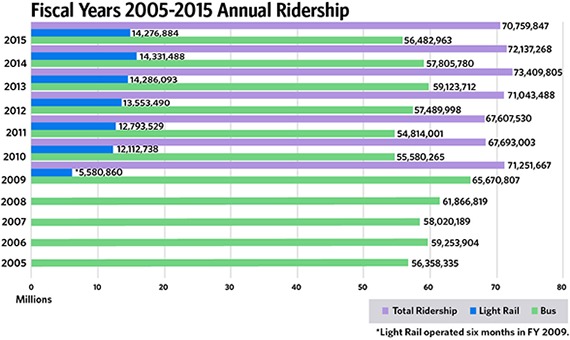
As predicted by skeptics of light rail, like myself, the Phoenix light rail system is starting to kill bus service.  This is a familiar pattern — in most cities that have added rail, from LA to Portland, total transit ridership has fallen as light rail systems have been built.  That is because rail is so expensive, and its costs are mostly fixed (ie bond payments for construction costs) and absolutely inflexible (ie you can’t shift routes).  Since rail costs far more, even orders of magnitude more, per rider than buses, this means that even with modest increases in total transit budgets, total ridership falls when capacity is being shifted to much higher cost rail.  Bus service is inevitably cut, because even if you close rail lines, the costs remain.

So here we are, in Phoenix.  The article is mainly about the regional transit coalition falling apart, which I have no opinion or interest in, but you can see what is going on anyway.

A bad economy has meant that building a regional bus system in the Valley is no longer a regional endeavor.

A half-cent sales tax was supposed to be the magic bullet that paid for transit and roads. But as tax revenues continue to shrink, cuts to the plan have become inevitable.

Avondale leaders say the toll includes the decimation of future West Valley bus routes and the end of the regionalism that Proposition 400 promised….

Paul Hodgins, capital-programming manager for Valley Metro, which operates the transit system,said every region took a 25 percent cut in transit dollars.

Here is what is going on, though the article only sort of alludes tangentially to this way down in the last 2 paragraphs.  Half of the transit dollars in the sales tax increase went to rail, and half to buses.  The rail money is almost all for debt service on capital spending which has already occurred.  This money has to be spent or the local authorities will default on their bonds.  The other half was for bus operations.

Now, there is a 25% cut in the sales tax dollars from this sales tax increase.  The half that went to rail can’t be touched.  So the 25% cut results in a 0% cut in rail and a 50% cut in buses.  Further, since bus service carries a lot more passenger trips per dollar spent than rail, this 25% cut will end up affecting well over 50% of the total ridership that benefited from the sales tax funds.

It is clear from the article that folks probably understand this, but no one from the AZ Republic to the transit agencies are yet ready to admit it.  Expect the proposed solution to be in the form of more taxes rather than a rethinking of transit strategy.  Rail is an albatross, and I wonder how often it has to drive failures like this before people start recognizing it as such.

More Italy

After several more days and locations (Florence, Cinqueterre via Portovenere) I am left with one question:  Why is it that even supposedly elegant European hotels charging many hundreds of Euros a night for a room are oblivious to the quality of their beds?  I am getting tired of paying tons of cash for rooms with bed linens whose quality is measured in “grit” rather than “threadcount.”  The beds are uncomfortable and the pillows are awful.   The blankets are sick polyester jokes that Motel 6 would be embarrassed to offer.  For the price of just one night’s room rent I could go to IKEA and outfit the rooms better.  It’s not like I am some spoiled princess-and-the-pea sleeper — I stay in a lot of cheap hotels and I tent camp, for god sakes.  My camping equipment is more comfortable than these beds.  I routinely stay in $70 hotels in the US and never get beds or linens this bad.  Do they not care, or is this what Europeans all sleep on at home?

OK, rant over.  Florence was as great as it always is.  There is way too much stuff to do there ever to get bored, all within just a few minutes walking.   Unlike past visits, we entirely skipped the Uffizi and hit a lot of historic buildings we had missed before (e.g. Medici Palace).  I enjoyed it but if you are on your first visit, the Uffizi is a must.  Also saw a bit of above-average engineering, like this:

Seriously, I wonder if I could have — without a)  any kind of materials strength data base; b) no structural steel or modern concrete; c) no CAD facility — designed and built such a thing in the 1400s, even with the Pantheon as a go-by to copy.  Really remarkable.

In Florence, there is a famous bridge called the Ponte Vecchio which is actually covered in buildings:

You can’t tell from this picture, but the bridge (open only to pedestrian traffic) is lined with at least 40 jewelry stores.  Seriously, each storefront has bout 6 feet of space, and every one had a window with zillions of gold trinkets.  It got me thinking about the paradox of choice.  It’s not hard to buy into the economic theory that too much choice may inhibit purchase while walking along this bridge, though I am told most of these folks do very well (I have never bought into the paradox of choice as social theory — the one that says people would be happier with fewer choices.  If this were true, we would all be emigrating to North Korea).

Speaking of pedestrian streets, one important takeaway from Italy has been that one should never assume a road is too narrow, even if it is no wider than your pantry door, for a vehicle to come racing through any second.  The other day I was in a really narrow alley I thought was foot-traffic-only when a bus(!) came screaming down the lane like a piston through a cylinder.  Only a well-located doorway got me out of the way, and even then the bus’s mirror clipped my arm.

The last few days we have been staying at the port town of Portovenere on the Italian Riviera.

The town itself is attractive with a fair amount to explore for its size.  I experimented some with night photography from my room

I have some other exposures that I want to try with HDR software to try to bring out a bit more of the buildings.   The town was kind of fun on a Saturday night — in addition to a couple of rowdy weddings, there were also a lot of BIG boats that came in for dinner in the evening.  Very nice (except for my bed).

Portovenere is a convenient gateway to the Cinqueterre, five absurdly picturesque downs laid down in about 1100 AD by Walt Disney to attract American tourists.  You may have not heard their names, but you have likely seen one or all of them the last time you were at an art fair in one of the photo exhibits — here is one example (though they had the patience to wait for a time of day where the lighting was better, presumably in the early morning).

More than the towns, I enjoyed the walking trail in between, which is an attraction in and of itself.  It winds through wilderness and vineyards along the coast.  All through the vineyards I kept seeing what looked like a guide rail for some sort of gear-driven device.  The rail wound up and down the hills and through the vineyards.  I had assumed that it was some sort of irrigation system where the sprinkler moved along the rail (though I could not figure out how the water supply would work).  Then I found this absolutely awesome piece of steampunk-style tech:

It is hard to tell, but its a little one-person monorail that rides on the rail and pulls a couple of carts behind the “engine.”  This is why I could not find any roads or really many trails in the vineyards — they use these cool things to move about, do maintenance, and bring in the crop presumably.  And the rail does not run on the ground, but 4-5 feet in the air, so one can see over all the vines and brush.  Totally awesome.  And not a seatbelt to be found on it, which made me love it all the more.   I loved it so much, here is another shot head-on (sorry it is overexposed, I don’t have the energy to edit it right now).

One Lab Left Out

Glen Reynolds linked this gallery of 30 awesome college labs.  My favorite at Princeton was our Junior year mechanical engineering course which was basically interfacing micro computers to mechanical devices  (which was a non-trivial task in 1983).  There were two one-semester courses.  The first was mostly software, and involved programming an s-100 bus computer in assembly language to do various things, like control an elevator.  My final project was a put one of the first sonic rangefinders from a Polaroid camera on a stepper motor and built a radar that painted a blocky view of its surroundings on a computer monitor.

But the really cool part for me was the second semester, when it was software + hardware.  We had to build a complete electronics and mechanical package to perform an automated function on … a very large n-scale model railroad.  Well, readers of my blog will know that model railroading is my hobby anyway.  My team built a coal loading facility where the train was stepped forward one car at a time and a hopper filled each successive car to the right level with coal (or actually little black pellets).  We had sensors to be able to handle certain problems the professor might throw at us, like a car that was already full, cars of different sizes and lengths, etc.  That lab with the big model railroad was easily my favorite.

In retrospect, I almost miss programming in assembler code, trying to cram the code into 4K EPROMS, etching my own circuit boards….  Almost.   Now my only use for circuit boards is to shear them into strips to act as railroad ties when I hand-solder track work and my only use for etchant is weathering scale sheet metal to make it naturally rusty.  Pictures of the latter in a few weeks.

Blaming Private Companies for Government Procurement Errors

The blaming of private companies for government procurement errors is one I deal with frequently at my privatization blog.  This seems to be a particularly egregious example:

Maricopa County officials can’t sue the Sheriff’s Office for buying a $465,000 bus without their approval, so now they want to sue the bus company.

Precisely why Motor Coach Industries would be sued over the internal squabble remains unclear.

The county has maintained in this months-long bus battle that Sheriff Arpaio’s office bought the vehicle with Jail Enhancement funds, when it should have used a typical county procurement process.

From the bus company’s point of view, though, the Sheriff’s Office was a customer with cash. For the county to demand a full refund, without so much as a deduction for the depreciation, seems like a raw deal for MCI.

Cari Gerchick, spokeswoman for the county, says text of the lawsuit won’t be released until after the Board of Supervisors votes on it at Monday’s meeting. She could not provide the legal justification for the expected lawsuit, beyond saying that MCI “should have known” the MCSO had not followed the county’s procurement process.

Get that?  The company should have known that our County’s chief law enforcement officer was not following the law.  This is obviously an absurd contention, but further the company had two geographic disadvantages:  1.  Not being from AZ, they don’t know just how unethical our sheriff really is; and 2.  Being from Chicago, even if they had recognized unethical behavior, they would have assumed it was perfectly legal

Devastating Post on Houston Light Rail

This post at Houston Clear Thinkers is just a devastating analysis of Houston light rail.  In it, we see the age-old story — rail is enormously expensive, and starves the rest of the system for money, ultimately leading to fewer people riding at much higher costs.  He quotes from Bill King:

Decline in Ridership. Since 2004, Houston population has grown by over 10% from just over 2 million to 2.25 million. At the same time gas prices rose 47% from $1.81 per gallon to $2.67 per gallon. These two factors should have virtually guaranteed an increase in transit. However, exactly the opposite has occurred as bus boardings dropped almost 24% from 88 million in 2004 to 67 million in 2009. Instead of increasing bus service by 50% as it promised the voters in the 2003 referendum, Metro has slashed bus routes and increased fares by over 50%. Today Metro actually operates 225 fewer buses than it did in 2003. An outside performance audit in 2008 found that on-time performance fell by 29% from 2004 to 2008.

Financial Disaster. Since 2003, Metro’s sales tax revenues have increased by 43%, rising from $357 million to $512 million. At the same time, its fare revenue increased by 41% from $42 million to $60 million by charging an ever dwindling ridership more. Yet, Metro is in the worst financial shape in recent history. At year end 2003 Metro’s current assets exceeded its current liabilities by $125 million. The budget just adopted by the Metro board projects that it will have current accounts deficit of $165 million by the end of this fiscal year, a stunning loss of nearly $300 million in just five years. Over the same period, Metro’s debt has swelled by nearly 50% from $546 million to $816 million. [.  .  .]

In the meantime, the cost of the [Metro’s Light Rail Transit lines] has risen from the $1.2 billion originally estimated to something well in excess of $3 billion. Metro is seeking to borrow $2.6 billion to build the LRT, over four times what it promised the voters would be the limit in the 2003 referendum. Originally, Metro assured voters that it could build the LRT without tapping the mobility payments that are so critical to the Houston and the other member cities. Metro’s projections now show that it can only afford the LRT if those payments are terminated in 2014. [.  .  .]

Faith-Based Government Investment

The Tampa Rail blog has responded to my post criticizing Phoenix light rail (which the Tampa folks used as a glowing example of rail success).  Remember I wrote, in part:

Look, I don’t think I have ever argued that Phoenix Light Rail was run poorly or didn’t have pretty trains.   And I don’t know if moving 18,000 round trip riders a day in a metropolitan area of 4.3 million people is a lot or a little (though 0.4% looks small to me, that is probably just my “pre-web” thinking, whatever the hell that is).The problem is that it is freaking expensive, so it is a beautiful toy as long as one is not paying for it.  Specifically, it’s capital costs are $75,000 per daily round trip rider, and every proposed addition is slated to be worse on this metric (meaning the law of diminishing returns dominates network effects, which is not surprising in this least dense of all American cities).

Already, like in Portland and San Francisco, the inflexibility of servicing this capital cost (it never goes away, even in recessions) is causing the city to give up bus service, the exact effect that caused rail to reduce rather than increase transit’s total share of commuters in that wet dream of all rail planners, Portland.  Soon, we will have figures for net operating loss and energy use, but expect them to be disappointing, as they have in every other city (and early returns were that fares were covering less than 25% of operating costs).

Of course, as with all government issues, the ultimate argument is that I am some sort of Luddite for actually demanding definable results for billion dollar government spending

Sorry Coyote, save for the topic matter I’m afraid I’m just not going to be much fodder for you. We’re years past ‘it’s an expensive tax thing’.

We know that. We know rail like any capital project is expensive to execute and expensive to maintain – in dollars. But anyone who raises the math to me will wind up with the same big ‘so what’. Community investment doesn’t bother everyone the same way and different people see different value. There’s no way you or I cold supernaturally understand the net benefit for or against light rail. We must simply choose to believe and pick our sides.

If you believe that just because rail is expensive they aren’t worthwhile, you need to explain every public vote that has gone for implementing and expanding rail systems around the world even though most operations are publicly subsidized.

Gotta run’em well, and, over time, integrate with a city, but LR is a carefree mobility solution in areas where people choose to support and pay for it.

See, they are well past my neolithic argument, into their little post-modernist world where aesthetics and political correctness trump any actual need to demonstrate money is being used well.  Though it is interesting to see him resorting to faith as a justification.

I have two words for this person — “opportunity cost.”  On one hand, the money for this project must be taken out of private hands to build the rail line — even leaving out the substantial individual liberties questions here, there is still some obligation to demonstrate the money is better used than it would have been in the private hands from which it is taken.  Ditto, by the way, for the stimulus bill.   On the other hand, to the extent that one wishes to spend government money to move people from A to B, one needs to demonstrate that this method is better than others.  I would argue high speed rail fails both tests.

Update: Joel Epstein and I have a go around the same issues in the Huffpo comments.

Great Article on Transit Decision-Making

Via a reader, the article is about Madison, Wisconsin, but it could be about anywhere.  The author highlights at least three issues with the plans:

  • Unelected tax authority

Dane County, for instance, plans to fund its transit authority with a half-percent sales tax. Members of the RTA board were told by the officials who appointed them to put the tax to voters in a referendum, likely next fall.And if the voters say no? In theory, said County Board member Al Matano, a key RTA backer, it means no funding. But “it’s not on our list of things to worry about,” he told me.

Why should it be? The legal fact is the tax needs no referendum. Gov. Jim Doyle vetoed that part of the transit authority law. Struck it right out. The decision is solely up to an unelected RTA board.

“Quite honestly, they don’t need (a referendum), legally,” said Dave Ripp, a County Board member who doesn’t favor the RTA. “And if it fails, they don’t have to follow it.”

  • Obsession with trains over more affordable solutions

Quite a few wonder why Madison, with 480,000 people and short distances, needs the expense of trains. Buses are much cheaper. They can go more places, and you can afford to run them more frequently. “We actually support buses,” said Richardson. “They’re very flexible.”

“The main thing that worries me, and I’m not the only one,” said Susan De Vos, head of the Madison Area Bus Advocates, a riders’ group, “is that people put in rail at the expense of the existing transit system, and that’s the bus.” That’s how things worked elsewhere, such as in Los Angeles, said De Vos. When train plans inevitably outstrip revenue, the money comes from cutting back the unsexy part of the system. She favors a series of limited-stop express “bus rapid transit” lines for a fraction of rail’s cost.

  • The real focus is on rigid government control of development (ie the Portland model)

“Their agenda really isn’t about transportation,” as Dane County Towns Association President Jerry Derr put it to a reporter. “It’s about land use. They want to build a rail system so they have a reason to force all new development to within a half-mile of the rail corridor.” Surely he exaggerates? No. The commuter rail plan’s founding document lays out the rationale thus: “Goal 1: Promote Efficient Land Use/Develo

Sounds like a another great town (Madison is really a great place from my experience) is about to be screwed up, just like Portland has.

The Leftish Mindset, In One Sentence

Cameron Scott meant this sentence as a withering critique of everything that is wrong with the government, from his point of view:

Transit riders shouldered four times the share of the MTA [Metropolitan Transit Authority] 2008 budget disaster [than] drivers did, but officials promised to seek more revenue from parking.

Holy cr*p!  You mean that transit users shouldered four times more of the transit budget than transit non-users?  Gasp!

The Bay Area where he lives is experiencing light rail disease.  This is the phenomenon where middle class voters along heavy white collar commuting routes push for horrendously expensive light rail lines.  The capital costs of these systems drain transit budgets into the distant future, forcing service cuts, particularly in bus systems that serve the poor.  The result is that the city ends up with bigger transit bills, but less actual transit, and progressives like Scott scratch their head and try to figure out what went wrong.  It must be because non-users of Transit aren’t paying enough!

Light Rail Killing Another Transit System

I have written frequently that light rail tends to kill transit systems (Randal O-Toole has been a Cassandra on this subject for years).  Rail is so expensive to build and operate, and so inflexible in its routes and service structure, that once constructed it sucks resources from other modes (especially buses).   This leads to the counter-intuitive conclusion that these huge investments actually in the long run end up reducing transit system coverage and service and reducing ridership.  In particular, the poor, who depend on public transit as their lifeline rather than as a publicly subsidized alternative to buying a Prius, tend to get hammered.  Their bus service is cut and the light rail seldom runs where either their work or their homes are located.  Light rail is in effect a shifting of transit focus from serving the poor to serving the middle class (who wouldn’t be caught dead on a yucky old bus but who like trains).

Enter Phoenix.  For the capital cost of $75,000 per daily rider, and large operating losses, we built ourselves a light rail line in one of the most dispersed cities in the country.  In other words, we spent $1.4 billion to serve a single 20 mile corridor which represented a tiny fraction of the city’s commutes.  I predicted a while back two outcomes:

1) Light rail fares skyrocket to cover their immense operating deficits and capital costs, giving the lie to politicians that sold these systems as helping working poor.

2) Bus service, the form of transit that serves most of the working poor …  is cut back to help pay for rail.

So, here is what I woke up to on the front page of our newspaper:

Phoenix’s bus system, the largest in the Valley, may see a $16 million budget cut next year to avoid a deficit in 2012, transit officials say.

Bus-system officials will discuss the issue with the Citizens Transit Commission today.

The looming deficit is more bad news for bus riders. Cost-cutting in December and July reduced the frequency of some Phoenix routes and eliminated early morning and late-night service. Also, bus fares went up in all metro Phoenix cities and for Metro light rail this year.

Of course, as with all government analyses, the problem is not enough taxes:

Phoenix is going through multiple rounds of belt-tightening because sales-tax revenue, a crucial part of Phoenix’s $171 million transit operating budget, continues to drop because of the economic downturn.

Transit 2000, the 0.4 percent sales tax that voters approved in March 2000, is bringing in less than projected. The tax was expected to generate $21.4 million during the first two months of this fiscal year. It brought in $14.3 million, said Lauri Wingenroth, assistant public-transit director.

Here is what they say dont say in the article, but should:  Most of the 2000 sales tax increase was allocated to the capital costs of light rail construction.  Those can’t be cut back, because they are already sunk.  That means that most of these taxes are dedicated to paying off light rail bonds for the next 30 years, and those expenses exist no matter what they do.  So with no way to cut back on light rail expenses, buses (which have more variable costs than rail) are cut.  All exactly as predicted.

PS- Hilariously, right next to this article which should have been labeled a light rail fail, is an article about the “tragedy” that Phoenix is not on the Obama light rail boondoggle map.  Everyone else gets to waste a ton of federal money, why don’t we have the same right?  If you read the article, you will find that a lot of countries that are orders of magnitude more dense and have much shorter inter-city travel distances than in the US are way ahead of us.  Left out of the article is the much higher percentage of freight that moves by rail rather than road in the US.

Light Rail Uses Twice the Energy as Driving

One of the justifications for diverting highway money to ridiculously expensive light rail systems is that light rail supposedly reduces energy consumption.  Really?  This is via the most recent report from the DOE’s Transportation Energy Book, as highlighted by the Anti-Planner (click to enlarge):

light-rail-energy

The figures for cars are from tables 2.12 and 2.13 of the same report.  Even the best light rail systems are not substantially more efficient than cars, and this gap will likely continue to close, as it has for years, as cars get more efficient.

A Note on Freight: By the way, passenger rail promoters in the US always point to the Europeans as having a better rail system.  But while the Europeans put more of their passengers on rail than does the US, they put less of their freight there.  I would argue that the US system is much more “green”, as the differences in energy use between a ton mile of freight on road vs. rail is much larger than the difference in energy use of a passenger mile on road vs. rail.  And besides, from a lifestyle standpoint, would you really want more freight on the roads?  (This is a real tradeoff — unless one spends the absurd amount of money to build two separate systems, a rail network can be optimized for freight or passengers — the two do not coexist very well on the same tracks).

Postscript: Just to head off the obvious rhetorical battles — the incremental energy efficiency of moving one driver to a light rail rider of an existing system is very high.  The car consumption goes away and the train does not incrementally increase its energy use much with one more passenger.  So at the margin, it is correct when someone tells you that it saves energy to shift your commuting to an existing light rail line.  However, it does not make sense, from an energy perspective, to build a light rail line in the first place.  The investment is too high, the energy savings are negligible or non-existent, and the operating cost are so high that light rail tends to crowd out bus operations that help the poor.  As I have written before, for every light rail system I have checked, the cost to build the system is enough to buy every daily rider a Prius and the operating deficit enough to keep every one of these Prius’s filled with gas.

Update:  I further understand that cars in the city likely have lower gas mileages than these averages, particularly for commutes that might be substituted by light rail.  But light rail is sold as if it is substantially more energy efficient, and it really would have to be orders of magnitude more efficient to justify the capital costs that are so much higher than for an equivalent capacity of roadway.  The efficiency is just not there.

Gates-Type Encounters with Police Happen Every Day, Irregardless of Race

Some cops just abuse power, and make up rules as they go along.

Gordon Haire, a former newspaper reporter and former police officer, was sitting at a table on the campus of the University of Texas Medical Branch at Galveston when he snapped a photo of a university police officer strolling towards him.

Officer Tim Wilson then came up to him and told him he was not allowed to photograph the Galveston National Library, which apparently is so top secret that only a Google search will reveal its true appearance.

Wilson told him it was against the law to photograph the building because it is a security threat.

Haire, 66, told Wilson he did not believe him.

Sensing the impending terrorist threat, Wilson asked for Haire’s identification.

But having lost his drivers license, Haire was only able to produce a Medicare card (he had arrived by bus for a doctor’s appointment).

The cop then asked for his full name and date of birth, then relayed that information to a dispatcher through his collar microphone.

“He’s giving me a hard time,” the cop said to the dispatcher, according to Haire.

The cop finally left, but not before informing Haire that it was illegal to even photograph the sidewalk.

You Guys Are Losers Because You Are Not Paying For My Stuff

The Thin Green Line has been running a series of articles complaining about price increases and service cuts at the local MTA.  I will leave aside for today the critique I have been putting in the comment section of that blog, which is that if you really care about transit service for the working poor, then you never should have started down the light rail path in the first place.  Light rail is an expensive yuppie toy that inevitably, through its high costs and continuing capital requirements, starves money from the bus services that the working poor actually depend on.

But anyway, I thought it was endemic of a certain type of political outlook that the author could write this with a totally straight face:

Also problematic is that the MTA did not hit drivers and riders equally [with proposed fee and fair increases].

Wow!  You mean a price increase for a service does not hit users and non-users of that service equally?  On what planet does one have to live on to believe that they should?

Update on Light Rail Alternative

Yesterday I posted on a new bus system Phoenix is implementing but that appears to cost 30x less than the light rail system we just built.  I wrote Randal O’Toole of Cato, also known as “the AntiPlanner,” to see what he knew about this system.  Here is what he was wrote back”

Yes, I’ve written about it a lot. The best system is in Kansas City, where they didn’t feel they had to spend $750,000 to make a $300,000 bus look futuristic.

Take a look at my blog, http://ti.org/antiplanner and search for “bus rapid transit” to see some articles on better bus service. Here is the article about Kansas City BRT: http://ti.org/antiplanner/?p=102

Here is an article about Eugene’s bus-rapid transit, which was a stupid waste of money: http://ti.org/antiplanner/?p=21

The only thing good about it is that it didn’t waste as much money as light rail. But that’s like saying you’d rather be stabbed in the heart with a three-inch knife than a six-inch one.

The Eugene mess he refers to has the city building a dedicated bus lane, something Phoenix fortunately is not considering, opting for a traffic light transponder approach rather than dedicated lanes to try to hold schedules.  Here is a snippet of what he wrote about Kansas City:

In 2005, Kansas City did a wonderful thing: It started a bus-rapid transit system the way bus-rapid transit ought to be done. The transit agency didn’t spend hundreds of millions of dollars building exclusive bus lanes. It didn’t buy million-dollar buses just to have a semi-futuristic look.

Instead, it simply began running buses on existing streets on rail schedules. That is, the buses stop only once per mile and the operate three to four times every hour from 4:20 am to 11:20 pm. The greater frequencies and faster buses increased ridership by 25 to 30 percent (see page 11), and most of these new riders were new to transit.

The city built inexpensive but easily identifiable transit stops for the route. The buses were regular buses but were “branded,” that is, painted in an easily recognizable style. In short, Kansas City achieved the kind of ridership increases that light rail would achieve for a tiny fraction of the cost.

In other words, the basic idea makes great sense, but spending a million bucks a bus (as Phoenix plans) just to make the bus look like a train is crazy.

All true, but I might be willing to give in on the more expensive busses if thats what it takes to kill this crazy infatuation with steel rails.   In the Phoenix Mesa Link example, they are probably spending $4.5 million too much for the train-like busses, but if that gives public officials the ability to walk past the light rail buffet and save the $800 million extra rail would have cost, I might consider that a good investment.

Light Rail Alternative

Apparently, Phoenix is experimenting with a new style of bus transport that looks and operates like a train:

The Mesa Link debuted the same week as light rail. For now, Link involves a fleet of 10 buses. Each $756,000 vehicle carries a transponder to coordinate traffic lights and keep the bus on schedule for a 12-mile run in 45 minutes.

It’s the start of a much more ambitious program.

Over the next few months, the Regional Public Transportation Authority, which coordinates Valley Metro bus service, will build stations and add technology to the Mesa line to give it more of the pace and feel of a train.

Basically, they are building the thing to look and operate like a light rail train, only running on tires on the existing road.    The travel time may seem slow, but it is nearly identical to the average speed of our light rail line (20 miles in a claimed 70 minutes, though a number of riders say its slower).  And the capacity is nearly identical.

So with the same speed and the same capacity and similar scheduled service with similar style stations, here is the real appeal:

In 2010, a second line will be created to run 12 miles along Arizona Avenue in Mesa and Chandler. It will feature 10 stations and cost $28 million for construction and the purchase of nine buses. Future lines are planned for Scottsdale Road, Baseline Road and Chandler Boulevard.

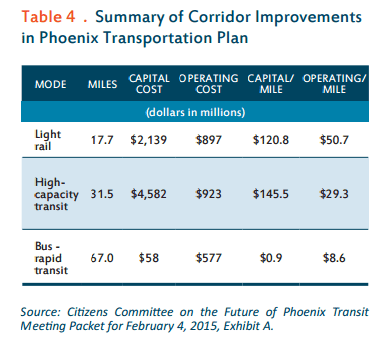
The 20-mile light-rail line cost $1.4 billion to build.

Holy cr*p.  $70 million a mile for light rail vs. $2.3 million a mile for this system.   That is 30x cheaper.  The only discernible difference is one runs on steel rails and the other on tires.  Oh, and the rail line, in most places it was built, completely removed up to two lanes of existing roadway capacity, while the bus-type system leaves the roadway intact and just uses a fraction of one lane’s capacity.

Now, I would have to sit down and look at the numbers and the service profile to decide if this new bus system made sense financially vs. the old bus system, but why are we even considering extending light rail?  And why oh why did we build this white elephant in the first place.

Regulation is About Protecting Incumbents

Darin Morely sent me this.  Woe be it to the upstart competitor with a new business model who challenges an incumbent with political connections.  This goes double when the incumbent is the government itself:

One of the great things about the web, obviously, is that it allows for much more efficient communication that opens up new and useful offerings. For example: the web offers the ability to find other people traveling to the same general place you’re heading and to set up a convenient carpool. It’s good for the environment. It’s good for traffic. It just makes a lot of sense. Unless, of course, you’re a bus company and you’re so afraid that people will use such a system rather than paying to take the bus. That’s what happened up in Ontario, as earlier this year we wrote about a bus company that was trying to shut down PickupPal, an online carpooling service, or being an unregulated transportation company. TechCrunch points us to the news that the Ontario transportation board has sided with the bus company and fined PickupPal. It’s also established a bunch of draconian rules that any user in Ontario must follow if it uses the service — including no crossing of municipal boundaries — meaning the service is only good within any particular city’s limits.

All of us in the states need to be prepared for more of this corporate economy thing in the US.  I saw last night on Sunday Night Football that NBC is really going hard on some green initiative, including having a green peacock.  GE (parent company of NBC) is a smart company and sees the writing on the wall.  It understands the new administration and Congress seem hell-bent on moving us to a more European model.  In that model, there are 10-20 corporations per country that insinuate themselves into government and get the opportunity to help run the country to their own benefit.  GE wants to be one of these chosen few.  The push is going on not just at NBC, but in light bulbs (betting on Congressional action to provide regulatory support for a new type of bulb they have invented) and in power systems (who are making large bets on wind that will not pay off without a government subsidy program).

In the near term, GE may need a bailout in its financial arm.  GE must have seen that GM made a huge public push for its Chevy Volt over the last 6 months, spending hundreds of million in advertising on a car that does not exist yet. Why would a company near bankrupcy do this?  We now know the advertising was aimed at Congress and the Administration, not consumers, trying to burnish their green image to give Democrats enough political cover to vote for the bailout their UAW supporters so desperately need  (any chapter 11 would likely result in enormous restructurings of union contracts).

Absolutely Predictable

Apparently, even before the first train starts carrying passengers (sometime in December), Phoenix’s new light rail system is already forcing bus fares up.  (via a reader)

Before the Valley’s light-rail service ever begins, the cost to ride the train and city buses may be headed up.

The issue of raising the Valley’s regional fare policy has been brewing for several months as transit officials have struggled to cover
rising gas prices and other increased operation costs, said Greg Jordan, Tempe’s transit administrator. Transit and light-rail costs are covered by a half-cent sales tax, which has fallen over the past year.

The real issue is that transit agencies are generally given a fixed pot of money for operating subsidies (in this case the proceeds of a half-cent sales tax) and rail tends to take a hugely disproportionate share of that money, starving out less sexy but more practical and cost-effective bus systems.  Even in the that wet dream of rail planners, Portland:

In fact, 9.8 percent of Portland-area commuters took transit to work before the region build light rail. Today it is just 7.6 percent. In a story repeated in numerous cities that have built rail lines, rail cost overruns forced the city to raise bus fares and reduce bus service. That’s a success?

This is even more likely in Phoenix, where buses make far more financial sense than rail, given our very low densities, lack of a real downtown area, and numerous commuting routes.  In fact, not only is it predictable, but I predicted it:

Rail makes zero sense in a city like Phoenix.  All this will do is create a financial black hole into which we shift all of our bus money, so the city will inevitably end up with a worse transportation system, not a better one.  Cities that build light rail almost always experience a reduction in total transit use (even the great God of planners Portland) for just this reason – budgets are limited, so since rail costs so much more per passenger, other transit is cut back.   But the pictures of the train will look pretty in the visitor’s guide.

Why Phoenix Light Rail is Doomed in One Chart

The Arizona Republic had another of its cheerleading articles on light rail this morning.  In it was a chart that, contrary to the intent of the article, summarized exactly why Phoenix light rail is doomed.  Below is a chart of the employment density (top chart) and population density (bottom chart) at each stop along the first rail route.  Note that this line goes through what passes for the central business district of Phoenix and the oldest parts of town, so it was chosen to run through the highest density areas – all future extensions will likely have lower numbers.  Unfortunately, they do not reproduce this chart online so here is a scan:

Lightrail

Take the population density chart.  As a benchmark, lets take Boston.  The average density for all of the city of Boston is 12,199 people per square mile.  Phoenix’s light rail line cut through the highest density areas of town has only one stop where density reaches this level, and most stops are less than half this density.  And this is against Boston’s average, not against the density along its rail routes which are likely much higher than the average.

Rail makes zero sense in a city like Phoenix.  All this will do is create a financial black hole into which we shift all of our bus money, so the city will inevitably end up with a worse transportation system, not a better one.  Cities that build light rail almost always experience a reduction in total transit use (even the great God of planners Portland) for just this reason – budgets are limited, so since rail costs so much more per passenger, other transit is cut back.   But the pictures of the train will look pretty in the visitor’s guide.

Postscript: Phoenix’s overall average density is around 2,500 per square mile.  Assuming that the 12,000 in the chart above is one of the densest areas of Phoenix, this gives a ratio of about 5:1 between peak and average density.  This same ratio in Boston would imply peak density areas of 60,000 per square mile.  This may be high, but indicates how much higher route densities on Boston rail should be.  Oh, and by the way, Boston rail is losing a ton of money.

Other city densities here from 1990.  People think of LA as spread out, but LA has a density over three times higher than Phoenix!

Update on My Light Rail Bet: The Energy Issue

I generally have a bet I make for new light (and heavy) commuter rail systems.  I bet that for the amount the system cost to build, every single daily rider could have instead been given a Prius to drive for the same money; and, with the operating losses and/or subsidy the system requires each year, every one of those Prius drivers could be given enough gas to make their daily commute.  And still have money left over.  I have tested this bet for the systems in Los Angeles and Albuquerque.

Well, it turns out I left something out.  Many people are interested in commuter rail because it is perceived to be greener, which nowadays generally means narrowly that it uses less energy and thus produces less CO2.  But in fact, it may not.  Blogger John Moore sent me a link to this article by Brad Templeton analyzing energy usage in various transportation modes.  While a full train can be fairly efficient (just as a full SUV could be if 7 passengers were in it), cars and trains and busses are seldom full.  When you look at their average load factors, trains are seldom better than cars:
Transenergy

In fact, a car at its average load factor (1.57 pax) has about the same energy use as busses or light rail per passenger mile.  The analysis is difficult to do well, but even with errors, its clear that rail projects do not dominate over car travel in terms of energy use  (One must be careful to differentiate rail project construction decisions from individual choice of mode decisions — an individual at the margin shifting from car to train saves a lot of energy;  a city choosing to invest in a large new rail system to entice drivers off the road does not).

In fact, relevent to my bet, Mr. Templeton says this:

My first conclusion is that we would get more efficient by pushing
small, fuel efficient vehicles instead of pushing transit, and at
a lower cost.

He explains his results, which are counter-intuitive to many

A full bus or trainload of people is more efficient than private cars,
sometimes quite a bit more so.   But transit systems never consist
of nothing but full vehicles.   They run most of their day with light
loads.  The above calculations came from figures citing the
average city bus holding 9 passengers, and the average train (light
or heavy) holds 22.   If that seems low, remember that every packed
train at rush hour tends to mean a near empty train returning down
the track.

Transit vehicles also tend to stop and start a lot, which eats
a lot of energy, even with regenerative braking.   And most
transit vehicles are just plain heavy, and not very aerodynamic.
Indeed, you’ll see tables in the DoE reports that show that over the past 30 years,
private cars have gotten 30% more efficient, while buses have
gotten 60% less efficient and trains about 25% worse.   The
market and government regulations have driven efforts to make cars
more efficient, while transit vehicles have actually worsened.

In order to get people to ride transit, you must offer frequent
service, all day long.  They want to know they have the freedom to leave at
different times.  But that means emptier vehicles outside of
rush hour.   You’ve all seen those huge empty vehicles go by, you just
haven’t thought of how anti-green they were.    It would be better
if off-hours transit was done by much smaller vehicles, but that
implies too much capital cost — no transit agency will buy enough
equipment for peak times and then buy a second set of equipment for
light demand periods.

A lot of his data can be checked at the US Department of Energy data book here.  In particular, you can see the key numbers in table 2.12.  After perusing this data for a bit, I had a few other reactions:

  • Commercial air travel gets a bad rap.  On a passenger mile basis, it is really not worse than driving and only about 20% worse than Amtrack  (and probably the same as Amtrak or better if you leave out the Northeast Corridor). (table 2.14)
  • Busses have really gotten way more inefficient over the years, at the same time cars have become substantially more efficient.  While the government criticizes its citizens for not practicing enough energy conservation, in fact its citizens have been buying more and more fuel efficient vehicles while the government has been buying less efficient vehicles.  (table 2.13)
  • While passenger cars have increased substantially in efficiency, over the road trucks have seen no progress, and have actually gotten less efficient over the last 10 years (table 2-18)

Make sure to read the whole article.  I think the author is pretty fair at achnowleging where the uncertainties are in the analysis.  He also has comparisons of mass transit energy numbers between cities.  A few individual cities seem to beat even the most efficient cars — most, including places like New York, do not.

Postscript:  I don’t think numbers for New York include taxis.  If they did, New York would likely look terrible.  From an energy standpoint, taxis are a horrible transportation option, perhaps the worst possible.  It would be interesting to know how many New Yorkers who look down on SUV’s routinely get around town using taxis.