Well, I have (mostly) sold my business and eliminated some of the conflicts that restricted my blogging for several years. Right now, I am trying to get this old blog spooled up with some new features. Right now I am testing the direct link to X as well as the ability to send our email summaries of posts.
I have considered substack and still have coyoteblog staked out there if need be, but there is a lot of content here I would hate to lose so I am going to try to make wordpress into what I need.
I am on the road but trying to stay in the blogging habit so this is a bit of a throwaway. But anyway...
You probably know words like SCUBA, SNAFU, laser, lidar, and sonar are all acronyms. But here are two you might not know about:
The first word is "posh," which generally means a luxury experience (or Beckham's wife). But it was originally an acronym for ship voyages from the UK to India. Because it was a hot trip and there was no air conditioning, the best cabins were on the north side of the ship (at least above the equator) or the east side of the ship (ie facing away from the heat of the afternoon sun). This would be the port side going to India and the starboard side coming home. So to get the best cabin you asked for port out, starboard home or "POSH".
The other word is "Pakistan" which is the name of the country that split from India in 1947. As India was approaching independence, Muslims (who were quite numerous all over in India but particularly in the northwest and the far east) proposed the new states formed form the old British Empire in India include a Muslim state. They were seeking a state made up of the Muslim-majority whole provinces of Punjab, Afghan, Kashmir, Indus, and Sind. This forms the acronym PAKIS-tan with the "tan" meaning "land of". The word Pakistan also means "land of the pure" in Sanskrit. It was a powerful piece of branding.
As a postscript, these 5 provinces were all in the west. The original Pakistan also included parts of the state of Bengal in the east which formed East Pakistan. East Pakistan was actually more populous than the West but the West tended to dominate the country's leadership, leading to E. Pakistan breaking away in the early 70's to form Bangladesh. The entirety of these 5 states in the acronym were not included in the final borders of Pakistan. In particular, Kashmir was divided between Pakistan and India and has been the site of a lot of fighting between the two countries over the last 70 years (queue Led Zeppelin song).
I know I have not been blogging serious topics much of late. In part this is due to just being busy -- holidays, end of year accounting closeouts for the business, and some geeky projects (a few raspberry pi things I will share soon). In part this is due to the fact that whenever I engage with social media too long I become a worse person and back away again. In part this is because my daughter said I needed to lighten up on my blog for a while. And in part this is to my not wanting my obsessive fascination with the trainwreck that is Tesla to dominate my blogging (though there are a couple of updates coming).
As I close in on my 15th(!) year on this blog, this sort of ebb and flow happens from time to time. I will be back in force soon.
Yes, I know that blogging women's hair care products is not really in my wheelhouse but my wife reports that the Dyson Airwrap she gave herself for Christmas is the greatest hair dryer-like product ever. Expensive though.
Tags: blogging, Dyson Airwrap Category: Other |
Comments Off on Your Once-A-Decade Coyoteblog Beauty Products Recommendation
WordPress 5 changed to an entirely new editor where construction of a post that historically just involved typing now involves pasting together a series of blocks that have to be added, for example, just to have quoted text. Am I missing something?
This seems ludicrously more awkward than the original editor, which I immediately switched back to by downloading and activating a plugin for that purpose. My guess is that this functionality is aimed at the large number of folks who use WordPress as a content management system for building websites and not for actual bloggers. I am guessing that content management for website design is actually a much bigger market for WordPress than blogging, and so development is focusing more on that market. Maybe someone needs to fork WordPress for a version track focused on traditional bloggers.
Update: Apparently the WordPress 5 editor is the same as the Gutenberg editor that has been available as a plugin for a while. A couple of observations. First, few people every really liked Gutenberg. It has a 2.5 star rating which is really low for any WordPress plugin with a lot of installs, particularly one WordPress decided to make standard. And second, this just reinforces my sense that WordPress 5 is a sign that WordPress is leaving the blogging community behind and focusing on CMS. I have used WordPress as a CMS for our company websites until we mostly switched to ProcessWire, which is an actual CMS from the ground up and not a modified blog engine. Gutenberg made much more sense as a CMS tool than a blogging tool.
Well, I guess it should be obvious that I have not totally given up blogging. I thank everyone for the nice emails and the nice comments.
However, I am going to try some new rules for the next month, less on my blogging and more on how I engage with the news.
No more Twitter. For those of you who use Twitter as a news aggregator, my posts will still appear on twitter and from time to time I will post things there that fit on twitter better than in a full blog post. But I am not going to read my feed, and I am really not going to engage with things in my feed. Everyone is trying to piss me off, and worse, a few times they have been successful and I have posted juvenile retorts that I later regretted. I am going to keep a Civ 6 game on my computer and every time I am even tempted to open twitter I will play a couple of turns of Civ 6, worrying instead how to keep Gandhi from nuking me again. Ironically, I just today ticked over 1000 followers on Twitter, so thanks very much for the support, but if you tweet at me over the next month I won't see it.
Paring down my RSS feed. I have read partisan political blogs on both sides of the aisle for years. In fact it has been a point of pride that I read from both sides. But these folks are all crazy, all the more so because they waste so many electrons arguing their side is sane and the other is crazy. Everyone on these blogs is trying to just make me angry or afraid. I am not going to play. I can get angry and afraid all by myself. All the political blogs are going out the window for the next month. The more polemical climate blogs are going out. Anyone who uses the words "Comey" or "Russia" or "Impeach" or "Benghazi" in two out of three posts is gone. Unfortunately, this means, at least for this month, that I cast off Instapundit as well, which is hard for me because Professor Reynolds really gave me my first traffic and helped promote my book.
I have been reading the same stuff for years. Over time I need to find some like-minded folks interested in discussing policy while still capable of assuming that folks who disagree with them may actually be people of good will. But I don't want to spend my time in full wonk mode either. I will call Megan McArdle my benchmark of what I am looking for, and I am accepting recommendations for folks Left and Right of her to read. Kevin Drum for example on the Left was pretty good on this dimension when his guys were in office but he is much more in team politics mode now (Mother Jones banning me didn't help, particularly since they banned me for referring to the "NRA" in a comment -- particularly funny since I was referring to FDR's National Industrial Recovery Act and not to the much-hated-by-progressives National Rifle Association).
My wife never reads my blog and probably is not too in touch with my existential blogging angst of late, but out of the blue the other day she suggested it would be fun to set up a salon where we could bring together folks across the political spectrum to have discussions of issues of the day. I thought this was a great idea and have been thinking about how to pull this off. Unlike what seems to be fashionable today, we actually have friends across the political spectrum -- something that has been easy considering one of our families consists of Massachusetts Progressives (from Antioch, no less!) one is of Texas Conservatives (with oil company executives, no less!). Our families always got along great but I worry that a few of my friends my be at each others' throats if we have them talking politics in the same room. So we have to figure out how to discuss policy, not politics.
I am not sure I am able to continue blogging in the current environment. When I began blogging over 12 years ago, it was to report on my various adventures in trying to run a small business. It soon morphed into a platform for me to think out loud about various policy issues. For example, while I didn't really understand this when I started, it became a platform for me to think through mistakes I made in my initial enthusiasm for the Iraq War. You can see me in the early years evolve from a kind of knee-jerk global warming absolute denier to a lukewarmer with much more understanding of the underlying science. I think of myself as an intellectual (though one who cannot spell or proof-read) who likes to discuss policy.
But I am not sure this is the time for that. The world seems to be moving away from intellectualism. I say this not because Trump voters were somehow rejecting intellectualism, but because intellectuals themselves seem to be rejecting it. They act like children, they are turning universities into totalitarian monoculters, and they compete with each other to craft mindless 140-character "gotchas" on Twitter. I challenge you to even find a forum today for intellectual exchange between people who disagree with one another. In politics, Trump clearly rejects intellectualism but for whatever reasons, the Democratic opposition has as well.
We have a tribal war going on in this country that has officially gone beyond any real policy issues. While the US and the Soviet Union had real differences in philosophy and approach, most of their confrontations were in proxy wars which bore little resemblance to these values. That is what politics are now -- a series of proxy wars. We spend several days focusing attention on Jeff Sessions, but spend pretty much zero time talking about real issues like approaches to the drug war, and police accountability, and sentencing reform. Instead all we can focus on is the political proxy war of this stupid Russia hacking story. Obama's birth certificate and Hillary's servers and Russian hacking and Trump's real estate sales -- all we fight are proxy wars.
And like most tribal warfare, the two tribes are incredibly similar. I have called them the Coke and Pepsi party for years. Go talk to the the rank and file and sure, one group may like Nascar and barbecue while the other likes Phish concerts and kale, but you will see them asking for the same sorts of things out of government. Take the minimum wage, a traditional blue tribe issue. In Arizona, a heavily red state (we have a super-majority in the legislature of the red team), a $10 minimum wage referendum passed by nearly 60% of the vote last year. The members of the two tribes absolutely hate each other, but they support the same laws. I guess I should be happy they don't get together, since as a libertarian I think many of these things they want are bad ideas.
People tell me I need to just deal with the adversity. But I don't mind opposition per se. I love when I get a chance to respond to real criticism. Hell, I wrote 5000 words or so here in response to such criticism. It's fun. But more likely nowadays I will write a couple thousand words on school choice and the response will be, in total, "Your a Trump cuckservative." Several years ago I wrote a long article on rail in response to a Joel Epstein piece. Epstein had argued the US rail rail system was inferior to those in Europe and Asia because we don't have enough passenger rail. I argued with a series of charts and analysis that the US rail system was superior because it focused on freight over passengers, and that shifting freight to rail had far more environmental benefits than shifting passengers to rail. Epstein's entire response to my article was, "You should get out of the country more often." This is the classic intellectual argument of our day. It was smug. It implied my article was based on being part of the wrong tribe, the narrow-minded denizens of flyover country rather than the coastal set that have been to Gstaad but not Tulsa. At it did not even bother addressing the issues raised.
Or look at Black Lives Matter. BLM actually had what looked to me to be the outlines of a pretty good plan. To really achieve their goals, though, was going to take a lot of work jurisdiction by jurisdiction, establishing some model legislation and best practices and bringing it to various municipalities. It didn't even try. It abandoned this plan in favor of just disrupting sh*t and shaming the unwoke for saying that "all lives matter." Today, invocations of BLM consist pretty much 100% of virtue signalling for one's own tribe or shaming of the other tribe. Its the equivalent of dueling fans at a game yelling "Yankees suck!" "No, Red Sox suck!"
People also tell me to just deal with it, that if I love the policy stuff I should ignore these problems. But let me give you an analogy. Let's say you absolutely love English Premier League football, but every time you try to go to a game, you miss most of what happens on the field because hooligans are fighting around you in the stands. Do you keep going for your love of football or at some point is the mess that surrounds it just too much?
Anyway, I am highly tempted just to say "screw it" for a while and focus on something else entirely. I am trying a different approach as a change of pace, trying to write a more formal policy piece for a think tank, but I am having a surprising amount of trouble doing it well. Writing such pieces was not really my forte at McKinsey when I was a consultant and I am not sure it is now. Not disciplined enough in my writing, I think.
Anyway, on a positive front, I now have a dedicated (though very small) room for my model railroad and I installed the first bit of benchwork. This is sort of like laying the keel for a new ship. Coyoteblog readers, I know, will be hanging on the edges of their seats for further updates.
From Parks and Recreation:
Jean-Ralphio: Why don’t you use that time to go after one of your passions? Like model trains, or toy Gandalfs or something.
Ben: I don’t know why you jumped straight to model trains. I mean, it’s accurate…
I am, depending on the day, a moderate to strong introvert. Nowadays, basically no one understands what this means, because they use it as a synonym of social awkwardness or occasional social discomfort, and everyone will answer "I am introverted too" even when it clearly is not the case. I can interact socially but only with a great expenditure of energy -- the few people I call my friends are the ones whom I can hang out with without it costing me energy. I cross streets to avoid interacting with neighbors, and frequently avoid eye contact with most everyone because every instance of eye contact could potentially lead to a social interaction I am trying to avoid. Like a manic depressive, I go through times that are better and worse -- in times of extreme introversion I will hide in the bathroom for hours rather than even attempt to make conversation with people at some function. If I am not in the bathroom, I sometimes go on talking jags, which is another way not to interact if you think about it. Also like many introverts, I love public speaking, the larger venue the better. Despite it being the #1 reported fear in the general population, I have never feared public speaking -- in fact, I often seek it out.
I don't avoid social contact because I hate people. I like people, and I am not a misanthrope (except maybe when I watch MSNBC too long). I don't avoid social contact because I dislike myself or lack confidence -- folks around me can tell you I have an over-abundance of self-confidence. If this does not make much sense, neither do a lot of phobias to folks who do not have them. The closest I can equate it is that I can get a feeling similar to claustrophobia when interacting with people.
I don't really discuss this much in the blog because a) it is largely irrelevant to blogging and I am unlikely every to meet 99.9% of you face to face; b) I have learned to function pretty well in most situations; and c) I have no particular desire to be a victim. In fact, to the latter, it is impossible to escape feelings of guilt about it, particularly for my wife who has to put up with embarrassing things like seeing me stand alone in a corner at some function.
Students who avoid making eye contact with their peers could be guilty of racism, according to Oxford University’s latest guidance.
The university’s Equality and Diversity Unit has advised students that “not speaking directly to people” could be deemed a “racial microaggression” which can lead to “mental ill-health”.
Over the last several weeks, you have seen a series of posts on climate, and completing them has dominated much of my blogging time. There are two or three chapters left to post.
This does not mean that I am shifting my attention on this blog to doing mostly climate. In fact, if anything, it means perhaps the opposite. I find the climate debate increasingly boring. I don't think the arguments going on today are really much different than those that were going on five years ago. So I have decided to try to get my current thinking on the topic online in an organized way, and then I likely will move on from the topic for a while. I will still give presentations on it, and certainly will blog on the current efforts by AG's to use the force of government to suppress one side of the debate, but I have other things I would like to dig into more.
A while back, I was in Houston and having dinner at the bar of one of my favorite steakhouses (Eddie V's). The guy next to me was apparently the owner of a gate guard company. Given that what he does is sort-of similar in some ways to what my company does, we chatted for a bit.
Anyway, he asked me at one point if my employees were independent contractors. I told him no, even though by the text of labor law they probably could be. However, even if it would be legal by statute, life was too short to try it because the Department of Labor HATES the independent contractor designation. This designation has the effect of making the Department of Labor irrelevant (since most of what they enforce does not apply to independent contractors) and there is nothing worse than making a regulator irrelevant. In effect, while defensibly legal, making such a designation would be like putting a big "kick me" sign on my back and inviting years of Department of Labor harassment.
This is when he told me that his gate guards are independent contractors and that he actually beat the Department of Labor. Not only did he win his case and get awarded a million two in attorneys fees from the DOL, but he was also awarded $300,000 from the court for aggravation. I refused to believe him until he showed me a picture of him with the check. He had had it blown up into one of those huge golf tournament checks. I told him he was my hero and tried to buy him drinks the rest of the night, but when I got up to leave, I found he had actually paid my tab. I drank that evening on the Department of Labor's dime, I guess.
The next morning, I couldn't shake the sense that he was having me on. After all, one might eventually prevail against the bureaucracy (I once won my own case against the DOL). But attorneys fees? And a payment for aggravation?
But it turns out to all be correct. A couple of weeks ago the indispensible Walter Olson featured the Gate Guard story in an article at Cato. From the judge's decision:
It is often better to acknowledge an obvious mistake than defend it. When the government acknowledges mistakes, it preserves public trust and confidence. It can start to repair the damage done by erroneously, indeed vindictively, attempting to sanction an innocent business. Rather than acknowledge its mistakes, however, the government here chose to defend the indefensible in an indefensible manner. As a result, we impose attorneys’ fees in favor of Gate Guard as a sanction for the government’s bad faith.
At nearly every turn, this Department of Labor investigation and prosecution violated the department’s internal procedures and ethical litigation practices. Even after the DOL discovered that its lead investigator conducted an investigation for which he was not trained, concluded Gate Guard was violating the Fair Labor Standards Act based on just three interviews, destroyed evidence, ambushed a low-level employee for an interview without counsel, and demanded a grossly inflated multi-million dollar penalty, the government pressed on. In litigation, the government opposed routine case administration motions, refused to produce relevant information, and stone-walled the deposition of its lead investigator.
By the way, for small business owners, I wrote (a long time ago, at least in the blogging world) a multi-part article with a description and my advice from my run-ins with the Department of Labor. Part 1 begins here.
The other day when I expressed my (temporary) ennui about blogging, I said I was tired of posting about things like "why the minimum wage is a terrible anti-poverty program" and getting back one line comments such as "you hate poor people." In looking back at that post, I realize I actually haven't put in one place my reasons why minimum wage increases are a bad way to fight poverty. So here they are:
1. Only a tiny minority of workers make the minimum wage. Something like 5% of hourly workers, and 3% of all workers, are paid minimum wage or less. This number is not quite right for two reasons. One, many states have higher minimum wages than the Federal rate and this analysis by the BLS is done at the Federal rate only. Thus this understates the number of minimum wage workers in those higher minimum wage states. But, these numbers also exclude tips, which about half these workers receive. If one reasonably includes tip income, these numbers are overstated. On balance, if one looks carefully state by state and excludes workers who get tips, the percentage of all workers who make the minimum wage holds around 3%.
Further, about half (53% by the source above) of minimum wage earners are 24 years old and under. These are not the folks activists generally picture when they say "A family cannot live on that wage..." Thus only about 1.5% of all workers are people 25 and older making minimum wage. The target for this "anti-poverty" program is thus truly tiny.
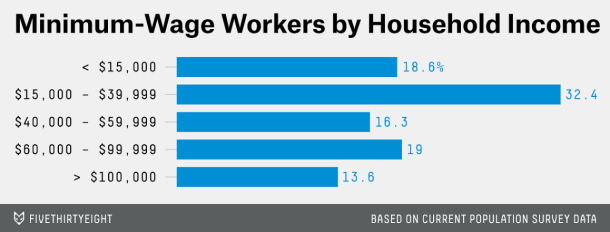
2. Most minimum wage earners are not poor. The vast majority of minimum wage jobs are held as second jobs or held by second earners in a household or by the kids of affluent households (source)
Most of the data I have seen points to about a third of minimum wage jobs held by earners in families below the poverty line. So 2/3 of the increased wages from a minimum wage increase go to non-poor households (it is actually probably more than this given #4 below).
4. Minimum wage increases kill unskilled labor hours. You can certainly find Leftish studies that point to niche situations where a minimum wage increase maybe kindof didn't hurt employment. But in general I think most people understand that when you raise the price of something, people will use less of it. In this case, businesses will find ways to hire less unskilled labor as the price of such labor rises with the minimum wage. Even if businesses hire the same number of people after a minimum wage increase, they likely will demand and get more skilled and experienced employees for this money, which likely will leave the poor out in the cold just as much as if the job were eliminated.
If one replaces the words "minimum wage" with "starting wage for new unskilled workers", the problem becomes more obvious.
5. Minimum wage laws ignore substantial non-monetary benefits of entry-level jobs. Many young workers or poor workers with a spotty work record need to build a reliable work history to get better work in the future, just as a young couple must build their credit history with small purchases before they can take out a mortgage. Further, many folks without much experience in the job market are missing critical skills -- by these I am not talking about sophisticated things like CNC machine tool programming. I am referring to prosaic skills you likely take for granted (check your privilege!) such as showing up reliably each day for work, overcoming the typical frictions of working with diverse teammates, and working to achieve management-set goals via a defined process. I wrote a lot more about these here. By defining acceptable compensation of jobs only as dollars of pay rather than to include softer skills and such, these wages disproportionately discriminate against unskilled and inexperienced workers.
Well, it is time for many of our seasonal operations to open over the next few weeks so I have been running in circles on business issues. Also, I must confess that blogging is becoming a sort of Groundhog Day (the movie) experience, with the same arguments circling over and over. How many more times can I write, say, a long article about how minimum wage increases are a terrible anti-poverty program only to get one line emails asking me why I hate poor people. So blogging will be light as I do real world work and try to recharge.
I will leave you with one note of optimism, from Mark Perry. I went to college in the nadir (1980) of the American beer industry, where a small oligopoly of mediocre beer producers was protected by government legislation. It was a classic example of how regulation drives monopoly, consolidation, and loss of choice. With deregulation, the American beer industry has exploded.
As an aside, my current go-to beer is actually Brazilian, Xingu Black
As most of you may know, our company privately operates public parks. Just before Memorial Day, our largest contract (which covers a lot of our overhead) was shut down by a fire in the Sedona area. Since that time, our landlord the US Forest Service has announced it is going to keep all of these locations closed indefinitely out of fear of flash flooding (fire-damaged hillsides create a lot more runoff in eve light rain due to loss of ground cover and chemical changes in the soil that make it less permeable). I think they are over-reacting, but it is not my decision to make.
The result of this is I have been in total operational scrambling mode and may remain so for a while, reducing the amount of blogging I do.
Studies are still mixed about the direction of feedbacks, with as many showing negative as positive feedback. No study that I have seen supports positive feedbacks as large as those used in many climate models
As a result, climate models are systematically exaggerating warming (from Roy Spenser, click to enlarge). Note that the conformance through 1998 is nothing to get excited about -- most models were rewritten after that date and likely had plugs and adjustments to force the historical match.
To defend the forecasts, modellers are increasingly blaming natural effects like solar cycles on the miss, natural effects that the same modellers insisted were inherently trivial contributions when skeptics used them to explain part of the temperature rise from 1978-1998.
By the way, 1978-1998 is still the only period since 1940 when temperatures actually rose, such that increasingly all catastrophic forecasts rely on extrapolations from this one 20-year period. Seriously, look for yourself.
Alarmists are still blaming every two or three sigma weather pattern on CO2 on global warming (polar vortex, sigh).
Even when weather is moderate, media hyping of weather events has everyone convinced weather is more extreme, when it is not. (effect explained in context of Summer of the Shark)
My temperature forecast from 2007 still is doing well. Back in '07 I regressed temperature history to a linear trend plus a sine wave.
I discuss in a bit more detail at my climate blog why I feel like climate blogging has become boring and repetitious. To prove it, I predict in advance the stories that skeptics will run about the upcoming IPCC report.
Does anyone know if the Google feedproxy servers are going away with Reader? If so, about a zillion links on my site are about to break. My hope is that Google uses these for more than just reader. Perhaps at Feedburner? (though if Google is bailing on RSS that might be next on the kill list).
I would normally just do a Regex search to fix this, but there is no systematic way to do it, you have to resolve the link and then replace the resolved URL. Someone seems to have an app for this, but I am not sure it is ready for prime time and I do not want to use it unless I have to. But once the servers are turned off, it will be too late.
Anyone know about this or have advice? Obviously, I have been trying not to use these feedproxy URL's if I can remember not to do so.
Apparently it is somewhat unethical in the feminist world for women to go to the Ivy League and then become a full-time mom. I know several women who have Ivy League undergrad or graduate degrees and have, for at least part of their lives, been full time moms. I am married to one, for example. I have a few thoughts on this:
People change plans. Life is path-dependent. Many women who ended up being full time moms out of the Ivy League will tell you that it still surprises them they made that choice.
Why is education suddenly only about work? I thought liberal arts education was all about making you a better person, for pursuits that go far beyond just one's work life. I, for example, get far more use of my Princeton education in my hobbies (e.g. blogging) than in my job. The author uses law school as an example, and I suppose since law school is just a highbrow trade school one might argue it is an exception. But what is wrong with salting the "civilian" population with non-lawyers who are expert on the law?
Type A Ivy League-trained full-time moms do a lot more that just be a mom, making numerous contributions in their community. I am always amazed what a stereotyped view of moms that feminists have.
If spots in the Ivy League, as implied by this article, should only be held by people seriously wanting to use the degree for a meaningful lifetime career, then maybe the Ivy League needs to rethink what degrees it offers. Ask both of my sisters about the value of their Princeton comparative literature degrees in the marketplace. By this logic, should Princeton be giving valuable spots to poetry majors?
I can say from experience that the one thing a liberal arts education, particularly at Princeton which emphasized being well rounded, prepared me for was being a parent. I can help my kids develop and pursue interests in all different directions. One's love of learning and comfort (rather than distrust) of all these intellectual rubs off on kids almost by osmosis. In other words, what is wrong with applying an Ivy League education to raising fabulous and creative kids?
The author steps back from the brink, but this comes perilously close to the feminist tendency to replace one set of confining expectations for women with a different set.
Oh and by the way, to the author's conclusion:
Perhaps instead of bickering over whether or not colleges and universities should ask us to check boxes declaring our racial identity, the next frontier of the admissions should revolve around asking people to declare what they actually plan to do with their degrees. There's nothing wrong with someone saying that her dream is to become a full-time mother by 30. That is an admirable goal. What is not admirable is for her to take a slot at Yale Law School that could have gone to a young woman whose dream is to be in the Senate by age 40 and in the White House by age 50.
I would argue the opposite -- the fewer people of both sexes who go to law school to be in the Senate by 40 and the White House by 50, the better.
Update: My wife added two other thoughts
Decades ago, when her mom was considering whether she wanted to go to graduate school, her dad told her mom that even if she wanted to be a stay at home mom, a good graduate degree was the best life insurance she could have in case he died young.
Women with good degrees with good earning potential have far more power in any divorce. How many women do you know who are trapped in a bad marriage because they don't feel like they have the skills to thrive in the workplace alone?
By and large, my friends and my friends’ friends are all intelligent, educated, gregarious, and creative. They’re insightful and thoughtful. They’re critical and ambitious. So why do so many employers put them in positions that don’t take full advantage of what they’ve got to offer?...
But this is really bad talent management on the part of our employers. If you have ambitious, smart young people who actually want to do more work and use their talents to the maximum – so that they can grow as people and employees – then you’re an idiot as an employer to not take advantage of this....
The places that we work for are chock-a-block with people who are contented in their positions; they’re sitting low in their saddles, riding out the last miles toward the sunset of retirement. They’re not interested in changing horses any more, the way we are, and so those saddles that we want to have remain full, often by people who have lost more than just their ambitions for new jobs. They’ve lost the drive to get things done quickly, they’ve lost creativity, and they’ve especially lost the outsider’s perspective on the job they do and the company they work for. They’re entrenched in the corporate culture of the place, and nothing kills innovation or ambition faster than people dedicated to the status quo....
This is where I am, and many of my friends are in this position too, just hoping and waiting for either the next better job outside, or some radical shift inside. I’ve thought seriously about changing my LinkedIn profile blurb to something like, “My career goal is to gain a position that energizes, excites, challenges, and values me, so that I can continue to develop my skills and talents, and grow as a person.” I wonder if that would catch anyone’s eye?...
OK, stay with me, I am saving the good part for last, but it is important to get this background. This person is seriously confused. Companies do not exist to give one jobs that match one's skills. In fact, they do not exist to provide jobs at all. They exist to serve customers and thereby generate surpluses for the owners. They hire people to do specific jobs that are part of a process to serve these customers and owners.
I am sympathetic to the notion that there is lost value in my employees, that they can do things that might be useful to me that I do not tap. But I have 500 employees. I have time to customize like maybe two of those jobs to the talents of individuals, and these are high level jobs where the benefit of that time commitment on my part is worth it. For the rest of the employees, I have to be satisfied I am missing some value, because at best I don't have the time or resources to customize jobs to every employee's unique snowflakeness. And at worst, such customization would mess up our customer service process. At some level, I don't want every front line employee inventing his or her own imagined customer contact or cash management process.
But I promised you the best is yet to come. and here it is:
All of them wonder when their break is going to come, when the thing they’re doing will finally spill over from ‘just making it work’ to ‘making it.’ And I wonder that too, because this risk-taking group of determined individuals should be rewarded by the universe, I think, for their innovation and dedication. The other group, sitting undervalued at their desks, should be likewise rewarded for their abilities and ambitions.
My overall sense is that we’re all in the same place, sitting together in a kind of employment purgatory, waiting for something to happen. We keep working – we’re not sitting idle. We apply for jobs, we network, push for promotions or projects, advertise ourselves, and keep our eyes on the horizon. We are striving, ever striving, for the thing that we want that we know we can do. Economists be damned, we’re all just waiting for our big break, and we won’t be satisfied with a comfy saddle riding toward the sunset.
Did you get that? This risk-taking and proactive group is determined to sit on their ass and wait for someone in the universe to appreciate them, for some organization to create a perfect job that gives each employee snowflake his or her perfect work experience.
Jeez, I have had a series of sucky jobs over time. So as advice to those that think a proactive job search encompasses seriously considering a new Linked-in profile blurb, I did two things:
I changed jobs, and eventually went to work for myself.
I stopped defining my total-life fulfillment by what I do for a paycheck, and took on other tasks outside of work (blogging, writing, building) that brought me satisfaction but for which people have been as-yet unwilling to pay me.
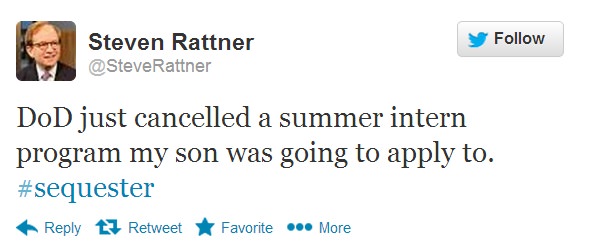
I don't know how I got onto blogging all Steven Rattner, all the time, but here I go again. Mr. Rattner is complaining that the sequester is costing his son a chance at a government internship for which he had wanted to apply.
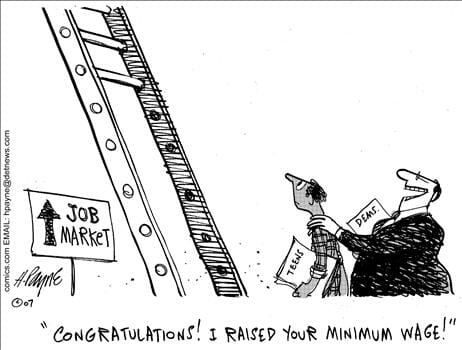
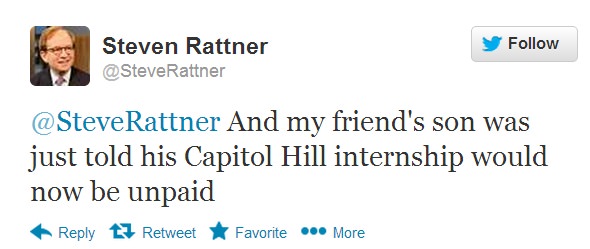
So perhaps Mr. Rattner's son could go work in a productive field instead? Oops, probably not, because rising minimum wages and Obama Administration crack-downs on unpaid private internships have made it harder for all the rest of us to get our little preciouses an internship. I will bet any amount of money that the number of internships killed by minimum wage laws is at least two orders of magnitude larger than the number of internships killed by the sequester.
And besides, we should be thrilled that one less young person is having their formative organizational experiences (from conflict resolution to productivity expectations) in government.
Oh, and by the way, that bit about the Obama Administration cracking down on unpaid internships? Well, that only applies to you private employers who are teaching useless skills like innovation and wealth creation. Jobs that teach Congress's organizational and productivity secrets don't have to be paid because of all the valuable lessons taught.
...for the first time that I can remember, this means that I have a personal stake in the election. It's not just that I find one side's policies more congenial in the abstract, but that one policy in particular could have a substantial impact on my life.
You see, I've never really intended to keep blogging until I'm 65. I might, of course. Blogging is a pretty nice job. But I'd really like to have a choice, and without Obamacare I probably won't. That's because I'm normal: I'm in my mid-50s, I have high blood pressure and high cholesterol, a family history of heart trouble, and a variety of other smallish ailments. Nothing serious, but serious enough that it's unlikely any insurance company would ever take me on. So if I decided to quit blogging when I turned 60, I'd be out of luck. I couldn't afford to be entirely without health insurance (the 4x multiplier that hospitals charge the uninsured would doom me all by itself), and no one would sell me an individual policy. I could try navigating the high-risk pool labyrinth, but that's a crapshoot. Maybe it would work, maybe it wouldn't.
But if Obamacare stays on the books, I have all the flexibility in the world. If I want to keep working, I keep working. If I don't, I head off to the exchange and buy a policy that suits me. No muss, no fuss.
Attempting to remind him of these comments, I commented today:
I'm confused here. A few weeks ago, didn't you say you support Obamacare because it let you retire early? You said you could not afford to quit working early without Obamacare, because you would need your work and income to pay for, what to you, is a vital good. Obamacare allows you to quit working earlier, presumably because other people, rather than you, will pay for at least a part of your health care with their labor.
I understand no one likes the word "moocher." But you came on these pages really proudly announcing that Obamacare allowed you to retire early while others labored to support your needs. What word would you suggest as an alternative, then, to describe this behavior?
(Yeah, I can predict the response. It's not the subsidy you want, just the community rating. Well, high premiums for 55-year-olds with pre-existing conditions are not some evil conspiracy, they reflect true cost to serve. Having a government mandate that you pay the premiums of a healthy 25-year-old when you are 60 and sick is still a subsidy, paid for with someone else's labor. As a minimum, 25-year-old minimum wage workers just entering the work force pay more when they are healthy so you can lead a life of indolence).
...for the first time that I can remember, this means that I have a personal stake in the election. It's not just that I find one side's policies more congenial in the abstract, but that one policy in particular could have a substantial impact on my life.
You see, I've never really intended to keep blogging until I'm 65. I might, of course. Blogging is a pretty nice job. But I'd really like to have a choice, and without Obamacare I probably won't. That's because I'm normal: I'm in my mid-50s, I have high blood pressure and high cholesterol, a family history of heart trouble, and a variety of other smallish ailments. Nothing serious, but serious enough that it's unlikely any insurance company would ever take me on. So if I decided to quit blogging when I turned 60, I'd be out of luck. I couldn't afford to be entirely without health insurance (the 4x multiplier that hospitals charge the uninsured would doom me all by itself), and no one would sell me an individual policy. I could try navigating the high-risk pool labyrinth, but that's a crapshoot. Maybe it would work, maybe it wouldn't.
But if Obamacare stays on the books, I have all the flexibility in the world. If I want to keep working, I keep working. If I don't, I head off to the exchange and buy a policy that suits me. No muss, no fuss.
So yes, this election matters, and it matters in a very personal way. It does to me, anyway. It's not just about gridlock as far as the eye can see.
I usually have a pretty thick skin for this type of stuff, but this got to me. I wrote:
Great. Those of us who are comfortable actually, you know, working to support ourselves look forward to subsidizing your future indolence.
Sorry, I am not usually that much of a snarky jerk, but really, that is what you are celebrating. You are not celebrating some medical or scientific breakthrough that allows you to stay healthy at a lower cost. You are celebrating a system to force other people to pay for your body's maintenance. All so you don't have to support yourself for over a quarter of your life.
If you were to say that, "wow the health dice really rolled against me and I need help," few would begrudge you the help. But this notion of an indolent retirement is radically new. It is a product of our century's and our country's great wealth. Retirement is a luxury good. I have no problem with anyone consuming this luxury good out of their savings, but consuming it out of mine, and then crowing about it to my face, is highly irritating.
If I were a Republican, or if I had one iota of trust in them, I might write that this is what the election is about. Since I don't have such trust, I will instead merely highlight Drum's thoughts as a good representation of modern entitled thinking. For God sakes this guy is not even trying to use my money to escape, say, a coal mine early. He wants my cash to escape blogging early, perhaps the cushiest job there is (as indicated by the fact that many of us do it for no compensation what-so-ever).
The whole topic of licensing as anti-consumer efforts to restrict competition is a long-running one here. Since I am sort-of-kind-of not-blogging right now, I won't excerpt or comment on it a lot, but this is a very interesting piecelooking at internal documents of the American Dietetic Association discussing their efforts to pass laws in various states that essentially ban anyone but their members from giving diet and nutrition advice. It is one such law in North Carolina which required that Steve Cooksey take down all his blog posts about his dieting experiences (since he is not licensed by the state, it is illegal for him to speak on the topic).
The funniest part for me in the ADA materials is that they constantly seem to be put out that their efforts to ban competition from anyone outside of their organization are described by critics as creating a monopoly. Who, us? Monopoly? We are just trying to help customers. Missing in all this, of course, is any evidence of a grass roots effort by nutrition customers. I will remind everyone of this great Milton Friedman quote:
The justification offered is always the same: to protect the consumer. However, the reason is demonstrated by observing who lobbies at the state legislature for the imposition or strengthening of licensure. The lobbyists are invariably representatives of the occupation in question rather than of the customers. True enough, plumbers presumably know better than anyone else what their customers need to be protected against. However, it is hard to regard altruistic concern for their customers as the primary motive behind their determined efforts to get legal power to decide who may be a plumber.
I have picked up my family and moved to a rental house on the California coast for a month. I am still working, but experimenting with getting out of town for the hot Arizona summers. I may or may not take the opportunity to cut back on blogging for a month or so. I haven't decided.