There's no point trying to fight climate change - we'll all be dead in the next decade and there's nothing we can do to stop it, a visiting scientist claims.
Guy McPherson, a biology professor at the University of Arizona, says the human destruction of our own habitat is leading towards the world's sixth mass extinction.
Instead of fighting, he says we should just embrace it and live life while we can.
"It's locked down, it's been locked in for a long time - we're in the midst of our sixth mass extinction," he told Paul Henry on Thursday.
....
"I can't imagine there will be a human on the planet in 10 years," he says.
"We don't have 10 years. The problem is when I give a number like that, people think it's going to be business as usual until nine years [and] 364 days."
He says part of the reason he's given up while other scientists fight on is because they're looking at individual parts, such as methane emissions and the melting ice in the Arctic, instead of the entire picture.
"We're heading for a temperature within that span that is at or near the highest temperature experienced on Earth in the last 2 billion years."
Instead of trying to fix the climate, Prof McPherson says we should focus on living while we can.
"I think hope is a horrible idea. Hope is wishful thinking. Hope is a bad idea - let's abandon that and get on with reality instead. Let's get on with living instead of wishing for the future that never comes.
Our company operates a number of public campgrounds and parks, including about 35 in Arizona. This is a letter I sent early this morning to the agencies we work with in Arizona
It appears that the ballot initiative for a higher Arizona minimum wage is going to pass, raising minimum wages as early as January, 2017 from $8.05 to $10.00. This is an increase of 24%, and comes on very short notice.
Currently, about half of our total costs are tied to wage rates (both payroll taxes and workers compensation insurance premiums are directly tied to wages and go up automatically by the same amount wages go up). Because of this, a 24% increase in wage rates will result in our costs going up on average by 12%.
It had been my intention to keep fees to customers flat in 2017, but that is now impossible in Arizona. This 12% expense increase is about twice the amount of profit we make -- there is no way we can absorb it without a fee increase. I apologize for the late notice, but I have never, ever had a minimum wage increase imposed on such short notice.
We will have to look at our financials for each permit, but my guess is that on average, we are talking about camping fee increases of $2 and day use fee increases of $1. This range of fee increases will actually not cover our full cost increase, but we will try to make up the rest with some reductions in employee hours.
Americans are leaving the costliest metro areas for more affordable parts of the country at a faster rate than they are being replaced, according to an analysis of census data, reflecting the impact of housing costs on domestic migration patterns.
Those mostly likely to move from expensive to inexpensive metro areas were at the lower end of the income scale, under the age of 40 and without a bachelor’s degree, the analysis by home-tracker Trulia found.
Looking at census migration patterns across the U.S. from 2010 to 2014, Trulia analyzed movement between the 10 most expensive metro areas—including all of coastal California, New York City and Miami—and the next 90 priciest metro areas, based on the percentage of income needed to pay a monthly mortgage on a typical home.
I can't tell you now many people I know here in Arizona that tell horror stories about California and how they had to get out, and then, almost in the same breath, complain that the only problem with Arizona is that it does not have all the laws in place that made California unlivable in the first place. The will say, for example, they left California for Arizona because homes here are so much more affordable, and then complain that Phoenix doesn't have tight enough zoning, or has no open space requirements, or has no affordability set-asides, or whatever. I am amazed by how many otherwise smart people cannot make connections between policy choices and outcomes, preferring instead to judge regulatory decisions solely on their stated intentions, rather than their actual effects.
Christopher L. Eisgruber
1 Nassau Hall
Princeton University
Princeton, NJ 08544
Mr. Eisgruber:
The other day I received a call from a Princeton student calling to encourage me to participate in annual giving this year. I was in a hurry, and I feel bad that I gave the student a rushed answer, but I told him that I thought universities were lost and that I no longer had any desire to donate money to any of them. The word “lost” is admittedly imprecise, but it was the best I could to summarize my concerns in a brief call.
When I was at Princeton, we used to laugh at those crotchety alumni who wrote angry letters about Princeton letting in women, or integrating the all-male eating clubs, or whatever else. I never imagined that someday I would find myself writing one of those “I can't donate to Princeton any more” letters, yet here I am doing just that.
I find that the local newspaper in most towns is generally a strong supporter of most every business relocation subsidy or tax incentive that comes along -- whether it be for Apple or an NHL team or a movie production, the local paper benefits from having more newsworthy activity in town.
But the AZ Republic actually ran an article this weekend questioning movie tax incentives, perhaps the only government subsidy dumber than buying sports stadiums for billionaires
States, including Arizona, that don't offer movie and television tax breaks usually are smart not to do so, a researcher contends.
Nearly all states have lured Hollywood productions at one time or another with special tax incentives, but a University of Southern California professor says such spending fails to deliver the long-term economic benefits promised by industry lobbyists and lawmakers.
“The subsidies are a bad investment," said Michael Thom, an assistant professor in USC's Price School of Public Policy, in a prepared statement. "States pour millions of tax dollars into a program that offers little return."
Arizona doesn't currently offer tax incentives for the industry but spent $23.7 million on subsidies between 2005, when the program started, and 2010, when incentives ended amid a state budget crisis.
Thom, who has led two recent studies on the topic, looked at job growth, wage increases, entertainment-industry output and other factors for each state. "On average, the only benefits were short-term wage gains, mostly to people who already work in the industry," he said. "Job growth was almost non-existent. Market share and industry output didn’t budge.”
A two-fer! This is from Yglesias's very good article on passenger rail also quoted in the previous post. In discussing why Amtrak is generally uninterested in making incremental improvements on the Northeast Corridor, he writes:
The way Amtrak is currently set up, there's no real incentive to undertake incremental improvements. The Northeast Corridor already generates an operating profit, which simply defrays losses elsewhere in the system. Making it run better doesn't generate any wins for the people who would have to do the work, and would plausibly just lead Congress to reduce subsidies. If the NEC were spun off as an independent entity — perhaps even a private company — then it could internalize the gains from improved service and seek private financing to make cost-effective investments.
Long-time readers will know that my company privatizes the operation (but not the ownership) of public parks. I will make two-hour presentations to parks agencies about how we can improve operations quality while cutting costs by 30-50% or more, and the near-universal response is, "well, if you reduce costs, then the legislature will just reduce our appropriations." More efficient park operations, and at the margin better visitor service, don't create any wins for agency employees given their incentives. In fact, if the parks are improved and more people show up, their job is just harder. I had the manager of Arizona's premier state park tell me, absolutely in all seriousness, that he had the best job in the world if it wasn't for all the visitors. Can you imagine a McDonald's franchise manager saying that? As I have always said, government is not populated with bad people, it is populated with perfectly normal people who have terrible incentives.
When agencies choose how to spend incremental funds, they will almost always try to route these to the agency staff, in the form of more headcount and/or more pay. When money is actually spent to make investments in the parks themselves, projects are chosen not by return on investment or customer priorities, but based on which ones will create the most prestige for the agency and its leaders. This latter is one reason the Washington Metro is the mess it is, as the agency and the politicians who make appropriations will always prioritize system expansions over capital maintenance and sensible incremental improvements.
This is home repair day, so I am working from home while a variety of repair people show up (none of whom has yet shown up in their promised arrival time window).
Anyway, the A/C guy was here first and was diagnosing why my condenser didn't seem to be running. He found this on the cooling fan motor (dead):
In part A of this chapter, we showed that the world had indeed warmed over the past 30-100 years, whether you looked at the surface temperature record or the satellite record. Using either of these metrics, though, we did not see global warming accelerating, nor did we see warming rates that were faster than predicted. In fact, we saw the opposite.
One story I left out of part A, because it did not affect the basic conclusions we drew, is the criticisms of the surface temperature record. In this part B, we will discuss some of these criticisms, and see why many skeptics believe the 0.8C warming number for the past century is exaggerated. We will also gain some insights as to why the satellite measured warming rates may be closer to the mark than rates determined by surface temperature stations.
Uncorrected Urban Biases
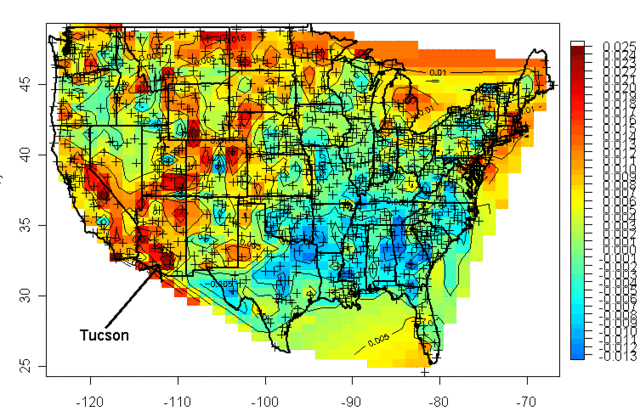
Years ago a guy named Steve McIntyre published a graphical portrayal of warming rates across the US. This is a common chart nowadays. Anyway, this chart (almost 10 years old) drew from temperature measurement stations whose locations are shows with the crosses on the map:
I was living in Arizona at the time and I was interested to learn that the highest warming rate was being recorded at the USHCN station in Tucson (remember, just because Arizona is hot is no reason to necessarily expect it to have high warming rates, they are two different things). At the time, Anthony Watt was just kicking off an initiative to develop quality control data for USHCN stations by having amateurs photograph the sites and upload them to a central data base. I decided I would go down to the Tucson site to experience the highest warming rate myself. This is what I found when I tracked down the station, and took this picture (which has been reproduced all over the place at this point):
That is the temperature station, around that fenced in white box (the uproar over this picture eventually caused this location to be closed). It was in the middle of a parking lot in the middle of a major university in the middle of a growing city. 100 years ago this temperature station was in the countryside, in essentially the open desert - no paving, no buildings, no cars. So we are getting the highest warming rates in the country by comparing a temperature today in an asphalt parking lot in the middle of a city to a temperature a hundred years ago in the open desert.
The problem with this is what's called the urban heat island effect. Buildings and concrete absorb heat from the sun during the day, more than would typically be absorbed by raw land in its natural state. This heat is reradiated at night, causing nights to be warmer in cities than in the areas surrounding them. If you live in a city, you will likely hear weather reports that predict colder temperatures in outlying areas, or warn of freezes in the countryside but not in the city itself.
It turns out that this urban heat island effect is easily measured -- it even makes a great science fair project!
My son and I did this project years ago, attaching a small GPS and temperature probe to a car. We then drove out of the city center into the country and back in the early evening, when the urban heat island effect should be largest. We drove out and then back to average out any effects of overall cooling during our testing. One of the trips is shown above, with around 6 degrees F of temperature change. We, and most others who have done this in other cities, found between 5 and 10 degrees of warming as one drives into a city at night.
If this effect were constant over time, it would not pose too many problems for our purposes here, because we are looking at changes in average temperatures over time, not absolute values. But the urban heat island warming of a city (and particular temperature stations) increases as the urban area grows larger. Because this urban warming is many times the global warming signal we are trying to measure, and since most temperature stations are located near growing urban locations, it introduces an important potential bias into measurement.
A number of studies have found that, in fact, we do indeed see more warming historically in thermometers located in urban areas than in those located in rural areas. Two studies in California have shown much lower warming rates at rural thermometers than at urban ones:
Anthony Watt has been working for years to do this same analysis for the entire US. In fact, the pictures taken above of the temperature station in Tucson were part of the first phase of his project to document each USHCN site used in the global warming statistics with pictures. Once he had pictures, he compared the details of the siting with a classification system scientists use to measure the quality of a temperature sites, from the best (class 1) to the worst with the most biases (class 5). He found that perhaps a third of the warming in the official NOAA numbers may come from the introduction of siting biases from bad sites. Or put another way, the warming at well-sited temperature stations was only about 2/3 in the official metric.
By the way, this is one other reason why I tend to favor the satellite measurements. Going back to the numbers we showed in part A, the satellite temperature metric had about 2/3 the trend of the surface temperature reading, or almost exactly what the surface readings would be if this siting bias were eliminated (the absolute values of the trends don't match, because they are for different time periods and different geographies).
There is one other aspect of this chart that might have caught your eye -- if some temperature stations are showing 2 degrees of warming and some 3.2 degrees of warming, why is the total 3.2 degrees of warming. Shouldn't it be somewhere in the middle?
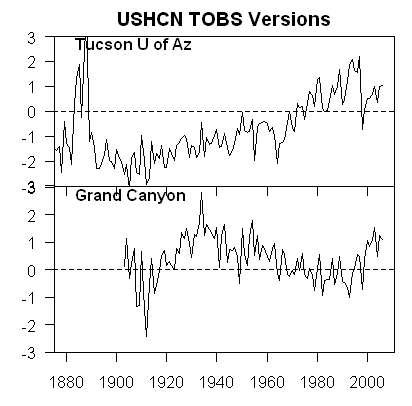
One explanation is that the NOAA and other bodies take the data from these stations and perform a number of data manipulation steps in addition to a straight spatial averaging. One such step is that they will use a computer process to try to correct temperature stations based on the values from neighboring stations. The folks that run these indices argue that this computational process overcomes the site bias problem. Skeptics will argue that this approach is utter madness -- why work to correct a known bad temperature point, why not just eliminate it? If you have a good compass and a bad compass, you don't somehow mathematically average the results to find north, you throw out the bad one and use the good one. In short, skeptics argue that this approach does not eliminate the error, it just spreads the error around to all the good stations, smearing the error like peanut butter. Here is an example from the GISS, using station data that has only been adjusted for Time of Observation changes (TOBS).
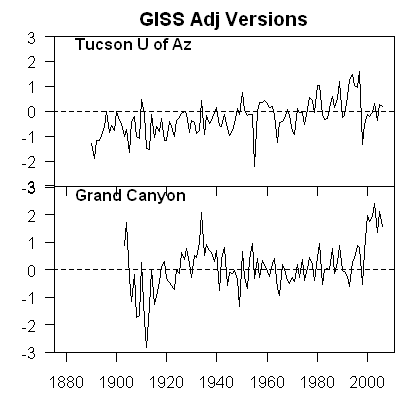
This is exactly what we might expect - little warming out in undeveloped nature in Grand Canyon National Park, lots of warming in a large and rapidly growing modern city (yes, the Tucson data is from our favorite temperature station we featured above). Now, here is the same data after the GISS has adjusted it:
You can see that Tucson has been adjusted down a degree or two, but Grand Canyon has been adjusted up a degree or two (with the earlier mid-century spike adjusted down). OK, so it makes sense that Tucson has been adjusted down, though there is a very good argument to be made that it should be been adjusted down more, say by at least 3 degrees. But why does the Grand Canyon need to be adjusted up by about a degree and a half? What is currently biasing it colder by 1.5 degrees, which is a lot? One suspects the GISS is doing some sort of averaging, which is bringing the Grand Canyon and Tucson from each end closer to a mean -- they are not eliminating the urban bias from Tucson, they are just spreading it around to other stations in the region.
Temperature Adjustments and Signal-To-Noise Ratio
Nothing is less productive, to my mind, than when skeptics yell the word "fraud!" on the issue of temperature adjustments. All temperature databases include manual adjustments, even the satellite indices that many skeptics favor. As mentioned above, satellite measurements have to be adjusted for orbital decay of the satellites just as surface temperature measurements have to be adjusted for changes in the daily time of observation. We may argue that adjustment methodologies are wrong (as we did above with urban biases). We may argue that there are serious confirmation biases (nearly every single adjustment to every temperature and sea level and ocean heat database tends to cool the past and warm the present, perhaps reinforced by preconceived notions that we should be seeing a warming signal.) But I find that charges of fraud just cheapen the debate.
Even if the adjustments are all made the the best of intentions, we are still left with an enormous problem of signal to noise ratio. It turns out that the signal we are trying to measure -- warming over time -- is roughly equal to the magnitude of the manual adjustments. In other words, the raw temperature data does not show warming, only the manually adjusted data show warming. This does not mean the adjusted data is wrong, but it should make us substantially less confident that we are truly measuring the signal in all this noise of adjustment. Here are two examples, for an individual temperature station and for the entire database as a whole:
In this first example, we show the raw data (with Time of Observation adjustments only) in orange, and the final official adjusted version in blue. The adjustments triple the warming rate for the last century.
We can see something similar for the whole US, as raw temperature measurements (this time before time of observation adjustments) actually shows a declining temperature trend in the US. In this case, the entirety of the global warming signal, and more, comes from the manual adjustments. Do these adjustments (literally thousands and thousands of them) make sense when taken in whole? Does it make sense that there was some sort of warming bias in the 1920's that does not exist today? This is certainly an odd conclusion given that it implies a bias exactly opposite of the urban heat island effect.
We could go into much more detail, but this gives one an idea of why skeptics prefer the satellite measurements to the surface temperature record. Rather than endlessly working to try to get these public agencies to release their adjustment details and methodology for third party validation to the public that pays them (an ongoing task that still has not been entirely successful), skeptics have simply moved on to a better approach where the adjustments (to a few satellites) are much easier to manage.
Ultimately, both approaches for seeking a global warming signal are a bit daft. Why? Because, according to the IPCC, of all the extra warming absorbed by the surface of the Earth from the greenhouse effect, only about 1% goes into the atmosphere:
Basically, water has a MUCH higher heat carrying capacity than air, and over 90% of any warming should be going into oceans. We are just starting to get some new tools for measuring the changes to ocean heat content, though the task is hard because we are talking about changes in the thousandths of a degree in the deep oceans.
After this brief digression into the surface temperature records, it is now time to get back to our main line of discussion. In the next chapter, we will begin to address the all-important attribution question: Of the warming we have seen in the past, how much is man-made?
I just got a bill for some extra property tax I owe to a county in California. The story behind it is sad and sort of hilarious.
A year or two ago I got billed in an audit for some "California use tax" on some golf carts we moved to California from Arizona. I hadn't thought I owed use tax on them because I paid sales tax in Arizona where I bought them. But California sales tax is higher than that in Arizona (naturally) so I apparently owed use tax on the difference. OK, I paid it.
Then, just recently, I was informed by one county in California that my property tax reports were wrong. I reported the value of the gold carts based on what I bought them for but I did not include the California use tax in the value. That had to be added to their value (even though in actuality the use tax made them less valuable). Anyway, I got a tax bill for the property tax I owe on the value of the use tax I paid for carts, which in turn was based on the higher rate of sales taxes charged in California than Arizona. All because I actually moved business assets into California.
Won't make that mistake again! Over the last 5 years I have pulled nearly a half million dollars in business assets out of California, terminated 5 contracts, and laid off nearly 100 employees there -- all mostly due to the hostile business environment there.
I don't want to give too much credence to Cruz's "New York values" dig on Trump. First, it's silly -- New York is not at all monolithic. Second, it doesn't really even apply to Trump, who often thumbs his nose at New York elite.
But I think that if you asked a lot of people in flyover country, the statement would still have resonance. I think the reason is that while New York is not at all monolithic in its culture and values, its media exports do tend to be much more homogeneous and tend to reflect a Left-liberal coastal condescension.
I was thinking about this watching the Broadway show If/Then which was in Phoenix this weekend. I thought this was a pretty forgettable musical, essentially a sort of remake of the movie "Sliding Doors", that was elevated by Idina Menzel in the lead. We in flyover country seldom get stars of this caliber (at least after they are famous) in our roadshows and she (along with one other female lead who was quite good) made the show worth the ticket.
Anyway, a couple of observations about the show in the context of Cruz's statement:
No character in the show (with 2 exceptions) had a productive job in the private sector. Everyone worked in the city planning department or was a housing activist or a public school teacher. I kid you not, there was actually a song about the joys of urban planning. The two exceptions were: 1) a private architect who thanked the city planning department for overruling his designs and 2) an investment banker who acted like a complete tool and was included for 10 seconds only to illustrate the worst possible imaginable male date.
Accusing a character of being a Republican was used as a laugh-line twice. Since the character was one the authors wanted to the audience to have sympathy for, the character quickly avowed he was an Independent.
Living any place in flyover country (e.g. Nebraska, Arizona**) was used as a laugh line in the show and choosing to live in those places was offered up as an example of bad decision-making. The only place deemed acceptable to live outside of New York was Oregon.
I got over getting too worked up about this sort of stuff years ago (or else I would spend all my time holed up in a cave listening to a few old Rush albums). Cruz was wrong to criticize New York values but I think there is a .... call it an attitude that emanates from New York media that the rest of the country sometimes finds irritating.
** in the show we saw, the lead character had just escaped from a bad marriage in Phoenix. My guess is that this was not the original location, but was switched for the show here (though I could be wrong, since such a switch would have meant adjusting a couple of songs too). Anyone see it on Broadway and know what location was used there?
This is sort of an odd topic to have on my mind, but I was thinking about it today in the context of a bid package I have in my hands for concession management of a park in Georgia.
The RFP kept referring to "community workers" who do 60% of the labor in the park, and part of our responsibilities included managing these workers. In my naivete, I thought these were volunteers, and sent a note telling them that while the government could legally use volunteers, it was very problematic under labor laws for a private company to benefit in any way from volunteer labor.
I was quickly informed that I had it all wrong, that this was a euphemism for "prisoners," and that I could take advantage of their close to fee labor to do much of the heavy lifting in the park maintenance.
I must confess this is a new one for me but my initial reaction is queasiness about it. On the one hand, we are talking about unpaid labor from men in involuntary servitude -- do I really feel good about benefiting economically from this work? On the other hand, I do understand that work programs can be beneficial for prisoners, though I am not sure the work we need is really going to be teaching many skills. On the gripping hand, there is "Cool Hand Luke", which is impossible to get out of my head when considering prison labor in the deep south.
One other aspect of the RFP that struck me cold was the pages and pages of requirements, including an actual oath I have to take, that I will do everything possible not to hire an illegal immigrant. Now, that sort of thing is likely required of them by state law, and is not that unusual (Arizona has similar provisions, I believe). But juxtaposed with the prison labor, it leaves me cold. Essentially, they won't allow me to accept the voluntary labor of a Mexican man paid at minimum wage, but they are encouraging me to accept the involuntary labor for free from a group of prisoners.
I just encountered this about 10 minutes ago so I am still thinking on it -- the basic opportunity is attractive. But I have walked away from opportunities before over these sorts of ethical issues -- most recently, over a refusal to drug test employees when that was a state requirement.
I welcome thoughts in the comments (I know I mentioned immigration, but in this one post I would be thrilled if we could lay off my supposed naivete on immigration and focus on the ethics of profiting from free prison labor).
As someone currently being sued for libel by a deep-pocketed corporation who wants me to take down a product review they don't like, I am happy to see Mother Jones prevail in their libel case brought by Frank VanderSloot, a case pretty transparently brought to suppress speech Mr. VanderSloot didn't like. The bad news is that Mother Jones ended up with a bunch of legal bills for which they cannot get reimbursed (the exact same situation I am likely to face when I inevitably win my case).
This is exactly why we need better state and Federal anti-SLAPP laws, though I have found from personal experience campaigning for them here in Arizona that it is easy to run up against bipartisan opposition. I will say that as happy as I am about Mother Jones' victory, there is a teenie tiny bit of schadenfreude seeing them lament the lack of loser-pay rules, something they would oppose in most any other case but their own.
A few days ago, there was an article in our daily fishwrap that said something I found hard to believe. It said that the state had initiated a crackdown on unlicensed shipments of wine from out of state at the behest of a letter from the Goldwater Institute. It even had a picture (at least in the online edition) of Clint Bolick, Goldwater's chief of litigation.
Essentially, most states do not allow or severely restrict direct purchase by consumers of liquor products from out of state. As usual for such protectionist stupidity, it is claimed to be for the children, but in fact mainly is meant to protect a small, very powerful group of liquor distributors who make a fortune from their state-granted monopoly on liquor wholesaling. Basically, by some outdated post-prohibition laws, every drop of alcohol in the state must pass through the hands of a couple of companies, who of course extract their toll like Baron's of old with castles on the Rhine.
I simply found it unfathomable that Clint Bolick, a founder of the Institute for Justice (IC) for god sakes, would be pestering the state to more vigorously enforce stupid, outdated, and protectionist licensing laws. And it turns out I was right.
Clint Bolick, the Goldwater Institute’s director of litigation, said he sent the state a letter in November 2012 asking it to get rid of a rule that required customers to show up at certain wineries annually in order to get direct shipments to their homes.
Bolick’s letter, which he provided to The Republic and azcentral, said that rule made no sense and would stop Arizonans from joining wine clubs, where wineries send a designated amount of wine to customers each year, sometimes including wines not available to the general public.
“A requirement of annual presence also does not serve any obvious public purpose, given that the purchaser has established age and identity at the time of the order,” he wrote.
Bolick said he met with the director of the department at the time, Alan Everett, who told him the department would start a regulatory review.
So it turns out that Goldwater was trying to ease regulation and make it easier for consumers to have some choice and access to more suppliers. All good.
But it turns out "regulatory review" means something different to a state regulator. I suppose it was too much to think that they might have a review to see if their regulations went too far. In fact, the "regulatory review" seems to have focused on how they could tighten regulations even further. The result was not the one Goldwater hoped for ... instead of making things easier on consumers, the state went all-in trying to make things even worse for consumers.
Hill said Bolick's 2012 letter made the department question whether the wineries sending club shipments into Arizona were all licensed.
“It was the basis for us starting to ask questions about who is shipping liquor into the state of Arizona that does not hold an Arizona liquor license,” Hill said....
So far, the department has investigated 223 violations at a total of 199 wineries, according to records obtained through the Liquor Department’s website.
Additionally, somewhere between 250 and 300 wineries were found to have not filed their production reports. Once the department receives those, it could cause some or all of those to be found in violation. Some of those wineries, in order to comply with state liquor laws and have their cases closed, might also agree to not ship wine to Arizona.
Customers frustrated that they cannot get their wine shipped anymore are funding a renewed effort to change the state’s shipping laws. Two California-based groups, The Wine Institute and Free The Grapes, said they are work
It is clear that Goldwater, representing consumers, has very little influence on the state agency. So who does? Well, you have probably guessed:
Hill said last Thursday the crackdown came at the request of a member of the Arizona wine industry, saying it was an example of government and industry working together.
Ugh, what a happy thought -- government and industry working together to protect incumbents from competition and restrict consumer choice.
The local food movement in Arizona needs just that – movement.
While some shoppers enjoy spending their Saturday mornings at local farmers markets, new research indicates Arizona lacks per-capita sales in the local food industry.
The 2015 Locavore Index found that of the 50 states and Washington, D.C., Arizona has the second lowest per-capita sales for local foods.
Here is a scoop for you: We live in the middle of the freaking Sonoran desert. It is a terrible place to grow most foods. In fact, it is an environmentally awful place to grow food. Local food folks somehow have gotten locked into transportation costs as the key driver of food sustainability that they want to focus on, but transportation costs are 10% or less of most food costs. A small savings on transportation is absolutely dwarfed, from a productivity and resource use standpoint, by the productivity of the soil and the fit of the climate with whatever is being grown.
Here is one way to think of it -- yes, locally grown food may not have to be transported very far, but every drop of water for food grown here in the Phoenix area has to be brought hundreds of miles from declining reservoirs to grow that food.
The movement seems to imply that locally grown food is more healthy. Why? Why is an Arizona tomato healthier than a California tomato?
Finally, the micro-trade-protectionism is pretty funny:
If local Arizonans start buying more local food, the economy may benefit as well.
When buying local grown food, “the money stays here in the local economy, as opposed to buying something in a national chain,” said R.J. Johnson, a sales representative for Blue Sky Organic Farms in Litchfield Park. “You buy something locally, 75 percent of that money stays here in town.”
This is so economically ignorant as to be beyond belief. If more people are growing food here locally (something that is likely a fairly unproductive task given our climate), what productive tasks are they giving up. And this is a national effort -- are they really with a straight face telling every single state that they should buy more locally so their money stays at home? Isn't that just one big zero sum game (actually a negative sum game because you lose benefits of specialization and comparative advantage).
If I were a Mexican in Phoenix, I would do a full walk-around checking my vehicle before every trip. A visiting friend once asked me if the fact that Hispanics all seem to drive so slow was a cultural thing and I said that more likely, they know they will get busted for going even a hair over the speed limit.
When Kris Kobach says "In four different sections, the law [SB1070] reiterates that a law-enforcement official 'may not consider race, color, or national origin' in making any stops or determining an alien's immigration status," he is ignoring reality. The law asks police to make a determination (e.g. probable cause that one is an illegal immigrant) that is impossible for actual human beings to make without such profiling. It's like passing a law that says "police must drive their cars 30 miles a day but can't drive their cars to do so." The reality on the ground here in Arizona is that, illegal or not, Sheriff Joe Arpaio has been using racial profiling to make arrest sweeps for years, and his officers have become masters at finding some pretext to pull over a Mexican they want to check out (e.g. the broken tail light). Words in this law about racial profiling are not going to change anything.
Update: I forgot this story from 2008, which is a great example of what I am talking about here
Arrest records from crime sweeps conducted by the Maricopa County Sheriff's Office add substantial weight to claims that deputies usedracial profiling to pull Latino motorists over to search for illegal immigrants....
even when the patrols were held in mostly White areas such as Fountain Hills and Cave Creek, deputies arrested more Latinos than non-Latinos, the records show. In fact, deputies arrested among the highest percentage of Latinos when patrols were conducted in mostly White areas.
On the arrest records, deputies frequently cited minor traffic violations such as cracked windshields and non-working taillights as the reason to stop drivers.
"These are penny-ante offenses that (police) almost always ignore. This is telling you this is being used to get at something else, and I think that something else is immigration enforcement against Hispanic people," Harris said....
First, let me establish a few background facts. Several years ago I headed an attempt to put a Constitutional amendment legalizing gay marriage on the ballot here in Arizona. As far back as 2004 I had a gay couple running a campground, and faced a customer petition demanding we remove them because they promoted moral degeneracy by being gay (it's for the children!). I told those customers to camp somewhere else, as we were not changing our staffing. Since then I have probably hired more gay couples to run campgrounds than anyone else in the business.
After a period of foreshadowing and rumor, the Equal Employment Opportunity Commission has now gone ahead and ruled that employment discrimination on the basis of sexual orientation is forbidden under existing federal civil rights law, specifically the current ban on sex discrimination. Congress may have declined to pass the long-pending Employment Non-Discrimination Act (ENDA), but no matter; the commission can reach the same result on its own just by reinterpreting current law.
There are multiple problems with non-discrimination law as currently implemented and enforced in the US. Larger companies, for example, struggle with disparate impact lawsuits from the EEOC, where statistical metrics that may have nothing to do with past discrimination are never-the-less used to justify discrimination penalties.
Smaller companies like mine tend to have a different problem. It is an unfortunate fact of life that the employees who do the worst job and/or break the rules the most frequently tend to be the same ones with the least self-awareness. As a result, no one wants to believe their termination is "fair", no matter how well documented or justified (I wrote yesterday that I have personally struggled with the same thing in my past employment).
Most folks grumble and walk away. But what if one is in a "protected group" under discrimination law? Now, not only is this person personally convinced that their firing was unfair, but there is a whole body of law geared to the assumption that their group may be treated unfairly. There are also many lawyers and activists who will tell them that they were almost certainly treated unfairly.
So a fair percentage of people in protected groups whom we fire for cause will file complaints with the government or outright sue us for discrimination. I will begin by saying that we have never lost a single one of these cases. In one or two we paid someone a nominal amount just to save legal costs of pursuing the case to the bitter end, but none of these cases were even close.
This easy ability to sue, enabled by our current implementation of discrimination law, imposes a couple of costs on us. First, each of these suits cost us about $20,000 to win (insurance companies are smart, they know exactly how this game works, and will not sell one an employment practices defense policy without at least a $25,000 deductible, particularly in California). It takes a lot of effort for the government, even if neutral and not biased against employers as they are in California, to determine if the employee who was fired happened to be Eskimo or if the employee was fired because he was an Eskimo. Unfortunately, the costs of this discovery are not symmetric. It costs employees and their attorneys virtually nothing to take a shot at us with such discrimination cases, but costs us$20,000 each to defend and win (talk about Pyrrhic victories). Which is why we sometimes will hand someone a few bucks even if their claim is absurd, just to avoid what turns out to be essentially legal blackmail.
Second, the threat of such suits and legal costs sometimes changes our behavior in ways that might be detrimental to our customers. A natural response to this kind of threat is to be double careful in documenting issues with employees in protected groups, meaning their termination for cause is often delayed. In a service business, almost anyone fired for cause has demonstrated characteristics that seriously hinder customer service, so drawing out the termination process also extends the negative impact on customers.
To make all this worse, many employees have discovered a legal dodge to enhance their post-employment lawsuits (I know that several advocacy groups in California recommend this tactic). If the employee suspects he or she is about to be fired, they will, before getting fired, claim all sorts of past discrimination. Now, when terminated, they can claim they where a whistle blower that that their termination was not for cause but really was retaliation against them for being a whistle-blower.
I remember one employee in California taking just this tactic, claiming discrimination just ahead of his termination, though he never presented any evidence beyond the vague claim. We wasted weeks with an outside investigator checking into his claims, all while customer complaints about the employee continued to come in. Eventually, we found nothing and fired him. And got sued. The case was so weak it was eventually dropped but it cost us -- you guessed it -- about $20,000 to defend. Given that this was more than the entire amount this operation had made over five years, it was the straw that broke the camel's back and led to us walking about from that particular operation and over half of our other California business.
The brief time I led the Equal Marriage Arizona efforts to amend the Constitution to allow gay marriage was a real eye-opener for me. I expected that since I was not a member of the largest gay activist groups, I might have to work to build up trust. But it turned out, trust was not an issue. I seldom had anyone question my sincerity. However, I quickly found all the major gay rights groups (excepting the ACLU, bless their hearts) not just neutral or skeptical but actively opposing our effort. Several people in these organizations dragged me in the figurative back room and explained that the leadership of their group would never accept a non-Democrat getting credit for such a success. And one member of prominent organization (hint: has same initials as Hillary Rodham Clinton) told me that their internal position was that they did not want gay marriage to come to Arizona until after 2016 because they wanted Hillary to be able to run on the issue and hoped to flip AZ blue in 2016.
So, a couple of years ago I would never have believed this story, but now it seems all too familiar
Just this week, legislators introduced a bill that would encourage drug companies to apply to sell contraceptives without a prescription.
But if Republican Sens. Cory Gardner of Colorado and Kelly Ayotte of New Hampshire, along with four other GOP senators, were expecting flowers from Planned Parenthood and others for their bill, the Allowing Greater Access to Safe and Effective Contraception Act, they should brace for disappointment. Suddenly, the idea doesn’t sound so great, and the former supporters aren’t mincing words.
Planned Parenthood president Cecile Richards said the bill is a “sham and an insult to women.â€
Karen Middleton of NARAL Pro-Choice Colorado even got personal, saying, “Cory Gardner can’t be trusted when it comes to Colorado women and their health care.â€...
Beneath the fear-mongering lies the more likely reason for the change of heart on the left. The bill was simply introduced by the wrong party.
My little town that in the Phoenix area is apparently setting up surveillance cameras all over town, hidden in fake cacti. This never once was discussed in any public meeting, and residents only found out about it when the cameras starting going up.
Residents were alarmed to see the cactus cameras popping up throughout the town over the last few days with no indication of what they were being used for as city officials refused to explain their purpose until all the cameras were installed.
Town leaders initially declined to even talk to local station Fox 10 about the cameras, with Paradise Valley Police saying they were “not prepared to make a statement at this time.” The network was similarly rebuffed when they attempted to get answers on license plate scanners that were being installed in traffic lights back in February.
Fox 10’s Jill Monier was eventually able to speak to Town Manager Kevin Burke, who admitted that the cameras were being used to “run license plates of cars against a hotlist database.”
When asked why officials had been secretive about the cameras, which are being placed on the perimeter of the town, Burke asserted that there was “nothing to hide” and that the cameras wouldn’t be activated until privacy concerns had been addressed.
“Shouldn’t that have been vetted before they even went up?” asked Monier, to which Burke responded, “It probably is fair.”
This appears to be part of the on-again-pretend-to-be-off-again DHS program to set up nationwide tracking of license plates. Ugh. Really gives a creepy Owrellian vibe to our town name of "Paradise Valley". More good news:
The American Civil Liberties Union subsequently revealed that the cameras were also using facial recognition technology to record who was traveling in the vehicle “as part of an official exercise to build a database on people’s lives,” reported the Guardian.
But you don't have to go to Bratislava to see something like it. You can find something similar in Mesa, Arizona -- this is the city hall.
Kudos to the photographer for getting the shadow on the concrete pylon on the right to be positioned almost perfectly to fill out the missing part of the building. I actually don't mind the Tempe building, it looks good in context, more public sculpture than building (particularly since this is likely a really inefficient building, with minimal floor space for the money spent to build it).
For some reason, it appears that building hotels next to city convention centers is a honey pot for politicians. I am not sure why, but my guess is that they spend hundreds of millions or billions on a convention center based on some visitation promises. When those promises don't pan out, politicians blame it on the lack of a hotel, and then use public money for a hotel. When that does not pan out, I am not sure what is next. Probably a sports stadium. Then light rail. Then, ? It just keeps going and going.
The city-owned Sheraton Phoenix Downtown Hotel has lost so much money — more than $28.2 million total — that some city leaders say the hotel must be put in the hands of the private sector.
They also worry that the hotel, Arizona's largest with 1,000 rooms, could harm other projects in the downtown core.
When Phoenix leaders opened the Sheraton in 2008, they proclaimed it would be a cornerstone of downtown's comeback. They had one goal in mind: lure big conventions and tourism dollars. Officials argued the city needed the extra hotel beds to support its massive taxpayer-funded convention center a block away.
The city-owned Hilton Baltimore convention center hotel lost $5.6 million last year — a worse performance than 2013 despite its close location to Camden Yards and the Orioles' playoff run.
It was the seventh consecutive year that the hotel has underperformed financially, according to an audit of financial statements presented Wednesday to the city's Board of Estimates. Under the deal's initial projections, the hotel was supposed to be making $7 million in profit by now — pumping that mone into the city's budget....
The hotel has lost more than $70 million since it opened.
I am sure that politicians in both cities called the lack of a hotel a market failure. But now we see that it was a market success. All the companies who chose not to build a hotel with private money obviously knew what they were doing, and only the political benefits of pandering the the public at large and a few special interests in specific made it seem like an attractive investment to city politicians. Which is all pretty unsurprising, since hotels have pretty much been built off every exit ramp in this country, so there seems to be no private inhibition towards building hotels -- just towards building hotels in bad locations.
Kudos to Jeff Gibbs for finally bringing to the pages of the Arizona Republic what strikes me as the most economically obvious, but least mentioned, solution to future water shortages: Price.
Folks often use the abuses in the prostitution industry as evidence of why it should be illegal. But these abuses are actually a result of the illegality. Sex workers in illicit industries cannot use the police and legal system to address abuses without risking arrest. Essentially, they are cut off from access to the legal system and its protections that we take for granted.
People act like the abuses are inherent to the fact that prostitution is a sex work industry, but here is an example of (legal) sex workers protecting themselves and addressing abuses through the legal system, just like all the rest of us do. If prostitution were legal, then prostitutes could do the same.
Three Valley strip clubs are being sued by exotic dancers with the help of a Texas law firm over alleged unpaid tips and wages....
Hodges' firm and the strippers are suing to make the strippers official employees. Their new system would be similar to that of restaurant wait staff, who typically earn a sub-minimum salary (Arizona allows as low as $3 an hour for tipped employees) while pooling tips among their fellow workers. If no customers come in, the staff is still guaranteed to make at least minimum wage, plus time-and-a-half for any overtime worked.
I'm not a big fan of the premise of the lawsuit (trying to force businesses to change their employment model from dancers as independent contractors to dancers as employees) but it is their free access to the legal system that is the point here. One could never imagine such a lawsuit with a group of prostitutes arguing that the people they worked for were not paying them fairly.
My Arizona-raised, thin-blooded son was convinced that he had no problem with cold weather when he departed for Amherst College several years ago. That, of course, was based on exposure to cold via a couple of ski trips. What he likely underestimated was the impact of cold that lasts for like 6 freaking months.
So it was with good-natured parental fondness for my child that I was LMAO when I read this:
The average temperature in Amherst in the past month was 11.2 degrees, the lowest average monthly temperature since records were first kept in town in 1835. It broke the previous record of 11.6 degrees set in 1934, according to Michael A. Rawlins, an assistant professor in the department of geosciences and manager of the Climate System Research Center at the University of Massachusetts.
As it turns out, I have made a climate presentation in Amherst so I actually have historic temperature charts. It is a good example of two things:
While Amherst has been warming, it was warming as much or more before 1940 (or before the era of substantial CO2 emissions) as much as after
Much of the recent warming has manifested as increases in daily minimum temperatures, rather in an increase in daily maximum temperatures. This is as predicted by warming models, but poorly communicated and understood. Possibly because fewer people would be bent out of shape if they knew that warming translated into warmer nights rather than higher highs in the daytime.
I really, really did not want to have to write yet another post on this. 99+% of all climate funding goes to alarmists rather than skeptics. Greenpeace laments donations of funds to skeptics by Exxon of a million dollars or so and wants to drive out all such funding when Greenpeace and Tides and the US Government are giving literally billions to alarmists. Despite this staggering imbalance, the only stories you ever see are about the dangers and bias introduced by that measly 1% skeptics get. I guess that 1% is spent pretty well because it sure seems to have people running in circles declaring the sky is falling.
One would think that at some point the world would wake up and realize that criticizing the funding sources behind an individual does not actually rebut that individual's arguments.
Potential bias introduced by funding sources (or some other influence) are a pointer -- they are an indication there might be a problem warranting deeper examination of the evidence introduced and the methodology of collecting that evidence. Such potential biases are not themselves evidence, and do nothing to rebut an argument. A reasonable way to use such biases in an argument would be something like:
I want to begin by noting that Joe may have had a predisposition to his stated conclusion even before he started because of [funding source, political view, whatever]. This means we need to very carefully look at how he got to his conclusion. And I intend to show you that he made several important errors that should undermine our acceptance of his conclusions. They are....
Unfortunately, nowadays people like the New York Times and our own Arizona Representative Raul Grijalva seem to feel like the job is done after the first sentence. They have decided that the best way to refute recent scientific work by a number of climate scientists is to try to show that some of their funding comes from fossil fuel companies.
Beyond the strange implicit assumption that fossil fuel funding would automatically "disprove" a research paper, there is also an assumption that oil company funding is "unclean" while government or non-profit environmental group funding is "clean". Remember the last time you saw a news story about a climate alarmist's funding? Yeah, neither do I.
There is no justifiable reason for this asymmetry. Funding does not potentially introduce bias because it is sourced from for-profit or non-profit entities. In fact, the motivation of the funding source is virtually irrelevant. The only relevant questions related to bias are:
Did the funding source demand a certain conclusion at the outset of the study as the price of the funding -- or --
Is there a reasonable expectation that the source would deny future funding if the conclusions of the study don't go their way
My sense is that #1 is rare and that the real issue is #2.
But #2 is ubiquitous. Sure, if a group of skeptical scientists suddenly started writing papers about 8 degree warming predictions, Chevron is going to be less likely to fund their future research. But on the flip side if Michael Mann suddenly started saying that future warming will only be a modest 1-2 degrees, do you think that he would continue to get funding from Greenpeace, the Tides Foundation, the WWF, or even from an Obama-run Federal agency? No way. There is absolutely no less bias introduced by Chevron funding than from Greenpeace funding, because in each case there can be a reasonable fear by the researcher that future funding would be denied by that source if the "right" answer was not reached.
Postscript & Disclosure of Biases: I have never received any outside funding for this blog or my climate work. However, if Chevron were to send me a check for a million dollars, I would probably cash it. I do own individual shares of ExxonMobil stock as well as shares of the Vanguard S&P500 index fund, which includes equities of a number of energy companies. I also am a frequent purchaser of gasoline and electricity, as well as a number of other products and services whose prices are tied to energy prices (e.g. air transportation). As a consumer, I would rather not see the prices of these products rise. I buy a lot of food, whose price might be improved by longer growing seasons. My camping company tends to benefit from rising gasoline prices, because rising prices causes people to stay closer to home and camp at the type of places we operate. It is hard to predict how regional climates will change if overall global temperatures rise, but since many of my campgrounds are summer escapes at high altitude, they would probably benefit somewhat from rising temperatures. I own a home in Arizona whose value would probably be lessened if the world warmed 2-3 degrees, because it would make winters in the northeast and midwest more bearable and thus hurt Arizona as a location for a winter second home. Global warming may reduce the life of my dog as we are less likely to walk her when it is over 100 degrees out which makes her less healthy. I own land in Hawaii that might be more valuable if sea level rises puts it 6-8 inches close to the ocean. I am planning a vacation to see the tulips bloom in Holland and changes in climate could shift the blooming date and thus cause me to miss the best colors. Fifteen years from now my daughter would like a June wedding and changes to climate might cause it to rain that day. My daughter also owns 5 shares of Walt Disney and their earnings might be helped by global warming as nostalgia for cooler weather could greatly increase DVD sales of "Frozen".
I am always amazed that the media will credulously run stories against "corporate welfare" for oil companies (which usually mostly includes things like LIFO accounting and investment tax credits that are not oil industry specific) but then beg and plead for us taxpayers to subsidize movie producers.
I wish I understood the reason for the proliferation of government subsidies for film production. Is it as simple as politicians wanting to hobnob with Hollywood types? Our local papers often go into full sales mode for sports team subsidies, but that is understandable from a bottom-line perspective -- sports are about the only thing that sells dead-tree papers any more, and so more local sports has a direct benefit on local newspapers. Is it the same reasoning for proposed subsidies for Hollywood moguls?
Notwithstanding a recent flurry of Super Bowl-related documentaries and commercials that got 2015 off to a good start, Arizona appears to be falling behind in a competitive and lucrative business. The entertainment industry pays well, supports considerable indirect employment and offers the chance for cities and states to shine on a global stage.
Seriously? I am sure setting up the craft table pays better than catering a party at my home, but it is a job that lasts 2 months and is then gone. Ditto everything else on the production. And I am sick of the "shines on the world stage thing." Who cares? And is this really even true? The movie Chicago was filmed in Toronto -- did everyone who watched Chicago suddenly want to go to Toronto? The TV animated series Archer gets a big subsidy from the state of Georgia. Have they even mentioned Georgia in the series? Given the tone of the show, would they even want to be mentioned?
When government subsidizes an industry, it is explicitly saying that resources are better and more productively invested in the subsidized industry than in other industries in which the money would have been spent in a free market. Does the author really have evidence that the money I would have spent to improve the campgrounds we operate in Arizona is better taken from me and spent to get a Hollywood movie shot here instead? Which investment will still be here 6 months from now?
Arizona is one of 11 states that don't offer tax incentives, primarily in the form of income-tax credits, and that's the core of the problem. There's also no state film office to help out-of-state crews obtain filming permits, locate vendors, hire temporary staff and so on.
Arizona's tax incentives expired after 2010 and the film office closed in the wake of a recession that hit the state especially hard and necessitated tough spending choices. Although bills to revive those programs have been introduced, they're not given high odds of success in the current session as the governor and lawmakers struggle to close $1.5 billion in deficits over this year and next.
"Right now, there's nobody to call, the phone isn't being answered and nobody responds to e-mails," said Mike Kucharo, a local producer and director who serves as the state-government liaison for the Arizona Production Association, an entertainment trade and networking group. "We need a film office."
Yeah for us! While all the lemmings in other states bid up the price of a few politicians being able to get their picture with Hollywood types on a production set, we have chosen not to play. Good for us. Only an industry insider clown with a straight face could say that we need a taxpayer-funded film office. Really? Do we need a taxpayer-funded florist office to attract flower sales?
Years ago I wrote an article calling sports team subsidies a prisoners dilemma game, where the only winning move was not to play. The NFL has 32 teams, mostly in the largest cities. Without subsidies the NFL would have ... 32 teams, mostly in the largest cities, and taxpayers would have saved billions of dollars. The same is true for film:
Indeed, the number and size of incentives escalated from just two states offering $2 million in combined incentives in 2003 to 40 states offering $1.2 billion just six years later, according to the Tax Foundation.
So subsidies have gone up by over a billion dollars a year, and yet roughly the same films are being made. This is one of the best examples I can think of where politicians are using taxpayer money to increase their personal prestige. The AZ Republic should be embarrassed they are out front actively encouraging this behavior.
Postscript: For all of its flaws in teaching real-world relevant business topics, the Harvard Business School was very good, at least when I was attending it, at teaching business strategy. My memory may be fuzzy here, but I am pretty sure that "40 other groups have all jumped into this activity and have ramped up their spending by a factor of 50 in just six years and all 40 competitors are really focused on winning almost irregardless of the price they pay" is not a very good pitch for investing money in a new field.
Postscript #2: All of this is a wonton violation of the AZ state Constitution, though of course big government advocates are really good at totally ignoring Constitutional limits on government power. Here is what our Constitution says:
Section 7. Neither the state, nor any county, city, town, municipality, or other subdivision of the state shall ever give or loan its credit in the aid of, or make any donation or grant, by subsidy or otherwise, to any individual, association, or corporation, or become a subscriber to, or a shareholder in, any company or corporation, or become a joint owner with any person, company, or corporation, except as to such ownerships as may accrue to the state by operation or provision of law or as authorized by law solely for investment of the monies in the various funds of the state.
Similar to most targeted tax breaks, movie production incentives routinely fail to deliver on the economic promises made by their proponents. Supporters frequently claim movie incentives create jobs and lead to net gains in tax revenue. However, data from several states find movie production incentives generate less than 30 cents for every lost dollar in tax revenue.
Providing tax breaks specifically to the film industry is an example of government working to choose winners and losers in the marketplace. States could attract almost any industry if they paid for a quarter to a third of its expenditures, but such a policy would be fiscally unsustainable. A better system would be to lower state tax rates for everyone, encouraging economic growth.
Film is a particularly poor industry to subsidize because it does not create long-term employment and other lasting economic benefits for states. Even though a well-made film might boost tourism, productions only offer short-term employment and the workers are highly specialized. Production and workers can easily move from one location to wherever better deals are offered.