Noting that the United States is currently experiencing a drastic shortage of laws, America's media (example, but many others) have finally begun to chastise the recent Congress for being, as described by the Huffington Post, "pretty close" to "the least productive ever." Like fishes cast ashore flopping on the beach dying for lack of oxygen, Americans are desperately begging for more laws and for more things to be made a criminal offense, and Congress is shamefully ignoring them.
Said one man interviewed on the streets of New York, "there are barely 4000 criminal offenses outlined in the Federal code. No wonder we have so much anarchy. We need a lot more crimes and Congress is not cooperating."
A local business woman echoed these thoughts: "With only 80,000 pages in the Federal Register, I often don't know what I should be doing. Sometimes I go a quarter of an hour in my business making decisions for which there is absolutely no Federal guidance. It's criminal Congress is shirking its responsibility to tell me what to do."
I have debated a while whether to run this personal experience, and in the end have reached a (perhaps wimpy) compromise with myself to run it but disguise the agency involved.
As most of your know, I run a company that helps keep public parks open by privately operating them. As part of that business, it is unsurprising that I would run a specialized blog on such public-private recreation partnerships. Most of the blog is dedicated not to selling my company per se, since there are not many who do what we do, but advancing the concept. In particular, I spend a lot of time responding to objections from folks who are concerned that private operators will not serve the public well or care for public lands as well as civil servants do.
One such objection is around law enforcement -- parks agencies who oppose this model argue that my company cannot possibly replace them because all their rangers are law enforcement officials and mine, a certification my private employees can't match. So a while back I wrote an article discussing this issue.
I argued that parks were not some lawless Road Warrior-style criminal anarchy and simply did not need the level of law enforcement concentration they have. We run nearly 175 public parks and do so just fine relying on support from the sheriff's office, as does every other recreation business.
I argued that so many rangers were law enforcement officials because they have a financial incentive to get such certification (e.g. more pay and much better pension, plus the psychic benefits of carrying a gun and a badge) and not because of any particular demand for such services.
Finally, and perhaps most importantly, I argued that providing customer service with law enforcement officials can cause problems -- after all, McDonald's does not issue citations to their customers for parking incorrectly. To back up the last point, I linked to an article in the Frisky (of all places) and a Yelp review of a park where customers bombarded the site with one star reviews complaining about the rangers harassing them with citations and ruining their visit.
Well, one day I got a letter via email from a regional manager of the state parks agency whose park was the subject of that Yelp review I linked. I was notified that I had 48 hours to remove that blog post or I would lose all my contracts with that state. In particular, they did not like a) the fact that I linked to a negative Yelp review of one of their parks and b) that I impugned the incredibly noble idea that state parks are all operated by law enforcement officials. I found out only later that there is a very extreme law enforcement culture in this agency -- that in fact you historically could not even be promoted to higher management positions without the law enforcement badge, truly making this an agency of police officers who happen to run parks. I would normally quote the letter's text here, but it is impossible to do so and keep the agency's name confidential.
Fortunately, I was able to write the acting General Counsel of the agency that afternoon. Rather than sending something fiery as the first salvo, I sent a coy letter observing innocently that her agency seemed to believe that my contracts with the state imposed a prior restraint on my speech and I asked her to clarify the boundaries of that prior restraint so I would know what speech I was to be allowed. To her credit, she called me back about 6 minutes after having received the letter and told me that it was void and asking me to please, please pretend I had never received it. So I did, and I reward her personally for her quick and intelligent response by not naming her agency in the story.
I am reminded of all this and write it in response to this story passed on by Ken at Popehat. It is a story of free speech and petty government retribution for it. I will let you read the article to get the details, but I will repost the original speech that earned Rick Horowitz a good dollop of government harassment. As an aside, I realize in posting this how far from the law and order conservative I have come since my early twenties.
Your approach should be to try to live your life, as much as possible, without giving them one minute of your time. If they want to talk to you, you should ask, “Am I being detained, or arrested?” If they say “no,” then you walk away. If they tell you that you cannot leave, then you stay put, but don’t talk to them. Because they aren’t following the law when they detain you for no reason.
And if the government will not follow the law, there is no reason why anyone else should.
Let me repeat that:
If the government will not follow the law, there is no reason why anyone else should.
So this is the proposal I set forth:
To the government, you can start following the law, or none of us will.
To everyone else, if the government will not follow the law, you should stop pretending law means anything.
The US Federal expenditures for 2007 were a total of $2.8 trillion. The US Federal expenditures for 2010 were $3.55 trillion. This is a more than 25% increase. Where has all of this increased spending gone, and why are the programs it went to fund so critical that cutting them is not a serious option? It's not like 2007 was the dark day of anarchy, lawlessness, and starving seniors. Originally the increase was 'stimulus spending' of various kinds, but it seems to have morphed from 'temporary increase' into 'permanent budget baseline,' and any talk of serious cutting is treated as beyond the pale by the media and the Democrats alike.
I'm of the opinion that going back to the 2007 budget (adjusted to account for population growth) should be a viable option, and would save something like $5-6 trillion over 10 years. It sounds (to me) both simple and feasible. What am I missing?"
To understand how badly we're doing the most basic work of journalism in covering the law enforcement beat, try sitting in a barbershop. When I was getting my last haircut, the noon news on the television"”positioned to be impossible to avoid watching"”began with a grisly murder. The well-educated man in the chair next to me started ranting about how crime is out of control.
But it isn't. I told Frank, a regular, that crime isn't running wild and chance of being burglarized today is less than one quarter what it was in 1980.
The shop turned so quiet you could have heard a hair fall to the floor had the scissors not stopped. The barbers and clients listened intently as I next told them about how the number of murders in America peaked back in the early 1990's at a bit south of 25,000 and fell to fewer than 16,000 in 2009. When we take population growth into account, this means your chance of being murdered has almost been cut in half.
Its almost impossible to convince folks that AZ is not in the middle of some sort of Road Warrior-style immigrant-led wave of violence. In fact, our crime levels in AZ have steadily dropped for over a decade, in part because illegal immigrants trying to hang on to a job are the last ones to try to stir up trouble with the law (charts here, with update here)
In Phoenix, police spokesman Trent Crump said, "Despite all the hype, in every single reportable crime category, we're significantly down." Mr. Crump said Phoenix's most recent data for 2010 indicated still lower crime. For the first quarter of 2010, violent crime was down 17% overall in the city, while homicides were down 38% and robberies 27%, compared with the same period in 2009.
Arizona's major cities all registered declines. A perceived rise in crime is one reason often cited by proponents of a new law intended to crack down on illegal immigration. The number of kidnappings reported in Phoenix, which hit 368 in 2008, was also down, though police officials didn't have exact figures. [see charts above, these are continuation of decade-long trends]
But over Thanksgiving my niece visited from the Boston area for a national field hockey tournament and her teachers and coaches had carefully counselled them that they were walking into a virtual anarchy, and kidnapping or murder would await any teen who wandered away from the group.
...because the US Fish and Wildlife service has a SWAT team and is not afraid to use it. Yet another heavily armed government team making sure our nation does not teeter over the brink of anarchy. Because if everyone were allowed to freely import orchids, our civil society would come to an end. Fortunately at least one such miscreant was thrown in jail for a well-deserved two years for having the gall not to fill out his import paperwork correctly on otherwise legal orchids. Thank god Fish and Game had a SWAT team -- who knows what kind of violence 66-year-old orchid terrorists are capable of. I sure hope I filled out my clock importation paperwork correctly.
There are two words that really separate us hard-core libertarians from small-government Republicans and civil-liberties-focused Democrats: Chaos and Anarchy. Libertarians love chaos and anarchy, while most Americans still cringe from these words. For most folks, chaos is some Road Warrior-style dystopia and anarchy is Molotov cocktails sailing into passing cars.
But chaos and anarchy are in fact the hallmarks of a free society. They imply a bottom-up society where the shape and pattern of everything is driven by the sum of individual decisions, each decision made with that person's own optimization equation of his or her best interests, constrained only by the requirement they interact with other people without use of force or fraud. Our wealth, our technology, our modern economy are all born out of this chaos.
I have heard it said that capitalism is not a system, it is the anti-system. This is the true beauty of capitalism -- it is the only way for human beings to interact with each other without compulsion. Every other approach to organizing society involves some group of people using physical force to coerce other people.
This does not mean that every individual decision made, every investment choice, or every business model in a free society is mistake-free. Society and the economy are in fact riddled with mistakes. The HAVE to be, when one considers that the shape of this country is the sum of literally billions of individual decisions, small and large, made every day. The key, however, is that the outcomes are generally robust to mistakes, even large ones. Business people, for example, who make large mistakes see their business fail and their capital disappear and their assets repurchased in bankruptcy by other business people who may well make better, smarter use of them. Costly mistakes only persist when they are enshrined by law and enforced by government, and thereby protected from the forces that tend to act to correct them.
But despite all we owe to our capitalist system that fundamentally strives on anarchy, we attend schools run by large authoritarian institutions, like the Catholic Church or the US Government, which train us from an early age to fear chaos. This is not surprising, because the opposite of anarchy is control, regimentation, and top-down planning, all the things that authoritarian institutions strive to have us meekly accept. Large investments in public education in Western countries have always been in times of rapid expansions of state power and control. This was true in France in the early 19th century and Germany in the early 20th. It is even true in the US. If you doubt this, and want to claim that public education is all humanitarian, then why does the state make it so hard to opt out? The ultimate argument of every opponent of school choice is always some gauzy notion that public schools create a "shared experience," which sounds a lot like indoctrination to me.
The current administration is dominated by technocratic planners. For them, any process that is not being controlled top-down by "smart" people like themselves is by definition a failure. When I say that the current administration is reminiscent of Mussolini-style fascists, I am not implying that folks are going to be rounded up soon and sent to camps. I mean that the animating assumptions -- that any process controlled top down is more efficient than one that is allowed to operate bottom-up and chaotically -- are similar. FDR, for example, and much of the American intelligentsia were driven by very similar assumptions, and the National Industrial Recovery Act (fortunately struck down by a non-packed Supreme Court) was pretty directly modeled on Mussolini's economic planning system.
Examples? Well, the GM/Chrysler situation is a great one. One can easily paint a story that Obama's work to avert bankruptcy at these companies is just a crass political handout to powerful unions who supported him. But, just as easily, one can portray these efforts as a man who is uncomfortable letting the fate of a large sector of the economy play out beyond his control. Obama killed school choice in Washington DC despite fairly strong evidence of its success, because, again, everyone being educated in his or her own way just cedes too much control.
Ron Utt, the Antiplanner's faithful ally, has uncovered the first steps of President Obama's plan to force smart growth on those parts of the country that managed to escape the housing bubble. The departments of Transportation and Housing & Urban Development have signed a joint agreement to impose smart growth on the entire nation.
Under the agreement, the departments will "have every major metropolitan area in the country conduct integrated housing, transportation, and land use planning and investment in the next four years." Of course, nearly all of the metropolitan areas that already did such integrated planning suffered housing bubbles, while most of those that did not did not have bubbles. The effect of Obama's plan will be to make the next housing bubble much worse than the one that caused the current financial crisis.
Obama first hinted about this plan in a town hall meeting in February. "The days where we're just building sprawl forever, those days are over," he told a group in Fort Myers, Florida. "I think that Republicans, Democrats, everybody recognizes that that's not a smart way to desig, n communities." Not everybody.
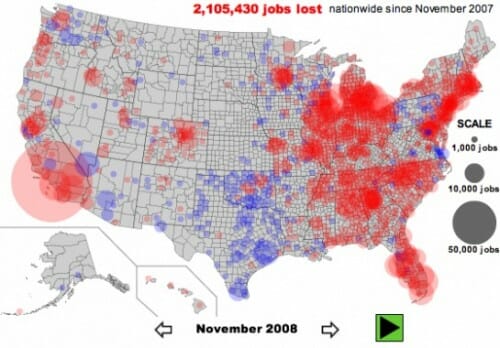
As a note on city planning, I will not claim a direct causality, because I am the first one to warn of the danger between directly correlating two variables in a complex system, but check out this map of job losses in the recession, noting the situation in Houston as the least planned city in the country.