Posts tagged ‘Alex Tabarrok’

Licensing to Restrict Competition

The WSJ has yet more examples of crazy job licensing, example:  (ht Alex Tabarrok)

But economists—and workers shut out of fields by educational requirements or difficult exams—say licensing mostly serves as a form of protectionism, allowing veterans of the trade to box out competitors who might undercut them on price or offer new services.

"Occupations prefer to be licensed because they can restrict competition and obtain higher wages," said Morris Kleiner, a labor professor at the University of Minnesota. "If you go to any statehouse, you'll see a line of occupations out the door wanting to be licensed."...

Texas, for instance, requires hair-salon "shampoo specialists" to take 150 hours of classes, 100 of them on the "theory and practice" of shampooing, before they can sit for a licensing exam. That consists of a written test and a 45-minute demonstration of skills such as draping the client with a clean cape and evenly distributing conditioner. Glass installers, or glaziers, in Connecticut—the only state that requires such workers to be licensed—take two exams, at $52 apiece, pay $300 in initial fees and $150 annually thereafter.

California requires barbers to study full-time for nearly a year, a curriculum that costs $12,000 at Arthur Borner's Barber College in Los Angeles. Mr. Borner says his graduates earn more than enough to recoup their tuition, though he questions the need for such a lengthy program. "Barbering is not rocket science," he said. "I don't think it takes 1,500 hours to learn. But that's what the state says."

Many, many other examples -- it takes 750 hours of training to be a manicurist in Alabama.  Somehow my daughter learned to paint her own nails during the course of a single sleepover.

We're All Safer Now

Via Alex Tabarrok:

New Environmental Protection Agency regulations treat spilled milk like oil, requiring farmers to build extra storage tanks and form emergency spill plans.

Local farming advocates says it's ridiculous to regulate a liquid with a small percentage of butter fat the same way as the now-infamous BP oil spill.

"It's just another, unnecessary over-regulation by the government just lacking any common sense," said Bill Robb, dairy educator for Michigan State University Extension...

The EPA regulations state that "milk typically contains a percentage of animal fat, which is a non-petroleum oil. Thus, containers storing milk are subject to the Oil Spill Prevention, Control and Countermeasure Program rule when they meet the applicability criteria..."

Police and Accountability

I have written before that the inexpensive handheld video camera is perhaps the most important innovation in police accountability in my lifetime.  So of course, the police want them banned.

In response to a flood of Facebook and YouTube videos that depict police abuse, a new trend in law enforcement is gaining popularity. In at least three states, it is now illegal to record any on-duty police officer.Even if the encounter involves you and may be necessary to your defense, and even if the recording is on a public street where no expectation of privacy exists....

In short, recordings that are flattering to the police - an officer kissing a baby or rescuing a dog - will almost certainly not result in prosecution even if they are done without all-party consent. The only people who seem prone to prosecution are those who embarrass or confront the police, or who somehow challenge the law. If true, then the prosecutions are a form of social control to discourage criticism of the police or simple dissent.

Folks who read Radley Balko or Carlos Miller will not find a lot new hear, but it is a very good overview of an issue that is hot among blogs but rarely if ever makes the major media.

After an encounter with the public goes wrong, the police have historically been able to make up any story they want and make it stick, in many cases shifting the blame to innocent civilians.  It is scary to see how many times this happens, with the officer's story shown to be a lie by cameras on site (and even then it can be hard to get the police to investigate).  Only the combination of cameras and YouTube (to publicize the video so it can't be ignored) have begun to bring some justice to these encounters.

HT Alex Tabarrok

Libbertarian Disconnect

I don't know that I have ever seen a clearer example of the disconnect of thinking between libertarians and authoritarian political thinking than in this brief paragraph from Dahlia Lithwick.  She is writing about a court case reviewing whether it should be a crime to deny police your identification.  She writes, making fun of libertarians:

It would be easier to credit the Cato and ACLU arguments if we didn't already have to hand over our ID to borrow a library book, obtain a credit card, drive a car, rent videos, obtain medical treatment, or get onto a plane. So the stark question then becomes this: Why are you willing to tell everyone but the state who you are? It's a curious sort of privacy that must be protected from nobody except the government.

Really??  It is strange to her that we would treat privacy uniquely with the one and only organization in this country that can legally use force against us, legally take our money without our permission, and legally throw us in prison?  Is she really so blinded by a love for state authority that she can't tell the difference between a transaction at Blockbuster, which we can choose not to patronize if we don't like their terms of sale, and an interaction with police, where there is not even a hint of it being an arms-length, consensual, balanced interaction.

There is an largeand growing body of evidence that police take advantage of their power mismatch with citizens and abuse their power in multiple ways, large and small.  These abuses have likely always existed, but were covered up by police officers standing up for each other.  Only the advent of portable video cameras has started to really document what really goes on in these interactions.  Just read a few posts at this site to get a flavor.  And cops sure don't like when you ask them for their ID, as they hate anything that might impose accountability on them:

And in today's daily contempt-of-cop story, Ft. Lauderdale Police Officer Jeff Overcash did not appreciate a man asking him for his badge number, so he pulled out his handcuffs and arrested him.And it was all caught on video.

The video shows Brennan Hamilton walking up to Overcash in a calm manner with a pen and notepad in his hand. Overcash, who is leaning against his squad car with other cops, then pulls out his handcuffs and arrests Hamilton.

Overcash charged him with resisting arrest without violence and disorderly intoxication.

Alex Tabarrok makes a good point.   Based on these arguments, Lithwick must be A-OK with Arizona's new immigration laws, right?

Update:  It is interesting that while sneering at slippery slope arguments, she proves their merit.

The slippery-slope arguments"”that this leads to a police state in which people are harassed for doing nothing"”won't really fly, although I guarantee that you'll hear more and more of them in the coming weeks.

But in the immediately proceeding lines she wrote:

Is there something about stating your name or handing over a driver's license that differs from being patted down or frisked, which is already constitutional for Terry purposes?I, for one, would rather hand over my driver's license to a cop than be groped by one.

This is a perfect illustration of the slippery slope, almost textbook.  Libertarians certainly opposed current pat down and frisking rules, but since these are legal, Lithwick uses their legality to creep the line a little further.  And then the legality of these ID checks will in turn be used to justify the legality of something else more intrusive.

Friday Funnies #2, Via the SEIU

The union whose president leads the world in visits to the White House this year has shown what is at the heart of its quest to help mankind -- a  naked power grab.

In pursuit of an Eagle Scout badge, Kevin Anderson, 17, has toiled for more than 200 hours hours over several weeks to clear a walking path in an east Allentown park.

Little did the do-gooder know that his altruistic act would put him in the cross hairs of the city's largest municipal union.

Nick Balzano, president of the local Service Employees International Union, told Allentown City Council Tuesday that the union is considering filing a grievance against the city for allowing Anderson to clear a 1,000-foot walking and biking path at Kimmets Lock Park.

"We'll be looking into the Cub Scout or Boy Scout who did the trails," Balzano told the council.

Balzano said Saturday he isn't targeting Boy Scouts. But given the city's decision in July to lay off 39 SEIU members, Balzano said "there's to be no volunteers." No one except union members may pick up a hoe or shovel, plant a flower or clear a walking path.

via Alex Tabarrok

ADM's Mistake (Mostly Corrected)

Alex Tabarrok discusses the new movie about Mark Whitacre and price fixing at Archer Daniels Midland.  ADM apparently was caught holding meetings with competitors to fix prices of certain chemical commodities, specifically Lysine.

Here was ADM's mistake, and it is one they have clearly learned from:  in the modern American corporate state, there is no reason to engage in illegal private price fixing or cartel arrangements when corporations can achieve similar ends legally and openly through the government.  If ADM was concerned about difficult competition depressing pricing, they could have emulated any of these examples:

  • Run to Congress to beg for strong tariff's on foreign sources of their commodity product (as do the sugar and ethanol industries)
  • Run to Congress and have them institute minimum pricing or buy up excess supply (as do many agricultural producers)
  • Run to Congress to seek supply restrictions (as does the taxi business)
  • Run to Congress and have them restrict new competition and sources of supply through licensure (as do a variety of industries, from real estate to funeral homes to medicine)
  • Run to Congress to have them pass onerous legislation that makes it difficult for new capacity to be added in the business (as does the waste disposal industry)
  • Run to Congress to seek subsidies for their product in the name of some public good - it doesn't even have to be true (as does, well, ADM with ethanol)
  • Run to Congress to seek regulations that favor your particular production and product technologies while hamstringing your competition (as does GE with light bulbs)
  • Run to Congress and have them enforce an industry price-fixing arrangement -- its legal when Congress does it (as do the Milk producers)
  • Run to the FTC to bring anti-trust actions against your competition (as did Netscape and Sun against Microsoft)  This is an interesting article on this, which says in part, "Most [antitrust] cases are not brought by public representatives, whether elected or self-appointed, but by private companies, often rivals of the defendant who are being driven out of business. Businessmen believe that competition is good if they win but bad if the other guy wins."

Of course, all of this takes a little care.  The competitive relief must be couched in something like "consumer protection" or "saving jobs" or "going green" or "fairness," but there are plenty of good examples of consumers getting the shaft in the name of consumer protection that it shouldn't be too hard to come up with something.  Developing a high profile in an early Presidential primary state like Iowa doesn't hurt either.

As I said in the title, ADM has certainly figured this out, if their approach to the ethanol business is any guide.  In ethanol, they have resorted to any number of these tactics simultaneously.

So If It's All About the TED Spread, Should We Be Worried?

Us non-financial types are always learning something new.  After a lifetime of thinking that our economy rests on free markets, entrepreneurship, an educated and flexible labor force, risk-taking, etc., we suddenly find that everything depends on the TED Spread, a metric most of which most of us were blissfully ignorant 2 months ago.

The TED spread is basically the difference or spread between short term inter-bank loan rates and short term treasuries or T-bills.  It is in some sense a measure of perceived risk of lending to banks vs. (what are considered) low or near-zero risk US treasury obligations.  One way to think about it in the current market is how much extra would you need in interest to lend to your slacker brother-in-law Earl vs. say to Bill Gates.

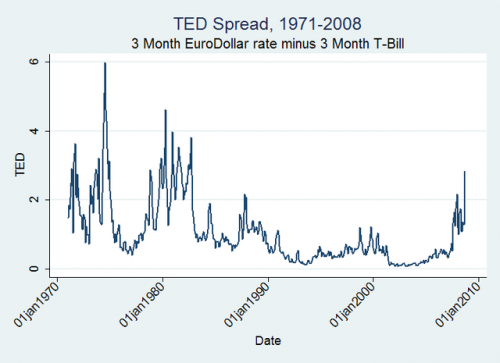
Not surprisingly, the TED spread has shot up over the last few weeks, and it tends to be the #1 metric cited in declaring impending doom for the US economy.  But Alex Tabarrok looked at a longer view of the TED spread, and found this:

ted-spread

Now, the period from 1970-1983 were not by any means an economic glory period, but on the other hand its clear that TED spreads of the order of magnitude we have seen in the past weeks are not unprecedented by any means.

The problem I have with the TED spread is that higher recent spreads are being used as an indicator that credit has "dried up" and lending is at a standstill.  Why do I resist this conclusion?  Because of this chart:

real_gas_prices

So, gasoline prices rocketed from $1.50 a gallon to over $4.00 a gallon.  Does this mean that gasoline purchases have stopped?  Has the gasoline market closed up shop?  Of course not.  It just means the price went up.  It is absurd to show me a price chart, which is what the TED spread graph is, and infer from it changes in the underlying transaction volume.

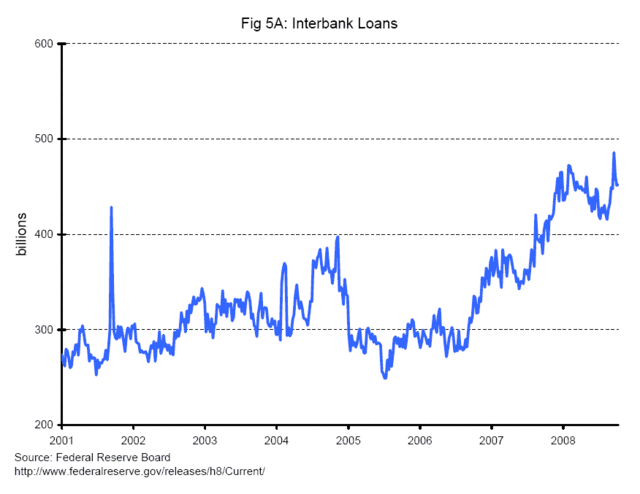
In fact, when one looks at actual volume, of inter-bank loans or new commercial lending, there is not (at least yet) any of the drop-off everyone seems to assume exists.  For example:

Interbank_4

But We Can Run Healthcare

By now, this story has been linked all over, but it is still hilarious.  The folks who want to run the US healthcare system and the US energy industry have found that they are not competent enough to manage even the Senate cafeteria:

Year after year, decade upon decade, the U.S. Senate's network of
restaurants has lost staggering amounts of money -- more than $18
million since 1993, according to one report, and an estimated $2
million this year alone, according to another.

The financial condition of the world's most exclusive dining hall and its affiliated Capitol Hill
restaurants, cafeterias and coffee shops has become so dire that,
without a $250,000 subsidy from taxpayers, the Senate won't make
payroll next month....

In a masterful bit of understatement, Feinstein blamed "noticeably
subpar" food and service. Foot traffic bears that out. Come lunchtime,
many Senate staffers trudge across the Capitol and down into the
basement cafeteria on the House side [where food service is provided privately]. On Wednesdays, the lines can be
30 or 40 people long.

This is not a new issue - it has been a festering sore that the Senate has been unable to manage for decades.  And we're talking about a single freaking cafeteria here.  More from Alex Tabarrok

More on Education and Expertise

A few days ago, I highlighted an article that argued that the problem with public education was that there was not enough expertise and, heaven forbid, enough state level bureaucrats managing the infrastructure.  I pointed out that this is often the argument of technocrats in favor of failing public institutions:  The problem is not the institution, they argue, or its incentives but it just needs the right people in charge.  I argued that, probably like GM, all the expertise in the world was not going to turn around an organization whose DNA had gone senescent.

Alex Tabarrok comes at this issue from a different angle, but with similar results.  Too many of the examples highlighted of successes in public education rely on a super-teacher or super-administrator who overcomes all the organization problems in his/her school to create a success story, one that is usually fleeting and tends to die when that individual leaves  (Jaime Escalante is a great example - most of his math program improvements died after he left).

Tabarrok argues that you can't just keep hoping for more of these unique individuals who can overcome a myriad of bureaucratic obstacles.  You have to reinvent the system so that average capability, poorly motivated workers can still get a good result for students.  I know some will be scared off by the analogy, but this is the kind of thing that franchise restaurants do very well -- plug low-skill, sometimes poorly motivated employees into a system that successfully provides consistent, predictable service for customers.

What we need to save inner-city schools, and poor schools
everywhere, is a method that works when the teachers aren't heroes.
Even better if the method works when teachers are ordinary people,
poorly paid and ill-motivated - i.e. the system we have today. 

In Super Crunchers,
Ian Ayres argues that just such a method exists.  Overall, Super
Crunchers is a light but entertaining account of how large amounts of
data and cheap computing power are improving forecasting and decision
making in social science, government and business.  I enjoyed the
book.  Chapter 7, however, was a real highlight.

Ayres argues that large experimental studies have shown that the teaching method which works best is Direct Instruction (here and here
are two non-academic discussions which summarizes much of the same
academic evidence discussed in Ayres).  In Direct Instruction the
teacher follows a script, a carefully designed and evaluated script.
As Ayres notes this is key:

DI is scalable.  Its
success isn't contingent on the personality of some uber-teacher....You
don't need to be a genius to be an effective DI teacher.  DI can be
implemented in dozens upon dozens of classrooms with just ordinary
teachers.  You just need to be able to follow the script.

Contrary
to what you might think, the data also show that DI does not impede
creativity or self-esteem.  The education establishment, however, hates
DI because it is a threat to the power and prestige of teaching, they
prefer the model of teacher as hero.  As Ayres says "The education
establishment is wedded to its pet theories regardless of what the
evidence says."  As a result they have fought it tooth and nail so that
"Direct Instruction, the oldest and most validated program, has
captured only a little more than 1 percent of the grade-school
market."

I don't know anything about DI and haven't seen the data and so can't comment on its effectiveness.  But I can say that if it works, there is no way it will be adopted in public schools.  Public school systems are run first for the administration bureaucracy, second for the teachers, and only about third for the students.  Anything that serves the latter but reduces the power of the former will never succeed, again because the incentives are not there for better performance.  Only school competition will allow such new models to be tried.

Intellectual Welfare and Credit

A few years ago I coined the term "Intellectual Welfare."  I originally devised he term to describe Social Security, where it was arguable that most people in the program were not receiving a transfer payment, but they were instead receiving for-your-own-good government restriction of individual choice.  In the case of Social Security, government takes over the management of some of our retirement savings (at an appalling cost) because we lunkheads can't be trusted to manage our own savings for ourselves.

I was going to prepare a similar post about cries for regulation in the sub-prime credit market, but Alex Tabarrok did it already:

Roubini and others generating hysteria about defaults in the
mortgage market are credit snobs - they think credit is something that
only the rich can handle.  Just look at the language that Roubini uses
to analogize borrowers - they are "reckless patients" who "spent the last few years on a diet of booze, drugs and artery clogging junk food."  Similarly, the Washington Post tells us that it's the end of the "borrowing binge."

Yeah, we get it.  Credit is ok for us, the "sober" borrowers but poor people can't
handle credit.  Too much credit among the poor generates decay and
social pathology.  Credit must be regulated.  We can't, for example,
have credit stores in poor neighborhoods.  Don't you know that credit is bad for people without self-discipline?   Let the poor buy on installment credit?  That's unconscionable.  Today's furor over sub-prime mortgages is the same old story.

Update: This really ticks me off:

Representative Barney Frank, the Massachusetts Democrat who heads
the House Financial Services Committee, said in an interview on Friday
that he intended to move legislation in the coming weeks. He said the
measure he was preparing would discourage abusive loans by imposing
legal liability "up the chain." It would give borrowers and others the
ability to sue the Wall Street firms that package those mortgages and
then sell them as mortgage-backed securities, as well as the purchasers
of those securities in the secondary market.

"Anybody, including the original borrower, can make a claim, and the
liability would go up the chain," he said. "People say it may
discourage certain kinds of lending. But that's precisely what we want
to do. We will pass a bill that won't allow companies to loan people
more money than they can pay back or loans for more than the value of
the house."

GRRRR.  Does no one remember what it was like to get a mortgage before they were so easily securitized?  The paperwork in the credit application was horrendous, as was the time it took to complete the mortgage.  Today they check two or three numbers, and if these numbers match the requirements of the Wall Street companies that package the loans, the loan is approved.  This legislation, which is aimed at slamming the securitization process, will hurt everyone.  All of our lives will be made worse so a few politicians can demagogue an issue that will be forgotten in 12 months. 


Milton Friedman Dead at 94

Milton Friedman kept alive both the economic and philosophical basis for free markets and classical liberalism through the 60's and 70's when few others stood willing to carry the torch.  Like only a handful of other economists, he successfully went beyond pure economics to champion the link between economic liberty and all other freedoms.  But he was perhaps unique in taking this perspective to the masses, in ways that connected with the average person.  He will be missed.  In tribute, I guess I need to go out and pay for lunch today.

Update:  Tom Kirkendall, one of the best bloggers you may have never read, has a great roundup of Friedman quotes.  Also, Alex Tabarrok reminds us of this great Friedman quote:

President Kennedy said, "Ask not what your country can do for you - ask
what you can do for your country."... Neither half of that statement
expresses a relation between the citizen and his government that is
worthy of the ideals of a free society.

Economics is a Science. Really.

I was going to respond to Kevin Drum's post crowing that the Oregon minimum wage increase didn't do any harm.  But Brian Doss at Catallarchy does a fine enough job that I will outsource to him. Here is a taste:

The 5.4% unemployment rate tells us a bit more; its 1 point higher
than the national average. I'm not going to be as quick as Kevin to
infer causation from correlation here either, but it doesn't seem like
much of a positive spin to say that a rate of unemployment that's 25%
higher than the national average is good because it happened to be 7.2%
back in 2002"¦

Also, the quote seems seriously confused that there is a meaningful
distinction (in this case) between the theoretical and statistical
(what else would employment economists use in their theory?). Despite
that confusion, David Neumark (mentioned in the WSJ article) does lay out a fairly comprehensive, concrete,  statistical study of minimum wage laws and their effects here,
among other things showing that for whatever else a minimum wage does,
the effect is primarily among the teenaged to those in their early 20s,
the sign is negative, and in the long run negative if a minimum wage
prevents a teen or young adult from gaining employment and more
importantly not gaining the habits of employment.

Further evidence of the this kind is summarized by Alex Tabarrok here,
whereby he relates studies showing that 25% of the folk on the mininum
wage (nationall) are teenagers, and 50% of all minimum wage earners are
aged 25 and younger. These are people, Alex notes, that with age and
experience will likely soon earn more than minimum wage anyway, thus as
an antipoverty tool it's fairly weak....

Its a particularly bad antipoverty tool, it has non-trivial effects
on the structure of employment within and across industries, and has
possible non-trivial long term negative effects on low-skill
individuals' abilities to stay employed and to increase their own
productivity and standards of living. All of the things it purports to
want to do can be done by much more targeted, efficient, and effective
policy tools.2 

"˜Liberals' of America, please, I beg of you: save your breath for policies that actually help poor Americans, eh? And it you won't do it for me, can you do it for the children"¦?

There is much more good stuff.

Whenever I read these articles by progressives that basically boil down to "the most basic laws of supply and demand don't apply to labor, which is the most fundamental trade good in the economy," I just have to shake my head.  I am reminded of my advice to progressives:

Economics is a science.  Willful ignorance or emotional
rejection of the well-known precepts of this science is at least as bad
as a fundamentalist Christian's willful ignorance of evolution science
(for which the Left so often criticizes their opposition).
  In
fact, economic ignorance is much worse, since most people can come to
perfectly valid conclusions about most public policy issues with a
flawed knowledge of the origin of the species but no one can with a
flawed understanding of economics.

I Have Government Derangement Syndrome

Alex Tabarrok of Marginal Revolution makes a point I have been trying to communicate for some time now:

It's naive to only blame particular people (Bush, Cheney et al.) and
depressing when people at CT claim that if only "our guys" had been in
power everything would have been ok.  When you see the same behaviour
again and again you ought to look to systematic factors.  And even if
you do believe that it is all due to Bush, Cheney et al. it's not as if
these guys came to power randomly, they won twice.  The worst
get on top for a reason.  As a result, government ought to be designed
(on which see further below) so it works when the knaves are in power and not just when the angels govern.

I made a similar point in this post:

Over the past fifty years, a powerful driving force for statism in this
country has come from technocrats, mainly on the left, who felt that
the country would be better off if a few smart people (ie them) made
the important decisions and imposed them on the public at large, who
were too dumb to make quality decision for themselves.  People aren't
smart enough,they felt, to make medication risk trade-off decision for
themselves, so the FDA was created to tell them what procedures and
compounds they could and could not have access to.  People couldn't be
trusted to teach their kids the right things, so technocrats in the
left defended government-run schools and fought school choice at every
juncture.  People can't be trusted to save for their own retirement,
so  the government takes control with Social Security and the left
fights giving any control back to individuals.  The technocrats told us
what safety equipment our car had to have, what gas mileage it should
get, when we needed to where a helmet, what foods to eat, when we could
smoke, what wages we could and could not accept, what was and was not
acceptable speech on public college campuses, etc. etc....

the technocrats that built our regulatory state are starting to see the
danger of what they created.  A public school system was great as long
as it was teaching the right things and its indoctrinational excesses were in a leftish direction.
Now, however, we can see the panic.  The left is freaked that some red
state school districts may start teaching creationism or intelligent
design.  And you can hear the lament - how did we let Bush and these
conservative idiots take control of the beautiful machine we built?  My
answer is that you shouldn't have built the machine in the first place
- it always falls into the wrong hands.

I am particularly amazed of late at the popular leftish criticism of Bush that he was too slow after 9/11 (spending 10 extra minutes with the school kids), too slow during Katrina, and too slow entering the diplomatic fray in Lebanon.  I can't remember who, but someone lately was quoted publicly saying that they were frustrated with Bush taking vacations and that they would never vote for someone with a ranch.  Is that really the dual criticisms that people have of Bush?  That 1) he is evil and an idiot and 2) they want him to get involved faster and more aggressively in more types of problems?

Here's something everyone should know, which I have embodied in Coyote's Second Law (here's the first) which states:

Any person elected to government office has their effective IQ cut in half

I don't know if politicians wake up from this fog when they leave office or not.  I can easily imagine Bill Clinton, a man who is supposed to have a high out-of-public-office IQ, slapping his head and saying "did I really go running into Somalia and running right back out after the first casualties?' or maybe even better "jeez, I can't believe I turned down the chance to take Bin Laden into custody -- what was I thinking".  Whichever the case, governments are always stupid, even those made up of people provably of high IQ in their private lives.  Tabarrok has this humorous but depressing observation:

The Pentagon is the Post Office with nuclear weapons

Like Tabarrok, I think the bar has to be pretty high to send our military into battle, and I never thought the situation in Iraq justified the excursion.  However, perhaps differing from Tabarrok, I am sensitive to historic precedent and thus doubt that defense can always just end at our borders.  While I think the Bush administration is overly optimistic to think that Iraq will become a shining beacon of democracy that will help rally the democratic forces in neighboring countries, I also think Bush opponents are overly optimistic when they say that terrorists and Middle Eastern fascists will leave us alone as long as we just keep our distance.  There are too many historical reminders that the latter is not true.  Sometimes you do have to go over there to kick their ass before they come over here.  Afghanistan probably met this criteria, but I don't think Iraq did - Iraq feels more like the Gulf of Tonkin, a war certain people in power wanted to fight and for which they needed a public excuse.

All this means that I think that the number of times we need to go out and fight wars overseas is greater than zero and less than what we actually do.  I'm not smart enough, I guess, to make a clearer policy statement, but I would be really interested to ask all those who think they would have prevented Israel and its neighbors from going to war for the 47th time if only they had been in office what their coherent policy statement would be.