There are people who will swear to this day that, despite all evidence to the contrary, Bigfoot exists and they have seen it. Paul Krugman similarly is just sure he has seen European austerity. The rest of us are left scratching our heads for the evidence -- he doesn't even have a blurry photo or footprint. Just tales from a friend of a friend, who is not only sure there has been austerity, but that it caused an old lady to dry her cat in a microwave and that if you swim 20 minutes after eating you will get cramps.
The official Keynesian story is that the PIIGS of Europe (Portugal, Italy, Ireland, Greece and Spain) have been devastated by cutbacks in public spending. Austerity has made things worse rather than better – clear proof that Keynesian stimulus is the answer. Keynesians claim the lack of stimulus (of course paid for by someone else) has spawned costly recessions which threaten to spread. In other words, watch out Germany and Scandinavia: If you don’t pony up, you’ll be next.
Erber finds fault with this Keynesian narrative. The official figures show that PIIGS governments embarked on massive spending sprees between 2000 and 2008. During this period, their combined general government expenditures rose from 775 billion Euros to 1.3 trillion – a 75 percent increase. Ireland had the largest percentage increase (130 percent), and Italy the smallest (40 percent). These spending binges gave public sector workers generous salaries and benefits, paid for bridges to nowhere, and financed a gold-plated transfer state. What the state gave has proven hard to take away as the riots in Southern Europe show.
Then in 2008, the financial crisis hit. No one wanted to lend to the insolvent PIIGS, and, according to the Keynesian narrative, the PIIGS were forced into extreme austerity by their miserly neighbors to the north. Instead of the stimulus they desperately needed, the PIIGS economies were wrecked by austerity.
Not so according to the official European statistics. Between the onset of the crisis in 2008 and 2011, PIIGS government spending increased by six percent from an already high plateau. Eurostat’sprojections (which make the unlikely assumption that the PIIGS will honor the fiscal discipline promised their creditors) still show the PIIGS spending more in 2014 than at the end of their spending binge in 2008.
As Erber wryly notes: “Austerity is everywhere but in the statistics.”
A Colorado jury has awarded $11.5 million in a lawsuit originally brought against helmet maker Riddell and several high school administrators and football coaches over brain injuries suffered by a teenager in 2008.” While the jury rejected the plaintiff’s claim of design defect, it accepted the theory that the helmet maker should have done more to warn of concussions.
If the helmet makers are getting nailed, wait until every high school and college in the country is sued, not to mention the massive suit looming against the NFL. Expect to see a debate soon, beginning in state legislatures, over tort protection for football. Texas, for example, has several of the country's tort hellholes but if Friday night high school football is threatened, you can bet that the legislature will be moved to action.
Under the California Franchise Tax Board’s interpretation of a 2012 state Court of Appeals ruling, which found part of the tax law to be unconstitutional, anyone who acted in good faith to claim the now-deceased QSB incentive on their2011 California return owes the state back taxes on the excluded or deferred income.
And the same goes for 2010. And 2009. And 2008.
And, what’s more, these taxpayers will also be hit with back interest and possible penalties.
The penalties part is particularly hilarious. We are going to penalize you for doing what we told you to do.
By the way, I likely would have opposed the QSB incentive had I known about it as just another crony giveaway. So I have no problem ending it. But retroactive tax increases are a bad, bad precedent.
The story the other day that AIG was considering suing the taxpayers because the taxpayers did not give them a nice enough bailout was so vomit-inducing that I did not even look much further into it.
Every taxpayer and shareholder should be rooting for this case to go to trial. It addresses an important Constitutional question: When does the federal government have the authority to take over a private business? The question looms larger since the 2010 passage of the Dodd-Frank law, which gave the feds new powers to seize companies they believe pose risks to the financial system.
That vague concept of "systemic risk" was the justification for the AIG intervention in September 2008. In the midst of the financial crisis, the federal government seized the faltering insurance giant and poured taxpayer money into it. The government then used AIG as a vehicle to bail out other financial institutions.
But the government never received the approval of AIG's owners. The government first delayed a shareholder vote, then held one and lost it in 2009, and then ignored the results and allowed itself to vote as if the common shareholders had approved the deal.
In 2011 Mr. Greenberg's Starr International, a major AIG shareholder, filed a class-action suit in the U.S. Court of Federal Claims in Washington alleging a violation of its Constitutional rights. Specifically, Starr cites the Fifth Amendment, which holds that private property shall not "be taken for public use, without just compensation." The original rescue loans from the government required AIG to pay a 14.5% interest rate and were fully secured by AIG assets. So when the government also demanded control of 79.9% of AIG's equity, where was the compensation?
Greenberg is apparently arguing that he would have preferred chapter 11 and that the company and its original shareholders likely would have gotten a better deal. Perhaps. So I will tone down my outrage against Greenberg, I suppose. But nothing about this makes me any happier about bailouts and corporate cronyism that are endemic in this administration.
This story is simply unbelievable. Shareholders of AIG should have been wiped out in 2008 in a bankruptcy or liquidation after it lost tens of billions of dollars making bad bets on insuring mortgage securities. Instead, AIG management and shareholders were bailed out by taxpayers.
It is bad enough I have to endure those awful commercials with AIG employees "thanking" me for their bailout. It's like the thief who stole my TV sending me occasional emails telling me how much he is enjoying it.
Now, AIG managers and owners are considering suing the government because the the amazing special only-good-for-a-powerful-and-connected-company deal they got was not good enough.
Directors at American International Group Inc., AIG -1.28% the recipient of one of the biggest government bailout packages during the financial crisis, are considering whether to join a lawsuit that accuses the U.S. government of too-onerous terms in the 2008-2009 rescue package.
The directors will hear arguments on Wednesday both for and against joining the $25 billion suit, a person briefed on the matter said. The suit was filed in 2011 on behalf of Starr International Co., a once very large AIG shareholder that is led by former AIG Chief Executive Maurice "Hank" Greenberg. It is pending in a federal claims court in Washington, D.C....
Starr sued the government in 2011, saying its taking of a roughly 80% AIG stake and extending tens of billions of dollars in credit with an onerous initial interest rate of roughly 15% deprived shareholders of their due process and equal protection rights.
This is especially hilarious since it coincides with those miserable commercials celebrating how AIG has successfully paid off all these supposedly too-onerous obligations. And certainly Starr and other AIG investors were perfectly free not to take cash from the government in 2008 and line up some other private source of financing. Oh, you mean no one else wanted to voluntarily put money into AIG in 2008? No kidding.
Postscript: By the way, employees of AIG, you have not paid off all the costs of your bailout and you never will. The single largest cost is the contribution to moral hazard, the precedent that insurance companies, if sufficiently large and well-connected in Washington, can reap profits on their bets when they go the right way, and turn to the taxpayer to cover the bets when they go wrong.
In a world where I as a taxpayer have to bail out banks, I don't have a huge problem with capital requirements for banks, though this seemingly simply topic is rife with unintended consequences -- I have seen it argued persuasively that the pre-2008 Basil capital requirements helped fuel the housing bubble by giving special preference to MBS in computing capital. In fact, one might argue the same for the sovereign debt crisis, that by creating a huge demand for sovereign debt for bank balance sheets it fueled an unsustainable expansion in such debt.
Anyway, the point of this post was capital controls. Drum quotes this from an IMF report:
19. Indeed, as the recent global financial crisis has shown, large and volatile capital flows can pose risks even for countries that have long been open and drawn benefits from capital flows and that have highly developed financial markets. For example, in several advanced economies, financial supervision and regulation failed to prevent unsustainable asset bubbles and booms in domestic demand from developing that were partly fueled by cheap external financing. Rather than favoring closed capital accounts, these experiences highlight the need for policymakers to remain vigilant to the risks. In particular, there is a constant need for sound prudential frameworks to manage the risks that capital inflows can give rise to, which may be exacerbated by financial innovation.
The logic, then, is that bubbles are exacerbated by inflows of foreign capital so capital controls can keep bubbles from getting worse. I have very little knowledge of international finance, but let me test three thoughts I have on this:
Doesn't this cut both ways? If bubbles can be inflated by capital inflows, can't they also be deflated by capital outflows? Presumably, if people domestically see the bubble, they would logically look for other places to invest their money. International investments outside of the overheated domestic market are a logical alternative, and such capital flows would act a s a safety valve to reduce pressure on the bubble. So wouldn't capital controls just as likely make bubbles worse, by confining capital within the bubble, as make them better by preventing new capital from outside the country flowing in?
The implication here is that the controls would be dynamic. In other words, some smart person in government would close the gates when a bubble starts to build and open them at other times. But does that not presupposed the ability to see the bubble when one is in it? Certainly there were a few who pointed out the housing bubble before 2008, but few in power did so. And even if they had seen it, what is the likelihood that they would have pointed it out or taken action? Who wants to be the politician who pops the bubble? Remember the grief Greenspan got for pointing to an earlier bubble?
Controls on capital inflows tend to be anti-consumer. Yeah, I know, no one in government ever seems to care when they pass protectionist laws that protect 100 tire workers at the cost of higher tires for 100 million drivers. But limiting capital inflows would reduce the value of the dollar, and make anything imported (or made from imported parts or materials) more expensive.
Great idea, and consistent with my growing skepticism of all published research given a general bias towards positive results.
If you’re a psychologist, the news has to make you a little nervous—particularly if you’re a psychologist who published an article in 2008 in any of these three journals:Psychological Science, the Journal of Personality and Social Psychology,or the Journal of Experimental Psychology: Learning, Memory, and Cognition.
Because, if you did, someone is going to check your work. A group of researchers have already begun what they’ve dubbedthe Reproducibility Project, which aims to replicate every study from those three journals for that one year. The project is part of Open Science Framework, a group interested in scientific values, and its stated mission is to “estimate the reproducibility of a sample of studies from the scientific literature.” This is a more polite way of saying “We want to see how much of what gets published turns out to be bunk.”
One of the world’s most widely respected climatologists, James Hansen, director of NASA-GISS, which focuses on the study of earth’s climate for the space agency, testified to Congress in 2008 that the CEOs of fossil fuel companies (who, according to various professional reporting have been promoting this and other misleading messages about global warming in conjunction with ideological groups trying to prevent government regulation) “knew what they were doing” and, as stated in his written testimony to Congress in 2008, were guilty of “high crimes against humanity and nature.”
Hansen tells ABC News — in a phone call from the U.K. where he’s been traveling — that he used that highly charged phrase, crime against humanity, “not only for dramatic effect, but also because it is accurate, given the enormous scale of the consequences to humanity” if manmade global warming is not somehow stopped and reversed.
“It wasn’t only aimed at the fossil fuel CEOs,” Hansen added on the phone. “This also applies to politicians who pretend the global warming is not manmade.”....
“Crimes Against Humanity” is a category of culpability that found currency in the last century as a label for such atrocities as genocide, including the Nazi Holocaust.
This is a grave accusation, laden with great emotion, but it has not been made lightly — rather with extensive study and forethought.
I almost hate beating on the silly folks who run the City of Glendale even further, but they keep screwing up.
One of the reasons I think that city officials like those in Glendale like to dabble in real estate and sports stadiums is what I call the "bigshot effect." They don't have any capital of their own, and they don't have the skills such that anyone else would (voluntarily) trust them to invest other people's money, but with a poll of tax money they get to play Donald Trump and act like they are big wheels. The Glendale city council did this for years, and when their incompetence inevitably led to things starting to fall apart, they have simply thrown more money at it to try to protect their personal prestige.
But unfortunately, incompetence generally is an infinite reservoir, and apparently the City has screwed up again. Years ago, when the City promised the rich people who owned the AZ Cardinals a new half billion dollar stadium, they put a contract to that effect on paper. Granted, this was a sorry giveaway, spending hundreds of millions of dollars for a stadium that would be used by the Cardinals for 30 hours a year, by the Fiesta Bowl for 3 hours a year, and by the NFL for a Superbowl for 3 hours every 6-7 years. But, never-the-less, the City made a contractual agreement.
And then, in its rush to be real estate bigshots, the city turned about 3700 parking spaces promised contractually to the Cardinals over to a developer to create an outlet mall (of the sort that has been quietly going bankrupt all over the country over the last few years). Incredibly, the city did this without any plan for how to replace the parking it owed the Cardinals. To this day, it has no plan.
Apparently, there were also some shenanigans with $25 million that had been escrowed to build a parking garage.
The demand letter also blames the parking problem on the city's dealings with Steve Ellman, Westgate's former developer and a one-time co-owner of the Phoenix Coyotes. The letter states that Ellman's relationship with the city has been "characterized by a lack of transparency."
The letter raises questions about a January 2011 arrangement in which the city and Ellman equally split a $25million escrow fund that had been earmarked to build a parking garage in Westgate, the team said.
Ellman put that money in escrow in 2008 after failing to keep a promise to the city to provide a set amount of permanent parking in Westgate.
By early 2011, half of that money went back to Ellman's lenders as part of a deal to try to keep the Coyotes in Glendale, while the city received the other $12.5 million in the account.
What a mess. This is what happens when politicians try to be bigshots with our money.
A few weeks ago, I wrote that opposition to the Keystone was never about the Ogallala Aquifer. Polluting the water was a simply a convenient talking point that might play better with the American public than the true goal, which is to shut down the development of new sources of North American oil. I got a lot of comments and email that I was making this up, but in fact its pretty clear that opposition to the pipeline pre-dated knowledge even of its route. Here is a environmental group's presentation from 2008 which advocates opposition to all pipelines (without any reference to their routes) out of the Canadian tar sands as a strategy to halt their development.
Postscript: I really have little use for discussions about funding amounts and sources of various causes. I find it largely irrelevent. So I post this only because this week we are talking about the Heartland Institute's funding of climate skeptics as revealed by hero (if you are an environmentalist blog) or thief Peter Gleick. Heartland sends a portion of its $6 million budget to support various climate skeptics, and somehow this "revelation" has environmentalists running in circles screaming rape. But Heartland's pitiful few millions seem a joke in comparison to the environmental funding torrent. Take this example from the Canadian tar sands issue, just a single one of a myriad of climate-related issues getting millions, even billions of dollars of funding.
Northrop’s presentation promised funding from the Rockefeller Brothers Fund and the William & Flora Hewlett Foundation in the amount of $7 million per year. Named in the presentation were 12 participating environmental pressure groups, including the Natural Resources Defense Council, Greenpeace, the World Wildlife Fund and the Sierra Club.
According to Canadian writer and researcher Vivian Krause, U.S. foundations have poured more than $300 million into Canadian environmental groups since 2000. One foundation, endowed by Intel co-founder Gordon Moore, has been single-handedly responsible for $92 million of that total, Krause wrote Jan. 17 in Canada’s Financial Post. Foundations flush with the wealth of computer pioneers William Hewlett and David Packard, she added, sent another $90 million to wage green-politics wars in the Great White North....
Tax records from the Rockefeller Brothers Fund indicate that it sent $1.25 million to Michael Marx’s organization, Corporate Ethics International, between December 2007 and November 2010. The money was earmarked “to coordinate the initial steps of a markets campaign to stem demand for tar sands derived fuels in the United States.†The Fund has not yet filed its tax return for 2011.
Among other initiatives, Corporate Ethics International launched a campaign in July 2010 to persuade American and British travelers to avoid visiting Alberta while tar sands exploration was underway. Tourism brings $5 billion to Alberta, making it one of the Canadian province’s biggest industries.
The William and Flora Hewlett Foundation, the second philanthropy Northrop mentioned in 2008 as a partner in the concerted effort to stop tar sands oil development, contributed far more.
Its tax returns indicate expenditures of more than $17.5 million targeted at tar sands oil development, including more than $15.4 million to the left-wing Tides Foundation and the affiliated Tides Canada Foundation. At the time, Tides was led by progressive millionaire Drummond Pike, and by ACORN co-founder and AFL-CIO organizer Wade Rathke.
A newer philanthropy, the Sea Change Foundation, also sent Tides $2 million in 2009, all of it to “promote awareness of an opposition to tar sands.†Another $3.75 million to Tides followed in 2010.
Funded by Renaissance Technologies hedge fund founder James Simons and his son, Nathaniel, Sea Change gave away $120 million between 2008 and 2010 in connection with energy-related issue activism. More than $18 million more of the Simons’ philanthropic funding in 2009 and 2010 went to organizations named in Northrop’s 2008 presentations, including the Natural Resources Defense Council, the Sierra Club, the World Wildlife Fund and Ceres, Inc., although Sea Change did not disclose the specific purpose of those grants.
Smaller tar sands-related contributions to Tides came from the Oak Foundation, endowed by Duty Free Shoppers tycoon Alan Parker; the New York Community Trust; and the Schmidt Family Foundation, whose millions come from Google CEO Eric Schmidt and his wife Wendy.
Tides, in turn, made at least $8.6 million in grants to 44 different organizations, each time specifically mentioning its “tar sands campaign.†Funds went to Greenpeace, the Natural Resources Defense Council, the Sierra Club, Forest Ethics, the Rainforest Action Network and dozens of others. Fully $2.2 million of that total went to Michael Marx’s Corporate Ethics International.
I have no problem with private people spending money however they want, but after throwing around sums of this magnitude, it seems amazing they feel the need to stop Heartland from spending a couple of million dollars in opposition. It's like a rich guy telling you that your Chevy Nova is in the way of his Ferrari and could you please get it off the road.
I had thought the situation in Greece would eventually hammer home for everyone the perils of reckless enlargement of the state and deficit spending. But apparently, it is not to be. This is how Kevin Drum describes the core problem in Greece:
the austerity madness prompted by the 2008 financial collapse
So the problem is not a bankrupt state, but the "austerity" which by the way has at best carved only a trivial amount out of spending. And it was triggered not by a ballooning deficit as a percent of GDP and an inability to meet interest and principle payments, but by the US financial crisis.
This is willful blindness of absolutely astounding proportions. Which means the same folks are likely just rehearsing to ride the US right into the same hole.
Fannie and Freddie entered into agreements accepting responsibility for misleading conduct discovered by the SEC, including:
1. As of June 30, 2008, Freddie had $244 billion in subprime loans, while investors were told it had only $6 billion in subprime exposure.
a. Freddie knew it was inadequately compensated for the risks it was taking. For example, it was taking on “subprime-like loans to help achieve [its] HUD goals” that were similar to private fixed-rate subprime, but the latter typically received “returns five to six times as great,” says the complaint.
b. Freddie had concerns about risk layering on loans with an LTV >90% and a FICO <680. (Yet, in Freddie’s disclosures it only noted risk layering concerns on loans with an LTV >90% and a FICO <620. This is a major difference since only 10 percent of its loans fell into the LTV >90% and a FICO <620 category, while nearly half fell into the LTV >90% and a FICO <680 one.)
2. As of June 30, 2008, Fannie had $641 billion in Alt-A loans (23 percent of its single-family loan guaranty portfolio), while investors were told it had less than half that amount ($306 billion, or 11 percent of its single-family loan guaranty portfolio).
3. The SEC complaint disclosed that Freddie had a coding system to track “subprime,” “other-wise subprime,” and “subprime-like” loans in its loan guaranty portfolio even as it denied having any significant subprime exposure.
These suits are important because they demonstrate that Fannie and Freddie “told the world their subprime exposure was substantially smaller than it really was … and mislead the market about the amount of risk on the companies’ books,” said Robert Khuzami, director of the SEC’s Enforcement Division.
California voters -- unskeptical, unrealistic, and gullible -- nevertheless trusted their elected and unelected technocrats in Sacramento to be telling them the truth when they agreed to a $9.95 billion bond issue for high speed rail. It turns out, even according the HSR's most fervent supporters, that the numbers that were used to sell the bond issue were total crap, and they knew it at the time
In September, I was one of several journalists who interviewed top officials with the California High Speed Rail Authority. Here is board member Lynn Schenk’s response to my question about accountability:
Q: In 2008, this project was sold to voters with the claim that when it was done there would be 117 million annual riders, which is more than four times what Amtrak now has, and it operates in 46 states. It was sold with claims of a $100 round-trip ticket and many other claims that no one believes anymore. If we had known then what we know now, it might not have passed. So when do we get accountability?
SCHENK: This deserves as much of a direct answer as I can maybe possibly give. And that is about the first business plan and those early studies. These gentlemen were not there at the time. I was there. We had one professional and two half-professionals, who were constantly being furloughed because of the state budget issue. That first plan, much to the regret of many of us, was pulled together with Scotch tape and hairpins because we had to get something to the Legislature, but we didn’t have the money, the resources, the people to pull together, so there were a lot of errors. You’re right. But there were also things in there that still stand true today. And we have new studies, a new business plan coming out. The ridership study that we had it is not as bad as the opponents would say. But there are tweaks. And there are things that need to be adjusted and we are looking to do that.
Because the last thing a bureaucratic is ever going to say is "we don't know." So they told they public the rail line would have 117 million annual riders, when even an estimate of 5 million is probably high. Jeff Skilling is in jail for a far less substantial exaggeration of his business prospects.
At a million-dollar San Francisco fundraiser today, President Obama warned his recession-battered supporters that if he loses the 2012 election it could herald a new, painful era of self-reliance in America.
“The one thing that we absolutely know for sure is that if we don’t work even harder than we did in 2008, then we’re going to have a government that tells the American people, ‘you are on your own,’” Obama told a crowd of 200 donors over lunch at the W Hotel.
As GM was failing, I argued for the normal laws of bankruptcy to be allowed to work. After all, valuable brands and manufacturing facilities were not just going to go *poof* -- someone would purchase them and employ them, and hopefully those someone's would to a better job than the previous owners and managers.
A big part of the "logic" for bailout and Presidential intervention in the auto companies was that auto purchases would halt if consumers were unsure whether their warranties would be honored and service would be available.
Advocates for the nation's automakers are warning that the collapse of the Big Three - or even just General Motors - could set off a catastrophic chain reaction in the economy, eliminating up to 3 million jobs and depriving governments of more than $150 billion in tax revenue.
Industry supporters are offering such grim predictions as Congress weighs whether to bail out the nation's largest automakers, which are struggling to survive the steepest economic slide in decades....
Automakers say bankruptcy protection is not an option because people would be reluctant to make long-term car and truck purchases from companies that might not last the life of their vehicles.
General Motors Co (GM.N) is seeking to dismiss a lawsuit over a suspension problem on more than 400,000 Chevrolet Impalas from the 2007 and 2008 model years, saying it should not be responsible for repairs because the flaw predated its bankruptcy.
The lawsuit, filed on June 29 by Donna Trusky of Blakely, Pennsylvania, contended that her Impala suffered from faulty rear spindle rods, causing her rear tires to wear out after just 6,000 miles. [ID:nN1E7650CT]
Seeking class-action status and alleging breach of warranty, the lawsuit demands that GM fix the rods, saying that it had done so on Impala police vehicles.
But in a recent filing with the U.S. District Court in Detroit, GM noted that the cars were made by its predecessor General Motors Corp, now called Motors Liquidation Co or "Old GM," before its 2009 bankruptcy and federal bailout.
The current company, called "New GM," said it did not assume responsibility under the reorganization to fix the Impala problem, but only to make repairs "subject to conditions and limitations" in express written warranties. In essence, the automaker said, Trusky sued the wrong entity.
"New GM's warranty obligations for vehicles sold by Old GM are limited to the express terms and conditions in the Old GM written warranties on a going-forward basis," wrote Benjamin Jeffers, a lawyer for GM. "New GM did not assume responsibility for Old GM's design choices, conduct, or alleged breaches of liability under the warranty."
Of course, this happens all the time in bankruptcy (and it is my experience, but I am not a legal expert) that GM may or may not succeed in this argument. It is not always possible to leave liabilities behind in an old corporate shell, or else companies would reorganize every year.
But the point is that the special treatment of GM was supposed to be to protect consumers, and that turns out to be BS. The warranties were likely always going to be protected in any bankruptcy, as such consumer benefits nearly always are in chapter 11 (the fact that you still hold any frequent flyer miles is proof of this, as nearly every airline in the country has been through chapter 11 in the last couple of decades and none of them disavowed their frequent flyer miles, despite the fact that holders are the most unsecured of unsecured creditors).
Is this really what we've come to? That we should provide a (probably very small) boost to the job market by allowing businesses to hire people for $9,500 per year instead of $14,500? Seriously? I mean, this is the ultimate safety net program, aimed squarely at working people at the very bottom of the income ladder. If we're willing to throw them under the bus, who aren't we willing to throw under the bus?
Part of the problem is that Drum is absolutely convinced that our intuition (and, oh, 200 years of experience) that demand curves slope downward is flawed in the case of low-skill labor. He has read the two studies out of a zillion that, contrary to all the others, suggests that minimum wage increases may not affect employment and has convinced himself that these are the last word in the science. As an employer who has laid people off and made larger and larger investments in automation with each successive minimum wage increase, I will continue to trust my intuition that higher minimum wages makes hiring less desirable.
I will say, though, that there are a number of reasons why a change in the minimum wage may have a smaller overall effect nowadays than one might expect. That is because the minimum wage vastly understates the cost of taking on an unskilled worker. Even with a lower minimum wage, these government costs will remain:
Soon, the employer will have to pay for the employees health care, a very expensive proposition
Workers comp and other labor taxes add as much as 20% to the cost of labor
In states like California, bad employees have an increasing number of avenues to prevent employers from firing them, from appeal to an ADA law stretched out of recognition to any number of other legal presumptions that employers have to just live with hiring mistakes
Hiring employees used to be a joyous occasion. Now I cringe and wonder what kind of liabilities I am taking on.
But back to Drum's statement, how sick is it that allowing people off the dole to actually get a job is called "throwing them under the bus?" Drum, for someone so fired up to make decisions based on academic work, sure is willing to put on blinders to all the academic work that actually characterizes who works for minimum wage and how long they stay on it. He who argues against making policy based on flawed intuition is operating here entirely from a flawed perception of who minimum wage workers are. He seems to want to picture families of eight supported for decades by someone trapped in the same minimum wage job, for whom a raise only comes when Congress grants it, but that is simply not the reality.
Just as one metric, for example, the percentage of all wage and salaried workers making minimum wage or less fell from 8.8% in 1980 to 1.7% in 2008. In fact, the actual absolute number of people making the minimum wage fell by over 2/3 during these years. I would argue that this number is probably too low. A dynamic labor market needs to bring people in at the bottom, and raising the minimum wage makes this harder, and so traps people into unemployment. In fact, the number of unemployed in this country is at least 6 times larger than the number of minimum wage workers.
If we dropped the minimum wage, only a fraction of the 2 million or so who make the minimum wage would see their wages go down, but lets assume a quarter of them would. We are therefore trying to prop up wages for 500,000 but at the same time creating barriers for 13.9 million people who are unemployed and are looking for work. And it is low-skilled workers who we are most particularly throwing under the bus by keeping minimum wages high.
I have no idea why this town of 250,000 people is so fired up to hand money over to sports enterprises. This time, its a Superbowl bid:
Glendale is throwing its support behind a regional bid to bring Super Bowl XLIX to the city in 2015.
In return for the prestige of hosting the National Football League game at University of Phoenix Stadium, Glendale must guarantee services such as public safety and sanitation for free and exempt game-day tickets from sales tax for the NFL.
When Glendale hosted its first Super Bowl in 2008, it saw $1.2 million boost in sales-tax revenue. But a city-commissioned study showed it cost the city $2.6 million in services.
The City Council on a 5-2 vote Tuesday approved the resolution. Councilwomen Joyce Clark and Norma Alvarez dissented.
Councilman Phil Lieberman asked for Glendale's cost to host the Super Bowl in 2015, but Deputy City Manager Cathy Gorham said she didn't want to speculate because "things change on a regular basis." The needs in 2015 may be much different from 2008, she said.
These guys are beyond parody. We lost money last time so lets do it again, and by the way lets be sure not to estimate our costs before we make this decision. Here is a bit more:
Clark said the NFL's demands grow more "invasive" every year.
Clark ticked off requirements such as use of the stadium for nearly two months, final cleaning of the stadium and equipment as needed for free. The NFL doesn't pay state or local levies such as payroll, sales, use and occupancy taxes.
Clark cited two former host cities, Arlington, Texas and Miami Gardens, Fla., which did not shoulder the costs of a Super Bowl. In both those cities, the states stepped in and reimbursed them, Clark said. She said that communities that hosted the NFL game didn't see "big spikes" in their tax revenues.
"The city of Glendale should not be expected to pay the Super Bowl's costs without recompense when it benefits the entire region," she said. "We are at a disadvantage because the NFL is hosting in our city."
Alvarez, an ardent opponent of using taxpayer money for professional sports, said the city was in no position to be spending money for the Super Bowl with the economic crisis. She said she couldn't face her constituents if she supported the resolution when there are unmet community needs and employees are still taking unpaid days off.
Note the only alternative suggested - the alternative is not "let's not do this, it makes no sense" but "let's make sure we stick the costs on a larger group of taxpayers.
The U.S. Department of Justice recently released its first-ever estimate of the number of inmates who are sexually abused in America each year. According to the department’s data, which are based on nationwide surveys of prison and jail inmates as well as young people in juvenile detention centers, at least 216,600 inmates were victimized in 2008 alone. Contrary to popular belief, most of the perpetrators were not other prisoners but staff members—corrections officials whose job it is to keep inmates safe. On average, each victim was abused between three and five times over the course of the year. The vast majority were too fearful of reprisals to seek help or file a formal complaint.
Just to calibrate, the total number of sexual assaults reported outside of prisons in the US is something like 190,000 a year.
Sexual violence is not an inevitable part of prison life. On the contrary, it is highly preventable. Corrections officials who are committed to running safe facilities train their staff thoroughly. They make sure that inmates who are especially vulnerable to abuse—such as small, mentally ill, and gay or transgender detainees—are not housed with likely perpetrators. And they hold those who commit sexual assaults accountable, even if they are colleagues.
But many corrections administrators are reluctant to make sexual abuse prevention a top priority, preferring to maintain the status quo rather than acknowledge the role their own employees play. Others are actually fighting reform efforts, claiming, in spite of the evidence, that sexual violence is rare.
This resistance is reflected in the slow implementation of the Prison Rape Elimination Act, which Congress unanimously passed in 2003. The law mandated binding national standards to help end sexual abuse in detention. But almost eight years later, the Justice Department has yet to promulgate final standards.
Take California for example, where the prison guard union is among the most powerful in the country. Given how far in the tank legislators in that state are for their public unions, it is hugely unlikely this will get addressed any time soon
I am afraid we are on a path to thoroughly eviscerating the Fourth Amendment simply because police forces find it too big of a hassle to comply. Just look at almost every case of abuses of search and seizure rules or of missing search warrants and you almost never see a time-based urgency that is often used as an excuse to end-around the rules. What you almost always see is just, well, laziness.
Now comes the news that the FBI intends to grant to its 14,000 agents expansive additional powers that include relaxing restrictions on a low-level category of investigations termed “assessments.” This allows FBI agents to investigate individuals using highly intrusive monitoring techniques, including infiltrating suspect organizations with confidential informants and photographing and tailing suspect individuals, without having any factual basis for suspecting them of wrongdoing. (Incredibly, during the four-month period running from December 2008 to March 2009, the FBI initiated close to 12,000 assessments of individuals and organizations, and that was before the rules were further relaxed.)
This latest relaxing of the rules, justified as a way to cut down on cumbersome record-keeping, will allow the FBI significant new powers to search law enforcement and private databases, go through household trash, and deploy surveillance teams, with even fewerchecks against abuse. The point, of course, is that if agents aren’t required to maintain a paper trail documenting their activities, there can be no way to hold the government accountable for subsequent abuses.
Freedom dies because we couldn't be bothered with all the work to protect it.
PS- why is it no one wants to address any of the paperwork hassles in starting construction or opening a restaurant or getting a liquor license or starting a taxi service or any number of other private enterprises, but the government jumps right on the task of streamlining the work it takes to spy on me.
Well, you now have a simple algorithm for sorting flakes and politicized hacks from honest scientists -- anyone who is going around this week saying that the tornadoes in Alabama this week were due to manmade CO2 sit firmly in the former category. First up, Dr. Roy Spencer
If there is one weather phenomenon global warming theory does NOT predict more of, it would be severe thunderstorms and tornadoes.
Tornadic thunderstorms do not require tropical-type warmth. In fact, tornadoes are almost unheard of in the tropics, despite frequent thunderstorm activity.
Instead, tornadoes require strong wind shear (wind speed and direction changing rapidly with height in the lower atmosphere), the kind which develops when cold and warm air masses “collide”. Of course, other elements must be present, such as an unstable airmass and sufficient low-level humidity, but wind shear is the key. Strong warm advection (warm air riding up and over the cooler air mass, which is also what causes the strong wind shear) in advance of a low pressure area riding along the boundary between the two air masses is where these storms form.
But contrasting air mass temperatures is the key. Active tornado seasons in the U.S. are almost always due to unusually COOL air persisting over the Midwest and Ohio Valley longer than it normally does as we transition into spring.
For example, the poster child for active tornado seasons was the Superoutbreak of 1974, which was during globally cool conditions. This year, we are seeing much cooler than normal conditions through the corn belt, even delaying the planting schedule. Cool La Nina years seem to favor more tornadoes, and we are now coming out of a persistent La Nina. The global-average temperature has plummeted by about 1 deg. F in just one year.
An unusually warm Gulf of Mexico of 1 or 2 degrees right now cannot explain the increase in contrast between warm and cold air masses which is key for tornado formation because that slight warmth cannot compete with the 10 to 20 degree below-normal air in the Midwest and Ohio Valley which has not wanted to give way to spring yet.
The “extra moisture” from the Gulf is not that important, because it’s almost always available this time of year…it’s the wind shear that caused this outbreak.
More tornadoes due to “global warming”, if such a thing happened, would be more tornadoes in Canada, where they don’t usually occur. NOT in Alabama.
Thus we yet again run into the logic of the marketing campaign to change the effect of CO2 from global warming to climate change, as if CO2 could somehow make for random climate changes without the intermediate step of warming.
We all draw upon fallible memories to come to conclusions about whether events are more or less prevalent today, and in many cases our memories fail us (often due to observer bias, in particular the increasing frequency of an event in the media being mistaken for the increasing underlying frequency of the event). I will say that my memory is that the seventies were the time in my life with the most severe weather (including horrible regional famines) and the seventies were the coldest decade of my life so far.
Anyway, tornadoes are something we can measure, rather than just remember, so let's go to the data:
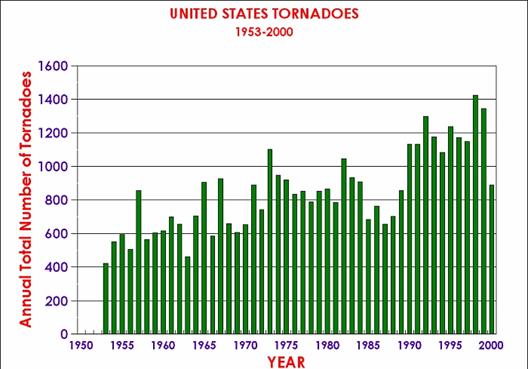
In An Inconvenient Truth, Al Gore and company said that global warming was increasing the number of tornadoes in the US. He claimed 2004 was the highest year ever for tornadoes in the US. In his PowerPoint slide deck (on which the movie was based) he sometimes uses this chart (form the NOAA):
Whoa, that’s scary. Any moron can see there is a trend there. Its like a silver bullet against skeptics or something. But wait. Hasn’t tornado detection technology changed over the last 50 years? Today, we have doppler radar, so we can detect even smaller size 1 tornadoes, even if no one on the ground actually spots them (which happens fairly often). But how did they measure smaller tornadoes in 1955 if no one spotted them? Answer: They didn’t. In effect, this graph is measuring apples and oranges. It is measuring all the tornadoes we spotted by human eye in 1955 with all the tornadoes we spotted with doppler radar in 2000. The NOAA tries to make this problem clear on their web site.
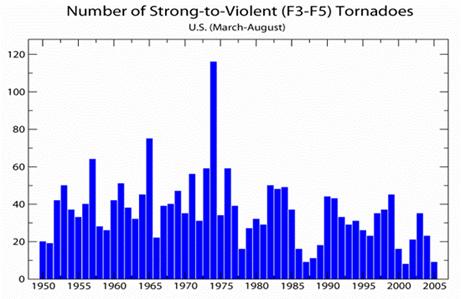
With increased national doppler radar coverage, increasing population, and greater attention to tornado reporting, there has been an increase in the number of tornado reports over the past several decades. This can create a misleading appearance of an increasing trend in tornado frequency. To better understand the true variability and trend in tornado frequency in the US, the total number of strong to violent tornadoes (F3 to F5 category on the Fujita scale) can be analyzed. These are the tornadoes that would have likely been reported even during the decades before Dopplar radar use became widespread and practices resulted in increasingtornado reports. The bar chart below indicates there has been little trend in the strongest tornadoes over the past 55 years.
Well, that certainly is different (note 2004 in particular, given the movie claim). No upward trend at all when you get the data right. I wonder if Al Gore knows this? I am sure he is anxious to set the record straight.
By the way, note the 2nd to last bar, which I believe it the 2008 bar (this chart is really hard to read, but it is the only way I have found the data from the NOAA). In spring of 2008, the media went nuts with a spring spate of tornadoes, saying that the apocalypse was here and this was the ultimate proof of global warming. In particular, ABC ran a story about how the frequency was twice the previous year. Beyond the insanity of drawing long term trends in a noisy system from 2 data points, notice that the previous year was virtually the lowest number in half a century, and despite being twice as high, 2008 turned out to be an average to lower-than-average tornado year. This is what the media does with the climate issue, and why you can trust almost none of it.
Update: By the way, 10 of the top 10 deadliest tornadoes occurred before 1955? An artifact of increasing wealth, better construction, and in particular better warning and communication systems? Likely -- it is no accident, I think, these all occurred before the popularization of TV. However, remember this argument when you see charts of increasing property damage from hurricanes. These are also an artifact of increasing wealth, but the other way around -- more rich people build expensive houses on the beech, the more property damage from hurricanes irregardless of hurricane strength or frequency.
I know that this pathetic bit by Kevin Drum was done to death by blogs last week, but I was on the road and still want to get my innings. For those who have not seen it, Drum said (in a post about Obama and Libyan war):
So what should I think about this? If it had been my call, I wouldn't have gone into Libya. But the reason I voted for Obama in 2008 is because I trust his judgment. And not in any merely abstract way, either: I mean that if he and I were in a room and disagreed about some issue on which I had any doubt at all, I'd literally trust his judgment over my own. I think he's smarter than me, better informed, better able to understand the consequences of his actions, and more farsighted. I voted for him because I trust his judgment, and I still do.
A few thoughts
Leaders on the Left have a strongly arrogant belief that they are smarter than ordinary citizens, and so it is their duty to make decisions for individuals because politicians will do a much better job of running people's lives than ordinary folks would themselves. I have always supposed that for this governing philosophy to be successful, there had to be a deep parallel desire among the rank and file of the Left to be led, to put their own life in the hands of politicians who can be better trusted to make decisions for them. This bit from Drum seems to be evidence of that desire.
I know of absolutely no one, politician or otherwise, whose judgement I would generally trust more than my own. Seriously, this is just pathetic. Sure there are folks whose judgement I might trust, based on long experience, over my own on narrow issues (e.g. my wife on restaurant choices or my son on who to draft for my fantasy football team).
Drum completely ignores the issue of incentives (as do most folks on the Left). Even if a politician's judgement were better than mine on a certain issue, could I trust his or her incentives to make the decision based on the same goals I might have? In the case of Libya, Obama has any number of incentives -- his poll numbers, reelection in 2 years, pressure from members of his own party, his legacy, his image in other countries, finding consensus among his advisors, etc -- that might affect his decision-making but which I do not share.
What in God's name in Obama's pre-Presidential career provided the basis for Drum's staggering trust in his judgement? Where have we ever, ever seen this judgement exercised in any meaningful way, particularly on an issue with this many chips on the table? Even since he has been President, where has this judgement been evidenced? As I have said any number of times in the last two years, having a really, really good speaking voice is not a proxy for intelligence.
To the extent that Drum voted for Obama based on his foreign policy judgement, Drum's perception of Obama's judgement had to have been based in large part on campaign statements and speeches Obama has made on foreign policy. And those statements basically said that what Obama is doing now is illegal. How can Obama have universally good judgement if he promised to do A in the campaign and is doing not-A today. Both A and not-A cannot simultaneously constitute good judgement.
Apparently the Left is still trying to argue that the stimulus (the process of taking money out of private hands to have it spent by government officials instead) was really a super-fabulous idea and only failed because it was too small. Here is Kevin Drum:
But another reason [the stimulus failed] is that at the same time the feds were spending more money, state governments were cutting back. The chart below from CBPP tells the story. They have data for all but six states, and on average for 2012, "those 44 states plan to spend 9.4 percent less than their states spent before the recession, adjusted for inflation." That's not just less than last year, it's less than 2008. That wiped out nearly the entire effect of the federal stimulus pacakge [sic].
I have a different take. A number of states, because they don't own a printing press as does Uncle Sam, actually tried to deal with economic reality and cut their bloated spending, an effort that was largely wiped out by Obama's "stimulus" spending.
The California Air Resources Board violated state environmental law in 2008 when it adopted a comprehensive plan to reduce greenhouse gases and again last year when it passed cap-and-trade regulations, a San Francisco Superior Court judge has ruled in a tentative decision.
If the decision is made final, California would be barred from implementing its ambitious plan to combat global warming until it complies with portions of the California Environmental Quality Act, though it is not yet clear what the air board would have to do to be in compliance. The state’s plan, which implements AB32, the Global Warming Solutions Act of 2006, would reduce carbon emissions to 1990 levels by 2020.
The management of the Post Office is a joke, and it is hardly worth the electrons to write more about it. But I did find this factoid in Tad DeHaven's commentary on the Post Office's hopeless efforts at cost reduction interesting.
Traditional post offices, which number about 27,000, cannot be closed “for solely operating at a deficit” and the closure process is burdensome.
Wow, that is a bad law (though no worse than 10,000 others like it). This sounds similar to the military base problem, where every facility that needs closure has a Congressperson desperately trying to keep it open against all economic reality, merely as a jobs/welfare program once its true utility is over. Apparently, the Post Office has an overcapacity problem that rivals the US Military's after the Cold War (and really to be honest after WWII)
Full post offices are more costly to operate than other means of serving customers. The average post office transaction cost 23 cents per dollar of revenue in 2009 while the average transaction at a contract postal unit cost just 13 cents. Post offices used to generate almost all postal retail revenue, but 29 percent is now generated online through usps.com and other alternative channels.
In 2009 post offices recorded 117 million fewer transactions than in 2008. Four out of five post offices are operating at a loss. However, the postal network’s overcapacity has drawn little corrective action from Congress. In fact, legislation introduced in the House with 102 cosponsors would apply the burdensome procedures for closing post offices to other postal outlets as well. Congress is actively working against the modernization of the U.S. postal system.
The amazing thing is that they have tons of extra capacity and still provide poor service. Just compare the process of mailing a package UPS vs. USPS. I have a UPS account, I can print my own labels, I get billed automatically, I get package tracking, and I can send the package from the drop box downstairs in my building.
It is almost impossible to do this with the USPS. To mail anything larger than 13 ounces, to buy postage without an expensive meter, to get a greatly inferior sort of tracking -- all require a grim trek to the post office.
My guess is that just like Pemex is not longer really about producing oil, the USPS mission is no longer primarily about delivering mail, its a welfare program.
PS - my USPS delivery guy is great. Nicest guy in the world. The mistake for years in criticizing the USPS has always been about criticizing the people. Not only is that wrong, but it distracts from the problem. By implying the problem is bad, surly people, it implies the problem is fixable with new people. But in fact, the problem, as with all government, is information and incentives .... and in this case Congressional meddling in their mission.
To understand how badly we're doing the most basic work of journalism in covering the law enforcement beat, try sitting in a barbershop. When I was getting my last haircut, the noon news on the television"”positioned to be impossible to avoid watching"”began with a grisly murder. The well-educated man in the chair next to me started ranting about how crime is out of control.
But it isn't. I told Frank, a regular, that crime isn't running wild and chance of being burglarized today is less than one quarter what it was in 1980.
The shop turned so quiet you could have heard a hair fall to the floor had the scissors not stopped. The barbers and clients listened intently as I next told them about how the number of murders in America peaked back in the early 1990's at a bit south of 25,000 and fell to fewer than 16,000 in 2009. When we take population growth into account, this means your chance of being murdered has almost been cut in half.
Its almost impossible to convince folks that AZ is not in the middle of some sort of Road Warrior-style immigrant-led wave of violence. In fact, our crime levels in AZ have steadily dropped for over a decade, in part because illegal immigrants trying to hang on to a job are the last ones to try to stir up trouble with the law (charts here, with update here)
In Phoenix, police spokesman Trent Crump said, "Despite all the hype, in every single reportable crime category, we're significantly down." Mr. Crump said Phoenix's most recent data for 2010 indicated still lower crime. For the first quarter of 2010, violent crime was down 17% overall in the city, while homicides were down 38% and robberies 27%, compared with the same period in 2009.
Arizona's major cities all registered declines. A perceived rise in crime is one reason often cited by proponents of a new law intended to crack down on illegal immigration. The number of kidnappings reported in Phoenix, which hit 368 in 2008, was also down, though police officials didn't have exact figures. [see charts above, these are continuation of decade-long trends]
But over Thanksgiving my niece visited from the Boston area for a national field hockey tournament and her teachers and coaches had carefully counselled them that they were walking into a virtual anarchy, and kidnapping or murder would await any teen who wandered away from the group.