If I had to Summarize Entrepeneurship with One Observation
Working for someone else: Days are way too long.
Working for myself: Days are way too short.
Dispatches from a Small Business
Archive for the ‘Small Business’ Category.
Working for someone else: Days are way too long.
Working for myself: Days are way too short.
Why is it so much fun to hate Ivy Leaguers? In part, because they
(well, we*) can often be so hateable. For years, I toyed with the idea
of offering a prize to the first Harvard grad I met who did not, in the
first ten minutes of conversation, manage to work that fact into the
conversation somehow.
OK, I have a couple of Ivy League degrees, so now I have fallen into the trap as well. But I say that mainly to tell a story about running a small business.
Running a service business that is dispersed across many locations in 12 states, I cannot personally be on top of everything. Not even close. I depend on my employees taking the initiative to tell me when they think the company should be doing something differently or better. However, many of my employees do not have college degrees at all. This is not a problem for their job performance, as most have a lot of life experience and they do their jobs quite well. Unfortunately, if or when they find out I have a Harvard B-School degree, the very likely outcome is that they stop making suggestions. They make the assumption that because I have a more expensive piece of paper on my wall than they do, that I must know what I am doing. They are embarrassed to try to give me suggestions. Which is a crock.
I constantly have to hammer home two messages to my employees, both of which are hard to get people to believe despite the fact that they are true:
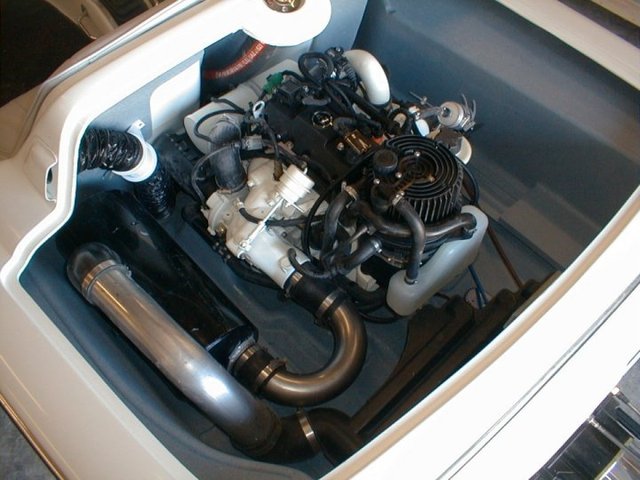
I know a gentleman named Alan Shapiro who has come up with what looks to me to be a nice new boat concept he calls the "Raptor". Pictures of the boat are below (click on any picture for larger image)
I believe he also has a link to some YouTube video at his web site. Update: Here is the YouTube link.
He knows how to design and build the boat and has pretty good contacts for selling it, but needs help from a CFO/Strategist/business-type to push the company forward. He has a prototype built and the production model fully costed-out and sourced. However, he is about to look for a new round of financing and need help in that process. He is offering equity in the company but can't pay a salary. The job would not be full-time in the beginning. If anyone has some time on their hands and has experience with startups and likes boating, this may be something to look into. I have helped him a little bit, but I am out of time and need to focus on my own business.
I do not in any way warrant whether this is a good opportunity or not. Don't assume that because Coyote seems like a smart guy, that this must be a viable business, because I just don't know. I have given him a bit of startup money in exchange for some future boats, and a bit of advice, but that is the extent of it. He has a draft business plan I am sure he would share with qualified candidates.
What I like about the product is that in the rental business, there really is a need for a personal watercraft or jetski that is enclosed, such that it will rent in colder waters and does not require renters to get out of their street clothes. If you know what a mouse boat is, these are much higher performance versions of that type product. He takes jetski engines, from 50-110HP, and puts them into this really fast hull shape. This boat is fun to drive (see the video linked above) and my opinion is that it would rent well, but I of course have not been able to prove that with actual boats. Alan believes there is also a strong market for individual sales, but I can't confirm or deny that from my own knowledge.
If you are interested, or know someone who might be, email me at the link on the right with some information about yourself and I will pass it on to Alan.
It always happens this way.
Pick a random message: Let's say I want my folks at Matagorda to know that what they do is important. So I visit from time to time and tell them they are doing a great job. I will email them with the same message, emphasizing how important Matagorda is to the company. Each quarter I will compliment them on their results. I will show Matagorda in all my long-term strategy documents as one of our core operations. Every time I am on the phone with them I thank them for their had work at so important a facility.
And then one of our employee's mailman's wife's gynecologist's dog's veterinarian's receptionist might say at a social gathering that she heard our company was leaving Matagorda and the next day I will have 8 people emailing me to ask me why I was about to fire everyone and, further, how mad they were to hear about it second hand.
Sometimes I want to just give up.
A bit over five years ago, I wrote an op-ed piece in our local paper calling for further privatization of public recreation. The editorial was in response to a proposal for a large bond issue to rebuild recreation infrastructure. I argued that the state should instead be focusing on attracting private investment. Not only was there more money for recreation in private hands than public, but I sensed that private funds would more likely be invested in facilities the public really wanted, rather than goofy politically correct projects. Further, private operators could operate recreation facilities much less expensively, in part because they are not tied to ridiculous public pay scales, pension plans, and job classifications.
Soon after, I had a business broker call me and ask me if I wanted to put my money (such that it was) and time where my mouth was. After a lot of twists and turns, I ended up the owner of a recreation concession company. In a recreation concession, a private operator pays the government rent in exchange for the ability to charge visitor fees and run the recreation facility for profit. In most cases, our company can operate a property and make a profit on fees lower than the government must charge just to break even.
My business, Recreation Resource Management, has prospered since then. And as I have gotten deeper into public recreation, what I have learned has only confirmed what I wrote in that editorial. I have seen that when the government runs recreation facilities, it almost never spends enough money on capital maintenance and refurbishment. The reason seems to be that legislators, given the choice, would much rather spend $X on a shiny new facility they can publicize to their constituents than spend $X maintaining facilities that already exist. I laugh when I here progressives argue that private industry is too short-term focused and only the government invests for the long-term. In practice, I find exactly the opposite is true. Think about hotels, or gas stations, or grocery stores. Private businesses understand that every 15-20 years, they need to practically rebuild existing infrastructure from scratch to keep them fresh for customers. This kind of reinvestment almost never happens in public recreation.
Except this week!
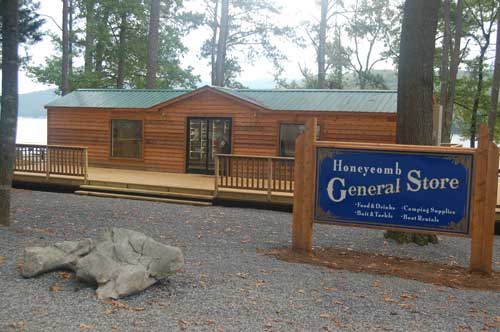
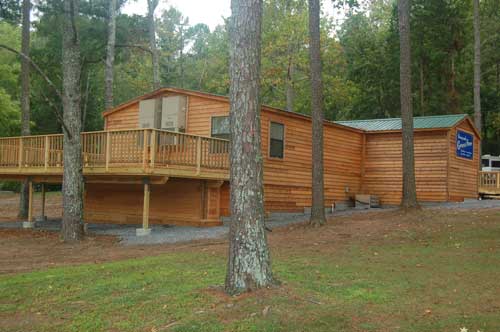
After years of building up our business, we just completed a project with California State Parks that is what I have always wanted to achieve with the company. At McArthur-Burney Falls State Park, California State Parks had an aging concession store and an outdated section of the campground that it really did not have the money to rehabilitate (by the way, this is an absolutely beautiful park -- I highly recommend it). We crafted a two-part lease with the state which eventually led to us investing over a million dollars in the park: In phase one, we built a new concession store (old store on left, our new store on right):
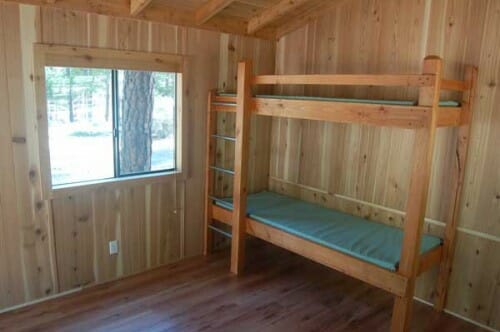
In phase two, just complete, we took an old tent-camping loop with no utilities and added 24 new cabins. These cabins not only refurbish an aging and dated section of the campground, but they also add new amenities to the park to attract visitors who may not own an RV and who don't want to sleep in a tent. In addition, since they are insulated and heated, these cabins will extend the camping season -- in fact, we already have a number of reservations for Thanksgiving, a time when no one would have wanted to tent camp here.
Its a win-win-win, where we make money, the state gets lease revenues
from us that exceed their previous camping revenues, and the public
gets new amenities without any taxes or public spending.
So, in answer to the question I so often get, "why does a libertarian run a company that works with the government?" Now you know why. I will admit that from time to time I find myself on the losing end of libertarian-intellectual-purity debates because I choose this path rather than, say, living in a cabin in the wilderness and manufacturing rifle barrels for a living. *Shrug*
Postscript: One lesson I have also learned is that state governments are not always a monolith. Texas and Florida, for example, while being beloved of libertarians for having no state income tax, can be horribly bureaucratic in certain areas (e.g. sales tax reporting and vehicle registrations). California, on the other hand, which in many ways is one of the worst states to do business in, actually has what is probably the most innovative and business-friendly state parks organization in the country. Go figure.
PS#2: By the way, the cabins shown are actually modular buildings, built here in Phoenix by Cavco, and shipped to the site. The classy interior work was done my by maintenance supervisor.
One of my favorite bloggers, TJIC, also runs a business called SmartFlix
which has an enormous collection of instructional videos, from crafts
to outdoors to home improvement, all for rent. Most of these niche
videos are incredibly helpful, but are almost impossible to find
anywhere else.
Anyway, TJIC apparently wrote James Lileks, a really fun-to-read columnist and author, with the following come-on:
We send you a video. You watch it, or watch 10 minutes of it, or don't watch it at all.
Then you write something, which might be a review, or might
barely mention the video at all. For example, a short review on a video
that instructs one on how to play pool might mention the fact that you
watched 10 minutes of the video, and then segue onto a story about you
playing pool 15 years ago with The Giant Swede"¦In short, I propose a business relationship where you do whatever the heck you want to.
Small business tip of the day: If you find yourself waking up on Monday, thinking that you have finally climbed on top of things and everything is humming pretty well, expect a torpedo to hit you. Maybe several.
The red lights are all flashing here and the bulkheads are leaking. Blogging will be light for a couple of days, while damage control progresses.
There are probably a lot of reasons out there to criticize Las Vegas, but one thing it is great for is that it is perhaps the best and least expensive place in the country for a small business like mine to put on a national managers meeting.
We bring 60 managers in from all over the country. We held our event at a hotel/casino a mile or two off the strip called the Orleans, where two years running we have gotten nice clean rooms and great service. Beyond the good service and more-than-acceptable rooms, we get:
On top of all this, my people love it there. Anyone running a national meeting on a budget should definitely consider it.
Sometimes entrepreneurs are successful enough to buy themselves sexy toys: It may just be a nice pool table for the office, or it might be that new Gulfstream jet bought with the IPO proceeds. But little did I know that entrepreneurial success would allow me to buy this beauty (click to enlarge):
This septic tank truck can really haul a load, carrying over 3800 gallons of, uh, poop.
We have a new facility at Pyramid Lake we run in LA County, where, due to its location, all the bathrooms run into series of underground holding tanks. At some point in the past, someone converted all the bathrooms into flush toilets, which in this area makes for a real waste of water and creates a lot of liquid waste we have to pump out and dispose of, at the cost of over $80,000 a year. This truck is the intermediate solution, letting us cut our pumpong costs in half. The long-term solution we are working with the US Forest Service on is to replace the bathrooms with a great composting technology from Bio-Sun, which will cut the waste and water use both to near zero.
Note that this article is one in a series of articles on small business how-to's. Past series have covered how to buy a business, labor audits, sales taxes, and workers comp.
I recently went through the process of obtaining an SBA (Small Business Administration) loan. These are loans that are what I call "cash flow" loans, secured more by the companies earnings rather than collateral (though collateral may be required, see below). SBA loans are written by private banks to standards set by the government. If these standards are met, then bank loans under this program get a partial guarantee from the US government.
Before I go on to describe the process, I feel compelled to note that as a libertarian who does not believe the SBA should even exist and who believes that such loan guarantees are a subsidy program that should be eliminated, I was obviously conflicted by whether to seek out such a loan. What finally made the decision for me is that this government program has crowded out all other private options. Banks get about the same rate for an SBA loan as they would for a commercial loan without the guarantee. Since the guarantee is out there and doesn't cost the bank anything, the bank has no reason not to insist on it? Therefore, as a small company in the SBA size range, there just are not any banks willing to lend without the SBA guarantee. This does not mean that in a free market without the SBA there would be no loans - it just means that when such a free subsidy program exists, banks are going to take it.
Types of Loans
The following is a gross simplification, but for a small company, there are basically two types of loans: secured loans and cash flow loans. Secured loans are by far the most common for small businesses. I, like nearly every entrepreneur I know, have had to pledge my house at various times as collateral for loans. While it is fairly easy in today's market for a small company to get an equipment loan (typically lease-finance of a purchase) secured by hard assets, few lenders will provide loans for general business and working capital needs unless they are secured by something tangible -- homes, vehicles, receivables, etc.
However, most businesses need capital for more things than just to buy hard goods. Seasonal businesses may need loans to pay the rent in off-seasons, retail businesses need money to grow inventory and pre-pay for new leases, while opening new divisions may require paying salaries well in advance of first revenues. Unfortunately, most businesses that claim to be business banks have no desire or talent to understand a business well enough to make a cash flow loan. I am not talking about just Ethyl's Bank, but large banks like Bank of America and Wells Fargo who were stumped when I wanted to discuss some unique financing needs in my business. I know people with a half million dollars a year in free cash flow out of their business who have trouble getting bankers to make unsecured cash flow loans. And, as mentioned above, those who do make cash flow loans typically insist on having the SBA guarantee.
How an SBA Loan Works
I will not pretend to be an expert on all the intricacies and rules. The SBA has a number of programs, offering loans of different lengths of time and for different purposes. The SBA has programs for both revolving lines of credit as well as standard 10-15 year loans. Each of these programs has different under-writing criteria, fees, and limitations, which your banker will have to explain to you. Most SBA loans, including mine, fall under the section 7(a) program. The SBA site tries to explain some of this.
As stated in the intro, an SBA 7(a) loan actually is issued by a bank, but to SBA underwriting criteria and with an SBA guarantee. The SBA only guarantees a portion of the loan, something like 50-75% depending on the exact loan type, with the bank taking the rest of the risk. These loans are issued at a floating rate of prime plus a percentage, and the SBA has rules that caps the rates as well as fees the bank can charge. The SBA charges a substantial fee, in the 2-3% of total loan value, up front to the borrower for the guarantee.
Banks participate in the program in one of two ways. Most any bank can originate an SBA loan, collecting all the (very substantial) paperwork needed by the SBA and forwarding it to the SBA for approval. In addition to the underwriting time at the bank, the SBA can take many weeks to complete this analysis. A smaller subset of banks have been pre-approved by the SBA to act as their underwriting agent - called a preferred lender or PLP. This means that they can do the SBA's analysis for them. This often greatly accelerates the process. My total time form the bank's first data request to the final loan closing was less than a month, which is very fast.
Choosing the Bank is Critical
From the section above, it should be obvious that you should strongly consider working through a bank that has the preferred lender status with the SBA. Note that having or not having this status does not necessarily correlate with bank size. The "expert" I was hooked up with at Bank of America (my main bank) was useless, and told me in so many words that it would be impossible for me to ever get an SBA loan. I ended up working with Silver State Bank, a relatively new business bank out of Nevada. They had the whole process automated, and when combined with a very knowledgeable banker on the front end named Jerry Woods here in Phoenix, the process was as smooth as silk and very, very fast. In fact, I got the whole loan done in less time than it took BofA two years ago to do my line of credit.
Costs and Other Considerations
SBA loans are not cheap, and I would strongly urge you to pursue secured asset-backed loans as far as you can. My total fees, including the cost of the guarantee, ran to about 3% of the total loan value. In addition, I STILL had to put up collateral to back the non-guaranteed portion of the loan. In retrospect, I think I did a bad job of negotiating with my banker on this. No matter how good they are, bankers are still bankers and are going to attach every asset that can sit still for collateral whether they really need it or not. I should have pushed back harder on this issue. Overall, though, I am excited that I now have the capital to continue to grow my business.
PS- If you want to enjoy some of this capital at work, come to Lake Havasu and rent a jet ski for a day! All those other entrepreneurs out there are investing money in dead-end stuff like microchips and improved manufacturing -- Ha! There is nothing like being able to tear around a big lake on 110HP to really make America competitive!
The original purpose of this blog was to pass on my experiences and lessons-learned running a small business. Over time, though, since I have the attention span of an 8-year-old boy mainlining Hershey bars, I have gone many different places with this blog, well beyond day-to-day experience of a small business.
However, today I will return to this original goal, at least for one post, by asking the question "what's on my desk this morning?" I tackle this question for two reasons. First, it is interesting to compare how different the issues I struggle with day-to-day are as compared to my previous life as an executive at several Fortune 50 companies. I am sure I did more, but all I can remember from my daily activities at large companies seems to involve either working on PowerPoint presentations or traveling to give them to somebody. The second reason for visiting the contents of my desk is to reinforce my usual libertarian political points, which I think will be made sufficiently obvious just in the description of my to-do list that I won't need to editorialize further.
So here is what's got to get done today [ed note -- while published on Sunday, this is based on my worklist on Friday morning, May 13.]
There are a million other things going on, but that is what is burning me up today. In fact, since I have been spending the last hour writing this post, these tasks will probably also be occupying me this weekend. An alien from another planet in reading this post might question whether I am really working for myself or this "government" entity.
In the span of one hour this morning, I got to "enjoy" both my most and least favorite business activity.
My least favorite activity is always paying taxes, but within that broad category (remember that being in 10 states and 25 counties means that I file over 50 different tax returns or one sort or another every year) my least least favorite are business property tax returns. If you have not run a small business, you may not be aware of what a pain these are (individuals don't have to file them, and large companies have poor schleps in accounting to do it).
First, business property tax statements usually have to be filed by county, so I have to do a zillion of them. Second, governments require that you report every year and in great detail on essentially every asset your business owns in a state or county. A business must report these assets, usually with a description, date purchased, original purchase price and estimate current market value. Imagine as an individual if you had to report this information on everything in your house - furniture, computers, appliances, tools, etc. Now imagine doing it for a business, which owns a lot more miscellaneous stuff than you have in your house.
What really irritates me is that filing some of these statements requires the person filling out the statement to take a chance. Clearly, no one is going to list every asset, down to the last pencil and paper clip -- you are going to establish some reasonable cutoff, and group similar assets into catch-alls like "miscellaneous tools" or "office supplies". Note however, that this is taking a chance: In counties that require detailed asset listings, there is never any statutory language like "you can ignore items under $100 as de minimis" or "you can group similar items". Technically, you are supposed to list them all. Take my word for it, this is very, very tedious.
But wait, as the Ginsu knife guy would say, for our business there is more aggravation. We do business as a concession holder on federal lands. For example, we might run a US Forest Service campground. By US law, states and counties may not charge the US government property taxes on these facilities. BUT, certain of the most acquisitive states, including California and Washington, have devised taxes that get around this requirement. These two states make me pay the federal government's property taxes for them at the facilities I operate. This is kind of like being forced by law to pay your landlord's taxes for him. I always find this terribly irritating, all the more so since now that I know the game, when time comes to bid on concessions in these states, I just subtract the estimated taxes from what I am willing to pay the government in rent, in effect ensuring that the US government ends up paying the tax.
This whole enterprise left me feeling depressed, when a couple who I had called about a manager position at a new store concession of ours at Clear Lake State Park in California called me back. It turned out this couple is incredibly entrepreneurial, has great business experience, and are very well-suited to running my operation with minimal supervision. I was thrilled to find them, and they were in turn thrilled to find an outdoor summer job opportunity in a nice location which could be flexible enough to accommodate a person with a disability (one of the couple has Parkinsons). There is NOTHING I enjoy more than finding great people to work for me, and finding such people is all the sweeter if I can offer them an opportunity that uniquely fits their own needs.
Running a small business can be quite "interesting". Last summer we dealt with 4 hurricanes that shut down our Florida operations for over a month. This winter we have had great success winning new contracts, including one we are very excited about at Pyramid Lake, California. We got all our investments made to support this contract, got all the necessary staff on payroll, and wham, a local pipeline company spills over 100,000 gallons of crude oil into the lake and it is now closed for weeks, with a substantial loss of revenue in prime spring boating season. Sigh.
A while back I wrote a series of posts here, here, and here on buying a small business. One of the things I said in that post was:
Then, there are the banks. From my experience, it is very, very
difficult to get a bank to make an collateralized loan - i.e. a loan
that is secured only by the cash flow of a company rather than by
assets. In fact, I have never been successful at that. About the only
way that I have found that banks will make a loan is if it is an SBA
loan, where the SBA basically guarantees the loan for the bank. The SBA
goes through cycles of being very open to lending to being very tight.
I have not dealt with them for over two years, so I don't know what
their stance is today. Remember, though, that the SBA is not going to
approve any loan where the buyer has no experience in the industry or
where the buyer is not putting down his own money as well. The SBA has
a lot of information here.
This statement is still mostly true but I have learned a lot over the last couple of months. The following is an update.
One of the things they tell you all the time in business school, but frankly I always found impossible to really internalize, was how much cash growth takes. I guess I always thought of businesses with cash flow problems as being unsuccessful, slowly sliding down the drain and trying to make ends meet. Wrong. Growth is tremendously expensive. And stressful.
My business is based on concession contracts. Each winter, we are usually presented with the opportunity to bid on many contracts. We narrow the field down to 4-6 we bid on, hoping to win about 2. One of the things I did last year was greatly improve our standard bid materials, hoping that would help us win good projects. Did it ever. We bid on 6 last year and we won 6 (including Burney Falls, Pyramid Lake, and Lake Havasu). Yea! But then I began adding up all the investments in new inventory, new equipment, salary (you always have to hire people before the first revenues come in), licenses, building improvements, etc. Eeek!
After a lot of work with bankers, I stand by most of my statement above. Most bankers will not lend to businesses on cash flow, and always want some type of collateral (like my home equity). Over time, though, I have found a few bankers who are willing to lend on cash flow and really understand business growth and why maybe I don't want to have my business's growth rate limited by how much equity I have in my personal home. There are bankers who will put together packages of long-term loans backed by the SBA plus short term working capital loans that will now let me grow faster. The folks at Copper Star Bank, for example, have been great.
One of the reasons I felt the need to post this update is that I have been told that my difficulty finding a good business banker was due in part to my location here in Phoenix. The Phoenix banking market is very real estate driven, so bankers usually come from that background rather than a business background. I am told that those of you on the east coast or in the Midwest may have an easier time finding good business bankers.
Postscript: By the way, you might ask how I feel as a small government libertarian about accepting the government subsidy implicit in an SBA loan. The answer is "conflicted". Some libertarians are fine accepting government services, on the theory that they certainly have paid for them with all their taxes. Some try to avoid government services, but that is almost impossible in today's world (such as using government roads). I generally try to be pragmatic, operating somewhere in the middle.
As far as SBA loans go - I don't know what the commercial banking world would look like without SBA loans. I think that the banking world would have found an alternative way to mitigate the risk (e.g. via securitization) without the government gaurantee, but we can't know. The fact is that SBA gaurantees exist and banks would be crazy not to use the gaurantees in making business loans. So, the reality is, if I want a cash flow based loan for a company my size, it will likely carry the SBA gaurantee. My appologies to all those whose taxes support my loan gaurantee.
Hey, this may be a first -- audit blogging. I have an auditor from the Washington Department of Revenue in my office right now auditing my last two years sales tax returns. She's a nice lady and so far the interaction has been pleasant.
Here is the funny thing - she has spent about 3 hours now trying to figure out what tax rates should apply at my various locations, and she is still at it. I have written several times about the complexity of WA state sales tax variations for lodging, and how they vary by geography (here and here). OK, if your experienced auditor has to spend hours in frustration trying to figure out what tax applies, the system is too complicated.
Update: At halftime I am ahead, with WA owing me $800. Stay tuned.
UPDATE #2: Small potential setback in the 3rd quarter. Several years ago I shifted assets (vehicles) I had bought in Arizona and used for years in Arizona to Washington for operations there. The auditor suggested I may owe use tax on the vehicles in WA. Huh? Use tax drives me up a tree in general, but this seems really crazy. WA is hyper sensitive to this issue because they have high sales taxes and very high vehicle registration fees and neighboring Oregon has not sales tax and lower registration fees.
Last Thursday I spoke at the the Phoenix Enterprise Network about buying your own business, a topic I discuss in more depth here. The audience was pretty full, not for me, but in expectation of Sharon Lechter of Rich Dad, Poor Dad fame. Since Ms. Lechter and her partner Robert Kiyosaki have become the chief evangelists of starting your own business, a lot of people were there who were interested in that topic.
I found that for at least one reason, I was probably the wrong person to speak at this function. Many people in the audience seemed fixated on my Harvard MBA and felt intimidated that somehow they were under-qualified or undereducated to be entrepreneurs.
I tried as hard as I could to convince folks that everything I learned at Harvard was virtually useless for running a small business. I told them (truthfully) that my Harvard diploma hangs in my laundry room, since that was the only thing I really learned to do well at school. I emphasized that knowledge and passion about the business you want to start is much more important, and that everything else could be learned. Night courses in certain areas could help, and I would focus on two areas:
In reality, the Harvard sheepskin on my wall actually hurts me running a small business as often as it helps me. For example, many of my employees when they first work for me seem intimidated by the degree, and assume I must know everything and therefore they are afraid to raise concerns or share ideas. Any of my managers who read this will probably laugh, because most have gotten some version of my speech on this topic:
DO NOT assume Warren has a secret plan or brilliant idea on any subject that he has not told you yet. Assume that if you have not heard from Warren on a topic, he either has no clue there is an issue at all or else he has no idea what to do. Therefore, do what you think needs to be done, and call Warren if you need help.
By the way, if you are in the Phoenix area, the Enterprise Network not only has one of those exceedingly rare and valuable two-letter URL's, but it is a great group if you are an entrepreneur or you business sells to entrepreneurs.
It's called Kona Nigari, comes from 2,000 feet down off the coast of Hawaii, and it's bottled by Hawaii Deep Marine.
Kona Nigari is a seawater mineral concentrate you mix with regular water. You can buy some at the Key of Life store in the Royal Hawaiian Shopping Center in Honolulu.
As always with expensive weird shit, the Japanese are driving the market. They can't drink it fast enough.
They are apparently selling 80,000 2 oz. bottles A DAY to Japan, with each bottle going for $33.50. Wow.
I don't know if you get these, but about twice a month we get what looks like a refund check in the mail, usually for a couple of dollars and change, from some yellow pages company. Today we got one from "Directory Billing, LLC" for $3.25. We get a lot of small checks for pay phone and ATM commissions, NSF check refunds, etc, so sometimes these almost slip through - be VERY careful.
Why? Well, the check looks all normal and innocuous, but in tiny grey lettering in the background of the endorsement section on the back, there is a lot of legal verbiage that amounts to the following "by endorsing and cashing this check, you are signing up for a directory listing in some random yellow pages you never heard of for some god-awful amount of money which we will bill later".
Marginal Revolution cites a James Surowiecki article on branding, arguing that increased information flow, particularly over the Internet, is reducing the power of brands. This seems right to me. Brands exist and command premiums for many reasons. One role of brands is that they serve to reduce risk - without any other information about a product, many people would likely assume an electronics product from Sony to be more trustworthy than a no-name brand with the same features, and might be willing to pay a premium for the Sony product. However, with all the review information on the Internet, people may be more comfortable buying the off-brand, if it has good reviews, and saving the Sony premium.
Of course, brands serve some communication roles that are likely not threatened by the Internet. For example, high end brands like Prada or Gucci have power because they allow the owner to communicate things about themselves to others.
I would argue that, even with Internet reviews, brands will continue to be powerful in the service sector. In fact, with the growing complexity of some service offerings and the increasingly high standards of consumers, they may be more important. Why? Consistent product quality is much easier than consistent service quality. A no-name product maker can get high quality product all over the world from one single factory -- all they have to do is to get that one location right. This is much easier to do than with McDonalds, where there are thousands of locations, or even in our business, where we have hundreds of locations. Service quality happens in real time, often in many dispersed locations miles away from supervision and the management staff.
Also, in many cases, service failures are more critical and are harder to correct than product failures. If my printer does not work, I get mad and box it up and return it for a new one. But what happens if FedEx fails me on a critical shipment? Or worse, what if United Airlines fails on me mid-flight?
An interesting way to prove this is to go to a site like epinions. Service reviews are generally much more variable than product reviews. Compare Fedex, who's review is a mix of the lowest and highest scores, with this Apple Ipod, where reviews are much more consistent. Even when products get a mix of low and high scores, often the low scores are driven by service and support and not the product itself. In positioning their brand today, does Dell emphasize the product or their service around the product?
First, I will say there are no books out there about what business is really like, probably because reality can be pretty grim -- I don't think that people would be hanging on the edge of their seat reading about a manager arguing with the Department of Labor about a fine for his minimum wage poster not being in the right location. Maybe if Dave Berry wrote it.
Anyway, most fiction that involves a business is either about some rapacious capitalist who is stealing or killing or destroying the environment or whatever or it is a sort of Machiavellian opera ala Dallas or Dynasty. Few actually portray a business leader as a hero.
For business people that are heroic and multi-dimensional, and exempting Atlas Shrugged as in a class by itself, I recommend James Clavell's Noble House. This zillion page book covers but 8 days of time in early 1960's Hong Kong, but is epic none-the-less. I just finished reading it a second time and I enjoyed it even more than the first time.
I am feeling a little guilty tonight. I just dumped a pain in the butt troublesome employee on another company. Without warning. Specifically, we fired him a couple of weeks ago, for a variety of issues, but mentioned no negative information in his reference check from his new employer. Here's why.
It has become dangerous to give out negative references. Ex-employees have become increasingly succesful at suing employers for bad references. I don't have to tell any small business owners that lazy, incompetent, unreliable, whining, trouble-making employees never believe that they are lazy, incompetent, unreliable, whining, or trouble-making. You give them a negative reference, and before you know it they are in front of a jury saying "I never did any of those things, that employer was just biased against me, that's why he fired me and then tried to get revenge on me by lying to all these other companies and blackballing me from getting a job to feed my family". Now, you are stuck trying to prove in a court of law that the reasons for termination, and what you said in the reference check, are valid. It's always good to document these situations well, but no business documents this stuff well enough to survive a plaintiff's attorney's cross examination.
You can learn more about these lawsuits here and here and here.
As a result, our company policy is to not allow any employee to give out any references whatsoever. They are not allowed to give out any information about employees except the dates of their employment. They are most definitely not allowed to discuss reason for termination. In a few cases, I will make an exception for good employees, but even in that case I require their permision in writing.
So, sorry employers out there. I feel bad about it, but I have to protect myself because the sharks are always circling. While its inconvinient to hire a bad employee in our business, it can be a disaster in places like hospitals that have life and death situations. Crazy? Check this out.
Dear Congress: If you would like to do something useful for a change, please consider granting employers some sort of liability shield for the information they give out in references.
Most of the facilities we run are concessions on government lands. To get these concessions usually requires a bidding process, where the government authority evaluates qualifications to run a quality operation as well as the amount of rent (usually as a percentage of sales) "bid" by the concessionaire. Like most government contracting processes, proposals are usually due by a hard deadline (say, 2:00 Tuesday on X date). No proposals are accepted at 2:01 (unlike some arbitrary government regulations, this is actually for a good reason - there is plenty of history of late proposals coming in based on some insider knowledge of the contents of other proposals that have already been opened).
Anyway, we had such a deadline in Florida on Tuesday of this week. Normally, to make a Tuesday deadline, we will ship overnight on Friday, which gives us a buffer day in case of problems. This time, because we only got the RFP last week, we had to work through the weekend and ship Monday.
So we shipped FedEx for 10:AM delivery on Tuesday (paying $155 for 38 pounds, ugghh). And, of course, since this is the one time we had no margin for error, the box ends up sitting in Memphis for a full day, due apparently to excess demand for Florida that day, and arrived a day late and after the deadline. So all the work we did, all went to waste. Bummer (I have cooled down, I was using much worse words than bummer with FedEx this morning).
I learned this lesson once before about 8 years ago. FedEx is NOT for things that absolutely positively have to be there overnight. They are for things that would be best if it were there tomorrow but the world won't end if it is not. In a case like this, where we miss out on a big contract and we could waste hundreds of man-hours of work, I should have gotten on an airplane myself, checked the box as baggage, and taken it to the door. Yes, it would have cost me a few hundred dollars more, but we already had thousands of dollars in time and effort invested in it.
Most all of our managers in the company are promoted from within - this means that they started as a "camp host" with us, collecting fees and keeping the park and especially the bathrooms clean. One of the great joys I have found in business is finding someone with the talent and energy that deserves promotion. Many of the people we hire are retired, and a stunning percentage of my employees are over 70 -- I even have a few in their nineties! In several cases we have found folks over 65 who have never had a management job in their working career, or maybe never have worked out of the home before, who have made fabulous managers for us.
However, once in a while, something strange happens. We take a dedicated, customer-focused, friendly and sensitive employee, give them a manager title, and they become a monster. Something about the title, or rather their perception of the title, turns them into der fuhrer, barking orders at everyone, treating customers with disdain, etc. One of the classic lines I have heard quoted back to me intwo or three of these instances is "this is my campground, and I make the rules here". This line is usually stated at about the same time a customer or employee is being treated shabbily.
Of course, it is not their campground. In fact, since we operate facilities on public lands, it is not even the company's campground. In the end, in these two or three cases, the employees have left or were eventually terminated.
In response, we've beefed up our training and tried to better set expectation for managers, but we still have this problem once in a while. I wonder if it is a generational thing, as older employees whose business experience began in the 50's and 60's are channeling an outdated view of leadership. Anyway, it sure is frustrating.
Here is a quick scorecard of the Convenience Store convention today.
Scope: B decent mix of vendors but repetitious in some odd categories
Relevance to me: C- unfortunately, not many vendors of the type I was looking for
Venue: C Las Vegas convention hall, been there, done that. Positive of new Star Trek show next door offset by the fact the monorail was broken and traffic, as usual, sucked.
Food and Bev: A+ Awesome. This is basically 60% a snack food show and everyone had samples. Plus, all the beer manufacturers there in the middle pouring cold ones
Booth Babes: B- Kind of disappointing -- couldn't hold a candle to the consumer electronics or even better, the auto shows. Would have been a C+ but presence of vendor booths for Playboy, Penthouse, and Hustler staffed, uh, how you might think they would be staffed, brought up the score.
Other: B+ Got two good autographs, one from Raleigh Fingers (sp?) and one from Ed McCaffery. Skipped on the centerfold and Dallas Cowboys Cheerleader autograph lines (which, interestingly enough, were filled with women waiting for autgraphs).
Feet are killing me.
I am blogging today from Las Vegas, here for the convenience store convention. We run a number of small stores in our campgrounds and marinas, and I am trying to figure out how to make these operations more sophisticated.
I don't know if anyone else feels this way, but I am always a bit self-conscious at a convention. The whole thing is so stereotypical from TV and movies and so predictable from past experience, it somehow becomes kind of a caricature of itself. I always feels like a bit of a schmuck walking around with my little badge and doing that predictable little dance with vendors.
Thank God, though, that I am not working the convention tables as an exhibitor any more. "Have you seen the new model T-1000?" Uggh. And the stodgy companies I worked for never even had booth babes.