Things like Obamacare cannot be discussed, it seems, in anything but a political context. So if you don't like Obamacare, everything that happens has to be bad. But I actually think this is good news, and goes against my fears in advance of Obamacare. I had been worried that Obamacare would just increase the trends of more and more health care spending being by third-party payers. And my guess is that this is happening, when you consider how many people have gone from paying cash to having a policy, either a regular policy or expanded Medicaid.
A report out today puts numbers behind what hit many workers when they signed up for health insurance during open enrollment last year: deductible shock.
Premiums for employer-paid insurance are up 3% this year, but deductibles are up nearly 50% since 2009, the report by the Kaiser Family Foundation shows.
The average deductible this year is $1,217, up from $826 five years ago, Nearly 20% of workers overall have to pay at least $2,000 before their insurance kicks in, while workers at firms with 199 or fewer employees are feeling the pain of out-of-pocket costs even more: A third of these employees at small companies pay at least $2,000 deductibles.
“Skin-in-the-game insurance” is becoming the norm,says Kaiser Family Foundation CEO Drew Altman, referring to the higher percentage of health care costs employees have to share.
Honestly, this is good news, sort of. I don't like the coercion and lack of choice, but the main problem with health care is that the person receiving the benefits is not the person paying the bills, which means there is no incentive to shop or make care tradeoffs. Higher deductibles mean more people are going to be actively shopping and caring what health services cost, and that is a good thing for prices and health care inflation.
Remember the whole VA thing? It has mostly been forgotten, though we will all remember it again, or more accurately get to experience it ourselves, once the Democrats manage to get single payer passed.
People talk about government employees being motivated by "public service" but in fact very few government agencies have any tangible performance metrics linked to public service, and when they do (as in the case of the VA wait times) they just game them. At the end of the day, nothing enforces fidelity to the public good like competition and consumer choice, two things no government agency allows.
I will admit that government employees in agencies may have some interest in public welfare, but in the hierarchy of needs, the following three things dominate above any concerns for the public:
Keeping the agency in existence
Maintaining employment levels, and if that is achieved, increasing employment levels
Getting more budget
But look at the VA response in this context:
The agency remains in existence and most proposals to privatize certain parts were beaten back
No one was fired and employment levels remain the same
The agency was rewarded with a big bump in its budget
The VA won! Whereas a private company with that kind of negative publicity about how customers were treated would have as a minimum seen a huge revenue and market share loss, and might have faced bankruptcy, the VA was given more money.
On the free market, in short, the consumer is king, and any business firm that wants to make profits and avoid losses tries its best to serve the consumer as efficiently and at as low a cost as possible. In a government operation, in contrast, everything changes. Inherent in all government operation is a grave and fatal split between service and payment, between the providing of a service and the payment for receiving it. The government bureau does not get its income as does the private firm, from serving the consumer well or from consumer purchases of its products exceeding its costs of operation. No, the government bureau acquires its income from mulcting the long-suffering taxpayer. Its operations therefore become inefficient, and costs zoom, since government bureaus need not worry about losses or bankruptcy; they can make up their losses by additional extractions from the public till. Furthermore, the consumer, instead of being courted and wooed for his favor, becomes a mere annoyance to the government someone who is "wasting" the government's scarce resources. In government operations, the consumer is treated like an unwelcome intruder, an interference in the quiet enjoyment by the bureaucrat of his steady income.
Washington’s response to the menace of school bake sales illustrates progressivism’s ratchet: The federal government subsidizes school lunches, so it must control the lunches’ contents, which validates regulation of what it calls “competitive foods,” such as vending machine snacks. Hence the need to close the bake sale loophole, through which sugary cupcakes might sneak: Foods sold at fundraising bake sales must, with some exceptions, conform to federal standards.
So if school lunch programs are a platform for so much micro-regulation, how much regulation do you think the government takeover of healthcare will justify? If government is paying most of the health care bills, then any activity that might affect your health is then logically subject to government regulation, if for no other reason than to protect against additional costs. Motorcycle helmet laws have been justified for years on this logic that helmetless riders impose additional costs on government health programs. Well, if that works for motorcycling, why shouldn't government be heavily regulating skiing? Or for that matter, why should it allow people to drive cars at all? Perhaps we should have to get government approval before every car trip to make sure it is not "frivolous" and creating future health care costs through accident risk.
Or how about that most costly-to-health-care activity of all: sex. Sex spreads expensive diseases. It can lead to expensive procedures like abortion. And of course it can lead to costly pregnancies and, worst of all, new lives that have to be maintained for another 80 years by the government health care system. If funding school lunch programs leads logically to banning cupcake sales at schools, why won't Obamacare lead logically to micro-regulation of our every activity?
A lot of discussion has gone into the costs of the employer mandate.
These costs certainly were potentially high for my company. If we had to provide health care for all of our employees, it would cost us an annual sum between 3 and 4 times our annual profit. As many of your know, my company runs public parks and campgrounds. Already, we have struggled to get government authorities to approve fee increases driven by local minimum wage increases. Most of these authorities have already told us that they would not allow fee increases in most cases to offset the costs of the PPACA employer mandate. So we have spent a lot of time converting between 90 and 95% of our employees to part-time, so the mandate would not apply to them. I have gotten a lot of grief for my heartlessness on this in the comments, but I have zero idea what else I could have done short of simply shutting down the business.
Yesterday I was in an information session about the employer mandate and saw that the other shoe had dropped for companies -- the reporting requirement. Despite the fact that the employer mandate was supposed to kick in almost 9 months ago, until recently the government had still not released the reporting requirements for companies vis a vis the mandate. Well, apparently the draft reporting requirements was released a few weeks ago. I may be missing something, but the key requirement for companies like mine is that every employee must receive a new form in January called an IRS 1095-C, which is parallel to the W-2 we all get to report income.
I know that many of you have probably been puzzled as to what some of those boxes mean on the W-2. Well, you are going to love the 1095C
Everyone is scratching their heads, wondering what this means. For someone like me who has seasonal and part time workers, this form is a nightmare, and I have no idea how we are going to do this. Just to give you a flavor, here are the code choices for line 14:
1A. Qualified Offer: Minimum Essential Coverage providing Minimum Value offered to full-time
employee with employee contribution for self-only coverage equal to or less than 9.5% mainland
single federal poverty line and Minimum Essential Coverage offered to spouse and
dependent(s).
1B. Minimum Essential Coverage providing Minimum Value offered to employee only.
1C. Minimum Essential Coverage providing Minimum Value offered to employee and at least Minimum Essential Coverage offered to dependent(s) (not spouse).
1D. Minimum Essential Coverage providing Minimum Value offered to employee and at least Minimum Essential Coverage offered to spouse (not dependent(s)).
1E. Minimum Essential Coverage providing Minimum Value offered to employee and at least Minimum Essential Coverage offered to dependent(s) and spouse.
1F. Minimum Essential Coverage not providing Minimum Value offered to employee, or employee and spouse or dependent(s), or employee, spouse and dependents.
1G. Offer of coverage to employee who was not a full-time employee for any month of the calendar year and who enrolled in self-insured coverage for one or more months of the calendar year.
1H. No offer of coverage (employee not offered any health coverage or employee offered coverage not providing Minimum Essential Coverage).
1I. Qualified Offer Transition Relief 2015: Employee (and spouse or dependents) received no offer of coverage, or received an offer of coverage that is not a Qualified Offer, or received a Qualified Offer for less than all 12 Months.
Completing lines 14-16 will require an integration of our payroll provider with our health insurance information that I have no idea how we are going to pull off.
In Halbig, the DC Circuit argued that the plain language of the PPACA should rule, and that subsidies should only apply to customers in state-run exchanges. I am going to leave the legal stuff out of this post, and say that I think from a political point of view, Obamacare proponents made a mistake not sticking with the actual language in the bill. The IRS was initially ready to deny subsidies to the Federal exchanges until Administration officials had them reverse themselves. When the Obama Administration via the IRS changed the incipient IRS rule to allow subsidies to customers in Federal exchanges, I believe it panicked. It saw states opting out and worried about the subsidies not applying to a large number of Americans on day 1, and that lowered participation rates would be used to mark the program as a failure.
But I think this was playing the short game. In the long game, the Obama Administration would have gone along with just allowing subsidies to state-run exchanges. Arizona, you don't want to build an exchange? Fine, tell your people why they are not getting the fat subsidies others in California and New York are getting. Living in Arizona, I have watched this redder than red state initially put its foot down and refuse to participate in the Medicaid expansion, and then slowly see that resolve weaken under political pressure. "Governor Brewer, why exactly did you turn down Federal Medicaid payments for AZ citizens? Why are Arizonans paying taxes for Medicaid patients in New Jersey but not getting the benefit here?"
Don't get me wrong, I would like to see Obamacare go away, but I think Obama would be standing in much better shape right now had he limited subsidies to state exchanges because
The disastrous Federal exchange roll-out would not have been nearly so disastrous without the pressure of subsidies and the data integration subsidy checks require. Also, less people would have likely enrolled, reducing loads on the system
Instead of the main story being about general dissatisfaction with Obamacare, there would at least be a competing story of rising political pressure in certain states that initially opted out to join the program and build an exchange. It would certainly give Democrats in red and purple states a positive message to run on in 2014.
With our new prosthetic memory, called the Internet, it should be easy to go back and look at past predictions and see how well those predictions played out. Heck, sports talk radio hosts do it all the time, comparing their beginning of season predictions with what actually happened. But no one ever seems to hold the government or politicians similarly accountable.
In 2014, the Affordable Care Act will greatly expand access to insurance coverage, mainly through Medicaid and new state health insurance exchanges which will facilitate the purchase of insurance. The result will be an estimated 22.9 million newly insured people.
As the law's initial enrollment period closes, at least 9.5 million previously uninsured people have gained coverage. Some have done so through marketplaces created by the law, some through other private insurance and others through Medicaid, which has expanded under the law in about half the states.
The tally draws from a review of state and federal enrollment reports, surveys and interviews with insurance executives and government officials nationwide.
....Republican critics of the law have suggested that the cancellations last fall have led to a net reduction in coverage. That is not supported by survey data or insurance companies, many of which report they have retained the vast majority of their 2013 customers by renewing old policies, which is permitted in about half the states, or by moving customers to new plans.
This is presented as a great victory, but in fact it is nearly 60% below expectations of less than two years earlier. We don't know the final number. Drum, who should be expected to be on the optimistic end of projections, has upped his estimate to 11-13 million, but this is still barely half what was expected. The disastrous Obamacare exchange rollout did one thing at least -- it hammered expectations so low that even a 50% miss is considered a great victory.
One of the great dangers of historical analysis is applying our modern standards and ex post facto knowledge to analysis of historical decisions. For example, I see modern students all the time assume that the Protestant Reformation was about secularization, because that is how we think about religious reform and the tide of trends that were to follow a century or two later. But tell John Calvin's Geneva it was about secularization and they would have looked at you like you were nuts (If they didn't burn you). Ditto we bring our horror for nuclear arms developed in the Cold War and apply it to decision-makers in WWII dropping the bomb on Hiroshima. I don't think there is anything harder in historical analysis than shedding our knowledge and attitudes and putting ourselves in the relevant time.
Believe it or not, it does not take 300 or even 50 years for these problems to manifest themselves. They can occur in just four. Take the recent Halbig case, one of a series of split decisions on the PPACA and whether IRS rules to allow government subsidies of health care policies in Federal exchanges are consistent with that law.
The case, Halbig v. Burwell, involved the availability of subsidies on federally operated insurance marketplaces. The language of the Affordable Care Act plainly says that subsidies are only available on exchanges established by states. The plaintiff argued this meant that, well, subsidies could only be available on exchanges established by states. Since he lives in a state with a federally operated exchange, his exchange was illegally handing out subsidies.
The government argued that this was ridiculous; when you consider the law in its totality, it said, the federal government obviously never meant to exclude federally operated exchanges from the subsidy pool, because that would gut the whole law. The appeals court disagreed with the government, 2-1. Somewhere in the neighborhood of 5 million people may lose their subsidies as a result.
This result isn’t entirely shocking. As Jonathan Adler, one of the architects of the legal strategy behind Halbig, noted today on a conference call, the government was unable to come up with any contemporaneous congressional statements that supported its view of congressional intent, and the statutory language is pretty clear. Members of Congress have subsequently stated that this wasn’t their intent, but my understanding is that courts are specifically barred from considering post-facto statements about intent.
We look at what we know NOW, which is that Federal health care exchanges operate in 37 states, and that the Federal exchange serves more customers than all the other state exchanges combined. So, with this knowledge, we declare that Congress could not possibly meant to have denied subsidies to more than half the system.
But this is an ex-post-facto, fallacious argument. The key is "what did Congress expect in 2010 when the law was passed", and it was pretty clear that Congress expected all the states to form exchanges. In fact, the provision of subsidies only in state exchanges was the carrot Congress built in to encourage states to form exchanges. (Since Congress could not actually mandate states form exchanges, it has to use such financial carrots and stick. Congress does this all the time, all the way back to seat belt and 55MPH speed limit mandates that were forced on states at the threat of losing state highway funds. The Medicaid program has worked this way with states for years -- and the Obamacare Medicare changes follow exactly this template of Feds asking states to do something and providing incentives for them to do so in the form of Federal subsidies). Don't think of the issue as "not providing subsidies in federal exchanges." That is not how Congress would have stated it at the time. Think of it as "subsidies are not provided if the state does not build an exchange". This was not a bug, it was a feature. Drafters intended this as an incentive for creating exchanges. That they never imagined so many would not create exchanges does not change this fact.
It was not really until 2012 that anyone even took seriously the idea that states might not set up exchanges. Even as late as December 2012, the list was only 17 states, not 37. And note from the linked article the dissenting states' logic -- they were refusing to form an exchange because it was thought that the Feds could not set one up in time. Why? Because the Congress and the Feds had not planned on the Federal exchanges serving very many people. It had never been the expectation or intent.
If, in 2010, on the day after Obamacare had passed, one had run around and said "subsidies don't apply in states that do not form exchanges" the likely reaction would not have been "WHAT?!" but "Duh." No one at the time would have thought that would "gut the whole law."
Postscript: By the way, note how dangerous both the arguments are that opponents of Halbig are using
The implementation of these IRS regulations are so big and so far along that it would be disruptive to make them illegal. This means that the Administration is claiming to have the power to do anything it wants as long as it does it faster than the courts can work and makes sure the program in question affects lots of people
The courts should give almost unlimited deference to Administration interpretations of law. This means, in effect, that the Administration rather than the Courts are the preferred and default interpreter of law. Does this make a lick of sense? Why have a judiciary at all?
This is one of those "bad policy conflicts with bad policy" decisions that I have trouble getting excited about. The government should not be mandating tiny details of health insurance policies. On the flip side, personal religious beliefs should not trump the rule of law (example: the fact someone has a religion that says it is legal to beat his wife should not create an exception allowing spouse abuse).
That being said, the case only seems legally difficult if one completely ignores the existence of the 1993 RFRA, which most on the Left seem to want to ignore.
I have zero patience with the facile argument that corporations have no individual rights. Corporations are just assemblies of people. Our right to assembly should not cause us to lose our other rights. If I have freedom of speech as an individual, I don't give it up when I create a corporation.
I am even more exhausted with the argument that opposing government subsidies of an activity is the same as opposing the activity itself. Though half the readers who see this post will assume that I am anti-abortion or anti-contraception, which I am not. (Update: This seems to be a prevalent argument today, though -- see here)
The most ignored fact of this case in my mind is the absolute insanity of the government mandating that regular, predictable purchases be covered in an insurance policy. Intelligent health insurance policies should no more cover routine contraception than home insurance policies should cover the cost of light bulb replacements. Sure, I have no problem if some private person wanted such a policy and a private company offered one -- but mandating this craziness is just amazingly bad policy.
If you really want to help women and reduce their net cost of contraception, stop requiring a prescription for certain contraceptives, like birth control pills.
This is a re-post of an article I wrote in 2012. I am re-posting it to demonstrate that recent stories about doctor shortages and wait times are absolutely inevitable results of government interventions in the health care economy.
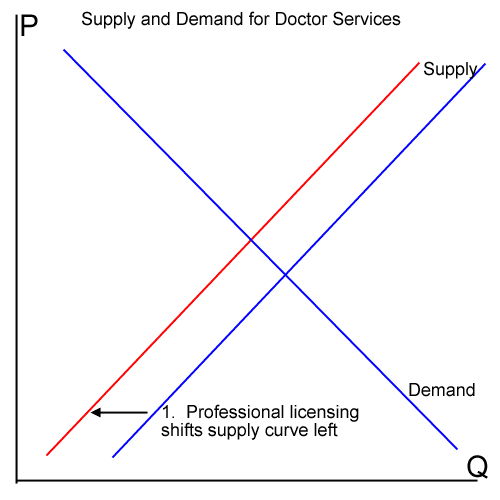
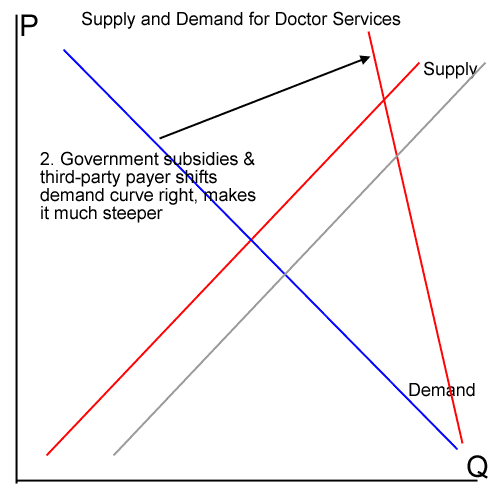
My son is in Freshman econ 101, and so I have been posting him some supply and demand curve examples. Here is one for health care. The question at hand: Does government regulation including Obamacare increase access to health care? Certainly it increases access to health care insurance, but does it increase access to actual doctors? We will look at three major interventions.
The first and oldest is the imposition of strong, time-consuming, and costly professional licensing requirements for doctors. At this point we are not arguing whether this is a good or bad thing, just portraying its inevitable effects on the supply and demand for doctors.
I don't think this requires much discussion. For any given price for doctor services, the quantity of doctor hours available is certainly going to increase as the barriers to entry to the profession are raised.
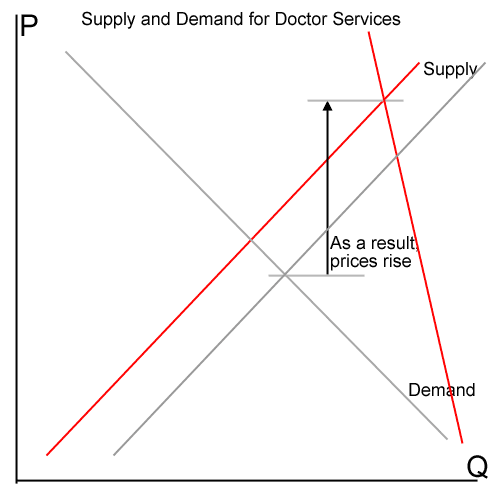
The second intervention is actually a set of interventions, the range of interventions that have encouraged single-payer low-deductible health insurance and have provided subsidies for this insurance. These interventions include historic tax preferences for employer-paid employee health insurance, Medicare, Medicaid, the subsidies in Obamacare as well as the rules in Obamacare that discourage high-deductible policies and require that everyone buy insurance rather than pay as they go. The result is a shift in the demand curve to the right, along with a shift to a more vertical demand curve (meaning people are more price-insensitive, since a third-party is paying).
The result is a substantial rise in prices, as we have seen over the last 30 years as health care prices have risen far faster than inflation
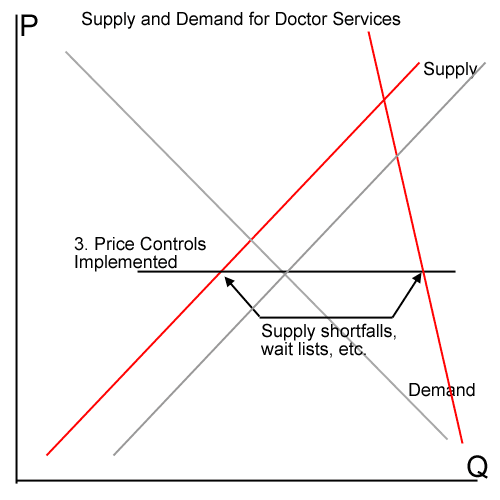
As the government pays more and more of the health care bills, this price rise leads to unsustainably high spending levels, so the government institutes price controls. Medicare has price controls (the famous "doc fix" is related to these) and Obamacare promises many more. This leads to huge doctor shortages, queues, waiting lists, etc. Exactly what we see in other state-run health care systems. The graph below posits a price cap that forces prices back to the free market rate.
So, is this better access to health care?
I know that Obamacare proponents claim that top-down government operation is going to reap all kinds of savings, thus shifting the supply curve to the right. Since this has pretty much never happened in the whole history of government operations, I discount the claim. When pressed for specifics, the ideas typically boil down to price or demand controls. Price controls we discussed. Demand controls are of the sort like "you can't get a transplant if you are over 70" or "we won't approve cancer treatments that only promise a year more life."
Most of these do not affect the chart above, since it is for doctor services and most of these cost control ideas are usually doctor intensive - more doctor time to have fewer tests, operations, drugs. But even if we expanded the viewpoint to be for all health care, it is yet to be demonstrated that the American public will even accept these restrictions. The very first one out of the box, a proposal to have fewer mamographies for women under a certain age, was abandoned in a firestorm of opposition from women's groups. In all likelihood, there will be some mish-mash of demand restrictions, determined less by science and by who (users and providers) have the best lobbying organizations.
I feel like I was way ahead of the pack on May 1 reminding everyone that the Left until recently held up the VA as a model for government health care. I pointed to articles by Kevin Drum and Phil Longman in 2007, but since then others have highlighted articles by Paul Krugman and Ezra Klein that made the same point. Klein said:
If you ordered America's different health systems worst-functioning to best, it would look like this: individual insurance market, employer-based insurance market, Medicare, Veterans Health Administration.
Paul Krugman said
Well, I know about a health care system that has been highly successful in containing costs, yet provides excellent care. And the story of this system's success provides a helpful corrective to anti-government ideology. For the government doesn't just pay the bills in this system -- it runs the hospitals and clinics.
No, I'm not talking about some faraway country. The system in question is our very own Veterans Health Administration, whose success story is one of the best-kept secrets in the American policy debate.
Supposedly, the reason for this success according to Drum and Longman was that ever-popular Lefty magic bullets, electronic medical records and preventative care. On medical records:
"Since its technology-driven transformation in the 1990s...the VA has emerged as the world leader in electronic medical records — and thus in the development of the evidence-based medicine these records make possible." Hospitals that joined Longman's "Vista network" (his name for the VA-like franchise he proposes) would have to install the VA's electronic medical record software and would "also have to shed acute care beds and specialists and invest in more outpatient clinics." By doing this they'd provide better care than any current private network and do it at a lower cost.
On preventative care:
How is a supposedly sclerotic government agency with 198,000 employees from five separate unions outperforming the best the private market has to offer? In a word: incentives. Uniquely among U.S. health care providers, the VA has a near-lifetime relationship with its patients. This, in turn, gives it an institutional interest in preventing its patients from getting sick and in managing their long-term chronic illnesses effectively. If the VA doesn't get its pre-diabetic patients to eat right, exercise, and control their blood sugar, for example, it's on the hook down the road for the cost of their dialysis, amputations, blindness, and even possible long-term nursing home costs....The VA model is that rarest of health care beasts: one with a perfect alignment of interest between patients and providers.
Neither of these have ever proven in real life to actually lower costs in anything but tiny pilot programs, and there is a lot of reason to believe that while preventative care can improve health outcomes, it tends to increase costs.
I have said for years that at the end of the day, the only ideas government planners have for cost control are rationing (which leads to queuing) and cost controls on things it buys from private markets, like doctor time (which leads to shortages and more queuing). This is why every health care system that offers free care to all comers, whether it be socialist systems in other countries or the VA or even an urban emergency room, has long queues.
In fact, the situation, as I think we will find at the VA, is worse. Not only is the old pie being allocated differently (shifting from price-sensitivity to queue tolerance) but the pie of available supply is likely getting smaller as resources are consumed by government red tape and price controls drive suppliers out of the market. The next stories will be about the staggering waste of money on red tape in the VA system, and the stories after that will be about a few VA users jumping the queue because of political connections.
This stuff is so inevitable that it was all addressed years ago in my three part series of Obamacare. In that series, the issues were not failing exchanges and the mess we have seen so far, but the issues we are more likely to see over the long term. The VA is merely a preview, but we shouldn't have needed a preview because we could have looked at countries like England. Of course, if the media had any desire to honestly tell these socialized medical stories we would not get fawning profiles of the horrendous system in Cuba.
As regular readers may know, Phil Longman thinks the VA model of healthcare is the best around. In the October issue of the Monthly, he takes his admiration to another level, suggesting that the best way to provide healthcare to the 45 million uninsured in America is via — what? I guess you'd call it a franchised version of the VA. Basically, the federal government would offer struggling municipal hospitals a trade: if you adopt the VA's management guidelines, the government will pay you to care for all those uninsured folks currently jamming up your emergency rooms and driving you bankrupt. Deal?
The supposed reason is that great panacea, electronic medical records, cited by the Left as the solution to all woes as often as the Right mentions the Laffer Curve.
"Since its technology-driven transformation in the 1990s...the VA has emerged as the world leader in electronic medical records — and thus in the development of the evidence-based medicine these records make possible." Hospitals that joined Longman's "Vista network" (his name for the VA-like franchise he proposes) would have to install the VA's electronic medical record software and would "also have to shed acute care beds and specialists and invest in more outpatient clinics." By doing this they'd provide better care than any current private network and do it at a lower cost.
Since that time, the Left has mostly stopped talking about the VA as a miracle solution, because it is becoming clear that the VA cuts costs the same way every state health care agency cuts costs -- by restricting capacity, leading to huge waiting times, and rationing care. The scandal here in the AZ VA is just the latest
The chairman of the House Committee on Veterans Affairs said Wednesday that dozens of VA hospital patients in Phoenix may have died while awaiting medical care.
Rep. Jeff Miller, R-Fla., said staff investigators also have evidence that the Phoenix VA Health Care System keeps two sets of records to conceal prolonged waits that patients must endure for doctor appointments and treatment.
"It appears as though there could be as many as 40 veterans whose deaths could be related to delays in care," Miller announced to a stunned audience during a committee hearing Wednesday.
Supporters of government health care like t o waive their arms about magic bullets, but the only strategy that has ever reduced costs in government health care systems is rationing and queuing (which is also a form of rationing). Resources are always scarce, but the question is whether we want our health care rationed by government beauracrats or by ourselves. The latter can only happen if we get away from first dollar and single payer medicine and find a way to get real, transparent price signals (which is the way every other service in this country is managed).
"In Britain, even though they're already paying for the National Health Service, six million Brits—two-thirds of citizens earning more than $78,700—now buy private health insurance. Meanwhile, more than 50,000 travel out of the U.K. annually, spending more than $250 million, to receive treatment more readily than they can at home."
Which is the exact same way we run our education system -- everyone has to pay for a basic crappy level of the government monopoly product, and then if you can afford it you pay again to get a better private product.
RAND has a study out on changes in people's sources for health insurance. Once you get the hang of reading it, this is a great table:
This is how to read it -- of the 40.7 million uninsured in September of 2013, 26.2 million remained uninsured, 7.2 million got new employer health insurance (ESI) , 3.6 million joined medicaid, etc. But then some new uninsured were added back so the new total uninsured is 31.4 million.
One of the first things to notice is the marketplace number of 3.9 million is well below the Administration's claim of 7.1 million. The Administration's number is not even within the error bar here, so one needs to be skeptical, if he was not already, of Administration sign-up figures.
We also can notice that the individual marketplace seemed to have shrunk from 9.4 million to 7.8 million. No huge surprise, with all the cancellations that made the news last year.
The really interesting question, of course, is what happened to the uninsured. We can use this table to look at net changes (millions of people).
2013 Uninsured
40.7
To Employer
-5.1
To Medicaid
-2.6
To Individual
+0.2
To Exchange
-1.4
To Other
-0.3
2014 Uninsured
31.4
To make sure everyone understands the math, 7.2 million left the ranks of the uninsured to get an employer policy, but 2.1 million previously insured by employers became uninsured. The net is -5.1 million as shown. All the other numbers are calculated the same way.
I have always had serious questions about the value of the Medicaid signups during this period. Medicaid is not a limited enrollment product. You can sign up bleeding on a gurney being rolled into the operating room, and in fact many do -- Hospitals are very good at enrolling people into Medicare as they walk in. So it was really a misnomer in the first place that someone eligible for Medicaid is "uninsured" -- they are in fact insured, they just have not done the paperwork. The Medicaid expansion in the PPACA probably helped, but many states that did not expand Medicaid had a lot of signups as well.
The exchange seems to have done little to affect the uninsured. Net of the reductions in individual insurance presumably driven also by the PPACA, the exchanges reduced the uninsured by 1.2 million.
The really interesting number everyone is looking at is the huge number of the insured that gained employer coverage. Three quarters of the non-Medicare related reduction in uninsured (since I don't consider a lot of the Medicare signups a real reduction) were from people going onto employer plans.
If it’s correct, it was probably motivated multiple factors—I hate the word “synergy” on principle, but it comes to mind. The economy has been improving, so some of the previously unemployed have secured jobs with benefits. But CBO built in expectations about economic recovery, so I don’t think it’s quite right to try pinning all (or even most?) of the 8.2 million on that. The individual mandate, while weak in its first year, might be a stronger stick than we expected, nudging people to take their health benefits where they’d previously been opting out. Employers could be helping this move this trend along; the University of Michigan, for example, eliminated “opt out dollars” in 2014 (cash compensation for employees who declined coverage).
Drum add triumphantly
If this finding is confirmed, it's a genuine shocker. Although CBO projected that ESI would stay steady, there's been a lot of chatter about the likelihood of employers dropping coverage thanks to Obamacare. But that sure doesn't seem to have happened. So in addition to the usual sources of coverage—Medicaid, exchanges, sub-26ers—it looks like Obamacare has yet another big success story to tell, one that was almost completely unexpected.
Uh, maybe. The employer insurance changes could also be an artifact of normal churn and of the odd study period. The study period is only about half a year. If there were annual patterns, ie with people losing employer health care early in the year and then gaining it at the end of the year, then only the gains would show up in the study and not the losses. In fact, there is some reason to believe this is the case, as most corporations have open enrollment periods at the end of the calendar year.
But there is a more interesting issue here. Folks arguing for Obamacare in the first place sold it by implying that most all the uninsured were uninsured because they could not afford coverage or did not have access. Now it turns out a large block of the uninsured actually did have access and could afford it, they just chose not to buy it, for whatever reason. Was this really what it was all about from the very beginning, forcing people to buy a product that they could afford but did not want?
The second problem is that the 40 percent excise tax on especially expensive plans — the so-called Cadillac tax — is going to hit union plans especially hard. Unlike most people negotiating compensation, union negotiators make an explicit trade-off between wages and other benefits, and the benefit that they seem most attached to is generous health plans. Union plans are made more expensive still because union membership is heavily skewed toward older workers. They are thus very likely to get hit by the Cadillac tax, which takes effect in 2018.
The preference for health benefits over cash compensation makes some sense for tax reasons (as it shifts taxable income to nontaxable income). And at some level it is typical of union thinking, which is often driven by seniority and by benefits for older workers over younger workers. But there is another reason for this that is almost never stated -- the unions themselves run many of these health plans. And because it is priced as a monopoly, the unions often earn monopoly rents on these plans, and use management of large health plans to justify much higher compensation levels for union leaders. In Wisconsin, ending public union strangleholds on health plan management immediately saved the state and various local school districts millions of dollars when they were allowed to competitively bid these functions for the first time.
I guess I never really paid much attention to how the Obamacare "risk corridors" work. These are the reinsurance program that were meant to equalize the risks of various insurers in the exchanges -- but as exchange customers prove to be less healthy than predicted, they are more likely to become a government subsidy program for insurers.
According to the text of Obamacare, the health law's risk corridors—the insurance industry backstop that’s been dubbed a bailout—are only supposed to last through 2016. For the first three years of the exchanges, insurers who spend 3 percent more on health costs than expected will be reimbursed by the federal government. It’s symmetrical, so insurers who spend less will pay in, but there’s no requirement that the program be revenue neutral
So what, exactly, are the incentives for cost control? If you lose control of your costs, the government simply pays for the amount you overspent. Combine this with the fact that Obamacare puts caps on insurer non-patient-cost overhead spending, and I don't think you are going to see a lot of passion for claims management and reduction. Note after a point, excess claims do not hurt profits (via the risk corridor) but more money spent on claims reduction and management does reduce profits (due to the overhead caps).
Nice incentives.
Postscript: There is one flaw with my analysis -- 3% is a LOT of money, at least historically, for health insurers. Why? Because their margins are so thin. I know this will come as a surprise with all the Obama demonization of insurance profits, but health insurers make something like 3-5% of revenues as net income. My Boston mother-in-law, who is a very reliable gauge of opinion on the Left, thinks I am lying to her when I say this, even when I show her the Google finance pages for insurers, so convinced is she by the NYT and PBS that health insurer profits consume a huge portion of health care spending.
All that being said, I am pretty sure if I were an insurer, I could raise prices slightly, cut back on claims overhead, and make a guaranteed profit all while the government absorbs larger and larger losses.
Consider what administration officials announcing the new exemption for medium-sized employers had to say about firms that might fire workers to get under the threshold and avoid hugely expensive new requirements of the law. Obama officials made clear in a press briefing that firms would not be allowed to lay off workers to get into the preferred class of those businesses with 50 to 99 employees. How will the feds know what employers were thinking when hiring and firing? Simple. Firms will be required to certify to the IRS – under penalty of perjury – that ObamaCare was not a motivating factor in their staffing decisions. To avoid ObamaCare costs you must swear that you are not trying to avoid ObamaCare costs. You can duck the law, but only if you promise not to say so.
As I have written about before, our company closed some California operations in December and laid off all the employees. As with most business closures, we had multiple reasons for the closure. The biggest problems were the local regulatory issues in Ventura County that made it impossible to make even simple improvements to the facilities. But certainly looking ahead at costs soon to be imposed due to looming California minimum wage increases and the employer mandate contributed to the decision.
So, did I fire the workers over Obamacare? If Obamacare were, say, 10% of the cause, would I be lying if I said I did not fire workers over Obamacare? Or does it need to be 51% of the cause? Or 1%? Or 90%. Business decisions are seldom based on single variables. I am just exhausted with having my life run by people whose only experience with the real world was sitting in policy seminars at college.
Update: The actual effect of this will not likely be to change business behavior, but change how they talk about it. Worried that there will be too many stories next election about job losses due to Obamacare, the Administration is obviously cooking up ways not to limit the job losses, but to limit discussion of them.
This is a pretty amazing chart from Jed Graham and IBD which I have annotated a bit
Note first that the diversion between high and low-wage** industries did not occur during the recession, and in fact through the recession the two groups tracked each other pretty closely until early 2010. Then, in early 2010, something made the two lines start to diverge and in 2012-2013 they really went in opposite directions.
Well, my suggestion for the "something" is Obamacare. In March 2010, the PPACA was passed. Looking at the jobs data, one can date the stall in the economic recovery almost precisely from the date the PPACA was passed (e.g. here).
The more important date, though, is January 1, 2013. This is a date that every business owner was paying attention to at the time but which seems entirely lost on the media. All the media was focused on the start-date of the employer mandate on January 1, 2014. Why was the earlier date important? Let's go back in time.
At that time, the employer mandate had yet to be delayed. The PPACA and IRS rules in place at the time called for a look-back period in 2013 where actual hours worked for each employee would be tracked to determine whether the employee would classified as full or part-time on the Jan 1, 2014 start date. So, if a company wanted to classify an employee as part-time at the start of the employer mandate (and thus avoid penalties for that employee), that employee needed to be converted to part-time as early as possible, preferably before 2013 even started and at worst by mid-year 2013 [sorry, I typo-ed these dates originally].
Unlike the government, which apparently waits until after the start-up date to begin building large pieces of major computer systems, businesses often tackle problems head on and well in advance. Faced with the need to have employees be working 29 hours or less a week in the 2013 look-back period, many likely started making changes back in 2012. Our company, for example, shifted everyone we could to part time in the fourth quarter of 2012. I know from talking to the owners of several restaurant chains that they were making their changes even earlier in 2012. One employee of mine went to Hawaii in October of 2012 and said that all the talk among the resort employees was how they were getting cut to part-time over Obamacare.
Yes, the employer mandate was eventually delayed, but by the time the delay was announced, every reasonably forward-looking company that was going to make changes had already done so. Having made the changes, there is no way they were going to switch back, and then back yet again when the Administration finally stumbles onto an actual implementation date.
If this chart gets any traction over the next few days, expect to see a lot of ignorance as PPACA defenders claim that the fall in low-wage work hours can't possibly have anything to do with the PPACA because the employer mandate has not even started. Now you know why this argument is wrong. The PPACA, and associated IRS implementation rules, drove companies to convert full-time to part-time jobs as early as 2012.
Usual warning: Correlation is not causation. However, I will submit that I was predicting exactly this sort of result years before it occurred. This is not a spurious correlation that is ex post facto blamed on whatever particular bete noir I might have. I and many other predicted that Obamacare would drive down work hours per week in lower-wage industries, and now having seen exactly that correlated with key Obamacare dates, it is not going to far to hypothesize a connection.
** Why could low-wage industries be impacted more than high-wage? Two reasons. One, low-wage industries are far less likely to offer a full Obamacare-compatible health plan to employees than high wage industries. Second, the fixed penalties ($2000 and $3000 per employee) for lack of insurance plans are obviously a far higher percentage of the total pay in low-wage vs. high-wage industries. A penalty that is 15% of annual pay is much more likely to cause employers to shift or reduce work than a 3% penalty.
Apparently people in California doctors offices are encountering signs that Covered California (e.g. Obamacare Exchange) Plans are not accepted. If anyone sees one, could you snap me a picture and send it to me?
Looking more closely, the CBO report does in fact say that it cannot find that many companies eliminating full-time jobs due to Obamacare. I think they are missing the boat, as I explained earlier, but perhaps my personal experience as a business owner is unusual.
The President's defenders want to make sure that we understand that the CBO is actually saying the 2 million job losses are from people dropping out of the work force because they have lost the incentive to work and/or they want to make sure they don't earn their way out of government freebies.
Whew. I am sure relieved that all Obamacare is doing is destroying the incentive to work. I thought for a second there we had a real problem.
The Affordable Care Act will reduce the number of full-time workers by more than two million in coming years, congressional budget analysts said Tuesday in the most detailed analysis of the law’s impact on jobs.
After obtaining coverage through the health law, some workers may forgo employment, while others may reduce hours, according to a report by the Congressional Budget Office. Low-wage workers are the most likely to drop out of the workforce as a result of the law, it said. The CBO said the law’s impact on jobs mostly would be felt after 2016.
This almost certainly underestimates the impact. Why? Well, one reason is that a lot of full-time jobs were switched to part-time jobs way back in late 2012. That is what our company did. Why so early? Because according to rules in place at the time (rules that have since been delayed at least a year) the accounting period for who would be considered full-time for the purpose of ACA penalties would be determined by an accounting period that started January 1, 2013. So, if a business wanted an employee to be considered part-time on January 1, 2014 (the original date employer sanctions were to begin), the changes to that employees hours had to be put in place in late 2012. More on this here in Forbes.
In addition, this CBO report is a static analysis of existing business. It does not seem to include any provisions for businesses that have dialed back on investment and expansion in response to the ACA (we have certainly cut back our planned investments, and we can't be the only ones.) This effect is suggested (but certainly not proven) by this chart.
The sequester and government shutdown were cited by the Left as reasons for a sluggish economy. Which government action seems most correlated with a flattening in job growth?
Early signals suggest the majority of the 2.2 million people who sought to enroll in private insurance through new marketplaces through Dec. 28 were previously covered elsewhere, raising questions about how swiftly this part of the health overhaul will be able to make a significant dent in the number of uninsured.
Insurers, brokers and consultants estimate at least two-thirds of those consumers previously bought their own coverage or were enrolled in employer-backed plans.
The data, based on surveys of enrollees, are preliminary. But insurers say the tally of newly insured consumers is falling short of their expectations, a worrying trend for an industry looking to the law to expand the ranks of its customers.
… Only 11% of consumers who bought new coverage under the law were previously uninsured, according to a McKinsey & Co. survey of consumers thought to be eligible for the health-law marketplaces.
So, we know that 80% of the people are getting subsidized on the exchanges, and now we know that 70-90% of those previously had a unsubsidized policy beforehand. This means that what the exchanges are doing is NOT insuring the uninsured, but converting people previously responsible for their own health care into government dependents. The more cynical out there will argue that was the whole point in the first place.
I like digging through the raw data in the Obamacare report rather than just accepting the bits the New York Times wants to report. As a business guy, I was looking at the data from a sales-conversion perspective -- ie, who is buying and who is not? And of course, why?
When I was in the marketing world, we used to call the process of sales conversion the sales funnel. For the exchanges this means some percentage of the available market actually show up at the exchange, and then some percentage of those actually complete the arduous sign-up process, and some percentage of those actually select a policy, and presumably some percentage of those actually pay, though we don't know what that latter percentage is. At each step, we ask ourselves what people are we converting from one step to the next, and why.
Here is the Obamacare exchange sales funnel through December (as has become tradition, it is a scavenger hunt to fill this in and the data locations move around from month to month).
As you can see, of the nearly 3.7 million people who have selected a private plan or been put in Medicaid or CHIP, fully 88% are on the government dole (subsidized or full Medicare).
The interesting new data is on the plan selection breakdown between subsidized and un-subsidized. This leads to an interesting finding that is a bit non-obvious from the report itself because the data is spread all over the report. But lets look at conversion of applicants to plan selection based on whether folks are subsidized or subsidized.
For the 2,383,131 applicants who find they are no going to be subsidized, only 436,603 have selected a plan, for a 18% conversion rate
For the 2,756,667 applicants who find they will get supported by the taxpayer, 1,646,237 selected a plan, far a 60% conversion rate.
In essence, applicants are more than 3 times more likely to sign up if they are getting taxpayer money. The exchanges are not selling health care, they are selling subsidies. People sign up, check to see if they have money coming, and go away if they don't and stay if they do.
The next really interesting piece of data would be the demographics and health status of the 18% who did sign up for an unsubsidized plan. I would not be at all surprised if the demographics there were far, far worse than the average. Emerging hypothesis: People come to the exchange, and sign up if they get a subsidy, or if they have health problems or high risk.
The proletatrianization of the middle class has been a Marxist goal from the beginning. To this end, Obamacare is making great strides. I will get my new Obamacare enrollment summary out soon, but apparently 79% of the people buying private policies are subsidized. Add to this all the people who are being added to Medicare, and my guess is that over 90% of enrollments are into plans fully or partially funded by taxpayers. Since almost by definition, these are all people who were paying their own way before, these are all people converted from individual responsibility to wards of the state.
And don't forget my 9 predictions for Obamacare stories in 2014. Remember this one?
3. Despite fewer exchange enrollments than expected, total Federal subsidy payments higher than expected
Here are a few shoes that are left to drop for Obamacare:
Millions complain about their doctor no longer being in-network
Thousands of companies are finding it cheaper to drop coverage and pay Obamacare penalties than continuing to provide health care coverage under new rules
Despite fewer exchange enrollments than expected, total Federal subsidy payments higher than expected
Emergency rooms overflow with new Medicaid patients that no private doctor will take on
Exchange-sold health policies, particularly the unsubsidized ones, were mainly bought by the old and sick
Obama Administration works to bail out health insurers via a number of different avenues
Small to mid-size companies are shocked as Obama Administration finally reveals new record-keeping requirements
After 5 years of 3-4% growth, health care spending skyrockets in 2014
________ health insurance company dropping coverage in ____(state)_______
Hackers steal tens of thousands of names and social security numbers from health care exchange computers.
I will score myself as the year progresses to see how many of these we actually see. I would not be surprised to see every one of these.