Currently, most Americans seem to be largely carrying on as normal during the Federal government shutdown. I know I am able to pretty much completely ignore it. Looking at front pages of sites like the WSJ and CNN, stories on the shutdown are still there but are certainly not the lead, center pieces. This is the government employee's nightmare, where they effectively go on strike and no one notices.
So where will enough public pain come from to force concessions on one or the other party in Congress? The game used to be closing high visibility public parks to tick the citizens off, but a lot of parks are still open today under private management (I know, my company operates hundreds of them). Want to see the volcano erupting in Hawaii? The Volcano House we operate in the National Park is still open.
My new hypothesis came from my wife, who was worrying the other day whether we would be able to make some critical flights in early November. I initially scoffed, but thinking about it more, I think the TSA and more particularly the FAA may be the key to this shutdown. Already this year, antiquated systems from years of government mal-investment combined with understaffing and poor training have led to manpower shortages and sick-outs in certain locations, particularly Newark. Now, the FAA is apparently working unpaid. If they were walking out when they were being paid, things can only get worse with them not being paid. I can easily imagine rising flight cancellations that will get great play in the media -- TV news is very experienced at showing masses of people camped out at the airport due to cancelled flights and interviewing people with heartbreaking stories about weddings and such missed. Three or four days of that kind of mess leading the news each night and the R's and D's will quickly find some sort of accommodation.
This is all ironic, and somewhat infuriating to this libertarian, as the FAA and TSA should have been privatized years ago, and such privatization works just fine in Canada. This issue of privatizing the FAA actually came up last April during the bad Newark slowdowns but the Trump Administration passed on the opportunity. If the FAA is the entity that generates the most pain in the shutdown, these discussions might get restarted.
The administration also seems keen to rescind federal funds awarded under President Joe Biden, like the billions of dollars in clean energy grants to states in the Inflation Reduction Act (IRA) and the Infrastructure Investment and Jobs Act (IIJA).
This would be a good idea, if it were applied smartly. Instead, the administration seems to prefer dinging members of the opposing political tribe rather than effecting any sort of across-the-board changes.
"Nearly $8 billion in Green New Scam funding to fuel the Left's climate agenda is being cancelled," OMB Director Russell Vought wrote Wednesday in a post on X. While there is not yet an official announcement, he added that there would be "more info to come" from the Department of Energy. Vought said the newly rescinded funds would come from terminating projects in California, Colorado, Connecticut, Delaware, Hawaii, Illinois, Maryland, Massachusetts, Minnesota, New Hampshire, New Jersey, New Mexico, New York, Oregon, Vermont, and Washington.
If it feels like those 16 states have something in common, it's true: All voted for then-Vice President Kamala Harris, Trump's opponent, in the 2024 election. In fact, other than Maine, Rhode Island, and Virginia, Vought's list includes every single state that didn't go for Trump.
Trump would be justified in wanting to rescind all such grants. Instead, he's apparently content to let states who voted for him keep the cash. This naked partisanship is unseemly, but unfortunately par for the course under Trump. It's also particularly ironic, since red states were much bigger beneficiaries of Biden-era grants.
The article goes on to explain that most of the large payments went to Red states under the law, so rescinding them only from blue states takes some explicit effort. Look, the IRA was clearly a big enormous pork barrel waste of money from the very beginning. I would not be surprised if every dollar in it were political payoffs. But this use of the money as a partisan bludgeon as if Trump were a modern-day Tom Shanahan is outrageous.
Postscript: In fact, Republicans missed a perfectly justified and in my mind acceptable way to bludgeon blue states: Elimination of the State and Local Tax (SALT) deduction on federal income taxes. There is zero justification for having citizens of low-tax states forced to subsidize more profligate states via their Federal taxes. And no economic reason why the Federal tax code should give special breaks for state income taxes but not for state and local sales taxes, gas taxes, property taxes, etc. In Trump's first term Congress capped the SALT deduction, impacting mostly high tax blue states, and I had zero problem with that. But Republicans in the most recent BBB walked away from that by substantially raising this cap.
I am sorry I have not had time to write sooner, and I only have time for a short missive. But I want you to know that you are NOT going to like living with the precedents that Trump is setting right now for Presidential power.
I know you have convinced yourselves that you will be in power forever. Believe me, I know -- the Democrats thought the same thing after 2020 and even more so after the 2022 election. And I know some of the court challenges at the margin have been nutty -- the injunction against Congress legislatively cutting funding to certain organizations was completely baseless, for example. These crazy court challenges at the bleeding edge have allowed you to convince yourselves -- wrongly -- that all of Trump's actions are perfectly normal and legal and all the legal actions are unjustified. You will not like future administrations firing Republican commissioners from typically bipartisan organizations. You will not like Presidents setting tariff rates (or by extension other tax rates) at will. You will not like a Federal Reserve that is a lapdog to the current administration (perhaps the only thing that can make the Fed worse than it is already). You will not like Presidential powers that trump state and local governments on even the smallest details.
You all need to relearn Coyote's Law -- never give the government (or particularly the President) powers you do not want your worst enemy to wield, because sure as hell your worst enemy will be in charge some day. Yes, I know previous administrations pushed the envelope on Presidential power. Unfortunately, when faced with an opposition party in the prior administration that took a bad precedent from level 4 to an 8, both parties will likely NOT respond by de-escalating but by pushing the 8 up to 11.
The admissions by the media and government insiders just keep on coming. We've had:
We knew all the time that COVID likely was a Wuhan lab-leak
We knew all the time that the vaccine did not stop transmission
We knew all the time that Biden was increasingly frail and senile
We knew all the time that the inflation-reduction act infrastructure spending was burdened by unwieldly bureaucratic rules
Each and every one of which was not only vociferously denied at the time but contemporaneous critics pointing out the obvious truths were labelled as conspiracy theorists and targeted for censorship. Now to these we can add:
We knew all the time we were really engaging in a proxy war with Russia as much as a defense of Ukraine
The linked article above -- Matt Taibbi reacting to reporting from the NY Times -- is just infuriating for those of us who -- while greatly disliking Russia and its aggression -- were skeptical about our role. A couple of examples since the article is paywalled (Taibbi in regular font, NY Times quoted in italics)
To many watching from afar, it seemed like simple common sense that using American weapons and American support personnel to attack Russians in Russia risked drawing this country into a shooting war with a nuclear enemy at any moment. Those of us who said these things were dismissed as alarmist, Putin-loving fellow-travelers. Now we have Entous describing American officials feeling the same after the opening of “ops box” attack....
In some ways, Ukraine was, on a wider canvas, a rematch in a long history of U.S.-Russia proxy wars — Vietnam in the 1960s, Afghanistan in the 1980s, Syria three decades later… It was also a grand experiment in war fighting, one that would not only help the Ukrainians but reward the Americans with lessons for any future war....
If you’re counting, that means we were lied to about the risk of World War, the chance of “victory,” the desire for negotiations, the success of last year’s counteroffensive, the solidity of our relationship with Ukraine, and the significance of U.S.-backed incursions into Russia. This was before Democrats lost the election last November, after which Biden crossed one more line:
Mr. Trump won, and the fear came rushing in… In his last, lame-duck weeks, Mr. Biden made a flurry of moves to stay the course, at least for the moment, and shore up his Ukraine project… He crossed his final red line — expanding the ops box to allow ATACMS and British Storm Shadow strikes into Russia — after North Korea sent thousands of troops to help the Russians dislodge the Ukrainians from Kursk… The administration also authorized Wiesbaden and the C.I.A. to support long-range missile and drone strikes into a section of southern Russia used as a staging area for the assault on Pokrovsk, and allowed the military advisers to leave Kyiv for command posts closer to the fighting....
There are a hundred details in this “Secret History” that serve as stark warnings to anyone who thinks protection from Armageddon is secure in the hands of career military and intelligence officials. Not only did we allow ourselves to be “blackmailed” into escalating a conflict with a nuclear power, the management of the “partnership” broke down because of a Heathers-style spat between the key brass twits, Ukrainian general Valery Zaluhniy and Mark Milley.
When Milley second-guessed Zaluhniy, the latter would respond with teen-like silence, or by avoiding Milley’s next call. Underscoring: the country to which we were giving hundreds of billions in aid didn’t feel a need to pick up the phone. Entous describes the general lack of communication via a moment of levity: “Biden administration officials would joke bitterly that they knew more about what the Russians were planning by spying on them than about what their Ukrainian partners were planning.”
Aggravating from first to last. The news briefly made a big deal about supposed releases of Epstein Clients and JFK Shooting Documents. But these have little interest to me when compared to what we are finding out about the secrets the government has kept these last 5 years. I will end with what I have written before on Ukraine:
The biggest question is -- what is the alternative? The implication is that there is somehow a hope to get the territory under Russian occupation back by military force. But I just don't see it. The Ukrainians have certainly been scrappy and creative and did a better job beating back the Russian thrusts at Kiev in the early days of the war than I would have guessed they would. They are now, though, fighting a static war of attrition with a county 4x its size. So what, at this point after 3 years, is the alternate plan that preserves territory? If that plan is to send a million American soldiers to Ukraine and risk escalation of the war, a nuclear exchange, and possibly a Chinese attack on Taiwan while our back is turned, then I am not going to agree.
Again, I would be happy to see Russia lose, but short of sending the American military into the line of fire, what is the plan? Perhaps Russia's will collapses before Ukraine's, but no one has presented me any evidence of that. That would be a sort of WWI outcome, where one side was eventually exhausted (though only after the intervention of US troops). As an aside, I wonder sometimes, would peace in 1915 perhaps with Germany retaining control of Alsace and Lorraine have been worse than all the deaths that followed, not to mention the platform the war built for the later rise of Hitler and the Nazi party?
As I said before, I am amazed that our ex-peace-protesting-hippies of the Left who would 100% retroactively say that the US should never have escalated in Vietnam after 1964 are in the lead of those who want us to fight in the Ukraine to the very end. Someone needs to tell me what's different, and I have not heard a good answer yet.
Many readers will know that I have spent 25 years working with government agencies in a company that privately operates public recreation facilities. Not infrequently I have had my managers, in frustration over something our agency partners have done or not done, complain that the folks they are working with in the government are “bad” people. More generally this is a common refrain of government critics, that state agencies are full of “bad” people. I always disagree with them.
The people that the government hires are no different on average than the people hired in private industry. Sure, there is some self-selection as people may migrate to institutions they trust more than others or to work cultures they find more appealing, but this is true as well among private entities (e.g. choosing to work at a startup vs Exxon). My strong belief, from theory and long experience, is that when government employees appear to act “badly” or irrationally, it is not because they are (or began as) bad people but because they are working in an organization with terrible incentives and a counter-productive performance management system. This is not unique to government organizations – many or most of the great failures of once-proud private companies have come about due to issues with incentives. The difference is that when private organizations go bad, there is a culling by customers and competitors that has no equivalent in the perfect monopoly of government agencies.
In this post, I want to go further into incentives and metrics helping to explain the behavior of government agencies. In particular, I want to look at two interrelated complaints often voiced about government agencies: "why are they so inefficient and/or slow?" and "why do they say 'no' to every new idea?" The answer to both comes down to performance metrics.
But in looking at the performance metrics of government agencies, we immediately run into a problem: many, perhaps most, government agencies don't have any written performance metrics or productivity standards for the majority of their employees. I have worked with public recreation agencies for decades (think NPS, USFS, BLM, state parks, etc) and I have never once seen anyone with a set of written performance metrics relevant to their job (some agencies will claim hey have metrics and then point to their 200-page strategic plan that was crafted a decade ago).
I understand that creating a good set of job-related performance metrics might be hard for some staff functions, but even for people, say, running a park I have never seen any goals for expense reduction, visitation increases, or visitor satisfaction (eg customer review scores) -- all metrics every one of our managers who privately operate public parks have. And even when they do have performance metrics, they are often for the wrong things (** see bonus story in the postscript).
So is Coyote full of sh*t? How can their behaviors be driven by performance metrics when they don't seem to have any?
Here is Coyote's first law of incentives: There are always incentives. If they are not embodied in written performance metrics, then there are unwritten ones that rule behaviors. And these unwritten incentives are generally a) very powerful and b) almost never aligned with the greater organization's goals.
If there is a very good manager, the incentive might be that manager's praise and recognition. Small teams can sometimes be energized by a shared mission they all believe in. To some extent the agencies I worked with were better than most because public lands agencies (eg NPS, state parks) attracted people with a sense of mission which could motivate people even when the organization did not.
But in general, government employees operate in a vacuum without any positive metrics -- they can't prove themselves by meeting or exceeding this or that goal because the goals have not been assigned and are not measured. So the default metric becomes this: to avoid screwing up.
Government employees operate in a web of hundreds, even thousands of procedural rules. The most obvious of these are very strict budgeting rules where (unlike in the private world) money is not fungible but is divided up into scores of buckets and has to be spent within both the dollar limit of its bucket and the narrow expense categories the bucket is assigned for. Everyone lives in fear of violating these spending and budget rules. I will give one example -- I know of $4 million from a private insurance settlement in favor of a public agency that has languished in a private bank account FOR FIVE YEARS because the government agency can't figure out how to receive the money and decide what account it should go in. Fearful of making a mistake, the money sits dormant.
But beyond money-related rules there are scores of others -- rules for environmental reviews and approvals and rules for archeological reviews of any digging. We had to replace a road culvert a year ago in California on public lands and among the 12 reviews that had to be completed was an historical review to make sure the culvert was not some sort of historical artifact. I remember we inherited a shack on the end of a dock that we wanted to replace (because it was falling apart) and the agency who owned the dock said "wait a minute, we think that is a historic building." I have to admit I laughed pretty hard when my COO lost it and said "then I will drop the f*cker on the Washington Mall in front of the Smithsonian for all the tourists to see but it is unsafe where it is and needs to be replaced."
And the list of rules keeps getting longer. When the organization has new top-down initiatives, they are layered on top of all the other initiatives and mandates to add more layers of review. In several California agencies, for example, simple contract changes have to be reviewed automatically by BIPOC and gender groups. There are climate and sustainability reviews of everything.
And all of the above does not even get to the subject of decision-making authority. In many organizations people are unclear who has the authority to make a decision, so "to be safe" they will kick it upstairs to their boss. Who might kick it upstairs to their boss. The hardest problem we often had in working with agencies was, even when we were pretty sure person X could approve our request, person X often felt safer kicking the decision to a higher level. Now the decision is on the desk of someone who isn't directly involved with the issue, and thus who is reluctant to do make a decision for something they don't really understand.
I want to remind folks that this is intended to be sympathetic -- the behaviors that can be so irritating are NOT the result of bad people being jerks. They are the rational responses of absolutely normal people operating without positive incentives and walking through a minefield of ways to screw up.
All of this leads logically to several behaviors:
If you go to an agency for a decision, there is absolutely nothing positive they can gain from the situation. They don't get rewarded for satisfied citizens or number of requests approved. What looks like a simple decision to you is fraught for them. Every decision is a chance to screw up on any one of scores of rules without any possible upside for them.
Even the simplest approvals and decisions take forever. Given that they are now saddled with your request, they are going to make sure they respond to the only incentive they have, which is to make sure they can't get criticized later. They are going to run an environmental review even if it is not necessarily required. They are going to insist a historian does an evaluation. They are going to check with their DEI folks to make sure you are being inclusive. They are going to kick the decision upstairs one or more levels higher than they actually need to. Meeting after meeting will be held with everyone who could possibly be involved, sometimes over a dozen people.
They will not care about the time, because they are not rewarded for responding quickly. They have no upside and can only focus on making sure that they don't skip a step some later Monday morning quarterback thinks they should have followed. This could, by the way, be by an external group -- say the Audubon Society or a tribal group -- that sues the agency for its decision. The US Forest Service, which has to balance diverse activities on public land from mining and off-road vehicles to conservation, is sued over everything.
The default answer is "no." Every "yes" is a risk, and government employees don't get any reward or recognition for a "yes." But they frequently get called on the carpet or trigger a lawsuit when they say "yes."
I will add that every agency has brave people who get positive things done for the public and their agency despite the incentives above. I met one such person a few weeks ago, Superintendent Trimble at Mammoth Cave National Park. He and his team are doing a fabulous job creating new ways for the public to enjoy the park. But folks like this are recognized and stand out as exceptions. It takes an unusual person to rise above this quagmire of bad incentives. Many folks that see these problems but don't have the nerve or energy or skill or will to persevere eventually leave government service for other things.
There is a lot more I want to get into on this, but before I do I want to step back and review another old business-economics chestnut, the agency problem. That will be the next post.
**Postscript -- Bonus Story. It used to be that California State Parks had a rule that only front-line employees badged as law enforcement could be promoted to higher ranks of the Agency. This was incredibly limiting and distorting and my favorite parks director Ruth Coleman got the rule changed 10-15 years ago (she later took the fall for a financial problem in the state, in part I think because the union was still angry about this change).
Anyway, before this change (and as a good illustration of why the change needed to be made) I was going to visit one of their parks and looked at the online reviews. They were terrible! Apparently the state park rangers handed out a zillion parking and related citations. When I visited their office, I saw on the wall a performance metric! Apparently there was a tracking sheet showing who had made their minimum citation goals and issued the most tickets. Apparently since this was the only metric they had, this is the one they focused on. And according to the reviews, they did a bang-up job finding any excuse to drop a citation on their visitors. But these were the folks responsible for the parks management -- it was like a McDonald's manager spending all their time citing customer cars in the parking lot. It was crazy.
Part of a Series: Organizational Design, Behavior, and Change
To understand why organizations grow senescent, get fat, and fail – whether they be public or private – there is probably no topic more important than performance measures and incentives. Many readers will know that I have spent 25 years working with government agencies in a company that privately operates public recreation facilities. Not infrequently I have had my managers, in frustration over something our agency partners have done or not done, complain that the folks they are working with in the government are “bad” people. More generally this is a common refrain of government critics, that state agencies are full of “bad” people. I always disagree with them.
The people that the government hires are no different on average than the people hired in private industry. Sure, there is some self-selection as people may migrate to institutions they trust more than others or to work cultures they find more appealing, but this is true as well among private entities (e.g. choosing to work at a startup vs Exxon). My strong belief, from theory and long experience, is that when government employees appear to act “badly” or irrationally, it is not because they are (or began as) bad people but because they are working in an organization with terrible incentives and a counter-productive performance management system. This is not unique to government organizations – many or most of the great failures of once-proud private companies have come about due to issues with incentives. The difference is that when private organizations go bad, there is a culling by customers and competitors that has no equivalent in the perfect monopoly of government agencies.
I will return to the issue of government incentives in the next post, but I want to reinforce the importance of incentives to organizational failure by discussing one famous private example, a company everyone thinks of as failing due to fraud and malfeasance – ie bad people – but whose downfall was at its core due to bad incentives: Enron. In what follows I don’t want to take away from the criminality of various executives. But I believe the failure at Enron started WAY before the criminality and was rooted in bad incentives.
The story starts with Jeff Skilling coming to Enron to implement the gas bank model he came up with at McKinsey. Having personally been on this study for a brief time (as a very junior associate), I don’t think there was anything particularly wrong with the strategy. The problem was perhaps in Jeff himself. As has been reported many times, he was certainly brilliant, but my guess is that he was likely manic-depressive, and he certainly did not have a very good read on people. I won’t say he was on the spectrum but had a sort of quasi-autistic inability to understand how people really tick. He could fall in love with his own intellectual creations, which might be marvelous in theory, but fraught in actual implementation with real people.
Here is my theory – the downfall of Enron can be traced directly to Jeff Skilling’s implementation of what he called “mark-to-market accounting” for new Enron contracts, an academically intriguing idea that met with disaster in the face of real people. To understand it, we first need to know what he meant by “mark-to-market accounting."
Since the dawn of capitalism, enterprises have struggled with how to provide the proper incentives to their sales force and dealmakers. The simplest example to reward salespeople with a percentage-of-revenue commission. It certainly seems logical to reward salespeople for making sales. But even something so simple quickly becomes fraught when it encounters real human behavior. The problem is that sales people will chase the easiest sales with the highest discounts, building a book of business that maximizes their commissions but may miss the most profitable sales. The same is true for deal makers, who (if allowed) will pursue the riskiest deals with the highest potential returns, leaving the company on the hook for future potential losses.
And this problem was an order of magnitude worse at Enron, where Skilling implemented a strategy in which traders are tasked with executing complicated long-term deals. Traders were executing deals as long as 20 years in which natural gas might be bought here and then sold there and then converted to electricity which is sold somewhere else all tied to a capital investment at a certain plant and sale of tax credits to other companies. Most, meaning pretty much all, companies would account for this by simply reporting the net profits from this deal in each year as they occur. But what if most of the profit in the deal was 10+ years out? Should the company, or the individual dealmaker, really have to wait 10 years to be rewarded? Would the organization even bother pursuing these contracts if that were the case?
Skilling hated this traditional accounting. Companies are often criticized for not thinking about the long term – how can one reward the organization for selling business 20 years out? He believed strongly that once the deal was signed these gains were all earned and locked in, such that the present value of the contract was essentially earned at signing and should be booked at signing. Rather than waiting 20 years for the earnings to flow through, Skilling wanted to book the whole profit immediately, crediting both the company and the individual deal-maker with the entire value immediately. This is what he called mark-to-market. All the present value of profits from a multi-year contract would be booked when signing the contract. And the deal maker would be rewarded for a percentage of those profits on signing. Like much of Skilling’s thinking, this was a theoretically compelling approach.
Mark-to-market was a term well known at the time in the banking and securities world. It refers to the process of adjusting the book value of investments to their market price. All well and good – this was something the government was trying to get banks and financial institutions to adopt – so the government was open to approving Enron’s proposal for what was very unusual accounting in the energy world.
The problem for Enron was that they were, by their own admission, doing deals that were unique, that no one else was doing. So how does one establish a market price? Not everything was locked in by the contract – profits might depend on commodity prices or cost overruns or interest rates or even the bankruptcy of a counter-party. Skilling may have called it mark-to-market, but that was effectively impossible. What Enron was really doing could more reasonably be called mark to forecast. The forecasted revenue and profits for the contract would be recognized immediately on signing.
And now we arrive at the disaster. Enron had the dealmakers themselves creating the pro formas or forecasts from their deals from which the present value determination was made. So, what is this forecast going to look like? The forecasts were going to be hugely optimistic -- the deal is going to make a freaking fortune with little risk, the forecast is going to be a hockey stick upwards. This does not necessarily even require fraud – every sales person and deal maker who has ever existed is optimistic about their own deals. And given that these are 20-year forecasts, the valuation of the deal might turn on the price of natural gas 20 years out. Whose to say that $5 is more or less reasonable than $3? The net effect is that all the mark-to-market valuations skewed high.
Skilling and Lay seemed mostly blind to this problem. They did (nominally) create internal agencies that were meant to neutrally review deals and these mark to market valuations. But these groups got little support from executives, particularly when deal makers seemed to be making so much money for the company (at least on this mark-to-market basis). Deal makers had become the elite of the organization, virtually unchallengeable even by staff originally tasked with challenging them. And remember that Lay & Skilling’s prestige and compensation – not to mention the compensation of every manager at Enron given their compensation system -- was largely stock-based, and the stock price was being driven up by the stacking up of these skewed mark-to-market valuations of projects, causing the company to effectively pull forward years of future (potential) earnings into the current year. Anyone who started challenging project valuations was effectively attacking the entire organization’s compensation.
Enron eventually applied mark-to-market accounting to everything. Change in tax law? Take a one-time gain for expected net present value of decades of tax breaks. Sign a video streaming deal with Blockbuster? Immediately book profits for 20 years of hypothesized streaming revenue. Of course, if the assumptions behind a deal were to change for the worse – say a reduction in natural gas prices from those forecast – then there should have been a mark-to-market loss taken on the contract, but that almost never happened.
This was Skilling’s underlying ethical failure – mark-to-market was his conception, and he was responsible for making sure both halves of the process were implemented: both taking credit for future gains when contracts were signed but also taking losses for impairments on those future results as they became obvious. I am not sure the mark-to-forecast approach could ever have worked in the real world, but its only chance was to have Skilling create a strong ethics and value structure in the company around rigorous and honest evaluation of current and past marks. And that sure as hell did not happen. If anything, Skilling behaved in the opposite manner, rewarding creativity in evading any loss and eking out new gains from re-marking past projects with rosier assumptions.
Enron’s reported results quickly began diverging from reality. Reported results looked fabulous, as they were based on stacked project valuations that were in turn based on optimistic forecasts of dealmakers who had every incentive to be optimistic. But at the same time many of the deals were crap – some just projects where core assumptions such as natural gas prices had not played out as expected but increasingly including dumb domestic merchant investments and even worse international projects. Crap projects were being approved based on insanely optimistic forecasts that no one had an incentive to challenge. Eventually, in bankruptcy, outsiders would be staggered by how much of Enron’s investments were absolute money-losing garbage. Enron’s strategy went awry almost from the beginning, but that fact was hidden by the bad measurement system and so Enron kept doubling down on worse and worse investments, with the inflated mark-to-forecast numbers convincing everyone, especially themselves, that they were brilliant.
At some point the divergence between mark-to-market project values and actual results could not be ignored, and with the refusal to mark project values down, some other alternative was needed. The solution they found was via corporate weasel Andy Fastow, their CFO who created off-books entities to hide losses from bad merchant investments rather than mark the losses to market. Because the bad deals created little cash, new borrowing was constantly required which again was dumped into off-books entities (which were made worse by Fastow’s gluttonous self-dealing).
It is these deals that get most of the historic attention, but in my mind, the off-books fraud merely delayed (and magnified) the reckoning of an organization already set up for disaster by the incentives and measurement plan of mark-to-market accounting that Skilling put in place.
Today I am starting a new series on organizational design and behavior and the very difficult process of creating organizational change. To some extent this is a return to my roots on this blog, and to some extent it is an admission that I have no desire to hover around my computer for enough hours in the day to keep up with the incredibly rapid news cycle the Trump Administration is driving.
But that does not mean I intend this to be irrelevant to current politics. At the core of a lot of what is hitting the news – DOGE investigations, government headcount reductions, government employee accountability – are issues of organizational design and behavior and of how organizational change can be managed. Most of the media discussion of current actions by the Trump Administration is not at all informed by any reasonable assumptions about how organizations work or how they can be improved.
To some extent I started this series out of order, beginning with a post on downsizing before I ever thought of this as a series. I realized after I wrote that post that I wanted to take a step back and cover more background first. In my next post I shall embark on the series, starting first with incentives and performance measures.
I am on vacation and had not really intended to post but I wanted to quickly comment on one of the arguments used to push back on the DOGE effort. The Democrats, who historically have been real masters of managing the media, have had a pretty flat-footed response to DOGE and have floundered for any sort of messaging that offsets the near endless revelations of stupid spending that DOGE is finding. Most of their protests just look like hysterical defenses of the indefensible.
But the argument I have heard recently that is more likely to resonate with the Democrat's traditional (read: sane) base is something like "we are all for explorations of government efficiency but think it needs to be done in a much more measured and careful way." Unfortunately, for anyone with any experience in organizational cost cutting, a "measured pace" is another way of saying "let's move slow enough so the antibodies in the system have time to kill us." As a result, if anything, I think DOGE is moving too slow.
Way back when I was a newly minted MBA with a less cynical view of how organizations work, I was employed by consultant McKinsey & Co to do cost cutting studies. McKinsey had a pitch to clients where they said that simple-mindedly mandating across-the-board cuts was stupid and destructive. Instead they advocated for a process, I think it was called EVA but it was 30 damn years ago and I cannot remember, to carefully look at every process in the company, to redesign the process, and then cut headcount based on implementing the better process. They would say that the only way to cut staff was to first cut the work that employees had to do first.
As a over-educated and under-experienced consultant, this sounded great to me. It made logical sense as the most thoughtful way to go about cost and headcount reduction, and really it still does make sense in an academic vacuum. It just feels better doing a detailed analysis that leads to 10% less needed staff rather than simply at the outset demanding a 10% across-the-board staff reduction (it also demands orders of magnitude more consulting hours, but that only occurs to the current more cynical version of myself).
But in the real world, one often does not have this luxury. First, going into such an analysis can take many months, all through which the organization knows cuts are coming and productivity plummets. It is effectively pulling off the Band-Aid really slowly. Second, the only way to do this analysis is to have the cooperation of the staff that is about to be cut, a tall order in many real world situations where the staff is ready to fight you (and especially when the staff is organized into unions to fight you). Third, you really don't necessarily get much innovation through this process. By the way, all these problems are squared and cubed in a public vs private context with powerful unions and constant media spotlight.
When I was fresh our of mba-school, I thought just whacking 20% of the staff without analysis was the dumbest thing in the world. But having tried to change and manage organizations, I have changed my mind. Necessity is the mother of invention, and sometimes just getting rid of 20% of the staff and having to make do is the ultimate in necessity. In a reverse of the McKinsey formulation, you cut the work that has to be done by cutting the staff. This approach is fast, and there is no way for the anti-bodies to organize to fight the change when the change comes fast enough. Rip off the Band-Aid, get the required savings, fix problems where you went to far later.
The DOGE efforts are doomed at some level no matter what because so much of Federal spending is programmed by law. It is going to take legislative changes and a better budgeting approach out of Congress to make big changes. But I do think there is staffing efficiency to be had but DOGE is not going to get there alone either**. At some point Trump is going to have to just pick a number and say that in 30 days, every department has to cut their staff by that number. Nothing else is going to work. Nothing else usually works in the private world and it certainly is not going to work in the government where the antibody strength is the highest.
Which is not to say that what DOGE is doing is not valuable, because it is. The constant string of factoids and revelations are going to be the PR air cover that larger cuts via legislation and/or mass layoffs are going to need.
** Postscript: it is useful to keep a few numbers in mind to see the difficulties with the DOGE process getting their promised savings. Yes they can keep finding million dollar examples of stupid spending to be cut. But to get a trillion dollars in savings -- an almost unfathomably large number -- requires a million individual cuts of a million dollars each. The other thing to remember is just how large the federal workforce is. As I pointed out the other day, the 75,000 that took Trump's early retirement package seems like a lot, but it is well under just the normal annual 6% turnover in the federal workforce.
I still think my first reaction to the Left's pushback on DOGE's probe of the spending of USAID and later other government departments was on target:
The $$ that DOGE is looking at now are the funding source for a lot of the Democratic (and some of the Republican) base. My guess is that even much of the international spending is flowing back to US-based influence groups.
Which led to this meme (it's an old standby but under @boriquagato influence I am dipping my toe into meme creation:
As an aside, I am fully supportive of addressing real privacy abuses found in the DOGE process, though having these concerns come from the party and the media complex that spent the last four years trying to leak Donald Trump's and other rich people's tax returns and whose first response to these privacy concerns was to dox members of Musk's analytical crew makes me skeptical this is the real concern. For government workers, "privacy" means keeping secret bad or stupid decisions. Remember this one (which was again about covering up spending)?
Some of the questionable redactions, by contrast, are charming efforts at bureaucratic butt-covering. Lisa Page, for example, was discussing with Peter Strzok the challenge of having an intimate meeting in Andrew McCabe’s conference room, given the size of his grand new conference table. “No way to change the room,” Page texts in the version provided by Justice. “The table alone was [REDACTED]. (You can’t repeat that!)” Hmmm, what classified, top-secret, national-security information could possibly have been redacted? The blacked out bit, it seems, was a simple “70k.” The DoJ—and can you blame them, really?—didn’t want Congress to know they were in the habit of spending $70,000 on a conference table.
Update 2-17: DOGE is seeking access to IRS systems with taxpayer data. As loath as I am to slow this effort down, I think we need to hear about some strong controls before this proceeds.
But having thought about this longer, I think this is about more than just money. It is also about class. Just listen to how the cool kids in the media talk about Musk's group of young weirdly-nicknamed geeks. This is fairly typical:
He was speaking specifically about a Trump executive order that decrees that the Department for Government Efficiency can force federal agencies into firing four people for every new hire. “Who the hell voted for Mr. Musk?” Begala raged. “Who the hell voted for—excuse the phrase—a guy who calls himself Big Balls? A 19-year-old kid going in there and trying to fire cancer researchers and scientists and teachers and agricultural specialists. It’s, it’s appalling.”
This is moderately hilarious from a) a party who still has not told us which unelected people really were making decisions behind the curtain for a senile Joe Biden; and b) an individual (Begala) who wielded immense power and influence across all departments of the Clinton Administration. The department staffs in DC are 99.99% people who are both unelected and unconfirmed by Congress. The issue is not that they are unelected, the issue is that they are "the wrong sort." I am reminded of the British aristocracy in the 19th century that would tolerate almost any sort of governmental incompetence or malfeasance as long as the people were "the right sort" -- meaning of their class.
The mention of Victorian England reminds me of another way that class is likely involved here. In the English aristocracy the oldest son inherited the title and often all the land and income (which was entailed to the title). This left little for any additional sons, so an income had to be found somewhere for them in a profession that did not require them to sully themselves with "trade" (daughters were handled a different way, through the marriage market). Reading for the law was an acceptable profession for a son with brains, and the army or navy were outlets for many. But most families needed a way for their sons without too much brains or ability and not militarily inclined to make a living. A position in the Church was often the solution.
Modern American blue-blood parents are no different -- they need a way to secure a living for their kids who won't or can't land a job in the modern elite career choices (law, consulting, investment banking, or a sexy startup). Unlike in Victorian times, the military or the Church are no longer preferred elite options? So what to do with your 22-year-old gender studies major? The parents need her to get an income and they need her to do it in a context that they can proudly report to their friends -- Paul Begala does not want to tell his friends that his son's job is maintaining distributor pricing lists ** (anyone who does not believe the latter criteria should have been at my Princeton or Harvard Business School 25th reunions).
The solution? Get them a job at a non-profit, the modern American version of going to the Church. As Arnold Kling noted once, non-profits tend to have much higher status than do for-profits. And without competition they don't have to carry the same performance standards as for-profits. And they are incredibly susceptible to trading a position for your kid in exchange for a nice donation.
The employment rosters of non-profits and NGO's are stuffed with the children of privilege. So much so that there are many non-profits that seem to do nothing EXCEPT employ and pay the travel expenses of 20-something kids from rich and/or influential families. I have been writing about the non-profit scam for years. As I wrote then:
From my direct experience, I would go further. There is a tranche (I don't know how large) of non-profits that are close to outright scams, providing most of their benefits to their managers and employees rather to anyone outside the organization. These benefits include 1) a salary with few performance expectations; 2) expense-paid parties and travel; 3) myriad virtue-signalling opportunities; 4) opportunities to build personal networks. This isn't just criticizing theoretical institutions -- people I know are in such jobs in these organizations.
The spending that DOGE is going after at USAID and other departments likely threatens the income of a number of under-qualified elite kids. So I will update my meme:
**Footnote: I will proudly tell the world that my son's first job out of college was indeed maintaining distributor pricing lists for Ballast Point beer. Trying to optimize profits across the matrix 100+ sku's and scores of distributors is a great real world skill building entry-level job that so many of the change-the-world-before-I-am-25 college kids currently eschew.
Postscript: If you want the blank template for the Astronaut meme updated for DOGE, I share it here.
I know, with like 200 executive orders already in this administration, it is hard to imagine one was missing. But if I were the victim of some sort of horrible karma and found myself as President, I was thinking about what EO I might sign (other than one repealing all the others). This is what I came up with:
Subject: Federal Transparency
I hereby order that all Federal agencies, from this day forward, follow the letter of the f*cking law in the Freedom of Information Act. All requests will be processed in a timely manner as specified in the law and all redactions will be made solely based on the exceptions allowed in the law and those exceptions will be interpreted narrowly. Redactions in any document released to the public solely to protect the reputation of an individual or agency shall be grounds for immediate termination of those involved [update: here is a famous example]
Further, all public business will be handled through public channels and will be archived as required by law. Anyone attempting to conduct public business through private channels that cannot be archived or FOIA'd will be subject to immediate termination.
Further, within 90 days the US military, the US state department, and all intelligence agencies are required to submit to me proposed updated guidelines and processes for marking documents as classified or secret with the goal of reducing documents with any sort of classification by 90%. Anyone found to be over-classifying documents to protect an individual or agency's reputation will be subject to immediate termination.
If I knew more about Federal organization I would probably propose pulling FOIA officers out of their agencies and into some new group. Maybe we pull out all the Inspector Generals as well and put them in that new group too.
Postscript
Who the heck remembers all the stuff like this to do day 1? I can't remember that my wife told me to start the dishwasher at the next commercial.
Just as Republicans were starting to successfully cast themselves as an alternative to blue state COVID totalitarianism, Republicans in Texas decide to dabble in a bit of creepy statism themselves. I am going to stay away from the abortion issues involved (a policy that has served me well for decades on this blog), but I do want to address the enforcement mechanisms in the law. From Zero Hedge:
One provision that makes the law unique is the fact that private citizens will be allowed to sue providers and anyone involved in "facilitating coverage", which could mean people who drive others to the abortion clinic could be found liable in court to losses of at least $10,000. The ACLU says this provision "actively encourages private citizens to act as bounty hunters".
It is good to see the ACLU weighing in on the bad aspects of this enforcement mechanism, though it is telling we have never heard a peep out of them when this same private bounty hunting enforcement mechanism has been used in numerous California laws aimed at leftish goals (eg the dysfunctional ADA lawsuit mess and sue your boss laws, both of which substitute private bounty-hunting litigation for what normally would be state regulatory enforcement actions).
At least in the California laws, the litigant had to actually be a somewhat interested party (eg disabled or an employee of the firm). Texas has unleashed the equivalent of Cuban block captains on their citizens.
This is a terrible precedent. Conservatives who are really passionate about abortion may not be able to see it, but I can easily imagine this applied to all sorts of awful rules. How about lawsuits for $10,000 for any parent that drives a kid to school that is not wearing a mask? How about a $5,000 lawsuit by any citizen against someone who idles their car too long and thus destroys the planet? Conservatives are handing the Left a gift with this enforcement precedent and we could all be suffering under it soon.
Category: Government |
Comments Off on Texas Republicans Want to Be Creepy Totalitarians Just Like Their Blue State Counterparts
When I argue with folks about the irrationality of certain COVID NPI mandates, eg masks and lockdowns, their ultimate argument when their backs are up against the wall is this: the government and/or the "experts" would not have mandated these interventions if they did not make sense. The purpose of this and several following posts is to explain exactly why they might, or more particularly, why certain government mandates might make sense for government officials even when they make sense for no one else.
Briefly, the case against masks
There are people I talk to that assume that the entire history of science consists of a march towards more and more certainly that public masking is essential to stopping respiratory disease spread and that the only people who oppose this NPI are doing so because Donald Trump or the Baptist Church told us to oppose them. But there are actually really good reasons to be skeptical of masks as a mandated NPI for this respiratory disease:
The body of public health research prior to 2020, on balance, held that public masking (and large scale lockdowns, btw) were not effective and generally not recommended (at least once the outbreak is past a very small group). A good roundup of the studies is here.
People usually respond to this by saying, well, you wouldn't want your surgeon to operate on you without a mask. Of course, this use case comparison is absurd, since standing next to someone in line at Walmart for 60 seconds is not really anything like hovering over someone's open incision for 3 hours. But it turns out that the scientific support for masks even in surgery to reduce post-op infection is surprisingly equivocal.
The weave of your mask looks to a COVID virus approximately what a chain link fence looks like to a mosquito. It is not stopping the virus itself. And this is even before discussing the total lack of sealing against the face I see on pretty much every mask. And the fact that many people are reusing the same mask for days.
The argument is thus made that the mask is stopping saliva droplets. But we have known pretty much since last March that droplets don't spread the disease. Droplets end up on the floor, not floating around for hours. The disease is spread best by aerosols, and masks are only marginally effective at blocking these aerosols
A case can be made that masks can make spread worse. Imagine being on a plane for 4 hours and you have COVID. Before you ever even get on the plane, you mask is saturated with COVID virus and moisture. You then spend the entire flight blowing COVID-laden aerosols out through the mask like bubbles from a bubble wand.
Incentives of Government Agencies
But within weeks of the start of the pandemic in 2020, government agencies like the CDC threw out all this history and decided to mandate masks. Masks were mandated for people outdoors, even when we knew from the start that transmission risks outdoors were nil. Officials are still mandating masks for children, who have lower death rates from COVID than the flu and despite a lot of clear research about the importance of facial expressions in childhood development and socialization. Officials are even starting to mandate masks for the vaccinated who, if they are not effectively immune from the disease, are nearly perfectly immune to hospitalization and death from the disease. So why?
One needs to remember that the officials of government agencies like the CDC are not active scientists, they are government bureaucrats. They may have had a degree in science at one time and still receive some scientific journals, but so do I. Dr. Fauci has seen about the same number of patients over the last 40 years as Dr. Biden. These are government officials that think like government officials and have the incentives of government officials.
I will take the CDC as an example but the following could apply to any related agency. Remember that the CDC has been around for decades, consuming billions of dollars of years of tax money. And as far as the average American is concerned, the CDC has never done much (at least visibly) as we never have had any sort of public health emergency when the CDC had to roll into action.
If you think this unfair, consider that the CDC itself has recognized this problem. For years they have been trying to expand their mandate to things like gun control and racism, trying to argue that these constitute public health emergencies and thus require their active participation. The CDC has for years been actively looking for a publicly-visible role (as opposed to research coordination and planning and preparation and such) that would increase their recognition, prestige, and budget.
So that is the backdrop. And boom - finally! - there is a public health emergency where they can roll into action. They see this new and potentially scary respiratory virus, they check their plans on the shelf, and those plans basically say -- there is nothing much to be done, at least in the near term. Ugh! How are we going to justify our existence? Tellingly, by the way, these agencies and folks like Fauci did follow a lot of the prior science in the opening weeks -- for example they discouraged mask wearing. Later Fauci justified his flip flop by claiming he meant the statement as a way to protect mask supply for health care workers, but I actually think that was a lie. His initial statements on masks were correct, but government agencies decided they did not like the signal of impotence this was sending.
There was actually plenty these agencies should have been doing, but none of those things looked like immediate things to make the public feel safer. Agencies should have been:
Trying to catalog COVID behavior and characteristics
Developing tests
Identifying and testing treatment protocols
Slashing regulations vis a vis tests and other treatments so they could be approved faster
Developing a vaccine
If we score these things, #1 was sort of done though with a lot of exaggerated messaging (ie they communicated a lot of stuff that was mostly BS, like long covid or heart risk to young athletes). #2 the CDC and FDA totally screwed up. #3 barely happened, with promising treatments politicized and ignored. #4 totally did not happen, no one even tried. #5 went fabulously, but was an executive project met with mostly skepticism from agencies like the CDC.
Instead, the CDC and other agencies decided they had to do something that seemed like it was immediately affecting safety, so it reversed both years of research and several weeks of their own messaging and came down hard for masks and lockdowns. And, given the nature of government incentives, they had to stick with it right up to today, because an admission today that these NPI aren't needed risks having all their activity in 2020 questioned.
Incentives for Government Officials
Pretty much all of the above also applies to the incentives of government officials. Our elected officials of both parties, but particularly the Democrats, have been working to have the average American think of them as super-dad. Got a problem? Don't spend too much time trying to solve it yourself because its the government's job to do so. Against this background, the option to do nothing, at least nothing with immediate and dramatic apparent potency, did not exist. We have to do "something."
It might have been possible for some officials to resist this temptation of action for action's sake, except for a second incentive. Once one prominent official requires masks and lockdowns, the media began creating pressure on all other government officials. New York has locked down, why haven't you? Does New York care more than you? We had a cascade, where each official who adopted these NPI added to the pressure on all the others to do so. Further, as this NPI became the standard government intervention, the media began to blame deaths in states with fewer interventions on that state's leaders. Florida had far fewer COVID deaths, particularly given their age demographics, than New York but for the media the NY leaders were angels and the Florida ones were butchers. For a brief time terrible rushed "studies" were created to prove that these interventions were working, generally by the dishonest tactic of cherry-picking a state with NPI mandates that was not in its seasonal disease peak and comparing it to another state without NPI mandates that was in the heart of its seasonal peak. (We are, by the way, starting to see a similar cascade around the most recent delta-driven mandates -- just today a random Arizona county with no uptick in COVID hospitalizations just required indoor masking for the vaccinated).
And then the whole thing got polarized around party affiliation and any last vestige of scientific thinking got thrown to the curb. Take Chloroquine as a possible treatment protocol. Personally, I have not seen much evidence in its favor but early last year we did not know yet one way or another and there were some reasons to think it might be promising. And then Donald Trump mentioned it. After that we had the spectacle of the Michigan Governor banning this treatment absolutely without evidence solely because Trump had touted it on pretty limited evidence. What a freaking mess. In addition to giving us all a really beautiful view of the hypocrisy of politicians, it also added another great lie to the standard list. To "The check is in the mail" and "I will respect you in the morning" is now added "We are following the science."
Incentives for the Public
I won't dwell on this too long, but one thing COVID has made clear to me is that a LOT of people are looking for the world to provide them with drama and meaning. The degree to which many folks (mostly all well-off white professionals and their families) seem to have enthusiastically embraced COVID restrictions and been reluctant to give them up has just been an amazing eye-opener for me.
Incentives for Businesses
Many businesses have been caught up in the politicized virtue-signaling, making a big deal of their support for or opposition to various NPI. But even without this political element, businesses were always going to be conservative and mandate a lot of this stuff if for no reason than to avoid liability. If politicians are worried about blame from the media for deaths if they did not mandate every intervention their neighbors required, just think what a corporation worries about. Any tort lawyer worth their salt can get a jury to blame a customer or employee death, without evidence, on a company that somehow did not follow the CDC advice of the microsecond.
Next Episode
In our next episode, I will discuss the role of poor selection of metrics for crazy government interventions. Spoiler alert -- focusing on cases via positive readings on an overly sensitive test has led to a LOT of the most recent wave of stupidity.
Category: COVID-19, Government |
Comments Off on Crazy Government Responses to COVID Part 1: Understanding Incentives
I know most of you (and I as well, most of the time) are perfectly happy to have the IRS just shut down. Unfortunately, when one runs a business, there are certain things that have to be done through the IRS, particularly when setting up or reorganizing a new business. One of my companies made a pro forma request (a subchapter S election) in a request to the IRS dated August 4. Today, on May 27, I received the one page confirmation that it had been processed. Unfortunately, I requested the IRS do some more critical things in December, and I am now worried that if there is a FIFO queue then I may have to wait another 4+ months for these to be completed. The worst of these is we changed our name, and we submitted the change to the IRS to update our FEIN records. Unfortunately, every time we try to open a bank account or a do a state registration they come back and deny our application because right now the IRS computer shows a mismatch with our FEIN and our new name. It takes hours and scads of paperwork to explain what is going on every time, making even the smallest things really hard to do.
Tags: IRS Category: Government |
Comments Off on Please President Biden, Hire Some Temps for the IRS
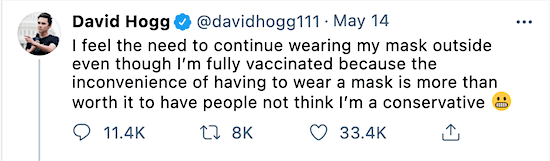
I want to thank David Hogg for this remarkably honest explanation for why he wears a mask when it is completely unneeded.
While others may not be doing it strictly to avoid looking Conservative, I do think that many young people wear them because they don't want to be mistaken as somehow anti-social or a Neanderthal.
When I am pressured to put a mask on despite having been fully vaccinated 8 weeks ago, I feel like I am signaling as well -- I am signaling that I am a rube who is meekly knuckling under to an irrational state. It is certainly an eye-opener to see so many of the supposed members of the counter-culture marching in lockstep with state authority.
Category: COVID-19, Government |
Comments Off on Masks as Virtue Signaling
I found the immediate arguments about filling the Supreme Court vacancy literally seconds after the announcement of her death to be extremely distasteful.
I think the idea that she somehow betrayed her supporters by not retiring when a Democratic President was in office with a Senate majority is outrageous. Court justices shouldn't be in the mode of actively managing the Court's ideological makeup. That's a political process. And yes, I say this despite the fact that I would not choose to have the Trump-McConnell axis filling the Court.
I know several young people who looked to her as a role model, which in the judiciary likely puts her in a Venn diagram circle of one person (unless someone is selling a set of 9th circuit trading cards that I have missed).
As with most libertarians, I liked some of her decisions and disagreed with others. Of the latter, Kelo (in the majority) and Citizens United (in the minority, fortunately) stick most in my mind as betrayals of individual rights in the face of expanding government power.
I think people would be surprised (given the tone of media coverage of the Supreme Court) how many decisions are 9-0
The way we focus on the Supreme Court almost solely through the abortion lens is frustrating to me. Can't we have a second Supreme Court, whose job is just to twiddle the abortion knob and the original can be left alone to handle the 99% of the other business the Court addresses?
Category: Government |
Comments Off on Thoughts on RBG
I am not going to take a position on COVID-19 severity now, if for no other reason as I am not an expert and I think its fine not to clutter the debates about virus responses too much with non-experts (though it is wrong, as discussed below, to censor experts who have heterodox opinions). I am convinced COVID-19 is "not just the flu" but when I see the governor of Texas being told that there will be a million deaths in Texas alone if there is not a hard quarantine there -- well, I am skeptical. Like with global warming, the full denier and total alarmist positions are likely both wrong -- with a lot of bad data analysis in the media along the way. I have decided to focus on the latter. So here are a few random thoughts:
The data we have sucks, and thus any conclusions we are drawing mostly suck too. The data is worse than just being incomplete or bad -- if it was randomly distributed, we could live with that. But the lack of test kits and how we have deployed the few we have means that the data is severely biased. We are only testing people who are strongly symptomatic. If there is a normal distribution of outcomes from this disease, we are only testing on the right side of the distribution. We have no idea where the median is or how long the tail is to the left side of asymptomatic outcomes. The only thing we absolutely know about the disease is its not as deadly as the media is portraying as we are missing hundreds of thousands of cases in the denominator of the mortality rates. The media has also been terrible about reporting on risk factors of those who died. When a bunch of people died suddenly in Seattle, one had to read down 5 paragraphs into the story to find that they were all over 70 in an old-age home. Or when prime-of-life people die, facts such as their being type 1 diabetics -- a known severe risk factor for this virus (and one that makes it different from the flu) are left out.
The media is constantly confusing changes in measurement technique and intensity with changes in the underlying progress of the virus itself. Changes in case numbers have as much to do with testing patterns and availability than they do with the real spread of the disease.
While COVID-19 is likely worse than the normal flu, our perceptions of how much worse are strongly affected by observer bias. Frankly, if every news broadcast every night spent 15 minutes reciting flu deaths each day, we would all be hiding in our homes away from flu. They present a healthy man in his thirties dying clearly as the tragedy it is, but the spoken or unspoken subtext is, "this is abnormal so this thing is much worse." But it seems abnormal because we do not report on the very real stories of healthy young people who die of the flu. My nephew who was 25 years old and totally healthy with no pre-existing conditions died of the flu last month -- and no one featured this tragedy on the national news.
The data we are getting sucks worse because the media has decided, as one big group, that for our own good they are going to limit all facts about the virus to only the bad ones. There is a strong sense -- you see it on Twitter both in Twitter's policies as well as Twitter group attacks -- that saying anything that might in any way reduce one's fear of the disease should be banned for our own good. One of the more prominent examples was Medium removing an article NOT because it was proven wrong but because it took one side of a very open question and it was obviously decided it was "unsafe" to allow that side to even be aired.
This strikes me as a terrible precedent and one with a very slippery slope. We have had to fight this attitude for years in the climate debate, the bad idea that good science is unacceptable if it gets to the wrong answer.
The media is never more dangerous than when it understands a little about a scientific topic. After 40 years of engineering experience with feedback phenomena and exponential effects like positive feedbacks, the media suddenly thinks its the expert now and needs to lecture me that I don't really understand the power of exponential spread. They are right that exponential disease spread with a highly transmissible virus is dangerous, but their 3rd grade math understanding is so simplistic it makes me scream. Yes I understand the growth math, but I also understand that the same growth math says that a single bacteria colony in a month of growth should consume the whole Earth and a single chunk of plutonium that fissions indefinitely could destroy the planet. But neither happens because there are brakes on the doubling process in later iterations. I don't know in the case of COVID-19 if these brakes are strong or weak, but showing me mindless doubling trees is just insulting.
Many of the computer model results I am seeing make no sense to me. I am exhausted with people talking about computer models as if they are some fact, rather than a really opaque calculation on some researcher's set of non-transparent hypotheses. The only way I respect a computer model is if someone presents it this way, "If X, Y, and Z are true, and you assume A and B, then this model shows what the result might be, with some large error ranges." Add to this the fact that most modelers run a range of models based on a range of inputs that yield a range of outputs, and then the media picks the most extreme of all these outcomes and presents it as "the model results of experts" without even showing the range of other outcomes. Arnold Kling wrote something I nodded my head to about COVID-19 and data modelling:
Once you build a model that is so complex that it can only be solved by a computer, you lose control over the way that errors in the data can propagate through the model. For me, it is important to look at data from a perspective of “How much can I trust this? What could make it misleadingly high? What could make it misleadingly low?” before you incorporate that data into a complex model with a lot of parameters.
It will be interesting to see if anyone goes back to the models making the national news today and reconciles them to actual results. Certainly no one ever does this in the climate debate, so I am not holding my breath.
Frankly, I am done with the Precautionary Principle. This does not mean I am against taking precautions, even strong and expensive precautions, against bad things. But I am done with the notion that one should ignore the costs of these precautions and not make sensible tradeoffs. This is even true when trading off the risk to life on one hand with reduction of economic outcomes on the other. This is in part because reduced economic activity has real effects on human misery and has direct correlations with lifespan and well-being.
I am perfectly willing to believe that some school districts somewhere have spending too low to ever provide the education we expect in 2019. But after sending my kids to a private school that did a fabulous job with kids and whose tuition was lower per student than the spending in most public schools, I have become suspicious of pleas for more and more money. It seems that lack of money is ALWAYS the claimed problem at public schools.
In fact, I am increasingly convinced the problem is not lack of money but how the money is spent. As the percentage of staff in most public schools who are administrators rather than teachers climbs over 50%, many public schools are doing exactly what every other government bureaucracy does -- starve spending for actual public services in favor of feeding a growing, increasingly well-paid administrative staff.
The Baltimore Teachers Union (BTU) has set up a donation page on their website to raise money and supply classrooms with fans this school year because of 60 Baltimore City School (BCS) buildings don't have air conditioning.
"It's no secret that Baltimore's students have had to weather the spectrum of extreme temperatures in their classrooms. We've all seen the photos of kindergarteners sitting in their coats and mittens at their morning circle. The reverse is true when school is back in session at the end of summer, when schools' internal temperatures have been measured at over 100 degrees. The Baltimore Teachers Union knows that educators' working conditions are students' learning conditions," BTU said on the donation page under the title "Donate to the BTU Fan Drive."
You see this all the time -- teachers begging the public for donations to help them through shortages of basic school supplies. The blame is always put on public funding -- obviously Baltimore public schools are starved for cash and forced to beg for simple infrastructure items like fans. But wait:
Of the 100 largest school systems based on enrollment in the United States, the five school systems with the highest spending per pupil in 2017 were New York City School District in New York ($25,199), Boston City Schools in Massachusetts ($22,292), Baltimore City Schools in Maryland ($16,184), Montgomery County School District in Maryland ($16,109), and Howard County School District in Maryland ($15,921). Maryland had one additional school system in the top 10, making it four of the top 10 school systems in the United States.
In the public recreation field, I call this borrowing from the infrastructure. Infrastructure maintenance and spending is starved in favor of richer deals for growing administrative staffs. That is why most major parks agencies have billions of dollars in deferred maintenance. Transit agencies apparently do the same thing.
Category: Education, Government |
Comments Off on This Is Why I Resist Pleas for More Spending on Government Schools
Prostitution is a person selling sexual services of their own free will. Trafficking is a form of kidnapping and slavery, when someone is forced to provide sexual services by someone with power over them.
All or even most prostitution is not trafficking, but many in the media and political sphere use these two a synonyms. I have seen it all week surround the Robert Kraft bust for seeking a private happy ending even before his team played in the Superbowl. I see this as a victory of traditionally anti-prostitution folks on the Right who have found a way to take advantage of a division on the Left, and specifically a division within feminism, to rebrand prostitution and bring some folks on the Left over to their side.
I am not an expert on feminist politics, but what I do know is the prostitution has created a divide among feminists. You remember the old abortion chant that feminists wanted the government to keep its laws off their body? That what a woman did with her body was an eminently private affair and should not be subject to government regulations? Well, feminists who followed up on this thought in a consistent manner generally supported legalization of prostitution. Bans on prostitution were seen by these folks as just another example of the male-dominated system limiting women's choices and ability to make money the way they choose.
On the other side more modern feminists see everything through the prism of male power over women. This is the "all sex is rape" group and for them prostitution has nothing to do with women's free will and everything to do with yet another channel through which men objectify and dehumanize women. From here it's only a small step to thinking that all prostitution is slavery. And thus by attempting to rebrand prostitution as trafficking, the Right found new allies on the Left in their campaign against sex work.
Those who read me a lot know I come down on the side of women being able to exercise choice, and I think the only real dehumanizing going on is the denial by modern feminists of any agency among most women.
But real abusive trafficking certainly exists. How much of prostitution fits this category is impossible to really know as a layman because the media and activists do so much to blur the line in their reporting. But I will say this: To the extent trafficking exists, it is not enabled by society somehow being soft on prostitution, in fact it is enabled by the opposite. By making prostitution illegal, we give unscrupulous people leverage to abuse those in sex work. Women being abused by men at, say, Wal-Mart have many legal outlets to air their grievances and seek change or compensation -- no one talks about trafficking in Wal-Mart greeters. But abused sex workers cannot go to the legal system for redress of abuse because they themselves are treated as criminals in the system. Contributing to this is our restrictionism on immigration. This is why many real trafficking cases revolve around the abuse of immigrant women, because abusers know these victims have not one but two impediments to seeking legal help.
For a short time 5-10 years ago I thought we might be near a breakthrough in softening the penalties on women voluntarily seeking to make a living through sex work. Now, my optimism has dimmed. The success the Right has had in enlisting parts of the Left in rebranding all prostitution as slavery has polluted discourse on this issue and means a lot of women will still be left outside the law.
Last year’s attempt by the West Virginia legislature to impeach and remove from office several members of the state’s supreme court effectively ended when the state supreme court ruled the impeachment proceedings were unconstitutional. (State ex. rel. Workman v. Carmichael) Now members of the legislature have moved to withhold judicial retirement benefits unless that decision is overturned.
Under SB 398 as amended yesterday by the House Judiciary committee, the payments for retirement benefits would cease unless Workman v. Carmichael is overturned.
I discussed the shutdown and its effects on the parks my company operates here (spoiler: all are still open). Shawn Regan of PERC has a good article in the National Review on the same subject:
....under new shutdown guidelines established by the Trump administration, our parks have been rightfully spared from serving as pawns in Washington’s partisan budget battles as they did in the past.
Under a contingency plan created by the administration, park officials are allowed to keep sites accessible to visitors during the shutdown with skeletal staffs, rather than being forced to close them as was the case during the 2013 government shutdown presided over by President Obama. That means many important visitor activities and park operations — from snow-coach rides in Yellowstone run by private concessionaires to guided battlefield tours of Gettysburg — can continue yielding economic benefits for the surrounding communities. This week, the National Park Service also announced it will begin tapping unspent visitor-fee revenues to bolster operations at some parks.
These new plans are attracting criticism in the familiar anything-Trump-does-must-be-bad vein. Theresa Pierno of the National Parks Conservation Association slammed the administration’s decision to keep parks open, calling it “unrealistic and dangerous,” even though the NPCA repeatedly called for parks to be reopened during the 2013 shutdown. Representative Raúl Grijalva, the new Democratic chairman of the House Natural Resources Committee, pledged to hold hearingson the administration’s decision to support park operations with fee revenues....
The Trump administration’s approach is sensible. Why unnecessarily ruin visitors’ plans or jeopardize the millions of dollars in revenue that local communities receive from park visitation? If visitation begins to pose significant health or safety concerns, the contingency plan gives park superintendents the option to close areas or shut down parks entirely, as some parks have already done.
He goes on to make the very logical point that the vast majority of BLM lands and US Forest Service lands -- whose acreage dwarfs that under management by the National Park Service -- mostly all remain open in every shutdown. The large amounts of government staffing on NPS lands are needed to handle large visitor concentrations in small areas, something that really is not an issue in most parks in January.
Folks who have been hunting for pictures of overflowing trash cans to paint the current opening of parks as a bad idea could find just as many in the summertime on government lands when the government is not shut down. Remember, for all the love folks want to throw at the National Park Service at these times, it is an agency that has allowed many of its parks to fall apart, with perhaps $20 billion in deferred maintenance and very little new investment in the modern infrastructure visitors are demanding. And it has a labor model that is well suited to counting wolves but poorly suited to efficiently cleaning bathrooms and emptying trash cans even when the government is open. This shutdown is the least of the problems faced by public recreation lands.
I think people get confused about the purpose of the government shutdown. It is not a punishment, or a timeout, meted out by the law when Congress can't agree on a budget. It is a mechanical (and logical) requirement that spending on certain activities stop when that spending is no longer legally authorized. The media acts like it is supposed to be painful, and that Trump is somehow breaking the rules by making it less so. I often criticize this President, but this is one area Trump should be applauded. I think the wall funding issue is a dumb reason to go into budget gridlock, particularly when he had 2 years of Republican Congresses to get this done, but given the fact of the shutdown he should be applauded for attempting to reduce its impact on ordinary Americans. President Obama, for all his reputation of caring and hope, was to my mind overly callous in explicitly trying to make the shutdown more painful for average people.
Several readers have been nice enough to write me and ask how my business is doing during the government shutdown. As background, my company privately operates public recreation areas, mostly campgrounds, under concession contract. We manage public lands for many different government agencies, but many of the campgrounds we run are in the Forest Service. Typically the Forest Service (and National Park Service) must close in this and most other shutdowns. In fact, public parks are often a significant pawn in budget battles, so much so the term "closing the Washington Monument" has become shorthand for using popular public facilities as a leverage point in spending fights (the fact that politicians always threaten to close the MOST popular public services when money is tight rather than the most useless is exhibit A in why we shouldn't trust our money to Congress).
But all the Federal facilities we operate are still open right now through the government shutdown. The reason for this is that our company does not receive a dime from the government -- all the money goes the other way. We operate the facilities essentially under a (very restrictive) lease. We collect visitor use fees and then pay a bid percentage of those fees back to the Feds as our rent -- this is a huge advantage to the government as before our management they typically lost money even after collected visitor fees and now they are gaining money**. Since the government does not have to fund these locations, and since their daily operation requires no federal employees, the parks we operate are typically not closed during government shutdowns.
Long-time readers will be familiar with one exception -- in 2013 during the Obama Administration we were forced to close during a Federal shutdown. Originally, the agencies we work with (particularly the US Forest Service which is part of the Department of Agriculture) gave us the usual guidance, that we were to remain open. Then, suddenly, our company and those like it were told to shut down. When I and my trade group attempted to protest the decision with whatever official in the agency made the decision, we were told it came from "above the Department of Agriculture," which narrows the field of possible decision-makers pretty substantially. My hypothesis, though I can never prove it, was that the Obama Administration wanted to put as much pressure on Congress as possible, and closing the Washington Monument doesn't work as leverage if some damn private company is keeping it open. My competitors and I banded together and took the US Forest Service to court (past articles here) and were in the process of winning our case when the shutdown ended, but ever since then the US Forest Service has allowed us to stay open in shutdowns. If you have WSJ access, they actually covered our effort here; I made an early morning appearance on Fox & Friends; Reason TV did a nice piece; and Hans Bader of the CEI was all over the story and a big help in getting the issue some visibility.
Christmas and New Years are popular times for folks to visit in places like Sedona and Florida where we run Forest Service recreation areas, and we are happy we have been able to stay open and serve them this time around.
**Postscript: This private concession management model also has a benefit in state and local budget battles, though it is slightly different. I can tell you from loooooong personal experience that the public really does not like recreation use fees on public lands. My taxes should pay for that! But now, and certainly in the future, our taxes go mostly to fund programmed expenses like healthcare and welfare plus our bloated military. Anything else is going to be starved -- which leads to the estimated $114 billion in deferred maintenance in federal / state / local public recreation areas and parks ($20+ billion in the National Park Service alone). Seeing this happening, most of the public has become reconciled to user fees for recreation as long as the recreation fee is used to support the local park they are visiting.
To this end, one reason folks are sometimes leery about private management of these lands is they wonder if their fees are being sucked away to some corporate equivalent of Scrooge McDuck's gold vault rather than supporting operations at the park. It's the reason I keep this chart up on our web site:
In fact, it is the government agencies themselves that often sweep user fees out of the parks and into general revenue funds. The Arizona legislature did this for years to the state parks agency. The result in this situation is that the infrastructure crumbles while the user fees that should be fixing these issues actually has just become another general revenue tax. I think of deferred maintenance in government facilities -- parks, subways, roads, etc -- as a kind of shadow borrowing where government officials borrow against the infrastructure. This borrowing is almost invisible, at least on an incremental basis, and often the debt is eventually defaulted on as the infrastructure is never repaired and has to be closed or torn down. By putting parks under concession management, user fees can no longer be swept away from the management and maintenance of the park, and private companies can often be held accountable for poor maintenance more readily than agencies are able to hold themselves accountable.
Years ago the Forest Service wanted to eliminate car traffic in popular Sabino Canyon near Tucson, AZ, so they closed the road and asked companies for proposals to run a tram service to various stops in the canyon. While a bit unusual at the time this service started, this is now a very common response to overcrowding in popular natural areas. These services are typically leased as concessions, with the operator charging some sort of fee or fare from passengers, paying all expenses, and then paying the government an agreed rent in the form of a percentage-of-revenue concession fee.
In my world of campground operations, these concession fees are typically competitively bid and thus variable, but in the world of services like this one, there is a fixed list in the regulations of services and the percentage to be paid. The problem here started because there is no item on the list for "tram operator". So the government, in this case the local Forest Service, picked a logical equivalent from the table and told the tram operator what the percentage would be. The tram operator set his fares based on this and his other costs and went on with business.
Flash forward many years. The tour operator does a good job and has great reviews but the owner is a crusty guy who sometimes rubs the Forest Service staff the wrong way. The Forest Service decides at the end of his term to compete the contract (called a permit by the FS) and give it to a non-profit. Its not clear by the rules the FS can do this -- there are supposed to be protections built in for good-performing concessionaires who have invested a lot in the operation -- so the old permit-holder sued but the courts backed the Forest Service.
The Forest Service recently and retroactively imposed a 150% increase in a permittee’s fees for the period 2011-2015. The Forest Service decision was based on the views of outside third party auditors it had hired to audit the agency’s fee assessments during that period. The permit involved shuttle operations and fees were established under the Graduated Rate Fee Structure (GRFS) which sets fees based on the type of operations. Because GRFS does not contain a classification for shuttle operations, the agency had previously categorized the operations as “Outfitting/Guiding.” When the third party auditors reviewed the agency’s prior fees, they believed that the shuttle operations should have been classified as “Rental and Services” by the agency.
In 2016, the auditors completed their review of the prior five years of fee assessments and issued their final audit. The permittee had paid fees totaling $99,231 for the period 2011-2015. After changing the classification of the operations under GRFS, the auditors asserted that the permittee owed an additional $148,305 for that period.
This is really outrageous. The mistake made was by the government -- the private operator logically trusted the numbers on his signed contract and assumed that those were the numbers he was operating under. To retroactively charge this poor guy an enormous amount of money for a government mistake he had nothing to do with and couldn't even know about is just absurd. Had he known the government wanted a higher fee before he actually started operations, he could have charged a higher fare to make up for it but now he can do nothing because it is all retroactive. Its all the worse because this decision has a whiff of retribution about it given that this concessionaire took the government to court earlier over the loss of his permit.
This penalizing of a private company for a government mistake is not atypical in a government audit. Years ago I had the Forest Service tell our company to do X and Y maintenance projects for them and that they would reimburse us for the costs (it was their responsibility but we were closer and and cheaper so it made sense). Years later an auditor said that the FS should not have asked us to do the project that way, and that the FS had violated their internal rules. So instead of just fixing their internal procedures or punishing those guilty in their agency they ... judged I was at fault and told me I had to refund all the money we were reimbursed for the project. I obviously cried foul -- I told them I was authorized in writing, that I could not un-spend the money, that I had no responsibility for their internal compliance to their internal procedures, and that the error was theirs and I should not be the one punished for it. As logical as this seems, it took me a surprisingly long time to get them to stop demanding this money back.
I was among those who has opposed forced institutionalization. The practice used to be rife with abuse, and when it was really being challenged in the 1970's it was with recent knowledge of how institutionalization for supposed mental health issues had been used in the Soviet Union as a tool against dissent. And in a world where political partisans still routinely assign negative mental health diagnoses to their political enemies and have even suggested using mental health diagnosis-from-a-distance to unseat the current President, there is still a lot of possibility for abuse. But seeing that most of those who would have been in state mental hospitals are now in prison or living (and dying) on the streets, I am open to having made a mistake. I am still not sure, though, who advocates for such people who are without friends and family and would help guard against their abuse.
I understand that the general media explanation of homelessness is to blame it on the cold heart of whoever was the last Republican President in office, but it is hard for me to correlate national policy with trends in homelessness. I am maybe 70% convinced that the closing of mental health facilities in the 70's and 80's across most cities and states was the main cause, a hypothesis born out by the high rates of mental illness recorded in most homeless populations. This is why I think so much government spending for the homeless is wasted -- it all focuses on creating homes, I guess just because of our word choice of "homeless". If we called them the mentally ill, or perhaps "helpless" rather than "homeless" we might investigate other approaches.
I see a number of sources nowadays trying to pin these closures entirely on tight-fisted Republican governors, and I am sure this is partly true. But this misses an important element -- that civil libertarians had real issues with both the conduct of these institutions (e.g. One Flew Over The Cuckoo's Nest) and the fairness of the forced-institutionalization process. Also tied up in all this were Cold War stories of Soviet Russia using institutionalization in mental hospitals as a way to dispose of dissidents. After all, it is a short step from the totalitarian view of ideology (ie that everyone must believe, not just comply) to declaring that any deviation from the official orthodoxy constitutes mental illness.
Marine Le Pen, the leader of the French far right has been left shocked and furious after a court ordered her to be examined by a psychiatrist to determine if she "is capable of understanding remarks and answering questions".
Le Pen, who is head of the former National Front party - now National Rally (Rassemblement National) revealed on Twitter her shock and anger at being ordered to undertake a psychiatric assessment.
The unusual summoning is in relation to Le Pen having tweeted out gruesome propaganda images from terror group Isis that showed the bodies of people having been executed by the so-called Islamic State.
And as part of their investigation it appears magistrates in Nanterre near Paris have ordered Le Pen to visit a psychiatrist for an expert assessment.
"I thought I had been through it all: well, no! For denouncing the horrors of Daesh (Isis) by tweets the "justice system" has referred me for a psychiatric assessment. How far will they go?!" she said on Thursday.
Ms. Le Pen is not really my cup of tea, but this strikes me as a creepily totalitarian action, oddly similar to certain groups in the US that want to take on Trump with mental health claims. If you are imitating strategies used by Soviet Russia to suppress dissidents, you are probably doing Democracy wrong.
For some reason my small business now has to fill out three incredibly time-consuming census reports every year. I don't know what we did to be punished in this way, but each of these (if one were truly diligent) can take more time than a tax return to fill out.
Several of the reports ask for accounting data in ways no private company keeps accounting data, such that really giving them the number they want would take hours or days of recasting thousands of accounting transactions. I try to give them something reasonable but let's just say they get exactly the quality they pay for here.
There does not seem to be any filter or limit on the amount of time government bureaucrats can demand for this cr*p. Every bureaucrat seems to have some piece of data they think is desperately needed, so every year each of these reports gets longer and every few years another report is added. It is particularly frustrating because the government is just going to use this data to justify regulating or taxing me more. My forced unpaid labor is providing ammunition for the government to make my life harder.
And speaking of unpaid labor: Last time I wrote something like this about how much I hated this data gathering (at that time I only had to fill out one of these) I had economists write me that this is really important data and without it they could not do their job. You know what? I don't demand economists perform unpaid labor to support my job, why do I have to provide unpaid labor to support theirs? If this is such vitally important data, pay me for it.
Tags: accounting Category: Government |
Comments Off on I Am Tired of Being An Unpaid Laborer For My Own Destruction