Archive for the ‘Education’ Category.

Freedom from Criticism

I have argued many times on this page that there is a dangerous new rights theory gaining traction in today’s college campuses.  That theory holds that there exists a freedom (mostly for people in "protected" groups — women, minorities, etc) from being offended or even being criticized, and that this trumps free speech. 

For years I have supported the legality of what is called hate speech — not because I agreed with it, but because I thought its expression, no matter how contemptible, should be legal.  Free speech should have no content tests.  I also argued that there was a slippery slope.  If making racist remarks is illegal today, perhaps just criticizing a woman or an African American might be illegal tomorrow.

Enter Priya Venkatesan, former English teacher at Dartmouth.  Ms. Venkatesan was hired by Dartmouth to teach all kinds of odd (but always trendy) socialist eco-feminist babble.  Such courses seem to be a staple of colleges today.  I remember a number of such professors at Princeton, but it was no big deal as long as the course were clearly labeled and one could avoid them.  After all, if people really were attracted to such drivel, it just left more spots open for the rest of us in classes that actually prepared us for the real world. 

The problems began, though, when Ms. Venkatesan’s students refused to blindly agree with her  (apparently, they did not attend the University of Delaware indoctrination course that explained why you are not allowed to criticize anyone but white males).

The agenda of Ms. Venkatesan’s seminar, then, was to
"problematize" technology and the life sciences. Students told me that
most of the "problems" owed to her impenetrable lectures and various
eruptions when students indicated skepticism of literary theory. She
counters that such skepticism was "intolerant of ideas" and "questioned
my knowledge in very inappropriate ways." Ms. Venkatesan, who is of
South Asian descent, also alleges that critics were motivated by
racism, though it is unclear why.

After a winter of discontent, the snapping point came
while Ms. Venkatesan was lecturing on "ecofeminism," which holds, in
part, that scientific advancements benefit the patriarchy but leave
women out. One student took issue, and reasonably so – actually,
empirically so. But "these weren’t thoughtful statements," Ms.
Venkatesan protests. "They were irrational." The class thought
otherwise. Following what she calls the student’s "diatribe," several
of his classmates applauded.

Ms. Venkatesan informed her pupils that their behavior
was "fascist demagoguery." Then, after consulting a physician about
"intellectual distress," she cancelled classes for a week. Thus the
pending litigation.

Litigation, exposure of the names behind anonymous course evaluations, and email threats from Ms. Venkatesan follow.  More from Lubos Motl.

Postscript:  By the way, it is just astounding to me that anyone with an over-room-temperature IQ could passionately believe that technological progress is bad for women.  One might argue that way society is organized still under-utilizes women and/or puts artificial roadblocks up to a woman’s progress, but get some perspective!

Pre-modern life for women was horrible.  Because of the biological complexities of child-rearing alone, they died young far more often than men and their physical vulnerability caused them to be marginalized in virtually every society of every culture of the world until at least 1750 and really until 1900.  The whole women’s movement is built on a platform of technology that only begins with the pill and encompasses a thousand things from automobiles to computers that reduce the importance of size and physical strength in getting ahead in the world. 

Selection Bias

I thought it was kind of interesting that upon reading this McKinsey & Co study (currently the top one in the list) on education, Kevin Drum and a number of other left ‘o center blogs pulled out this one chart to highlight.  It shows starting teacher pay  (i.e. out of college) as a percent of the economy’s average)

Blog_mckinsey_teacher_starting_pay

The author’s of the study argue that the countries higher on this list also have better student results.  Now, I will confess that this is a pretty interesting finding in the study — that starting teacher pay is more important than teacher pay in later years, because the key is to attract talented people right out of college away from other professions.  Interesting. 

But here is the quite fascinating selection bias by the lefty blogs:  I have read the whole report, and this is absolutely the only chart in the whole study that in any way, shape, or form might be interpreted as a call for higher government education spending.  Even more interesting is what these bloggers left out.  This is the other half of the starting teacher pay analysis Drum et. al. chose note to include, and makes clear that even this chart is not a call for more total spending:

South Korea and Singapore employ fewer teachers than other systems; in effect, this ensures that they can spend more money on each teacher at an equivalent funding level.  Both countries recognize that while class size has relatively little impact on the quality of student outcomes (see above), teacher quality does.  South Korea’s student-to-teacher ration is 30:1, compared to an OECD average of 17.1, enabling it in effect to double teacher salaries while maintaining the same overall funding level as other OECD countries….

Singapore has pursued a similar strategy but has also front-loaded compensation.  THis combination allows it to spend less on primary education than almost any other OECD and yet still be able to attract strong candidates into the teaching profession.  In addition, because Singapore and South Korea need fewer teachers,  they are also in a position to be more selective about who becomes a teacher.  This, in turn, increases the status of teaching, making the profession even more attractive.

Whoops!  Don’t want our friends at the NEA to see that!  Most of the study turns on McKinsey’s finding that teacher quality drives student results, way ahead of any other factor, from class size to socioeconomic background:

Teacherquality

Well, now the NEA might be getting really nervous.  Something like this might cause parents to do something rash, like demand that low-performing teachers get fired.  Gasp.

Anyway, to get back to the cherry-picking and selection bias issue, the study is pretty clear that it thinks that "more spending" is a failed strategy for improving public education
Education1

If school choice is off the table, then I would be very supportive of a program to increase starting teacher pay, funded by larger class sizes and substantial reductions in useless administrators and assistant principals.  Anyway, it is kind of an interesting study, though you may find the pdf file format really irritating to try to read.  Lots of funny formatting. 

Update on the “Right Not To Be Offended”

Every decade or so, enemies of free speech adopt a new strategy for trying to curtail the First Amendment.  The current effort consists of attempting to define a "right not to be offended", and college campuses are a leading laboratory for this approach (see here and here).

Chris Robinson was recently brought up on trial at the University court for violating this right not to be offended of some of the women at Colorado College (you may notice that this "right not to be offended" seems to be enforced suspiciously asymmetrically, like all speech restrictions).  He has fired back with a marvelous editorial, of which I include one short excerpt:

Hyper-sensitivity in service to a purported greater good became the
justification for an authoritarian lock-down on speech. It’s the same
logic every time: the state comes down hard on behalf of "community."
Changing the rhetorical justification only masks the tyranny. The
effect of this on citizens, in the words of John Adams, is "reducing
their minds to a state of sordid ignorance and staring timidity."…

The simple fact that we were brought before a Soviet-style show
trial has already sent a message to campus, and it is a clear one,
namely that every other potential bearer of heterodox views
should think long and hard about expressing them for fear of ending up
in the same situation as us. In order to avoid even the possibility of offending one group or another, nobody outside the "approved" ideological categories will say anything.

This
is precisely the chilling effect that the First Amendment is
specifically designed to guard against, and to sanction it is a
fundamental violation of the mission of this college. Transparently
selective enforcement against ideologically disallowed speech is
categorically the same as those abhorrent thought-control missions
carried out by the Saudi Ministry of the Propagation of Virtue and the
Prevention of Vice, a perfect example of what John Adams called "the
most mischievous of all doctrines, that of passive obedience and
non-resistance." It’s Orwell and Kafka, together at last.

Bonus judos to Mr. Robinson for recognizing that as a private institution, Colorado College can legally implement whatever speech restrictions it likes, and so frames the question as an issue of "should it" rather than "can it?"

Eww, Yuck, I missed this

Via TJIC, from that California homeschooling court decision, as reported in the San Francisco Chronicle:

"A primary purpose of the educational system is to train school children in good citizenship, patriotism and loyalty to the state and the nation as a means of protecting the public welfare," the judge wrote, quoting from a 1961 case on a similar issue.

So I Guess I Got Caught Up In It Too

The Mises Blog, not one to give the government much of a break, argues that the decision on home education last week in California was narrow and has been mis-interpreted, and applies narrowly to the credentialing of home tutors, not parents performing home-schooling. 

Maybe, but the teacher’s union certainly thought that was what the judge was saying and the judge went out of his way to say specifically "Parents do not have a constitutional right to home school their
children" which is an overly broad statement that was not at all required had the decision really been intended to be narrow.  Jeffrey Tucker at Mises argues:

It comes down to a case of a judge who got carried away with his rhetoric and didn’t understand the law.

Oh, OK.  I feel so much better now.

More on the Cost of College

I don’t know why I can’t just move along from Michelle Obama’s rant about the terrible cost of her Princeton / Harvard Law degree.  Maybe its because I attended the same schools (different degrees) and my reaction is just so different — I had a fabulous experience and live in awe that I had such a unique chance to attend these schools, while Michelle Obama seems to experience nothing but misery and resentment.  Granted that I did not have to take on a ton of debt to get these degrees, but I have plenty of friends (and a wife) that did.

This analogy comes to mind:  Let’s say Fred needs to buy a piece of earth-moving equipment.  He has the choice of the $20,000 front-end loader that is more than sufficient to most every day tasks, or the $200,000 behemoth, which might be useful if one were opening a strip mine or building a new Panama Canal but is an overkill for many applications.  Fred may lust after the huge monster earth mover, but if he is going to buy it, he better damn well have a big, profitable application for it or he is going to go bankrupt trying to buy it.

So Michelle Obama has a choice of the $20,000 state school undergrad and law degree, which is perfectly serviceable for most applications, or the Princeton/Harvard $200,000 combo, which I can attest will, in the right applications, move a hell of a lot of dirt.  She chooses the $200,000 tool, and then later asks for sympathy because all she ever did with it was some backyard gardening and she wonders why she has trouble paying all her debt.  Duh.  I think the problem here is perfectly obvious to most of us, but instead Obama seeks to blame her problem on some structural flaw in the economy, rather than a poor choice on her part in matching the tool to the job.  In fact, today, she spends a lot of her time going to others who have bought similar $200,000 educations and urging them not to use those tools productively, just like she did not. 

Postscript:
Ironically, two Ivy League schools have actually decided that they want their graduates to be able to afford any career they wish, without fear of student debt, and so endeavor to provide student aid nowadays in the form of grants rather than loans.  One of those is Princeton University, her and my alma mater.

I Wonder if This Is Related?

Megan McArdle had a stat the other day that was pretty depressing, related to the number of kids of middle class African-Americans that appear to fall back into poverty:

A chapter of the report released last fall found startling evidence
that a majority of black children born to middle-class parents grew up
to have lower incomes and that nearly half of middle-class black
children fell into the bottom fifth in adulthood, compared with 16
percent of middle-class white children

That is not good, though I am always suspicious of income statistics (for example, income statistics show me as close to or below the poverty line over the last few years, a function of an entrepreneurial startup).

Then I saw all the silly to-do about Michelle Obama’s senior thesis at Princeton (I can’t say I honestly even know what my wife’s thesis was about).  But what got me to thinking was the fact that as an African-American Ivy League student, she felt compelled to study and write her thesis about race.  I started to remember a disproportionate number (but by no means all) of my middle-class African-American Ivy League acquaintances studied and wrote on the same thing – race.  This means that while I was studying engineering, which had obvious value in the workplace, many blacks are studying a topic that has no marketplace value except to get a very low paying job in a non-profit somewhere.  Which is all fine and good if that is what people want to do, but if blacks are worried their kids are not financially successful, they should consider whether its smart that, while other kids are studying subjects that will get them ahead, their kids are studying a subject that seems to focus mainly on explaining to them why they will never get ahead.

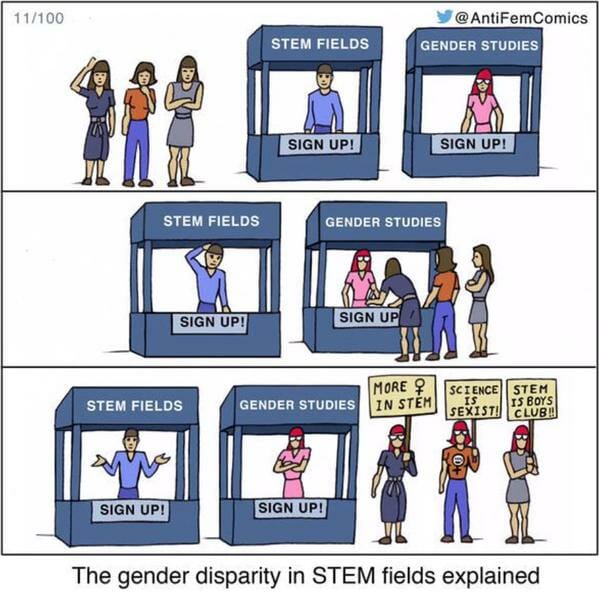
Update:  I want to be careful not to call race / gender / group identity majors "worthless."  Worthless is in the eye of the beholder, and if a student values such a course of study, then it has worth.  However, by the same token, the student should be prepared for the fact that most of the world, particularly the subset called "hiring managers", does not value degrees in majors that have little practical application outside of academia and which have a reputation in general for having low academic standards.  The student does not have to accept the rest of the world’s judgement of her degree, but in turn the student can’t demand that the rest of the world adopt hers.

In fact, when I made these comments, I didn’t know Ms. Obama’s choice of course of study.  Knowing that now, it is even more amazing to me that she sees her student debt experience as an average data point indicating a structural flaw in the economy instead of the fact that she chose perhaps the most expensive college in the country and then chose to dedicate four years of study to a major that is nearly impossible to monetize in the job market.

Oops, There Goes Another Bridge

I probably shouldn’t criticize a curriculum that I have not observed, but as someone who studied engineering the old-fashioned way (ie with lots of math and equations) this looks kind of worrisome:

Today’s Christian Science Monitor profiles Glenn Ellis, a professor who helped develop Smith’s innovative engineering curriculum, which emphasizes context, ethics, and communication as much as formulas and equations.

We know that when the goals in public schools were shifted from education to graduation and retention (e.g. social promotion), the results were disastrous.   So one has to be a little wary of a curriculum aimed more at retention than, you know, designing bridges correctly:

Smith, the first women’s college to offer an engineering degree, graduated its first class of engineers in 2004, and since the program’s creation, in 1999, has attained a 90-percent retention rate.

Hmm.  Well, if they are teaching the same material in a more engaging manner, fine.  But lower degree retention rates in hard core engineering programs is not a "female thing."  I know that we had a lot of attrition from the harder engineering degrees (mechanical, chemical) at Princeton even among Ivy-League-Quality students and even among the males. 

Hat tip: TJIC

I Don’t Think He Understands

The Colorado faculty is going apeshit because the state has proposed making Bruce Benson, a Colorado oilman-Republican, who *gasp* only has a paltry BA degree, head of the University of Colorado system.  To a large extent, folks are going nuts largely because he has different politics than 97% of the faculty and because he has actually done something productive in his life.  However, not being able to say this out loud  (we’re a government body so we are not supposed to have political tests, wink wink) his lack of an advanced degree has become the centerpiece of the opposition.

State House Majority Leader Alice Madden, a Democrat and CU law school
graduate, declared that Benson would be "the least educated president
ever considered in modern history."

Apparently, his academic record does not live up to University of Colorado standards, which has gleefully employed academic titans like Ward Churchill.  (By the way, isn’t it interesting that these folks respect a couple of years at the age of 23 getting a masters in petroleum engineering more than 50 years of demonstrated excellence actually practicing petroleum engineering.)

But here is my advice to Mr. Benson:  Don’t take the job.  Mr. Benson, in the private sector, you were probably used to having employees who didn’t like you or think you were the best person for your job.  However, you knew that they could either be persuaded by demonstrated performance over time, or else you at least knew that people would work for your goals despite their dislike for you, since they knew that their success lay in the success of the organization as a whole.

University faculty do not behave this way.  They have a completely different set of incentives.  With a job for life, and knowing that no matter how bad the university gets, it will still get state support, they have absolutely no incentive to pull together for the good of the institution or, even less likely, for the well-being of the student body.  There are many exceptions to this; in fact, the exceptions may number more than 50% of the faculty.  But these exceptions do not drive faculty behavior.  Those that drive faculty behavior are the ones that are out for either self-aggrandizement or the promotions of symbols over performance or both. 

There once was a dean at Princeton University I liked and respected named Neil Rudenstine (actually he was Provost when I was there, but who the hell knows what a Provost is?).   Rudenstine was named President of Harvard, and was a good fundraiser (like Benson) and was very hands-off in his management style (as Benson promises to be).  Neil was a good man, but he was broken by the Harvard faculty, driven to what probably was literally a mental breakdown.  And then there was Larry Somers.  He was a very different type of man than Rudenstine — tougher, more politically experienced.  But he too was broken by the Harvard faculty in an attempt to move that institution perhaps 1% of the way towards where you probably want to move Colorado. 

Don’t do it. 

More on Public School Spending

Bill Steigerwald has a great editorial in the Pittsburgh Tribune-Review dissecting per-pupil public school spending in Pittsburgh.  Generally, when I quote media articles about school spending, I have to do what should be the obvious analyses myself (as with this pathetic Washington Post piece on school spending).  However, this would be totally redundant for Steigerwald’s column.  I encourage you to read it all, but here are some highlights for Pittsburgh schools:

  • Per pupil spending in the public schools is $18,719
  • Quality private schools in Pittsburgh charge from $7,000 to an elite level at $19,500.  Humorously, just over $12,000 will get you a year at the University of Pittsburgh
  • Barely half of this spending goes towards the classroom.  The rest, presumably, goes to funding a probably enormous corps of vice-principals.  (If you ever are at a school board meeting that allows public comment or Q&A, ask how many vice-principals they have in their system).  In Pittsburgh, administrative costs are 72.5% of teacher salary costs, meaning there are likely about 3 administrators for every 4 teachers.  Ugh.
  • Teachers make $86,000 in salary and benefits, or $114,667 if you adjust for the fact they only work 9 months of the year.  Kind of obviates the "teachers are underpaid" myth.

The only other thing I would have called the schools out on is their defense that they have to pay transportation, administration, and debt service out of these costs, as if somehow this made their numbers non-comparable to private benchmarks.  So what?  Do you think my kid’s private school evades these costs somehow?  Their school charges about $6,500 for middle school, and they make a profit on this (and do not get any donations).  I am pretty sure they also have to pay for administration of multiple schools (they have a network of 5 schools) and for debt service on the capital costs to build the schools in the first place.  Our schools don’t have transportation, but many other private schools do.

Like Bill Gates Complaining About Starbucks Prices

I thought this from

At Montgomery Blair High School in Silver Spring, parents fear cuts in
Montgomery County’s proposed $2.1 billion budget will threaten the
math-science magnet program.

Schaeffer puts this in perspective:

The desperate schools of Montgomery County will need to find some way
[to] stretch the $15,246 they have to spend on each of the 137,745 students
in their schools.

This is simply hilarious.  Sometimes it is hard to compare per-pupil spending on an apples to apples basis since each grade tends to be progressively more expensive than the last (high school is more expensive than middle school which is more expensive than elementary school).  Recognize that this is only partially because the education per se is more expensive at each step — it is more because the expectation of extra-curriculars (sports, theater, etc.) go up at each level. 

However, taking 8th grade as a mean, I can say that my 8th-grader’s tuition in a for-profit private school that receives no donations or outside scholarship money is less than half $15,246.  And the education he gets is generally considered the best in the city  (though his school is lighter than some rich-suburb public school on extra-curriculars).

If you have any doubt that local media generally act as cheerleaders for increased public spending, look no further than this.  Note the newspaper quote (from the Washington Post) and then Schaeffer’s context:

I have saved the most touching story for last . . .

In Loudoun County, School Board members approved a
budget 14 percent higher than last year’s to accommodate an expected
3,000 new students. The county faces a projected $250 million
shortfall, and the 54,000 student system will probably have to look for
new places for savings.

My heart goes out to the Loudoun County administrators. I can’t see
how anyone can be expected to educate a child with just $15,000 or to
cover a 6 percent enrollment increase with just a 14 percent increase
in the budget.

An Old Joke, But New To Me

The author says this is an old joke, but it was new to me.  It traces the evolution of math quizzes in our public schools:


1960s

A logger cuts and sells a truckload of lumber for $100. His cost of
production is four-fifths of that amount. What is his profit?

1970s New-math

A logger exchanges a set (L) of lumber for a set (M) of money. The
cardinality of Set M is 100. The set C of production costs contains 20
fewer points. What is the cardinality of Set P of profits?

1980s

A logger cuts and sells a truckload of lumber for $100. Her cost is $80, her profit is $20. Find and circle the number 20.

1990s

An unenlightened logger cuts down a beautiful stand of 100 trees in
order to make a $20 profit. Write an essay explaining how you feel
about this as a way to make money. Topic for discussion: How did the
forest birds and squirrels feel?

He goes on to show how reality may have overtaken the joke.

8th Grade, 1895

I thought this was pretty interesting. It purports to be (and I have no reason to doubt that it is) an 8th grade final exam given in 1895 in Salina, KS.  I have seen it in the context of "gee, look how much worse our schools are" and to some extent that is unfair.  Sure, I think we all can get a gut feel from the test that expectations on students were a bit more unyielding and rigorous back then. One gets the sense that the Salina school district has not had to defend the test in court against charges that it discriminates against … whatever and that they would not really understand the current public mantra that self-esteem should somehow trump learning and achievement.

But the fact that you and I can’t answer a lot of the questions doesn’t really mean much. Some of it would be hard to pass because it asks for frameworks we don’t necessarily ascribe to today.  For example, it asks for the epochs into which US history is divided.  I have no idea what such epochs would be and in fact they are probably irrelevant given we have twice as much history as a country today as in 1895.  And it takes a minute to remember that when they say the "rebellion" they are probably talking about the Civil War.  And as to "orthography,"  I am not losing much sleep at night over not being able to "Give four substitutes for caret ‘u’."

In general, the test reflects a shift in teaching from a lot of technical memorization to the more conceptual.  Kids who passed this test in 1895 could probably spell oddball words and fill out a map better than my kids, but I would be curious how well they would do on a five paragraph persuasive essay, something my eighth grader spends a lot of time on. 

Math is one area where my kid’s education would blow this stuff away.  The math on this 1895 test is pretty tailored to the needs of a small farming town:

1. Name and define the Fundamental Rules of Arithmetic.

2. A wagon box is 2 ft. deep, 10 feet long, and 3 ft. wide. How many
bushels of wheat will it hold?

3. If a load of wheat weighs 3942 lbs., what is it worth at 50 cts.
per bu., deducting 1050 lbs. for tare?

4. District No. 33 has a valuation of $35,000. What is the necessary
levy to carry on a school seven months at $50 per month, and have
$104 for incidentals?

5. Find cost of 6720 lbs. coal at $6.00 per ton.

6. Find the interest of $512.60 for 8 months and 18 days at 7
percent.

7. What is the cost of 40 boards 12 inches wide and 16 ft. long at
$20 per m?

8. Find bank discount on $300 for 90 days (no grace) at 10
percent.

9. What is the cost of a square farm at $15 per are, the distance
around which is 640 rods?

10. Write a Bank Check, a Promissory Note, and a Receipt.

But by the end of eight grade my kids will have had two years of algebra, not necessarily because they are smarter than kids in 1895, but because perceived needs change.  My kids are more likely to need complex math for advanced science and technical degrees than they are going to need to be able to figure out how many bushels of grain will fit in the silo.  Further, where is the science on the test?  How about a second language? 

My kids go to a private school, so maybe public school parents have a different perspective.  There are a lot of reasons to criticize public schools today, but I don’t think this test gives us much insight into them.

Creepy Big Brother Education at University of Delaware

You have probably seen the stories about the creepy, mandatory reeducation program for University of Delaware students.  If you have missed the story, or want more, the Foundation for Individual Rights in Education is all over it — here is a roundup.

However, if you don’t have time to go through it all, here is a couple of examples I took right from their curricula.  Note that the following goals for the program are set in the context of, as the university puts it, "treatment" for students incorrect beliefs and worldviews.   This is from the Central Complex residence hall:

Delaware

Look at 2B and C for example!  Its coincident timing, but look at stuff above in the context of this post, which I wrote before I even saw this.  Could there be a more resounding confirmation of this:

I have to lay a lot of this failure on universities like my own.
Having made students jump through unbelievable hoops just to get
admitted, and then having charged them $60,000 a year for tuition,
universities feel like they need to make students feel better about
this investment.   Universities have convinced their graduates that
public pursuits are morally superior to grubby old corporate jobs (that
actually require, you know, real work), and then have further convinced
them that they are ready to change to world and be leaders at 22.  Each
and every one of them graduate convinced they have something important
to say and that the world is kneeling at their feet to hear it.  But
who the f*ck cares what a 22-year-old with an Ivy League politics
degree has to say?  Who in heavens name listened to Lincoln or
Churchill in their early twenties?  It’s a false expectation.  The Ivy
League is training young people for, and in fact encouraging them to
pursue, a job (ie 22-year-old to whom we all happily defer to tell us
what to do) that simply does not exist.  A few NGO’s and similar
organizations offer a few positions that pretend to be this
job, but these are more in the nature of charitable make-work positions
to help Harvard Kennedy School graduates with their self-esteem, kind
of like basket-weaving for mental patients.

If you read through the whole document, which is nearly impossible because it is a classic example of academic mental masturbation, you will see the curriculum is dominated by this sustainability notion

Delaware2

Somehow none of the residence halls chose "the role of capitalism and individual entrepreneurship in creating wealth."  Remember that these are all areas that the university has declared that students require "treatment" if their views do not conform with the university orthodoxy.  They are expecting that all students must share all of these beliefs.  For real creepiness, read about the student that the RA conducting this curriculum actually felt the need to report to university officials because her attitudes were so "out of whack".  She was reported for saying obviously horrendous things like this answer:

1) When were you first made aware of your race?

“That is irrelevant to everything. My race is human being.”

Fortunately, the University of Delaware killed the program after a firestorm of national outrage.  If you have read the FIRE blog long enough, you will suspect that Delaware will find some way in the future to sneak it back in.

My post of the vacuousness of student activists, written before I even saw this, is here.

Update:  How did I miss this great quote, from the university’s Office of Residence Life Diversity Education Training documents:

“A RACIST: A racist is one who is both privileged and socialized on the
basis of race by a white supremacist (racist) system. ‘The term applies
to all white people (i.e., people of European descent) living in the
United States, regardless of class, gender, religion, culture or
sexuality. By this definition, people of color cannot be racists,
because as peoples within the system, they do not have the power to
back up their prejudices, hostilities, or acts of discrimination….’”

Wow! Megan McArdle on Vouchers

I won’t even bother to try to excerpt the post.  Just read it if you are interested in vouchers.  Or Education.  Or just read it anyway.

OK, I lied, one excerpt.  She is refuting anti-voucher arguments.  Here is #11:

11)  There’s no way to assure the quality of private schools
Ha. Ha. Hahahahahahahahahahahahahahaha. Seriously? The problem with
private schools is that they can’t match the same level of quality
we’ve come to expect from our urban public school system? And what else
have you learned in your visit to our planet?

Giving to State Universities

A few weeks ago, I discussed how Ivy League schools came under fire from some leftist for not spending their endowments fast enough.  Obviously this guy has been a succesful adviser to Congress.

Anyway, one of the differences between private and state schools is not just that many private institutions get a lot more per alumnus giving.  Another big differentiator is how the money gets spent.  Here is a great example of private giving taking on the, uh, most critical challenges in public education.  Via Market Power.

Go, Megan, Go

Best thing I have read all week, from Megan McArdle:

I very rarely get angry about politics. But every time I see some
middle class parent prattling about vouchers "destroying" the public
schools by "cherry picking" the best students, when they’ve made damn
sure that their own precious little cherries have been plucked out of
the failing school systems, I seethe with barely controllable inward
rage. It is the vilest hypocrisy on display in American politics today.

This is Low?

A study finds that 17.6% of social scientists at American universities self-identify themselves as Marxists.  And the study’s authors find this percentage to be "low".  By the way, had Coyote been responsible for assigning the Marxist label rather than just self-idntification, my guess is the number would have easily cracked 50%.

How Princeton Uses Its Money

Everybody is always trying to spend someone else’s money.  This kind of thing would really make me sick, except it is a little funny to see the kind of class warfare and redistributionist economics preached by elite universities come back to bite them:

Dr. Gravelle points out that endowment wealth is concentrated in the
upper ranks, much of it at 62 institutions with endowments larger than
$1 billion. But just three years ago only 39 schools had billion-plus
endowments. That’s a 38% increase in just a few years. In 2006, 125
schools had endowments over $500 million—a third more than in 2002. The
number of schools that can count themselves as endowment-rich or
super-rich is growing rapidly….

What the data shows is that endowment wealth is everywhere—except in
the hands of the students who need it today. Last year endowments
increased 17.7% on average—those larger than a billion increased 18.4%.
Yet, despite double-digit increases stretching back a decade or more
—endowment spending is at a nearly all-time low of 4.2%–down from 5.1%
in 1994, 6.5% in 1982, and 5.2% in 1975….

Tuition has been going up so rapidly for so long it has reached nearly
ungraspable levels. So let me put today’s tuition cost in concrete
terms. Senators, what would your constituents say if gasoline cost
$9.15 a gallon? Or if the price of milk was over $15? That is how much
those items would cost if their price had gone up at the same rate that
tuition has since 1980.

I believe that skyrocketing tuition is
undoubtedly the biggest “access” problem in higher education. What can
possibly be more discouraging to a capable student whose parents are
not wealthy than a school with a $45,000 price tag on the door?…

Congress should not hesitate to consider a minimum payout
requirement—and 5% should be considered a starting point. The 5% number
is a dated one—even for private foundations. Many schools have been
rolling over so much money for so long that they should easily be able
to accommodate a higher rate of payout. Possibly the most significant
challenge for policymakers will be to make sure that any newly directed
monies actually go toward aid or tuition reduction and don’t become
part of a shell game.

Seriously, is there no pocket of private money that socialists won’t stick their hand into?  In effect, at the same time Americans get lambasted for saving too little, this guy is going after private universities for saving too much?  And note the implicit assumption about government intervention he holds and expects all of Congress to hold in the third paragraph above:  It is just assumed that if prices go up enough to upset the constituents, then it is Congress’s job to act.

Far be it for facts to get in the way of good populism, but I do know what Princeton does with its 2nd or 3rd largest endowment:

  • Every student who gets admitted gets a financial aid package from the University that will allow them to attend, no matter what their finances are.  Yes, the student may have to work his butt off, but if he really wants to go to Princeton he will be able to go.  Princeton’s wealth also allows it to be much more friendly in these financial assessments.  For example, many assets like the parent’s house are taken off the table when assessing ability to pay
  • If a student graduates normally, then all of her debts are paid off at graduation.  Every student graduates debt-free, giving them far more flexibility in what jobs they choose our of college.  No longer must they eschew non-profit or low-paying jobs due to the burden of debt.
  • Princeton has accepted that applying more money to increasing the educational intensity of its existing 4000 students by an additional 0.1% is not the best use of its investment.  It has committed (in too small of a way for my preferences, but that is another matter) to using its fortunes to increase its size and bring Ivy League education to more people.  This year, it increased its entry class size by 250, which may seem small to those of you from large universities but is about a 20% increase for Princeton.

Since all Princeton students get whatever aid they need and graduate debt-free.  So the tuition number is irrelevent.  And statements like "I believe that skyrocketing tuition is
undoubtedly the biggest “access” problem in higher education" are virtually meaningless. 

More on Education and Expertise

A few days ago, I highlighted an article that argued that the problem with public education was that there was not enough expertise and, heaven forbid, enough state level bureaucrats managing the infrastructure.  I pointed out that this is often the argument of technocrats in favor of failing public institutions:  The problem is not the institution, they argue, or its incentives but it just needs the right people in charge.  I argued that, probably like GM, all the expertise in the world was not going to turn around an organization whose DNA had gone senescent.

Alex Tabarrok comes at this issue from a different angle, but with similar results.  Too many of the examples highlighted of successes in public education rely on a super-teacher or super-administrator who overcomes all the organization problems in his/her school to create a success story, one that is usually fleeting and tends to die when that individual leaves  (Jaime Escalante is a great example – most of his math program improvements died after he left).

Tabarrok argues that you can’t just keep hoping for more of these unique individuals who can overcome a myriad of bureaucratic obstacles.  You have to reinvent the system so that average capability, poorly motivated workers can still get a good result for students.  I know some will be scared off by the analogy, but this is the kind of thing that franchise restaurants do very well — plug low-skill, sometimes poorly motivated employees into a system that successfully provides consistent, predictable service for customers.

What we need to save inner-city schools, and poor schools
everywhere, is a method that works when the teachers aren’t heroes.
Even better if the method works when teachers are ordinary people,
poorly paid and ill-motivated – i.e. the system we have today. 

In Super Crunchers,
Ian Ayres argues that just such a method exists.  Overall, Super
Crunchers is a light but entertaining account of how large amounts of
data and cheap computing power are improving forecasting and decision
making in social science, government and business.  I enjoyed the
book.  Chapter 7, however, was a real highlight.

Ayres argues that large experimental studies have shown that the teaching method which works best is Direct Instruction (here and here
are two non-academic discussions which summarizes much of the same
academic evidence discussed in Ayres).  In Direct Instruction the
teacher follows a script, a carefully designed and evaluated script.
As Ayres notes this is key:

DI is scalable.  Its
success isn’t contingent on the personality of some uber-teacher….You
don’t need to be a genius to be an effective DI teacher.  DI can be
implemented in dozens upon dozens of classrooms with just ordinary
teachers.  You just need to be able to follow the script.

Contrary
to what you might think, the data also show that DI does not impede
creativity or self-esteem.  The education establishment, however, hates
DI because it is a threat to the power and prestige of teaching, they
prefer the model of teacher as hero.  As Ayres says "The education
establishment is wedded to its pet theories regardless of what the
evidence says."  As a result they have fought it tooth and nail so that
"Direct Instruction, the oldest and most validated program, has
captured only a little more than 1 percent of the grade-school
market."

I don’t know anything about DI and haven’t seen the data and so can’t comment on its effectiveness.  But I can say that if it works, there is no way it will be adopted in public schools.  Public school systems are run first for the administration bureaucracy, second for the teachers, and only about third for the students.  Anything that serves the latter but reduces the power of the former will never succeed, again because the incentives are not there for better performance.  Only school competition will allow such new models to be tried.

The Problem in Education Is Not Expertise

Via Kevin Drum, Mark S. Tucker and Kevin Toch make the argument, if I understand it right, that school districts and state education organizations simply don’t have the expertise or the capacity to handle the changes required to meet the standards that are being applied by efforts like NCLB (they also argue the tests themselves suck, but I am not going to address that issue).  By the way, you know I’m going to get worked up when the title of an article is "The secret to making Bush’s school reform law work? More bureaucrats"

…we need a long-term solution, which can only lie in building
the capacity of the states, districts, and schools to reach the kinds
of goals contemplated by the framers of NCLB. This is not a simple
matter, but a vast, man-to-the-Moon kind of challenge. It means finding
people with the data management experience to build and administer the
very complex systems called for by the law. It means recruiting experts
who can help create truly world class curriculum standards so that
teachers will know what they are supposed to teach and students will be
able to reach the standards. It means identifying and training
thousands of educators who have succeeded in improving their schools to
provide on-site assistance at other failing schools, and recruiting
still others who can take those schools over if the current staff
cannot or will not rise to the challenge. It means creating and
expanding networks of talent-laden organizations–universities, think
tanks, for-profit and non-profit school companies–that have the skill,
experience, and management capacity to turn around individual schools
and entire districts. And it means greatly strengthening the
capabilities of the agencies that will coordinate this massive effort:
state departments of education.

Wow!  It’s hard to even know where to start, but I guess my first thought is : What the f*ck have public schools been doing in the last 100 years?  Why, after an absolutely enormous spending growth over the last several decades, do districts still not have the ability to create world class curricula?  Why don’t teachers know what they are supposed to teach?   Why is the system so talent poor, despite a huge increase in the number of administrators with various advanced education degrees at all levels of the system?  It’s as if the highway department announced today that they didn’t have the ability to design roads.

The first and last resort of every technocrat is to complain that the system is great, if only the right "smart" people could get put in charge.  These folks are making this same argument yet again.  Our public schools are fine, if we could just get the right experts in charge. 

Bullshit.

The issue is not the lack of expertise.  The issue is one of incentives and senescence in the system itself.  In this context,  NCLB is completely off the mark.   I work with government employees all the time.  There is a very clear difference between the incentives they see and the incentives I see in the market.  For government employees, the biggest incentive is to avoid missing some bureaucratic check box.  They are much more concerned that they not be found later in some audit to have missed a procedure or a required approval authority than with actual performance or productivity.  NOT, I want to emphasize, because they are bad or misguided people, but because that is how their incentive system is set up.  Their actions are entirely rational in the context of their incentive structure, but the results are no less disastrous.

For example, government managers of recreation facilities get almost no credit for improving the customer experience, a metric my company lives and dies for.  I have seen a government park manager do a great job obtaining funds from private sources to add a new facility to their park that pleased guests, only to get criticized for having the slope of an access ramp be 1/4 degree off ADA standards and have a grievance filed by the union that park visitation had gone up, creating more work for the government employees.  I spent an evening having a beer with that manager, and you can bet they are never going to try to actually improve the customer experience again.  As another example, I went in to my government landlord last week and just blasted them for their lack of customer service focus, for the fact that they are blocking me from making improvements customers are begging for.  They yawned, gave me no response,  and handed me a notice that they were missing some of our water testing paperwork and please get it to them ASAP.

NCLB just gives government schools another government wammy to be managed and avoided.  The authors will probably get their wish, and huge bureaucracies will rise up to manage the numbers and reports without anything being done to really improve education.  The authors lament that the California state education department has "only" 1452 employees.  I have every confidence that this "problem" will soon get fixed by California, and the number will balloon up nicely, long before children see any better education.

A while back I wrote a plea to just let GM die.  I said:

A corporation has physical plant (like factories) and workers of
various skill levels who have productive potential.  These physical and
human assets are overlaid with what we generally shortcut as
"management" but which includes not just the actual humans currently
managing the company but the organization approach, the culture, the
management processes, its systems, the traditions, its contracts, its
unions, the intellectual property, etc. etc.  In fact, by calling all
this summed together "management", we falsely create the impression
that it can easily be changed out, by firing the overpaid bums and
getting new smarter guys.  This is not the case – Just ask Ross Perot.
You could fire the top 20 guys at GM and replace them all with the
consensus all-brilliant team and I still am not sure they could fix
it. 

All these management factors, from the managers themselves to
process to history to culture could better be called the corporate
DNA*.  And DNA is very hard to change.  Walmart may be freaking
brilliant at what they do, but demand that they change tomorrow to an
upscale retailer marketing fashion products to teenage girls, and I
don’t think they would ever get there.  Its just too much change in the
DNA.  Yeah, you could hire some ex Merry-go-round** executives, but you
still have a culture aimed at big box low prices, a logistics system
and infrastructure aimed at doing same, absolutely no history or
knowledge of fashion, etc. etc.  I would bet you any amount of money I
could get to the GAP faster starting from scratch than starting from
Walmart.  For example, many folks (like me) greatly prefer Target over
Walmart because Target is a slightly nicer, more relaxing place to
shop.  And even this small difference may ultimately confound Walmart.
Even this very incremental need to add some aesthetics to their
experience may overtax their DNA….

Changing your DNA is tough.  It is sometimes possible, with the right
managers and a crisis mentality, to evolve DNA over a period of 20-30
years.  One could argue that GE did this, avoiding becoming an
old-industry dinosaur.  GM has had a 30 year window (dating from the
mid-seventies oil price rise and influx of imported cars) to make a
change, and it has not been enough.  GM’s DNA was programmed to make
big, ugly (IMO) cars, and that is what it has continued to do.  If its
leaders were not able or willing to change its DNA over the last 30
years, no one, no matter how brilliant, is going to do it in the next
2-3.

I would say the exact same thing is true of public schools: Their DNA is senescent.  Most are the equivalent of alcoholics who keep falling off the wagon and keep asking for more chances.  At some point, you just have to give up.  At some point, it is easier to just start from scratch.  After 30 years of trying, Sears still can’t change itself so there is Wal-Mart.  After 30 years of trying, GM still can’t change itself so there is Toyota.  After 30 years of trying, United Airlines still can’t change itself so there is Southwest.

The only difference in education is that the government has to date suppressed the emergence of Toyota and Wal-Mart and Southwest because, well, because it can.  I am sure that United Airlines would have liked to ban competition from Southwest, but it does not have the coercive power of government.  Fortunately, in most industries other than education, the public gets a choice of offerings, and companies that customers don’t prefer tend to die.

It’s time to give school choice a chance, and radically shift the incentives for public schools in a way that the government can’t with bureaucracy-based programs like NCLB.  Some public schools will thrive, and many will die in favor of private options, but our kids will be far better off either way.  It’s time to stop doubling down on failure.  It’s time to stop giving the alcoholic one more chance.

Postscript:  One of the reasons that competition is important is in the very definition of "expertise."  An expert is someone who presumably has been succesful at a certain activity when others have been less so.  We call Herb Kelleher an expert on airlines and customer service because he designed a model that kicked everyone else’s butt.  But would you have called him an expert in 1972, before Southwest took off?  Probably not.  He was just one of many voices with diverse, untested opinions of what would make a better airline.  What eventually made him an expert, and the others less so, is he went out and applied his ideas and they were succesful.

So the author’s want to send more "expertise" to the schools.  OK, who are the experts?  Nearly every public school is using the same version of the same failed model.  Some succeed more than others, but these differences tend to be incremental rather than radical, like the difference between Sears and Montgomery Ward rather than between Sears and Wal-Mart (or even Amazon.com).  So how can you even know who the experts are within the same failed system, where no one is really allowed to go out and fully test their ideas in practice?  What happens, in reality, is that "experts" in education are the ones that can best enthrall academics and politicians and think tanks with grandiose or politically correct visions.  I would argue that as of this moment there are no experts in education in the US and we have no hope of identifying them until we let entrepreneurs go out and start testing various new models.

The Problem in Education Is Not Expertise

Via Kevin Drum, Mark S. Tucker and Kevin Toch make the argument, if I understand it right, that school districts and state education organizations simply don’t have the expertise or the capacity to handle the changes required to meet the standards that are being applied by efforts like NCLB (they also argue the tests themselves suck, but I am not going to address that issue).  By the way, you know I’m going to get worked up when the title of an article is "The secret to making Bush’s school reform law work? More bureaucrats"

…we need a long-term solution, which can only lie in building
the capacity of the states, districts, and schools to reach the kinds
of goals contemplated by the framers of NCLB. This is not a simple
matter, but a vast, man-to-the-Moon kind of challenge. It means finding
people with the data management experience to build and administer the
very complex systems called for by the law. It means recruiting experts
who can help create truly world class curriculum standards so that
teachers will know what they are supposed to teach and students will be
able to reach the standards. It means identifying and training
thousands of educators who have succeeded in improving their schools to
provide on-site assistance at other failing schools, and recruiting
still others who can take those schools over if the current staff
cannot or will not rise to the challenge. It means creating and
expanding networks of talent-laden organizations–universities, think
tanks, for-profit and non-profit school companies–that have the skill,
experience, and management capacity to turn around individual schools
and entire districts. And it means greatly strengthening the
capabilities of the agencies that will coordinate this massive effort:
state departments of education.

Wow!  It’s hard to even know where to start, but I guess my first thought is : What the f*ck have public schools been doing in the last 100 years?  Why, after an absolutely enormous spending growth over the last several decades, do districts still not have the ability to create world class curricula?  Why don’t teachers know what they are supposed to teach?   Why is the system so talent poor, despite a huge increase in the number of administrators with various advanced education degrees at all levels of the system?  It’s as if the highway department announced today that they didn’t have the ability to design roads.

The first and last resort of every technocrat is to complain that the system is great, if only the right "smart" people could get put in charge.  These folks are making this same argument yet again.  Our public schools are fine, if we could just get the right experts in charge. 

Bullshit.

The issue is not the lack of expertise.  The issue is one of incentives and senescence in the system itself.  In this context,  NCLB is completely off the mark.   I work with government employees all the time.  There is a very clear difference between the incentives they see and the incentives I see in the market.  For government employees, the biggest incentive is to avoid missing some bureaucratic check box.  They are much more concerned that they not be found later in some audit to have missed a procedure or a required approval authority than with actual performance or productivity.  NOT, I want to emphasize, because they are bad or misguided people, but because that is how their incentive system is set up.  Their actions are entirely rational in the context of their incentive structure, but the results are no less disastrous.

For example, government managers of recreation facilities get almost no credit for improving the customer experience, a metric my company lives and dies for.  I have seen a government park manager do a great job obtaining funds from private sources to add a new facility to their park that pleased guests, only to get criticized for having the slope of an access ramp be 1/4 degree off ADA standards and have a grievance filed by the union that park visitation had gone up, creating more work for the government employees.  I spent an evening having a beer with that manager, and you can bet they are never going to try to actually improve the customer experience again.  As another example, I went in to my government landlord last week and just blasted them for their lack of customer service focus, for the fact that they are blocking me from making improvements customers are begging for.  They yawned, gave me no response,  and handed me a notice that they were missing some of our water testing paperwork and please get it to them ASAP.

NCLB just gives government schools another government wammy to be managed and avoided.  The authors will probably get their wish, and huge bureaucracies will rise up to manage the numbers and reports without anything being done to really improve education.  The authors lament that the California state education department has "only" 1452 employees.  I have every confidence that this "problem" will soon get fixed by California, and the number will balloon up nicely, long before children see any better education.

A while back I wrote a plea to just let GM die.  I said:

A corporation has physical plant (like factories) and workers of
various skill levels who have productive potential.  These physical and
human assets are overlaid with what we generally shortcut as
"management" but which includes not just the actual humans currently
managing the company but the organization approach, the culture, the
management processes, its systems, the traditions, its contracts, its
unions, the intellectual property, etc. etc.  In fact, by calling all
this summed together "management", we falsely create the impression
that it can easily be changed out, by firing the overpaid bums and
getting new smarter guys.  This is not the case – Just ask Ross Perot.
You could fire the top 20 guys at GM and replace them all with the
consensus all-brilliant team and I still am not sure they could fix
it. 

All these management factors, from the managers themselves to
process to history to culture could better be called the corporate
DNA*.  And DNA is very hard to change.  Walmart may be freaking
brilliant at what they do, but demand that they change tomorrow to an
upscale retailer marketing fashion products to teenage girls, and I
don’t think they would ever get there.  Its just too much change in the
DNA.  Yeah, you could hire some ex Merry-go-round** executives, but you
still have a culture aimed at big box low prices, a logistics system
and infrastructure aimed at doing same, absolutely no history or
knowledge of fashion, etc. etc.  I would bet you any amount of money I
could get to the GAP faster starting from scratch than starting from
Walmart.  For example, many folks (like me) greatly prefer Target over
Walmart because Target is a slightly nicer, more relaxing place to
shop.  And even this small difference may ultimately confound Walmart.
Even this very incremental need to add some aesthetics to their
experience may overtax their DNA….

Changing your DNA is tough.  It is sometimes possible, with the right
managers and a crisis mentality, to evolve DNA over a period of 20-30
years.  One could argue that GE did this, avoiding becoming an
old-industry dinosaur.  GM has had a 30 year window (dating from the
mid-seventies oil price rise and influx of imported cars) to make a
change, and it has not been enough.  GM’s DNA was programmed to make
big, ugly (IMO) cars, and that is what it has continued to do.  If its
leaders were not able or willing to change its DNA over the last 30
years, no one, no matter how brilliant, is going to do it in the next
2-3.

I would say the exact same thing is true of public schools: Their DNA is senescent.  Most are the equivalent of alcoholics who keep falling off the wagon and keep asking for more chances.  At some point, you just have to give up.  At some point, it is easier to just start from scratch.  After 30 years of trying, Sears still can’t change itself so there is Wal-Mart.  After 30 years of trying, GM still can’t change itself so there is Toyota.  After 30 years of trying, United Airlines still can’t change itself so there is Southwest.

The only difference in education is that the government has to date suppressed the emergence of Toyota and Wal-Mart and Southwest because, well, because it can.  I am sure that United Airlines would have liked to ban competition from Southwest, but it does not have the coercive power of government.  Fortunately, in most industries other than education, the public gets a choice of offerings, and companies that customers don’t prefer tend to die.

It’s time to give school choice a chance, and radically shift the incentives for public schools in a way that the government can’t with bureaucracy-based programs like NCLB.  Some public schools will thrive, and many will die in favor of private options, but our kids will be far better off either way.  It’s time to stop doubling down on failure.  It’s time to stop giving the alcoholic one more chance.

Postscript:  One of the reasons that competition is important is in the very definition of "expertise."  An expert is someone who presumably has been succesful at a certain activity when others have been less so.  We call Herb Kelleher an expert on airlines and customer service because he designed a model that kicked everyone else’s butt.  But would you have called him an expert in 1972, before Southwest took off?  Probably not.  He was just one of many voices with diverse, untested opinions of what would make a better airline.  What eventually made him an expert, and the others less so, is he went out and applied his ideas and they were succesful.

So the author’s want to send more "expertise" to the schools.  OK, who are the experts?  Nearly every public school is using the same version of the same failed model.  Some succeed more than others, but these differences tend to be incremental rather than radical, like the difference between Sears and Montgomery Ward rather than between Sears and Wal-Mart (or even Amazon.com).  So how can you even know who the experts are within the same failed system, where no one is really allowed to go out and fully test their ideas in practice?  What happens, in reality, is that "experts" in education are the ones that can best enthrall academics and politicians and think tanks with grandiose or politically correct visions.  I would argue that as of this moment there are no experts in education in the US and we have no hope of identifying them until we let entrepreneurs go out and start testing various new models.

Trying to Hold Up the Ivy League’s Honor

Scored 58 of 60 on the Civic’s Quiz that apparently 40% of Ivy Leaguer students don’t seem able to pass.  Missed the Jamestown founding date and Just War Theory.   Now I can be the crotchety old Princeton alum:  "Well in my day…"

…Or, You Could Choose Your College This Way

Last week, I pointed out that my alma mater Princeton had again topped the USN&WR college rankings.  But those college rankings were for those who wanted to invest their tuition money and four years of their life at the school that would, you know, educate them the best. 

If, however, you would rather choose a college based on how well it serves everyone else’s interests rather than your own, you can use this ranking from Washington Monthly, presumably chosen with help from special correspondent Ellsworth Toohey.  Universities are chosen for social contribution and research and number of Peace Corps volunteers and the like.  No indicators of educational quality or student satisfaction are used.  Really, they don’t seem to be joking:

U.S. News & World Report publishes its university rankings
every year, and every year people complain about them. So starting in
2005 we decided to do more than just complain, and instead came out
with our own rankings — based not on reputation or endowment size, but
rather on how much of a contribution each university actually makes to
the country.

Top universities on the list presumably teach important skills like:

  • How to find a job that helps lots of people but doesn’t pay very much and provides no job satisfaction
  • How to find a boyfriend who beats you a lot and never can hold a job, but needs your financial support really badly
  • How to invest in companies with no prospects but who need the money very much (taught presumably by Eugene Lawson)

In this list, a Peace Corps volunteer is ranked to have made a larger contribution to America than say:  Jimmy Stewart, Meg Whitman, Jeff Bezos,  James Madison,  etc.  (Oh, and Pete Conrad, probably my personal favorite Princeton Grad, and first man on the moon after Neil Armstrong’s dress rehearsal on a Hollywood soundstage with Buzz Aldrin and OJ Simpson.)

This is maybe a great list if you have a billion dollars burning a hole in your pocket and want to find a university to endow, but of what utility is this for prospective students?

Postscript: You do, though, have to give Washington Monthly props for putting Texas A&M at the top of their list, a university whose student body is probably least likely of almost any major state school to purchase very many copies of their magazine  [a comment on their political orientation, not their ability to read].

Update: OK, this is how people REALLY pick schools, from this list.

Tune Every Heart and Every Voice

We’re number one, again.


              Tiger, tiger, tiger
              Sis, sis, sis,
              Boom, boom, boom, ah!
              Princeton! Princeton! Princeton!