increases in minimum wages almost always causes job losses among the poor and unskilled
GMO's and genetically modified foods have zero proven negative effects on the body or the environment
homeopathy is completely useless and has zero medical benefits beyond any potential placebo effects
All of these are super-majority consensus statements in their respective fields. It's fine if you are skeptical of any of them (and even better if you can justify this skepticism with a reasonably intelligent scientific argument). But don't tell me that I am somehow inherently wrong to challenge the climate orthodoxy.
I have over several months been answering questions about my climate positions -- I think for a woman's school project but I honestly can't remember any more. Anyway, I answered a question for her today and though I did not spend a ton of time on it, I thought I would share.
She asked:
Why do you find it unproductive to argue for something based on how many experts are agreeing to it? Wouldn't it be hubris to dismiss the fact that a number of experts are contradicting you on a subject that is pretty complex and is something that isn't nesessarily understood intuitively?
Why do you believe it is unproductive to take such a point into serious consideration?
The way I see it. there is this kind of logic:
A math student works on a very complicated math problem from his homework and has all his justifications for his answer. However, it turns out that his math professor has a different answer-- which is saying something important. It would be a slippery slope for the student to posit that his answer is right and the professor's answer is wrong just because the justification he came up with on his own always leads him back to the same answer. (That is, unless he found out an explanation for why his professor got that answer, like say-- maybe the professor never worked out the problem by himself and looked at an answer key which was wrong.)
My off the cuff responses to the student:
This is not a simple math problem. It is a super complex multi-variable chaotic system in which we are trying to attribute changes in one output variable (temperature) to a single input variable out of thousands or millions (CO2). I think the majority of the hubris (given the state of our knowledge) is on the certainty side, not the doubting side. I would observe, by the way, that many of the exact same people who use this "you must respect the experts" argument against climate skeptics themselves challenge many expert assertions, e.g. that minimum wages reduce employment or that GMO's are safe, that are supported by at least as many experts in those other fields. You would be unusual if you personally do not disagree with some proposition that most of the "experts" support.
The way folks often describe science when trying to criticize climate skeptics sounds to me a lot more like religion than science. Saying that there are fundamental assertions that one cannot challenge is a feature of religion, not true science. Science is about having a theory, making predictions from that theory, and if those predictions consistently turn out to be true, then gaining confidence in the theory. Many of global warming predictions have been wrong -- they have overestimated temperature increases to date, hurricanes and tornadoes are not getting more frequent, droughts are not getting more frequent, etc (do not confuse the frequency of these events in the news with their actual underlying frequency -- go live with the data at the NOAA to see that all these severe weather trends are dead flat). But no one goes back and relooks at the model or theories and those that do point out these shortcomings, eg. skeptics, are threatened with censure. Does not sound like science to me.
I am not without relevant expertise. Though I don't have as deep of climate knowledge as some, I know a lot about modeling chaotic multivariable systems (in finance and economics) and know exactly what the shortcomings of models are and can recognize the patterns of many mistakes in climate that I have seen in other fields of modeling. Further, the key difference skeptics have with alarmists is the expectation of strong positive feedbacks in the climate accelerating temperatures greatly. My major and research work in college were in dynamic systems and feedbacks. Climate scientists are positing that there is more positive feedback in the climate system than exists in any other stable natural system we know about. That is worth some skepticism if one understands feedbacks.
The experts in climate would be a lot more credible if they were more transparent and open to discourse. Instead, they frequently refuse to release their data (even on government-funded projects) for replication and carefully engineer peer review panels so no one who actually disagrees with them are on it. It has been years since any climate "expert" has agreed to participate in a public debate.
The most important answer is that what the "experts" are saying and what the media and the general public are saying the experts are saying is completely different. There is a bait and switch going on, where the majority (though maybe not the most vocal) of the experts are very careful and conservative (little c) in their claims, but they are portrayed as being all-in en masse on the most outrageous and spectacular of the claims by activists. I would refer you to this article, but I will reprint below the key part to your question:
So let's come back to our original question -- what is it exactly that skeptics "deny." As we have seen, most don't deny the greenhouse gas theory, or that the Earth has warmed some amount over the last several year. They don't even deny that some of that warming has likely been via man-made CO2. What they deny is the catastrophe -- they argue that the theory of strong climate positive feedback is flawed, and is greatly exaggerating the amount of warming we will see from man-made CO2. And, they are simultaneously denying that most or all of past warming is man-made, and arguing instead that the amount that is natural and cyclic is being under-estimated.
So how about the "97% of scientists" who purportedly support global warming? What proposition do they support? Let's forget for a minute a variety of concerns about cherry-picking respondents in studies like this (I am always reminded by such studies of the quote attributed, perhaps apocryphally, to Pauline Kael that she couldn't understand how Nixon had won because no one she knew voted for him). Let's look at the actual propositions the 97% agreed to in one such study conducted at the University of Illinois. Here they are: 1. When compared with pre-1800s levels, do you think that mean global temperatures have generally risen, fallen, or remained relatively constant? 2. Do you think human activity is a significant contributing factor in changing mean global temperatures? The 97% answered "risen" and "yes" to these two questions. But depending on how one defines "significant" (is 20% a significant factor?) I could get 97% of a group of science-based skeptics to agree to the same answers. So this is the real problem at the heart of the climate debate -- the two sides are debating different propositions! In our chart, proponents of global warming action are vigorously defending the propositions on the left side [see chart in the original], propositions with which serious skeptics generally already agree. When skeptics raise issues about climate models, natural sources of warming, and climate feedbacks, advocates of global warming action run back to the left side of the chart and respond that the world is warming and greenhouse gas theory is correct. At best, this is a function of the laziness and scientific illiteracy of the media that allows folks to talk past one another; at worst, it is a purposeful bait-and-switch to avoid debate on the tough issues.
I could have also said that there were several times in class when I challenged the teacher on a math problem answer and I was right and they were wrong. My wife-to-be was actually in one of these classes and can testify to the fact.
By the way, I find the last point I made about bait and switch to be surprisingly similar to problems I have arguing net neutrality. The problem is that the FCC's actions under Obama were NOT net neutrality, they were applying early 1900's telephone regulation which pretty much killed innovation in that industry to the Internet. Unfortunately, everyone calls those regulations "net neutrality" so if you oppose these dumb counter-productive regulations one is somehow against net neutrality when in fact it is nothing of the sort.
After an unusual number of years of being missed by major hurricanes, the US was hit by several large hurricanes in an above-average Atlantic hurricane season in 2017. But as is typical of weather, while the Atlantic had more hurricanes than average, other parts of the world had fewer than average, such that overall for the northern hemisphere as a whole, it was a pretty average year.
Most of the observed increase in global average temperatures since the mid-20th century is very likely due to the observed increase in anthropogenic GHG concentrations.[7] It is likely that there has been significant anthropogenic warming over the past 50 years averaged over each continent (except Antarctica)
I want to come back to this in a second, but here is a story the Bryan Caplan posted on his blog. He is quoting from Tetlock and Gardner's Superforecasting
In March 1951 National Intelligence Estimate (NIE) 29-51 was published. "Although it is impossible to determine which course of action the Kremlin is likely to adopt," the report concluded, "we believe that the extent of [Eastern European] military and propaganda preparations indicate that an attack on Yugoslavia in 1951 should be considered a serious possibility." ...But a few days later, [Sherman] Kent was chatting with a senior State Department official who casually asked, "By the way, what did you people mean by the expression 'serious possibility'? What kind of odds did you have in mind?" Kent said he was pessimistic. He felt the odds were about 65 to 35 in favor of an attack. The official was started. He and his colleagues had taken "serious possibility" to mean much lower odds.
Disturbed, Kent went back to his team. They had all agreed to use "serious possibility" in the NIE so Kent asked each person, in turn, what he thought it meant. One analyst said it meant odds of about 80 to 20, or four times more likely than not that there would be an invasion. Another thought it meant odds of 20 to 80 - exactly the opposite. Other answers were scattered between these extremes. Kent was floored.
Let's go back to the IPCC summary conclusion, which is quoted and used all over the place (no one in the media ever actually digs into the charts and analysis, they just stop at this quote). A few thoughts:
This kind of conclusion is typical of team process and perhaps is a reason that large teams shouldn't do scientific studies. We wouldn't have aspirin if 500 people all had to agree on a recommendation to allow it.
Climate alarmists often claim "consensus". Part of the way they get consensus is by excluding anyone who disagrees with them from the IPCC process and publication. But even within the remaining core, scientists have vast differences in how they evaluate the data. Consensus only exists because the conclusions use weasel words with uncertain meaning like "most" and "significant" (rather than a percentage) and "very likely" (rather than a probability).
Is "most" 51% or 95%? The difference between these two is almost a doubling of the implied temperature sensitivity to CO2 -- close to the magnitude of difference between lukewarmer and IPCC estimates. Many skeptics (including myself) think past warming due to man might be 0.3-0.4C which is very nearly encompassed by "most".
It may be that this uncertainty is treated as a feature, not a bug, by activists, who can take a word scientists meant to mean 51% and portray it as meaning nearly 100%.
For an example of this sort of thing taken to an extreme, arguably corrupt level, consider the original 97% global warming consensus survey which asked 77 scientists hand-selected from a pool of over 10,000 working on climate-related topics two questions. Answering yes to the two questions put you in the 97%. In the context of what was written above, note the wording:
That anything-but-scientific survey asked two questions. The first: “When compared with pre-1800s levels, do you think that mean global temperatures have generally risen, fallen, or remained relatively constant?” Few would be expected to dispute this…the planet began thawing out of the “Little Ice Age” in the middle 19th century, predating the Industrial Revolution. (That was the coldest period since the last real Ice Age ended roughly 10,000 years ago.)
The second question asked: “Do you think human activity is a significant contributing factor in changing mean global temperatures?” So what constitutes “significant”? Does “changing” include both cooling and warming… and for both “better” and “worse”? And which contributions…does this include land use changes, such as agriculture and deforestation?
Good Lord, I am a hated skeptic frequently derided as a denier and I would answer both "yes" and be in the 97% consensus. So would most all of the prominent science-based skeptics you have ever heard of.
Most folks, even those who say they are data-driven, are not data-driven. They react to their perception. If some sort of activity suddenly makes the news more, we assume that activity is increasing, even if all that is happening is that the activity is simply making the news more.
A lot of the folks who want to blame this year's landfalling hurricanes on global warming are making this mistake. If you are 20, the last major hurricane landfalls were in 2005 when you were 8. The last decade has seen a nearly unprecedented drought in US major hurricane landfalls, so against the backdrop of this drought, several major Atlantic storms seems highly unusual. But I grew up in the 1960's to the 1980's on the Gulf Coast and hurricanes were a regular part of our life then. When I lived in Clear Lake City, Texas, we had so many in a few years in the 1980's that I had a special spot picked out to park my car to keep it above flood waters. In the 1990's, we had a memorable vacation where we rented a house on the North Carolina coast for a month and got hit by three hurricanes -- we spent the whole trip hiding in the laundry room from tornado warnings and evacuating back and forth to the interior of the state.
For those who like simple charts, the WSJ had a good one the other day:
Making this a chart of hurricane landfalls deals with the public perception issue, as landfalls tend to be the only ones we really remember. But this is actually a terrible metric (even though it makes my point about Irma and Harvey not representing any sort of upward trend) because landfalls are random and may not really represent actual hurricane activity. A better metric is accumulated cyclonic energy of tropical storms, which looks at a sort of integral of storm strength over time. This does not show a trend either, but since I cannot find a chart of ACE updated with recent activity I am not going to put it up here. Here it was as of June of this year, and this chart only goes back to 1970 -- if we had good data early in the 20th century it would have been much higher.
Many media outlets were calling the post-Harvey flooding in East Texas a "1000-year" flood. Forget for a moment on the craziness of saying this is a 1000-year flood when we have at most about 150 years of weather records for the Houston area. Consider something else -- that our intuition about outlier events tends to suck.
Let's say the flood affected a quarter of Texas. This is probably an exaggeration, but it will help the following analysis be conservative. Based on numbers from Wikipedia, Texas has 268,597 square miles of land area and the whole globe has 57.5 million square miles of land area. This means that a quarter of Texas is about 1/1000 of the land area of the globe. Even if this were truly a 1000-year storm, we should see such a storm over a similar area of land every single year on average somewhere in the world. And if you add in other weather events that I have seen described as "thousand year", including snowfalls, heat waves, cold waves, droughts, etc. then we should be seeing a thousand-year weather event of some sort over a similar area as that affected by Harvey every few months.
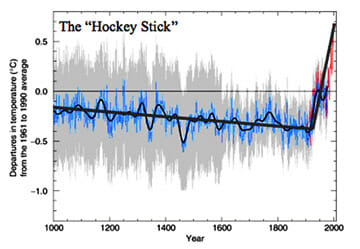
Most folks even slightly acquainted with the climate debate have seen Dr. Mann's hockey stick. It is a historical temperature reconstruction using proxies such as the width of tree rings.
There were a zillion problems with this analysis, which I and many covered years ago and, frankly, I am past my tolerance in reiterating once again. Just to name three:
The inflection of the hockey stick occurs right where two completely different data sets - proxies and actual thermometer readings -- have been grafted together, leading one to wonder if the inflection is a real natural phenomenon or instead related to differences in how the data was gathered
The blue line, of the proxy data, ends in 1950. The reason for that is that the proxy data actually shows temperatures falling since 1950. This does not mean that temperatures actually fell - we are sure they have risen -- it means that the proxies are not very good proxies. If they are not following temperatures well in the last 50 years, why do we think they mirrored temperatures well in the 1000 years before that?
As Steve McIntyre showed, while Mann used many proxies, his statistical method basically over-weighted a single data set from bristlecone pines in California and used techniques that were shown later to generate hockey sticks even from random noise.
Anyway, you can search Google and spend most of the day reading critiques and defenses of Mann.
But I think a lot of laymen missed the point of the analysis. Folks want to say that the hockey stick proves we have a big current spike in temperatures -- ie they focus on the blade of the hockey stick. But we already knew from surface temperature records that world temperatures have risen perhaps 0.8C over the last century. And besides, as mentioned above, Mann's proxy data does not even confirm or support the current working.
No, the "insight" of the hockey stick analysis was the handle -- the fact that until 1900, Mann was essentially claiming that temperatures had been 1) dead flat with limited variation and 2) consistently well below current temperatures. Prior to Mann's analysis, most scientists had a picture of past climate that had a warm period from 1000-1300 that was perhaps as warm as it is today followed by a cold period (called the medieval warm period and the little ice age). Most of this was based on historical analysis. Go to your local university and find a medieval historian. Going forward, universities will probably not teach any European history any more, but you probably can find a few old folks still hanging on via tenure. I took an audio course from Philip Daileader of William and Mary and he started his course on the high middle ages (1000-1300) by saying the most important fact of that period was the demographic expansion allowed in part by a warm and favorable climate. The warm climate allowed more food production as new areas, particularly in the north, could be brought into production. In turn, after 1300, Europe was met with a cooler and wetter climate that created a horrible famine in the 1320's, which in turn likely weakened the population and made the black death a few decades later all the worse. Later on, we have records of canals and rivers freezing across Europe that almost never freeze today. This colder period lasted until the early 19th century (I use 1812 as a break as I think of the freezing Russian winter of that year that sent Napoleon home without most of his army). Temperatures and sea levels began rising after that, long before man was burning fossil fuels in earnest.
This historical picture, shared by pretty much everyone until 20 years ago, was overturned by Mann. Look at his chart - no warm period in the middle ages, and no substantially colder period just afterwards. How did he refute the historical evidence, which is robust? He waved this evidence off as limited to Western Europe. Which was sort of funny, because most of his proxy data came from an even smaller area, the mountains east of Bishop, CA**.
So all this is a leadup to a new study out of China looking at temperature proxies for China. And it turns out China, which is on the other side of the world from the west (I know that because when Bugs Bunny digs straight down he always comes out in China), has pretty much the same temperature history everyone before Michael Mann thought we had in Europe.
**postscript: If you have a sports car, and want to drive a curving mountain road that does not have a lot of big cliffs and has pretty much zero other cars to get in the way, you might try Highway 168 from near Bishop up towards the ancient bristlecone pine forest.
You are likely aware that the US, and many other countries, are spending billions and billions of dollars on climate research. After drug development, it probably has become the single most lucrative academic sector.
Let me ask a question. If you were concerned (as you should be) about lead in soil and drinking water and how it might or might not be getting into the bloodstream of children, what would you spend money on? Sure, better treatments and new technologies for filtering and cleaning up lead. But wouldn't the number one investment be in more and better measurement of environmental and human lead concentrations, and how they might be changing over time?
So I suppose if one were worried about the global rise in temperatures, one would look at better and more complete measurement of these temperatures. Hah! You would be wrong.
There are three main global temperature histories: the combined CRU-Hadley record (HADCRU), the NASA-GISS (GISTEMP) record, and the NOAA record. All three global averages depend on the same underlying land data archive, the Global Historical Climatology Network (GHCN). Because of this reliance on GHCN, its quality deficiencies will constrain the quality of all derived products.
The number of weather stations providing data to GHCN plunged in 1990 and again in 2005. The sample size has fallen by over 75% from its peak in the early 1970s, and is now smaller than at any time since 1919.
Well, perhaps they have focused on culling a large poor quality network into fewer, higher quality locations? If they have been doing this, there is little or no record of that being the case. To outsiders, it looks like stations just keep turning off. And in fact, by certain metrics, the quality of the network is falling:
The collapse in sample size has increased the relative fraction of data coming from airports to about 50 percent (up from about 30 percent in the 1970s). It has also reduced the average latitude of source data and removed relatively more high-altitude monitoring sites.
Airports, located in the middle of urban centers by and large, are terrible temperature measurement points, subject to a variety of biases such as the urban heat island effect. My son and I measured over 10 degrees Fahrenheit different between the Phoenix airport and the outlying countryside in an old school project. Folks who compile the measurements claim that they have corrected for these biases, but many of us have reasons to doubt that (consider this example, where an obviously biased station was still showing in the corrected data as the #1 warming site in the country). I understand why we have spent 30 years correcting screwed up biased stations because we need some stations with long histories and these are what we have (though many long lived stations have been allowed to expire), but why haven't we been building a new, better-sited network?
Ironically, there has been one major investment effort to improve temperature measurement, and that is through satellite measurements. We now use satellites for official measures of cloud cover, sea ice extent, and sea level, but the global warming establishment has largely ignored satellite measurement of temperatures. For example, James Hansen (Al Gore's mentor and often called the father of global warming) strongly defended 100+ year old surface temperature measurement technology over satellites. Ironically, Hansen was head, for years, of NASA's Goddard Institute of Space Studies (GISS), so one wonders why he resisted space technology in this one particular area. Cynics among us would argue that it is because satellites give the "wrong" answer, showing a slower warming rate than the heavily manually adjusted surface records.
Bret Stephens has initiated a huge storm on the Left as journalists and other Leftwing luminaries have fallen over themselves to make sure everyone understands how evil and absolutely unacceptable Stephens' article is. A good example is probably "This New York Times Article on Climate Change Is So F***ing Bad". I don't know where and how these things are announced, but apparently virtue-signaling on the Left offcially requires that everyone denounce the article as the most evil thing ever written (actually reading it is apparently optional).
But you will almost never see much of Stephens article quoted. Here is the entirety of the article that discusses climate. This is all there is (there are other discussions that are meant to be a parable somewhat relevant to the climate debate, but below is the entirety of what Stephens writes directly about climate:
Let’s turn to climate change.
Last October, the Pew Research Center published a survey on the politics of climate change. Among its findings: Just 36 percent of Americans care “a great deal” about the subject. Despite 30 years of efforts by scientists, politicians and activists to raise the alarm, nearly two-thirds of Americans are either indifferent to or only somewhat bothered by the prospect of planetary calamity.
Why? The science is settled. The threat is clear. Isn’t this one instance, at least, where 100 percent of the truth resides on one side of the argument?
Well, not entirely. As Andrew Revkin wrote last year about his storied career as an environmental reporter at The Times, “I saw a widening gap between what scientists had been learning about global warming and what advocates were claiming as they pushed ever harder to pass climate legislation.” The science was generally scrupulous. The boosters who claimed its authority weren’t.
Anyone who has read the 2014 report of the Intergovernmental Panel on Climate Change knows that, while the modest (0.85 degrees Celsius, or about 1.5 degrees Fahrenheit) warming of the Northern Hemisphere since 1880 is indisputable, as is the human influence on that warming, much else that passes as accepted fact is really a matter of probabilities. That’s especially true of the sophisticated but fallible models and simulations by which scientists attempt to peer into the climate future. To say this isn’t to deny science. It’s to acknowledge it honestly.
By now I can almost hear the heads exploding. They shouldn’t, because there’s another lesson here — this one for anyone who wants to advance the cause of good climate policy. As Revkin wisely noted, hyperbole about climate “not only didn’t fit the science at the time but could even be counterproductive if the hope was to engage a distracted public.”
Let me put it another way. Claiming total certainty about the science traduces the spirit of science and creates openings for doubt whenever a climate claim proves wrong. Demanding abrupt and expensive changes in public policy raises fair questions about ideological intentions. Censoriously asserting one’s moral superiority and treating skeptics as imbeciles and deplorables wins few converts.
None of this is to deny climate change or the possible severity of its consequences. But ordinary citizens also have a right to be skeptical of an overweening scientism. They know — as all environmentalists should — that history is littered with the human wreckage of scientific errors married to political power.
Ten years ago I would have thought this so milquetoast as to be uncontroversial to anyone -- almost unpublishable as an editorial due its shear lack of controversy. He acknowledges warming, acknowledges some is man-made, states that some activists have gone beyond the science in their claims, and that climate action folks tend to be hostile to anything but ardent agreement (an attitude not really consistent with "science"). In response, ironically, virtually the entire Left has responded to this mildest of mild criticisms by treating Stephens as the next incarnation of Joseph Goebbels. Apparently he was spot-on about the lack of tolerance for any debate or disagreement.
This reminds me when my speech on global warming was banned from a conference by representatives of the City of Los Angeles. I remember writing to them:
Apparently, several folks on this board were calling me a climate denier and a flat Earther. Now, it seems kind of amazing that a presentation that calls for a carbon tax and acknowledges 1-1.5 degrees C of man-made warming per century could be called an extremist denier presentation. But here is the key to understand -- my bet is that not one of you in opposition has ever bothered to see it. This despite the fact that I sent your organization both a copy of the CMC video linked above as well as this very short 4-page summary from Forbes. But everyone involved seems more willing to spend hours and hours arguing that I am a child of Satan than they were willing to spend 5-minutes acquainting themselves with what I actually say. (By the way, at this point you probably should not look at this material, as all it will do is embarrass you because I am positive that it is nothing like what you expected)
In fact, I would be willing to bet that the folks who were most vociferous in their opposition to this talk have never actually read anything from a lukewarmer or a skeptic. It is a hallmark of modern public discourse that people frequently don't know the other side's argument from the other side itself, but rather from its own side. This is roughly equivalent to knowing about Hillary Clinton's policy positions solely from listening to Rush Limbaugh. It is a terrible way to be an informed adult participating in public discourse, but unfortunately it seems to be a practice that is increasingly common, and in fact encouraged by most universities, which have become echo chambers of conventional thought rather than real institutions of learning.
I am at an impasse. Here is my dilemma: I don't know if the media is purposely obfuscating the climate debate or whether they are just ignorant and scientifically illiterate. For now, because I am a happy soul that does not like making dark assumptions about other people's motivations, so I am going to give the media the benefit of the doubt and just assume they are ignorant. But it is getting harder to reach this conclusion, because for it to be ignorance, it has to be serial ignorance lasting many years and crossing thousands of people.
The other day, in response to an article at Skeptical Science, I wrote about the typical media myths in the climate debate that make actual conversation about the theory so difficult. The first one I listed was this:
"Climate deniers are anti-science morons and liars because they deny the obvious truth of warming from greenhouse gasses like CO2"
In fact, if you read the article, most of the prominent climate skeptics (plus me, as a non-prominent one) totally accept greenhouse gas theory and that CO2, acting alone, would warm the Earth by 1-1.2C. What we are skeptical of is the very net high positive feedbacks (and believe me, for those of you not familiar with dynamic systems analysis, these numbers are very large for stable natural systems) assumed to multiply this initial warming many-fold.
This is just tremendously frustrating, in part because climate alarmists (at least in the media) don't seem to understand their own theory. I constantly have to patiently explain that the theory of catastrophic man-made global warming (or climate change if you prefer) is a two part theory, and that warming forecasts are based on two independent chained theories: First, CO2 acting as a green house gas incrementally warms the earth and second, large net positive feedbacks in the Earth's climate multiply this initial warming many times. The majority of the warming actually comes from the second theory, not greenhouse gas theory, but every time I am in a debate or interview situation one of the early questions is "how can you deny greenhouse gas theory, it is settled science?" This is what I call the climate bait and switch -- skeptics have issues with the second theory but the media and climate alarmists only want to argue about the first.
In a CNBC interview, the host asked, “Do you believe that it’s been proven that CO2 is the primary control knob for climate?” Pruitt answered: “No, I think that measuring with precision human activity on the climate is something very challenging to do, and there’s tremendous disagreement about the degree of impact. So no, I would not agree that it’s a primary contributor to the global warming that we see. But we don’t know that yet. We need to continue the debate and continue the review and the analysis.”
This is a pretty reasonable answer. It is simply absurd to argue that CO2 (at a current atmospheric concentration of 0.04%) is the "primary control knob for climate". CO2 is obviously part of a large and complex equation with many, many variables, but calling it the primary control knob is like saying that the sugar industry is the primary control knob for the US economy.
But back to the issue of the climate bait and switch. Here is NPR responding to Pruitt's comments. Can you guess what they say?
Those statements are at odds with an overwhelming body of scientific evidence showing that humans are causing the climate to warm by releasing CO2 into the atmosphere. The view that CO2 is a major heat-trapping gas is supported by reams of data, included data collected by government agencies such as NASA and the National Oceanic and Atmospheric Administration.
Greenhouse gas theory is settled science! But Pruitt has never, in anything I have read, disagreed with greenhouse gas theory. He just thinks the effects have been exaggerated. But here is the media, yet again, ignoring the actual arguments of skeptics and trying to recast their position as denying greenhouse gas theory. The media sets up this false dichotomy that either you accept that CO2 is "the primary control knob of climate" or you deny CO2 is a greenhouse gas at all. They allow no intermediate position, despite the fact that both of these choices are scientifically absurd.
Mr. Tracinski goes on to make the same point I often make, so I will let him do it in his own words since I don't seem to have any success explaining it:
The question is not whether carbon dioxide is a greenhouse gas. The question is whether it is the “primary control knob for the climate.” The question is whether it is the greenhouse gas, the one factor that dominates all other factors.
There is good reason for skepticism. For one thing, just on the “basic science,” Pruitt is absolutely correct. Carbon dioxide is a greenhouse gas, but it is not the most powerful greenhouse gas, by a long shot. Water vapor is far more effective at trapping heat and releasing it back to the atmosphere, primarily because it absorbs a lot more radiation in the infrared spectrum, which is released as heat.
That’s why all of the climate theories that project runaway global warming use water vapor to juice up the relatively small impact of carbon dioxide itself. They posit a “feedback loop” in which carbon dioxide increases temperatures, which increases the amount of water vapor in the atmosphere, which increases temperatures even more. These models need a more powerful greenhouse gas to magnify the effect of carbon dioxide.
But does it really work that way? By how much does water vapor magnify the impact of carbon dioxide? And is that effect dampened by other factors? Consider cloud formation: more water in the atmosphere means more clouds, which reflect sunlight back into space and have a cooling effect that counteracts the warming effect. But by how much?
The answer is that nobody really knows. There are varying estimates for “climate sensitivity,” that is, how sensitive global temperatures are to increases in carbon dioxide. They range from a relatively trivial impact—less than one degree Celsius warming from a doubling of atmospheric carbon dioxide—to more than five degrees.
I really wasn't going to do much with this Skeptical Science post by Rob Honeycutt called "Correcting Warren Meyer on Forbes," but several readers have asked me about it and it's Friday and I am sort of bored in the office so here goes. I may skip parts of his critique. That does not necessarily mean I agree with it, but several sections of this article are just so trivial (let's defend Al Gore!) that it is hard to work up any energy about it. As reference, my original article published back in 2012 is here.
Dammit Meyer, You Changed The Words to the Doxology!
The author begins his critique this way:
Mr. Meyer opens with a misleading attempt to frame the issue as a debate on "catastrophic man-man global warming theory." This approach conflates two very distinct elements of the science on anthropogenicclimate change. Nowhere in the published scientific literature can you find the phrase he uses. When I did a search on this term in Google Scholar, what did I find? Mr. Meyer's Forbes article. Also searching "catastrophic man-made climate change" I get a smattering of non-research related materials coming from people who rejecting human influence on climate. Meyer has formed a completely irrelevant and fabricated framing of the issue for the basis of his discussion.
In Mr. Meyer's article he claims this is the "core theory" and states that he will use the IPCC as the primary source for this, even though there is no place where the IPCC frames climate change in this manner.
Hey, thanks for making my point! I always start climate discussions by saying that supporters of climate action are frequently sloppy with the way they frame the debate. They use phrases like "climate denier" for folks like me which make no sense, since I don't deny there is a climate. Clearly "climate denier" is a shortcut term for my denying some other more complex proposition, but what proposition exactly? Merely saying "global warming" as a proposition is sloppy because it could include both natural and manmade effects. Climate change is even sloppier (I would argue purposely so) because it obscures the fact that deleterious effects from anthropogenic CO2 must be via the intermediate stage of warming (i.e. there is no theory that CO2 causes hurricanes directly).
With this in mind, I begin nearly every discussion of climate change by doing what many proponents of climate action fail to do -- I am very precise about the proposition I am going to discuss. It's not just global warming, it's man-made global warming. And since the climate alarmists are urging immediate action, it is not just man-made global warming but it is catastrophic man-made global warming, ie man-made global warming with negative effects so severe it requires urgent and extensive actions to circumvent. I think that is a very fair reading of what folks like James Hansen have in mind (if he does not think it will be catastrophic, why is he getting arrested in front of power plants?) The fact that Google searches do not yield these precise terms but rather yield millions of hits for meaningless phrases like "climate denier" just go to support one of the themes of my original piece, that the climate debate is made much muddier by the sloppy framing of the issues in the media.
However, while Mr. Honeycutt criticizes my framing as non-canon, he offers no specific critiques of how the phrase "catastrophic man-made global warming" might be wrong and offers no alternative framing. I really do try to pass Bryan Caplan's ideological Turing test on this stuff, so I am interested -- if advocates for climate action do not think "Catastrophic Man-Made Global Warming" is a fair statement of their theory, what would they use instead?
So Is Feedback a Critical Assumption or Not?
I really don't want to repeat my article, but it is useful to understand my thesis: Catastrophic Man-Made Global Warming Theory is actually a two-part theory, with two chained steps. In the first, CO2 (and methane and other stuff) act as greenhouse gasses and incrementally warm the planet (about 1-1.2C per doubling of CO2 levels). In the second step, via a second theory unrelated to greenhouse gas theory, the initial warming from greenhouse gasses is multiplied several times by positive feedbacks that dominate the Earth's climate system, up to the IPCC's estimate of 3-5 C per doubling. Most of the projected warming in forecasts, such as those from the IPCC, are actually from this second step. My position is that I largely agree with the first step, which is well understood, but believe there is little real understanding of the second, that feedbacks could be net positive or negative, and that scientists either over-estimate their certainty on feedbacks or, more commonly, bury the feedback assumptions and don't even talk about them in public.
As an aside, I have presented this in front of many climate scientists and no one has really disputed that my summary of the logic is correct (they have of course disputed my skepticism with the feedback number). In fact Wikipedia, no climate denier, has this in their article about climate sensitivity:
CO2 climate sensitivity has a component directly due to radiative forcing by CO2, and a further contribution arising from climate feedbacks, both positive and negative. "Without any feedbacks, a doubling of CO2 (which amounts to a forcing of 3.7 W/m2) would result in 1 °C global warming, which is easy to calculate and is undisputed. The remaining uncertainty is due entirely to feedbacks in the system, namely, the water vapor feedback, the ice-albedo feedback, the cloud feedback, and the lapse rate feedback";[12] addition of these feedbacks leads to a value of the sensitivity to CO2 doubling of approximately 3 °C ± 1.5 °C, which corresponds to a value of λ of 0.8 K/(W/m2).
In a critique, I would expect someone to say, "your description of the theories is wrong because of X" or "I agree with your basic description of the theories but think there are good reasons why we expect feedbacks to be strongly positive". But this is what we get instead from Mr. Honeycutt
New errors pop up when trying to describe this "theory" where he attempts to describe water vapor feedbacks. He states that the IPCC "assumed" a strong positive feedbackfrom water vapor. The IPCC doesn't assume anything. The IPCC is a collection of leading experts in their fields who ware painstakingly cataloguing the scientific research. Meyer also makes an error suggesting the IPCC "just add" 2-4°C onto the 1°C for CO2 warming. Such figures, again, are completely manufactured by Meyer. They don't jibe with climate sensitivity figures and he provides no reference to what he means with figures like these.
The IPCC actually produces graphs such as the following to quantify forcings on the climate system, which also very clearly indicate levels of scientific understanding and uncertainty ranges.
He follows with a IPCC chart that showing forcing number estimates for different atmospheric components and the range of IPCC climate sensitivity forecasts, then says
By comparison, the IPCC and research scientists take the uncertainties involved with climateforcings and feedbacks very seriously. They clearly quantify and document them. The net result of the research suggests that our climate's sensitivity to forcing centers around 3°C for doubling CO2 concentrations. The low end probability is ~1.5°C, and the IPCC clearly state that anything lower than this is highly improbable.
My first thought is a snarky one, that it is interesting to see someone from a site with the word "skeptical" in the title go in for such a full-bore appeal to authority. But to the substance, I am certainly familiar with all the IPCC forcing charts, and what is more, that these charts include a self-assessment by the IPCC about how confident they are in their estimates. Since that self-assessment never is supported by any methodology or analysis in the reports, or any neutral third-party review, I take it with a grain of salt.
But to the rest, if one wants to discuss climate change with a lay audience, it is not wildly useful to start spewing out forcing numbers that have little meaning to the reader, and which the reader has no ability to connect to what they really care about, ie how much temperatures may rise.
More tellingly, though, after I spend most of my article discussing how the media frequently merges the effects of greenhouse gasses acting alone with the effects of feedbacks in the system that multiply or reduce these direct effects, Mr. Honeycutt does just that, offering forcing numbers that, if I read them correctly, include both direct effects and feedback multipliers.
The reason why it is useful to separate the direct warming effect from CO2 from the follow-on effects of feedback multipliers is the level of certainty we have in assessing their values. We can figure out pretty precisely the absorption and reradiation characteristics of CO2 in a laboratory. We can't do anything similar with feedbacks -- they must be inferred using various (all to-date imperfect) approaches to isolating feedback effects from everything else in the climate. An example from another field might be useful. Let's say we want to know the economic effect of hosting the Superbowl in Phoenix. It is pretty easy to measure the direct effects, like the money spent on tickets for the event. But when we look at the total system, things get really hard. Sure we had people come in spending money on the Superbowl, but maybe we had fewer tourists doing other things, or maybe increased spending at the Superbowl was offset by less spending at movies or amusement parks. We might compare that day's revenues to other years, but other years might have had different weather, different population, and a million other small differences that affect the outcome. Sorting through all these literally millions of changing variables to get the net effect of hosting the Superbowl is hard (and in fact for the last Superbowl hosted in Arizona, academic groups have come up with a huge array of numbers that range all the way from highly positive to negative for the net economic effect). The one difference between this example and what scientists have to do to isolate effects of individual inputs to the climate system is that the climate problem is much harder.
In responding to Mr. Honeycutt, I cannot honestly tell if Mr. Honeycutt is refuting this formulation of the problem (ie incremental warming from greenhouse gas effects of CO2 is increased to much higher, catastrophic levels by a second theory that the earth is dominated by strong positive feedbacks) or merely disputing my assertion that the second half of this proposition is not well-proven.
Missing the Point on Past Temperatures
Mr. Honeycutt has a number of problems with my discussion of past temperatures. First, he doesn't like my saying that warming from pre-industrial times was 0.7C. Mea culpa, it was probably 0.8C when I wrote the article. He also does not like the satellite temperature measurement, because it measures temperatures in the lower troposphere (a couple miles up in the atmosphere) rather than at the surface. He is absolutely correct, but you know what? I am skeptical of both land and space data sets. They both have their flaws. Land surface temperatures, especially near the poles and in places like Africa, are widely spaced requiring a lot of interpolation. They are also subject to a number of biases, such as from changing land use and urbanization. Satellite data tends to cover larger swaths of the Earth, but have to be corrected for orbital decay and other satellite aging factors. And as the author mentioned, they measure temperatures in the lower troposphere rather than the surface. However, since the IPCC says that the most warming from greenhouse gasses should be in the lower troposphere, even greater than the warming on the surface, satellites strike me as a useful tool to look for a global warming signal. That is why I always use both. (As an aside, Mr. Honeycutt departs from his appeals to IPCC authority by advocating two land surface data sets NOT chosen by the IPCC as their lead data set -- I use the Hadley CRUT4 because this is what the IPCC uses as their gold standard).
But all this misses the point of why I introduced past temperatures in the first place. My thesis was that past warming was not consistent with high CO2 temperature sensitivity numbers. I used charts in the article but I can repeat the logic simply here. Sensitivity numbers in the IPCC are the warming expected per doubling of CO2 levels. Since pre-industrial times we have increased global CO2 concentrations from about 270ppm (or 0.0270%) to about 405 ppm. This increase of 135pp from 270ppm is conveniently (for the math) about 50% of a doubling. Because the ratio between concentration and temperature is logarithmic, at 50% of a doubling we should see 57% of the doubling effect. So for an IPCC sensitivity of 3C per doubling, since pre-industrial times we should have seen a warming of .57 x 3 = 1.7C. We are nowhere close to this, even if every tenth of degree of warming over the last 100 years was man-made (a proposition with which I would disagree). At the high end of the IPCC range, around 5C, we would have had to see 2.85C of warming to date. At the low end of 1.5C, which the author calls unlikely, we would have seen about 0.86C of historical warming. If one argues that manmade warming is only about half the past warming, then the sensitivity would have to be less than 1C (by the way, this disconnect only gets larger if one considers greenhouse gasses other than CO2).
There are plenty of potential arguments one could counter with. One could argue that time delays are really long or that man-made aerosols are masking past warming -- and we could have a nice back and forth on the topic. Instead we just get printouts from models. Seriously, is that how skeptical folks approach science, accepting black box model output that embodies hundreds or even thousands of potential GIGO assumptions and inputs? I would love someone to show me in a sort of waterfall chart how one gets from 1.7C of expected warming from 270-405ppm to Hadley CRUT4 actual warming around 0.8C. Doesn't anyone feel the need to reconcile their forecasts to actual observations?
There are really good reasons to distrust models. If Donald Trump wanted to invest $100 million in building new military bases, and said that he had a computer model from experts with graphs that show the plan will grow GNP by a trillion dollars, would you automatically accept the model? If GNP only grew by $200 million instead of by a trillion, would you want a reconciliation and explanation?
There are also good reasons to distrust climate models and forecasts. James Hansen's models he used in his famous testimony in front of Congress in 1988 over-predicted warming rates by quite a bit (full explanation here). Since people argue endlessly over this chart about how to center and zero the graphs, it is much easier just to look at implied warming rates:
Even the IPCC finds itself questioning its past warming forecasts:
These forecast failures are not meant as proof the theory is wrong, merely that there is good reason to be skeptical of computer model output as somehow the last word in a debate.
Actually, Missing the Whole Point of the Article
I had naively thought that the title of the article "Understanding the Global Warming Debate" (rather than, say, "Climate Alarmists Are Big Fat Liars") might be a clue I was trying outline the terms of the debate and the skeptic position in it rather than put a detailed dagger through the heart of, say, climate models.
I wrote this article based on my extreme frustration in the climate debate. I have no problem with folks disagreeing with me - in enjoy it. But I was frustrated that the skeptic argument was being mis-portrayed and folks were arguing about the wrong things. Specifically, I was frustrated with both of these two arguments that were frequently thrown in my face:
"Climate deniers are anti-science morons and liars because they deny the obvious truth of warming from greenhouse gasses like CO2"
In fact, if you read the article, most of the prominent climate skeptics (plus me, as a non-prominent one) totally accept greenhouse gas theory and that CO2, acting alone, would warm the Earth by 1-1.2C. What we are skeptical of is the very net high positive feedbacks (and believe me, for those of you not familiar with dynamic systems analysis, these numbers are very large for stable natural systems) assumed to multiply this initial warming many-fold. Of all the folks I have talked to in the past, perhaps less than 1% were familiar with the fact that warming forecasts were a chain of not one but two theories, both greenhouse gas theory and the theory that the Earth's atmosphere is dominated by strong net positive feedbacks. Even if the audience does not choose to agree with my skepticism over feedback levels, isn't this education of the public about the basic theory useful? The author accuses me of purposeful obfuscation, but for those of us who are skeptical, it is odd that alarmists seem to resist discussing the second part of the theory. Could it be that the evidence for strong positive feedbacks dominating the Earth's long-term-stable greenhouse gas theory is not as strong as that for greenhouse gas theory? Evidence for high atmospheric positive feedbacks simply HAS to be weaker than that for greenhouse gas theory, not only because they have been studied less time but more importantly because it is orders of magnitude harder to parse out values of feedbacks in a complex system than it is to measure the absorption and emission spectrum of a gas in a laboratory.
"Climate deniers are anti-science morons and liars because there is a 97% consensus behind global warming theory.
Well, studies have shown a 97% agreement on .. something. This comes back to the first part of this post. If one is sloppy about the proposition being tested, then it is easier to get widespread agreement. The original study that arrived at the 97% number asked two questions -- "do you think the world has warmed in the last century" and "do you think a significant part of this warming has been due to man". 97% of scientists said yes. But I, called a climate denier, would have said yes to both as well. Alarmists attempt to shut off debate with skeptics by siting 97% agreement with propositions that have little or nothing to do with skeptics' arguments. Try asking a large group of scientists if they think that the world will warm 3C per doubling of CO2 levels, the proposition with which I disagree, and I guarantee you are not going to get anywhere near 97%. This is simply a bait and switch.
I will conclude with his conclusion:
Meyer ends with an unjustifiable conclusion, stating:
So this is the real problem at the heart of the climate debate — the two sides are debating different propositions! In our chart, proponents of global warming action are vigorously defending the propositions on the left side, propositions with which serious skeptics generally already agree. When skeptics raise issues about climate models, natural sources of warming, and climate feedbacks, advocates of global warming action run back to the left side of the chart and respond that the world is warming and greenhouse gastheory is correct. At best, this is a function of the laziness and scientific illiteracy of the media that allows folks to talk past one another; at worst, it is a purposeful bait-and-switch to avoid debate on the tough issues.
The positions he's put forth in this article are the epitome of lazy analysis and scientific illiteracy. He's bizarrely framed his entire discussion attempting to attack the positions of the IPCC, a body composed of the world's leading researchers, as being scientifically illiterate. One has to ask, from where does his own "literacy" if not from leading climateresearchers? It's certainly not based in the available published research which the IPCC reports are based on.
In this, perhaps he's inadvertently answering his own questions in a manner that he would prefer to reject. What are "skeptics" denying? Answer: The scientific research.
Well, first, I would advise him to work on his reading comprehension scores. I called the media scientifically illiterate, not the IPCC and researchers. The basic framework of greenhouse gas incremental warming multiplied many times by assumed positive net feedbacks is in the scientific literature and the IPCC -- my frustration is that the feedback theory seldom enters the public debate and media articles, despite the fact that the feedback theory is the source of the majority of projected warming and is the heart of many climate skeptic's criticisms of the theory.
And with that, the "skeptical science" article ends with an appeal to authority.
Postscript: Thinking about it more, at some level I find this article weirdly totalitarian, particularly the last paragraph where I am described as doing nothing but polluting the climate discussion. Here he writes:
Forbes is a very high profile publication and thus someone there, at Forbes, decided that it was fine and well to give this person an internet soapbox to promote a position rejecting the climate science which he has absolutely no expertise. He is not genuinely adding to the discussion on climate change but is being placed into a position as someone to listen to. Meyer is polluting the discussion with misinformation and poor analysis which has no bearing on the actual issue of climate change. And thanks to Google, these types of discussions, lacking in any substance, are given equal weight to actual science due to the traffic they generate.
This seems an oddly extreme response to someone who:
agrees in the linked article that the world has warmed over the last century
agrees in the linked article that a good chunk of that warming is due to manmade CO2
agrees in the linked article that CO2 acting as a greenhouse gas will increase temperatures, acting alone, by about 1-1.2C per doubling
but disagrees on the magnitude of added warming from net feedback effects.
It seems that we have moved beyond "you are either with us or against us" and entered the realm of "you are either entirely with us on every single detail or you are against us".
Postscript #2: Something else has been bothering me about this critique and I think I can finally put it into words -- the critique is sort of science without thought, a regurgitation of the canon whenever I diverge from orthodoxy without actually considering the arguments presented.
Look, there are tens of thousands of people talking past each other on climate issues. One of the things I try to do, if nothing else to bring something new to the discussion, is try to reframe the discussion in more useful and accesible terms, often with different sorts of graphs. Sometimes these are useful reframings, and sometimes not, but I do know that in general I am a heck of a lot better at creating charts to communicate with a lay audience than is the IPCC or most of the prominent folks on either side of the climate debate. This is why getting feedback (as in this critique) that I use different words to summarize the issue or that I do not use the standard charts everyone else xeroxes out of the IPCC reports (as did Mr. Honeycutt) is not very helpful.
I just updated my climate presentation with data through December of 2016, so given "hottest year evah" claims, I thought I would give a brief update with the data that the media seldom ever provides. This is only a small part of my presentation, which I will reproduce for Youtube soon (though you can see it here at Claremont-McKenna). In this post I will address four questions:
Is the world still warming?
Is global warming accelerating?
Is global warming "worse than expected"?
Coyote, How Is Your Temperature Prediction Model Doing?
Is the world still warming: Yes
We will use two data sets. The first is the land surface data set from the Hadley Center in England, the primary data set used by the IPCC. Rather than average world absolute temperature, all these charts show the variation or "anomaly" of that absolute temperature from some historical average (the zero point of which is arbitrary). The theory is that it is easier and more accurate to aggregate anomalies across the globe than it is to average the absolute temperature. In all my temperature charts, unless otherwise noted, the dark blue is the monthly data and the orange is a centered 5-year moving average.
You can see the El Nino / PDO-driven spike last year. Ocean cycles like El Nino are complicated, but in short, oceans hold an order of magnitude or two more heat than the atmosphere. There are decadal cycles where oceans will liberate heat from their depths into the atmosphere, creating surface warming, and cycles where oceans bury more heat, cooling the surface.
The other major method for aggregating global temperatures is using satellites. I use the data from University of Alabama, Huntsville.
On this scale, the el nino peaks in 1999 and 2017 are quite obvious. Which method, surface or satellites, gets a better result is a matter of debate. Satellites are able to measure a larger area, but are not actually measuring the surface, they are measuring temperatures in the lower tropospehere (the troposphere's depth varies but ranges from the surface to 5-12 miles above the surface). However, since most climate models and the IPCC show man-made warming being greatest in the lower troposphere, it seems a good place to measure. Surface temperature records, on the other hand, are measuring exactly where we live, but can be widely spaced and are subject to a variety of biases, such as the urban heat island effect. The station below in Tucson, located in a parking lot and surrounded by buildings, was an official part of the global warming record until my picture became widely circulated and embarrassed them in to closing it.
This argument about dueling data sets goes on constantly, and I have not even mentioned the issues of manual adjustments in the surface data set that are nearly the size of the entire global warming signal. But we will leave these all aside with the observation that all data sources show a global warming trend.
Is Global Warming Accelerating? No
Go into google and search "global warming accelerating". Or just click that link. There are a half-million results about global warming accelerating. Heck, Google even has one of those "fact" boxes at the top that say it is:
It is interesting by the way that Google is using political advocacy groups for its "facts" nowadays.
Anyway, if global warming is so obviously accelerating that Google can list it as a fact at the top of its search page, it should be obvious from the data, right? Well let's look. First, here is the satellite data since I honestly believe it to be of higher quality than the surface records:
This is what I call the cherry-picking chart. Everyone can find a peak for one end of their time scale and a valley for the other and create whatever story they want. In economic analysis, to deal with the noise and cyclicality, one will sometimes see economic growth measured peak-to-peak, meaning from cyclical peak to the next cyclical peak, as a simple way to filter out some of the cyclicality. I have done the same here, taking my time period as about 18 years from the peak of the 1999 El Nino to 2017 and the peak of the recent El Nino. The exact data used for the trend is show in darker blue. You can decide if I have been fair.
The result for this time period is a Nino to Nino warming trend of 0.11C. Now let's look at the years before this
So the trend for 36 years is 1.2C per century but the trend for the last half of this is just 0.11C. That does not look like acceleration to me. One might argue that it may again accelerate in the future, but I cannot see how so many people blithely treat it as a fact that global warming has been accelerating when it clearly has not. But maybe its just because I picked those darn satellites. Maybe the surface temperatures show acceleration?
Nope. Though the slow down is less dramatic, the surface temperature data never-the-less shows the same total lack of acceleration.
Is Global Warming "Worse Than Expected"? No
The other meme one hears a lot is that global warming is "worse than expected". Again, try the google search I linked. Even more results, over a million this time.
To tackle this one, we have to figure out what was "expected". Al Gore had his crazy forecasts in his movie. One sees all kinds of apocalyptic forecasts in the media. The IPCC has forecasts, but it tends to change them every five years and seldom goes back and revisits them, so those are hard to use. But we have one from James Hansen, often called the father of global warming and Al Gore's mentor, from way back in 1988. His seminal testimony in that year in front of Congress really put man-made global warming on the political map. Here is the forecast he presented:
Unfortunately, in his scenarios, he was moving two different variables (CO2 levels and volcanoes) so it is hard to tell which one applies best to the actual history since then, but we are almost certainly between his A and B forecasts. A lot of folks have spent time trying to compare actual temperatures to these lines, but it is very hard. The historical temperature record Hansen was using has been manually adjusted several times since, so the historical data does not match, and it is hard to get the right zero point. But we can eliminate the centering issues altogether if we just look at slopes -- that is all we really care about anyway. So I have reproduced Hanson's data in the chart on the left and calculated the warming slopes in his forecast:
As it turns out, it really does not matter whether we choose the A or B scenario from Hansen, because both have about the same slope -- between 2.8C and 3.1C per century of warming from 1986 (which appears to be the actual zero date of Hansen's forecast) and today. Compare this to 1.8C of actual warming in the surface temperature record for this same period, and 1.2C in the satellite record. While we have seen warming, it is well under the rates predicted by Hansen.
This is a consistent result to what the IPCC found in their last assessment when they evaluated past forecasts. The colored areas are the IPCC forecast ranges from past forecasts, the grey area was the error bar (the IPCC is a bit inconsistent when it shows error bars, including error bands seemingly only when it helps their case). The IPCC came to the same result as I did above: that warming had continued but was well under the pace that was "expected" form past forecasts.
By the way, the reason that many people may think that global warming is accelerating is because media mentions of global warming and severe weather events has been accelerating, leaving the impression that things are changing faster than they truly are. I wrote an article about this effect here at Forbes. In that I began:
The media has two bad habits that make it virtually impossible for consumers of, say, television news to get a good understanding of trends
They highlight events in the tail ends of the normal distribution and authoritatively declare that these data points represent some sort of trend or shift in the mean
They mistake increases in their own coverage of certain phenomenon for an increase in the frequency of the phenomenon itself.
Coyote, How Is Your Temperature Prediction Model Doing? Great, thanks for asking
Ten years ago, purely for fun, I attempted to model past temperatures using only three inputs: A decadal cyclical sin wave, a long-term natural warming trend out of the little ice age (of 0.36 C per century), and a man-made warming trend really kicking in around 1950 (of 0.5C per century). I used this regression as an attribution model, to see how much of past warming might be due to man (I concluded about half of 20th century warming may be due to manmade effects). But I keep running it to test its accuracy, again just for fun, as a predictive tool. Here is where we are as of December of 2016 (in this case the orange line is my forecast line):
Still hanging in there: Despite the "hottest year evah" news, temperatures in December were exactly on my prediction line. Here is the same forecast with the 5-year centered moving average added in light blue:
Well, I got dis-invited yet again from giving my climate presentation. I guess I should be used to it by now, but in this case I had agreed to actually do the presentation at my own personal expense (e.g. no honorarium and I paid my own travel expenses). Since I was uninvited 2 days prior to the event, I ended up eating, personally, all my travel expenses. There are perhaps folks out there in the climate debate living high off the hog from Exxon or Koch money, but if so that is definitely not me, so it came out of my own pocket. I have waited a few days after this happened to cool off to make a point about the state of public discourse without being too emotional about it.
I don't want to get into the details of my presentation (you can see it here at Claremont-McKenna College) but it is called "Understanding the Climate Debate: The Lost Middle Ground" (given the story that follows, this is deeply ironic). The point of the presentation is that there is a pretty mainstream skeptic/lukewarmer position that manmade warming via greenhouse gasses is real but greatly exaggerated. It even suggests a compromise legislative approach implementing a carbon tax offset by reductions in some other regressive tax (like payroll taxes) and accompanied by a reduction in government micro-meddling in green investments (e.g. ethanol subsidies, solyndra, EV subsidies, etc).
I am not going to name the specific group, because the gentleman running the groups' conference was probably just as pissed off as I at the forces that arrayed themselves to have me banned from speaking. Suffice it to say that this is a sort of trade group that consists of people from both private companies and public agencies in Southern California.
Attentive readers will probably immediately look at the last sentence and guess whence the problem started. Several public agencies, including the City of Los Angeles, voiced EXTREME displeasure with my being asked to speak. The opposition, particularly from the LA city representative, called my presentation "the climate denier workshop" [ed note: I don't deny there is a climate] and the organizer who invited me was sent flat Earth cartoons.
Now, it seems kind of amazing that a presentation that calls for a carbon tax and acknowledges 1-1.5 degrees C of man-made warming per century could be called an extremist denier presentation. But here is the key to understand -- no one who opposed my presentation had ever bothered to see it. This despite the fact that I sent them both a copy of the CMC video linked above as well as this very short 4-page summary from Forbes. But everyone involved was more willing to spend hours and hours arguing that I was a child of Satan than they were willing to spend 5-minutes acquainting themselves with what I actually say.
In fact, I would be willing to bet that the folks who were most vociferous in their opposition to this talk have never actually read anything from a skeptic. It is a hallmark of modern public discourse that people frequently don't know the other side's argument from the other side itself, but rather from its own side (Bryan Caplan, call your office). This is roughly equivalent to knowing about Hillary Clinton's policy positions solely from listening to Rush Limbaugh. It is a terrible way to be an informed adult participating in public discourse, but unfortunately it is a practice being encouraged by most universities. Nearly every professor is Progressive or at least left of center. Every speaker who is not left of center is banned or heckled into oblivion. When a speaker who disagrees with the Progressive consensus on campus is let through the door, the university sponsors rubber rooms with coloring books and stuffed unicorns for delicate students. There are actually prominent academics who argue against free speech and free exchange of diverse ideas on the theory that some ideas (ie all the ones they disagree with) are too dangerous be allowed a voice in public. Universities have become cocoons for protecting young people from challenging and uncomfortable ideas.
I will take this all as a spur to do a next generation video or video series for YouTube -- though YouTube has started banning videos not liked by the Left, there is still room there to have a public voice. I just bought a nice new microphone so I guess it is time to get to work. I am presenting in Regina next week (high 22F, yay!) but after that I will start working on a video.
Postscript: You know what this reminds me of? Back when I was a kid, forty years ago growing up in Texas, from time to time there would be a book-banning fight in the state. Perhaps there still are such fights. Generally some religious group will oppose a certain classic work of literature because it taught some bad moral lesson, or had bad words in it, or something. But you know what often became totally clear in such events? That the vast vast majority of the offended people had not actually read the book, or if they had, they could not remember any of it. They were participating because someone else on their side told them they should be against the book, probably also someone else who had never even read the thing. But I don't think that was the point. The objective was one of virtue-signalling, to reinforce ties in their own tribe and make it clear that they did not like some other tribe. At some point the content of the book became irrelevant to how the book was perceived by both tribes -- which is why I call this "post-modern" in my title.
I have written about the horribly stupid but oddly appealing idea of solar roads many times before, most recently here. As a quick review, here are a few of the reasons the idea is so awful:
Even if they can be made to sort of work, the cost per KwH has to be higher than for solar panels in a more traditional installations -- the panels are more expensive because they have to be hardened for traffic, and their production will be lower due to dirt and shade and the fact that they can't be angled to the optimal pitch to catch the most sun. Plus, because the whole road has to be blocked (creating traffic snafus) just to fix one panel, it is far more likely that dead panels will just be left in place rather than replaced.
But the environmentalists are at it again, seem hell-bent on building solar roads with your tax money; (hat tip to a reader, who knew these solar road stories are like crack for me)
France has opened what it claims to be the world’s first solar panel road, in a Normandy village.
A 1km (0.6-mile) route in the small village of Tourouvre-au-Perche covered with 2,800 sq m of electricity-generating panels, was inaugurated on Thursday by the ecology minister, Ségolène Royal.
It cost €5m (£4.2m) to construct and will be used by about 2,000 motorists a day during a two-year test period to establish if it can generate enough energy to power street lighting in the village of 3,400 residents.
The choice of Normandy for the first solar road is an odd one, given that:
Normandy is not known for its surfeit of sunshine: Caen, the region’s political capital, enjoys just 44 days of strong sunshine a year
Wow, nothing like a 12% utilization to really bump up those returns on investment.
The article follows the first rule of environmental writing, which is to give the investment required or the value of the benefits, but never both (so the return on investment can't be calculated). This article follows this rule, by giving the investment but stating the benefits in a way that is impossible for the average person to put a value on, e.g. "enough energy to power street lighting in the village of 3,400 residents". Since we have no idea how well-lighted their streets are or how efficient the lighting is, this is meaningless. And by the way, they forgot to discuss any discussion of batteries and their cost if they really are going to run night-time lighting with solar.
But, the article does actually give something close to the numbers one would like to have to evaluate another similar investment, and oh boy are the numbers awful:
In 2014, a solar-powered cycle path opened in Krommenie in the Netherlands and, despite teething problems, has generated 3,000kWh of energy – enough to power an average family home for a year. The cost of building the cycle path, however, could have paid for 520,000kWh.
As a minimum, based on these facts, the path has been opened 2 years and thus generates 1500 kWh a year (though probably less since it likely has been open longer than 2 years). This means that this investment repays about 0.29 percent of its investment every year. If we ignore the cost of capital, and assume unlimited life of the panels (vs a more likely 5-10 years in this hard service) we get an investment payback period of only 347 years. Yay!
If you are worried about greenhouse gasses and global warming, then I have some Christmas advice for you. When you are done with your Christmas tree, do NOT take it to one of those "recycling" locations most towns have. The recycling process is typically chipping and mulching the trees, which just accelerates their decomposition into greenhouse gasses. If you are really concerned about catastrophic warming, you want to use your tree as a carbon sink. Have it shrink-wrapped in some sort of plastic what won't biodegrade and then landfill it -- the deeper it is buried, the better. Those folks trying to get you to "recycle" your tree are secretly in the pay of the Koch brothers and trying to trick you into ruining the environment.
There was a period of time -- now a decade ago at least -- when folks were actually willing to have debates on climate and I was invited to participate in a number of them. In several of these, fellow skeptics would try to mock alarmists by saying that cow farts are a big source of methane (a much stronger greenhouse gas than CO2) and thus alarmists were going to be regulating cow farts soon. On several time, I criticized my fellow skeptics, calling this both a conspiracy theory and a distraction from the real debate -- once someone says "cow farts" in a discussion, it is almost a lock that you will have a hard time getting back to serious science.
Well, sort of. In fact, even the California legislature is not really stupid enough to require that long vent hoses be hooked up to the rear ends of all the cows in the state. While you will hear this law derided as the cow fart legislation, it actually about cow poop -- specifically the collection of all the cow poop so it can be put into devices that contain and harvest the methane emissions from the poop.
What this is far more likely to be is not the cow fart or cow poop legislation, but the "send California's dairy business to other states" legislation.
There's no point trying to fight climate change - we'll all be dead in the next decade and there's nothing we can do to stop it, a visiting scientist claims.
Guy McPherson, a biology professor at the University of Arizona, says the human destruction of our own habitat is leading towards the world's sixth mass extinction.
Instead of fighting, he says we should just embrace it and live life while we can.
"It's locked down, it's been locked in for a long time - we're in the midst of our sixth mass extinction," he told Paul Henry on Thursday.
....
"I can't imagine there will be a human on the planet in 10 years," he says.
"We don't have 10 years. The problem is when I give a number like that, people think it's going to be business as usual until nine years [and] 364 days."
He says part of the reason he's given up while other scientists fight on is because they're looking at individual parts, such as methane emissions and the melting ice in the Arctic, instead of the entire picture.
"We're heading for a temperature within that span that is at or near the highest temperature experienced on Earth in the last 2 billion years."
Instead of trying to fix the climate, Prof McPherson says we should focus on living while we can.
"I think hope is a horrible idea. Hope is wishful thinking. Hope is a bad idea - let's abandon that and get on with reality instead. Let's get on with living instead of wishing for the future that never comes.
When some sort of "bad" phenomenon is experiencing a random peak, stories about this peak flood the media. When the same "bad" phenomenon has an extraordinarily quiet year, there are no stories in the media. This (mostly) innocuous media habit (based on their incentives) creates the impression among average folks that the "bad" phenomenon is on the rise, even when there is no such trend.
Case in point: tornadoes. How many stories have you seen this year about what may well be a record low year for US tornadoes?
Extreme lack of extreme with tornadoes. Will need "second season" to stop it from being quietest year on record! pic.twitter.com/PuBvgjJBvn
Postscript: By the way, some may see the "inflation-adjusted" term in the heading of the chart and think that is a joke, but there is a real adjustment required. Today we have doppler radar and storm chasers and all sorts of other tornado detection tools that did not exist in, say, 1950. So tornado counts in 1950 are known to understate actual counts we would get today and thus can't be compared directly. Since we did not miss many of the larger tornadoes in 1950, we can adjust the smaller numbers based on the larger numbers. This is a well-known effect and an absolutely necessary adjustment, though Al Gore managed to completely fail to do so when he discussed tornadoes in An Inconvenient Truth. Which is why the movie got the Peace prize, not a science prize, from the crazy folks in Oslo.
Apparently, the Left is opposing the initiative in part because
It turns out the carbon tax, for many on the Left, is more about increasing the size of government rather than really (or at least solely) for climate policy, and thus they do not like the revenue neutrality aspects. They see carbon taxes as one of the last new frontiers in new government revenue generation, and feel like it would be wasted to make it revenue neutral
The Greens have made common cause with the social justice warrior types, so they dislike the Washington initiative because it fails to allow various social justice and ethnic groups cash in.
Apparently, folks on both the Left and the Right actually like government picking winners and tinkering in individual subsidies and programs, such as funding various green energy and conservation initiatives. To me, that stuff is all a total waste and made irrelevant by a carbon tax, whose whole point is to allow markets to make the most efficient CO2 reduction choices, but looking at this election it would not be the first time the electorate was ignorant on basic economics.
There is a real disconnect here that it is important to understand. I don't think I really understood how many of us could use the term "carbon tax" but understand its operation in fundamentally different ways, but I think that is the case.
The authors of the law, like me, see the carbon tax as a pricing signal to efficiently change behaviors in the market around use of carbon-based fuels. The whole point of a carbon tax is to let individual actions and market forces shape how solutions are created. But the Left seems to see the carbon tax totally differently. They don't understand, or don't accept, the power of the pricing signal in the market, or else they would not say things like they want a "put a fee on emissions and reinvest that revenue in clean energy" -- the latter is a redundant and pointless government action if one accepts the power of the tax, since individuals will already be responding by making such investments. The Left instead sees the carbon tax as the source of a new kitty of money that then must be fought over in some sort of political process.
Check out this passage, and consider whether these folks are thinking of the carbon tax as a pricing signal or a source of new money to be spread around:
Either way, state social justice groups did not feel consulted. "Rather than engaging with these communities," wrote Rich Stolz and De'Sean Quinn of environmental justice group OneAmerica, "I-732 organizers patronized and ignored concerns raised by these stakeholders."
White people who work with other white people — and the white people who write about them — tend to slough off this critique. What matters, they insist, is the effect of the policy, not the historical accident of who wrote it down.
Bauman points to a set of policy demands posted by Black Lives Matter. Among them: "shift from sales taxes to taxing externalities such as environmental damage." Also: "Expand the earned income tax credit."
"Well," Bauman says, "we did both those things, right?"
But communities of color want more than for mostly white environmental groups to take their welfare into account. Most of all, affected groups want some say in what constitutes their welfare. "All of us want to be included from the beginning of any decision," says Schaefer. "We don't want to be told after the fact, ‘Hey, by the way, we decided all this stuff for you.’"
This tension within the climate movement has played out most recently in California, where low-income and minority groups have won substantial changes to the state’s climate law, ensuring that a larger portion of cap-and-trade revenue is directed to their communities. Given demographic changes sweeping the country — and climate funders’ newfound attention to building up the capacity of those groups — those tensions are unlikely to remain confined to the West Coast.
These folks see the carbon tax as a pool of money to fund a patronage system, and are thus scared that any groups not involved in crafting the legislation will be left out of the benefits of the patronage -- after all, that is how most programs from the Left are put together. The Obama stimulus program back in 2009 was such a patronage project, and those who were in on crafting it got windfalls, and those who were left out of the process had to pay for it all. Either the Left assume that everything works this way, even when it does not, or they want everything to work this way -- I don't know which.
One thing I do know is that I fear I am going to lose this argument in the future. Here is one way to look at it -- are more people graduating from college looking at the world through the lens of markets and economics and incentives or are more graduating structuring issues in terms of social justice and government authority?
After the Civil War, as settlers began to settle the drier lands of the western plains, they noticed that the low rainfall had started to increase. In what must be some impulse programmed into human behavior, folks at the time attributed this cyclical natural variation in climate to man's actions. The theory went that actually settling the land and overturning the sod brought more rain, encapsulated by the phrase "rain follows the plow".
The theory arose in the late 1860s and 1870s during the westward expansion of European-American settlement west of the Missouri River and across the 100th meridian west. The definition can be found in the Kansas Journey Textbook as well. This was the traditional boundary line between the humid and semi-arid portions of central North America. Specifically, in the early part of the decade, white settlement had spread into central and western Nebraska along the Platte River. Emigrants on the Oregon Trail began reporting that the land in western Nebraska, previously known for its yellowed, dry vegetation during the summer, had seemingly become green.
Out of this evidence, some scientists concluded that the apparent increase in rain was due to the settlement and the effects of cultivation. One of the most prominent exponents of the theory in the United States was Cyrus Thomas, a noted climatologist. After studying the recent history of Colorado, he concluded that the increase in moisture was permanent, and that it coincided exactly with the first settlers' cultivating of the land. Other prominent advocates of the theory were Ferdinand Vandeveer Hayden, the notedgeographer who had explored and surveyed parts of the Rocky Mountains of Colorado; Samuel Aughey, a professor at the University of Nebraska; and Charles Dana Wilber, an amateur scientist and author.
Thomas and other climatologists offered a variety of explanations for the theory. A common idea was that the plowing of the soil for cultivation exposed the soil's moisture to the sky. In addition, newly planted trees and shrubs increased rainfall as well, as did smokefrom trains, or even the metal in the rails or the telegraph wires. Another hypothesis stated that the increased vibrations in the atmosphere due to human activity created additional clouds, from which rain fell. This idea led to the widespread dynamiting of the air across the Great Plains in the 1870s.[3]
The theory was widely embraced in its day, not only by scientists, but land speculators and emigrants. Some historians have argued that the theory was embraced readily as an outgrowth of Manifest Destiny, the idea that the United States had a mission to expand, spreading its form of democracy and freedom. The theory is regarded as partially responsible for the rapid settlement of the Great Plains in the later 19th century. In 'The Great Valleys and Prairies of Nebraska and the Northwest', published in 1881, Charles Dana Wilber wrote:
In this miracle of progress, the plow was the unerring prophet, the procuring cause, not by any magic or enchantment, not by incantations or offerings, but instead by the sweat of his face toiling with his hands, man can persuade the heavens to yield their treasures of dew and rain upon the land he has chosen for his dwelling... ...The raindrop never fails to fall and answer to the imploring power or prayer of labor.[4]
William Gilpin, the first territorial governor of Colorado and an aide to President Abraham Lincoln, was a proponent of this theory. Gilpin was a strong believer in the idea of Manifest Destiny. One of his books was called The Mission of the North American People. He strongly promoted western settlement and invoked this theory as one of his reasons for people to migrate west.[5]
Climatologists now understand that increased vegetation and urbanization can result in increased precipitation. The effect, however, is local in scope, with increased rainfall typically coming at the expense of rainfall in nearby areas. It cannot result in a climatological change for an entire region. They also understand that the Great Plains had had a wetter than usual few seasons while this theory was developed and increasing settlement were both taking place. When normal arid conditions returned, homesteaders suffered
Postscript: This is even funnier, potentially, since given the size and design of those cooling towers, this is very likely a nuclear plant, which of course has no CO2 emissions at all.
Postscript #2: I tried a reverse image search to try to confirm my guess this is a nuclear plant. This is what Google returned:
That will give you some idea how often the media has used this stock image of water vapor to illustrate CO2 articles.
Michelle Minton on flawed government nutrition guidance and the science behind it:
Congress, of course, is an inherently political entity. And so when it — or any other government-appointed body — privileges one theory over another, it creates bias that trickles down to the research community. The problem is not simply that the government makes decisions on the basis of imperfect information, but that government intervention, itself, can distort the development of research.
For example, the theory that dietary fat plays a large role in cardiovascular disease was controversial in the scientific community, even as the government began relying on it to develop the first federal nutritional guidelines. In fact, a lot of the existing research contradicted it. Nevertheless, the theory flourished. Why? In part, no doubt, because researchers — many of whom rely on government grants — faced risks associated with bucking the new zeitgeist created by the government.
In Bloomberg, Megan McArdle gives me a nice link to my climate series that begins here. Some of you may wonder if I know about such things in advance. The answer is no. The only way I really knew was that I woke up in my little hotel in Bruges and fired up my email on my 300 baud hotel internet connection and found about 20 loooong emails wishing to discuss some aspects of climate in detail. Which I actually really enjoy, except that I was sort of unprepared for the deluge.
I will get back to everyone in time. I do enjoy the feedback, and consider myself pretty persuadable on climate topics.
PS- If you have not seen the movie "In Bruges", it is not particularly well-known but is a good film, imho.