Archive for the ‘Climate’ Category.

A Guide to the Global Warming Debate

My new column at Forbes is a post I have been thinking about and working on for quite a while, trying to refine over time a simple explanation of what is and is not understood in climate science.  This is how it begins, but I hope you will read it all

Likely you have heard the sound bite that “97% of climate scientists” accept the global warming “consensus”.  Which is what gives global warming advocates the confidence to call climate skeptics “deniers,” hoping to evoke a parallel with “Holocaust Deniers,” a case where most of us would agree that a small group are denying a well-accepted reality.  So why do these “deniers” stand athwart of the 97%?  Is it just politics?  Oil money? Perversity? Ignorance?

We are going to cover a lot of ground, but let me start with a hint.

In the early 1980′s I saw Ayn Rand speak at Northeastern University.  In the Q&A period afterwards, a woman asked Ms. Rand, “Why don’t you believe in housewives?”  And Ms. Rand responded, “I did not know housewives were a matter of belief.”  In this snarky way, Ms. Rand was telling the questioner that she had not been given a valid proposition to which she could agree or disagree.  What the questioner likely should have asked was, “Do you believe that being a housewife is a morally valid pursuit for a woman.”  That would have been an interesting question (and one that Rand wrote about a number of times).

In a similar way, we need to ask ourselves what actual proposition do the 97% of climate scientists agree with.  And, we need to understand what it is, exactly,  that the deniers are denying.   (I personally have fun echoing Ms. Rand’s answer every time someone calls me a climate denier — is the climate really a matter of belief?)

It turns out that the propositions that are “settled” and the propositions to which some like me are skeptical are NOT the same propositions.  Understanding that mismatch will help explain a lot of the climate debate.

Perfect for Climate Scientists

I propose a similar law for all climate scientists when they are presenting their computer model forecasts.  Actual legislation once proposed in New Mexico:

When a psychologist or psychiatrist testifies during a defendant’s competency hearing, the psychologist or psychiatrist shall wear a cone-shaped hat that is not less than two feet tall. The surface of the hat shall be imprinted with stars and lightning bolts. Additionally, a psychologist or psychiatrist shall be required to don a white beard that is not less than 18 inches in length, and shall punctuate crucial elements of his testimony by stabbing the air with a wand. Whenever a psychologist or psychiatrist provides expert testimony regarding a defendant’s competency, the bailiff shall contemporaneously dim the courtroom lights and administer two strikes to a Chinese gong…

In the case of New Mexico, this was meant as satire and eventually was removed from the final bill, but I think it would be a great adjunct for climate forecasts, better than a surgeon general’s warning.


Katrina Flashback

It is December, 2005.  The Gulf Coast had just been pounded, in succession, by Katrina, Rita, and Wilma.  Everyone was talking about how global warming seemed to be intensifying hurricanes.  In a speech just after Katrina, Al Gore said

 When the corpses of American citizens are floating in toxic floodwaters five days after a hurricane strikes, it is time not only to respond directly to the victims of the catastrophe but to hold the processes of our nation accountable, and the leaders of our nation accountable, for the failures that have taken place….

There are scientific warnings now of another onrushing catastrophe. We were warned of an imminent attack by Al Qaeda; we didn’t respond. We were warned the levees would break in New Orleans; we didn’t respond. Now, the scientific community is warning us that the average hurricane will continue to get stronger because of global warming. A scientist at MIT has published a study well before this tragedy showing that since the 1970s, hurricanes in both the Atlantic and the Pacific have increased in duration, and in intensity, by about 50 percent….

Two thousand scientists, in 100 countries, engaged in the most elaborate, well-organized scientific collaboration in the history of humankind, have produced long-since a consensus that we will face a string of terrible catastrophes unless we act to prepare ourselves and deal with the underlying causes of global warming….

At about the same time, the IPCC was in the process of preparing its fourth report, later released in 2007.  It said, in part:

Several peer-reviewed studies show a clear global trend toward increased intensity of the strongest hurricanes over the past two or three decades. The strongest trends are in the North Atlantic Ocean and the Indian Ocean. According to the 2007 Fourth Assessment Report of the Intergovernmental Panel on Climate Change (IPCC-AR4), it is “more likely than not” (better than even odds) that there is a human contribution to the observed trend of hurricane intensification since the 1970s. In the future, “it is likely [better than 2 to 1 odds] that future tropical cyclones (typhoons and hurricanes) will become more intense, with larger peak wind speeds and more heavy precipitation associated with ongoing increases of tropical [sea surface temperatures].”

So what happened?  Since Wilma in 2005, we have gone 6 full years without a category 3+ hurricane making landfall in the US, the longest span since 1900 without such an event.  And the clock is still counting.  When alarmists of all stripes were breathlessly predicting hurricane after hurricane in late 2005, the reality is that we wouldn’t see another in the US for  over six years.

Of course, US landfall is in fact a terrible indicator of hurricane activity.  Its relevant to us, but it is a pretty random metric.  I said this when there were a lot of landfalls and I say it again since there have been so few.

A better metric is accumulated cyclonic energy, a sort of time integral of all large cyclonic storms worldwide.  Here is the most recent ACE figures:

As it turns out, the total strength of hurricane and hurricane-like storms has been falling almost since the exact day of Al Gore’s speech in 2005 (another Gore effect!)  In fact, of late, it has hit numbers close to all-time lows.

Of course this chart will go back up some day, and then back down, and then up … because hurricane activity has always been cyclical over decadal time scales.

The media loves to trumpet end-of-the-world predictions from folks like Al Gore and Paul Ehrlich, but they never go back five years later and back-check their predictions.  And despite their horrendous record for accuracy, the media eagerly publishes the next one.  Here is a proposed editorial rule for the MSM — no breathless publication of anyone’s next prediction without first revisiting the last one.

The Missing Heat

It is possible for the theory that the climate has a high sensitivity to CO2 (ie that a doubling of CO2 concentrations will lead to global temperature increases of 2.5C or higher) to be correct while still having ten years of flat to declining surface temperatures.  That is because Earth’s great surface heat reservoir is the oceans, not the atmosphere, and so the extra heat from the greenhouse effect could be going into the oceans rather than into near-surface air.

However, it is NOT possible, as least as we (and by “we” I mean everyone, skeptics and alarmists alike) understand the climate, for CO2 to be holding a lot of extra heat and it not show up either in surface temperatures or ocean heat content.  The greenhouse effect does not turn off — its effects may be masked in the chaotic weather systems, perhaps for years, but if the climate sensitivity to CO2 is really as high as the IPCC says, there has to be new heat going somewhere.

That is why a number of folks, including Roger Pielke, have argued for years that the best way to monitor whether we are truly seeing an additional forcing or heat input to the climate is to look at ocean heat content.  Understand, changes in ocean heat content would not tell us where the heat is coming from (e.g. anthropogenic CO2 vs. solar activity).  But it is pretty much impossible for us to imagine a new heat input to the Earth’s surface, like greenhouse gas forcing from anthropogenic CO2, without observing its effect in ocean heat content.

I will turn over the story to Jo Nova, who has a good post on the new tools we have to measure ocean heat content since 2003.  In short, though, we have seen no rise in measured ocean heat content since we started measuring with technology dedicated to the task.  This means, if those who believe the climate has a high sensitivity to CO2 are right, something like 50,000 quintillion joules of energy have gone missing since 2003.  This is the “missing heat”, and though climate scientists sometimes discuss it in private, they almost never do so in public.  Ocean heat is the dinosaur bone fossil that the creationists simply don’t want to acknowledge.

Read the whole thing.  It is very simple and well-written and written.

PS- note in the chart above, the y-axis is mis-labelled a bit, it is not absolute heat content but changes in heat content from some base period.  Scientists call this the “anomaly.”  This is typical of many climate charts.

Phil Jones Hoping for Warming

I feel the need to reproduce this email in its entirety.  Here is Phil Jones actively hoping the world will warm (an outcome he has publicly stated would be catastrophic).  The tribalism has gotten so intense that it is more important for his alarmist tribe to count coup on the skeptics than to hope for a good outcome for the Earth.

>From: Phil Jones [mailto:p.jones@uea.ac.uk]
>Sent: 05 January 2009 16:18
>To: Johns, Tim; Folland, Chris
>Cc: Smith, Doug; Johns, Tim
>Subject: Re: FW: Temperatures in 2009
>
>
>   Tim, Chris,
>     I hope you're not right about the lack of warming lasting
>   till about 2020. I'd rather hoped to see the earlier Met Office
>   press release with Doug's paper that said something like -
>   half the years to 2014 would exceed the warmest year currently on
> record, 1998!
>     Still a way to go before 2014.
>
>     I seem to be getting an email a week from skeptics saying
>   where's the warming gone. I know the warming is on the decadal
>   scale, but it would be nice to wear their smug grins away.
>
>     Chris - I presume the Met Office
> continually monitor the weather forecasts.
>    Maybe because I'm in my 50s, but the language used in the forecasts seems
>    a bit over the top re the cold. Where I've been for the last 20
> days (in Norfolk)
>    it doesn't seem to have been as cold as the forecasts.
>
>     I've just submitted a paper on the UHI for London - it is 1.6 deg
> C for the LWC.
>   It comes out to 2.6 deg C for night-time minimums. The BBC forecasts has
>   the countryside 5-6 deg C cooler than city centres on recent nights.
> The paper
>   shows the UHI hasn't got any worse since 1901 (based on St James Park
>   and Rothamsted).
>
>   Cheers
>   Phil

Is this better or worse than rooting for a bad economy to get your favorite politicians elected?  Anthony Watt has more in this same tone, showing how climate scientists were working to shift messages and invent new science to protect the warming hypothesis.

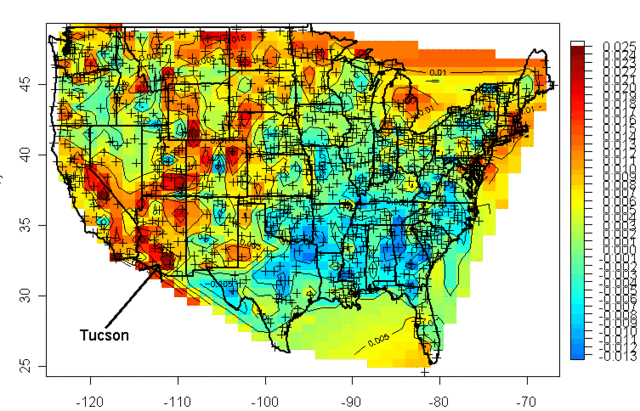
The last part about the UHI (urban heat island) study is interesting.  I don’t remember this study.  But it is interesting that he accepts a UHI of as high as 1.6C (my son and I found evening UHI in Phoenix around 4-6C, about in line with his London results).    It looks like he is trying to say that UHI should not matter to temperature measurement, since it has not changed in London since 1900  (a bias in temperature measurement that does not change does not affect the temperature anomaly, which is what tends to be important).  But the point is that many other temperature stations in the Hadley CRUT data base are in cities that are now large today but were much smaller than London in 1900 (Tucson is a great example).  In these cases, there is a changing measurement bias that can affect the anomaly, so I am not sure what Jones was trying to get at.

I Will Accept This Description

I normally object to the ways in which global warming alarmists portray skeptics.  But I will accept this from Phil Jones

They [skeptics] mostly look at observation papers and ignore modelling ones, as they believe by default models are wrong!

Models are nothing more than scientific hypotheses programmed into computer code.  As such, I must admit to finding papers that merely model various hypotheses (generally in a very nontransparent and non-replicable sort of way) to be the least interesting of all possible papers.   It is far more interesting to see someone lay out their hypotheses and attempt to justify them with observational data.  In climate, the prevalence of modelling tends actually obscure this discussion, as we don’t always see all the relevant hypotheses that form the foundation of a model, and even when we do, we usually don’t see the details of its implementation  (which can be as important to the results as, say, the exact wording of a poll question).

So, yes, if Dr. Jones wishes to defines the sides in this debate as skeptics whose science is driven by observational data and alarmists whose science is driven by computer models no one has seen or replicated, I will accept those definitions.

Update on My Comment Policy: It’s Not This

In the Climategate 2.0 emails, Michael Mann confirms what we already knew – there is absolutely no tolerance for dissent, even the scientifically thoughtful sort, among climate alarmists.  Writing about their mother-site, RealClimate, Mann says

 I suspect you’ve both seen the latest attack against [Keith Briffa's] Yamal work by McIntyre.    Gavin and I (having consulted also w/ Malcolm) are wondering what to make of this, and what sort of response—if any—is necessary and appropriate. So far, we’ve simply deleted  all of the attempts by McIntyre and his minions to draw attention to this at RealClimate.

Note that the knee-jerk, default action is to purge, hide, and delete criticism, even before it is understood.  They make absolutely no attempt to understand the argument, reading it just enough to know that it is critical and therefore must be deleted.  The second action is to find someone to refute it, again even before the critique is understood.  It is critical of us so it must be wrong.  QED.

Here is one of the original McIntyre posts where he outlines the problem he found in Briff’s work.  He argues that the findings in Briffa are not very robust, as substitution of a larger sample of trees (this is a tree-ring temperature reconstruction study, like the hockey stick) from the same area for Briffa’s apparently small, hand-picked sample have an astoundingly large effect on the study’s findings (the red study line below, McIntyre’s reconstruction in black).

Perhaps McIntyre was missing something (though over the 2 years since no one involved has suggested what that might be).  But the tone of the article is certainly scientific and thoughtful.   It has no resemblance to the unscientific polemic that alarmists often use as an excuse to excise skeptical comments from their web sites.

My Favorite Climategate 2.0 Email (so far)

I am working on a summary post of the new batch of climategate emails, but this is perhaps my favorite.  It is written to Andy Revkin, nominally a reporter for the NY Times but revealed by the new emails to be pretty much the unpaid PR agent of Michael Mann and company.  Over and over, emails from Mann and his cohorts get Revkin to write the articles they want, drop quotes from skeptics from articles, and in general coordinate communications policy.

Anyway, one climate scientist writes Revkin this note

I think the notion of telling the public to prepare for both global warming and an ice age at the same [time] creates a real public relations problem for us.

Amazing that this actually had to be said.

Update:  Revkin is currently an opinion blogger but at the time of the emails he was supposed to be a news reporter at the NYT.

More Great Moments in Climate Science

We lost track of a caribou herd, so since we can’t find it, we will just tell the press it was destroyed by climate change.   (Happily the herd has been found, right where it always was, so we won’t have to see caribou heads on our diet coke bottles).

I joke about this but it is really a serious statement about the quality of science and science journalism that there was really a big climate-related panic over the disappearing caribou a couple of years ago.   This is climate science in a nutshell – make a measurement error, assume the faulty data is real, and then without evidence blame the changing data on climate change.

(Update:  Yes, I actually spelled caribou herd “heard” in the original.  I am a big believer there is no such thing as a single metric for intelligence, but that there are multiple intelligences of various sorts.    We can argue about the other kinds, but I clearly did not get much of the spelling and proof-reading sort.

What is Normal?

I often raise the issue of “What is Normal” when discussing climate.  The media frequently declares certain weather events as so “abnormal” that they must be due to man-made factors.  A great example is the current Texas drought, which is somehow unprecedented and thus caused by CO2 despite the fact that the great dust bowl drought of the 1930′s was many times larger in area and years in duration.

The EPA has a new slideshow purporting to aggregate these “abnormalities.”  While I could spend all year going through each slide, I want to focus on just one.

Now we all know that the EPA is just full of sciency goodness and so everything they say is based on science and not, say, some political agenda.  And the statement and the pictures above are absolutely correct, as far as they go.  But they are missing a teeny tiny bit of context.  Here is a longer history of that same glacier (thanks to the Real Science blog for the pointer, this is a much better map than the one I have used in the past).

The 1948 position is way up at the top.  You can see that the melting since 1966, which according to the EPA is an “acceleration,” is trivial compared to the melting since 1760.  Basically, this glacier has been retreating since at least the end of the little ice age.

Those who want to attribute the recent retreat to CO2 have to explain what drove the glacier to retreat all that way from 1760 to 1960, and why that factor stopped in 1960 at exactly the time Co2 supposedly took over.

By the way, this same exact story can be seen in glaciers around the world.  Glaciers began retreating at the end of the little ice age, and if anything that pace of retreat has slowed somewhat over the last few decades.


Stupid Math Tricks

James Hansen, head of NASA’s GISS and technical adviser on An Inconvenient Truth, wrote recently

Thus there is no need to equivocate about the summer heat waves in Texas in 2011 and Moscow in 2010, which exceeded 3σ – it is nearly certain that they would not have occurred in the absence of global warming. If global warming is not slowed from its current pace, by mid-century 3σ events will be the new norm and 5σ events will be common.

This statement alone should be enough for any thoughtful person who here-to-fore has bought in to global warming hysteria out of vague respect for “science” to question their beliefs.

First, he is basically arguing that a 3σ event proves (makes it “nearly certain”) that some shift has occurred in the underlying process.  In particular, he is arguing that one single sample’s value is due to a mean shift in the system.  I don’t have a ton of experience in process control and quality, but my gut feel is that a 3σ event can be just that, a 3σ event.  One should expect a 3σ event to occur, on average, once in every 300 samples of a system with a normal distribution of outcomes.

Second, and a much bigger problem, is that Hansen is gaming the sampling process.  First, he is picking an isolated period.  Let’s say, to be generous, that this 3σ event stretched over 3 months and was unprecedented in the last century.  But there are 400 3-month periods in the last hundred years.  So he is saying in these two locations there was a 3σ temperature excursion once out of 400 samples.  Uh, ok.  Pretty much what one would expect.

Or, if you don’t like the historic approach, lets focus on just this year.  He treats Moscow and Texas like they are the only places being sampled, but in fact they are two of hundreds or even thousands of places on Earth.  Since he does not focus on any of the others, we can assume these are the only two that have so-called 3σ temperature events this summer.

It’s hard to know how large to define “Texas”  (since the high temperatures did not cover the whole state) or “Moscow” (since clearly the high temperatures likely reached beyond the suburbs of just that city).

Let’s say that the 3σ event occurred in a circular area 500km in diameter.  That is an area of 196,250 sq km each.  But the land surface area of the Earth (we will leave out the oceans for now since heat waves there don’t tend to make the headlines) is about 150 million sq km.   This means that each of these areas represent about 1/764th of the land surface area of the Earth.  Or said another way, this summer there were 764 500km diameter land areas we could sample, and 2 had 3σ events.  Again, exactly as expected.

In other words, Hansen’s that something unusual is going on in the system is that he found two 3σ events that happened once every 300 or 400 samples.  You feeling better about the science yet?

Luboš Motl has a more sophisticated discussion of the same statement, and gets into other issues with Hansen’s statement.

Postscript:  One other issue — the mean shift in temperatures over the last 30 years has been, at most, about 0.5C  (a small number compared to the Moscow temperature excursion from the norm).  Applying that new mean and the historic standard deviation, my guess is that the Moscow event would have still been a 2.5σ event.  So its not clear how an event that would have been unlikely even with global warming but slightly more unlikely without global warming tells us much of anything about changes in the underlying system, or how Hansen could possible assign blame for the even with near certainty to anthropogenic CO2.

Generally Freedom-Loving Australia Turned Totalitarian By Climate Alarmists

This is really sad to see in what is supposed to be a liberal democracy:

Now that the carbon tax has passed through [Australian] federal parliament, the government’s clean-up brigade is getting into the swing by trying to erase any dissent against the jobs-destroying legislation.

On cue comes the Australian Competition and Consumer Commission, which this week issued warnings to businesses that they will face whopping fines of up to $1.1m if they blame the carbon tax for price rises.

It says it has been “directed by the Australian government to undertake a compliance and enforcement role in relation to claims made about the impact of a carbon price.”

There will be 23 carbon cops roaming the streets doing snap audits of businesses that “choose to link your price increases to a carbon price”.

Instead, the ACCC suggests you tell customers you’ve raised prices because “the overall cost of running (your) business has increased”.

Update:  Obama loves the Aussie carbon tax

Addressing the press in Australia, where legislators passed a carbon tax earlier this month, Obama praised Prime Minister Julia Gillard for pursuing “a bold strategy” to trim industrial emissions that most scientists say are contributing to global warming.

Well, It’s Good to Have That Settled

Via Junk Science

In “Capitalism vs. the Climate“, [Naomi] Klein rants against “the deniers” but makes this admission:

The deniers did not decide that climate change is a left-wing conspiracy by uncovering some covert socialist plot. They arrived at this analysis by taking a hard look at what it would take to lower global emissions as drastically and as rapidly as climate science demands. They have concluded that this can be done only by radically reordering our economic and political systems in ways antithetical to their “free market” belief system. As British blogger and Heartland regular James Delingpole has pointed out, “Modern environmentalism successfully advances many of the causes dear to the left: redistribution of wealth, higher taxes, greater government intervention, regulation.” Heartland’s Bast puts it even more bluntly: For the left, “Climate change is the perfect thing…. It’s the reason why we should do everything [the left] wanted to do anyway.”

Here’s my inconvenient truth: they aren’t wrong. [Emphasis added]

World is Getting Warmer

This is from 1906.   Most records show that glaciers have retreated since around 1820 right up to date.  Those who want to blame retreating glaciers today on man-made CO2 have to first explain why the natural retreat from 1820 to about 1955 ended natural somehow at the exact moment that manmade Co2 took over.

This is part of a retrospective of such articles over the last 100 years here.

In Honor of Today’s Gore-Fest, My Climate Video

Al Gore is doing his best Jerry Lewis imitation by holding an all day climate telethon today.  In honor of this, let me repost my climate video for those who have not seen it.

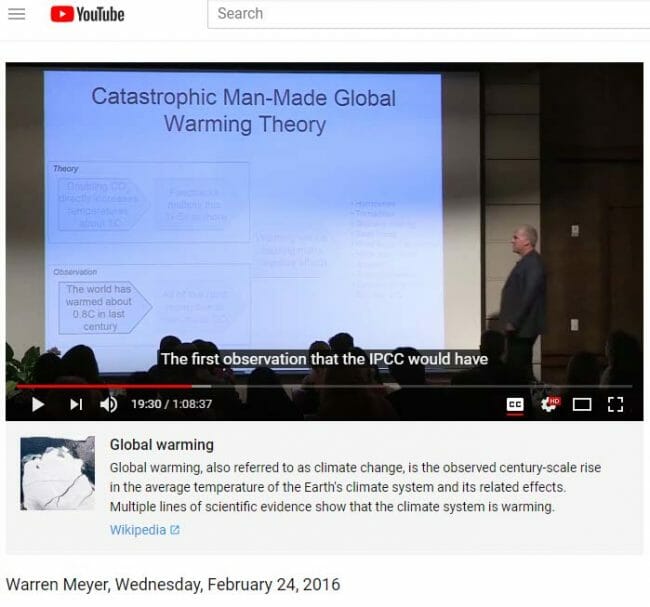
Catastrophe Denied: The Science of the Skeptics Position (studio version) from Warren Meyer on Vimeo.

Other viewing options, as well as links to download the powerpoint presentation, are here.

These Are The Folks Who Are Wrapping Themselves in the Mantle of “Science”

Oops.  Accounting error seriously overestimates benefits of biofuels.  

The European Union is overestimating the reductions in greenhouse gas emissions achieved through reliance on biofuels as a result of a “serious accounting error,” according to a draft opinion by an influential committee of 19 scientists and academics.

The European Environment Agency Scientific Committee writes that the role of energy from crops like biofuels in curbing warming gases should be measured by how much additional carbon dioxide such crops absorb beyond what would have been absorbed anyway by existing fields, forests and grasslands.

Instead, the European Union has been “double counting” some of the savings, according to the draft opinion, which was prepared by the committee in May and viewed this week by The International Herald Tribune and The New York Times.

The committee said that the error had crept into European Union regulations because of a “misapplication of the original guidance” under the United Nations Framework Convention on Climate Change.

“The potential consequences of this bioenergy accounting error are immense since it assumes that all burning of biomass does not add carbon to the air,” the committee wrote.

Duh.  This has been a known fact to about everyone else, as most independent studies not done by a corn-state university have found ethanol to have, at best, zero utility in reducing atmospheric CO2.

It is worth noting that the EU would likely have never made this admission had it solely been under the pressure of skeptics, for whom this is just one of a long list of fairly obvious errors in climate-related science.  But several years ago, environmental groups jumped on the skeptic bandwagon opposing ethanol, both for its lack of efficacy in reducing emissions as well as the impact of increasing ethanol product on land use and food prices.

I Don’t Think This is Settled

For those who have read my climate work or seen the video, the key question in climate science revolves around the feedback effects in the climate system to Co2 warming.

Skeptics, like alarmists, generally agree that a doubling of Co2 concentrations might warm the Earth about a degree Celsius, absent any other effects.  But we can imagine all sorts of feedback effects, the most important of which are in water vapor and cloud formation.  Warming that forms more clouds might have negative feedback, as clouds offset some of the warming.  Warming that increases humidity could lead to more warming, as water vapor is a strong greenhouse gas.

The difference, then, between minor warming and catastrophe is in the feedbacks, and most importantly in clouds and water vapor.  All the research the government is funding on whether warming will cause sterility in tree frogs is tangential to this key question.

And this question is far from decided.  I won’t get into all the arguments here, but to the extent there is any consensus, it is that man’ CO2 is probably causing some warming.  Whether this is a catastrophe or a nuisance depends on feedbacks which are not well understood.

This week there has been a lot of interesting back and forth over a paper by Roy Spencer several months ago arguing that cloud feedback was negative and would serve to limit the total amount of man-made warming.  Just how central this issue is can be seen in the fuss this paper has caused, including editors forced to resign for even daring to publish such heresy, and the speed with which a counter-paper flew through peer review.

I won’t get into the depths of this, except to show two charts.  The first is from Dessler in the alarmist camp, the second is the same chart but using a different data series.  I won’t explain the axes,  just trust the relationship between these two variables is key to diagnosing the size and direction of feedback.

So we get opposite results (the slope of the regression) simply by using temperature and radiative flux data from to different agencies.  And note how thin the fit is in both — basically drawing a line through a cloud.  Neither of these likely has an R-squared higher than about .05.

So there you have it, the most important question in climate – really, the only important question associated with anthropogenic global warming.  Settled science, indeed.

Did CLOUD Just Rain on the Global Warming Parade?

Today in Forbes, I have an article bringing the layman up to speed on Henrik Svensmark and this theory of cosmic ray cloud seeding.  Since his theory helped explain some 20th century warming via natural effects rather than anthropogenic ones, he and fellow researchers have face an uphill climb even getting funding to test his hypothesis.  But today, CERN in Geneva has released study results confirming most of Svensmark’s hypothesis, though crucially, it is impossible to infer from this work how much of 20th century temperature changes can be traced to the effect (this is the same problem global warming alarmists face — CO2 greenhouse warming can be demonstrated in a lab, but its hard to figure out its actual effect in a complex climate system).

From the article:

Much of the debate revolves around the  role of the sun, and though holding opposing positions, both skeptics and alarmists have had good points in the debate.  Skeptics have argued that it is absurd to downplay the role of the sun, as it is the energy source driving the entire climate system.  Michael Mann notwithstanding, there is good evidence that unusually cold periods have been recorded in times of reduced solar activity, and that the warming of the second half of the 20th century has coincided with a series of unusually strong solar cycles.

Global warming advocates have responded, in turn, that while the sun has indeed been more active in the last half of the century, the actual percentage change in solar irradiance is tiny, and hardly seems large enough to explain measured increases in temperatures and ocean heat content.

And thus the debate stood, until a Danish scientist named Henrik Svensmark suggested something outrageous — that cosmic rays might seed cloud formation.  The implications, if true, had potentially enormous implications for the debate about natural causes of warming.

When the sun is very active, it can be thought of as pushing away cosmic rays from the Earth, reducing their incidence.  When the sun is less active, we see more cosmic rays.  This is fairly well understood.  But if Svensmark was correct, it would mean that periods of high solar output should coincide with reduced cloud formation (due to reduced cosmic race incidence), which in turn would have a warming effect on the Earth, since less sunlight would be reflected back into space before hitting the Earth.

Here was a theory, then, that would increase the theoretical impact on climate of an active sun, and better explain why solar irradiance changes might be underestimating the effect of solar output changes on climate and temperatures.

I go on to discuss the recent CERN CLOUD study and what it has apparently found.

Hilarious New Study

I would like to think this new study was a joke like that one about the affect of different AC/DC lead singers on decision-making.

The study basically appears to be a transcribed version of some stoner late-night bull session imagining different contact scenarios with aliens.  But one of the conclusions is hilarious.  The Guardian describes the “logic”

It may not rank as the most compelling reason to curb greenhouse gases, but reducing our emissions might just save humanity from a pre-emptive alien attack, scientists claim.

Watching from afar, extraterrestrial beings might view changes in Earth’s atmosphere as symptomatic of a civilisation growing out of control – and take drastic action to keep us from becoming a more serious threat, the researchers explain.

This highly speculative scenario is one of several described by scientists at Nasa and Pennsylvania State University that, while considered unlikely, they say could play out were humans and alien life to make contact at some point in the future.

Every time you turn on an incandescent light bulb, ET nukes someone in China.  Or something.  Personally I think it is at least as likely that broadcast copies of Mariah Carey’s “Glitter” radiating out from Earth at the speed of light will get us pounded by meteors from space.  More here.

A Window on Climate Peer Review

I have written before that peer review is not a guarantee of correctness.  Most academics would laugh at that portrayal, yet that is exactly how climate peer review is treated in the media.

A number of years ago, Charles Monnett, flying over the Arctic to do some sort of whale study, saw 3-4 polar bears floating dead in the water.  Without either a) retrieving the bear carcasses or b) even getting a picture of them, he wrote up a paper that discussed the siting and hypothesized the bears drowned in a storm and further that more bears would likely drown in the future if global warming melts more Arctic ice in the summer.  The findings were the basis for a lot of worry about polar bears, and played a key role in Al Gore’s movie.   Panic over the dead bears and Monnett’s wild hypotheses about them helped fuel calls for declaring the bears endangered, despite all evidence that their populations have actually been increasing over the last few years.  Monnett did quite well from the work, parlaying his fame into management of a $50 million study budget, the dream of all academics.

Monnett’s study has come back into the news because there has been some kind of investigation of him and his work by the Feds.  There has been a lot of speculation among skeptics that the investigation focuses on academic fraud, but I thought that a stretch.  As I wrote here

  1. If you read between the lines in the news articles, we really have no idea what is going on.  The guy could have falsified his travel expense reports
  2. The likelihood that an Obama Administration agency would be trying to root out academic fraud at all, or that if they did so they would start here, seems absurd to me.
  3. There is no room for fraud because the study was, on its face, facile and useless.  The authors basically extrapolated from a single data point.  As I tell folks all the time, if you have only one data point, you can draw virtually any trend line you want through it.  They had no evidence of what caused the bear deaths or if they were in any way typical or part of a trend — it was all pure speculation and crazy extrapolation.  How could there be fraud when there was not any data here in the first place?  The fraud was in the media, Al Gore, and ultimately the EPA treating this with any sort of gravitas.

Seriously, you see four floating bear bodies from 1500 feet, once.  You don’t have any facts about how they died.  You only have one data point in time.  Where is there room for fraud?  It’s one freaking useless data point.    Here is just a taste of what a joke this study was:

The actual survey Monnett was conducting when he observed the dead bears in 2004 was the migration of bowhead whales.  Investigators questioned how he later obtained data for a table listing live and dead polar bear sightings from 1987 to 2004.

“So how could you make the statement that no dead polar bears were observed” during that time period? May asked.

“Because we talked to the people that had flown the flights, and they would remember whether they had seen any dead polar bears,” Monnett said.

They only mystery is how this unbelievably trivial piece of work was published.

Well, now we have a better idea.  The reviewers for the article were Lisa Rotterman and Andrew Derocher.   Incredibly, it turns out Ms. Rotterman is his wife – yes, some people are more peers than others – and Derocher was awarded a large research contract by Monnett just before he reviewed the article.  Wow.

By the way, I think I will be both right and wrong.  I was pretty sure any government investigation would be about misuse of funds, and that does seem to be the main thrust here, though I was wrong in that it does seem to touch on academic fraud as well, in particular the idea of giving out grant money as a quid pro quo for a positive review  (a practice that skeptics have long sustpected in the climate community).

By the way, both Monnett and his partner Gleason now are claiming that everyone blew their study out of proportion and it wasn’t really about global warming.  If this is true, they were sure silent about this when they were basking in all kinds of attention and press and grant money.  Either of them could have stepped forward and stopped the momentum that built from this article and they did not.

By the way, for those who still want to believe that the EPA is drive by science,

Gleason concedes that the study had a major impact on the controversial listing of the bear as an endangered species because of global warming.

“As a side note, talking about my former supervisor, he actually sent me an e-mail at one point saying, ‘You’re the reason polar bears got listed,’” Gleason said.

One sighting in history of four floating dead polar bears and suddenly our whole fossil fuel economy has to be shut down.


Using Computer Models To Launder Certainty

For a while, I have criticized the practice both in climate and economics of using computer models to increase our apparent certainty about natural phenomenon.   We take shaky assumptions and guesstimates of certain constants and natural variables and plug them into computer models that produce projections with triple-decimal precision.   We then treat the output with a reverence that does not match the quality of the inputs.

I have had trouble explaining this sort of knowledge laundering and finding precisely the right words to explain it.  But this week I have been presented with an excellent example from climate science, courtesy of Roger Pielke, Sr.  This is an excerpt from a recent study trying to figure out if a high climate sensitivity to CO2 can be reconciled with the lack of ocean warming over the last 10 years (bold added).

“Observations of the sea water temperature show that the upper ocean has not warmed since 2003. This is remarkable as it is expected the ocean would store that the lion’s share of the extra heat retained by the Earth due to the increased concentrations of greenhouse gases. The observation that the upper 700 meter of the world ocean have not warmed for the last eight years gives rise to two fundamental questions:

  1. What is the probability that the upper ocean does not warm for eight years as greenhouse gas concentrations continue to rise?
  2. As the heat has not been not stored in the upper ocean over the last eight years, where did it go instead?

These question cannot be answered using observations alone, as the available time series are too short and the data not accurate enough. We therefore used climate model output generated in the ESSENCE project, a collaboration of KNMI and Utrecht University that generated 17 simulations of the climate with the ECHAM5/MPI-OM model to sample the natural variability of the climate system. When compared to the available observations, the model describes the ocean temperature rise and variability well.”

Pielke goes on to deconstruct the study, but just compare the two bolded statements.  First, that there is not sufficiently extensive and accurate observational data to test a hypothesis.  BUT, then we will create a model, and this model is validated against this same observational data.  Then the model is used to draw all kinds of conclusions about the problem being studied.

This is the clearest, simplest example of certainty laundering I have ever seen.  If there is not sufficient data to draw conclusions about how a system operates, then how can there be enough data to validate a computer model which, in code, just embodies a series of hypotheses about how a system operates?

A model is no different than a hypothesis embodied in code.   If I have a hypothesis that the average width of neckties in this year’s Armani collection drives stock market prices, creating a computer program that predicts stock market prices falling as ties get thinner does nothing to increase my certainty of this hypothesis  (though it may be enough to get me media attention).  The model is merely a software implementation of my original hypothesis.  In fact, the model likely has to embody even more unproven assumptions than my hypothesis, because in addition to assuming a causal relationship, it also has to be programmed with specific values for this correlation.

This is not just a climate problem.  The White House studies on the effects of the stimulus were absolutely identical.  They had a hypothesis that government deficit spending would increase total economic activity.  After they spent the money, how did they claim success?  Did they measure changes to economic activity through observational data?  No, they had a model that was programmed with the hypothesis that government spending increased job creation, ran the model, and pulled a number out that said, surprise, the stimulus created millions of jobs (despite falling employment).  And the press reported it like it was a real number.

The Dog That Didn’t Bark

There may be something interesting coming out in the climate front over the next few weeks from CERN.

Years ago, a researcher named Henrik Svensmark developed a hypothesis that cosmic rays can seed cloud formation, and thus when there are more cosmic rays, there may be more clouds.  This is interesting because it may act as a sort of solar amplification.

Changes in the sun’s output through varying solar cycles are measurable, but seem to some scientists to be too small to drive substantial temperature changes on Earth.  But a more active sun tends to blow cosmic rays away from the Earth, thus reducing their incidence.  Therefore, if a more active sun reduced cooling clouds, and a less active sun increased cooling clouds, this might explain a larger effect for the sun.

I have avoided discussing Svensmark much, since the evidence seemed thin, though several labs recently have confirmed his hypothesis, at least in the laboratory.  But Svensmark is definitely a topic among some climate skeptics.  The reason is that higher solar activity levels  in the second half of the twentieth century coincided with much of the 20th century warming that is blamed on manmade CO2.  Svensmark’s theory, if true, might force scientists to apportion more of the historic warming to natural causes, thus reducing the estimated sensitivity of the climate to man-made CO2.

But apparently the CERN lab has been undertaking a substantial study to confirm or deny Svensmark’s hypothesis.  The results have not been released, but skeptics are beginning to anticipate that CERN’s work has confirmed the hypothesis of cosmic ray cloud seeding.  Why?  Because of the dog that did not bark, or rather was told not to bark.

Via Watts Up With That:

CERN Director General Rolf-Dieter Heuer told Welt Online that the scientists should refrain from drawing conclusions from the latest experiment.

“I have asked the colleagues to present the results clearly, but not to interpret them,” reports veteran science editor Nigel Calder on his blog. Why?

Because, Heuer says, “That would go immediately into the highly political arena of the climate change debate. One has to make clear that cosmic radiation is only one of many parameters.”

Skeptics are suggesting that had CERN disproved Svensmark, and thus protected the hypothesis that CO2 is driving most current warming, they would not have hesitated to draw exactly this conclusion in public.  Only a finding considered more consistent with the skeptical position would cause them to go silent, trying to avoid the taint from the politically correct intelligentsia that would come from even partially confirming a skeptic talking point.

I have to agree that Heuer’s comments seem to telegraph the result.  I have read a ton of global warming related studies.  And every single one I have read that has ever published negative results vis a vis the hypothesis of catastrophic manmade global warming has felt obligated to put in a sentence at the end that says something like “but of course this does not in any way disprove the hypothesis of anthropogenic global warming and we fully support that hypothesis despite these results.”  The absolute fear of becoming an outcast for coming up with the “wrong” result is palpable in reading these papers, sort of like the very careful language a report in Soviet Russia might have used to even mildly criticize some aspect of the state.  Of course, no such disclaimer can be found with narrow positive results – these are always immediately extrapolated  (in fact over-extrapolated in press releases) to be the final nail in the coffin proving once and for all that man is changing the climate in dire ways.

Global Warming Hype Process

Here is the current global warming hype process as it exists today:

  1. Identify a 2 or 3 sigma weather event.  Since there are 365 days in the year and hundreds of different regions in the world, the laws of probability say that some event in the tail of the normal distribution (local high, local low, local flood, local drought, local snow, local tornado, local hurricane, etc) should be regularly occurring somewhere.
  2. Play weather event all over press, closely linked as often as possible with supposition that this is due to manmade CO2.  If the connection to global warming is too outlandish to make with a straight face (e.g. cold weather) use term “climate change” or “climate disruption” instead of global warming.
  3. Skeptics will point to actual data that this event is not part of a long term trend, e.g. there is no rise in tornado activity correlated with 20th century rise in temperatures so blaming one year of high tornadoes on global warming makes no sense.    Ignore this.
  4. Peer reviewed literature will emerge 6-12 months later demonstrating that the event was not likely due to man-made global warming.  Ignore this as well.  Never, ever go back and revisit failed catastrophic predictions.
  5. Repeat

Last year’s Russian heat wave is a classic example.  Here is an example of the hype and the tie to man-made global warming in Time.  And here, 12 months later, is the study saying that weather was just weather:

Reference
Dole, R., Hoerling, M., Perlwitz, J., Eischeid, J., Pegion, P., Zhang, T., Quan, X.-W., Xu, T. and Murray, D. 2011. Was there a basis for anticipating the 2010 Russian heat wave? Geophysical Research Letters38: 10.1029/2010GL046582.

Background
The authors write that “the 2010 summer heat wave in western Russia was extraordinary, with the region experiencing the warmest July since at least 1880 and numerous locations setting all-time maximum temperature records.” And as a result, they say that “questions of vital societal interest are whether the 2010 Russian heat wave might have been anticipated, and to what extent human-caused greenhouse gas emissions played a role.”

What was learned
The nine U.S. researchers determined that “analysis of forced model simulations indicates that neither human influences nor other slowly evolving ocean boundary conditions contributed substantially to the magnitude of the heat wave.” In fact, they say that the model simulations provided “evidence that such an intense event could be produced through natural variability alone.” Similarly, on the observation front, they state that “July surface temperatures for the region impacted by the 2010 Russian heat wave show no significant warming trend over the prior 130-year period from 1880-2009,” noting, in fact, that “a linear trend calculation yields a total temperature change over the 130 years of -0.1°C.” In addition, they indicate that “no significant difference exists between July temperatures over western Russia averaged for the last 65 years (1945-2009) versus the prior 65 years (1880-1944),” and they state that “there is also no clear indication of a trend toward increasing warm extremes.” Last of all, they say that although there was a slightly higher variability in temperature in the latter period, the increase was “not statistically significant.”

Not sure I find the computer model work comforting one way or the other but the complete lack of any observational trend seems compelling.

OK, So We Greens Are Communists After All

This is pretty hilarious. Environmentalist and global warming advocate Chris Mooney writes

My latest DeSmogBlog post is about how climate skeptics basically seem to believe that their opponents are driven by socialism and communism. We aren’t, of course–duh–but it is fascinating to listen to how they explain this, in their own words.

After some participation years ago in this kind of finger-pointing over motivations in the climate debate, I have of late found such activity to be worthless at best and have tried to stay away from it.

But this became funny when Mooney’s readers started commenting on the post.  In effect, they wrote “we are anti-growth socialists.”  Mooney was forced to write, in comment #32:

yes. i guess my side loses this round, thanks to this thread. depressing

Thanks to Climate Depot for the tip.

Digging into the Climate Models

My article this week at Forbes.com digs into some fundamental flaws of climate models

When I looked at historic temperature and CO2 levels, it was impossible for me to see how they could be in any way consistent with the high climate sensitivities that were coming out of the IPCC models.  Even if all past warming were attributed to CO2  (a heroic acertion in and of itself) the temperature increases we have seen in the past imply a climate sensitivity closer to 1 rather than 3 or 5 or even 10  (I show this analysis in more depth in this video).

My skepticism was increased when several skeptics pointed out a problem that should have been obvious.  The ten or twelve IPCC climate models all had very different climate sensitivities — how, if they have different climate sensitivities, do they all nearly exactly model past temperatures?  If each embodies a correct model of the climate, and each has a different climate sensitivity, only one (at most) should replicate observed data.  But they all do.  It is like someone saying she has ten clocks all showing a different time but asserting that all are correct (or worse, as the IPCC does, claiming that the average must be the right time).

The answer to this paradox came in a 2007 study by climate modeler Jeffrey Kiehl.  To understand his findings, we need to understand a bit of background on aerosols.  Aerosols are man-made pollutants, mainly combustion products, that are thought to have the effect of cooling the Earth’s climate.

What Kiehl demonstrated was that these aerosols are likely the answer to my old question about how models with high sensitivities are able to accurately model historic temperatures.  When simulating history, scientists add aerosols to their high-sensitivity models in sufficient quantities to cool them to match historic temperatures.  Then, since such aerosols are much easier to eliminate as combustion products than is CO2, they assume these aerosols go away in the future, allowing their models to produce enormous amounts of future warming.

Specifically, when he looked at the climate models used by the IPCC, Kiehl found they all used very different assumptions for aerosol cooling and, most significantly, he found that each of these varying assumptions were exactly what was required to combine with that model’s unique sensitivity assumptions to reproduce historical temperatures.  In my terminology, aerosol cooling was the plug variable.