I Don't Think This is Settled
For those who have read my climate work or seen the video, the key question in climate science revolves around the feedback effects in the climate system to Co2 warming.
Skeptics, like alarmists, generally agree that a doubling of Co2 concentrations might warm the Earth about a degree Celsius, absent any other effects. But we can imagine all sorts of feedback effects, the most important of which are in water vapor and cloud formation. Warming that forms more clouds might have negative feedback, as clouds offset some of the warming. Warming that increases humidity could lead to more warming, as water vapor is a strong greenhouse gas.
The difference, then, between minor warming and catastrophe is in the feedbacks, and most importantly in clouds and water vapor. All the research the government is funding on whether warming will cause sterility in tree frogs is tangential to this key question.
And this question is far from decided. I won't get into all the arguments here, but to the extent there is any consensus, it is that man' CO2 is probably causing some warming. Whether this is a catastrophe or a nuisance depends on feedbacks which are not well understood.
This week there has been a lot of interesting back and forth over a paper by Roy Spencer several months ago arguing that cloud feedback was negative and would serve to limit the total amount of man-made warming. Just how central this issue is can be seen in the fuss this paper has caused, including editors forced to resign for even daring to publish such heresy, and the speed with which a counter-paper flew through peer review.
I won't get into the depths of this, except to show two charts. The first is from Dessler in the alarmist camp, the second is the same chart but using a different data series. I won't explain the axes, just trust the relationship between these two variables is key to diagnosing the size and direction of feedback.
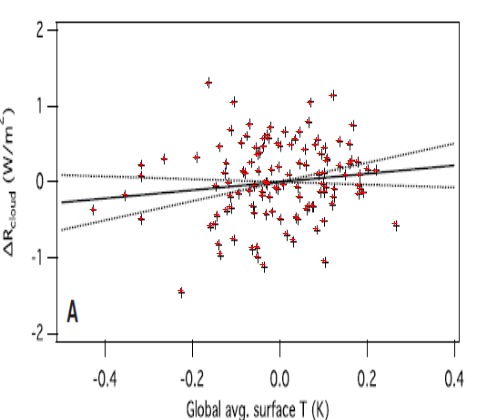
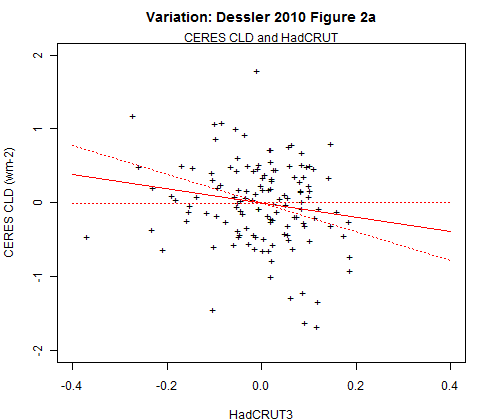
So we get opposite results (the slope of the regression) simply by using temperature and radiative flux data from to different agencies. And note how thin the fit is in both -- basically drawing a line through a cloud. Neither of these likely has an R-squared higher than about .05.
So there you have it, the most important question in climate - really, the only important question associated with anthropogenic global warming. Settled science, indeed.
You are right, its not settled. But mother nature will do that in the next 10-15 years. If it warms at the rates predicted by the consensus folks with a cold PDO and a quiet sun, the GHG effect my be pretty important. However if it cools by coupled of tenths of a degree C, they'll have to move onto another thing to get alarmed about.
More to the point though, If I'm not mistaken the GHG theory, even with feedbacks, is predicted to only increase the radiative balance of the earth by a couple of tenths of a percent toward warming and the satellite data precision for albedo and long wave radiation is on the order of 1-2% so we won't have a definitive measurement any time soon
Let's see...
Systems with positive feedback either oscillate wildly or crash into the rails. They are never stable. It's like being balanced on a knife edge. If there were significant positive feedback mechanisms driving the climate the Earth's temperature would never be stable. The tiniest little push in either direction would multiply itself into a climate disaster.
Warmenist theory seems to state that throughout all of geological time the Earth has maintained a steady temperature. Over hundreds of million years. Over episodes of massive volcanism, asteroid impacts, continental drift, you name it. Yet these warmenists are telling me that human civilization farting out a few ppm excess carbon dioxide is suddenly causing us to become the steaming swamps of Venus.
If you don't like "warmenist" how about warm mongers?
First of all, I'm not a global warming zealot. I believe it's happening, and like you, I think some of it is caused by humans and some of it relates to underlying changes in the environment that aren't man-made. I'm not convinced there's been a huge amount of man-caused warming, or that it's necessarily going to be catastrophic. The jury is still out.
What I do find interesting is comparing global warming and another potential crisis we face (the U.S. debt) and how conservatives respond to the two in such contradictory ways. The conservative response is to completely discount and ignore one (warming) and to warn of catastrophe and propose drastic measures to deal with the other (debt).
To me, this is troubling. I like to be prepared in case of emergency, so I agree we need to address the debt. But because global warming could also be an emergency, it strikes me as prudent to take measures to address it as well.
Conservatives propose taking austerity measures we haven't seen since the Great Depression to prevent debt from climbing, and warn of catastrophic inflation and soaring interest rates if we don't (meanwhile interest rates have descended to 60-year lows).
On the other hand, conservatives say global warming isn't worth our concern (G.W. Bush said addressing it would ruin our economy). But global warming is also supposed to have catastrophic results. Flooding, drought, millions of people dying, the list goes on and on. And there's no doubt temperatures are rising. Even the most conservative don't argue that. Perhaps the scientists are exaggerating the possible effects, but to completely ignore these warnings and the supportive data while preaching massive protective measures against a different crisis strikes me as hypocritical. I'm in favor of umbrellas, whether it's raining debt or warming.
And is it just a coincidence that doing something to prevent global warming potentially means a drain on the pocketbooks of the wealthiest, whereas addressing debt and inflation would help the wealthiest quite a bit? It looks pretty transparent to me. (And as full disclosure, I'm one of the wealthy people whose pocketbooks might get helped if we took the austerity measures).
Dan:
The difference between the debt and CAGW is that one is hypothetical and the other is real.
In the case of the debt, if we don't do something drastic soon, interest on the debt will consume us, not to mention that nobody will want to buy our bonds.
In the case of CAGW, school is still out, and will be for probably decades. Furthermore, there is no viable "alternative energy", and the Chinese and Indians will not stop their industrialization, even if we do. It makes no sense to destroy our industrial economy under these circumstances.
Two completely different issues. Thus, it is entirely rational to worry more about the one than the other.
The US debt is concrete, obvious and fairly simple, with measurements that can be agreed on-- you spend more than you bring in, you get higher debt. The solution is very simple-- get out of the way, stop trying to control everything, go back to something that worked before. (Oh, no, not "austerity" like going back a century in spending as the most extreme suggestion!)
Anthro Climate Change is theoretical, might be an artifact of what measurements you use, and insanely complicated-- good heavens, among those who believe in it we can't even get agreement on the causes, the effects or the solutions. The proposed solution is to give a massive amount of power and control to those who want to try a bunch of things they think might solve the problem that might exist, but will definitely cause massive damage to freedom, quality of life and our economy.
I agree school is still out on climate change, as I said at the top of my post. Nevertheless, if there's even a small chance that the consequences we hear about are possible, we should at the very least take it seriously and not write it off as propaganda. Some very smart people believe it's real, and since I'm not a scientist, I feel inclined to listen.
As for debt, I agree it's real and threatening. However, historically, the U.S. debt has been higher than this as a % of GDP and the sky hasn't fallen. For instance, right after WW2. The fast-growing economy of the 1950s and 1960s pretty much made debt a non-issue in those decades. If economic growth can improve, the debt would go down. It's a very simple solution.
"the U.S. debt has been higher than this as a % of GDP and the sky hasn’t fallen. For instance, right after WW2. The fast-growing economy of the 1950s and 1960s pretty much made debt a non-issue in those decades. If economic growth can improve, the debt would go down. It’s a very simple solution."
There are two HUGE differences between the post-WW2 period and today.
1. In 1945, the US was the only major world economy that didn't see its manufacturing infrastructure bombed into heaps of rubble. Basically, the US economy grew rapidly because it had no competition. Today the global competitive environment is very different... and the US manufacturing infrastructure has been slowly rusting while production has been offshored to lower cost countries. Without factories, what will the US economy produce? Financial services and iPhone apps? (Keep in mind, teh physical iPhones are made in China.)
2. In 1945, the average US household was emerging from years of forced austerity, savings was high and debt was low. There was legitimate pent-up consumer demand. Today, the US household is severely overleveraged, and the consumer credit spigot has run dry. Without domestic consumers, where's the demand going to come from? Exports? Of what? Financial services and iPhone apps?
Russ R.,
Those are excellent points and I agree. However, maybe there's something we're not thinking of that could jumpstart economic growth.
I admit times are not the same as in 1945. The only reason I used that example was to illustrate that debt can be addressed by economic growth. For a less dramatic example, debt was coming down as a % of GDP in the late-1990s due to the strong economic growth we were seeing then.
The government seems to want to run everything: R&D, energy, banking, real estate, etc. Where in the world did the idea come from that the IDIOTS in Washington could do anything better than the collective efforts of American enterprise? The result is such a blanket of smothering regulations that it is a wonder than business and industry can function at all.
In 1945 there was a minimum of USG intrusion, and the country prospered, which is why the WWII debt was manageable. The cost of all the current regs, mandates, etc. is astronomical. If this burden (which produces nothing of economic value) was lifted, the money would go to beneficial purposes.
As to the CAGW thing, leave the scientists alone to study and debate it, and the engineers alone to find alternaive energy sources. If there is a solution to the energy problem, it will be found much quicker without USG meddling and picking winners and losers.
I'm just so impressed they could draw a regression line through those data points at all. Kudos!
Nevertheless, if there’s even a small chance that the consequences we hear about are possible, we should at the very least take it seriously and not write it off as propaganda.
...
Noted, you're not interested in responding to the reality of what any of your chosen "Them" are doing, you're just trolling.
Not worth the time if your personal strawmen are busy being hacked to death.
"I agree school is still out on climate change, as I said at the top of my post. Nevertheless, if there’s even a small chance that the consequences we hear about are possible, we should at the very least take it seriously and not write it off as propaganda. Some very smart people believe it’s real, and since I’m not a scientist, I feel inclined to listen. "
Precautionary principle fueled by the deference to "authority" and these very smart (or just credentialed?) people that tell us that we have to give them more money or we'll cause our own extinction. Funny that these smart people don't seem concerned enough to live in smaller houses and avoid flying around in private jets, they just seem to want you to sacrifice and provide their funding.
Anyway, there are an infinite number of possible problems that we could face that have very low probability, yet we have limited resources. I don't see why CAGW should get any more resources than mitigating an asteroid impact, and I feel it should get none due to the misconduct revealed in the research.
Foxfier,
Maybe you're right. I'm trolling. It's certainly a waste of my time to share alternate views on this site, because most people here just want to say "attaboy" to each other.
So the recent successful experiment by CERN's CLOUD research team and earlier verification of Henrik Svenmark's cosmic flux theory by the Danish SKY scientists is not "earth-shattering" enough to satisfy your science bent?
I think that James Delingpole gets it right. As Michael Crichton wrote: "You think man can destroy the planet? What intoxicating vanity."
Shorter Dan:
You are close-minded because you won't take me seriously and agree while I mischaracterize you!
How many times did I argue with grad students over plots like these. Absolutely zero correlation in either of them. They prove nothing. No line of any kind is justified. I would bet the matrix has zero determinant or is at best ill-poised.
The cloud of unknowing, as the monk said.
Back when I was a govt regulator, if someone had presented me with this sort of data/regression, and the multiple datasets that could be cherry-picked to get the desired result, I would have thrown them out of my office. There is no discernable trend here, and trying to draw a line is meaningless unless you know the underlying physics of the curve(e.g., is the equation F=ma, or F=ma^1.5?). One would like to be able to infer/develop the shape of the curve from the correlation, but this data is too sparse and conflicting.
This science is NOT settled.
Dan, my take on the national debt analogy is simple. It's true that in the %GDP question, it's been worse. The big difference is that everyone agreed right after the war that it should be paid off, and what to do about it. And...well, the debt was accumulated in pursuit of a public good, removing Nazis from the planet. Nowadays, on the other hand, the debate is between increasing it more slowly and full speed ahead, and all the money is going to corruption - Wall Street, friends of the senators/president/etc, Detroit, etc and so on. It's this attitude that feels like a crisis, not objectively where we are at the moment. More than that - in the 1950's and briefly in the 1990's, USG actually ran a surplus to pay down the debt, not just economic growth to decrease the ratio to GDP. If we were in that position now, with a high debt but the political will and income to pay it, then I wouldn't be worried.
More - the national debt is by definition a well defined problem - we owe 14.7 trillion to a defined list of creditors. We know what the interest charges are, what the US government income looks like, and we know those are the only two factors that matter. In fact - if a creditor is not known, then they're not a creditor! We've seen the consequences of high national debt in other countries, and the consequences of low debt. But, honestly for me, my concern on the debt is not that I think it will be catastrophic - it's that I'm 26 and expect to be forced to be the one paying it. I know exactly how much it'll cost me - take the national debt and ratio it with my share of national taxes. Given what they're spending the money on, I don't think it's worth it.
When it comes to global warming, on the other hand - well, Warren's documented the degree of uncertainty in even measuring global temperature, in predicting future temperatures, and in predicting consequences of those temperatures. Frankly, except for the worst case in all three categories, it's not even clear that there is a cost. Not like the national debt, where even without catastrophe there's a known cost that will show up in my taxes. Sure, there might also be a catastrophe, maybe, if the macroeconomic models are right. But that's not what gets me worked up about it - it's the known costs that I find unfair and reprehensible.
Or a better comparison is Social Security vs. Global Warming. Conservatives/Libertarians are quick to worry about S.S. and how we going put our grandchildrens in the poorhouse but don't give a rat's about whether G.W. will screw the grandchildren and their children. Social Security was predicted to go belly up many times before yet it has because people simply adapted to change. Not to mention many people have the attitude that they're not obliged to worry about the fate of those who will young in a few decades time. They should grateful enough to be born in the West, period.
But with Social Security there are many concrete steps that can be taken (but not taken because of the political issues surrounding them).
ANd, there are some steps that can be taken too with "Global Warming" that are inexpensive and probably make sense without the issue of carbon dioxide in the atmosphere.
But the real problem with the entire issue has little to do with "Global Warming" and more to do with a tyrannical mindset that wants to control other people's lives. Most of the zealots, from Al Gore down, never practice what they preach. Clearly, if they truly believed in catastrophic consequences they would not fly in private aircraft and live the lifestyles that they do. When Sheryl Crow said that we all should use just one square when we wiped out asses, do you think she has ever used just one? Seriously?
What these people want is control. FOr some reason they do not like the fact that other people live with decent standard of living. They seem to want us to stat at our homes, which are dimmer and colder. For homes, they seem to want us to live in rent controlled apartments which they control and think we should be happy when they "give" us a room or two. They want us on public transportation to control where we go, making it inconvenient to go anywhere else.
What this does is free up everything for the "elite". Now they will not have to deal with families and other undeserved people that crowd to the parks and other liesure destinations and they can have it all to themselves.
An R-squared of .05 ? That's noise in my field. I use those kind of plots in presentations when I want to convince management that a methodology yields meaningless results, otherwise they never make slide or print format. In otherwords, to prove to the engineers (it's always engineers) that that new "Magic method" they saw at the last annual SPE convention, while it may well work where the authors tried it, doesn't do squat in the situation under discussion, inevitably due to different mechanics/physics. Give me something around .3 or better and I'll start considering it for inclusion in a multi-variate attribute analysis. For a single attribute, I want .6 or better to get intruiged and .7 or better to start thinking the company could bet money on it IF I can't find anything other than actual causation to explain it. And even then, it's still risked.
>>>> What I do find interesting is comparing global warming and another potential crisis we face (the U.S. debt) and how conservatives respond to the two in such contradictory ways. The conservative response is to completely discount and ignore one (warming) and to warn of catastrophe and propose drastic measures to deal with the other (debt).
> It makes no sense to destroy our industrial economy under these circumstances.
Indeed, as Ted says, and also that it makes even LESS sense to destroy our economy when the real option is to get richer still so we can AFFORD to deal with the problems it creates.
>>>> Nevertheless, if there’s even a small chance that the consequences we hear about are possible, we should at the very least take it seriously and not write it off as propaganda. Some very smart people believe it’s real, and since I’m not a scientist, I feel inclined to listen.
This is called Pascal's Wager, and the problem is there's a massive flaw in the notion:
Pascal said that even if the existence of God could not be determined through reason, a rational person should wager as though God exists, because living life accordingly has everything to gain, and nothing to lose.
Note that Pascal is not claiming God exists, only that that's the optimal bet because you have "nothing to lose".
The problem, of course, is that it presumes that, if God doesn't exist, then there is no correct religion at all. That latter part, that "You have nothing to lose" is blatantly questionable. Given the wide array of religious options, how do you know that one of THEM is not correct, instead...? And perhaps living by God's precepts you "damn" yourself by this other religious creed? This is nominally just as likely as any gain, so the possible gain from acting as though God exists is zero.
Back to your supposition -- suppose that, instead of AGW, we are actually entering a new ice age§? Is it not possible, even likely, then, that measures to offset warming will in fact exacerbate that problem? And in EITHER case, will we not want a viable, wealthy economy as our best weapon to offset the problems that result from those? If we CAN prevent those things, then being rich as sh** is certainly our best capability to fight to retain.
As a matter of fact, despite your imaginings to the contrary, opponents have made just that case -- it would seem possible or even probable that, even IF we are warming things up, our best bet may well be to spend money on dealing with the problems it creates rather than on fighting it. Use "judo" to redirect the problems, not attack it head on. Because, despite the imaginings of many children of the Left (that is, most of the Left), humans are not yet powerful enough to tell Nature what to do. And any significant earthquake's or hurricane's aftermath ought to be a remarkably obvious sign of how true this is. We are powerful in comparison to all of nature's species, past and present. We are, however, still not able to command energies a fraction of the power of those Nature throws around willy-nilly.
---------------------------------------------------------------------------------------------------------------
The energy in one Katrina is greater than that of all the world's nuclear arsenals at their peak.
---------------------------------------------------------------------------------------------------------------
And THAT is "let 'er rip!" energy, not really particularly directable energy to a task.
====
§ And, lest you claim this improbable, I will cite to you that, until the early 1990s, there were MANY proponents of JUST that idea. Don't believe me, go search the literature of the late 70s and early 80s. Use search terms like "the coming ice age" and the like. It may well be that, instead of going into a hothouse phase, the current situation is just a momentary delay in the oncoming freezer climate. Bet wrong, and you're screwed.
>>> Funny that these smart people don’t seem concerned enough to live in smaller houses and avoid flying around in private jets, they just seem to want you to sacrifice and provide their funding.
>>> Anyway, there are an infinite number of possible problems that we could face that have very low probability, yet we have limited resources. I don’t see why CAGW should get any more resources than mitigating an asteroid impact, and I feel it should get none due to the misconduct revealed in the research.
Moved, seconded. Interesting how any connection to, say, oil companies for a couple grand in funding means you're an ill-begotten, bribe-taking, unreliable shill.
But meeting celebrities, jetting around with the hoi-polloi, getting massive funding from governments that make the oil company fundees look like two-bit chiseling pikers, and advancing a control-of-population agenda the governments love... hey, that's NO PROBLEM. He's a good guy. It's OK. Pay NO ATTENTION to that man behind the curtain!
>>> Without factories, what will the US economy produce? Financial services and iPhone apps? (Keep in mind, the physical iPhones are made in China.)
Ah, Russ, while I completely agree with your conclusions, the actual basis elements you use to argue for it are about as fallacious as Dan's on AGW. Worse, even as yours are inarguably faulty.
1) Quick, what percentage of an iPhone's $600 price tag goes directly to China?
Don't cheat, make an answer in your head!
.
.
.
A: 1%:Turn over your iPhone and you'll see that it's "assembled in China." But that doesn’t mean that most of the profits or revenue go there. In fact, only about $6.54 (a little more than than 1%) of the full $600 retail price of an iPhone goes to China and more than 60% goes directly to Apple and other American companies
So YES, we WILL make iPhone Apps and sell financial services -- because the USA is the world's FIRST "IP & Services" economy. After the 1950s, after things got fully industrialized, there was speculation on "what followed" -- that is, after an agricultural economy, after an industrial economy, what was a "post-industrial" economy? Now we know. It's IP and Services. We create more of the world's IP by far than any other nation. American movies, music, and TV are all popular around the world. If we got paid even a fraction of the actual value (as oppose to the ridiculously inflated claimed value) of international piracy of our IP the balance would almost certainly be net positive to America. Just as we only have 2-5% of our population producing our entire food output, so, too, eventually, will 2-5% of the human population be involved in production of manufactured goods (right now, there are many places in world where manual labor is cheaper, yes, but that is slowly changing as the world as a whole is getting richer and richer).
2) Considering ONLY the USA's Industrial base -- our income from manufactured goods, where does the USA rank compared to the other nations of the world? 3rd? 10th? 47th?
Don't cheat, make an answer in your head!
.
.
.
A: We're still freakin' FIRST, dude!. We've lost a lot of jobs, yes, but far more because of increases in worker productivity over the last 3 decades, not to any other nation eating our lunch. The USA lost more than 5 million jobs in the last decade alone... because we are doing far more with our workers than we did 10 years ago. Part of the issue is that the term "made in XXX" doesn't mean as much as it did in a global economy. And, as indicated above, it means far, far less in terms of money delivered to the economy.
Russ, you need to become a regular reader of Dr. Perry's blog, your understanding of economics is in need of some improvement, and your factual base needs to be something other than the morons at MS-NBC and their ilk. This is likely true of MANY people. In regards to economics, most of what's tossed around as a given isn't even vaguely TRUE, much less "a given".
>>> And is it just a coincidence that doing something to prevent global warming potentially means a drain on the pocketbooks of the wealthiest, whereas addressing debt and inflation would help the wealthiest quite a bit? It looks pretty transparent to me.
Earth to DAN, earth to DAN....
1) The entire, complete, and total assets of the 10,000 wealthiest people on this planet would not be a freakin' DROP IN THE BUCKET to the sums involved here. This ain't coming out of THEIR pockets. Even if you TRY and do that, they will shift their wealth, and/or get legislation passed which will enable them to protect it. THIS IS SOMETHING THEY WANT YOU AND me TO PAY FOR. If you want to do it, fine and dandy. Just keep your #$%^ paws out of my pockets on your boondoggle chase.
2) In what ridiculous fantasy do you fail to grasp how seriously this will affect YOUR income. The funds involved will BREAK ECONOMIES. Most of them, including the USAs, given its current state. You think 10% unemployment is bad, wait until you experience 30% or more.
3) Among the measures of this will be a vastly lowered standard of living for any nation which is STUPID enough to attempt it. What the UK is on the verge of experiencing is just a foretaste:
having electricity when you need it is sooooo last century … UK families will have to get used to “only using power when it was available”.
You think the rich will have any electrical problems?
4) And on your "who pays", I'll reiterate:
Britain [hearts] green energy. And to consummate its love, the government's massively subsidizing the stuff, paid for by a 56 pence tax on electricity. The Sunday Telegraph suggests who benefits: They are among the nation's wealthiest aristocrats, whose families have protected the British landscape for centuries. Until now that is....{snip}...increasing numbers of the nobility -- among them dukes and even a cousin of the Queen -- are being tempted by tens of millions of pounds offered by developers to build giant wind farms on their estates.
Yeah, CAN **I** have some of this kind of drain on my pocketbook? I keep getting the other kind.
Here's another entry in the "who pays?" sweepstakes.
==============
Q.E.D. -- at best, Dan, you're a well meaning fool. What communists referred to as a "useful idiot" in advancing their cause, you are to the Green/Socialist agenda.
I think that political liberals and political conservatives are each consistent in their responses to CAGW and SS. Liberals generally respond by pushing for a continued or an expanded government role and conservatives generally respond by pushing for a reduced government role.
The seeming inconsistency stems from the ambiguity of a statement like "We should do something." With regard to CAGW, the statement typically refers to an expanded government role and with regard to SS to a reduced government role.
Other then losing a few islands when the oceans rise and maybe driving a few more polar bears south to hug Prius owners what are the dire circumstances we'll face? If you review the cooling and warming periods that have been documented you'll see find that warm periods ushered in periods of agricultural plenty, by expanding growing seasons. Trade expanded and civilization flourished. One cold period gave use the "Dark Ages", disease and famine. Besides I have an inland FL home and it would be nice to be oceanfront.
Foxflier,
You're too kind. I looked up trolling over the weekend and realized that's exactly what I've been doing. I don't particularly appreciate the libertarian philosophy, and I've been purposely going on a libertarian-oriented web site and making anti-libertarian comments to shake things up. You can't be more of a troll than that. I like Warren's posts, so I'll keep reading them. But I'll definitely be commenting less and not trying to convince people they're wrong. Thanks for showing me the light!
Dan
Dan, don't give up too easily. The folks on this site need to sharpen their arguments and your comments, though naive on economic concepts, provide good fodder.
Thanks, Caseyboy. I'm glad my comments have been somewhat useful.
"Nevertheless, if there’s even a small chance that the consequences we hear about are possible, we should at the very least take it seriously and not write it off as propaganda. Some very smart people believe it’s real, and since I’m not a scientist, I feel inclined to listen."
Okay, then . . . even if . . . EVEN IF we take it seriously, if we take it completely to heart and we decide to believe that AGW is real and is substantial and will bring us to harmful levels of warming absent major sociological correction . . . .
. . . now, believing the worstcase scenario to be the correct model, the one that will come true . . . .
. . . now ask those very smart people this:
If we do everything you suggest, if we spend every dollar you ask us to spend, if we change every aspect of our lives as you see fit . . .
. . . how much will it change the climate progression? How much warming will it avoid? What difference will it make to human life anywhere?
They won't answer, Dan.
Because the answer is that it will make no difference. It's all simply feel-good stuff, and the only effect that it will all have has much more to do with other, unspoken aims and desires and goals of the Red Green world. If we ignore the "problem", the earth's basic state of warmth in one hundred years will be "x". If we sacrifice our energy use and the concomitant growth of civilization, and we starve and freeze and exhaust our offspring, then, in about one hundred years, we might make a difference in temperature that would be big enough to actually be measured by our most precise instruments existing today. In other words, we might bring it down to "X - 0.001 degrees F".
And, Dan, if you think that the "science" supporting the movement is unsound, contrived, biased, falsified, and the product of venal intention, it makes it an even easier choice.
Bobby bo,
I haven't advocated doing any of the things you're ranting about. Take it easy.
Dan:
Three points:
1. Note that I say that we should address that question to "the very smart people" to whom your note referred. Thus, "you", in my note, is addressed to them ("the very smart people"), not to you ("Dan.") Not that you're not probably very smart yourself, but "the very smart people" was a defined and discrete group.
2. Rant? Hardly, unless . . . well, see #3.
3. If, at this stage of the controversy, knowing all that we know today about both camps and about the science, you tell us that you "feel inclined to listen" to the AGW proponents, you've either just awakened from a long sleep, or you're being disingenuous. If you were being disingenuous, then I can imagine how my note might be a "rant" to you. If you were not being disingenuous, and you perceived it as a rant, perhaps I was being overly dramatic, so here's the simple version:
Not only does the science not get us to the conclusion that man's generation of CO2 is causing a substantial proportion of whatever global warming is occurring, but even if you simply assumed that it did, the recommended "fix" cannot "fix" anything, but it can enrich those advocating it.
Exxon's putting their money where their mouth isn't:
http://thinkprogress.org/romm/2011/09/10/316176/exxon-climate-change-deniers/
Are they playing their listeners for fools?
As for ice ages, non-linear systems often have reversals, and over-heating can, (and has,) lead to ice ages. Indeed, during an ice age, the earth cools off, that is, it radiates(and reflects) heat faster, than it did between ice ages, Between ice ages, it absorbed heat more. And warmed up. This cycle has been going on for the past million and a half or more years.
Humble humans are well capable of messing up the planet, for themselves, and their companions. Ask the fish.
Bobby B,
Thanks for your update. I don't think the science has been settled by any means. I'm not convinced that man-made global warming is occurring. Nor am I sure it's a problem even if it is occurring.
However, from my vantage point, most of the "controversy" has been cooked up by people who never liked the global warming theory in the first place and sought any way they could to overthrow it.
Your argument that people are propogating the global warming theory to get rich doesn't make sense to me. In fact, I see it the opposite way. Corporations can get very rich by keeping regulations from taking effect that would combat global warming. I don't believe many scientists can get rich by warning about the dangers of global warming.
Though I'm still not saying that we should take huge measures, I do agree with Greg that humans are quite capable of screwing up the planet (just ask your local neighborhood passenger pigeon or any of the other hundreds of species we've wiped out).
It's quite possible that even if global warming is occurring, there's nothing we can do to fix it. But we should consider our impact on this planet, as it's our only home.