The Seen and Unseen: Passenger Rail Edition
We have all heard environmentalists and other American intellectual snobs lamenting that we just are not as smart as Europeans because we have so much less passenger rail. But because freight and high-speed passenger rail service does not coexist well on the same tracks, urging more passenger rail on the US rail net is effectively asking for more freight to be dumped onto the highways.
Moving freight by rail rather than by truck is an enormous carbon saving; one locomotive can haul as much as hundreds of trucks. It also reduces highway congestion. Unfortunately, it's hard for passengers and freight to share tracks. In part, it's difficult simply because it's expensive to upgrade track to handle passenger speeds, but also because freight moves much more slowly, and on an irregular schedule.
I might well argue that if we were simply trying to maximize environmental benefit, we'd ignore passenger rail, and focus on upgrading our freight systems, which sorely need it. Moreover, these upgrades could largely be made without the massive procedural obstacles that block new high speed rail lines.But freight rail is not sexy. It does not excite donors, and it does not excite most of the voters who are motivated by high speed rail. Politicians win votes by delivering (or at least promising) highly visible improvements; not by silently enhancing the movement of goods from port to Wal-Mart.
I am not sure politicians really have to do anything other stay out of the way (we already have among the cheapest rail rates in the world, 1/2 of China's and 1/8 of Germany's). The numbers on freight movement are pretty dramatic:
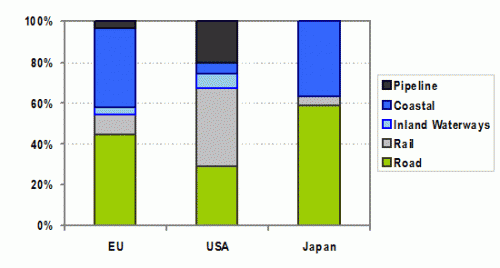
See the percentage of goods moved by freight, which is dramatically higher for the US. The end result is we have a LOT less freight on our roads than the EU or Japan, and might have even less if US maritime laws had not done so much to kill coastal shipping.
This is the great unseen in all these "sophisticated" conversations about Europe. These Euro-philes are so much smarter than the rest of us that they manage to ignore the most important part of the equation (largely because it is unseen and not sexy). In fact, the US has the best rail system in the world, and in fact the governments of Europe and Japan have likely sub-optimized their rail systems by forcing their focus towards passengers rather than freight.
I will leave the last word to the Anti-Planner:
Europe has decided to run its rail system primarily for passengers, while America's system is run mainly for freight. Europe's rail system has about 6 percent of the passenger travel market, while autos have about 78 percent. Meanwhile, 75 percent of European freight goes by highway. Here in the U.S., highway's share of freight travel is only 29 percent, while the auto's share of passenger travel is about 82 percent. So trains get 4 percent of potential auto users in Europe out of their cars, but leave almost three times as much freight on the highway.
Good post. The average person who writes about the superiority of the European and Asian passenger rail systems has no clue about freight rail and its importance. Passenger rail is a nice thing; without freight rail, we would soon freeze and starve in the dark.
Part of the problem with US rail passenger service, BTW, is the 1951 regulation which required passenger trains to have "an automatic cab signal, automatic train stop or automatic train control system" when exceeding 79 mph. This regulation was further strengthened in 1987. The effect is that many main-line passenger trains run slower than they did in the 1920s. Ironically, this regulation may *reduce* safety by driving passengers off the rails and onto the roads.
Though my guess is they use different data sources, this quote from Anti-Planner does not jive with the graph presented: "Meanwhile, 75 percent of European freight goes by highway. Here in the U.S., highway’s share of freight travel is only 29 percent". The graph makes it look like just >40% is sent via road in Europe.
BCM,
You're correct about the chart and quote being from different sources. Here's the chart. http://people.hofstra.edu/geotrans/eng/ch3en/conc3en/modalspliteuusjapan.html
The antiplanner quote may be using a data source that doesn't include coastal shipping. Eyeballing the chart, that might just about make up the difference.
I worked for UPS for many years and am intimately familiar with the amazing efficiency of our domestic rail system. It was not uncommon for us to receive 200 trailers/day off the rail during the Christmas season.
By the way, don't make the assumption that passenger traffic is faster than freight. Our rail priority required Amtrak to pull over for some of our dedicated trains.
After spending a recent busy week on business in Europe (Netherlands, Germany, France, Switzerland) and noting the lack of useful air routes and prohibitively-expensive passenger rail we hired a car and spent a week driving between cities (easy to do actuall).
I have never seen so much road freight in my life (living in Australia and the U.S. and travelling extensively by road). I nearly checked overhead for a "bear in the air" in case we had stumbled upon a European remake of "Convoy". Not really desirable. The passenger trains sure are fast though.
"... The end result is we have a LOT less freight on our roads than the EU or Japan..."
Our freight handling is MUCH, MUCH more efficient than Europe's or Japan's because when we do use trucks, we generally use semis towing large trailers or two medium trailers, even within cities. In Europe and Japan, with their narrower streets, trucked freight has to be hauled using much smaller (and therefore less efficient) trucks.
We lead the world in freight handling efficiency due to the most use of pipelines (that are extremely efficient), the most use of rail, the most use of large trucks, and the least use of small trucks. Our relative lack of passenger rail reflects the fact that our nation is much less densly populated than Japan, Great Britain, and most of Europe (except for Norway and Sweden that don't have much passenger rail in their sparsely settled northern regions).
I have seen these comparisons made many times, and it seems incredible that our politicians don't recognize a) the exorbitant cost of implementing and maintaining passenger rail, and b) the tremendous efficiency of our freight rail system. What I hadn't considered was the detrimental effect of passenger rail on the freight rail system.
Gee, think the teamster unions have figured that out (and those that receive their donations)?
As an aside: I'm not sure adding Japan in to the equation adds anything at all to the discussion. EU vs. US vs China/Mainland Asia or Australia seems to make sense. Japan is a) An archipelago and b) incredibly urbanized even in the industrial areas. Other factors such as pork barrel politics also factor in, although less so than land prices for rail infrastructure now that JR is 'privatized'.
Dr. T., not only is North America less densely populated than Japan/E.U., but its also more spread out. Population is Europe and Japan on the other hand is pretty concentrated which makes train travel more reasonable. Another reason is most North Americans own cars and don't need to travel by train. In Europe, high vehicle prices, high gas prices, combined with taxes makes owning a car a luxury many Europeans cannot afford.
@LJB: I'd love to see some numbers backing up the 'a luxury many Europeans cannot afford' bit. The last time I saw any hard numbers on it was a long time ago, but then it essentially boiled down to American households tend to own 2+ cars whereas Europeans tend towards only having 1 vehicle. It should be noted that there will be distortions due to urbanization I.e. New Yorkers, Parisians and Tokyoites probably don't own a lot of cars, whereas West Coasters, Hokkaidoites and Scandinavians probably do.
jones act wrecked us shipping.may have "saved"some "U.S."jobs but put the big snark on coastal freight.read somewhere;i.e. achryipical that sometimes cheaper to ship atlanta to rotterdam to NYC than direct
More international freight on the roadways leads to more accidents with passenger cars, which are smaller in Europe. Some cars are so light a truck-driver might not even notice the collision
http://www.youtube.com/watch?v=JnETGNFb_6g
Obama Replaces Costly High-Speed Rail Plan With High-Speed Bus Plan
http://www.youtube.com/watch?v=QNixDlRoMvA
@ Bryan: Thanks for the info.
Here's a train in India happily pulling along 50 regular road trucks! http://picasaweb.google.com/geofones/20101119GoaToMangalore#5542717247348331506